The Eye of the Whirlwind
Russian Identity and Soviet Nation-Building. Quests for Meaning in a Soviet Metropolis
Oslo, Tromsø, Copenhagen
St. Petersburg: Aletheia (Russian edition)
|
To download, print, or bookmark, click:
http://www.anthrobase.com/Txt/N/Nielsen_F_S_03.htm.
|
Preface to the Russian Edition - 1999
A. Post-Communist Anthropology
B. The Anthropology of East Europe
C. Theories of Socialism
D. History and Russian Identity
E. Private and Public Life in Russia
F. The New Class
G. Ordinary Life and Culture
Introduction - 1986
A. Defining the Problem
B. About the Field-Work
Chapter One: The Texture of Soviet Reality
A. Prospekt and Dvor
B. The Rules of the Game
C. Limbo
Chapter Two: Life on the Islands
A. The Weakness of General Rules
B. The Weakness of Money
C. The Importance of Place
D. Paradox and the Clear View
Chapter Three: Riding the Bus
A. Warmth - Serezha and Olya
B. Coldness - Fear and Formality
C. Peredat' and Propustit'
D. Materialism and Magic
E. The Arithmetic of the Masses
Chapter Four: The People and the Party
A. Dies Irae
B. Culture, Charisma and the Warrior State
C. Examination, Privilege and the New Class
D. Clients, Relations and Tradition
E. Mothers and Sons
Interlude: Father Peter and Tolya
Chapter Five: Freedom and Authority
A. Unifying the "Two Times"
B. Authority and Self-Defence
C. The Free Outpouring of the Soul
D. Faith and the Weakness of Authority
E. Guarding the Heart
Chapter Six: Europe and Asia
A. Western Europe
B. Central Asia
C. A Paradigm of Russian Identity
D. An Empire in Limbo
E. The Quest for a New Form of Communication
Conclusion: Visions of Evil
Epilogue - 2002
Appendix One: Fieldwork in the Soviet Union: An
anthropological research project in early 1980's Leningrad (Copenhagen-Riga
2003)
Appendix Two: Freedom Within - Authority Without: An exploration of certain Russian ideological
figures (Copenhagen-Helsinki 2003)
Appendix Three: Tables
Appendix Four: Survey Data on Informants
Bibliography
Indices: Citations index
- Thematic index
Notes
For my own part I'd just like to add that nearly every reality, though governed by its own, immutable laws, is almost always unlikely and unbelievable. Often in fact, the realer it is, the more unbelievable.
(Dostoevsky 1868-89, p.313)
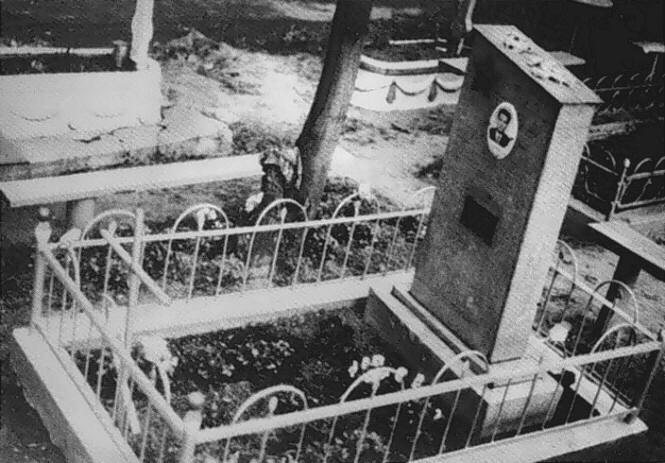
The Smolenskoe Graveyard submerged in early spring
This text is the product of a long-drawn and intense process of experience and thought, and it would be quite impossible to thank everyone who has somehow contributed to it. Clearly, without my friends in Leningrad, nothing would have come of it at all. Vera, Viktor and Pavlik, Vitya, Natasha, Serezha, Tolya, Andronov and many others (all names are pseudonyms), opened their doors and their hearts to me, and gave me the opportunity to learn to know a way of life which - I'm afraid - is far richer and more interesting than the portrait I have managed to draw of it. Particular thanks are due to my now deceased academic supervisor at the Leningrad State University, Professor Rudol'f Ferdinandovich Its, without whom I would have been unable to return to Russia in 1983.
At the Department of Social Anthropology, University of Oslo, two people in particular have put their mark on this study. First, my supervisor, Professor Arne Martin Klausen, who insisted, ever since I started writing in earnest, that I should think for myself, and that whatever I wrote should be clearly and unambiguously stated. Secondly, I owe warm thanks to Hans Christian (Tian) Sørhaug, for theoretical inspiration and tactful criticism during the early phases of my work.
My friends and colleagues Arild Moe (now at The Fridtjof Nansen Institute in Oslo), Pål Kolstø and Øivind Fuglerud (both now at the University of Oslo) have read and discussed early drafts of several chapters of the text. Their informed criticism has enriched the result significantly. Discussions with Kristin Aarnes and my brother, Christopher Sivert Nielsen, have contributed less visibly, but no less importantly. Astrid Bjønness, with her intimate knowledge of Russia and Russians, has inspired me in many ways; in fact, it was her idea that I start this work in the first place, back in 1981. My grandmother, Marabeth S. Finn, lent me the money with which to buy the word processing equipment on which the first version of this text was written.
The publication of the text in Russian in 2003 was made possible by the generous economic support of the Norwegian Research Council, the recommendations of Piers Vitebsky at the Scott Polar Institute in Cambridge and Nikolai B. Vakhtin at the European University of St. Petersburg, and to the excellent and meticulous translation carried out by Alexandra N. Livanova and Ekaterina P. Prokhorova.
The present, AnthroBase, version of this text is mainly based on the Russian version, but a number of small changes have been made in the text itself and the tables in Appendix Three from the original version have been included (and to some extent updated). Most importantly, two supplementary papers have been added (Appendix One and Appendix Two). These add a substantial discussion of field methods and ethics to the text and also carry the analysis of Russian values in Chapter Five somewhat further.
During various phases of the work with this text, I have received valuable comments and criticism from a number of people, including Reidar Grønhaug (University of Bergen), Øyvind Jaer (Østlandsforskning, Lillehammer), Dmitry Pospielovsky (University of Toronto), Fredrik Barth (University of Oslo), Marvin Harris (University of Florida), Piers Vitebsky (University of Cambridge), Yulian Konstantinov (BSRCS, Sofia), Alexandra N. Livanova (University of St. Petersburg), Trond Thuen (University of Tromsø), Hülya Demirdirek (University of Lethbridge, Canada), Nora Gotaas (NIBR, Oslo), Per Liltved (Arendal, Norway), Jorunn Magerøy (Molde County Hospital, Norway), Anna Birgitte Mørck (Oslo), Kristin Rande (University of Copenhagen), Johnny Leo Ludviksen Jernsletten (University of Tromsø), Eva Klingenberg (University of Tromsø), and my wife and colleague Kari Helene Partapuoli.
Finally, I want to extent a heartfelt thanks to all my students, in Oslo, Tromsø and Copenhagen, who, since I was allowed to start teaching back in 1980, have taught me more than any book or lecture possibly could.
Oslo 1987, Tromsø 1996, Copenhagen 2002-2004
This generation
will usher in a kind of life that we know nothing of, - let us what it will
be like. People want happiness, egoistical happiness, bright colors, noise,
fireworks, passions, - and that's not all they want, I know; they want culture,
knowledge; they want life to become European at last - for Russia too; they
want to speak all the languages in the world and visit every country on earth,
hungrily, now, now! They want comfort, elegant furniture and smart clothing,
instead of old village chests and homespun coats. They want to take over everything
from abroad - dresses, theories, art, philosophical trends, hair styles, everything,
- and they relentlessly discard our own achievements, our Russian tradition.
And who can condemn all of this, when it's all so natural after so many years
of puritanism and fasting, being closed in and closed off from the rest of the
world.
(Svetlana Alliluyeva 1967, p.15)
Fifteen years have passed since I completed the fieldwork that forms the basis of this study, which is now being published for the first time
- in Russian. In those years, the world I here describe - Leningrad in the early 1980's
- has changed so fundamentally that it has, in a certain sense, ceased to exist. In this sense, what follows must be read as history. But in another sense (and as so many times before in Russian history), the old world lives on beneath the new as its precondition, without which the present must seem meaningless. For an understanding of the post-Soviet Russia of our own day, this account by a Westerner of the state of mind and means of life that characterized the late Soviet
period may thus prove of interest.
When I originally wrote this book (in 1984-861) I was, inter alia, motivated by a typically anthropological passion: to show that the Soviet Union was not a static abstraction, an artificial construct of "totalitarian" ideology, but a living social organism, a complex and subtle compound of lifeworlds, a social Texture inhabited by real people with real lives to live. While Western sovietologists and Soviet ideologues unanimously proclaimed the centralized monolitnost' of the Soviet empire, I had experienced Leningrad as particularistic and pluralistic to the point of complete disorganization. The Soviet Union simply could not be a totalitarian dictatorship, I reasoned. It was an "unplanned society", as anthropologist Janine Wedel (1992) has later said of Poland. And while the experts insisted that the unspeakable power of the "Communist" states had frozen their societies in perpetual immobility, my informants' lives were filled with violent upheavals, sudden opportunities and chance encounters, and Soviet history itself seemed - as anthropologist Bruce Grant (1995) has recently phrased it - to have been a continuous "century of perestroikas". Perhaps most striking, in view of later events, people in Leningrad in 1983 were constantly telling me that still more dramatic changes were on their way. It is true that many of them envisioned these changes as a spiritual apocalypse, while I, as an anthropologist, speculated about the collective, social forces at work. Still, it was not hard to conclude that "something" was maturing deep down in the vast, chaotic social organism that was the Soviet Union - that heavy, ponderous forces were gathering and pressing against the barriers that contained them. This imagery seemed terrifying at times, since there was so much bitterness and pain at the root of what was taking place. But there was also hope - hope that sanity might prevail, that change could take place in a more or less peaceful manner (as indeed it so far seems to have done).2
In this context, I felt the need to express my belief that life in the Soviet Union was more often individualistic and creative than deadened by totalitarian conformity, that people were motivated by "passionate realism" rather than fear of power. The real pain of 1.1 million dead in Second World War Leningrad, the passionate skepticism to any new war after this one, and the creativity and pride to survive it all "and even laugh" (as Slavenka Drakulic (1992) puts it), are graphical metaphors of the qualities I here invoke.
My work, thus, came to have an implicit focus on the possibilities for change in the Soviet system. I did not foresee the demise of the Communist Party or the break-up of the Soviet Empire. Nevertheless, my text points forward to our own age, and there is a basic compatibility between the analysis I proposed in 1986, and the changes that have later occurred (see the Epilogue of the present volume for some further thoughts on this). This is for me confirmed by the fact that many of the conclusions I draw about the Soviet Union below, have later (and independently of me) gained wide acceptance in the anthropological literature on the post-Soviet societies. (On the other hand, a number of issues that are raised by my analysis seem, in hindsight, to have been insufficiently treated in the following. I have therefore included two short papers as appendices to this volume, which update my thinking (1) on the methodology and ethics of my investigation (Appendix One and Appendix Two), and (2) on my analysis of Russian values (Appendix Two).)
Since the advent of glasnost' and perestroika and the breakdown of the Soviet empire, a whole new field of study has appeared in Western social and cultural anthropology. Students of what is commonly referred to as "post-Communist anthropology" have described many interesting aspects of life in various parts of the former Soviet empire, and stimulated a creative and thought-provoking debate on general questions of social organization and human relationships in the region. Still more importantly, anthropologists have been consistently skeptical to the policies of economic "shock therapy" favored by many influential Western actors, and to the belief that total dismantlement of existing economic and political structures followed by rapid and consistent marketization, would by itself cure all the (real and imagined) evils of the "Communist" system. Through intensive studies of the effects of reform in local contexts throughout the former Soviet empire, anthropologists have demonstrated the deeply contradictory processes at work, and shown that when abstract policies are applied to real social situations, they have unpredictable and often counterproductive consequences (for examples, see de Soto and Anderson 1993, Hann 1993, Kideckel 1995, Verdery 1991a, 1995, Creed and Wedel 1997, Burawoy and Verdery 1999).
Contributions to this literature have come both from Western anthropologists and (increasingly) from colleagues in East Europe, where, as one of the minor results of the changes taking place, socio-cultural anthropology (and, in a wider sense, qualitatively oriented social science) is now emerging as an academic discipline. We are witnessing the birth of what Richard Fardon (1990) has dubbed a "regional tradition in ethnographic writing". What Fardon means by a "regional tradition" is a complex and evolving set of assumptions of what constitutes "relevant research strategies" in a given ethnographic region. The association of African studies with classical British lineage theory (Radcliffe-Brown, Fortes, Evans-Pritchard etc.) or of Melanesian studies with classical exchange theory (Malinowski, Mauss, Strathern etc.), are well-documented examples of this, as is the long-standing association of the Latin American and Mediterranean regions with studies of moral codes of honor and shame (Archetti, Blok, Bourdieu, etc.). Fardon emphasizes that regional traditions are both limiting and creative. Melanesia in fact enabled the study of exchange in anthropology, in the sense that the exchange systems of the Trobrianders, as described (most notably) by Malinowski (1922, 1935), revealed for the first time the vast complexity that even a relatively "primitive" system of moneyless exchange might have. At the same time, the researcher's insistent focus on exchange may restrain him from doing work on other problems that might be equally interesting; or else, through the power relations of the academic establishment, may prompt him to discourage his students from such work. A "regional tradition" is thus a cross between fact and fantasy, innovation and constraint, between actual field experience of a real world, and "constructions" (Berger & Luckmann 1966) of that experience to fit the researcher's notions of what he or she "should" find.
The anthropology that is being done in East Europe today is quickly acquiring the attributes of a new "regional tradition". The caveat is that we have problems delimiting the region as such. The cultural variety within the area that stretches from Eastern Germany to Mongolia, from the Caucasus to Kamchatka, is very great, and the people living in various parts of it may often seem to have more in common with their neighbors across the border than with people living at "their" region's other end.3 It is often argued that the only thing that unites this area into a region at all is the few decades it has spent under Soviet rule, and that defining a region on this basis is a political act that denies the traditional cultural plurality of the region's individual groups. One is, so to speak, reproducing the power of the Soviet state by treating its former domain as a unit of study. One should recall, however, that many other ethnographic regions are "politically" defined, although the political events in question usually lie much further back in time. The Mediterranean is perhaps the prime example, an ethnographic region that remains conterminous with the Mare Nostrum of imperial Rome, in spite of its later division into a Christian and an Islamic sphere.
Still, to my mind, the title "post-Communism" is something of a misnomer, since it defines our sphere of interest not in geographical terms, but in the terms of a (now defunct) political ideology. Like it or not, we are studying a geographical region. There exists a large "Soviet Studies" establishment in Western academia, and although this has by now mostly renamed itself "Post-Soviet", it is still applied to the same physical area, because this is where its cadres have their expertise and research experience. For anthropologists such considerations carry particular weight. Doing fieldwork anywhere in the "post-Communist" world presupposes the acquisition of a corpus of complex practical skills and cultural knowledge - that differs widely from what is needed, e.g. in Africa. Anthropologists must acquire this corpus in order to do fieldwork at all. And because we learn from colleagues with similar skills, we have founded a community of anthropologists who have done work in the "East European" region, and this community has proceeded to define the standards and interests of a "regional tradition" - which we might refer to (as does a well-known journal) as the Anthropology of East Europe.4
East Europeanist anthropology is a regional tradition in the making, and as such presents a somewhat unfinished and at times makeshift face to the world. The research community is rather small, with few older researchers with senior academic positions at prestigious universities, and a multitude of young students making interesting and unexpected contributions. The roots of this tradition go back to the work of sociologists, anthropologists and rural economists in the early years of the 20th century. These students, many of them East European (e.g. Bogoraz 1904, Chayanov 1919, Galeski 1976, Stahl 1958-65), were particularly concerned with the problems of the peasantry, and founded an influential school of rural anthropology. In many parts of East Europe, such studies continued under Communist rule after the Second World War. Most prominently, Polish sociologists developed a fieldwork-based school that is closely reminiscent of Western sociocultural anthropology (see Wedel 1992 for a cross section of the work of this school on informal organization in Communist Poland), and similar conditions prevailed for example in Yugoslavia and Hungary. In such countries, cooperation with Western colleagues was not uncommon, and a number of Western researchers who had been active before the war continued work in the area into the 50's and 60's (for examples, see Benet 1952; Halpern 1956, 1967, 1977; Sanders 1949). In the Soviet Union, in contrast, sociological and anthropological research was effectively silenced under Stalin (see Tumarkin 1999), and - in spite of the interesting empirical work that started appearing in the 70's (e.g. Arutyunyan 1970, Staroverov 1976, Boyko 1977, Pimenov 1977, Kon 1980, Shlapentokh 1989; for an early Western contribution, see Dunn 1967) - we have only recently seen a return to the social science "mainstream" (see Tishkov 1992 for a critical evaluation of the condition of contemporary Russian ethnography). Meanwhile, in the West, during the 70's and early 80's, a new generation of East Europeanist anthropologists had appeared, and a number of paradigmatic monographs, mostly on rural themes, were published (see Hann 1980 on Hungary; Humphrey 1998 [1983] on Buryatia; Kligman 1981, Sampson 1982 and Verdery 1983 on Romania; Wedel 1986 on Poland). All in all, however, we may conclude with Halpern and Kideckel (1983, p.378), in their review of the Western (particularly American) state of the art anno 1983 that Eastern European studies until the late 80's had had marginal impact on mainstream debate in Western anthropology.
Starting in the late 80's, this small, specialist field has seen unprecedented expansion, as previously inaccessible regions are explored, new questions are asked, and the number of students doing fieldwork steadily increases. Most of the leading figures of this new tradition are still the researchers that were active back in the early 80's, but today their students are also contributing to the field. Increasingly also, various traditions of anthropology - and more generally, of sociological research based on qualitative methods - are forming or reasserting themselves, often against significant opposition from traditional academia, in all the East European countries. In these circles, innovative and often interdisciplinary approaches are being pioneered, which challenge the rather airy generalizations that are often proposed by Western researchers. In St. Petersburg, for example, alongside traditional academic institutions (several of which have undergone significant internal reform), there have arisen a Faculty of Ethnology at the new European University (www.eu.spb.ru/ethno - led by Nikolay B. Vakhtin) and a Center for Independent Social Research - Centr nezavisimykh sociologicheskikh issledovanii (www.cisr.ru - led by Viktor Voronkov), specializing in applied qualitative research. As in the West, we find a young, enthusiastic, and often innovative research milieu.
One of the greatest problems of writing about Russia in the mid-80's was the almost complete lack of general sociological theory of Soviet society. Quite a number of interesting empirical studies of East European societies had appeared, but the theoretical debate, which is otherwise so lively in anthropology, was virtually absent. The study of East European societies was still heavily dominated by the paradigmatic theory of totalitarianism, which put prime emphasis on the (presumably) all-powerful state. Of course, totalitarianism theory was never completely hegemonic, and much of the empirical research that was conducted (in anthropology as elsewhere) in fact contradicted central tenets of the totalitarian model. Nevertheless, there existed no developed theoretical alternative to this model, and few efforts were made to revise existing grand theory (such as Marxism, structuralism or Weberianism) to suit the circumstances of East Europe. In writing the present volume, I was therefore explicitly attempting to build up an alternative theoretical framework, and to develop a number of analytical concepts related to empirical Soviet society. Since my work was never published, however (see Footnote 1), it has had little or no influence except on my own students.
But this of course does not mean that other anthropologists were insensitive to the need for general theoretical approaches to the East European societies (see Halpern and Kideckel 1983, p.394), and in the course of the last decade several interesting theoretical syntheses had appeared. The most prominent of these is that of Katherine Verdery, whose monograph describing life in a Transylvanian village was published in 1983. Early in the next decade, Verdery published a second monograph on urban Romanian intellectuals (1991a) and a number of theoretical studies (1991b, 1993, 1996) that detail a complex model of the inner workings of "socialist society". This model draws in part on the work of Hungarian and Romanian scholars (e.g. Konrad and Szelenyi 1979, Kornai 1980, Campeanu 1986), in part on general anthropological theory (e.g. Polanyi 1957), and in part on empirical studies by Western anthropologists (e.g. Humphrey 1991). During the 90's, both Verdery herself and a number of other prominent anthropologists of East Europe have developed her model further, and there seems at present to be something of a consensus that it represents an exceptionally fruitful avenue of inquiry.
I find it interesting and encouraging that there are many striking parallels between Verdery's account of "socialist society" and my own description of the Soviet Union below. We agree that the monolithic power of the Soviet state was a sham. In fact, the state was weak, and hampered by what Hungarian economist Janos Kornai (1980, 1992; see also Birman 1983) has called a "shortage economy". This state governed a society fragmented into Islands (enterprises, kolkhozy, bureaucratic institutions etc.) that were ruled as semi-feudal domains by rival fractions of a nomenklatura-mafia (see Verdery 1995, Humphrey 1996-97, and Wedel 1998ab for examples of how this model may be adapted to the present, post-Soviet, situation). In this scheme, the state functioned as the primary redistributor of resources and wealth within a "supply-constrained" economy of shortages, and Islands competed for access to its wealth:
"In a supply-constrained system [...] everyone scrambles for access to the pot. At all points in the system, jobs or bureaucratic positions are used as platforms for amassing resources. Personal influence, 'corruption', and reciprocal exchanges are some of the major mechanisms. This sort of behavior goes on throughout the society but is especially important for bureaucrats, whose entire reputation and prestige rest upon their capacity to amass resources. Any bureaucrat, any bureaucratic segment, tends to expand its own domain, increasing its capacity to give - whether the 'gift' be education, apartments, medical care, permission and funds for publication, social welfare, wages, building permits, or funds for investments in factory infrastructure. Throughout the bureaucracy, then, there is rampant competition to increase one's budget at the expense of those roughly equivalent to one on a horizontal scale, so as to have potentially more to disburse to claimants below. That is, what counts most in the competition among social actors within allocative bureaucracies is inputs to one's segment, rather than outputs of production." (Verdery 1991b, p.424)
Verdery emphasizes the systemic centrality of the "second economy" in Soviet-type societies, and the peculiar role played by "culture", as a battleground between state and oppositional legitimacy. The importance attached to "culture" by a regime that professed materialism as its official ideology was indeed one of the more paradoxical features of the Soviet system, and Verdery attaches great importance to it. It is linked, in her theory, to the pivotal role played by the intelligentsia in the legitimation of Soviet-type regimes, as well as to the sudden eruptions of (intelligentsia-led) nationalism that accompanied the breakdown of the Soviet world. More generally, Verdery (following Humphrey 1991) describes the growth of East European nationalism as a result of the fragmentation of socialist societies into competing "semi-feudal" domains (Islands). As will be seen below (see Chapters 2 and Chapter 4, Part D), there is close agreement in all of these respects between Verdery's reasoning and my own.
Nevertheless, there are several points on which we differ. Most importantly, I sense - in Verdery's original model, as well as in much of the later work that has been based on it - a rather incongruous distance to the subject being described. "At its best," Chris Hann remarks, "the anthropological approach can offer a fully satisfying account of 'how the system really works', the pays reel as opposed to the pays legal, including the influence of specific cultural traditions upon its operation. Perhaps even more valuably, the anthropologist should be able to convey a sense of what it feels like to live in such a system" (Hann 1993, p.9). Post-Communist anthropology has certainly contributed to this agenda, not least in the sense that it questions the meaning of many of the key terms that are taken for granted in much of the non-anthropological discourse on the "transition" - such as capitalism, democracy, privatization or civil society - and emphasizes the local complexity of the changes taking place. Nevertheless, there is surprisingly little "feeling" of everyday life in much of what is written by anthropologists about the "formerly communist" world. Verdery, for example, bases her model of "socialism" on a generalized, abstract description of the type of power wielded by the socialist state, and from this derives the parameters of daily life - rather than proceeding from daily experience to the structure of society as a whole. This approach may leave us with the impression e.g. that Russian "culture" was not primarily a lived reality, to which individuals related with emotional and esthetic passion, but (merely) an instrument of political legitimacy, over which the state and its opponents wrestled for control. Thus, the magical power and allure of "culture", to which I have devoted much attention below (see also Nielsen 1994), and which may ultimately derive from "culture's" embattled status, is lost from view in many influential texts of post-Communist anthropology.5
I believe that this distanced attitude is a legacy of the macro-political and macro-economic concerns that dominated Western pre-perestroika sociological work on the Sovietized societies, and of the strongly politicized views of many of its most prominent practitioners, notably political scientists, historians and economists (see Verdery 1996, p.7). In post-Communist anthropology, a much weakened, but rather similar bias is revealed e.g. in the fact that almost the entire literature takes for granted that its object of study is "socialism" (socialist ideology), or "socialist society", terms which are usually treated as interchangeable. Thus, the volume edited by Chris Hann that I cited above, is entitled Socialism: Ideals, Ideologies, and Local Practice. In his introduction, Hann, who has elsewhere (1992) argued against Verdery's holistic model and her emphasis on the urban intelligentsia, emphasizes that anthropological studies reveal many "local socialisms", rather than a single, uniform, global "socialism": "[D]espite the relative uniformity of socialist institutions among Soviet allies in Eastern Europe before 1989, the actual implementation of socialist programmes varied enormously, in ways that could to some extent be explained by reference to differences in pre-socialist history and 'political culture'" (1993, p.9). Despite this clearly valid insight, however, Hann's volume as a whole is premised on the idea that there exists a global category of societies and social processes that may usefully be described as "socialist", "communist" etc. In accordance with this assumption, the contributors to his volume discuss a very wide variety of subjects, ranging from philosophical critiques of Marx's theory of "socialism" to empirical studies of "socialist" societies in Tanzania, Sri Lanka, China, and various parts of the former Soviet empire - as well as an example of "local socialism" from England. What do all of these cases have in common, except for the label "socialist"? Elsewhere, Aidan Southall remarks that "the failure of socialism [in Africa] is simply an expression of the fact that it has not been socialism at all" (1993, p.60). Could not the same be said of the majority of the cases in Hann's volume? Perhaps, indeed, it is quite as misleading to refer even to the Soviet Union as "socialist", as to speak e.g. of American society as "Christian"? As I see it, the anthropology of "post-Communism" seems to waver between extremes: Either there exists a "global socialism", an abstract concept applicable to anything that calls itself "socialist", or else there exist only (very) "local socialisms", vastly different from each other, with nothing in common at all except that on some rarified level of abstraction they are "the same thing".
The second (and related) point on which I differ from Verdery is in the surprising lack of historical depth in her discussion. Her theory is, as she puts it, an "ideal-type model [...] especially suitable for the highly centralized, 'command' form of socialism, best exemplified by [Romania and] the Soviet Union under Stalin and Brezhnev" (1991, p.420). But this equation of Stalin and Brezhnev (and the implicit contrast with the "less centralized" rule of Khrushchev) is at best naive. It fails to appreciate not only the vast difference between the Stalin era and the forty following years as a whole, not only the vast social revolutions that took place under Stalin, but also the more gradual (though no less fundamental) changes during the years of the so-called "stagnation" (zastoy) (cf. Shlapentokh 1989). So, though Verdery successfully highlights the complexity of the transition from socialism, "socialism" itself remains a discrete and self-contained system based on the implementation of a particular ideology: a static "ideal type" rather than an evolving social organism. The analytical basis of this idealization is the concept of the redistributive state, which owes much to Karl Polanyi (1944, 1957) and the substantivist school in economic anthropology. A redistributive state, according to this school, has a particular logic that under certain circumstances may aggregate into a semi-feudal order of warring factions of followers lead by patrons, each of whom controls a "feudal" resource base or domain. But this pattern has appeared in a number of forms under very different historical circumstances, and if we wish to understand its social-cultural impact on a particular empirical case (e.g. late Soviet Russia), it is essential to give an account of its historical genesis. Verdery's continuing focus on "socialism" might seem to exclude this possibility, since the continuities between pre-socialist Russia and the Soviet Union are broken by the intrusion of an alien ideology.
My own analysis is deeply committed to the idea that the socio-cultural conditions prevailing in East Europe today are the result (though not, perhaps, the necessary result) of very long-term historical processes, which may be envisioned as a complex, changing pattern of interaction between various regions, nations and sub-regions of Europe, and the various locales, classes and institutions that make up each of these. More specifically, I argue (with Gerschenkron 1970), that modernization in East Europe since the Early Middle Ages has consistently followed in the wake of Western modernization, and (with Anderson 1974ab) that is has evolved under the constant pressure of West European imperialism. The structural position of Russia as the Easternmost of the Eastern societies, as the limes separating Europe from Asia, is therefore a sociological constant of very great historical depth, and it has been demonstrated convincingly that this constant has profoundly marked the (real and symbolic) relationships between state and people in Russia. Thus, according to the Russian émigré historian Alexander Gerschenkron (1970), late modernizers go through sudden, violent "spurts" of forced, state-led modernization alternating with "stagnant" periods that are often anti-modernist. They are ruled by states that compensate for economic "backwardness" by pursuing policies of economic and political centralization; they preside over empires that are predominantly multi-ethnic, where national identities are often weakly consolidated (see also Greenfeld 1990); and they have a weakly developed sphere of what Jürgen Habermas (1962) has called Bürgerliche Öffentligkeit - which in the East Europeanist literature is often referred to with the heavily ideological terms "Civil Society" or "Third Sector" (tretii sektor). In Russia, Europe's Easternmost and most "underdeveloped" periphery, we may (as Gerschenkron emphasizes) expect each of these elements to be very powerfully expressed.
It seems to me profoundly significant that Russian "native theory" (both popular and literary) is deeply concerned with exactly these issues: Russia's relationship to the West, its borderline position between Asia and Europe, the distance between state and people. Quite often, moreover, there is fairly good concurrence between the conclusions drawn by "natives" and "social scientists" about these issues. Thus, the "victimization" of Russia, a theme of popular discourse that authors such as Ries (1997) have lately made much of, reflects Russia's historical position as a repeatedly colonized "primary periphery" (Wallerstein 1979) of West Europe. Historical analysis may thus lead us to the conclusion that cultural values and narrative tropes, which most anthropologists today tend to view as reified "discursive objects" within a semiotic-symbolic system (as "symbols that stand for themselves", see Wagner 1986), are often accurate reflections of actual sociological circumstances. Symbols (as I argue below) may thus be "true", i.e. they may communicate sociologically valid knowledge.
Such a conclusion flies in the face of much that is written in present-day "postmodernist" anthropology. Values, according to this view, are always social constructions, reifications or objectifications of semiotically arbitrary signs. While I am not insensitive to the value of this position, and though I approve of the self-critical stance that it has induced in the anthropological community, I object to its universal application, and suggest that it be applied with caution to complex empirical conditions such as those prevailing in Russia.
To exemplify what I mean by this, I shall briefly discuss some of the most intriguing recent anthropological work on Russian identity. Nancy Ries (1997) has published a fascinating ethnography of popular "talk" among Russian intellectuals in Moscow during the years of perestroika. Ries documents a phenomenon that a great many observers remark on in passing (though surprisingly few have taken the time to study it systematically): the "free outpourings of the soul" or "endless, fruitless discussions" (as my informants variously called them) that take place within the Russian (or perhaps Soviet) intimate sphere. Ries maintains that in Russian "talk" (everyday discourse) perestroika was represented as a ritual drama of transition from one stage of "the Russia story" to another: a reiteration of history rather than a transformation of it. In "talk", the inevitability of suffering and chaos are bemoaned, the heroic strategies of survivors are celebrated, and apocalyptic demands for total social transformation are given voice. As the reader will presently see, these themes (and many others mentioned by Ries) were amply represented in pre-perestroika "talk" as well. But during the hectic, unbelievable days of the "transition" itself, "talk" was vastly intensified, and "the Russia story" more frequently and passionately reiterated. But the ritual intensification of everyday narratives that claimed to challenge the status quo in fact confirmed it.
"In essence, the rituals of perestroika were a public marking and lamentation of the opposition between power and powerlessness, or, in a different valence, the battle between hierarchical and egalitarian impulses in Russian society. This opposition was hardly resolved or cancelled by perestroika. If anything, it was culturally validated and reproduced, as systematic, rational modes of social transformation were excluded from imagination and practice. By uttering their litanies and mystical poverty narratives, many people rehearsed themselves in the very stances of passivity, ironic detachment, and victimization that have helped to ensure their continuing vulnerability to power and pain." (Ries 1997, p.188)
Clearly, Ries is here making an important point. I sympathize with her belief that there was "a moment of opportunity and that a rational combination of socialist and market systems could have occurred" (1997, p.16), though I find her emphasis on missed opportunity and her trust in rationality somewhat naive. I also believe, with Ries, that Russian "talk" in many cases reproduces the perennial Russian dilemmas. However, I am not convinced that there is a simple connection between these factors. Russian talk is deeply grounded in the sociological realities of national and international politics, economy and culture, and gives voice to many profoundly valuable insights into the facts (rather than the ideals) of life in Russian society. Studies of "talk" that occurs in active situations, rather than passively over a teacup, reveal this clearly. Thus, the "talk" of Russian drinking and exchange (Hivon 1994, Pesmen 1995, Ledeneva 1996-97), of middle-aged Russians telling the stories of their lives (Pahl and Thompson 1994, Dickinson 1995), of Russian female entrepreneurs in Moscow (Bruno 1997), Russian teenagers contemplating their hopes for the future (Markowitz 1997), or Russians managing their lives in Leningrad in 1983 (see below) reveal a deeply practical attitude to life, that differs radically from the Dostoevskian dualisms of "talk" that are dwelt on by Ries.
But even these dualisms are more than naturalized but "actually arbitrary symbolic elements", as Ries claims (1997, p.25). Thus, Russians (e.g. Gerschenkron) often point out that there seems to be a "repetitious" or "circular" quality to Russian history. This fatalistic trope of "history repeating itself" is no doubt, as Ries argues, an ideological-semiotic "construction" but it is also a grimly realistic assessment of the actual prospects of life in Russia up through the centuries, given Russia's seemingly inescapable structural position as the most distant primary periphery of the rapidly (and autonomously) developing societies of the West European center. Repeated state-sponsored attempts to "overtake the West" (militarily, economically, culturally) have always, in the long term, failed, and resulted in the reproduction of similar institutional structures, similar everyday exigencies, and a similar "fatalistic", "impractical" or "passive" mindset. But fatalism is not merely a resignation and a defeat, it is also an acceptance of inevitability, and thus, as I point out in Chapter 3, a creative contemplation of the inevitable rather than a naively Promethean attempt to change what cannot be changed. Seeing Russians face real crisis, real tragedy, reveals the wisdom of this position.
Various ideologies, and various symbolic expressions of the same ideology, may thus contain variable proportions of "realism" and "construction". "It strikes me," Ries observes, "that all the references (both serious and ironic) that Russians make to their character have motivated a common journalistic and occasional scholarly reification of that concept" (1997, p.25). Certainly. But this does not mean that Russian character is only a reification. It is also a valid representation of the real.
Ries's discussion might profitably be framed by the very similar analysis made by the Russian émigré anthropologist Svetlana Boym (1994). Boym's work, which is based on the personal experience of a lifetime in Russia, as well as extensive knowledge of Soviet and Russian literature, art and film, discusses the "commonplaces" and "common places" of everyday life in the Soviet Union. In much the same way as Ries, she describes an "absolutist" streak in Russian and Soviet discourse, a "story of Russia" that switches wildly between binary extremes. This story is believed, she says, and enacted - particularly among the intelligentsia that are Ries's fieldwork subjects - and the enactors thereby perpetuate the conditions against which they rebel. Boym, however, presents this sphere of (ideal and idealizing) "teacup" discourse against the background of discourse generated by the practical exigencies of the household. "Fatalism" and "passivity", seen against the background of the coerced intimacy and latent violence of the kommunalka, may as well be Russian virtues as capitalist vices. When you have nowhere to go, remain quiet and learn to master the art of balance in "the eye of the whirlwind". Or as one Russian friend recently told me: "You must not fight against your fate (sud'ba); it is much stronger than you. You have to be considerate of your fate and take good care of it, or else it may turn against you and crush you."
As the reader will presently see, this volume is less concerned with ideological and philosophical questions (though they are also discussed), than with the sociological "facts of everyday life". Clearly Boym's distinction between everyday life itself (byt) and the ideal of everyday life (bytie) represents one such sociological fact, and it is probably possible to document that the contrast between ideology and reality, between theory and practice, is sharper and more absolute in Russian collective consciousness than in the more instrumentally oriented, compromise-prone West.6 Within byt itself, however, within the sphere of the everyday, other distinctions arise, and these come to play an important part in sociologically oriented studies such as my own.
One of the most interesting distinctions within everyday life is the breach between byt in intimate and byt in public contexts. This dichotomization of "private" and "public" life in East Europe was given an early formulation by the Polish sociologist Stefan Nowak (1981). According to Wedel (1992, p.9ff), Nowak postulated an extreme dichotomization between state and people in Poland, and therefore an extreme disjuncture between "public" and "private" spheres. What one said and did "at home" and what one said and did "at work" were entirely different matters (members of the Russian intelligentsia have referred to this as "dual consciousness"). This dualistic social structure (as opposed to the more gradualist Western ideal) has no room for a neutral, middle ground, a "polite" or "civil" society (Bürgerliche Öffentlichkeit). In its place, we find a sociological vacuum, an absence of institutionalized connections between private and public worlds. Later Polish sociologists have argued, against Nowak, that the absence of "mid-range institutions" (as I call them below) is by no means total - particularly in Poland, the most consistently and successfully oppositional nation of the Soviet empire (see Buchowski 1994). Sociologists have studied the role played by such institutions as the Catholic Church and the rodowiska: the "social circle" of family, friends and acquaintances that may be mobilized for private or collective purposes (Wedel 1992, p.12). The absence of formal mid-range institutions is thus shown not to imply an empty "sociological vacuum" but a tangled breeding ground for informal mid-range institutions. Important research has been done in latter years into the subtler problems of this informal "second culture" (Wedel 1992, p.17) or "second economy" (Grossman 1977), particularly by economic anthropologists (for some examples, see Mars and Altman 1983, Sampson 1985-86, Hann 1992, Stewart 1992, de Soto and Anderson 1993, Hivon 1994, Verdery 1995, Bruno 1997, Creed and Wedel 1997, Humphrey 1998, Lemon 1998, Burawoy and Verdery 1999).
Nowak's notion of the "social vacuum" has thus been reconceptualized from a mere absence, to an absence of formally institutionalized, state-sponsored control - which necessitates the growth of informal organization. In the course of Soviet history the relationship between the state and the informal institutions has changed several times quite radically (see Grant 1995 for a description of the local effects of these transformations among an indigenous people of Sakhalin), and as a result, the configuration of "private" and "public" spheres has changed. Below, I describe or touch on several aspects of these changes: the genesis of the mafia-state under Stalin; the transition from the austere 50's to the consumer-oriented 70's; the changing governmental policies towards religion and nationality, the family and education; the switch, during the early 30's, from the esthetics of kul'tura 1, to the esthetics of kul'tura 2 (Paperny 1996). The Russian sociologist Vladimir Shlapentokh has pointed out that an underlying trend of the entire period since the mid-50's has been a gradual "privatization of Soviet society", a "withdrawal of energy and emotion from the State" (1989, p.153). Shlapentokh traces this withdrawal throughout the public and private sphere: by degrees, restrictions on ownership and accumulation of private property are relaxed, private living quarters are increasingly available, the media refocuses on family life and romantic love, sexual mores are loosened, networks of friendship expanded. This is the impulse described by Svetlana Alliluyeva in the quote at the beginning of this Preface, a mood of "collective relaxation" after the extreme pressures of the preceding four decades. It corresponds to the idea of the growth of the New Class, as described by Djilas (1957; see below). Finally, Shlapentokh sees an increase in peoples' engagement in the informal, "second economy" and "second culture". I consider it necessary to qualify this last position somewhat.
As I argue in Chapter 4 (Part D), the mafia-state developed and reached its apogee during the Stalin era. Violence at that time reached a level of intensity and unpredictability that has never since been approached, and that cannot be rivaled even by the immediately preceding decades. Despite the (largely legitimate) complaints of intellectuals, however, the four decades after Stalin were largely peaceful, prosperous, and fairly optimistic. The mass hysteria of violence engendered by unchecked war between powerful rival "feudal" factions that had swept society during the Stalin years, no longer occurred. In the "social contract" engineered by Brezhnev, the leaders of the major factions of the mafia-state made themselves accountable to the central governmental bureaucracy, while the center in turn guaranteed stable deliveries of resources and wealth. The Second Economy expands in the following years - throughout the lower echelons of the system. In its higher echelons, the opposite is the case, relative stability and control reign; until they are disrupted by perestroika.
In this book, I have attempted to describe some of these long-term processes, and to situate my informants' lives anno 1978 or 1983 within them. The post-war years were the first continuous generation of peace and relative prosperity in Russia since the beginning of our century. Peace allowed the predominantly rural, unindustrialized and uneducated population, which Stalin put through such violent changes, to assimilate what had happened to them. It is essential to bear in mind that Stalin's heritage was not merely one of terror and mismanagement, but that a fundamental sociological transformation was carried out during the years of his reign. In 1914, the country's urban population was 18%, primary and secondary schools had a mere 10 million pupils, less than 15% of the population were industrial workers and less than 15% of rural women could read and write. Fifty-five years later, about 60% of the population lived in cities, 55% were workers, there were close to 50 million pupils in primary and secondary school and almost the entire population was literate. In 1900, Russia was a society split in two - a vast, uneducated, poverty-stricken majority, and a minute, "cultured" splinter group. By the time of Brezhnev's death, a substantial "middle class" of educated professionals had emerged. As Milovan Djilas pointed out in 1957, this "New Class" (see Chapter 4, Part C) was in a sense an "instrument" created by the Stalinist regime to further its own ends. But, as Djilas further argues, a class is always more than a passive instrument in the hands of a ruling clique. A class consists of people, who strive to make life tolerable for themselves and to make sense of the world around them - goals that unavoidably conflict with the purposes of the state. This conflict, and the slow "privatization" (Shlapentokh 1989) that accompanied it, was in the long run fatal to the regime itself.
As the New Class grew and the state still insisted on treating it as an "instrument", more and more of its growth slipped silently out of the state-controlled public sphere and into the burgeoning Limbo of the Second Economy and Culture. The most dynamic entrepreneurs and stirring ideas escaped from the public sphere and created the rich, but in many ways destructive "counter culture" which is the main subject of this book. Increasing numbers of Soviet citizens came to depend on the black market to sustain an acceptable standard of living, on the cultural opposition to find a meaning in life. Some of the people I knew lived their entire lives in one part or another of this dual sphere. More importantly, by the beginning of the 80's it had become impossible to survive in the Soviet Union at all without to some extent participating in this vast "society outside society", and when stagnation and later catastrophic disruption hit the national economy in the 80's, dependence on the "Second Society" increased still further. I argue below (see also Nielsen 1994) that the dominant values of the emerging New Class - which became the sociological basis for the emergence of what is today the ruling class of Russia - derived from this economic and cultural "society outside society".
But the prolonged exclusion of the New Class and its values from positions of legitimate influence had destructive consequences. On the one hand the growth of the "second economy" was accompanied by a pervasive boycott of the official economy - a major factor underlying the economic crisis that overtook the Soviet Union in the early 80's (see Chapter 2). On the other hand, the frustration of the cultural opposition led to widespread disillusionment with modernity, increasing nostalgia for traditional values, and spreading Russian and non-Russian nationalism. Economic slowdown and ethnic activism overlapped and strengthened each other. Thus, by the time of my fieldwork, the substance of society had already changed irrevocably behind the "stagnant" official facade - a conclusion that is confirmed by the general demographic and economic slump that starts to be registered at this time.
Nevertheless, the most striking feature of life in the Soviet Union in 1978 or 1983 was its ordinariness, the peaceful, leisurely flow of everyday existence. There was a certain old-world gentility to this (and a very Russian bravura), by which the nights spent over a cup of tea in a cramped kitchen were made equivalent to visits at the country estate of the Karenins. People would go to great lengths to maintain what they construed as a "normal", "gracious", "beautiful" life. There was a strong consciousness of honor and shame, proper and improper demeanor. For this reason, and in spite of the horror stories recounted by many Western authors writing about the same period, such as Hedrick Smith (1976) or Ernst Brunner (1983), the Soviet Union in 1978 or 1983 was in most respects a very pleasant place for a foreigner to visit: people were hospitable, polite and took time off to be with you. Of course, the pressure was on, even then, but there was an underlying regularity, a sense in which a brittle, but still manageable social contract was maintained and could be trusted. Within this fragile, but known framework, there was room to create a life, a culture.
The term "Soviet culture" is commonly treated with disparagement. This "culture", we are told, was a fake; it was imposed from above by the State, a superficial product of ideology rather than an authentic growth of natural selection. Nevertheless, since people had to live with these impositions, they created a "culture" around them. It is beyond doubt that a unique "Soviet culture" existed, with its ethics and esthetics, its challenges, hopes, romance, and shattered dreams. This "culture" was not external to the people who shared it; it was the medium in which their lives were lived, and against which their measures of value and meaning were established (for examples of some aspects of this, see Boym 1994, Clark 1995, Yampolsky 1995). Even those who resented the Soviet state most intensely did so as Soviet people. Their visions of an alternative world resonated with the actual world they inhabited.
"Soviet culture" may be considered from many points of view, but one of the more interesting perspectives is to think of it as an all-out attempt to establish an alternative "model of globalization" to the model we speak of as "the West", "Western Capitalism" or "Western Civilization" (see Nielsen 1994). The "Soviet" model differed from its "Western" counterpart in many fundamental ways, among which ideology was perhaps the least important. It presupposed a different economic and historical order, a different power structure, different means and standards of education; it had its own ideals of propriety, practicality, sex, and common sense; it was expressed in automobile models and hair styles, in architecture, space programs, patterns of work and leisure, crime and punishment, love and humor, conformity and protest. The punk musicians I met in Leningrad in 1984 were Soviet punks, and the content as well as the form of their self-expression would have been unintelligible to punks from Great Britain or Norway. One of these young men carried an empty slide frame wherever he went. It was the nol'-ob"ekt, he explained - holding it up to "frame" the foot of an enormous statue of Lenin - the ultimate work of art: totally portable, totally subversive, and immune from prosecution.
Today, the ubiquitous, global quality of "Soviet culture" is easily forgotten, but the fact is that it pervaded life throughout the so-called "Soviet block", and that you felt just as much at the center of the world in Moscow or Leningrad as in Paris or New York - but at the center of a different world, that modeled "globality" differently. People derived satisfaction and pride from the mere consciousness that they belonged to a vast and powerful civilization. But they also seemed to realize that part of the price they paid for empire was a certain kind of superficiality, which is precisely what many Western observers and Soviet dissidents accused them of: "Yours is not a real culture!"
The Soviet Union, like the United States, was a multinational nation, and was built up institutionally around an (often tacit) acknowledgment of this. It is true that Lenin's idea that all nations would eventually melt away into meta-national solidarity was never much of a success; still, a particular brand of inter-cultural tolerance was an important aspect of "Soviet culture". People in Leningrad lived and died, often complaining, sometimes thriving, in what I refer to below as a state of "enforced pluralism": a rapidly changing and socially diverse public sphere. Tolerance was indeed often "enforced". A scholar in the Northern Caucasus, who received a grant to study ethnic conflicts in his native city, was required to keep his findings confidential. "That was the only sensible thing to do," he assured me, and I must say that later developments seem to have proven him right. Of course, Brezhnev's social contract could not contain all conflict, but every attempt was made not to publicize or incite those incidents that occurred. One had the impression that the remembered violence of the preceding generations, the war, hunger and terror that killed maybe 100 millions, had not simply hardened people to moral insensibility, but fostered in them a respect for life and a prudent regard for otherness.

"McDonald's - Chain of free toilets
throughout Russia"
Old-style humor in a new world
www.anektodov.net
On my first trip to Russia I traveled with a friend who made a point of his intellectual image and knowledge of the country. I was young, unprejudiced and easily impressed - still I felt he was overdoing things when he told me: "You can't spend more than an hour in the same room with a Russian without getting involved in a discussion about the existence of God." Two days later I arrived and was grabbed immediately by some Russian students, who welcomed me with vodka and zakuski - salt or spicy snacks to down it with. After half an hour we were, sure enough, heatedly discussing God's existence.
Although the topic wasn't broached again in my presence for months, this experience forced me to ask many questions: What does it mean to be Russian? How do they differ from us? Do they have some secret we might learn from? I was confronted with the "Russian enigma" from my first day in the country.
Later experience only served to confirm the reality of this enigma. As a foreigner I went through the traumas of being cold-shouldered in stores, on the streets, in offices; then, suddenly, being accepted into the "family" and subjected to the full weight of its curiosity, hospitality and portveyn; later, being shrugged off as an outsider who could "never understand us", while at the same time feeling that they hadn't the slightest wish to know me except as a reserve of information or luxury items from the West; and at last, gradually learning to trust and value a few close friends, and sometimes to be able to contribute constructive insights into their difficulties and joys. I experienced the extreme standpoints of intellectuals, each cooped up in his or her tiny world, suspicious of the other little worlds around them. I was drawn into the shapeless brawls of working-class youth. I felt the barriers of lies, mistrust, ignorance, gossip and fear surrounding each tiny group of people, and the care, consideration and tact my friends showed when I ventured to defy the barriers and introduce them to each other. I came to love the easygoing attitude to time, the disorder, the generosity and intimacy; to be repelled by those attitudes when they exceeded the invisible limits of respect. Gradually I recognized the fragility of personal relations, of life itself perhaps, the peaceful sadness of the empty fields and streets I passed through, the subtleness, sensitivity and endurance needed to live among them. The hollowness of so many outer forms, the warmth of heart within, and the courage, honesty and pain of those who strove to keep a fragmented world together.
This combination of fragility and strength is perhaps the strongest impression I am left with. It is also the one that is hardest to convey, since it is so paradoxical and so consistently present on every level of existence. There is a seriousness to it that I have never experienced anywhere else. Transported to our own society, it is so easily transformed into caricature, absurdity or triviality. Strangely enough, the opposite is also true: in Russia, much Western trivia takes on an earnestness we have difficulties accepting at face value.
But at the first meeting, the core of the Russian paradox is hardly discernible. One is bombarded by conflicting impressions, strikingly European in appearance, uniquely Russian in content. This perhaps is why Westerners, since their first meetings with Russia many centuries ago, have considered the country enigmatic.
The aim of this book is dual. I seek insight into the "enigma" of Russian identity. What does it mean to be Russian, and why? In the world of "Soviet Studies", bristling with statistical surveys and ideological involvement, such questions are rare, and I believe the field may be significantly enriched by an anthropologist, for whom they are a primary concern. My second aim is theoretical. Anthropology is a powerful tool - but exploring Russia, I found it would not cover all aspects of this exceedingly complex reality. My presentation is therefore a critique of anthropology itself, and an attempt at enriching it in specific ways.
But before these discussions can commence, we need a feeling for what the "enigma" itself entails. Father Peter,7 a priest who had seen many dark sides of Soviet reality without losing his clarity of mind, volunteered this (to me disheartening) statement:7a
- "Our reality is incomprehensible to the mind and completely paradoxical. Any attempt at understanding it is doomed to failure. It therefore finds its ideal and only expression in the anecdote."
- "So we can laugh at it?" I asked.
- "Well there isn't much of anything else we can do..."
I have spoken to many Russians about what it means to be Russian, and the impression I have gathered is "enigmatic", to say the least: people often seemed to see themselves as either rotten to the core or chosen, almost holy - one or the other (or both, as in the haunting poetry of Aleksandr Blok), intermediate standpoints were rarer. The classical symbol of this clear-cut dualism is that of Russia suspended between West and East, Europe and Asia, culture (or decadence) and nature (pristine or barbarian). The problem of choosing sides in the war between these poles, attaining truth (pravda) by alliance with one, the other, or both, is endemic.
Vera, hearing I was to read a lecture in Norway on the theme: "Europe's cultural heritage - does it include Eastern Europe?", got angry: "Of course! What a stupid question."
But in a discussion with an Intourist guide, when I expressed my conviction that it's important for Westerners to understand Russia, the guide looked strangely at me and sighed: "It'll never work out. Russians are so different. We live closer together, in bigger families. We're closer to the soil, that's incredibly important. We're somewhat Asian, not only Europeans - my nemnozhko aziaty."
In part, this ambivalence reflects a real historical situation: for centuries, the cultural, political and economic influence of both "Europe" and "Asia" on Russia has been intense. Still, the "enigma" cannot be reduced to externals only. True, Zina, an émigré intellectual, was struck by "how much poorer people's lives are in Russia, how much less cultured (kul'turno)." And a working-class woman I met on the train two days later, returning home after several years in the same country as Zina, complained that the West was degenerate, people cold and inconsiderate, she was pressed upon and controlled from all sides (oni davyat), there was nowhere to run away to. So the West itself clearly gives rise to strong positive or negative feelings. But then, one of my more bitter friends used expressions nearly identical to those of the woman on the train - to describe life in Russia: "It's getting impossible to live here in a spiritual sense. They press on you (davyat) stronger and stronger." Later he continued: "There's nowhere you can forget yourself here." This makes it natural to think of "Europe" and "Asia" as symbolizing internal states within Russia and the Russians.
The impression Russia has made on Westerners is no less contradictory. Throughout the Stalin era an ideal image of the Soviet Union was projected outwards. It was a country of heroes, of millions marching in step towards Communism, led by One Party, One Ideology, One Leader. Westerners tended to accept this fiction, either embracing it as Utopian or condemning it as Dystopian - as in Arthur Koestler's Darkness at Noon (1940) or George Orwell's 1984 (1949). The latter interpretation gained ground as rumors of the horrors of Stalinism filtered through, as Eastern Europe was subjugated by Soviet troops and the Cold War enveloped us. Western intellectuals denounced the Soviet dream, claiming that the Revolution had created a new "Asiatic Barbary" (Koestler 1954). The academic field of Soviet Studies was not uninfluenced by this trend, and it was in these years that the totalitarian model of the Soviet system was formulated:
"The totalitarian society is characterized by an official ideology, a single mass party and terroristic police control... The state has a monopoly of mass communications and means of armed combat... [and] central control of the entire economy." (Dellenbrant 1986, p.81) "The distinction between state and society ceases to exist; the state penetrates and politicizes all spheres of life." (Nørgaard 1986, p.50)
Totalitarianism was a mirror image of the Communist Party's own claims to monolithic unity. The reason for this underlying similarity may well have been that the Eastern and Western "totalitarianisms" were both based on highly inadequate knowledge of Soviet reality. Their simplistic generalizations could only survive as long as they had to account for very few facts. Indeed, until the late 50's, facts were hard to come by - in part due to the near hermetic isolationism of Stalin's reign, in part because very little relevant research was conducted in the Soviet Union.8 But since Stalin's death (1953) the availability of data has increased vastly. The first exhaustive census since 1926 was conducted in 1959, and in its wake sociological, demographic and economic research experienced a slow renaissance, and Eastern and Western "totalitarianisms" were supplanted by more nuanced views.9 In the Soviet Union, empirical sociology came into its right - e.g. in Arutyunyan's erudite and critical analysis of rural conditions during the Second World War (1970). In the West, "corporativistic" and even "pluralistic" models were proposed (Nørgaard op.cit.).10 Thus, until the 60's the Soviet Union was, sociologically, an "enigma" in the most literal sense - and later the primary need, in both East and West, has not been for general theories of wide scope, but simply for a rough idea of the lay of the land. Collecting and systematizing data has therefore been the main focus of Soviet Studies since the Cold War.11
Western Soviet Studies is a vast and heterogeneous field, encompassing political science, economy, demography, sociology, history and the humanities. It is beyond my capabilities to review this literature exhaustively here, but two common weaknesses with relevance for the present study must be noted:
First, research seems to concentrate on quantitative ("hard") data, ignoring systematic treatment of popular values and state legitimacy. Thus, in Alec Nove's classic The Soviet Economic System (1977), the all-important subject of work morale receives the following summary treatment:
"It is hard to evaluate some scattered evidence, mostly from conversations, about work morale... One hears of work-avoidance, absenteeism, drunkenness, petty and not-so-petty pilfering, bribery, and other negative phenomena. One must mention such reports..., without being able to evaluate them." (1977, p.228)
Specialized work on the "Second Economy", which has lately had increased attention, is no more informative. Gregory Grossman vaguely concludes that the Second Economy,
"...controverts such philosophical bases of Soviet society as the solidarity of the various population groups with one another and with the party and its leadership... It aggravates cynicism and lawlessness inside the Soviet Union, and even within the party... Furthermore..., it elevates the power of money in society to rival that of the dictatorship itself..." (1977, p.37)
A few studies of socialization treat these problems more seriously (Bronffenbrenner 1970; Dicks 1952; Gorer & Rickman 1949; Mead & Metraux 1953) But in these works, "typically Russian" values are reduced to a static a priori which can neither be affected by society nor itself affect it. These omissions seriously impair our understanding of Soviet society, where opportunities for formal organization of pressure groups have always been severely limited. As Abner Cohen points out, it is generally the case that "...interest groups which cannot organize themselves as formal associations manipulate... symbols in order to articulate informal organizational functions" (1974, p.14). In the absence of free political dialogue, symbolic discourse through literature and other "cultural" media plays a major role. Dissidents, black marketeers, high-level corruption and personal friendships are all part of a vast informal field, and to all, symbolic expression is essential. Informal organization thus penetrates the Soviet Union under the ideological facade, and we should therefore accord the study of symbolism and values the highest priority. There is no lack of literature on these subjects, but little of it is seriously studied except by humanists. Of particular interest is the internal dialogue of the Soviet intelligentsia - both in samizdat12 and émigré publications (Zinov'ev 1978; Yanov 1978), biographical accounts (Khrushchev 1970; Bukovsky 1978; Volkov 1979; Ivinskaya 1978; Nielsen 1984),13 and realistic literary works about various subcultures (Topol' & Neznansky 1981; Shukshin 1980; Vysotsky 1983a etc.).
Secondly, the lack of general theory in Soviet studies is striking. Thus, although by now it should be clear to all that the Soviet Union is as much a product of the forces of history as any other society, discussions of whether or not it lives up to the ideals of "Communism" are still common. Thirty years of scholarship have brought forth a varied and rich literature, spanning a wide field of interest and supplying fundamental insights into the Soviet system. Nevertheless, the few existing accounts of Soviet society as a whole are generally compiled by journalists - conglomerates of personal experiences (of variable quality) and "facts & figures" (Smith 1976; Mehnert 1958; Udgaard 1977). More and more the need for comprehensive studies of a more fundamental nature is felt. One attempt at synthesis deserves mention, mainly because of its failure. This is Kerblay's La société soviétique contemporaine (1977). Kerblay here shows a subtle understanding of many aspects of Soviet society, and at least implicitly presents his material in a unified historical perspective, but he lacks a ready-made theoretical paradigm on which to rest his analysis, and he has not been willing to risk proposing one himself. So when culture and values are approached, the presentation flounders into trivialities.
Thus, even today there exists no alternative paradigm to that of totalitarianism.14 It remains the one unified perspective from which Soviet society may be viewed. As Ole Nørgaard puts it:
"Totalitarianism is the archetype of concepts in Soviet studies, that which all other concepts have referred to and the basis of numerous attempts at operationalization and falsification." (1986, p.52)
In my opinion, only a holistic14a approach to Soviet reality - treating political power, economic integration, culture and ideology, and above all, the issue of values - as interrelated parts of a single whole, may enable us to formulate a less "enigmatic" paradigm. In this attempt anthropology, with its long-standing tradition of holistic analysis and intensive field studies, may have an important contribution to make.
Still, anthropology is no ideal tool. It studies informal organization and symbolism, yes, but its attitude to symbols is often inadequate. Let me illustrate this by returning to the image of Russia suspended between East and West. When people speak of their culture in such terms, "Europe" and "Asia" are clearly symbols. But they are not "mere metaphor" - they are statements about a concrete reality. As symbols they are part of Russian identity. As historical realities they have contributed to the genesis of this identity, and retain "true" information about the circumstances that led to its formation. So if the symbolism of Russian identity is "enigmatic", this is because Russians, in fact, live in an "enigmatic" world. As an anthropologist I was badly prepared to accept this. I was taught that,
"...the history of a cultural trait will tell us very little about its social significance within the situation in which it is found at present..." (Cohen 1974, p.3),
or, even more pointedly:
"To understand how some account comes to be offered, an investigator should not look to the objects being addressed; they will not explain the production of the account." (Shegloff 1972, in Larsen 1977)
In Russia I was confronted with symbols which not only spoke sensibly about "the objects being addressed", i.e. present-day Soviet society, but made valid statements about the past. Of course, they were not objectively "true" as a textbook or statistical survey attempts to be. Symbols are like dreams. They do not state facts but interpret them. They are models: viewpoints from which we can perceive reality as meaningful. They may contradict each other or lead us astray. But the same may be said of more formal models. And since the aim of science is not to catalogue facts but to understand them, "native symbols" are as good a point of departure as any, and have the advantage over most that they reflect the accumulated and sifted experience of generations. Yes, they must be examined critically. In an academic study, they must be placed in a wider theoretical and comparative perspective. But none of this is possible if we do not first admit to ourselves that symbols are indeed "true", and make a serious attempt to define what kind of truth they refer to.15
I shall discuss these issues in the second, theoretical part of Chapter One. But before going on I must make one point. It may be argued that anthropology's main asset is its insistence on seeing statements and acts holistically - in context. Symbols, values, tools and institutions are woven into webs of interrelationship, and acquire meaning and utility from the specific roles or functions they perform in these webs. Interpreting a cultural trait out of context is like understanding the Empire State Building on the basis of a single brick. I do not object to this. What I cannot accept is the narrow definition of "context", which reduces symbolism and the Quest for meaning to a matter of "strategic choice" and political expediency. In my view, symbols are powerful because they are incomprehensible. They refer to a wider context than the intentions and understanding of the conscious mind can encompass.16 They are keys to the social and existential circumstances of people's lives, and are embraced as much for the added understanding they give about the "context", as for their practical utility in manipulating it. The reason why this dimension is lost in many anthropological studies is that "the context" to which symbols refer is understood too narrowly:
My interpretation of the "Russian enigma" is deeply affected by these considerations. The reality I try to grasp consists of symbolic statements and acts by a limited number of individuals. But it is not limited to their personal circumstances. If we are to understand the full significance of the choice between "West" and "East", and how it connects with the question of the existence of God, we must explore the multiple threads leading outwards from this dualism to the furthermost limits of society in time and space, and inward, to problems common to all humanity. We must understand how simple words trigger complex emotions and thoughts that are products of a specific way of life, which, in its turn results from a unique historical past and political present. Symbols speak to and about this past and present. They are true. I mean this literally. Georgy, an Orthodox Christian, once said: "Westerners and Russians are so different that we can only meet on the basis of Faith." This is not only a statement about Russia - it is a truth about ourselves - about the West.
I shall commence my discussion of the "enigma" of Russian identity with a series of quotes out of context - to give the reader a feeling for the problems involved and let my friends themselves tell you who they are...
| Vera: | "The Russian people is asleep - like a bear." | |
| Mikhail: | "Russians are an anarchistic people. They would never accept power." | |
| Vasya: | "The Russian people is patient, it endures power." | |
| Ivanov: | "Iron-hard oak - that's genuine Russian." | |
| Kolya: | "Many Finns came back to Russia after the war. They got used to life here, it's softer. Russians are kinder (dobree) than people in the West." | |
| Zoya T.: | "Westerners are kinder (dobree) than Russians." | |
| Afanasy: | "People have lost their faith. There's a complete moral disruption going on among them. I often dream about the great migration, that we will all go to Siberia, and they will all come here. People there are better and purer." | |
| Vasya: | "It's bad enough in Leningrad, but once you get out into the countryside you're wallowing in Asia." | |
| A taxi driver: | "The Russian people isn't used to living well - as long as we have bread, vodka and some potatoes, things will be just fine." | |
| Andrey: | "Compared to Norwegians the Russian people is spoiled - they don't know how to do good work." | |
| Dima: | "Stalin was a hard man, but he appreciated good work." | |
| Galya: | "We're more collective..." | |
| Vitya: | "The greatest problem for people in this country is loneliness." | |
| Vitya: | "Half the people drinks, the rest whores." | |
| Vasya: | "It's impossible to be happy here! All good and honest people in this country have to suffer." | |
| Sonya: | "Russians are livelier than Westerners." | |
| Vasya: | "There's nothing here now - just a dead swamp." | |
| Masha: | "This is a country of Ideas." | |
| Zhenya: | "So you like the intellectual challenge? You know, it's interesting to talk this way. One understands that there really are big differences between Russians and Westerners. Take the Russian folk tales. It's always the stupid guy who wins. The one who isn't even trying." | |
| Lena: | "If there's no war - that's what everyone is talking about now - then in a hundred years the Soviet Union will be exactly like the West is today." | |
| Lena: | "You've got to understand this: the Russians you meet are exceptions. They are the ones who for some reason or other want to meet Westerners. You never meet the great majority who has no interest in you at all. So if you ask me what your position is here, I'll tell you: you are here in the position of a devil." | |
| Tolya: | "It must be a purely Russian trait, this insatiable need of ours to communicate with foreigners." | |
| Andrey: | "Our people is... how shall I say it?... simpler, more direct." (proshche) | |
| Pavlik (14): | "Our country is very queer..."17a | |
| His mother: | "Don't talk that way! You're too young to understand what you're saying." | |
| Pavlik: | "I understand perfectly well that our country is very beautiful and very... famous. It just hasn't learned to behave like other countries yet." |
The situation is succinctly summarized by Vasya, whose comments tend to be bitter. Still, he is an intelligent observer who has traveled widely and seen a lot, and his words should be accorded due weight when he simply states: "There are no Russians."
Obviously, when the contradictions of one's self-image develop to this point, things get uncomfortable - as many people, both loyal to the regime and in opposition, complain. Many contradictions in the statements I have quoted may be explained by observing that some refer to the Russian people, some to the Soviet state. Thoughtful Russians, observing the dilemmas they are caught in, often blame them on the state, particularly the Communist ideology. As Aleksandr Solzhenicyn puts it:
The Soviet system is not the result of Russian history but of a "...dark whirlwind of Progressive Ideology swept in on us from the West." (1974, p.17) "Soviet development is not a continuation of Russian development but a distortion of it carried out in a new and unnatural direction, hostile to its people... The terms 'Russian' and 'Soviet'... are irreconcilable opposites which completely exclude each other..." (1976, p.170) "For a thousand years Russia lived with an authoritarian order - and at the beginning of the twentieth century both the physical and spiritual health of her people were still intact." (1974, p.45)
Solzhenicyn superimposes the State-People dichotomy on the opposition between West and East. This is a Slavophile view, equating the state and the West with evil, asserting that Russia is "really" Eastern. It is possible, indeed common (perhaps even Solzhenicyn himself has done so?) to invert this image, making the state an "Asiatic Barbarism". Neither view is unproblematic. Many accusations that today are leveled at the Soviet state by members of the intelligentsia sound like verbatim quotes from the intelligentsia of the 19th century or earlier. Thus, in 1855, Konstantin Aksakov wrote:
"The current situation in Russia represents an internal decay covered over by shameless lies. The state and upper classes have turned away from the people and become foreign to them... And in the midst of this internal decay there has grown up, like a bitter weed, a vast and shameless flattery, asserting that all is well, transforming respect for the Czar into idolatry... Everyone lies to each other, sees this, keeps on lying, and no one knows what it all will lead to. The universal corruption or weakening of the moral fabric of society has reached enormous proportions. The bribes and organized plunder by bureaucrats are terrible... And this can no longer simply be attributed to personal sinfulness, but arises from the sin of society. It brings out the moral decrepitude of the public order itself, of the entire internal social structure. All these evils result primarily from the oppressive system of our government..." (p.38-9) "...in place of their former unity, the state has formed a yoke on the Soil - it is as if the Russian soil had been invaded, and the invader was the state." (p.36)
So many have been led to the opposite conclusion of Solzhenicyn, as in the following quote from the samizdat Vestnik RKhD (an Orthodox Christian periodical):
"Bolshevism... is not a Varangian invasion, and the Revolution was not made by Jews. For this reason the Communist regime is not an external force but an organic product of Russian life - a concentration of the whole rotten Russian soul, of the whole sinful outgrowth of Russian history, which cannot be mechanically cut off and thrown aside." (Vestnik RKhD No.97, p.6)
"It was the Tartar yoke that wrecked Russia," Lidiya Fyodorovna sighed.
Vasya corrected her:
"Russia was wrecked by Orthodoxy - by Byzantium."
But historical explanations offer little consolation or peace of mind. As Zina put it:
"So it's our history that's different from the West's! But with people living the way they do after all this, you can't count it a real history at all. I guess it might help to destroy a couple of generations altogether, so we wouldn't need to drag such a past along. But of course, that wouldn't be a solution."
Klaus Mehnert (1958), who has seen more of Russia than most Westerners, attacks the "enigma" from a different angle altogether. Without going into which Russian state (Medieval Byzantine, Tartar, Czarist or Communist) is to blame, he defines some characteristics of Russian national character itself, as a morality and style of life. He describes it as breite Natur - breit being a translation of one of two typically Russian words (shirota, prostor) meaning openness, width, freedom (of expression - the concepts are discussed in Chapter 3, Part A). Russian behavior is breit in the sense that it fluctuates between extremes of peaceful acceptance and sudden anarchic rebellion. To illustrate this, Mehnert cites the following story:
"One day in the village near Moscow where we used to spend our vacations before the First World War, the news spread that a hermit, a holy man, had come home from the wilderness in the far North to visit his family, which he had left to serve God. Together with all the others I ran to his hut. There, on a birch wood stool in the little front yard, sat a greybearded man, who seemed age-old to me, although he probably really was not past the middle of his fifties. He looked completely unkempt, and wore a long, white shirt full of holes and loose threads; from his ascetic face, piercing eyes peered out of deep caverns. All this thoroughly corresponded to my view of a holy man. The ascetic said little. What he did say, I did not understand, but the peasants received it with awe. For a few days the hermit was the talk of the village, then people calmed down and got used to his presence.
But he hadn't been home a week when I was hauled from my bed early in the morning by a neighbor's boy. Something terrible and extremely interesting had happened. We ran to the holy man's hut. It was no longer standing, all one could see were smoking ruins from which the chimney still jutted up. The wife and daughter of the hermit were wailing and digging among the ashes. He himself was gone. From the people standing around the house I learned that the holy man had been on a binge last night, after which he had hit at everything his eyes fell on, whipped his wife and done something terrible to his daughter that I didn't understand. Afterwards he set fire to the house and made for the fields. On the same day it became known that after sleeping it off he had delivered himself to the police, and was immediately transported off to jail in Moscow." (p.52)
I am not insinuating that this kind of "expansiveness" is or ever was typical of the average Russian. Still, to anyone who has "been there" for any amount of time (or has read Dostoevsky) the story sounds familiar. A Russian actor put it this way:
"The sudden warmth [is most typical of Russian nature]. There is only the breadth of the split hair between cruel, coarse, abject brutality and the greatest warmth and tenderness. The peasants will curse the Virgin Mary, and a moment later kiss the hem of her dress..." (quoted in Mead & Metraux 1953, p.206)
Back in the 1940's, a team of American anthropologists made this fluctuating behavior the subject of research. They dubbed it "ambivalent", and explained its patterns of extreme introversion and extroversion as the result of the traditional Russian practice of swaddling newborn babies tightly for months and releasing them once in a while to free movement. (According to Geoffrey Gorer a common explanation of this restrictiveness is that the infant is considered so strong that if it were not swaddled it might harm, scare or even destroy itself.) As far as I could gather, swaddling is still practiced, even in cities and among the educated. But I doubt that it is sufficient to explain the complex problem we are dealing with - as Gorer himself underscores (Gorer & Rickman 1949, p.129).
On another and simpler level, a common complaint of Westerners in the Soviet Union is that everyone they meet in public or official contexts is "cold", impolite, even hostile. It is equally common to hear from the same people, after they have spent some time there and made friends, that Russian hospitality is unique and overpowering, as if they saved all their "warmth" for intimate, personal contexts. These transitions from "warm" to "cold" and back again can be unnerving until one gets used to them. They seem sudden, total and inexplicable to the outside observer.
The first time I was invited home to a Russian (Seryozha, a chance acquaintance at a restaurant - see Chapter 3, Part 1) this became apparent. I arrived at the agreed time, with some difficulty located the narrow, worn-down staircase, smelling intensely of cat and lit by a single, dreary bulb a couple of stories above the entrance. I followed the stairs to the fourth floor, where a forbidding, padded, black door with a number (no name)18 blocked my further advance. I rang the bell and after an indefinite wait heard a cracked female voice wheezing "Kto?" - i.e. "Who('se there)?" In fumbling Russian I tried to explain to the closed door kto I was, but as soon as the woman understood I'd come for her hooligan grandson, she left the (still unopened) door with a laconic "ego netu" (="he's not (here (yet?))").19 I went and sat in the yard (it was early April and rather cold), thinking ugly thoughts about the famed Russian hospitality. After a while Seryozha arrived, dragged me up the steps, through the forbidding door into his warm home, where I was drowned in vodka, fried potatoes, chicken and family quarrels. Reserve was thrown to the winds and I was an honored guest at any time for the next five years, until our ways parted.
It remains to be seen if there is any connection between these everyday fluctuations of "coldness" and "warmth" and the dramatic instance described by Mehnert, not to speak of the abstract problems of state and people, West and East. But to me, such behavior, so typical of the Russians I have met, seems an easier and more direct approach to the "enigma", than speculation about infant rearing, Holy Russia and the Tartar yoke. I shall therefore set off on an exploration of Russians in "intimate" and "public" contexts. To summarize briefly: I first acquaint the reader with the central concept of my analysis - Limbo.19a This involves a theoretical groundwork, which takes up the last part of Chapter One. In Chapter Two I describe the political and economic framework within which public and intimate behavior take place. Chapter Three is a treatment of behavior patterns viewed as responses to this framework. Chapter Four seeks the framework's origin in Soviet history and concludes that much, but not all, can be explained by it. Chapter Five goes on to describe the "residue" of traditional values that underlie the patterns observed, and Chapter Six analyses pre-revolutionary history, to locate the deepest roots of the "enigma" there.
I must emphasize the tentative nature of much that follows. My association with Russia seems to me rather extensive. I started studying the language in 1974, and have visited the country about 15-20 times since then. Twice I have spent 6 months in the same city, the main body of my data derives from the last of these stays, in 1983,20 at which time I also took part in a one-month ethnographical "expedition" to Dagestan. In this time I have had talks with about 120 people. Perhaps 50 of these I have met more extensively, and of these perhaps one third might be termed friends, some 4 or 5 close friends.
My meetings with the country and its people have made a lasting impression on me. Two reasons for this should be mentioned: my two long stays (1978 and 1983) coincided with drastic changes in my personal life. In periods of inner tumult and uncertainty, my "Russian experiences" contributed a measure of perspective and direction to my life and influenced me profoundly. Secondly, on some level of subconsciousness the country and its people simply have an unusually strong appeal for me. I find myself liking things about the place (particularly its aesthetics), which few Russians like themselves. Fortunately I have two or three friends who agree with my views, or I would hardly have attempted to write this study. All this gives what I (perhaps over-optimistically) like to think of as a good general feeling for things Russian. I think I am reasonably objective, but also, definitely, emotionally involved.
Systematic fieldwork has been hard. The nature of the Soviet state necessitated considerable secrecy on my part, and only two or three people knew "what I was really up to". This does not mean that I am hostile to the Soviet state. I have defended it staunchly against my more fanatic acquaintances in Russia. I agree with a woman I met in Moscow, who criticized many Christians for "denying Soviet Power, as if it were not [also] an integral part of Russia". Of course, I can not either begrudge those who have suffered in the state's hands for hating it, but I think no future may be envisioned for Russia where this state does not play an important role.21 My secrecy was for practical reasons. Not only would "the powers" - vlasti - have stopped me if they knew what I was up to, but most people I talked to would have disapproved. From Ivan the Terrible's oprichina to Stalin's NKVD, Russians have seen too much "investigation" to tolerate it very well. Besides, in a country where Marxism is the State Church, any explanation of my activity in sociological terms would have been misinterpreted.
The ethical question of how I could go through with it anyway has caused me a lot of soul-searching.22 In the end I decided that I did it because I liked it, because I, in a sense, fell in love with the country and felt the need to understand it, and, in the process, understand myself better. Ultimately, this book is therefore the story of an experience, that of an abstract mind in a foreign world. And although my person may not always show up clearly in the following, I am constantly there, probing, trying to understand - and never entirely succeeding. Personally I owe Russia and the Soviet Union nothing but gratitude. I have had no "bad experiences" (except a few rides through customs), and everywhere I have met hospitality, helpfulness and openness. I consider myself privileged to have seen and done as much as I have. To be blunt: my experiences in Russia have probably been more positive - on every level - than anything the average Russian would experience if he or she came to Norway.
In the following I shall make some wide generalizations about "Russians", and I must therefore make it clear what my judgments are based on. For this purpose I have made a kind of "survey" comprising 64 of my informants,23 in which I have collected data about their age, family and work situations:
I do not know for sure how many of the 64 were or had been married. However, out of a total of 53 known cases, 41 had been or were married, giving me some knowledge of 31 marriages, besides 4 unmarried couples living together. 27 of these couples have given birth to a total of 33 children. 20 of 31 married couples were 20- to 40-year-olds. 12 of these (none of the older couples), were divorced - including 2 "fictitious" unions, organized for residence reasons. Small, short-lived families seem common. In this respect my group was typical of the Soviet Russian urban population.24
It was also typical in another respect: A large proportion had lived in the city only 1-2 generations. I know the birthplace of 34 people in my group. 18 of these were born outside Leningrad. This is hardly unexpected in a city that has swelled from 1,379 millions (1925) to 4,844 millions (1985) - largely on account of immigration.25 (Table 7)
Furthermore, while the parental generation were mostly either peasants or "intellectuals" (doctors, artists, academics, officers, managers), the younger generation was dominated by a middle stratum of petty bureaucrats, teachers and employees in the service sector. Declassed intellectuals and peasants newly exposed to "culture" are archetypical of Soviet society, which has undergone such deep and sudden changes. Both are amply represented in my group.26
Lastly, the changed status of women is reflected. The education levels of women and men seem (though my data is scant) as good as equal. All grown women in the group except two were regularly employed. (Two men were also unemployed, these however were active full time on the black market.) My data on income (very incomplete) seems to indicate that the sexes are equally represented in lower and middle-range income brackets. But a wider look at jobs held by men and women clearly indicates fewer women in the highest brackets. Always when a man's income is especially high his wife works less and/or has an inferior job.
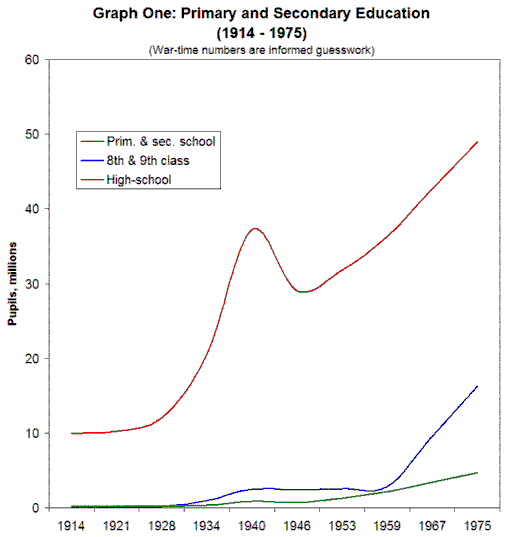
From other points of view the group is atypical: the mean age was 39 years - I have mainly associated either with 35-45-year-olds or younger people and their parents. I have seen little of people above 45-50, a serious shortcoming in a rapidly ageing society, with a pronounced generation gap (Table 9D). Clearly also, the dynamic and expanding qualified working class is underrepresented, while the intelligentsia has a more prominent place than in society at large. Most obviously, my informants are atypical in the sense that they live in Leningrad, the second largest urban center in the country. But it would be an over-simplification to say that I have investigated the life of "young intellectuals in a Russian metropolis". True, the group includes artists, university workers, two business managers and people we might term dissidents (hardly any would use the word about themselves). But though Seryozha's grandmother was a famous doctor, his parents have respectable jobs and he himself dabbled in the local version of 60's culture - his way of life, his friends, lover, jobs and values do not fit this bracket. The same goes for Vitya, whose lifestyle I describe below. From these two men we can trace contacts to typical working-class milieus and the "lower depths" of violent crime, black marketeering and prostitution. From Tolya's Christian friends, the painters Vasya and Andronov or the Baptist circles I met through Vera, threads might be followed to the inner circles of self-declared dissidents. Afanasy and Darya, qualified specialists with University educations, might introduce you to more respectable people. And 20-year-old Natasha could bring you to the hideouts of ultramodern youth culture, though she figured as a Komsomol leader. Roughly, my introduction to Leningrad has been along these disparate lines. I have followed up different people whom I met in very different ways, and they have led me to differing milieus. Only gradually did I realize that all my key informants (with one possible exception) could trace connections to each other.
Once I realized this I had to stop and think. I thought I was investigating several things: The logic of the black market, the return to Russian tradition and the Church, the role of Western models in critical thought and culture. Now I was faced with the possibility that the many little splinter groups I thought so unique, that mistrusted each other so intensely, were perhaps all part of a larger network, a social organism, facing the same basic "enigma", and on a deeper level, attempting to solve it in many of the same ways.
In this sense Leningrad is a very small city. Among all its millions there is only a minority that is truly interested in discovering and understanding the Other. Perhaps, as Lena insisted, I was indeed imprisoned in the nets of a unique group of "Russians who are interested in foreigners". Maybe this was all I met, and all I could meet, in spite of the variation I seemed to observe - only a mask directed against the perpetual Outsider, the Devil from abroad?
"Don't be fooled by the language. The problem with Russian both as a culture and as a language, is that it can be understood without being comprehended. For everything is 'similar' and nothing is the same. They seek to understand themselves in us, and we to understand them as us when we meet. But in reality we - the West - are something they think about themselves with. The likeness we see is frippery, costume."
I wrote this in a fit of depression, at a time when I seemed to confront an insurmountable barrier. Later I have come to other conclusions.
For lack of a better name, I shall call the group I met "representatives of the Russian counter culture". Possibly it is nothing but a mask covering the "Real Russia". But I myself think it is more. The discussions I engaged in with my friends about "Russianness" are, I think, a part (though one of the most conscious and self-reflective parts) of a more general Quest for Meaning, for an answer to the question: "What does it mean to be Russian?" I like to view my stay among them, and this book, as a modest contribution to that Quest.
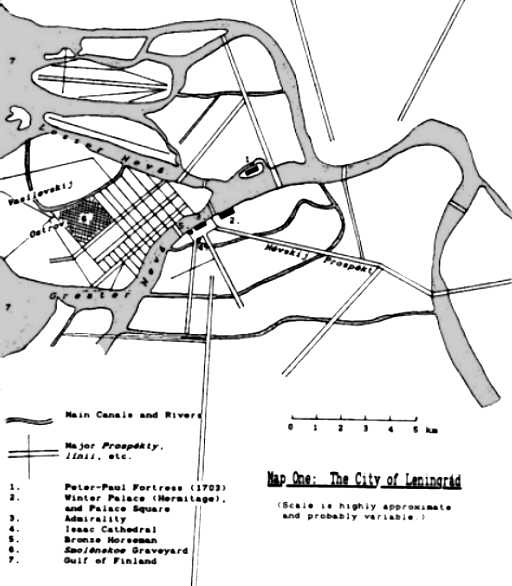
My hand-drawn map of Leningrad, from
the first edition of this volume. The obvious mistakes in scale are a
result of the Soviet policy of only releasing distorted cartographic
information to the public. In the 1980's, such secrecy seemed doubly
absurd, since exact maps based on satellite images were readily
available in the West. |
Countless times, in the midst of [the Petersburg fog] I've been gripped by a strange but forceful fantasy: 'What about it - when this fog disperses and goes aloft, won't the whole of this rotting, slippery city go along with it, rise with the vapors and disappear like smoke, and only the original Finnish marsh will be left, and in the middle of it, if you like, for decoration, a bronze horseman on his hotly panting, harassed mount?' In one word, I'm unable to describe my impressions, because it's all illusion, poetry in the end, and therefore, you might say, absurd; nonetheless I've often found myself musing and asking a completely senseless question: 'Look at them all, rushing and milling around, and how do you know it's not all just a dream someone's dreaming, and none of the people here are real, true, not one act is actual? Suddenly someone will wake up, the one who's dreaming it all, - and in an instant it will vanish.'
(Fyodor Dostoevsky 1875, p.134)
Even the casual observer straying through the streets of Leningrad cannot avoid the persistent impression of duality this city gives. No matter what area you choose, the same pattern repeats itself: in the Petrine nucleus, in the widespread classical center, nearly unchanged since the late nineteenth century in spite of the ravages of revolution and war, in the concentric rims of fifties, sixties, seventies and eighties housing, spreading ever wider and greyer out into the flat, marshy suburbs.
Everywhere you find the facade - the wide, ruler-straight boulevard or prospekt, which, in the words of Andrey Bely (describing the greatest prospekt of all: the Nevsky),
"...possesses a remarkable quality: it consists of a space for the circulation of the public bounded by numbered houses; the numbering follows the order in which the houses are located - which infinitely eases the quest for the house you are seeking." (Bely 1913-16, p.23)
The prospekty are a European idea. They were introduced by Peter the Great in an attempt to build the ideal Western capital in the midst of a Russian marsh, and ever since, Russian architects have planned their cities in this way. When Stalin and Khrushchev decided to modernize Old Moscow and turn that "heap of wooden shacks" (Bely, ibid.) into a showcase of Communism, they slashed prospekty through its mesh of winding streets. The prospekt is the clearest possible symbol of Order, clarity, visibility, efficiency and - hence - modernity and power. On Nevsky, the masses mill past, bodies touch, cars, trolleys and buses race to and fro, the atmosphere is hectic, the mob of pedestrians dense even for such huge sidewalks. This is Civilization, we are made to understand, Culture. Here the marshland is definitely tamed by the oaken pillars and granite foundations pounded into it by Peter's slave laborers. The wide river is chained by beautiful, flying bridges. The very word prospekt gives associations of a free, open view.27 Neither does it pass unnoticed that both the word and the reality it denotes are imports from the West, foreign.
But the quote from Bely is an (intentional) oversimplification, for the quadrangles enclosed by the prospekty, linii and bul'vary are much too large to be easily accessible from the street. Locating the house you seek may turn out to be harder than you think. Each block consists of quite a number of houses, approached by narrow, crisscrossing alleyways and tiny parks. These are the dvory, the back yards. They are as closed, as intimate and disorderly as the prospekty are open, official and formal. The dvor is homegrown and genuinely Russian - originally the word meant simply a farmyard. "Na dvore" - "in the yard" - is a way of saying "outdoors". In the dvor the babushki sit in the sun on worn benches, the children play, piles of garbage lie about, and random plantings of bushes and weeds grow knee high or are trampled to the root as the case may be. This is home, private, and a stranger strolling past is noted. It's comfortable in the dvor - prosto, but hardly Civilized - kul'turno.28 It is a closely guarded bit of untamed nature.
An obvious question is why the prospekty are there at all:
"Nevsky Prospekt is rectilinear (to put it bluntly), because it is - a European prospekt; and a European prospekt is not merely a prospekt, but (as I have noted above) a European prospekt, because... well, anyway... This is the reason why Nevsky Prospekt is a rectilinear prospekt." (Bely, op.cit. p.24)
Outside the Center in rush hour the streets seem absurdly overdimensioned. The few cars you meet go careening from side to side of the vast expanses of asphalt, barely avoiding potholes, puddles and pedestrians. Even in a modern Western metropolis such streets would be spacious, and when you consider that most of them were built at a time when traffic was a lot scarcer even than today,29 Bely's quandary is understandable. They are certainly based on a Western model, but the very consistency with which it is followed through makes them all the more un-European. They seem (in all their dreamlike beauty) to embody the megalomaniac ambition of some Oriental Despot in a Western idiom, and leave you with a strong impression of tension between form and content.
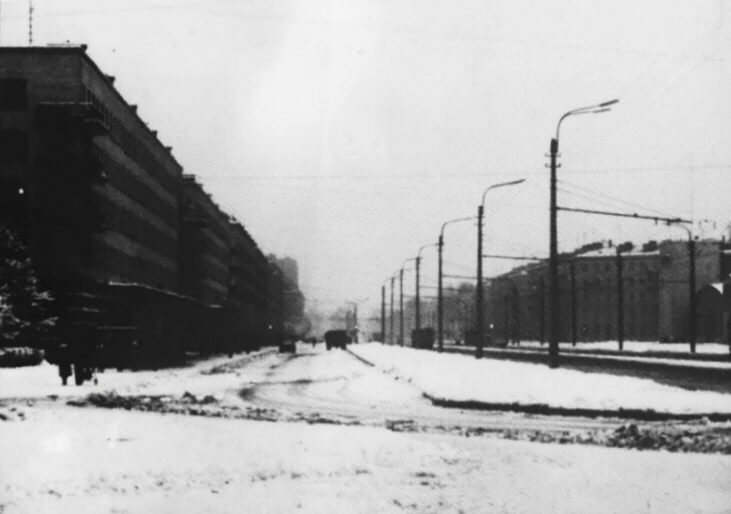
Prospekt on Vasilevsky Ostrov in December
Not only are the prospekty unnecessary from a purely practical point of view. They perpetuate the very problems they purport to solve. Since the blocks they enclose are so large, the ungoverned domain of the dvory comes to dominate the whole city, resisting the power of the prospekty and destroying the clear view they were designed to give. In the old parts of town you usually have to pass through a dark, smelly, exceedingly private-looking gateway in order to find the dvor at all. Once inside, however, you may issue again from a number of alternative portals at the most unexpected places. Several times I have walked nearly the whole length of Vasilevsky Ostrov (several kilometers) from dvor to dvor, never emerging onto the street except to cross it and disappear again into the next secretive passageway. Seryozha, a native of this island, told me how in his childhood back in the fifties, when Leningrad was a more dangerous city than today, the police used to lose track of local criminals in the fenceless maze.
In summer, the contrast between dvor and prospekt, nature and civilization, is clear-cut and obvious. Nature keeps within the confines defined for her by culture. But even in June the distinction may blur. In late spring, thousands of linden trees all over the city let loose a dense cloud of feathery-white, downy seeds. For weeks they fill the air, cover the streets, whirl through the open windows of overfilled buses. It has an eerie effect. Vitya, a black-market acquaintance, returning to Leningrad after some weeks on "business" in various northern towns, exclaimed: "It's like this down is pursuing me!" This may seem trivial, but at the time we both (and he is an ardent rationalist) were struck by the almost mystical quality of the experience.
As the seasons change and you get more intimate with the city, it becomes obvious that nature and culture are in fact at war. Just before the great May holidays there is always a collective, more or less festive "spring cleaning" - a subbotnik - when yards are raked, trash collected, fences painted, earth dug up around little bushes with comical but concerned care. The city looks nice and clean, with its red and light-blue May banners on every street corner and on the dainty bridges leaping across the canals. But the subbotnik lasts only one day, and when it's over nothing more is done about the matter. Piles of sticks and leaves and junk, waiting for a truck that never came, are left to be gradually spread out again in the course of summer. "Lawns" grow into jungles.
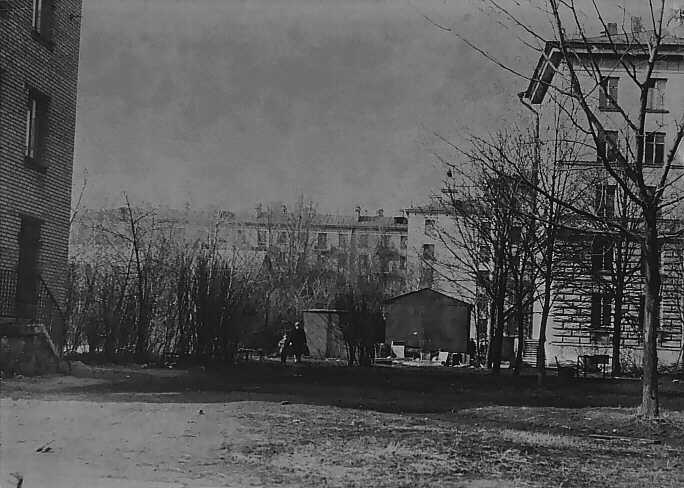
Dvor in March on Vasilevsky Ostrov
In winter the prospekty are thwarted again by their very size. The wind howls down mile-long corridors, snow piles up, defeating the hopelessly inadequate street cleaning equipment. The dvory lose all pretense of civilization. Snow is not removed, but narrow paths are trodden. Benches snow down and people clear off the top of the backrests to sit on them with their feet on the seat - level with the snow covering.
And when the drifts melt, the city reverts to its original state altogether - marsh and puddles. The biggest dvor of them all - the Smolenskoe graveyard, more than a square kilometer of bushes, birches, overturned graves and a maze of little paths, becomes a nearly continuous sheet of water with jumbled crosses and pale green birches rising from it. How tenuous the hold of culture is on the land becomes evident in this place. Ivanov told me how during the 900-day Nazi blockade of Leningrad, the local boys in each city block would split the graveyard into sectors and harvest nettles for soup. With starvation rampant, the boy who intruded on his neighbors' well-guarded patch might well be killed in the ensuing fight.
This is one of the places where my own sense of the esthetical conflicted with that of my Russian friends. To me the graveyard was a place of intense significance and beauty. To them it was scary. Rumor had it that all manner of drunks and criminals camped out there in summer and I was warned against entering it at night. (But imagine the moon shining through birch leaves down on swimming graves...) It was fine for skiing in winter or a summer stroll at noon, but on the whole it was a blemish on the city - a remnant of Chaos, definitely nekul'turno ("uncultured"). This is clearly the opinion of the city planners as well, who nibble away at the edges of the immense park to build factories and new housing. The resulting scars, themselves chaotic enough due to messy and inefficient building techniques, are directly painful to the eye: like wounds in a living organism. But building is slow, and the fight prolonged indefinitely. No doubt culture will win in the end, but by that time some new place like the graveyard may have emerged. And in the mean time it is truly symbolic, strongly evocative of the zona in Tarkovsky's film Stalker.30 Moreover, with its many untended pre-revolutionary graves it is not only a refuge of superstition and nature but a repository of history. It was here I met a man who took me by the arm and led me and my girlfriend conspiratorially along byways I have never been able to retrace, promising to show us something interesting. We arrived at an inconspicuous-looking grave, to which he pointed: "That is Trotsky's first wife." Here the battle between nature and culture is waged at close quarters. Amidst the general wreckage you come to a grave that is well kept. A fence is erected round it. Inside, the ground is swept meticulously clean, the cross painted gold or silver or light blue, a vase of flowers and a little table set up with benches where relatives can sit. But the fence is a demarcation line. Outside, Chaos takes over.
The battle between culture and nature is reflected in many stories people tell - perhaps true, perhaps fantasy - it's hard to say:
Obviously, the modern equivalent of a prospekt is the Metro, the only piece of consistently efficient civilian technology I have observed in the Soviet Union. In Leningrad its tunnels dive deep down under rivers and swamps - the escalators are more than a hundred meters long. The intense noise, the precision, the masses of people, the sumptuous marble stations, the violent speed of the journey, make the Metro a truly awe-inspiring experience. It embodies the essence of the Petrine spirit in modern guise. But slicing as it does through the deepest roots of the Marsh it symbolically invokes the wrath of nature. Tamara Ivanovna, an inexhaustible source of fascinating apocrypha, told about the difficulties encountered in building it. Under Leningrad, she said, are subterranean rivers as large as the ones above ground. Any manner of heavy construction can disturb these watercourses with unpredictable results, for "no one really knows where the rivers flow".31 Once one of them broke through into a Metro station, causing the whole structure to collapse. Luckily it was night, the station closed, and the houses above, which were destroyed by the sinking ground, uninhabited.
Thus, nature and culture confront each other in the city, in a permanent symbolic and real battle, the outcome of which is hard to predict for those witnessing it. Mostly they seem to choose the side of culture - but we should not jump to conclusions, it seems more likely that they are divided over the matter, that the visible, external battle mirrors a battle within. Seva showed this clearly enough. He was reading the paper, and happened across an item that fascinated him, so he read it aloud to me: it was about a hurricane on Kamchatka, which wrecked havoc with lots of little villages. "It just blew them to the devil! Roofs and people and cars and fishermen and boats!" With considerable satisfaction he added: "That's nature for you, eh?!"
I have mentioned Tarkovsky and will do so again, because to my mind no one else has succeeded so eminently in portraying the simultaneous decay of culture and frontal attack on nature, which is so typical of Soviet society as I have learned to know it. I have been to India and seen a similar "decay" going on, houses wearing away, slowly losing their sharp contours and colors and merging organically with the ground they stand on. But I did not notice that other aspect of the battle waged in Russia, the unrelenting and often misinformed attack on nature, splintering the wooden fence of Smolenskoe graveyard, erecting huge dams in the midst of the Siberian wilderness, finished by shock labor years before the power they produce can be used for anything at all (Udgaard 1977, p.72), drawing giant turbines over hundreds of miles of unpaved roads by horse power, back in the unindustrialized late nineteenth century.
"It's the essence of humanity to transform nature," said Svetlana Sergeevna. And Vanya: "In principle science can explain everything." They echo the nineteenth century's and Karl Marx' optimism, which we have learned to distrust. But they do so under circumstances Victorian Europe never knew. They are not confidently arrogant but clutching at straws, like Vitya, after a bad mishap in his black-market enterprise: he sat down with a pocket calculator and mathematically estimated the probability that his blunder would get him arrested. When he discovered (by intricate calculations revealing an astonishing knowledge not only of mathematics, but more significantly, of the ponderous bureaucratic machine confronting him) that the chances were only 6-7%, he was visibly relieved.
The attack on nature is violent because defeat is all too easy to envision. This, I think, is another indication that the battle is raging simultaneously in outer and inner worlds. The external decay of a culture at war with nature mirrors an insecurity of the soul, a doubt about the legitimacy, even reality, of society itself. Tarkovsky's films are superb illustrations of the resulting uneasiness and fear: the research station suspended over an inexplicable, distant planet, which turns out to be a single organism, benevolently but blindly driving the scientists insane one by one by confronting them with living replicas of their unconscious guilt ("Solaris"). The man trying to free himself from the rustling, ominous leaves of his childhood home, and from his mother - who converses with the shower (it's alive!) and fears that she has threatened the entire rational social order by dropping an unspeakable printing error into a book she is editing ("The Mirror"). The zona - a bit of civilization overgrown by wilderness, where human habitation is impossible because all cultural pretense breaks down - houses, tanks, machineguns and lorries are disabled for unknown reasons, as are all but the purest humans - because here they face their innermost, secret desire.
The zona - in Tarkovsky's definition - is a "system of traps... where everything is constantly changing". It really exists - not only in Smolenskoe graveyard, but in thousands of places throughout Leningrad and Russia. It is the battleground between nature and culture, the dvory and the prospekty, which is simultaneously a battle within the Russians themselves. "Before you enter the lift, assure yourself that the cabin is located in front of you" reads a laconic sign in one of Leningrad's suburbs. "Their refrigerator jumps!" Seryozha explained, upon introducing me to Fedya and Lyuba. "They've got to tie it to the wall or else it'll be standing in the middle of the kitchen floor by morning." Vitya once took me (illegally) to visit a large factory. He led me through narrow alleys covered with refuse, past an immense old warehouse where the roof had caved in three or four years earlier and no one had touched the place since. Through a gaping hole in the wall we saw rafters and rusty sheets of iron dangling from on high. Here and there crushed, formless machines jutted out of the wreckage. Outside, tons of precious raw materials and semi-processed goods lay rotting and rusting for lack of adequate storage space. We passed dark doorways where dense clouds of chemical smoke belched out at us, accompanied by scorching heat and mind-shattering din. Inside, finger-thick layers of soot covered roof and walls, and inch-deep ruts were worn in the stone flagging by countless handcarts that had been hauled that way since the building was erected - in 1905, as the faded sign over the door proclaimed. In a particularly impressive spot Vitya stopped and looked at me: "Svalka (a dump)," he murmured, gesturing vaguely with his large hands. "Zona."
It was a decisive moment for me. I had wondered why so many people disapproved of Tarkovsky's art. Ira and Edik said he tried to impress you with effects and ruthlessly used people. To Lena (quite an intellectual herself) he was guilty of "intellectualizing" and being "complicated for complexity's own sake". Borya and Zhenya called him a disillusioned intellectual and his views "decadent". A philosophically inclined samizdat author criticized him for not unifying the personal with the impersonal - i.e. God.
I don't know if Vitya liked Tarkovsky. But he found his imagery descriptive, and in this factory, with its bleak human prospects and weird, "impersonal" beauty, I think I understood why so many others didn't approve. He's just a little too realistic for comfort. In his imagery a battle with real casualties and real human suffering takes on a serene, silent beauty which many find offensive. Nevertheless Stalker, the guide who led the curious and the seekers into the zona, is an archetypical character in this world. To me it was significant that Vitya should have recognized him, since he had made that role into a way of life. Actually our little expedition to the factory - to the mysterious, forbidden battlefield - was an unconscious reenactment of the film's plot; one of several he staged for my sake. Another person who recognized Tarkovsky's imagery was the woman I call Vera. In later chapters I hope I will be able to show what reasons these two could have for this.
Tarkovsky's zona may be thought of as a symbol of the "enigma" of Russian identity. By immersing ourselves in its meaning and esthetics we are sensitized to a certain atmosphere, a poise, an attitude to life. But as I stated in the Introduction, a symbol is a repository of "true" knowledge: wandering through the streets of Leningrad we discover the zona all around us - it is a real battle of culture and nature, West and East, which is embedded in people's physical surroundings as well as in their hearts and minds. Indeed, it pervades every aspect of Soviet society. It may therefore be considered not only a symbol, but, in Victor Turner's words, a Dominant Symbol:
"Dominant symbols tend to become focuses in interaction. Groups mobilize around them, worship before them, perform other symbolic activities near them, and add other symbolic objects to them, often to make composite shrines." (1958, p.22)
The zona is, so to speak, a symbol of society as a whole, of the "medium" through which all activity, thought and emotion, regardless of its specific content, is transmitted. I shall refer to this "medium" as Social Texture. The zona is a dominant symbolic rendering of the Texture of Soviet Reality. But of course it is not the only dominant symbol of this reality, and if we choose another as our point of departure we will arrive at another final image of the society this book attempts to portray. The zona, we might agree, imagines Russia from the distanced, somewhat cerebral point of view that is typical of the alien, the outsider, the anthropologist. It is a viewpoint that is attuned to certain moods we recognize (and that I will point out later in the text) in such Russian authors as Dostoevsky, Blok, Bulgakov or Vysotsky; but it lacks the melodious sensuality of Pushkin, which is definitely also very Russian; nor does it approach the extravagance of Gogol', or the didactic moralism of Tolstoy. Many readers will perhaps not recognize the Russia they know in my imagery. Others will see in it a reflection of the specific place and period in which I came to know the Russians. Both will be right. My use of the zona as a focus of analysis and description reflects the nature and limitations of my own experience in Russia, and brings out aspects of Soviet reality, which I, as a result of that experience, have come to see as essential.32
Viewing society as I have done above is like listening from afar to the complex but uniform drone of a large factory. In fact, the sound is a composite of millions of clashes, clicks, rumbles, whirs and eruptions, steps, whispers and shouts - which when massed together, all merge into one voice, uniquely characteristic of this factory - its auditory signature, we might say. Intuitively we may be able to grasp the significance even of the mind-boggling complexity of this "signature". But an intellectual understanding of such a composite - social Texture or drone - demands that we split it into its components, analyze it. However, it is not enough to trace each element back to its origin - in a specific piece of machinery, say, or a certain category of events. We must not dismember our wide-angle picture for an album of unrelated close-ups, but sharpen focus while retaining scope. If my sketch of Leningrad is treated in this way, we may learn to walk through the city's streets in silence, meditating on them as a true Icon of the Soviet Union. The total expression contains the innermost essence.
As anthropologists we must therefore approach whole and parts simultaneously: society in its widest historical and regional context, and the scarcely noticeable inflections of individual acts and responses. I agree very firmly with Fredrik Barth that "everything influencing the shape of an event must be there asserting itself at the moment of the event" (1981, p.6). No complexity of scale or history is relevant to analysis unless its consequences are present here and now in the behavior of real people. Social systems are concrete, not abstract: society is human action. Nevertheless, the nature of the whole cannot be deduced from its parts. Complexity is so densely packed in any individual act that it is impossible to observe and interpret directly. So it must be approached indirectly, through studies of macro-scale structures and long-term history that are later referred back to "real people" in the here and now. For this to be possible we need a general theory of society and action, which interrelates many degrees and kinds of complexity systematically.
In the following I shall sketch out the rudiments of such a theory - of social complexity - or Texture.33 I have structured this presentation not as a commentary on existing theory but as a self-contained essay. Where appropriate I indicate my debt to other authors, but my attitude has been irreverent throughout. I have tried to develop an analytical toolbox - a set of theoretical instruments with precise and non-overlapping functions, and if an idea has sparked my imagination I have not hesitated to reinterpret it to suit my own aims, rather than tie myself to the author's intentions, nor have I hesitated to omit references, whenever these seemed to be a mere matter of formality. The main body of the book utilizes the resulting theory to understand a real, historical situation. The success or failure of this attempt may indicate the usefulness of my synthesis for anthropology.
Two ideas are crucial to social science, indeed to any thought at all - that of movement, force, energy; and that of restraint, form and order. These are the Yin and Yang of Chinese philosophy, where Yin is "the yielding", darkness - formless flux, while Yang is "the firm", "that which is shone upon" - static clarity of form (Wilhelm 1950, p.lvi). Similar dualities underlie much of Western thought - e.g. Aristotelian ontology (substance and form) and Quantum Physics (waves and particles); and many primitive cultures seem to have related ideas: in Michelle Rosaldo's monograph on the Ilongot (1980), the heedless passion of headhunting youth is balanced by the wisdom and stability of age. In anthropology these principles, which I refer to as Flow and Rules, are prominently reflected in so-called "action-oriented" theories (often referred to as "methodological individualisms") on the one hand, and in various "structuralist" (including some neo-marxian) schools on the other. Most anthropologists, however, rely in practice on some sort of complementarity between the two principles, and some theorists have gone to great lengths to establish a basis for this complementarity in formal language: the work of Anthony Giddens on "agency" and "structure" (1979) is here brought to mind, as well as the cybernetically inspired work of Bateson (1979), which focuses on such concepts as "process" and "categorization".34 I shall here bypass many of the complexities of this literature, and simply assert that Social Texture may be envisioned as an extremely complex mesh of "rules" of various kinds (cognitive, moral, biological, material), through which the "flow" of direct human action and its indirect consequences passes, and by which it is restricted, channeled and organized into recognizable entities or aggregates, which I refer to as Centers, and which are discussed in the literature under various headings, such as categories, symbols, identities, roles, statuses, persons, values, intentions, ideologies, resources, institutions, classes, cultures, nations, historical epochs, and social revolutions.
Flow, in this generalized sense, may be understood as any movement: of goods, value, information, intention, all human action including speech, thought, emotion. Rules,35 similarly, are anything that restricts, orders or governs flow. A moral principle or law is a rule. So is ignorance, lack of access to resources, or a brick wall, gravity, the fact that most human beings are born with two hands. The prospekty are a set of rules that order the flow of people, ideas, and goods differently from the rules of the dvory.
Three tenets will clarify the nature of these concepts further. The first has been pointed out by Bateson (1970a, p.458). All action is interaction, all flow cyclical. In cybernetic terms flow is a feedback circuit, self-sustained and self-regulating. A man chopping down a tree must receive impulses from it in order to transmit his will to it. A person paying his fare on the bus will reap the consequences - he's upholding not only the bus company, but the world market. All social entities - all "Centers" - are from this point of view aggregates of flow, they are more or less ephemeral states of dynamic equilibrium, rather than static objects. The second tenet has been succinctly formulated by Louis Althusser: a rule is its effect (Giddens 1979, p.160). It exists only if and when it governs flow - it is only real when we obey it. Rules flicker. They turn "on and off" as we confront or disregard them: the grammar of a forgotten language is as unreal as a car in the Amazon without roads or gas, the bus company disappears if we all boycott it, and the prospekty "rise with the vapors and disappear like smoke" if they do not impose their "European" rules on people successfully. Rules are the parameters, the boundaries, the "names" of states, and they exist only to the extent that the Centers they define are maintained. The third idea posits that reality in itself is unknowable. Knowledge is an ordering of experience by means of rules, and the reality we know is only knowable because we have thus ordered it. Hence, what is beyond order is unknowable, because we can only know it by imposing order (knowledge) on it, and thus changing it. But the unknowable should not be confused with Kant's idea of a transcendent Ding an Sich. As anthropologists such as Turner (1964, 1987), Mary Douglas (1966, 1975), and Bateson (1979) have pointed out, what resides outside the social order is not simply a vacuum, a Durkheimian anomie, but itself an active principle of change. The ordered Centers that we know (people, home, work, God, science, flag, truth, friendship, etc.) congeal out of the Unknowable - and when our ability to know them breaks down, they return to the ground from whence they came. The Unknowable is therefore the Potential - the ultimate resource - the ability to change. As Nietzsche puts it in Also sprach Zarathustra: "Man muß noch Chaos in sich haben, um einen tanzenden Stern gebären zu können" (1887).
Some preliminary conclusions may now be drawn: First, any social reality, i.e. any reality we can know and relate to, may be described in terms of rules and flow. Reality comes into being when we accept the conditions (rules) of its existence and act (flow) in accordance with or in opposition to them. The concept of "praxis" as reformulated by Neo-Marxists and others reflects the same idea: in a discussion of Engels's classical (but rather imprecise) maxim that economic production determines social relations "in the final analysis", Giddens thus concludes that production is indeed determinant, but what is "produced" belongs as much to the ideational as the material sphere (1979, p.150-55). In my terms, acts "produce" rules by letting themselves be governed by them. The distinction between material and ideational rules is trivial compared to this fundamental insight.
Secondly, no matter how assiduously we order the world, there remains a residue - perhaps subtle, but always present: the Unknowable underlies our edifices of order; it constantly threatens them, and always engulfs them in the end. This is the main point in Turner's description of rites-de-passage (1964): transitional stages like birth, coming of age, death - or in modern societies, indeterminate states like waiting in line - confront us with the basic inconsistencies of social life, and are thus important sources of insight, innovation, and critique. Tarkovsky's zona symbolically evokes such a residue of the Unknowable.
Finally, rules and flow cannot be conceived of in isolation from each other: they are complementary terms. Left to themselves, both return to the Unknowable; and the nature of this "return" will play a fundamental part in our further discussion. We have noted that a rule is its effect. If it is only "partly" obeyed by flow (like the prospekty) it is either not a rule at all or else a different rule from what it claims to be. It flickers "on" and "off" instantaneously, according to whether the state it defines is maintained or not. In contrast, flow without rules disperses gradually. Movement cannot arise or be disorganized all at once - it changes direction or intensity by degrees. In cybernetics, flow is analogue, rules digital. In music, flow is the tune, rules the beat. In Aristotelian terms flow is substance, rules form. Consequently it is through rules that reality acquires specific attributes such as time, space, life, meaning, value. All such states stand in constant danger of flickering "off", becoming unintelligible and returning to the Unknowable. This is a natural consequence of the abstract nature of rules. A rule defines an object as a specific thing simply by affirming that it is not anything else. Hence the rule is nothing but the abstract boundary implied by this word "not". But the only way such an intangible can give rise to the rich diversity of social phenomena is by limiting its own influence, by focusing and channeling flow rather than halting it, permitting contrast and comparison rather than segregating completely. Things therefore become things by engaging in specific types of interaction, and if the rules of interaction change they become things of a different kind. Rules are "gates" or "filters", and flow the self-sustaining flux of interaction running through them.36 But flow itself neither compares nor contrasts. It asserts its being by including things within its cycle, penetrating their boundaries and assimilating them as "parts into a whole". Without the resistance of rules, flow would swallow everything in that total interrelatedness we feel when we are so involved in an activity or relationship that nothing else seems real.
Thus a rule is an abstract distinction, a mode of comparison - a logical "not". Flow is an inclusive relationship, a world in itself - an "is". Paradoxical though it may seem, it is this very limitation of rules, their utter lack of concrete substance, which is the key to their power. Since they are abstract, their range of application is unlimited - they can be "moved out of context" as in humor, or "imposed on a new context" as in generalization, imperialism, legislation or engineering - or as prospekty are imposed on dvory. Conversely, the power of flow lies in its inability to free itself from the context. Indeed, since its only function is to connect, flow in a very real sense is the context. It is a closed circuit of feedback, which - like a spinning gyroscope - resists displacement.
I have defined Texture as the medium through which interaction and communication flow, and indicated that the Texture of a society (or a more limited social situation) may be thought of as the sum of all its rules, all restricting, governing, ordering boundaries. It is a kind of hyper-complex, many-levelled "labyrinth", through the corridors of which all acts and communication eddy, meander, trickle or roar. Texture denotes the total complexity of a context. We must not forget how abstract this idea is. Texture does not consist of things, persons, institutions, or even roles and symbols. Such entities (Centers) are states, which we maintain by acting within a Texture: by resisting, conforming to or trying to understand it. Texture itself is only a labyrinth of boundaries. But since it includes all the rules - all the actual and fictive distinctions of a society - it is also the fundamental source of the society's uniqueness - it's basic form, it's deepest rhythm, the way in which its interpretation of the Unknowable differs from all others.
We may now take another step and attempt to describe various empirical Textures as results of different types of relationship between rules and flow. An analogy may assist us in constructing such a typology. If flow is thought of as a river contained by rules, two types of variation present themselves. First, the current may either be efficiently concentrated, as in a steep river gorge, or it may dissipate in switchbacks and marshlands. Secondly, the intensity of flow - its brute force, its speed and the distance it traverses - may vary from a dribble to an Amazonian surge. Clearly, the prospekty are inefficient carriers of flow, but carry flow of far greater intensity than the dvory - while a German Autobahn is both efficient and intense.
When social systems increase their efficiency this may be referred to as Adaptation. In the terms defined above, adaptation may be described as an accretion of multiple rules to the same current of flow. Multiple rules act as a kind of "security net". They allow flow greater elasticity of movement, so no matter how often it changes direction and intensity there is always a rule ready to catch and hold it. Bateson (1970b) has defined this quality as Flexibility, and exemplified it with the body's reaction to hunger. Food consumption fluctuates between lethal limits of starvation and overeating. But if these limits were the only rules to turn eating "on" and "off", the body would constantly be poised on the verge of destruction, and any chance occurrence could "surprise" it to exceed its own lethal limits and die. So instead there are many rules warning us to eat or not long before lethal limits are reached. Some are biological (it's unhealthy to not feel hunger), some social (etiquette and habit). The lethal limits are shielded by a dense cocoon of rules, which permit us to respond to hunger in a wide variety of ways, depending on the circumstances - without endangering our life. Flexibility, in Bateson's definition, is "uncommitted potentiality for change" (op.cit.). If we keep to the metaphor of the river, flexible flood control might be achieved e.g. by a system of stepped dikes, which, as the current intensifies beyond a certain point, would dissipate the energy of the waters by allowing them to expand to the next step, and so on. A single, massive floodwall, in contrast, is immediately attacked at its base by even the smallest swell, and if it is pierced at any point, there is no backup to replace it. In this way multiple rules channel flow efficiently, and absorb any "leakage" that jeopardizes the survival of the system. The "labyrinth" of social Texture consists of countless channels of this kind, crisscrossing and branching off from each other on many levels, from the finest-grained nuances of speech and gesture, to the massive surges of international commerce. By "lining" its channels densely with rules, society "prepares itself for any eventuality" and "takes all circumstances into account", while reducing its need to insist rigidly on any single rule. Flexibility allows alternative solutions and freer scope of expression.
Adaptation thus harmonizes rules and flow, the form and content of expressions. It creates consistency and beauty - hence it is an important component in many forms of art. Flexible, "leak-proof" rules form the basis of norms, categories, ideologies, roles and institutions, which are convincing and predictable. Adaptation produces a legitimate social order. The fundamental reason for this is that redundancy is increased, i.e. rules overlap and intermesh so densely that by mentioning one you always imply them all. This is experienced as variation, since there are always many ways of saying or seeing the same thing. Furthermore, as Bateson points out (1979, p.75-98), such "multiple versions of the world" harmonize and deepen our perception of reality (two eyes see differently (in depth), not more, than one). Adaptation thus utilizes separation and discontinuity (many rules) to "simulate continuity" (flow). Transitions seem gradual, almost unnoticeable. Stability and immunity to external influence increase till we seem to be living in the "only possible world", unchallenged by abrupt, unpredictable change. (But although the Unknowable recedes into the background, it never disappears - a point we return to in Chapter 3, Part D.) Such Textures (flexible, efficient, legitimate, stable and redundant) are called Dense in the following, since they "cover" the Unknowable with tightly "packed" rules. A Texture of poor adaptation, in contrast, is Open. Its rules are inflexible and brittle: its flow inefficient, illegitimate and unstable, its transitions sudden and violent. It "covers" the Unknowable incompletely, and unpredictable, random change is a constant threat. Since the zona symbolizes a vast "residue" of the Unknowable in society, we conclude that Soviet Texture is extremely Open. We will return to the consequences of this conclusion below.
Returning to our metaphor of the river, we may now ask how increasing intensity of current may be conceptualized in terms of flow and rules. On one level this seems obvious. As the Amazon runs in a wide basin, so a society must contain rules of broad validity and application in order to convey large quantities of goods and information at high speeds over great distances. I shall refer to the development of such a universalistic order as Evolution, since rules of this kind are most typically embodied in the universal laws of modern society, as well as in its overarching infrastructure of machinery, highways and communication. But on another level the situation is more complex. The Amazon is not a single, wide channel, but a vast basin collecting trickles of flow from many sources. In the same way, the universalistic structures of modern administration, communication and economics must coordinate millions of individual human beings - diverting their efforts from areas with immediate and obvious relevance to their own life and wellbeing into an impersonal sphere that often directly contradicts their personal interests. Thus evolution not only establishes global, impersonal principles (which I refer to as General rules), but polarizes these with principles of personal and local validity (Specific rules).
Another crucial aspect of evolution should be noted: a general rule (e.g. a prospekt) is a rule of Power. It dominates specific rules by extracting part of their flow and redirecting it onto higher levels. A wage laborer, for instance, no longer works for himself. His relationships to tools and people acquire a wider, impersonal function, which he never fully comprehends. Part of the autonomy of face-to-face interaction is sacrificed to "feed" the aggregate interaction of higher levels.37 But since flow is a self-maintaining feedback circuit, specific rules turn inward on themselves and resist power. Indeed, general and specific rules are integrated into a hierarchy not by some kind of neutral, logical compromise, but by the constant conflict of power and resistance between its various levels. As Giddens points out (1979, p.145-50), this "dialectic of control" bears a striking resemblance to the "class conflict" of Marxism. But levels are rules, not groups. A high level is not a "ruling class", but a rule with universal pretensions, which extracts flow from throughout a widespread community. A "ruling class" may perform key high-level functions and exploit its position to terrorize the population. But violence is not power. Power exploits in order to integrate. The ruling class can neither fulfill this function alone nor limit itself to it exclusively. A class is not an abstraction - a rule, but a group of people, who themselves, in the very act of exploiting power, resist it. In the same way resistance to power is not mainly a conscious struggle, surfacing only at specific times or places, as certain versions of Marxism misleadingly assume, but a universal constant of all human interaction. Class struggle is an explicit conflict between groups, but in reality the conflict is far more pervasive, taking place within groups, within individuals, indeed, within the individual act itself.
Textures with intensive extraction and great power differences between their most general and most specific rules are Deep ("modern"). Textures with small power differentials are Flat ("primitive"). Like Density and Openness, these categories have implications for consciousness as well as social organization. Deep societies are held together by "abstract" circuits of flow conveying vast volumes of goods, information and people over great distances at high speeds. General rules are the infrastructure channeling this flow. But an infrastructure consists of more than material resources (roads, telephones, factories), it comprises all the knowledge, discipline and skills needed to operate and maintain these facilities. In both respects there must be uniformity for the infrastructure to function: smooth roads, universal laws, uniform value. Evolution thus enforces standardization, general rules that override the traditional barriers of Flat societies: immunities of caste and guild, local cultural variation, ritual and economic impediments to free exchange. The effect of the market on Flat societies with clearly delimited spheres of economic circulation exemplifies this (Bohannan 1959), as does the transformation of cyclical time conceptions into linear sequences measurable in standardized units (Löfgren 1979) or the development of written records, maintaining a stable standard of truth that local communities cannot reinterpret to suit their changing needs (Goody & Watt 1968). But in order to "fill" a general rule with flow, the efforts of innumerable individuals must be coordinated. Only part of a general rule is therefore found in any one place and time, in any individual or act, and only in the general rule itself - an abstraction inaccessible to consciousness - are all the fragments pieced together. From the point of view of the individual, standardization is therefore experienced as specialization of skills, roles and concepts.38
Thus evolution produces opposite principles - general and specific rules, power and resistance, standardization and specialization - and polarizes them. At one extreme are rules of an abstract, impersonal order - upholding institutions, nations, the world market. At the other extreme are concrete rules, which apply to the personal needs and relationships of individuals. But no rule, no matter how general, can survive except by governing real human action. The entire polarized hierarchy is therefore compressed into individual acts: although a rule is abstract and general, its only tangible presence is here and now, in the fact that we obey it. The act is the medium through which flow of all levels is conveyed, and most acts in Deep societies therefore encompass vast internal tensions between general and specific principles. I pay on the bus - but why? For my own self respect? For the sake of bus company, the state or the world market? No matter how I rationalize it, my act is not autonomous, but split between many such considerations. We lead life on many levels of abstraction and are alienated from many essential consequences of our acts.39 It is through this experience of alienation that a Deep Texture enters our consciousness, forcing us to distinguish between universal and local statements, abstract and concrete categories and values. It is therefore no coincidence that Western Europe - which has evolved, historically, into the Deepest and most powerful Texture in history - was also the point of origin of modern science. In contrast, polarization is weak in a Flat Texture. There is less power - primitive societies have rudimentary hierarchies. Standardization is not far-reaching - systems are small or weakly integrated into larger systems. Specialization is weak, roles multiplex (most people can perform most tasks). Abstract and concrete thought are not clearly separated, because they are not experienced as opposites.
The hierarchy produced by evolution is an apparatus of power and an instrument of abstraction. Once again we note that the distinction between "material" and "spiritual" orders does not apply, since we are dealing with a hierarchy of rules - not of things, concepts or groups (Centers). Power and abstraction are inseparable aspects of general rules, which extract flow from direct, spontaneous and personal acts - which are the only source of flow. In both cases this extraction is resisted. People do not willingly sacrifice time and energy for some impersonal "larger whole". Neither would they engage in abstract thought, irrelevant to the business of living, if they were not forced - i.e. if society had not "split" their acts, giving them a real stake in reflecting over such issues. This does not mean that people in primitive (Flat) societies do not engage in flights of fancy or devise ingenious systems of philosophy and art. All Textures adapt, increasing their variety and aesthetic elaboration. What is unique in Deep society is the polar opposition of abstract and concrete forms of life and thought - the fact that such forms belong to separate experiential worlds.
We have now arrived at two independent axes of complexity, at the extremes of which are four polar types of Texture: Deep, Flat, Dense and Open. None of these concepts are new: there is an extensive literature contrasting primitive (Flat) and modern (Deep) societies, notable are contributions by Marxists and social evolutionists. Studies of legitimacy and solidarity (both are forms of Density) go back to Weber and Durkheim, and ecological adaptation has received much attention since the early 60's. My ideas are inspired by this work but attempt to overcome one of its most common shortcomings: a tendency either to study one of the processes to the exclusion of the other, or to emphasize one as more beneficial. Bateson thus extols the virtues of flexibility and ecological health, but ignores the impersonal machinery of power enfolding through evolution, attributing this to individual motivation (1979, p.46-48). Maurice Godelier, in contrast, ignores adaptation and seeks a Communist Utopia in evolution (1978b). Marshall Sahlins (1960) demonstrates the spuriousness of such controversy by distinguishing between "general" and "specific" evolution (evolution and adaptation), and emphasizing their complementarity. But Sahlins's concepts have restricted application: evolution is only a long-term historical process, adaptation only ecological; both affect mainly material and economic conditions. The last tenet is clearly mistaken. Historical analyses since Weber and Marx demonstrate that evolution involves the psyche deeply. Ecological studies e.g. by Roy Rappaport (1968) show the same for adaptation. As I have emphasized above, the mental and the material are one. The fallacy of the first limitation is also clear: legitimacy (Density), and abstraction (Depth), affect not only the gross characteristics of culture, but its most intimate details as well. This is partly taken into account by Tord Larsen (1980): his processes of "immunization" and "mediation" correspond to adaptation and evolution, and describe daily life as well as cognition. But Larsen loses the historical dimension from view, assuming that the processes have equal weight in human affairs. This may be true in principle, but is denied by the empirical realities of modernization. Throughout the past five hundred years, evolution has become an increasingly dominating force, because it expands the scope of power and hence the ability to dominate one's neighbors: once a group has attained a certain level of Depth, surrounding societies are simply overrun. Morton Fried (1960) calls the origin of evolution pristine, its imperialistic sequel secondary. We shall return to the problems of a society undergoing secondary evolution in Chapter Four.
The concepts we have discussed may describe the Texture of any real system in formal terms. We may identify societies that (in an overall sense, and disregarding, for the time being, all local variation), are Deep and Dense, as in classical Western Europe; or Deep and Open, as the Soviet Union; or Flat and Dense, as most slowly changing, primitive cultures; or, finally, Flat and Open, as the volatile, messianistic cargo cults of Melanesia. But as yet our discussion has described society as if it were nothing but a field of flow. The Texture of this field is its rhythm or order, the sum of all its rules; and the tangible states we consider "objectively real" are nothing but evanescent byproducts, congealing out of Texture like icebergs out of the sea. I have referred to these products as Centers.
Centers arise from Texture as thoughts from the mind. Suppose a thought occurs to me - where did it come from? It congealed out of my mind's Texture, the "labyrinth" of rules guiding the flow of my impressions, desires and fears. In the same way objects, individuals, categories, values, situations, acts, roles, institutions, classes - even societies - congeal out of social Texture. They are "society's thoughts". But just as a person becomes more discerning, better able to make conscious judgments and perceive the world accurately when clear images and thoughts have formed in his mind, so society may become more "explicit", more efficient and flexible in its use of energy and people if its Centers are stable, clear-cut and many-faceted. Thus, it is an essential quality of Soviet society, as compared, for instance, to modern Western Capitalism, that its Centers - congealing out of an extremely Open Texture - are few and weak. Paradox and vagueness are here endemic, in personal life as well as politics. The omnipresence of the zona throws one back on one's own resources, forces one to improvise and endure like a Stalker. But to grasp the full impact of the zona we must understand how the Centers of "reality as we know it" arise from Texture.
First, no Texture is homogeneous. Any system consists of more or less independent sub-systems with varying degrees of Depth and Density. Even the Densest Textures retain lacunae of Openness, or, at times (as in the West, as we shall see below) deep-going and pervasive fissures that are systematically denied (and more or less successfully neutralized) by legitimation. Flat areas are common in Deep systems (an example is a family within a state). In Open societies - as the Soviet Union - people may create Islands of Density to defend themselves against the unpredictable world around them. Any more or less homogeneous area within a larger Texture may be considered an autonomous system - a system, which is able to sustain processes of adaptation and evolution independently, up to a point, and thence support its own version of the world, its unique Texture, which it develops and elaborates freely. A Center (e.g. a symbol, person, institution) congeals on the basis of such an autonomous sub-system. The impression it gives of being bounded in time and space is therefore a measure of the degree of autonomy of the sub-system upon which it rests, and as soon as evolution or adaptation can no longer be sustained by this sub-system, the Center collapses. The autonomy of some systems (e.g. societies or persons) is very great. Others (e.g. categories), may be considered autonomous only in specific situations. But every system has autonomy, and all autonomy is limited.
Its limits are of two kinds. The general rules of evolution define the outermost limits of a system's capacity for control, the "reach" of its power and abstraction: these are the Center's real boundaries. On the other hand, adaptation determines of the system's utmost ability to legitimize itself and resist change: the Center's perceived boundaries. The real boundary includes whatever the most general rule governs - whether or not this is perceived as legitimate - and the real and perceived boundaries of a Center therefore rarely coincide: we are often not what we hope or believe; we submit to incomprehensible rules. In modern times this is particularly true. Our most general rule, the world market, is global, impinging even on "closed" systems such as the Soviet Union - but even in Western Europe, where the market economy originated and matured, individuals rarely identify with its impersonal mechanisms. Centers thus embody a tension between two sets of boundaries, they are tenuous compromises between the perceived and the real, adaptation and evolution, and their equilibrium is easily upset by the forces flowing through and round them. Centers may seem separate and unalterable, but all are woven of the same woof - of Texture.
Centers would thus appear to be entirely ephemeral phenomena, ready to collapse at the slightest shift in the volatile Textures from which they spring. But all autonomous systems rest on Paradigms with great stability, and the Center is "anchored" in these. The nature of Paradigms will be discussed in the following:
A general rule coordinates specific rules by splitting off and re-channeling part of their flow: the reality of its abstractions is upheld by exploiting an underlying concreteness. The general rule is therefore dependent on the rules it governs, since they are its only source of energy. This however, implies that if the general rule overexploits the rules it rests on, it will undermine its own existence. This is most obvious in the relationship between society and nature. Society dominates nature just as general rules dominate specific rules, and for this reason it is also dependent on nature. True, when society extracts energy it transforms nature. But nature still does not "become society": social rules are meaningful, but nature, no matter how it is transformed, remains "meaningless". Without its people, Leningrad is a large and complex, but nameless and useless physical object, not a city. But since this object has been dominated and transformed by meaning, it bears an Imprint of society - it has become a natural "foundation" upon which a particular type of Social Texture can comfortably rest. The prospekty and dvory are external imprints in the material surroundings. But these external imprints elicit a spontaneous "gut reaction" from the people living among them, which I attempted to illustrate in my fable of the zona. This reaction rests on the internal imprint of social rules that are embedded in the body and psyche (Habermas 1973, p.27) - a "foundation" in memory, of unconscious habits and routines, basic attitudes, skills, and values - a "cognitive-emotional Texture" from which conscious choice and meaning spring. And like external imprints, these unconscious imprints in the psyche are not social or meaningful in themselves, but affect consciousness indirectly - through dreams, myth and symbolism - as in Tarkovsky's films (cf. Jung 1964, p.52-56).
The importance of imprints for our discussion lies in their relative stability, and in the fact that society depends on them for sustenance. If a Texture is firmly embedded in its imprints, it is established as an unalterable fact of life. We have noted how the power of general rules is transmitted downward from level to level in the social hierarchy, until all levels are compressed into the individual act on which they rest. But the act itself rests on external nature and on the body, dominating and depending on them. The entire complexity of society as compressed in the act is thus materialized in its imprints in nature. Leningrad's streets - their purely physical aspect - are silent witnesses to the complex organization of the Texture they bear. They are part of the Paradigm of Soviet reality. In Chapter Five and Chapter Six I shall expand the discussion of Paradigms. Here it is enough to remind the reader that Paradigms are the ultimate sources of social stability and continuity, and the ultimate obstacles to change. Both aspects of the Paradigm - the external, "architectural" imprints, and the internal imprints in the psyche - thus anchor society in history. Not only its present complexity but its past as well is contained, in a coded and highly abbreviated form, in its Paradigms.
A Center congeals out of an area of Texture where rules and flow intersect with particular Density, because they "cluster" around and gain stability from the same Paradigm. Nowhere does this occur with greater force and complexity than in the individual person. Since we are the ones "doing it all", the human body and psyche contain the supreme Paradigm of all Textures, the anchor of society's only truly autonomous Center: the Self. Other Centers (cultures, institutions, roles, symbols) are not as "solid" as the Self, they lack independent consciousness. But they acquire a limited autonomy that is stronger the more intimately they interact with the Self. We therefore seem to be surrounded by "other wills than our own" (the "wills" of societies, groups, traditions, ideas), shadowy and unsubstantial, but with a certain distinctness of purpose and identity. Symbols are such "shadow wills". Unlike the Self, these Centers are not alive, they make no judgments, but they are so complex that at times they seem to "come to life" and communicate the experience they contain to us.
The basic reason why symbols can communicate with us is that we, like they, are Centers. But it is only when their real boundaries overlap with ours (i.e. when they control, through power and abstraction, parts of "our" field of Texture) that symbolic communication attains importance. And when in addition our perceived boundaries do not overlap, symbolic communication becomes crucial to our lives. In such cases the symbol may be said to encompass something we "are", but do not "understand", a potential we have yet to realize. We may then learn from the symbol how to penetrate the depths of our being, to understand and influence the powers that rule us, or we may be obsessed by it, haunted and destroyed by its "evil" will. By learning to "know" and "master" such a symbol we expand our perceived boundaries, deepen and broaden the "area" of Texture we acknowledge as our Self until it coincides with the area encompassed by our real boundaries; by denying and resisting it, we cut our Self off from crucial sources of personal and cultural sustenance. This effect is never so strong as when we communicate with dominant symbols (such as the zona). Such symbols, in which vast expanses of Texture find expression, are vital keys to our psychological, moral and political situation. When we expand our perceived boundaries by symbolic communication we seek to "become ourselves", to "ground ourselves in our own reality". I call this the Quest for Meaning.
The Quest for Meaning takes many forms. Centers are flimsy creations, flickering lights of perception surrounded by darkness. Our basic problem is therefore to see a meaning in what we do and act consistently to sustain it. This is the same as saying that we must bring our own Center, our Self, into concord with the whole Textural field from which it springs, so our real and perceived boundaries coincide. To avoid this Quest is to lose control over part of our life. Bateson (1971) illustrates this in an analysis of the therapy of Alcoholics Anonymous. The "bottle" is a symbol congealed out of an area of Texture that the alcoholic does not perceive as part of his Self, though in fact it is. He has "projected" part of himself into it and thereby turned it into an ungovernable external force, an enemy he fights. But in fact he is fighting himself and thus doomed to failure. The AA claim that his only solution is to "hit bottom", admit that his fight has failed. Only then can he submit to a higher Will that controls both bottle and Self. This Will, or God, represents the real boundary of his Self, and his cure lies in perceiving that he is God and God is him. "Fighting it" implies an unfulfilled Quest. It is the logic of armament races and mother complexes - an internal deadlock projected outwards. Much human effort conforms to this pattern. What passes as "free choice" or "intention" is often, as Dag Østerberg (1963, p.16) points out, an ex post factum explanation of the act ("I did it because") rather than an envisioned goal carried out ("I shall do it in order to"). But the act may precede a discovery as well as a rationalization - it may allow us to see who we are - if interpreted correctly. Symbols are texts that teach us what we have done, ciphers deciphered by the Quest for Meaning.
A real society is an immensely involved, composite Center, rising out of a heterogeneous Texture with varying degrees of Density and Depth predominating in different fields; a colorful or blood-streaked patchwork. As we approach Soviet Texture we must keep this in mind. This is a vast world, and I do not pretend to know it in great depth. I shall attempt, on the basis of my observations and an analysis of macro-structures and history, to draw a single line through this world, an abstract little prospekt of my own - confirmed Westerner that I am - and arrive at some ideas about a Paradigm of Russian identity that has, I hope, a certain relevance for the Quest for meaning which my friends in Russia are engaged in.
My presentation is structured around a single concept: Limbo. This term attempts to capture an essential aspect of the Texture of Soviet society. It is the battlefield between prospekt and dvor, the social reality, which the zona, the space between, symbolizes. As a whole, Soviet Texture may be described as Deep and Open, polarized and illegitimate: we sense this as we see the general rules of its prospekty slice through the dvory. But the dvory resist power. There's a war going on. You may desert or turn traitor - but the war is omnipresent. Moreover, it is a battle that cannot be won, for there are streets within the mind. It is as in Dante's Limbo, the forecourt of Hell, where the virtuous (but not Christian) sages of Antiquity whiled away the millennia of immortality in grey, featureless destitution. Not Hell this, nor Heaven or Purgatory. Only the waiting, biding their time, in the still point surrounded by swirling Chaos - the Eye of the Whirlwind.
Let me recount a story before commencing my account. I shall return to a scene like the factory I visited with Vitya, a place I discovered myself one bitterly cold and clear March afternoon, which I later described in a letter I shall quote:
"Between the yellow wall and the low red wall is an opening, some three meters wide, beyond which lies a vacant lot. It is very quiet. To the left, the yellow wall bends round to form a large building. The part facing the lot is gutted by fire, and the remains of floors, of rusty scaffolding, old machines, crushed aluminum ventilation ducts, window glass, piles of bricks, lie strewn around inside. Everything is covered by snow and ice, and rusty as only old trash can be. To the right of the entrance I have found stands a small burnt-out brick shack, its empty rooms full of unspeakable things.
Through my 'entrance' a narrow, well-trodden path leads. It winds around a gigantic corroded sheet of iron, between two short, rusted stumps of railing jutting out from a tilted fragment of steel floor, and disappears into the wilderness. I timidly follow the path (it seems so private, for some reason). From behind an enormous metal drum, a well-groomed fur cap suddenly bobs up. I hasten to the street. Later I venture in again.
I see the brick shack from behind. Glass and old newspapers litter the floor, and - weird beyond all comprehension - a hot water pipe has sprung a leak. From a deep hole surrounded by mushrooming mountains of ice, a boiling, miniature geyser jets out at me, surrounded by billowing steam.
Where does the path lead? Further on I find my answer. At its back, the lot abuts on a high concrete barrier, behind this is a factory, where people work. But the factory exit is at the other end of the block, a long walk around. Some smart person has erected a series of steps, consisting of an oil drum and an old chair, and by climbing this it is possible to scale the wall more or less comfortably.
As I am about to leave, work is over, and a stream of businesslike, quick Russian men - some with document cases at their sides - clamber over the wall and hurry home along the narrow path without a glance at me. One stops and enters the shack for a minute - it's a latrine! The geyser hisses, suddenly a little bird rises towards the sky through the steam. It's built a home in there, where it's warm.
I wander to the other side, where they are evidently building, though half the windows aren't yet put in, and the rest are already broken. I like the sign here: 'The attainment of our production goals is a matter of honor for every worker!'"
I shall single out three elements from this little fable from life: the Barrier, the Gate, and the Path.
The Barrier is the perceived boundary of a Center. It defends the relatively Dense and stable microclimate of the factory against the Open street - restricting such endemic practices as smuggling (alcohol in, goods for sale out). Like the guarded wall around the zona, it keeps people out of Limbo - the physical and social "vacant lot". But in a city where nearly everyone gets to work either on foot or by public transport, it is obvious that any large factory area should have more than one entrance. By its very restrictiveness, the Barrier forces people to scale it and go where they shouldn't. The Soviet Union is full of Barriers, defending tiny (or not so tiny) areas of stability and security, and fragmenting society irrevocably. I call the Centers that arise in this way Islands. But the most striking characteristic of this factory-Island is its instability, the illegitimacy of its "self-perception", its Openness. It dissolves back into Texture before my eyes - into Limbo. This is why the Barrier is so obvious in the first place: the zona is omnipresent, an underlying insecurity in the most regulated contexts. People erect Barriers as fortifications against Limbo, to compensate for the lack of stable rules in the world around them and hedge off more or less safe and predictable fields in self-defense.
But no Island is self-sufficient. There must be Gates in its Barriers to allow a certain flow of skills, resources and people in and out of it. Gates may be official or not-so-official - as my little story shows. But neither the factory management nor the workers could manage without either kind. Indeed, if we take a closer look at this factory we may find that the management itself is vitally interested in the unofficial Gate. Thus, Barriers are defended, insisted on at all costs. But at the same time, they are controverted and undermined - even by the powers that erect them. For the Gate opens access to Limbo - and Limbo is the potential, the Unknowable resource. Perhaps you only need to traverse it to get home from work, perhaps - if you're a Stalker - there's something there you need or may profit from. By opening a Gate, you may not only find a more practical way home, but a heap of money, the love of your life, and the meaning of existence as well.
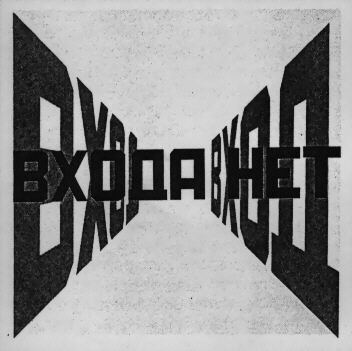
Barriers and Gates - the text reads:
Vkhod - Vkhoda net - Vkhod
Entrance - No entry - Entrance
Artist: E. Bulatov (AYa, 1979: 32)
My story is thus not really tied to any specific place, any more than Tarkovsky's film. It is a story of a Texture, Limbo, and a Texture is not a place, but a medium out of which places (Centers) congeal. We may find spots, which strongly evoke it, physical localities, imprints, which are paradigmatic of it. But Limbo itself is an all-pervading state of mind and society - a state of "unmediated polarization" (Chapter 2, Part A) - abrupt transitions (Barriers) and sneaky ways around them - "absolutist" insistence bordering on the paranoid, or delicate "animistic" sensitivity to its Unknowable "traps" (Chapter 3, Part C). It is freedom or bondage, but above all, it is unavoidable. Every day you are forced to cross areas of insecurity on the way from one Island to another. More fundamentally still: the Barriers you erect in self-defense are constantly undermined - by yourself. So the safe field is far from safe, and you learn to move with caution. Coming home from work you tread carefully, but as fast as possible, avoiding open manholes (common in Leningrad), falling rafters and unnecessary exposure of your opinions. For Limbo's essential quality is the unpredictability with which it is encountered. It may materialize anywhere - on the personal or state level, in politics and economy, family life or religion. So you keep to the Path, as the fur-capped workers in my story...
The Path is a track through Limbo. The Stalker follows cautious, roundabout ways. He casts a strip of gauze tied to a rock ahead of him, carefully sensing where it's safe today (he's moving through a landscape which is "constantly changing"). Then he motions his followers to proceed to the rock, bringing up the rear himself. In this circuitous manner they cover a hundred yards in a day. Any step to the side is perilous, we are told, and although we never see the danger, we sense it. A real Path is a seemingly unorganized, random result of collective experience. It is a tenuous thread stretched out between Islands, as rigidly and insistently hedged off from Limbo as they - and as constantly threatened. If you stick to it you may avoid uncomfortable incidents, but one step outside and no one knows what will become of you. The Path is for all of us who are hurrying home from work, who do not care to take chances. The Stalker makes his own Path, bites back fear and faces the challenge of the zona. He realizes that Limbo may be exploited, though he does so, like Vitya, tongue in cheek. His is a dangerous business and people look at him askance, but it is exhilarating as long as all goes well (and if it does, he may be sure everyone will be following him in a few years - though by then of course, he will have moved on). But for the rest of us, the established Path leads from one Island of relative security to the next. It is businesslike, never meanders without reason, makes no scenic detours. We reach our destination, close the door, erect our flimsy Barriers, and let zona be zona... till tomorrow.
|
An unofficial accommodation market at the
Bridge of Lions in March 1978. Note the tree trunks plastered with requests for
housing. People came together here once or twice a week to work out exchanges
and sales. |
The idea of impending doom had no place in their minds. Doom had been creeping up on them too slowly and had started moving closer too long
ago... They were unwilling and unable to draw conclusions, or even to think about the world outside their little village. There was the village, and there was the forest. The forest was stronger, but then the forest had always been and would always be stronger. So what's all this talk about doom, anyway? What do you mean, doom? That's just life...
(Arkady and Boris Strugatsky 1972)
The factory described above is prototypical of the Soviet Union as I have learned to know it. Seemingly, this is a society dominated by a "totalitarian" bureaucracy pursuing familiar goals of economic centralization and political control. But in fact, each institution, each group, even the state itself, is a self-defensive Center, an Island inhabited by people who simultaneously insist on its Barriers and controvert them. Soviet society is an archipelago of Islands rising from the sea of Limbo, and constantly threatened or even submerged by its unpredictable tides and gales. This is the external institutional framework40 through which people move in daily life, and to which they must be willing to adapt to survive. In this and the next chapter I shall examine the consequences of this situation (its causes are discussed in Chapter Four). It is essential to understand how people adapt, what ethic they adopt as a response to a life on and among the Islands. This ethic is self-defensive, but volatile, for Islands are not only refuges from the war between Culture and Nature, Europe and Asia, prospekty and dvory. They are also "home bases" from which the "soldiers" of this war issue forth.
I have characterized the Texture of Soviet society as Deep and Open. It contains vast differentials of power, but few intermediate levels and little overlapping of rules. General and specific rules are separated by an extensive sphere of contention, insecurity, and potential change: by a power vacuum that various groups may step into and seek to restrain, control or make use of, but which they never succeed in dominating other than on a strictly local and temporary basis.41 What power governs is thus divorced from power itself. This is a Texture of unmediated polarization. I have furthermore compared general rules to an "infrastructure", a network of "channels" ordering overarching flow. When influx into this network from below is irregular and unpredictable, the infrastructure is eroded and reduced to a shadow. Power exists in order to extract flow from lower levels and divert it into overarching, integrative circuits of flow. When it is divorced from its object, extraction is disrupted. Overarching flow is no longer regularly "fed" from below, it tends to "dry out", and the general rules governing it become "weak", "unreal", in constant danger of flickering "off" (for a rule that is not obeyed is no longer a rule). From the state's point of view, the situation is highly unstable. The state attempts to govern flow, but succeeds poorly. Power is highly inefficient.
This has repercussions throughout the Soviet economy. Most obviously, the infrastructure, as a purely physical means of moving resources, people, and information from place to place, is grossly inadequate. There are too few roads, railways, telephone lines to "cover" the vastness of the Soviet Union. Railways, handling 55.6% of all freight (Hunter & Kaple 1982, p.232) are unable to fulfill the needs of industry and factories stop production because there are too few railroad cars to empty the bursting warehouses (LP: 15/2-83). Shifting to more flexible truck transport has proved difficult because of the lack of roads. In face of an 85% increase in the number of trucks (1965-80) and a more than sixfold increase of passenger automobiles, the length of hard-surfaced roads has only doubled, and the total extent of the road network has even decreased slightly (Hunter & Kaple 1982, p.226).
In part, these problems may be accounted for by the uneven distribution of population and resources, due to which the sheer cost of transport is exorbitant: In the 30's, when coal mined in the Ukraine was used to smelt iron from the Urals, one third of it was consumed by the carrier trains (AP: 22/5-84). The crux of the matter, however, is not lack of infrastructure, but wastage. When general rules are "weak", the infrastructure "leaks", and flow escapes in transit: 25% of coal, mineral fertilizers and other powdery goods simply blow away on the road, thanks to inadequate methods of handling and loading (AP: 23/5-84, Posev: 84/9:9). A Soviet commission found that direct losses due to low quality storage, transport, and packing amounted to 20% of grain produced, 20% of fruit and vegetables, and one third of potatoes (Malish 1982:49). Similar inefficiencies hamper production: A documentary film produced in Estonia in the early 80's estimated that for every 5-6 agricultural machines delivered, one might be assembled that was in working condition: 613,000 tractors and 189,000 combines were produced during the last two years of the 8th Five Year Plan. But the actual number of serviceable vehicles delivered during the whole 5 years was only 394,300 and 103,000 respectively (Staroverov 1976, p.21). The kolkhozy in the film were forced to keep up elaborate repair shops, and experts interviewed estimated that if the labor from these shops could be freed for agricultural production, output of grain might increase by 25-30 million tons per year only in the North-Western Soviet Union. (Total Soviet output was 190 million tons in 1983.)
But to understand the true dimensions of these problems we must keep in mind that an infrastructure consists of rules, which are not mere physical equipment. It is imprinted in material structures, e.g. in roads and machines, but in a more general sense it comprises all the means by which power and coordination are maintained throughout society: the weakness of general rules thus effects meaning as well as things. It is often assumed that state control is to blame for the lack of free information in the Soviet Union, and certainly, this must not be overlooked. But "censorship" is not always politically motivated:
"[The chief of Melodiya explained] that it is not only censorship that makes it difficult to get hold of good records. Nearly half of Melodiya's recording equipment is more than 20 years old, and an antiquated order system hinders mass production of popular records..." (Inf: 24/1-86)
In a wider perspective, lack of information weakens the apparatus of control itself, impedes culture and science,42 hampers governmental agencies and planners: Enterprises, badly pressed for time and resources, have little opportunity to conduct marketing surveys or research consumers' needs. Even were this not so, economic planning - emphasizing quantity at the expense of quality - provides few incentives for such work. A railroad official complains that trains haul millions of tons of freight over short distances. Trucks could do it at lower cost, but truckers are paid per ton-kilometer, and are unwilling to take short-distance jobs (Hunter & Kaple 1982, p.230). By the same call, coordination between enterprises is impeded: Pipelines for natural gas (produced by one organization) are finished before compressors (produced by another), and as much as two full years may pass before the pipeline operates at full capacity (Hewett 1982, p.400).
I shall thus argue that the prime factor in understanding the "totalitarian" Soviet system is the weakness and unpredictability, rather than the consistent, mechanistic tyranny, of general rules. These rules are imprinted in roads, railways, machines, in telephones, the media, sociological and statistical surveys. But such resources can only be used and serviced effectively if the people operating them have acquired the necessary knowledge, discipline and skills. This in its turn presupposes the existence of an emotional and symbolic order, in the light of which such qualities may be interpreted as valuable. Only at this point does the full impact of the weakness of general rules become clear. Despite impressive advances since the Revolution (Graph 1, Graph 6), education levels remain low in many fields: While the number of tractors and combines in agriculture increased 4.1 times between 1950 and 1970, the number of qualified drivers increased by only 2.1 (Staroverov 1976). This is not merely a matter of education, however, but reflects the more basic fact that the infrastructure lacks a basis in morality and values: Workers steal and drink at work or shirk it altogether. Hardly a day goes by without complaints in the press on this account, and common people often voice the same views (when not bragging about their own exploits). Three quarters of those convicted for theft in Rostov-na-Donu had stolen at work (Udgaard 1977, p.99). On the average, each Soviet citizen consumes the equivalent of 4 liters of pure alcohol annually, not counting moonshine (Kerblay 1977, p.291), nor the fact that consumption in parts of the Muslim South is comparatively low - as it is among women. Shirking was common and accepted among many of my informants. After all, why should work time be respected, when inefficiencies lead to such inordinate waste of time in other respects? 37 billion hours are wasted yearly in queues (FØ: 84/3).43
The connection between such practices and the weak physical infrastructure is obvious: For the average consumer of the Soviet North, these conditions result in an almost universal shortage (deficit) of the most elementary necessities of life (in the South, for reasons we shall return to in Chapter Four (Part D), shortages are often not apparent in the same way). Examples could be drawn from any area, but I shall limit myself to complaints most often voiced by my informants: housing, food, services and "cultural goods" (books, amusements, etc.).
The housing problem is inordinate all over the Soviet Union, but particularly in war-ravaged Leningrad. In 1964, 55.6% of the city's population lived in a single room, most often sharing amenities (kitchen, bath) with several other families (kommunal'nye kvartiry or kommunalki), another 6.4% lived in dormitories (Kerblay 1977, p.62). Among my informants, 46.2% lived in various communal-type apartments, so it is evident that the problem is still serious. One young man told me about a family of five households crammed together in one apartment, which had queued several years for a place in a housing co-op. When at last one household could move, the other 4 were struck from the top of the list and had to start the process all over again. A woman in her 40's, living with her divorced husband and two handicapped children, was number 3500 in a housing queue, and was told (in 1983) that she had 4 years of waiting ahead of her.44 Fancy apartment exchanges are the subject of endless debate and untiring endeavor, thousands of classified adds, and special street corner "accommodation-markets" (split up by the police periodically), where the needy meet to work out complex deals, sometimes involving half a dozen parties.
Food shortages have been a scourge for generations. True, the famines of the 20's, 30's and 40's will hopefully never recur and the late 50's are remembered as a period of plenty, though conditions were bad enough in the countryside. But the late 70's and 80's brought new tribulations. By 1983, elementary necessities that had been easy to get hold of in Leningrad five years before, were often unobtainable in regular stores except early in the morning, and from the Northern countryside and lesser Russian cities, reports of rationing were becoming commonplace (Posev: 82/11:6-7; 83/2:12-3; 83/11:9).45
The service sector (obsluzhivanie) may be the greatest single cause of discontent, and service personnel are the butt of endless jokes, temper tantrums, and complaints in the press (LP:27/2-83, 16/3-83, 26/6-83b). Understaffed village schools and club houses (Staroverov 1976), hospitals where nursing and cleaning are carried out by patients' relatives or not at all, non-existent stores in areas of new housing, mile-long waiting lists for household repair jobs, baffling bureaucracy and paperwork, are among the more obvious inadequacies. Lack of daycare centers and convalescent hospitals of acceptable quality, niggardly pensions and social security payments, impractical or expensive household equipment, add to the problems of the young, the elderly, and (because she ends up caring for both) the housewife.
More subtle, but perhaps of greater ultimate importance, are shortages in the somewhat indefinite area Russians call kul'tura ("culture"). Some aspects are obvious: lack of books, theater tickets, discotheques and modern art exhibits. But when an old woman gazes at a photograph from Paris, showing street vendors selling glistening fruit and vegetables and exclaims: "Kak tam kul'turno!" - "How cultured it is there!", we sense that the real problem may be a shortage of beauty:
"More than anything I have been enraptured by the work of Alla Pugacheva," writes a woman to Leningradskaya Pravda. "When I hear her sing it seems to me that she knows all my worries, all my heartache and sorrow, all my soul. I was so happy to hear she was coming to Leningrad, how I dreamt of being at her concert! I got my name on all the lists, but still didn't get a ticket. Black marketeers were selling them at prices, which I cannot afford. I am crushed. In the deep of my soul I no longer know what to live for." (LP: 4/8-83)
So again we arrive at the question of values. Clearly, shortages have direct impact on people's work morale and state of mind. But on another level their effect is neither immediate nor simple. Living standards, though lower than ten years ago, are higher than in most Soviet (not to speak of Russian) history. Thus, people complain, but perhaps their most fundamental complaint is not the lack of material security, but of something - an "Idea" - "to live for".
Western critics often take a simplistic view of these problems: Communism, we are told, leads to centralization, centralization to shortages and shortages to disillusionment and apathy. If Communism were abandoned, control would be relaxed, the free market would dictate supply and demand, efficiency and morale rise high. I shall argue that the basic conditions for a market economy are absent in the Soviet Union.46 Instead, economic solutions of another kind are sought, both by common people and the state. I do not deny that suppression of the market is also a political choice. It might be said that once this choice is made, the system tends to perpetuate itself, producing conditions such as those described below, which preclude the introduction of the market - i.e. the political choice is primary, shortages follow from it. Though I agree with this view in principle, I believe (as I explain in Chapter 4, Part A) that the "choice" was made under historical circumstances of extreme external pressure, which effectively precluded any other option. Moreover I shall argue that without external pressure, even conditions where the market might be a conceivable option (as today [in 1986]) would not have arisen. The following discussion thus has an implicit historical dimension, which will be explicitly treated later in the text.
A major consequence of the prevailing shortages is the weakness of money in the Soviet economy. There are countless things that money cannot buy - simply because they are too scarce.
A black marketeer in his early 40's told about a girl who had "made a great deal", by exchanging a 13m2 room in a kommunalka for a 25m2 room. This was only possible, he emphasized, because she traded with a drunkard in desperate need of cash. She paid 50 rubles per extra square meter (600 rubles - quite a sum, when you earn 100-150 a month). Still he was the fool and the loser in the deal. No money could pay for extra living space.
The same informant also told me that he and his friends had planned to buy a house[!] outside the city. They thought the woman who had bought it (for 4000 rubles a few years ago) might be talked into selling it for 8000 rubles (illegal money of course). The only reason why she might have sold (she didn't in the end), was that she was a pensioner, and the kolkhoz that owned the ground on which the house stood would not permit her to live there, since she was unable to work on the farm. Money cannot replace the loss of a farm hand, so great is the labor shortage. This is even reflected in the law - she could not move if she did not find work at the place she was moving to.
The weakness of money and insecurity of private property are indicative of the differences between the Soviet economy and a free market. Hernes describes an "ideal market" in the following way:
"When everyone does what is most profitable for himself, commodities are produced in the most appropriate way, and marketed at the lowest possible price. Thus each furthers the interests of society, led by an invisible hand to achieve a goal he in no way intends... In this system specialization is profitable, the expectation of gain an incentive to effort and inventiveness. The prices give the necessary information when it is needed and the market automatically takes care of coordination - the system is self-regulating." (Hernes 1978, p.21-22)
In this model, the idiosyncratic choices of individual actors aggregate into a "rational and progressive" whole because each consistently maximizes his own profit. This is the same as to say that general rules arise from the greatest possible autonomy on lower levels, which is a clear contradiction in terms, since general rules are rules of power and cannot exist at all if they do not limit lower-level autonomy and extract flow. Still, the model may be salvaged by adding two premises: First, the choices of "free actors" are in fact constrained in important ways. Second, the model is valid only under the unique circumstances of plenty that prevailed during a limited period of Western history.
The first point was realized already by Weber: The market is not anarchic, but "...a regulated economic life with the economic impulse functioning within bounds." (1923, p.45, my emphases). Michel Foucault (1975) points out that the advent of capitalism presupposed increasingly subtle methods of controlling the population: Public shaming of delinquents was supplanted by internalized discipline imposed through schooling, religious morality, the intimate ethic of the nuclear family and the regulated time schedule of the work process itself (see also Weber 1927; Berger et al. 1973; Habermas 1962; Löfgren 1979). Discipline was thus a condition for the market. "Free choice" aggregates into an ordered whole if, and only if, power has become self-imposed on the part of actors. The market presupposes an infrastructure of values, and money is the physical medium in which these values are expressed. Only when money is accepted as a general rule, a universal medium of exchange, is it capable of distributing information through the economy by the mechanisms of price formation. Prices are agents of power, compelling actors to conform to the market's rules: The system is "self-regulating" because a powerful, historically established general rule constrains free choice.
Secondly, it is clear that actors will not maximize profit if there is not a realistic chance of achieving it.47 The market presupposes predictability. One must be able to plan ahead, lay up stocks, invest, take risks - all of which is impossible without an adequate and regular supply of resources. General rules must therefore not only be internalized as values, but their status must be more or less stable. Money must be a predictable measure: one must know what one can buy for it. Remarking on this, Birman (1980, see also Kornai 1980) contrasts Western economies of surplus with the Soviet economy of shortages.48 He estimates that 200 billion rubles were bound up in private savings accounts in 1980: more than three times the value of the total stock of goods in both trade and industry.49 There are simply not enough goods to buy - so the real value of money fluctuates dramatically, according to whether or not one has access to scarce resources. Wages therefore become a poor work incentive (Birman 1983, p.70-71). As one participant in the Soviet "second economy" put it: "You don't work to make money, but to avoid becoming a criminal." (Unemployment without good reason is illegal.) In an economy of shortages, profit seeking is not always profitable. Supply is too inconstant to induce predictable choice.
Both Depth and Density, powerful and stable values, are thus premises of the market model, and since Soviet society is Deep but not Dense, the model has no application there.50 In an unmediated hierarchy, general rules cannot rely on being "filled" by flow from below. The "economic impulse" does not function "within bounds", and can produce no stable aggregate. People simply do not think in terms of profit and loss: In the Capitalist West, if you want to live cheaply you hunt for "bargains". The shopper asks, "Where is it cheapest?" The producer does his best to "create a need" for his wares. In the Soviet Union, bargains are rare and unimportant for living standards. "How did you get it? (Kak dostal?)" is the question, and the answer will refer you not to the price of the item, but to some person, a "contact" or "acquaintance" with direct access. "Getting things" may mean paying more than in official stores, but oftener one is expected to do or "get" something in exchange - something else that "money can't buy". Similarly, a producer does not worry about how to sell his wares, but about keeping his factory staffed and procuring raw materials. The latter is the job of the tolkach, or "pusher",
"...a breed of unofficial supply agent, whose job is to agitate, nag, beg, borrow, sometimes bribe, so that the necessary materials, components and equipment arrive." (Nove 1977, p.103-4)
The tolkach "sells" a need, not a product...
For this reason, the "things" obtained or longed for tend to shed many of the attributes of "plain objects" that Western Capitalism attaches to them, and acquire instead an aura of privileged access, status, successful sociability and deserved trust.51 Their true value cannot be expressed in money, but springs from the situation in which they were "acquired". When a flamboyant young musician bragged to me about the cheap shirt he had bought, the price seemed a secondary matter. More important was the fact that he knew the woman who sold it and was taken by her past other customers into the back room.
The market model is thus an inadequate instrument for understanding or criticizing Soviet economy, because the values on which it is based are absent. To build a more applicable concept we must explore the Deep and Open Texture of Limbo in detail:
In all Deep Textures, general and specific rules are polarized, but in "the West", polarization is to a very great extent mediated: The "gap" between general and specific rules is more Densely packed with intervening levels than is case e.g. in the Soviet Texture.52 Each level consists of a multitude of overlapping rules, some of which overlap with the rules of other levels as well. Levels of integration therefore cannot easily be separated from each other, the hierarchy as a whole is flexible, flow slips from level to level by gradual, almost unnoticeable stages. A person climbing through such a hierarchy (stepping from a private to a public context or pursuing a career) advances smoothly, as long as he conforms to legitimate, mainstream procedures, and encounters few abrupt or unforeseen reverses. The Texture is - from the point of view of a well-adjusted, mainstream, middle-class actor - "vertically transparent". Furthermore, since the hierarchy is very Dense, a multitude of mid-range institutions congeal out of it, and their stability and flexibility is great. Though often highly specialized, they have overlapping functions and areas of interest - one may attain many of the same goals and "serve society" in many of the same ways in such diverse roles as that of a member of a Church and an entrepreneur in business. The system's flexibility is further indicated by the fact that today one may also do so as a punk rocker or a transvestite. Communication between institutions is therefore relatively easy. Thus, the hierarchy is "transparent" horizontally as well. This is what economists refer to as "horizontal integration".
Soviet Texture is polarized but, to a very great extent, unmediated. There are few intermediate levels, few overlapping rules, and climbing through the hierarchy is hazardous and fraught with uncertainty. Mid-range institutions (often referred to as Civil Society) are few and far between. Differences between "inside" and "outside", intimate and public contexts, "people" and "state", are great and obvious. Society is fragmented into Islands. In the West, "Centers" (as defined in Chapter One) tend to congeal within areas of pre-existing Density. In the Soviet Union, they must compensate for the prevailing lack of Density, closing out Openness in self-defense. People do this in personal life. But all institutions function in the same general way. In fact, the Island may serve us as a model for the formation of any Center - institution, role, concept or symbol - in the Soviet Union. Thus, Soviet Texture lacks the transparency that is typical of the West: Horizontal communication "across Barriers" is as difficult and dangerous as "climbing" vertically. Since the state nevertheless forces its way down through a vacuum to control and "plan" flow on lower (local, intimate) levels, economists refer to this as "vertical integration" or a "command economy" - misleading terms, as we shall see.
The stable power of money in the market is a reflection of the "transparency" of mediated hierarchies. Sectors and institutions are compatible, and in most of them money is a legitimate standard of value. Money brings a diverse reality into a single mold, forcing us to accept that "we are all equal", because we are all "comparable". In an unmediated hierarchy, Islands impede flow between institutions and fragment the legitimacy of general rules. In place of a single medium of exchange, multiple currencies arise, legitimate only within a single type of Island. Money is often necessary, but it is a hard fate indeed to depend on it alone. One informant told me about a film where the following curse is uttered: "Chtob tebe zhit' na odnu zarplatu!" - "I hope you'll have to live off nothing but your salary!" The joke is not merely (or mainly) a comment on poverty, which is widespread. The point is that there are other media of exchange besides money, which are often as important for a person's wellbeing and even survival. One of my religiously inclined friends made do - spartanly, but by no means in destitution - on 40 rubles a month, thanks to his many close friends and an uncommonly lucky housing arrangement.
Situations where money is not a universal medium of exchange abound in anthropology. Primitive economies are often arranged in "spheres" (Bohannan 1959, Barth 1967) reserved for specific categories of goods. Soviet "spheres" have a very different nature. First, they are subordinate to general rules, as primitive spheres are not. They are "inserted" at different levels in the Textural hierarchy, and monopolized by Islands with different power and privilege. "Our money is three-storied", Father Peter said, quoting the satirists I'lf and Petrov. Secondly, spheres regulate access to resources, not, as in primitive societies, prestige: Economic inefficiency results in highly variable quality of goods produced by different factories - or even by the same one under different circumstances. High quality goods are siphoned off to high-level spheres - so though currencies may seem to buy the same product, real differences may be great:
At a factory where Andrey once worked, controllers suddenly arrived to supervise production of a small quantity of the factory's standard produce. Excellent and abundant raw materials were for once provided, control was meticulous and thorough, stealing (usually commonplace) not to be attempted. Later they left, taking their goods along, and things returned to normal.
The hierarchy of spheres is complex and in many cases unofficial, and I shall limit myself to its more conspicuous elements. At its lower end, where scarcity is greatest, money loses its function altogether. The wage system on collective farms is a case in point. Until recently, salaries were awarded according to a "work-day" (trudoden') system, which made the amount of money in the countryside highly variable, but always extremely low, since the value of a trudoden' fluctuated dramatically from farm to farm and from season to season. As late as in 1963-4, the average wage of a kolkhoznik was about 30% of an industrial worker's, and only part was paid in money: The average trudoden' was worth 0.3 rubles plus 1.5 kg. of grain, and in some cases no money was paid at all (Nove 1977, p.218).53 Only in 1966 was a (low) guaranteed monthly wage introduced (Nove 1977, p.30; Dunn 1967, p.69). A system close to serfdom reigned. The state freely requisitioned the produce of public land. Peasants kept alive on meager, privately tilled plots, working overtime to produce the food they themselves ate by pure subsistence farming.54 Salaries have since been raised, the requisitioning system changed, internal passports issued to peasants (since 1981!) (Dunn 1967, p.44; Kerblay 1977, pp.90, 94). But when problems threaten the economy, as in latter years, the old system reasserts itself:
Once, while traveling, Borya had spoken to a peasant woman who said that in her village shops no longer sold industrial products (e.g. textiles) for money at all, but bartered for potatoes, vegetables etc. She complained that prices were high - a ton of potatoes bought produce worth 100 rubles.
In cities, where supplies may be meager enough, workers buy high quality foodstuffs at special factory stores, where outsiders are not admitted; other stores sell packages of goods at a higher price - three "scrap" items and one "scarcity"; "co-ops" import goods directly from the countryside and sell them at several times the usual price; peasants sell private produce to city dwellers at markets, where prices are high, but goods obtainable and often of superior quality.55 Higher in the hierarchy are stores and institutions catering to party workers, tourists, sailors returning with hard currency from abroad, diplomats, etc. Each has its own currency: Tourists use foreign money and there are several types of "certificate rubles" for the exclusive use of certain groups.
All the spheres I have so far described are established by the state and protected by formal regulations and laws. But where there are Barriers, there are also Gates. Spheres are circumvented and the "value gap" between currencies exploited. Alongside the formal system of spheres, an informal "Second Economy" flourishes. As we shall see, my friend Vitya made use of the gap in accessibility of resources between city and countryside. Regional differences are exploited by traders from the South selling fruit and vegetables to the hungry North. In cities where foreigners come, fartsovshchiki buy Western clothes to sell to Russians or acquire hard currency and buy items in berezki ("dollar shops"). Workers smuggle goods out of their factories for sale. But these are just some of the most obvious aspects of a virtually limitless domain of enterprise, ranging from gifts and mutual help among friends, to various quasi-legal services, to organized periodical markets for barter and/or sale (as the housing market mentioned above), to petty production, to - in the end - organized criminality and corruption. Some of these activities have congealed rather firmly as Centers: they are more or less consistently segregated and function informally as spheres. But as in the case of formal spheres, there are always Gates leading out from them, Paths connecting them:
I went to visit Seryozha (a former musician whom we will encounter again below), who decided to buy me some of the best Armenian portveyn. At the local store there was hardly any wine at all. So he took me to the meat counter and asked to see his friend Volodya. After a hurried conversation, Volodya escorted us to the cellar, where he spoke to the woman responsible for wines. In a back room she located several crates of the famous wine and sold us 4 bottles at half price. "That's how everything is here," Seryozha explained triumphantly on our way home. "Volodya's a butcher, and gets wine from her in return for meat." "And you give him records?" I asked (at the time he worked in a music store). "Well, once in a while I bring him an LP. But Volodya's a friend and a good guy. He won't object if he gets nothing in return."
Seryozha used the word priyatel' (friend or acquaintance), rather than the more serious and definite drug (friend) or the more distant znakomy (acquaintance). The word expresses his relationship to Volodya perfectly: not a friend "of the heart", as he claimed I was, nor a mere useful "contact". The transaction was a complex mixture of both, in constant danger of becoming one or another. It cannot be referred to a specific sphere. It hangs in Limbo, in between, where there are no clear boundaries.
A striking characteristic of Soviet spheres is that they permeate and overflow into each other. They are themselves Islands, and people try hard to keep them separate, but also constantly undermine their Barriers. Individuals may have definite ideas about how far na levo ("to the left") it is "moral" to go, but they often go further in practice than their principles admit. At least 55% of my informants aged under 45 years had to my (incomplete) knowledge taken more or less active part in various legal or illegal "deals". "Deals" are simply a necessity - for individuals as well as the economy as a whole. For this reason, the law is very vague in this area. Vitya complained that it was virtually impossible to know ahead of time if some biznis of his was legal or not. Bukovsky similarly recounts how he had to fight to be given a copy of the code of laws while in a large Moscow jail. It turned out that there was only one edition available in the whole establishment, belonging to the chief of police. This he was permitted to see as a personal favor (1978, p. 310). The vagueness of laws (rules) is directly related to the difficulty of gaining insight into them: like goods, they are "scarce".
One cannot stick to one's Island; it is too narrow and isolated. This is the main reason why the Second economy is not a capitalist market in embryo. It is neither regulated nor legitimate. Weber's economic impulse functions "out of bounds", and cannot generate an ordered aggregate.
Thus, under conditions of great and enduring scarcity, respect for "the rules" is minimal, because there is nothing positive to be gained from conforming to them (vs. the negative advantage of avoiding sanctions). Money, the carrot enticing the capitalist donkey to action, has limited value. The ideal is not to maximize profit, to "work one's way up" along the accepted ladder, but to "position oneself" strategically so the haphazard tide of goods, privilege and value somehow flows to you. It is not the job itself, nor the prospects of promotion that attracts workers, but "fringe benefits": access to privileged spheres. A janitor in the "right" place (a hotel for foreign tourists) may be better off than a manager in the "wrong" place. The reason is simply that you never know what tomorrow will bring. Planning is absurd where society is unpredictable - one of the more striking paradoxes of a state whose ideology presupposes that as much as possible be planned. The important thing is to find a "Place" - an Island - where Limbo's unpredictability can be kept at a minimum, and to keep your eyes open, grab opportunity as it flies by and hang on to it once you have found it. The "hunting", alert behavior of Tarkovsky's Stalker alternates with a paranoid fear of losing what you have. You either undermine Barriers or insist on them. The classical Western concept of the human being as an active initiator of productive processes is replaced by a more passive, waiting mentality.
Where to live and work is the fundamental question, and people are always on the move looking for a "Place" that is "better". As a result, the Soviet Union has an extremely high rate of mobility. True, compared to a country like the United States, it may not seem great. 23% of the US population changes address each year, compared to a mere 6.7% of Russians - the most mobile group in the Union (Kerblay 1977, p.231). But moving is harder for Russians due to the housing shortage, and hence labor mobility is considerably higher (20% job turnover in industry)56 (Kerblay 1977, p.232). Furthermore, people seem unwilling or unable to "accept the general rules", to strive for goals that society values, which are necessary to its functioning. For this reason, and again probably in contrast to the (mainstream, middle-class) US, Soviet labor mobility is predominantly horizontal, not vertical. Indeed, promotion often entails more disadvantages than benefits. Here again, some positions of "responsibility" are regular sinecures, all privilege and no effort, but the typical Soviet manager is overworked and understaffed. He lacks manpower and resources. He is under constant tutelage of several hierarchies of superiors who decide which rules to follow and which goals to seek. Any failing, self-inflicted or not, ideological or economic, may lead to his downfall:
"Even the elite in the Soviet Union lacks the personal and social security that a solid and independent private economy can give, [not to speak of the security of predictable legal and administrative routines]. Privileges are dealt out, and may also be recalled - therefore one must always be careful with one's bosses, criticism is subdued, discussions become less open." (Udgaard 1977, p.92)
The manager must cling to what he has. But neither is this a rule to be counted on. His essential problem is precisely the lack of predictability, and for a Stalker-type mentality this has assets as well:
"The sheer quantity of [the manager's] obligations, many of which are incompatible, enables [him] to choose from among them and to concentrate on those criteria most likely to show off [his] management to its best advantage and thus further [his] promotion, or else those criteria most profitable to [his] personnel." (Kerblay 1977, p.183)
In management as well, then, the important thing is to find a "Place" and hold on to it - defend its Barriers and controvert them - not to actively "maximize" profit for its own sake. Indeed, too much diligence may get you in trouble, as Bukovsky's meetings with former businessmen in prison illustrate (1978, pp.187-205). Surprisingly often, people therefore do work we would consider "below them". Among my informants there were two reasons for this "deklassirovanie", as one woman bitterly called it. For most it was a preferred choice, but a smaller group (mostly intellectuals) had been banned from more prestigious work after conflicts with the authorities. In this chapter I shall limit myself to a discussion of the first group (examples of the second will be encountered later).
Consider Seryozha: In 10-15 years he has changed jobs at least 5-6 times. When I asked why he didn't work as an engineer (his profession), he said the work was stupid and the pay low. In his present job in a record store (which he has kept about 4 years) the pay is highly variable, depending on how sales go. At the time of my stay it was low, since few good records were produced and nobody wanted the bad ones. He considered quitting, but decided against it for two reasons. First, he is in obsluzhivanie (service, retailing), and can obtain many of the good things in life by exchanging deficitnye (scarce) records for other goods. Besides, the hours are flexible and he can take time off freely - because he is well liked and because he travels a lot, and it's hard to check if he's on the job. This means he can get to stores at times when most people are working, when queues are short and supply greatest. Finally, he and his girlfriend live in a suburb where he knows almost everyone, and through contacts (like Volodya) he can get things without money.
Seryozha's choice is typical, and other people I knew had similar stories. Faced with chronic shortages, he moves around in the archipelago till he happens upon an Island that has the benefits he needs. He entrenches himself behind its Barriers, but often shows no loyalty to its "official" goals. Thus, he undermines the Barriers on which he depends. Surveys conducted to discover workers' motives for changing jobs confirm this pattern: Some 30% of Leningrad workers gave reasons like great distance between residence and place of work, poor transport and inadequate social amenities. More than 20% complained about conditions specific to the place they worked (unhealthy, unpleasant, bad superiors, poor prospects of promotion) (Kerblay 1977, p.191-2).
"In a country in which the right to strike does not exist, but in which freedom to work is generally respected, the possibility of leaving one's job is often the only means whereby one can express an opinion on living or working conditions." (p.191)
Obviously, this kind of behavior cannot aggregate in the "rational and progressive" fashion of the market. The job is a resource to be "mined" for your personal benefit, not an institution through which you seek self-realization and serve society as a whole. For this reason, labor mobility (tekuchest'), is not an asset to the Soviet economy, but one of its most serious problems today. People flit from job to job because of shortages of goods, services and welfare specific to the situation they find themselves in. Thus they undermine their job by increasing the already rampant labor-shortages - which are a main reason for the problems they seek to escape. An important result is an intense competition for labor among factories, which "...may lead to sizable disparities in pay for a given level of qualification from one enterprise to the next in a single city, which means that everyone will apply for a job in the factory that pays the best wages" (Kerblay 1977, p.191) - or offers privileges of other kinds.
The best-known examples of such "fringe benefits" are the premii, bonuses paid for overfulfillment of production plans. Again, these might seem to be market-style wage raises - but in fact they illustrate the non-market character of Soviet economy perfectly. For the success or failure of an individual's efforts depend largely on factors outside his own, or even the enterprise's control - most obviously on deliveries of raw materials from subcontractors or central depots. Since these are subject to the overall economic shortages, workers may lose a substantial part of their income through no fault of their own. (Seryozha made 200 rubles a month when premii were at a height. Now this was reduced to 85 rubles.) Hence, bonuses are inefficient individual work incentives, and indeed, this is not what they are meant to be. True, they are awarded to individuals. But they are calculated on the basis of plan fulfillment by a collective of workers. Their object is to strengthen this collective, enhance loyalty to the enterprise and create an attractive work-"Place".
An enterprise will go to great lengths to secure a stable workforce, and monetary bonuses are perhaps the least important of all. A successful factory caters to all the needs of its workers, and attempts, as far as possible, to close them off from the surrounding scarcities, so they will have no cause to move.
Polina was responsible for workers' welfare at the power station supplying heat to most of Leningrad. This is a subsidiary of the Ministry of Electric Power, which has considerable means at its disposal, hence working conditions are very good. Most workers receive around 300 rubles a month (not counting premii). They live in high-quality 2-room (35m2) apartments, built and maintained by the power station, which are new, complete with modern amenities, and located close to the workplace. Rent is low (8 rubles a month, gas and electricity included). The plant has its own sauna with two swimming pools, a house by a lake in the country for weekend excursions and sells inexpensive vacation tickets (which are easy to get: many places they are only for the bosses).
Other amenities typically supplied are special stores (stoly zakazov), where workers can buy deficitnye consumer goods, hospitals for workers, schools for their children - to educate new workers (Udgaard 1977, p.55), daycare centers, large welfare budgets (ibid., p.83), facilities for household services and repairs (cleaners, barbershops, etc.) (LP: 16/3-83), parks and recreational areas kept by the factory (LP: 26/6-83c). Under Stalin, when shortages were at a height, many factories evidently had their own kolkhozy, producing food for workers. In some cases this "feudal" system has survived until today, particularly in Siberia, where supplies are hard to come by and workers hard to keep (Udgaard 1977, pp.73,81). In any case, many people prefer this system, with the added security it gives: An informant from Dagestan, for example, was angry at Khrushchev for "replacing it with money".
A good factory acts as a patron toward its workers, enclosing them on an autonomous, self-sufficient Island and making the welfare of each dependent on the cooperation of all. Workers' attitudes to such enterprises often remind one of a child's to a strong father. Letters to Leningradskaya Pravda from satisfied workers show that this is at least an ideal. One man writes how his whole family works in the same place, how proud they are of its achievements and how they deplore its failings (16/3-83). In recent efforts to heighten work morale, the government is clearly trying to exploit such attitudes. Emphasis is placed on the brigade (brigadny poryadok), a smallish group of people working together, signing a contract with the factory collectively, and collectively responsible for output and discipline (LP:12?/3-83). The brigada-project seems designed with the mixture of coercion and allowance for traditional preferences so typical of the Soviet Union. Vitya, a seasoned skeptic, was sure the coercive element predominated, and convinced that the goals could not be achieved. When asked what he thought would help the economy, he immediately answered that something must be done with peoples' daily lives (byt), especially housing. As long as construction is mainly in government hands, inefficiency will continue to slow it. Responsibility should be transferred to individual institutions and factories - vedomstva. His solution was, in principle, close to the state's - though of course less colored by the overriding emphasis on control.
When economists of such different orders as Vitya (with his tumultuous private biznis) and the planners of Gosplan can agree on principles in a matter like this, we are clearly dealing with economic constraints of a very general kind. But the solutions proposed are fraught with difficulties. Vedomstva are Islands and fragment society into a multitude of self-contained units, each seeking its own goals, independent of, and often in direct opposition to, society as a whole. For vedomstva do not compete in a Western sense, according to rules set up by a legal bureaucracy and reflected in the value of money, as in the market. They compete for a "Place", for security and predictability rather than productive change. Different vedomstva, which are in theory allotted specialized functions, instead prefer to take on as many functions as possible. This leads to overlapping, diffuse divisions of responsibility and unnecessary doubling of work. Thus, a lengthy article in Leningradskaya Pravda (11/8-83) complains that central consumer distribution agencies are hampered by the multitude of vedomstvo-controlled ones. Goods go from agency to agency before reaching the people they are meant for. On the way much is lost, spoiled or slowed to a near halt due to low quality vedomstvennye facilities and the quantity of paperwork along the way - not to speak of the wasted labor. The article advocates abandoning the present system for at unitary, centralized one.
But another, perhaps even more serious problem inherent in vedomstvennost' is the competition for labor, which increases horizontal mobility and labor shortages still further. This is most severely felt between city and countryside. Indeed, the cities themselves are a kind of Island. Their vedomstvo-like character has led to the siphoning off of people and resources from the Northern countryside to a point where crisis is imminent, with agricultural production stagnating in spite of enormous, but belated, investments (Nove 1977, pp.136-7). The state has always realized the dangers of this movement and sought to control it. Until recent years, peasants simply had no right to travel outside their village. Today this remnant of the Stalin era is abolished, but other restrictions remain, most importantly the propiska. This much-hated document certifies your right to live in a certain Place. If that place happens to be Gubdor, Dukhovshchina or somewhere similar, the propiska isn't worth the wood to burn it with (though even wood may be scarce enough in places like these). But if it is Leningrad or another big city, it is more valuable than anything money can buy. Obtaining such a propiska other than by birthright is difficult. An accepted method is marriage, and fictitious unions are fairly widespread.57 A more common way is to get a job in the city. This involves problems of its own: Lately, nearly all city jobs have been closed for rural applicants. But the urban labor shortage being what it is, people who are willing to put up with a lot of hassle often wrangle a job anyway. The main reason for this is the competition for labor among factories. According to one knowledgeable informant, many enterprises do systematic recruiting in the countryside. They promise young people a limitka (temporary propiska),58 and after five years, an apartment, though this is probably illegal. In a passionate defense of the countryside, the sociologist Staroverov attacks this practice, pointing out that labor shortages in cities may be eliminated by rationalization.
Rural exodus is common to all industrializing countries. But in the Soviet North, labor shortages are greater in the countryside than in the cities. In spite of this, the factories tend to win out in the competition for labor, since the city is a more attractive (and richer) "Place". This complicates the clear-cut picture of rural exodus. In cities, it is being there that attracts people, not better work or increased pay. They seek as fast as possible to get out of the low status jobs, which gained them their propiska. This particularly affects building industry, where turnover is 32% annually (Kerblay 1977, p.191). (Which slows down housing construction, and so on.) Next stop is often a factory - poor conditions but better pay. As migrants gain knowledge of city life, they shunt from job to job, the ultimate goal being obsluzhivanie (as in Seryozha's case), where there is little to do and plenty of opportunity for activities "on the left".59
Neither is urbanization clear-cut from the point of view of the countryside, which has its own vicious circle - as devastating as that of the cities: Universal scarcities lower productivity and increase labor shortages. This forces kolkhozy and sovkhozy to emphasize self-sufficiency and Island-like separation from the public sphere. The family plot contributes to this picture, as its dominant subsistence function allows for little surplus sale. A lot of resources and labor are used just to keep alive, so the quality of public production declines still further, leading to greater scarcity and so on. The obvious solution is to migrate. But the whole country is segregated into Islands, enclosed by more massive Barriers the more benefits they give. One cannot simply move to Leningrad. Rural migrants are "hunters", looking for the Place where the good life is and hoping to work themselves closer to its wellsprings. From a small village, one moves to a larger one, from there to a small town, and so on (cf. Table 9H). Staroverov calculates that at least 50% of the rural population of the Northwest migrated during 1963-7, leading to an 8% overall population decrease in the area. The detrimental effect is enhanced by the fact that the youngest and best qualified move, leaving old people, invalids, women, children and the uneducated to care for the crops. Besides, those who get "furthest" are the best qualified and most enterprising individuals, and these, as we have seen, often end up in town, in jobs where their qualifications find no application at all. 44% of migrating agricultural specialists change profession, and for other educated workers (tractor drivers and mechanics), the percentage is even higher: In the 1960's, 1.4 million agricultural specialists received diplomas of higher or intermediate level, while the number of specialists working on the land increased by only 195,000 (Staroverov 1976).
Thus, in Limbo the economic rationality is not to expand, but to contract, not to maximize value through aggressive transactions, but to seek out a sheltered Place and entrench oneself behind its Barriers. This is a society of Islands, which I have referred to variously as spheres, vedomstva, kolkhozy, cities. Two other examples will be treated later: geographic regions (Chapter 4, Part D), and the closed circles of family and friendship - the uzky krug (Chapter 3, Part A).
But this is also a society of Paths. People close themselves in (or are closed in by others) behind Barriers, but there is almost always a "way out". One works one's way from one Sphere to another, from countryside to city; vedomstva are dependent on tolkachi for securing resources, on recruiting agencies for keeping up the work force. Where there are Islands, there are Paths, and in every Barrier there is a Gate, though it may be hard to find and perilous to pass through. So one insists on Barriers and undermines them - and to survive one must try to find a "balance" between these two movements. But this "balancing act" is not merely the pastime of individuals seeking to better their own lot. It is found on every level of society, for it is essential to society's functioning.
What we have described above is the very opposite of "totalitarianism", as defined in the Introduction: a situation where "...the distinction between state and society ceases to exist; the state penetrates and politicizes all spheres of life". The Soviet state is not "inside", but "outside" people's lives. There is no continuity, no consistent and accessible way from your Island to the distant locus of power - for in a Texture of unmediated polarization society is fragmented. But it is in the interests of the state to counteract fragmentation and unify the base on which it rests. Society may lack both horizontal and vertical "transparency", but vertical transparency must be forced to ensure the state's survival.60 It must extract the means of its own existence by force, because it rests on a self-defensive, fragmented, and volatile base. In a market system, general rules are aggregated "from below" by the ordered profit maximization of individuals pursuing the "economic impulse within bounds". In the Soviet system, where "free competition" degenerates into anarchy because stable rules are lacking, general rules must be imposed "from above", by the state. As Gerschenkron (1970) points out: centralization is a substitute for the market. The function of a planned ("command") economy is to simulate the impersonal control of price formation by administrative means, since general rules are too weak and shortages too great for ordered aggregates to arise "from below":
"The norms laid down by the administration play the part performed by competition in a market economy... Whereas the capitalist enterprise operates [independently] within a price system that dictates its constraints through the mechanisms of the market..., its Soviet counterpart is part of an overall plan... A single decision-making center, the Gosplan, takes the place of a multitude of arbiters." (Kerblay 1977, p.179)
That centralism is in fact a result of shortages becomes clear when we realize that the Gosplan's main function is to allocate resources. This is precisely the role played by money in the West, though far more abstractly: The right to goods and resources is "gathered up" and "stored" within the medium of exchange, and "released" by its owner. In the Soviet Union, the coordinating role of money is taken over by the administration, which controls access to all resources. As Father Peter shrewdly saw:
"The reason why we have a planned economy in this country is not that we control production any better that way, but that we lack money... The economy consists of an endless number of hyper-complex interconnections, and money is a measure of the collective dynamic of this system. It mirrors the whole system exactly. But plans, which people consciously try to build to measure this dynamic, mirror nothing at all."
His conclusion is significant. The market is altogether too complex to be "simulated", in particular in a society where the basic conditions for its formation are absent. Furthermore, the state pursues this aim in the midst of Limbo. It is itself beleaguered by the dissolution it makes out to control. Hence it is itself an Island, and shares the paradoxical duality of other Islands we have reviewed: insisting on Barriers and undermining them. The state, however, is an Island of a different order than the rest. Its insistence and subversion affect the whole of society and increase its paradoxes still further. So to understand how the state affects Russians, we must seek its manifestations in everyday life, rather than in abstract ideas of oppression and ideological monopoly. This becomes clearly visible through an analysis of its methods of control. For as an Island of order in Limbo, the state is continually striving for two goals simultaneously: to coordinate society, and to retain its own Island of independence and privilege. Where lack of control is endemic, the control mechanisms themselves are paradoxical.
The state's control apparatus may be likened to a piercing, but very narrow beam of light attempting to survey a large, dark area. Two approaches are appropriate in such a case, and both are frequently employed: singling out high priority areas for selective, continuous control, leaving the rest of society to itself; or sweeping at random throughout society, hoping for an occasional, haphazard hit. The first method demands that power be heavily concentrated in strategic areas. These must be strictly defined and segregated from society at large (e.g. high-priority factories). But in this way, the control apparatus itself creates Islands, strengthening the very tendency towards fragmentation, which it set out to combat. This is all the more true since circumstances outside such areas degenerate to more or less complete anarchy. Thus, although the capabilities of the KGB are undoubtedly unlimited once applied, it is common to hear the complaint that petty theft and criminality are endemic and the police can do little about it. According to Vitya, who should know more about the subject than most (since his existence depends on it), the police in small towns and villages is badly understaffed.61 Serious crime (e.g. murder) is often not even reported. Even in Leningrad, he said, apartment burglaries are rarely cleared up. The absence of central control also increases the autonomy of local authorities - vedomstva. They risk little by misusing - or dis-using - their power. The second method, the "random sweep", is dependent on sweeps being sufficiently unpredictable and frequent to keep lawbreakers constantly alert. Controllers must be where they are not expected. But again, the drawbacks are obvious: The state tears down the Barriers that protect Islands, and creates an image of itself as irrational and untrustworthy. It was a common view among my informants that the leaders are "too far from the people": unable to control their own emissaries. I have often heard Stalin defended in these terms: he didn't know about the persecutions, his assistants fooled him. Indeed, the state is often described as helpless, leading a heroic but hopeless battle against overwhelming odds. Of course the opposite stance is also common: The state, in its "distance from the people", is an all-seeing, malignant power, and its capabilities are then certainly greatly exaggerated, as when one old friend (whom I considered a sensible person), explained that the Moscow police had installed microphones in all city telephones, which automatically channeled conversations from all city apartments to a central computer. When "subversive" expressions were repeated often enough, a red light would blink, and the phone would be put under manual surveillance.62
Thus, no matter which method one prefers, the result is insecurity in face of the state. By combating Limbo, the state's mechanisms of control reinforce many of Limbo's typical traits. Symbolically (in the imagery of ideologists as well as counter-ideologists), the state is either a helpless partisan of order in the midst of chaos, or itself the instigator of chaos - it erects Barriers and controverts them, just as the workers and enterprises described above. One of Vitya's stories illustrates this precisely:
Some years ago he had been to a minor Russian city outside of Moscow on "biznis". He was relaxing in the restaurant with his friends, when they were approached by a local gang led by a tough named Stas. Few minutes later the groups were fighting openly, and Vitya and his friends were badly beaten up. Soon the commotion got out of hand, and the band turned up the volume to maximum and called for the police through the speakers. When the police came they wanted to arrest Vitya's group, but while Vitya was trying to explain that they had been the ones attacked, he was knocked cold by a blow from a (highly illegal) knuckleduster. Now it was obvious even to the police that the others were the aggressors, and to utilize this advantage, one of Vitya's friends claimed that his denim jacket had been stolen by the other gang. This was a bad mistake.63 The police let the others off and escorted Vitya's friends to their hotel room to see if the jacket "had been forgotten there". In the room they proceeded to comb every thread of luggage, assuming (rightly) that their business in the city was illegal. Since they had been celebrating the completion of a deal that evening, however, nothing was found, and they were led off to the police station. There Vitya (who is well versed in the workings of bureaucracy) insisted that the proceedings be protocolled. This led to a long argument, after which they were at last taken to the chief of police, a decent type, who decided they might as well have the full story: Stas and his gang, he told them, had been the terror of the community for years. The police knew all about them, once in a while they arrested some minor member, but the leaders were inaccessible. In court they could always muster any number of witnesses who would testify to their innocence, and a less important follower would take responsibility for the crime. The followers would never object, for the leaders could easily incriminate them by recounting some earlier, more serious, and as yet undetected misdemeanor. There was nothing the police could or would do about Stas. But they offered to escort Vitya and his friends to a place frequented by the gang, and let them beat the daylights out of them without interfering. Vitya thought this was a trap and declined the offer.
Later he returned to this town and was told that Stas had been arrested. His gang had broken into a local Orthodox church and stolen "cult items" (silver, icons etc.), which they sold on the black market. But the church is not a local concern. It is not integrated in the administrative hierarchy, but only connected to it on the highest levels (the Patriarch owes the state allegiance, and only through him, the priests). The crime against the church was therefore turned over to higher levels of the police apparatus, perhaps even the KGB. On this level, control is efficient, and the gang was promptly rounded up and sentenced.64
The state, though a formidable force at times or in selected areas, is basically a weak controlling factor in Soviet society. This is indeed quite predictable, given the pervasive shortages of information and resources with which it has to contend. It is itself a victim of Limbo. The violence and randomness of its measures against those who somehow come into conflict with its interests only confirm this point. There is nothing rational in such sanctions, which ultimately defeat their own purposes.
The power of the state cannot be measured by its meanness and terrorism against a small group of non-violent and apolitical artists and intellectuals. More suggestive is the news of popular unrest, which infrequently filters through to the West. In recent years [i.e. in the early 1980's], workers have staged a number of isolated strikes around the country, demanding such luxuries as drinking water or better food supplies. In most cases, the state has rushed supplies to the spot, concentrating its energies to that end (as it can, when essential issues are at stake), fulfilling the workers' material demands, and imprisoning their leaders to avoid repeat performances (Posev: 7/80:6, 8/81, 11/81?, 11/82b:4; Udgaard 1977, p.82). Strikes are a real danger and must be avoided at all costs.65
Another indication of the state's capabilities is the number and quality of personnel at its disposal. In the West, much is made of size of the KGB and army. Such measures are inappropriate for two reasons. First, both army and KGB have a wider range of functions than similar organizations in the West. They are high-priority Islands and must defend their Barriers against Limbo. According to Western estimates, the KGB has a staff of some 500,000 (Smith 1976, p.553), but by no means all of these are occupied with terrorizing the population. Aside from the substantial number devoted to activities abroad and the 175,000 man force patrolling the borders (Udgaard 1977, p.30), we have noted the inefficiency of the regular police, for which the KGB must compensate in situations vital to the state.66 The army, with its 4.8 million personnel, has a similar role. 250,000 "soldiers" work on high priority construction sites (Udgaard 1977, p. 39). As a vedomstvo, the army maintains its own agricultural enterprises, railway transport, publishing companies and bookstores, film studios, construction companies, even builds its own highways in places (Udgaard 1977, p.39). And all of these activities demand extensive expenditures of labor power.
Secondly, neither institution is exempt from shortages and inefficiencies. As hawkish a critic as Barron admits that "...the KGB is bloated, overstaffed, overly centralized, overly bureaucratic, and frequently inefficient to a degree that would be intolerable in free nations." (1974, p.10). Less rhetorically, it is afflicted by internal Barriers hindering free interchange of information (p.101-102). If this symptom of vedomstvennost' is a problem within the KGB itself, it is all the more so between the various police-type agencies at work. Rivalry and conflict seriously hamper the enforcement of law (Topol' & Neznansky 1981), and reduce governmental efficiency. A sociologist investigating potential ethnic conflict in Dagestan, spent months trying to convince a librarian to admit him to local archives containing material vital to his thesis. In spite of his strictly confidential and centrally sponsored status, he never won through, but had to get the material through a friend. Rivalries between vedomstva are a likely explanation of instances like this. By defending their own Barriers, institutions undermine each other, and ultimately the state, which they were to support.
But the paranoid secrecy surrounding government agencies seems so dysfunctional, even self-destructive, that this line of thought is insufficient. During my stay in Leningrad, a spring poem was published in the journal Molodoy Leninec, about babbling brooks and birds' sweet singing. As it turned out, the first letters in each line were an acrostic spelling Khristos voskrese ("Christ has risen"), the traditional Russian Easter greeting. Evidently the editor was fired as a result. So, they said, was the director of the Hotel Leningrad, who permitted a single letter to go dead in the gigantic neon sign bearing the hotel's name. It now spelled: "Lenin gad", meaning "Lenin is a creep" (gad = "reptile"). Authority must be fragile indeed for an accident like this to cause such a commotion. What is striking about the Soviet state is therefore not so much its ability, as its need to control. Most conspicuous of all, for a person used to the rampant commercialization of the West, is the need - so evident in these examples - to control culture, to monopolize ideology.
This brings us to the essential question of legitimacy, which will be discussed in detail in the next chapters. We shall assume that the Soviet state is unable to exercise effective control over the mass of its people by force alone. In fact, as we have seen, by seeking to control Limbo directly, the state actually strengthens it and undermines its own power. Like all other Islands, the state cannot defend its Barriers without controverting them. There is only one escape from this deadlock: One must establish the state as a legitimate force, tie the population to it by voluntary loyalty, by implanting in them an ideology emphasizing the impersonal and universalistic needs of "society as a whole". The state's primary concern in its effort to "simulate the market" is thus not control itself, but the establishment of legitimacy on the state level, and stable values on the level of individual work discipline. In a fundamental sense, the state is engaged not so much in a search for power, as in a Quest for Meaning.
But society is fragmented into Islands. Meaning must therefore be established and controlled by the state - "from above". As we shall see in Chapter Four, the party's propaganda is, as it quite explicitly states, a vanguard gospel, a message pertaining not to the present as much as to the future, to the people not as it is, but as it may become. "Da zdravstvuet velikoe edinstvo partii s narodom!", proclaims a banner: "Long live the great unity of party and people!" This asserts that there will some day be rules that apply to all, that all will follow. It seeks - in the face of all odds - to unite an archipelago into a continent. Any threat to this aspiration must be sanctioned and persecuted - even a spring poem.

Celi partii - nashi celi
The Party's goals are our goals
(Newspaper headline)
Girls can't be serious. I come running in, I've got real little time. They say: 'Now sit down, and have a bite to eat'! I can't talk to women. They give me a headache immediately - it's a totally different way of thinking.
(Vitya)
When Vitya and I first met, he was a young, mildly rebellious student, who satisfied his curiosity by hanging out with the foreigners at my dorm. He had a practical bent, and engaged in a number of more or less illegal dealings. There was nothing sensational about any of it. He acquired a room of his own, where he reconstructed shabby, mostly worthless icons, which he resold at a profit of sorts. He dabbled in
fartsovka - dealing with jeans and foreign currency - like many others of his age and sex.
But even in those days his interest in the West was limited. He did not dress in Western clothes nor find Western pop music particularly attractive. With me, he seemed more interested in showing off his own world than reaping profit from association with mine. He took me to Easter Mass (he was a declared atheist) in the same spirit as he guided me to an illegal book market on a forsaken field south of the city. As one of his friends put it: "Vitya is a real Russian. He loves his country: Russia, that is, not the Soviet Union... Like me. Like all Russian people."
Vitya was not merely showing off. By taking me into his world, I sensed that he somehow gained perspective on it, saw it through my eyes. He did not often discuss my opinions, indeed, he must have thought me inexperienced and naive. He seemed to take note of my reactions and file them away in his orderly mind for future reference. He had a scientific leaning, and maybe it was just another kind of research for him. If so, it was "research" of a highly personal kind. Later in our acquaintance, he several times took me on extensive "tours of the city", picking his way along secret byways, talking to people, explaining to me, in his soft, rapid voice, how everything functioned, what it meant. Once he concluded with a sigh: "So you see what peculiarities we have here..."67
Another time we were still thirsty, after visiting half a dozen bars and restaurants, but everything was closed - except the railway station. We passed the gates of the pre-revolutionary building and entered the vast hall enclosing platforms and waiting rooms. I headed for a sign reading "Restaurant", but he grabbed my arm with a laugh: "No, no. We go over there where it says 'No admittance for unauthorized persons'." We slipped through the little door, followed a narrow, stinking, neon-lit hall with cash registers along the wall and a small window at one end. Vitya explained: "You see, here you can always get a drink..." Deep inside the window we made out a swelling, insufferably sour female face, surrounded by a waitress' uniform that had once been white. It squinted out at Vitya when he bent down. I only heard her answer: "No, there's nothing!" He returned - unsatisfied, but undaunted: "She wouldn't give us anything. Control has gotten stricter under Andropov. But let's see..." A waiter staggered down the hall, drunk, his face shapeless, clothes covered with grease stains. He leant heavily on his cash register while he punched the keys. Vitya approached him with a hint of a smile, but almost respectfully, as one closes in on some exotic, slightly dangerous, but well-known animal. They exchanged mumbled phrases. Then we drank his health in two overflowing milk glasses of portveyn Agdam - but agreed that it was sad to stand in the hallway. So we followed the corridors, through the kitchen, where steaming tubs of dishes hissed after us and the girls yapped at each other and watched the clock. At the other end was a bufet - nearly empty because they sold no wine. We hung out at one of the tall, crooked plasticine tables, glasses hidden under our jackets and a couple of buterbrody (sandwiches) between us. At the counter, a couple of young men were flirting with the local whores. "Do you see why I'm happy to live here, and would never consider emigrating to the West?" he said, with something close to triumph. In this instant I think I "saw" him - the precision of a hunter in the jungle, a dancer.
During my stay in 1978, Vitya broke with his girlfriend. I remember Tamara as a big-boned, slightly vulgar woman, and her reaction to his leaving her bears this out. She evidently accused him to the KGB of spying for the Americans. He was interrogated, the officer was "polite, not coarse at all", and the charges were dropped since nothing could be proven. It is probable, however, as Vitya thought, that "they" noted his name, and perhaps put him under limited surveillance.
Vitya did not reform. He and his friends were not averse to a party now and then, and for this purpose would visit restaurants in the modern hotels reserved mainly for foreigners. These have since been closed to Russians with no business there, but at the time he was doing nothing illegal. One summer day, however, the hotel guards arrested him, interrogated him, and let him go. Three months later the University received a letter accusing him of "annoying a foreigner" and "appearing in an intoxicated state in a public place" - both charges false according to Vitya. He was reprimanded and expelled from the University for life. He tried to complain, but was told it would only make matters worse.
It's hard to say if the incident could have been avoided. However, two traits of Vitya's personality emerge from it. Both, as we shall see in the next chapters, are very Russian, and both tend to get you in trouble: First, his craving for freedom, to lay all caution and pretense aside, no matter the risk. Second, his fatalism, his conviction that you can't fight authority once it has it in for you. Vitya is a Stalker. Circumventing the powers that be is as natural to him as breathing. Confronting them head on in formal battle seems fruitless and hazardous to the extreme. He is bound by the very Barriers he controverts.
Both qualities are reflected in his family situation. Vitya grew up as an only child with his mother and grandmother. His father died when he was still a child, and since his death, his mother has born the responsibility for the household alone. She was a slight, unsmiling woman, kind and conscientious, who went through life with lowered eyes and gritted teeth. She lived for her work but constantly complained about it. "Older people believe they have to work - to survive, and to get money," Vitya said. "My mother is a householder. She knows which stores have the things she needs, she conserves fruits and vegetables. It's hard to survive with that attitude." Once I asked her why she didn't stop working and get her full pension - a fair, if not spectacular amount. "Oh certainly, I could stop. But it's not profitable," was her response. Fatalism seemed the essence of her existence, and Vitya, who still lived at home, constantly argued with her about it. Once I watched the film The Red Snowball Tree (Kalina krasnaya) with the two of them. This masterpiece by Shukshin portrays the life of a criminal after finishing his sentence. It is frankly realistic. We see how society shuns him, how he fights to establish a normal life until his past catches up with him. The film is old, but had (in 1983) never before been shown on TV. Vitya's mother was shocked: "Just look at their faces. You can see they're criminals!" Vitya fired back that lots of them had done no more wrong than she. "Don't tell fairytales!" she replied. "It's very rare that someone goes to jail without deserving it... You talk as if there were no honest people in this country at all!"
Vitya, it seemed to me, rebelled against the cheerless drudgery of his home. He desired freedom, but like his mother, he was practically - rather than ideologically - oriented. Like all of my Russian acquaintances, he was a dreamer, but his dreams were not of spiritual achievements, but of mastery of the material, practical and social world.
The incident in the hotel changed Vitya's life irrevocably. For years he was persecuted and harassed by the police. He was imprisoned several times on minor charges. His efforts to find a job were sabotaged. But he continued his illegal activities, learning a lot, and developing an instinctive caution, which kept him out of major trouble. Then he was summoned to military service. This was a bad setback. He assumed that with his background he stood a good chance of spending two years in some particularly unsavory part of the army, from which, likely enough, he might never return. He swallowed every pill he could lay his hands on, went into a coma, and awoke in a psychiatric ward. He described this institution with a shudder. Dangerous psychotics and common alcoholics were crammed together at random in forty-bed rooms and sedated with sleeping medicines. He had the good fortune to be singled out as a well-balanced patient and a willing worker and thus escaped "treatment". After four-five months he was discharged with a handy slip of paper in his pocket certifying that his medical record made him unsuited for military service.
From this day, the police also seem to have lost interest in him. Years later, a (hopefully) last episode rounded off this period of his life. I met him next day, in an unusually elated mood. He had been to the police to get some document. By this time he had acquired an image and self-assurance, which made such an expedition a routine matter. In a neutral, grey suit and tie, with a neat briefcase in his hand, a faint odor of eau-de-cologne hanging round him and a slight paunch at his belt, he looked very much like the efficient biznismen he in fact was. The secretary politely directed him to the chief of police. The room was empty. He returned to the front office, but the secretary was gone. He made a quick decision, retraced his steps. In the Chief's room he found an unlocked cabinet, located his own file, removed all incriminating papers, and left. To his chagrin there was nothing about Tamara's spy-report - he surmised that it must be in a central archive - hopefully well out of harm's way.
After his discharge from the hospital Vitya was able to engage in biznis unmolested. True, he was not accepted at any regular job, but this, he explained, was just an advantage. He didn't have time to work. In the beginning, he proceeded in much the same way as before. He and his friends engaged in irregular short-term moneymaking - working "on the left" for some kolkhoz, buying plain T-shirts, printing a logo on them and re-selling them. When a job was finished they would separate, live high on the proceeds till there was nothing left, and scrape through until a new job cropped up. But gradually a vision took form in Vitya's mind.
In this vision, of the delo68 as something worthwhile in itself, several components came together. First, Vitya liked working. He had acquired considerable proficiency as a cobbler, and as long as he had raw materials and equipment he could make better shoes than any in the stores. He was proud of his craft and wanted to perfect it. Secondly, he had a talent for sensing potential markets. He realized the importance of scarcity and the vast disproportions in accessibility of merchandise in different regions of the country. He also knew that localized scarcity went hand in hand with localized and inefficient control. The possibilities intrigued him and he wanted to try his hand at utilizing his knowledge systematically. Finally, he had a vision of organization. If people could be induced to work regularly and coordinate their efforts, a totally different dimension of biznis would be within reach. Vitya realized the importance of cultivating and changing personal relations. He started his own Quest for Meaning - different, and yet not so different from that of the state: a Quest for a "new form of communication" (cf. Chapter 6, Part E).
Vitya's little room in his mother's apartment looks crowded, but otherwise normal. This is a well-planned illusion. It is the nerve center of a konsern employing as many as 10-15 people at times. Even a thorough search would reveal no blueprints, accounts or notes. Such evidence is burned after use. But the searcher might wonder at other things: rolls of leather behind a cupboard - some of it very high quality indeed - the idea was to sew jackets of it sometime, as an experiment. Under the bedspread, folded in perfect order, lay soft materials for linings. The drawers held a couple of cobbler's needles, glue, tacks, zippers - all hard or impossible to find in stores. In the wastebasket stood two cans of excellent homemade dyes, which Vitya was very proud of. The bookcase held some technical books on chemistry and cobbling, and a Handbook in Marketing, translated from the Hungarian. He picked that up in a bookstore a few years ago, and it had since been a bit more useful, he told me, than the publishers had really intended. But no tools for mass production. The searcher might conclude that Vitya liked making shoes as a hobby - nothing illegal about that...
But the room held other surprises. In the cupboard stood a brand-new phonograph, an expensive Leika. A fine Soviet color TV he had acquired through a friend who worked at the factory was lodged under a dust cover in a corner along with two good speakers. On the wall hung a handmade Turkestan carpet. This was Vitya's bank. As opposed to a regular savings account, such investments increase considerably in value. The items were picked with care. All were finest quality, none were Western-made. In a pinch they could be instantly resold with no questions asked through a secondhand store at high profit.
"Business" itself might surprise modern industrialists in the West, but would gain nods of appreciation from an entrepreneur of the 1750's. Work was "farmed out", much as in the "cottage production" system of that time, though for very different reasons. Each of about 8-10 girls had a specific task: One glued soles, another sewed the body of the shoe itself, a third dyed leather. Vitya and a couple of other men carried raw materials and half-finished products from home to home. It was efficient and - a major concern - inconspicuous, since there was never much in one place at a time. Most of the girls didn't know each other and asked no questions. Besides, the work filled a need. For several young women it was the only source of livelihood. Their husbands had run off and left them with a baby and no time for regular jobs. Vitya brought the work home to them.
Raw materials were acquired in a similar way. Some were obtained from regular stores, others from friends with few ties to the konsern itself - who worked at factories where they were produced. Stealing a box of tacks or a dozen zippers was easy and safe, and quite profitable for a person making 170 rubles a month. One friend even produced custom-made metal clasps at work. He bribed the mechanic to declare his equipment out of order (it broke down every few weeks anyway), and used it for his own purposes while waiting for "repairs". Rarer items were harder to get. Caucasian leather had to be bought, at considerable risk and cost, from Georgian and Armenian traders who would sell you their mother if you could pay. And a few months ago, Vitya made a discovery of great promise. To counteract rural depopulation, an effort had been made of late to locate small, experimental industries in the Northern countryside. From a man on the train, Vitya learned of a factory of this kind in a desolate place called Solnychnoe ("Sunnyville"). Small amounts of footwear were produced here and sent to the army and other elite spheres for testing. Solnychnoe's isolation precluded extensive use of machinery, so most work got done by hand and held high quality. Vitya made inquiries. Sure enough, the workers were willing to earn a few extra rubles, and a deal was made with one that he should supply Vitya with shoe soles of a quality that the konsern could never hope to emulate.
The scheme with Solnychnoe conformed to Vitya's ideals in two important ways. First, the location. The factory lay at the end of a 30-mile stretch of potholed dirt road, impassible in spring and fall. Police and inspections were unheard of in such places. For this and other reasons, Vitya had long worked to reorient his enterprise towards the countryside. Leningrad was perfect for production. It was anonymous, well supplied with raw materials and willing workers. A booming black market produced a wide variety of goods and services - from personal gifts to high-level graft, from murder and prostitution to letting rooms and teaching, from individuals trading with foreigners or repairing radiators, to whole factory departments producing nothing but illegal jeans. Vitya's extensive network in many of these spheres was invaluable to his delo. Nevertheless, the city was not suited for sale. It was too controlled, for one thing. If illegal shoes were confiscated, the police could easily trace them to the producer. Besides, fashions changed fast, and out-of-date models were hard to sell.
So he tried selling out of the city. He made contacts with trusted people in a number of small Northern towns and spent an inordinate amount of time traveling between them - by train, since planes are too well checked. His products were spread over a wide and uncontrolled area. What could a constable in Vladimir do if he confiscated 15 pairs of shoes? He would check out the local archives - but he couldn't start calling all the towns in a 200-mile radius to see if they had anything similar - the telephone network was too inefficient, for one thing. The locals had too much to do and cared too little. And they'd never report a trifle to the central authorities.
The second reason why Solnychnoe seemed ideal was that it enhanced the quality of production. "Quality," Vitya said, "is essential. People call us speculators. But all this, every last bit of it, is the product of our own efforts. It's our work... The point isn't the money. You don't work for money, but to keep out of jail. If you want money, just stop working. Do anything you like, people will pay. There's money enough. What they need is something to spend it on... If I wanted money I'd be a fartsovshchik: buy cheap, sell expensive, don't give a damn about the product. Take what you get, and if customers complain, you don't have anything else: 'That damn German sold me nothing but shit...' It's different if you make it yourself. The customer comes to your place, calmly tries on the shoes. Maybe he orders something else. The point is to do good work. You like it, the customer likes it - and as long as the product's great and the customer's happy, the police will never notice. It's all connected." People need food and clothes, but Vitya catered to another need, the need of simple people for beauty, for something pretty, fashionable, pointing out of the drabness of everyday life. This is why quality is essential. They want something good. And by the same token, Vitya wanted to make something good.
"That's what it's all about," he pointed out to me once. "Delo - the work, the cause. The people I work with aren't serious about the delo... Look at Lyosha. Smart guy, no one denies it. But he won't work as long as he has cash. Then it's out on the town, find a new girl, sleep at the best hotels, the most expensive restaurants. Taxi from door to door. That's how it was when I got back from the hospital. Misha was fighting with his girlfriend. Lyosha lay around in bed and played cards, only left the house to buy booze. Four of the girls were prostitutes. Then I come home. 'Vitya, Vitya. Have you got a job for me?' So I get the wheels rolling again, they're happy. But as soon as we're producing something and making money, they're gone. You've got to start all over again next time. It's like children. They need a strong arm to guide them..."
Vitya seemed to see himself as a pedagogue, working with people to shape and change them. Lyosha worked for him. But Lyosha was also an old friend - an unreliable friend with an unpredictable temper - but you can't fire a friend, no matter how much you might like to. The konsern was an enterprise and a drunken brawl wrapped into one and without the rhythmic alteration between its two states, neither Vitya nor anyone else would have appreciated it as much. Work was cyclical, as in peasant society. Go at it like mad on some project for a few months. When you're done, you celebrate. There has to be a party, a prazdnik, with bottles emptied, dinners at fine restaurants, and a scandal for desert. Vitya gladly admitted this. But there had to be firm leadership, or nothing would come of it - the others didn't like that either. Since they reorganized, things had been going well. People used to get their money when the job was done. The group dissolved till the need for finances drew them together again. He wanted to change that. They protested, but he forced them. "There must be a leader." Now they shared only half the profit at once. The rest he kept until the next job got started. It gave him something to buy materials for and it meant a lot for continuity. And continuity, he assured me, was alpha and omega. It made for better workers and heightened quality. Soon he'd be able to do things he only dreamt of now.
The point was to become invisible, merge with society around you. To move the frontiers of the possible by a fraction of an inch. You need Barriers, and you need to disrupt them, to spread out into Limbo. But there must be balance between these movements. If authority, continuity and quality can be established on a firm basis, they strengthen each other, and establish your "balancing act" on a firm basis. The longer you stick with it, the better you get, and the longer you'll be able to stick with it. Just one more step, and they'd be able to change the sales system again. To reduce the discrepancy between city and countryside, the state had instituted a system of ambulating stores, coming to villages 2-3 times a month, at times bringing products that were unobtainable even in Leningrad. Vitya had spoken to a chauffeur who would willingly take along some of his shoes on commission to sell to the villagers. In this way, the sale would be as good as legalized, and the risky middleman system could be abandoned. Today, Vitya's shoes might pass through 3-4 middlemen before reaching the consumer - each stage adding danger and reducing profit, since middlemen were often rather shady individuals. The chauffeur would sell directly - and carefully, since he had a good job he wanted to keep. True, he would need documents authorizing the shoes for sale, or else the village administration might start asking questions. But Vitya knew people who could fake passports... But it would all fall through without excellent and stable quality. There must be no shadow of complaint. Through more than a year he had contemplated this possibility and the problems involved. By reorganizing finances they had achieved more stable production, but no matter what he did, he could not achieve the necessary quality. The konsern was too tied up in old routines, too unwilling to go professional.
I just happened to be in Leningrad when a serious accident occurred, which Vitya feared might be a police provocation. To minimize the risk, great amounts of equipment, raw materials and finished produce were destroyed. But maybe they gained something too, Vitya mused, once he felt safe again. They had to start all over, do things differently. But now he'd do it right.
At about this time he took me to the top (15th) story of one of Leningrad's few high-rises - a drab apartment complex with an incredible view. As we approached the tiny public veranda, he stopped me: "There's someone there. Let's go down a floor..." The fourteenth story also had a balcony, so we watched the city lights go on one by one while thunderclouds massed in the distance and the couple above us whimpered in ecstasy (finally a place to be alone...). We set our portveyn on the narrow railing, while deep below a red neon sign lighted up: "HEIGHTENING THE EFFICIENCY AND QUALITY OF PRODUCTION IS THE DUTY AND HONOR OF EVERY WORKER!" Vitya laughed. "Efficiency? Well..." He flicked a finger at his thirsty throat - a universal Soviet gesture. "But quality, yes, we'll see what we can do about that..."69
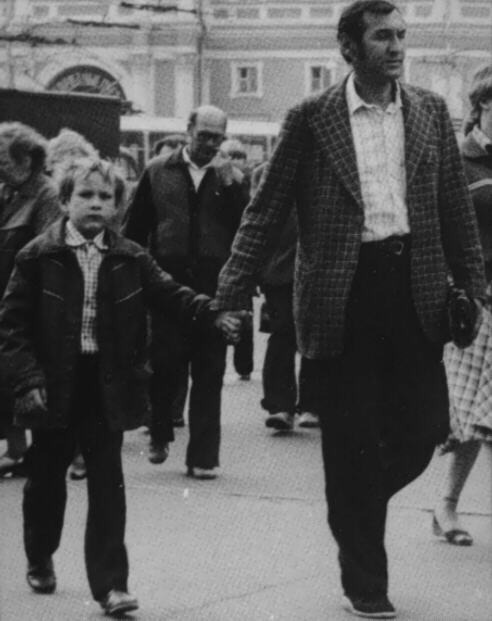
Father and son hurrying to the Metro on Nevsky prospekt
What courses
through his [Dostoevsky's] characters are the instinctual urges by which they
are possessed, which transform their ideas and acts into a disease that descends
upon humanity like a whirlwind, a tempest, a consuming spiritual flame, searing
away every tendon and scheme of the psyche in an all-encompassing, maniacal
fire. It is said about Raskolnikov that "his thoughts were feverish and
disconnected. He could hardly feel that he had a body..." The body is a
thin membrane, it burns away from within or cracks like an eggshell under the
pressure of the spirit that has taken its abode in the person and once in a
while forces itself out to mutilate the flesh it has gained mastery over.
(Abram Tertz (Andrey Sinyavsky) 1973, p.180)
In Chapter Two, I described the political and economic "framework" in which Russians live, and concluded that people lead their lives on Islands, enclosed by Barriers, which they both defend and subvert. Now we shall move closer to the people themselves and see how they react to this framework, how it influences their thoughts, acts and emotions, and, ultimately, their Quest for meaning. To do this, it is necessary to gain an understanding of behavior in intimate and public contexts.
Limbo, I have said, is an "unmediated hierarchy", a Texture in which general and specific rules are strongly polarized, but the "gap" between them is not "filled" with Densely interconnected intermediate levels. But we must remind ourselves that rules are governing principles, not persons, institutions or groups (Centers). A hierarchy of rules is a sociological abstraction; it is not "real", e.g. in a physical or geographical sense. Specific and general ("local" and "overarching") rules are not "objects" located in different "places", but epiphenomena of the fact that they are "obeyed" by flow, i.e. by action. All flow is extracted from individual acts, and therefore all rules - no matter how general - are present nowhere but in the interaction of real people. Therefore, the state, as an institution, a tangible "thing" (Center), may be perceived as distant and inscrutable, but the rules around which it congeals are present here and now, in the daily life of ordinary human beings.
In a Deep (modern) society, this means that the whole hierarchy, with the conflicting demands of all its rules, is compressed into individual acts. The act is therefore split. It is constrained by many, mutually opposed rules simultaneously: abstract and concrete, impersonal and personal, global and local. It contains violent inner tensions, which pose major emotional, intellectual and practical problems for the person acting. Such tensions can never be neutralized completely, but their effects may be minimized and kept under control if the influence of a specific range of levels is focused onto a limited number of acts, so that the extractive force radiating from these levels is to some extent - from the point of view of the actor - concentrated and restricted to certain characteristic places, times or situations. Groups of acts with relevance to different levels may in this way be separated and hedged off from each other, and ambiguity significantly reduced. Life is thus partitioned out into more or less clear-cut, unambiguous, tension-free zones. The actor must still relate to many levels of abstraction, but manages to keep some of their conflicting claims apart by relating to one set of levels at a time. I shall call this mechanism sorting.
When acts are sorted, they are grouped into more or less easily separable "packages". These "packages" are an important type of Center, which we may refer to (following standard sociological practice) as "offices" or roles. When many roles (offices) are grouped together into a more or less consistent, interdependent whole, they form an institution. We sort acts by arranging them in a diversified and stable system of roles, keeping roles separate from each other, and maintaining orderly relations between them. The tension inherent in the split act is thus reduced, by, so to speak, "flattening out the hierarchy onto the ground" - by projecting specific parts of it into specific Centers: roles and institutions.
When levels are thus "reduced to" acts, we recognize this as a form of adaptation (see Chapter One). Many overlapping discontinuities (rules) are used to "simulate" continuity (flow). Clearly, sorting is an ad hoc activity that can never succeed completely. We strive to keep our private life separate from our job, but they continue to influence and contradict each other. We adopt a politely formal persona in public contexts, but it is impractical and undesirable to eliminate the "personal touch" completely. An act is not and can never become a rule. But it is also clear that sorting can be achieved more stably, consistently and convincingly in a Dense (mediated) hierarchy, where roles congeal on the basis of a multitude of overlapping rules, and partake in the flexibility and stability of their underlying Texture. For this reason too, the perceived boundaries of role-Centers are widened and brought in more complete accord with their real boundaries, thus safeguarding the individual's need for order and consistency, and society's need for legitimacy.
The core institutions of Western, Capitalist society are constituted on the basis of a Texture that may be characterized as Deep, but simultaneously (with the reservations noted above, e.g. in Chapter Two, note 52) very Dense. Hierarchy is mediated: The violent tensions contained within each act are neutralized with unprecedented success, by pervasive and efficient sorting. Obviously, here as elsewhere the mechanisms of sorting break down, and sizeable parts of the population may be excluded from their benefits altogether. Nevertheless, in spite of the violent political and economic forces at work in modern Western welfare societies, mainstream middle-class citizens are assured a degree of security and predictability in their lives that has no historical parallel. There are pre-established ways of focusing emphasis and attention on one set of levels, of shifting between levels, and of reconciling their contradictions. As a result, individuals are seldom seriously at a loss as to how to sort their public and private roles, and when conflict arises, they are surrounded by service institutions expressly designed to help them out: kindergartens for working parents, therapists for those who can't "sort it out". In the legal system, the institutions of democracy, the media, public and private concerns are explicitly formulated, and made the object of intensive, mediating debate. In all these ways, and many others as well, "Westerners" are taught (in various ways, and to varying degrees) to become experts at the art of compromise, at rationalizing and reconciling the most glaring contradictions between general and specific rules as a matter of course.
Society is therefore highly legitimate, since private and public orders interpenetrate and influence each other so intimately. There are numerous mid-range institutions. The classical Western idea of "privacy" exemplifies this point. "Private property" is clearly of the utmost public importance, and ultimately belongs to the public sphere. But it is "left in trust of" individuals on the condition that they dispose of it in conformity with the needs of "society as a whole". Individuals gain freedom of action from this arrangement, while society gains flexibility. But the only reason why we are able to suppose, so placidly, that people will in fact conform to society's needs, is that rules of private behavior are congruent with rules in the public sphere, i.e. the polarization of general and specific rules is mediated. Privacy safeguards the individual in relation to the state, and society appears to us as rational and humane, though it would be more accurate to say that it is stable - and thence predictable; flexible - and thus open to criticism and change.
In person-to-person interaction, this legitimacy finds expression in a mode of behavior we call politeness. This is a refined, though mundane, version of the art of compromise, an extensive system of interrelated roles for behavior in all kinds of intermediate contexts - situations, which are neither clearly private nor clearly public. Its many-faceted flexibility allows the adept, cultured "Westerner" to slip with relative ease from formal to informal behavior with composure and grace.
In the unmediated hierarchy of Limbo, in contrast, there are few intermediate levels, and movement between them is unpredictable and abrupt. There is little interpenetration of personal and public spheres, and what penetration there is, is often violent and usually contradictory. Mid-range institutions are far between. Private property does not exist, since, as I argued in the previous chapter, people cannot be "trusted" to follow the rules of "society as a whole". Indeed "privacy" itself is a misleading term in the Soviet context: Circumstances are either public or non-public (I therefore prefer to speak of the "non-public" sphere as "intimate" rather than "private"). In Limbo, general and specific rules stand in glaring opposition, the tensions within acts remain very great, and society offers little assistance in mastering them. As a result, only a very crude and simplified sorting of acts is possible, and even this succeeds only when the act is governed by rules that are clearly either intimate or public. Sorting therefore neutralizes polarization very incompletely, and the role system itself is split into opposed halves. Most roles are either "informal" or "formal", "warm" or "cold". There is no "art of compromise". Instead, there is a "balancing act" between opposed roles and modes of behavior: between "cold" insistence on Barriers and "warm" subversion of them. Intimate roles make no claim to validity outside intimacy itself. They lack the implicit public content of "privacy" as practiced in the West, and are restricted more totally to personal contexts. For this reason they may be experienced as "warmer" than Western "privacy". Conversely, public roles are not considered to have personal relevance. They apply to society in general, but to no one in particular. They seem "artificial", "inhuman", "cold", since they emphatically exclude outsiders from the intimate circle. You either belong to our Island or not. But since most acts do not belong clearly to one category or the other, this insistent, "absolutist", sorting tends to break down. In "intermediate" situations, one is frankly disoriented, for the split remains in the act, making it ambiguous and volatile: "role-less". As a result, society is not legitimate, behavior not polite. There is one ethic of "warmth", another of "coldness", one morality for the individual, another for the state. Attaining a "balance" between these opposites is a difficult and hazardous enterprise, and one goes to great lengths to avoid engaging in it at all, for this is Limbo in its most obvious form: contradictory, dangerous - a battlefield of nature and culture, people and state, dvory and prospekty.
This should not, however, lead us to assume that there exist no ideals of political legitimacy or personal politeness in Russian culture. On the contrary, such values are pervasive, and play a major role in people's lives. Many aspects of these ideals are expressed by the Russian words kul'tura ("culture") and kul'turny ("cultured").70 Kul'tura may be thought of as representing the ideal of legitimate government and "true" human communication, of a balance between state and people, public and intimate spheres. We shall return to these themes in Chapter 4, Part B. At present, we shall concern ourselves mainly with ideals of interpersonal behavior in the "intermediate" zone, central aspects of which are embodied in the everyday usage of the word kul'turny. Kul'turnost' as a standard of behavior is an inflexible and fragile ideal. To be "polite", in the "Western" sense, is to engage in a pleasant, superficial and fluent process of compromise. To be kul'turny, in contrast, involves an uncomfortable and demanding balancing act. For although it is universally accepted that one should be so, and the rules for what one must not do seem both strict and uncompromising - what one should do is much harder to ascertain.
Thus, behavior in Limbo may be discussed under three headings. First, the informal "warmth" of intimacy, which Russians refer to as teplota, serdechnost' ("of the heart"), otzyvchivost' ("responsiveness"), or most importantly, prostota.71 Secondly, the "cold" formality reserved for "strangers", those who do not belong to your Island. And finally, kul'turnost', the harmonious ideal, and the unstable, intermediate practice, in which "warmth" and "coldness" coexist, but do not mingle. One balances between the two, but stable compromise is never achieved. Hence one is constantly acting "out of context": being "close" when distance might seem to be called for, meeting warmth with rudeness (khamstvo, grubost'), sincerity with lies or "rottenness" (lozh', gadost') - or, turning the tables, confronting impersonal evil with personal integrity and warmth.
In the following three sections I treat these forms of behavior in turn. In the fourth section I turn to a more general discussion of what the lack of compromise implies, and describe two methods of finding meaning in spite of it. I then return to problems of state legitimacy and - in the final section of this chapter - arrive at an assumption that both legitimacy and public behavior have a more complex, historical basis than we have hitherto assumed. Once the connection between person-to-person interaction and state legitimacy (kul'turnost' and kul'tura) has been established, I commence a discussion of their history in Chapter Four.
To give an idea of what "warmth" entails, I shall acquaint the reader with Seryozha and Olya, a couple in their late thirties. In 1978, Seryozha was an optimistic young man, newly married and with a baby. At the time of his marriage he had broken with his past: sold his drums. He could always buy new ones, he told me, but a married man didn't have time to move around with a band anyway. As a musician, Seryozha had been a man of some note back in '68, when rock came to Leningrad. Private concerts were arranged, musicians made big money, "the girls just came running up - 'Do you want to sleep with me? I know you're a great drummer!'" But aside from the status involved, and the free, easygoing life, Seryozha loved the music for its own sake. It was protest, and it was "kul'tura" - meaningful in itself. It gave an outlet for an important part of his background. For Seryozha belonged to that large group of "declassed" individuals, whose parents and grandparents had embraced "kul'tura" as embodied in the values of the Russian intelligentsia, but had then been forced by circumstances to abandon their ideals.
In 1981, Seryozha was divorced and had been living for 2 years with a divorcee, a girl named Olya, at her apartment in a suburb we shall call Pushkino. Here, in their snug, one-and-a-half-room, childless flat, I got to know Seryozha again in 1983. At the same time I was introduced to a number of his friends and acquaintances living in the immediate vicinity. The outlook and lifestyle of these people were probably typical of working-class youth in Leningrad. The men were into sport, rock and drinking (both heavy), and various (mostly minor) "deals". The women wanted a nice apartment, a baby (if they didn't have one, in which case they didn't), clothes and romantic music (scorned by the men).
Seryozha had aged since 1978. He had not bought new drums, but once in a while he took stand-in jobs with local dance bands. Perhaps due to drink, he had developed a paunch and a strong nervous trembling in his hands, which might hinder him in simple household tasks. He had settled with Olya and swore he would never leave her, but had a not-so-secret affair with 24-year-old Lyuba, the wife of his friend and neighbor Fedya. When he complained about life I found it hard to distinguish between the problems he attributed to society and the worsening economic crisis, and those of a personal nature. "Things have gotten so hard," he told me seriously. "Life is so empty. If it hadn't been for my records, I don't know if I'd stand it. When I listen to them, I forget everything around me."
Olya may have been part of the reason why he felt this way. She was a head-and-a-half taller than her wiry boyfriend and a dominating woman. Her background and values were simpler, less "kul'turnye", and gave less room for conflict than his. She was unashamedly uninterested in her job. She did not share Seryozha's passion for "good" music, and though she never actually discouraged him from playing, she was strongly oriented towards "keeping up with the Jones's", and this precluded any risky experiments that Seryozha might (and did) want to indulge in. Not that she didn't love him - she would defend him staunchly: "I love him. They say he's short and ugly, but he's a man. He's perfect for me. There's always something to talk to him about. Other guys are beautiful, but do nothing but swear at you." But she embraced the role of mother and caretaker, and I think Seryozha lost something in submitting to this: "He's like a child for me," she told me. Her behavior bore this out.
I was a guest at Pushkino quite a number of times, until the drinking and the whole cepky atmosphere got to be too much for me. In the process, I learned quite a lot about "warm" behavior and what it entails.
First of all, a "warm" person is inclusive - generous and hospitable: "You're just like at home here," they would repeat with urgency. "We'll invite you from Norway and you can come live with us." (Risky, at best!) "Bring your parents, we'll take care of them." Money (which they often had little of) was of no concern. Except on rare occasions they always paid for everything, and the presents I received were at times lavish to the point of absurdity. "We're used to giving everything to a good friend," Olya said. "People here are - somehow - kind." They gave of their time as freely: I have known Seryozha to take the whole day off from work and just wait around in case I should find the time to see him. My own attitude was different, of course, and to Olya that was incomprehensible: "So you don't love us enough, that's what it means! But we've loved you always," she told me (at a point when she hardly knew me at all). Underlying this statement is - we might reason - a deeper assumption that inclusiveness must be total, and open the other person's soul to you. "You're more than kin," Seryozha said. "No matter what happens you'll always understand me and I'll understand you." Being part of the same uzky krug ("narrow", intimate circle) of relatives and friends means sharing the most fundamental values, submitting to the collectivity without reservations. With outsiders the group is defended at the expense of any and all other loyalties. Once, after two full days with them, I left (unsteadily) for an appointment with a man I hardly knew, at which Olya erupted: "What does he mean to you? Tell him you don't give a shit!" The same attitudes were reflected in the way they judged other people:
I met Seryozha in Pushkino in a fury. Fedya had thrown his bass player out of the mediocre band he led. "That's rotten!" Seryozha exclaimed. "I never act rottenly... And he's a lousy drummer himself! Even his wife tells him so - 'is that drumming?' she asked him. He was banging away to a Beatles recording and going much too fast! When I had a band, I worked with my bass player, sat with him specially to work things out. 'You're going to be thrown out yourself,' I told him: 'Your wife's punishing you, and God will punish you.'" [Seryozha was alluding to his affair with Fedya's wife.]
"You know - we get paid exactly the same, but the other day we went to buy wine together and he wouldn't split even. Said he'd pay me back later. But when I needed 22 kopeks for bread he couldn't spare it. You know what he said? 'Why should I?' Besides, he treats his wife like shit, so she doesn't give a damn about him. He's a fool. She gives him presents [sex] on holidays," he snorted. "Once she came to our place, crying her heart out because of something he'd done. We told her not to cry. 'I'm not crying for him, I'm crying about the apartment,'72 she answered... That story with his bass player really pissed me off. I boxed him so he flew across the room and landed on his back on our bed. Then he left. 'Your wife's punishing you, and God will punish you,' I told him." (He kept repeating this, relishing the words.)
Like Vitya with his workers, you do not fire a friend. This is essentially what Seryozha is saying. A friend belongs to your uzky krug, and if you exclude him, you yourself risk exclusion. For there are only two states - "inside" and "outside" - and if you are "inside" you must be "warm". Clearly, Seryozha and Olya tried to include me in the same way, by tying me to them with the "power in the gift" (Mauss 1923-24). Their motives were complex. I am sure, for one, that Seryozha admired me as a representative of a more "kul'turny" lifestyle than his own. "You're so quiet and self-contained," Olya told me. "You'd never let yourself be carried away by emotion." My "reserve" and need for privacy, which they could attack so vehemently, were in fact an important reason why they wanted me around at all. I found myself in similar situations with many friends: Because I was a Westerner with an intellectual upbringing, my behavior was "colder" and more restrained, and I came to have an ordering and calming influence. As we saw above, something similar occurred with Vitya (though Vitya was obviously a far stronger and more discrete person). But in Seryozha's case the contrast was too great. Aside from being his friend and mentor, I became an exotic symbol of much that he had lost or hoped to attain. By showing off his hospitality and prestigious "contacts" to me he confirmed his own life, despite its sadly neglected potential. By showing me off to friends, he enhanced his prestige with them, proved he was not just "another one of the guys" (as, indeed, he was not!), but a special person with a background in "kul'tura" and access to the Mysterious West.
What strikes me now is not so much these motives themselves, as the intensely emotional way in which they meshed together. Seryozha was by no means a cynic; his show of sincerity and directness was whole-hearted and genuine in the sense that he himself was unable to relate to it in any other way. I think of him as a good (though somewhat negative) illustration of "warm" behavior: First, because the ideal he attempted to live up to was one of effusiveness and spontaneity. He condemned people who were calculating or "used" others. He sought unlimited trust, inclusion in a collectivity devoid of personal "egotism". Secondly, because his actual behavior conforms to this ideal. Indeed, as I experienced it, all separateness, self-discipline and ability to assess reality clearly were dissolved by it as if by acid.
Of course, "warm" behavior is often more enjoyable than this. The unguarded generosity of many of my Russian friends has always seemed a kind of miracle to me, and if they sometimes appreciated my "reserve", their own success at tearing it down and penetrating to the heart of matters was something I will always be thankful for. Still, in such an intensely personal world, problems of separateness and order - of establishing and defending moral boundaries - are bound to be endemic. Vitya faced this problem in his delo, where the people he worked with were also his friends. They demanded "warmth". He answered with authority, enforcing a discipline that they - in the long run - needed. For "warmth" - prostota - has (in the ideal type we are here describing) no internal discipline. It is "simple", unconstrained, unreserved, and, ideally, unworried. "People want to live prosto, humanly, without thought for money," Rodya said, complaining about the deceit and calculation needed to survive generously among of the shortages of modern Soviet society.
Prostota means opening your heart, "pouring out your soul" (izlivat' dushu). I've spent endless hours listening to rambling stories and anekdoty, and had a willing audience any time I myself had something to tell. "Tell me more!" Vera would say, wide-eyed as a child, when I stopped for fear of boring her. Seryozha at his best was a brilliant and interminable storyteller, with a sense of drama that made it hard, sometimes, to believe that he was telling the truth. But perhaps truth is not an issue. What attracts is the daring (udalost'), the humor, the beauty of the story itself, and when someone looks at you in consternation and asks "pravda!? (is it true?)", you sense it is not a literal but a dramatic truth they want you to confirm.
Prostota also means physical intimacy, with sensual overtones that I have only slowly and imperfectly learned to appreciate. It's common to see grownups embracing or holding hands in public, men as well as women. Touching strangers is unavoidable in a crowd, and may be a cause of conflict, but it arouses no objections when a man falls asleep on the train and lets his head droop onto the shoulder of the stranger beside him, or when a gaggle of giggling girls literally catapult themselves into the mass of people filling the Metro. Physical intimacy is precisely prosto - guileless and often artless. People on the street, especially women, seldom look as if they cared much for their fat, overworked, tastelessly dressed bodies.73 Indeed, physical closeness may express contempt for the body. Walking along the beach one day, I am shocked to see a bloated, middle-aged woman in a short dress, seated on a deck chair with legs spread wide, making no attempt to hide her panties which are striped dark, reddish brown by blood and shit...
But there is an element of sheer exuberance, of physical abandon in this attitude as well, a passion that is all the more intense because of its sudden and uninhibited release. I owe the following anecdote to a fellow Norwegian anthropologist:
While doing fieldwork in East Berlin, she shared a tiny room with a German girlfriend. One evening after a party, a young man and a visiting Russian woman spent the night with them. They spread mattresses and pillows on the floor, and, after the hostesses had gone to bed, the man demonstratively stripped to his underwear, and snuggled down beside them. Finally, the Russian woman entered the room. "Lichte aus, bitte", she said, with a demure blush and a heavy accent, and undressed in the dark. The man immediately started pawing the girls, first the Norwegian, then the German, both of whom told him laughingly to mind his manners. The Russian woman's modesty, however, seemed to vanish at his first touch, and the two made frantic love all night, paying no attention to their hosts, until they collapsed at daybreak. (Magerøy, p.c.)
When my colleague told this story, she asked if such behavior was typical of Russian women. Frankly, I have insufficient data to judge by. But I have noticed that sexually "charged" occasions often seem to have an abrupt, demanding, almost violent character that is at least reminiscent of the story above.74 Several years after my stay in Leningrad in 1983, a 14-year-old girl chose me as her confidant. Initially, she was circuitous and indirect about her personal life, rambling on about "love" in vague, poetical terms. Then, all at once, it was as if she decided to trust me and do away with all the small talk, and became amazingly outspoken about intimate physical details.75
More than anything, perhaps, prostota thus seems to imply informality, which was what Seryozha demonstrated in his inability to structure his life and keep it separate from that of his friends. In a wider sense, however, to be informal is simply to be unconcerned with trivial restrictions, to live spontaneously and fully. Vera, deciding late one evening that she was sick of the daily rut, put on her ugliest coat (she chose it with care), left her handicapped son and volatile ex-husband to their own devices, and jumped on the train with me to go see Zhenya. "It'll do him good to have us drop in at 1.30 in the morning," she laughed, lightheartedly.76 "He really is just a little pedantic, you know..."
If informality is valued among intimates, the converse is also true. Formality is disapproved of and resented. It radiates exclusion: hostility and mistrust, meanness, fear and constraint. Prostota, informality and intimacy on the other hand, let you be "natural", act out your innermost soul, they give freedom. The close inner circle is therefore, strangely enough, associated with endless, open spaces, with prostor.
"For Russians nature has always meant freedom, liberation, free abundance [svoboda, volya, privol'e]... Volya - is not being worried about tomorrow, it is carelessness, blissful immersion in the present. The wide-open spaces [prostranstvo, prostor] have always compelled the hearts of Russians. They are embodied in concepts and ideas, which other languages lack. How for example, to you distinguish volya from svoboda? Volya [the word also means "will"] is unconstrained, it is svoboda united with wide open spaces, space unbounded. The concept toska [nostalgia, sadness, longing], on the other hand, merges with tesnota [enclosed, crowded, narrow, straight], the loss of open space. To oppress someone [pritesnyat'] is above all to bereave him of space, to crowd him in..."77 (Likhachev 1984, p.10)
Significantly, the above quote is from a book that Vera once gave me, telling me that it would help me to understand the truth about Russia.
The "warm" role is one of inclusion: of generosity, freedom and informality. But in spite of the high value placed on such qualities, it is a common complaint that people, especially officials, are formalistic and "cold":
I needed a statement from the University administration, and approached the dekan in his spacious, old-fashioned office. No, he would not sign. He needed a certification from the Foreign Students' Section first. I had already been to the inotdel a number of times, besides getting stamps and signatures from half a dozen other officials, so this was no pleasing prospect. Also, I had been told earlier that I wouldn't need a certification. This made no difference to the dekan, who insisted that I follow "the rules".
Seemingly, there is nothing strange about this man's behavior. Just another bureaucrat: a mere agent, an office, a tool, putting the power of general rules into practice. Actually, it is not so simple at all. Two things struck me at the time: When I told him who had said I should get his signature, he promptly signed. Confronted with a name of greater importance than his own, the "rules" were suddenly irrelevant. Secondly, he himself did not know the formal procedures. He told me to get a stamp from his secretary when I left, but she explained that I wouldn't need it, and it turned out that she was right. The dekan shows the "weakness" of general rules: not only are they inconsistently enforced - even knowledge of them is incomplete.
Still, his insistence needs to be explained. For he did in fact have power, and if I had not over-trumped him, I would have left empty-handed, as all too many Russians are forced to do (cf. LP: 12/6-83; 27/2-83). There is a duality in this insistence, which we have noted earlier. To a certain extent, the man is in fact a tool - inefficient and incompetent, but still a tool - of overarching social control and coordination. On the other hand, he is defending his own position. By "playing safe", shoving the decision away from himself, he avoids responsibility for any mistake he might make. One might say that the character of his insistence - its formality - derives from the "original" and primary function of "the rules" (coordination and standardization), but the fact that he does insist, his sheer strength of motivation, is self-defensive. The dekan's nice office is an Island, which he defends by excluding the world around him.
Formality, "insistence on the rules", thus easily degenerates into a weapon of self-defense, and as such it is not limited to positions of power. It is a common way of defending any Island, a "cold facade" directed outwards, towards the ne svoi ("not ours"): "foreigners", "outsiders" of any description. But self-defense is not simply a rationalized form of paranoia. Inability to defend one's Island often has highly uncomfortable consequences:
Xeroxing is illegal without special authorization. Big libraries have copy machines, but access is strictly limited - a situation aggravated by the shortage of machines: My library (one of the country's largest) had only two. One morning I arrived at the desk to order some copies. The line was long, and the single woman working had to fill out a complicated form for each order, collect money, and after every few orders, carry the heavy books down the hall into the copy room - so time passed slowly.
While we waited, one of the machines broke down and orders for large books had to be refused. Since copy personnel started summer vacation the next day and no stand-ins could be found, tension mounted noticeably. A young man (probably Armenian or Georgian) placed an order for a pile of very large books. When the woman explained the situation, he got furious, hurled books down on the table and insulted her. At last he insinuated that she wouldn't help him because he wasn't an ethnic Russian. This brought her to the limit. She called in her boss and complained to her. This woman was restrained, but did not back her up at all. She said nothing to him, but told her to explain the situation. "I did!" she exclaimed. "Oh, but how, I wonder?"
At last the woman took one of the books and made a copy to show him how bad the result would be on the small machine. He said it was fine for him. She sniffed indignantly: "It is not good enough! We do quality work - like this," she tried showing him an example, then turned to the rest of us to demonstrate the difference. After more than an hour, the man reluctantly compromised. Later, I saw him in the reading room, complaining to the woman in charge: "She said the problems were technical, but I think she wouldn't!" The woman nodded evasively: "Try going down again," she suggested.
Several times the woman at the desk almost broke down, and she looked exhausted afterwards. I imagine her coming home tired, dispirited. She would have made out better if she had been able to act like the dekan. But she was too "kul'turny", believed too firmly in the dignity of work, and so she was vulnerable and went through an undue amount of hassle.
It is important to understand why. Rules are weak in the public sphere. As we saw in Chapter Two, shortages and technical inadequacies are a symptom of this weakness. This in turn creates bottlenecks, like the one in the library, Gates opening privileged access to Islands of scarce resources. Since state control is concentrated at such Gates, shortages are aggravated, bottlenecks further narrowed and the pressure on those guarding them increased. Finally, the mere existence of Islands in the midst of scarcity lends the commodities guarded additional prestige, adding moral responsibility to the guard's burdens: In part, it was plain that the woman simply did not want anyone to touch her expensive, beautiful machine. It was a white elephant, feared and revered.
In spite of all this, the woman at the desk was virtually defenseless. She was in the public sphere, "out in the cold", where, as Vasya put it, there are "no external forms that may receive the spirit": no mid-range institutions, no one to back you up. Her superiors did not support her, shrugging her off their shoulders. Like the dekan, they had their own Islands to guard. Any goodwill or effort she put into her job were her personal responsibility. Most fundamentally, she lacked the support of a stable role system of "polite" behavior. In the southern parts of the Soviet Union, professional haggling is common and accepted. This was lost on a Northerner. She was doing her best to be helpful. She was friendly to everyone else. She was proud of her work, in a slightly comical way, for the library is a symbol of almost holy values for educated Russians. The man stepped on her work, on her values, on the "European", "kul'turny" Russia. "He's in the library, and behaves like he's at the bazaar!" she exclaimed when he left. The bazaar of course, is "Asia", nekul'turno.
In a Texture of unmediated polarization, one is confronted, as this woman, directly and personally with the impersonality of general rules - rules which simply state that communication must be carried through, flow must go on, but (since they themselves are rigid and unstable) give no indication of how you are to achieve this in practice. Like the dekan, the woman merely followed "the rules", as she had to, as a subordinate in her job. But she had no way of knowing beforehand how people would react to such behavior, whether they would insist on their formal rights or "take it personally" (either sympathizing or blaming her). The formal system itself gave her no support when things went wrong.
Similar situations are encountered daily, in the endless queues, at work, in cramped kommunalki. General rules throw people together at random, with no respect for their preferences and no allowances for what to do when problems arise. You are on your own, facing what one might call an "enforced pluralism", a human chaos so prevalent, so diffuse and unpredictable, that it pays to make allowances for it in everything you do. People's constant concern about your health is a metaphor of this kind. Strangers stop you on the street if your shoelace comes untied or you look like you don't have enough clothes on. Friends carefully lead you across "dangerous" intersections.77a
You must protect your Island. The woman in the library faced the general rules without defense. The dekan defended himself by "insisting on the rules" and "co-opting" their formality for his own purposes. But his solution is often untenable. The general order itself is weak, its rules often unknown, not respected or followed up. It may impossible to "co-opt" them as an effective defense, or they may let you down when you need them most. Even the dekan's Island was far from invulnerable, as we have seen, and less privileged people may lack even the potential formality of a library. Other defenses are therefore devised:
One afternoon I stepped into a cafeteria. It was crowded, with 20-30 people lined up in front of the counter, seemingly getting no closer at all. Behind it, half a dozen young women in dirty, white aprons were talking loudly among themselves and working very slowly. Much of the time they sat around doing nothing. When I finally got my meal and found a seat, the establishment closed down - far too early, to judge from the sign on the door. The women came out with dishrags and mops and started cleaning the room and upending chairs, chasing away disgruntled customers still eating with cries of "young lady, you let go of that table now!"
These women are "cold" in a manner typical of service personnel in the Soviet Union, disregarding their customers and not caring about their work. But their behavior differs from the dekan's. They were not insisting on any "rules" at all - although if they knew of a rule to support them, they would undoubtedly have cited it. But few "rules" are beneficial to canteen workers, so formality would give poor defense. They are in an "intermediate" position, neither public nor intimate, and have no stable role to fall back on. So they revert to sullen "non-behavior", disregarding anything outside their Island, including the customers, which, as far as they were concerned, might as well not have been there at all. The customers disregarded them just as completely. Of course, there was yelling to and fro, whenever someone felt stepped on, but what characterizes the situation more than anything else is lack of communication. If one can neither be informal and "warm", nor formal and "cold", there is no middle way, no intermediate role, and one lapses into rejection and silence.
We might ask (as many Russians themselves do) why they could not simply "be polite". But this is not as "simple" as it seems. A Russian tourist guide expressed this clearly:
"People are cold in Scandinavia. That's why it's hard for Russians to live there... We're used to warmth. True, here they yell at each other a lot, where you come from at least they're polite..."
Politeness is a compromise between specific and general rules, personal and impersonal orders, "warmth" and formality. What this woman seems to be saying, however, is that politeness and "warmth" are mutually exclusive. "Warmth" is not polite. It is direct, personal, demanding: heated (s zharom) in arguments and loves, but not polite. The same goes for formality. It is a weapon: "artificial", "inhuman", "cold". And since politeness contains an element of formality, it is totally incompatible with informality and "warmth". Formal and informal behavior, exclusion and inclusion, are opposites, with hardly any mediation between them. Compromise, politeness, the "relaxed formality" of impersonal, anonymous behavior, is not an alternative. The very word "politeness" (vezhlivost') has a slightly exotic feel in Russian.
But at the same time, as we have said, kul'turnost', the ideal of intermediate, polite behavior, is very real, though it's successful realization is rare. It demands that one obey "the rules": Both the cafeteria girls and the man in the library were nekul'turnye by not doing so. But at the same time, it demands that one show "respect" - uvazhenie - "warmth", that one is personal, as neither was. Unifying "the rules" with "respect", formality with "warmth", exclusion with inclusion, is difficult, because there is no stable, intermediate system of roles.
The existence of such an ideal reflects the fact that "non-interaction", as with the girls above, is in the long run very uncomfortable. Instead of sorting roles, it denies the reality of the public sphere. Limbo is the confrontation of your own intimacy with the relentlessness of the general order. Disregarding it may at times succeed. But more often this is impossible. People are forced every day to traverse vast distances out of reach of any Island. Ignoring this fact is impossible for any length of time, and attempting to do so results in constant misunderstandings and conflicts, which stable roles would counteract. One therefore attempts to sort roles into the only stable categories that exist: "cold" formality and "warm" informality. On the bus, in queues, one adopts a narrow, "pedantic" formality. Foreigners are infuriated by expressions of this kind: Ne prinyato. (It's not accepted.) Nekul'turno. (It's "uncultured".) U nas tak ne delayut. (We don't do it that way.) U nas takoy poryadok. (This is the "order" we have.) One encloses oneself behind a Barrier of "rules", a hard shell of invulnerability, and in the midst of the "cold", each individual becomes a tiny Island, moving along a narrow, pre-set Path. Seemingly, such "formality" differs from that of the dekan. The "rules" on the bus are not formally codified or enforced by the state. But in fact, the two types are similar, both in origin and function, and share the same duality: self-defense, on the one hand, and on the other, coordination of high-level flow (the reason why people are "on the bus" in the first place is to fulfill the demands of general rules: go to work, visit stores, etc.). Formality attempts to sort acts, to signal that "I'm not doing this out of personal choice - I'm running errands for society in general". But in both cases "sorting" breaks down. What was in origin the definition of an impersonal act, degenerates into a defense of Islands and the moral order (the "rules") surrounding them - a very personal concern indeed:
I went for a pleasure stroll on the ice of one of Leningrad's canals. A woman spied me from a bridge and started yelling: "What are you doing on the ice?! Come up here immediately! Nobody else walks on the ice! You're going to slip and break a leg." The attack was so sudden and unexpected that I was struck dumb, and just stood there staring at her. In the end she turned and stomped away: "Well! He deserves it. If he's that stupid!"
Attempts at sorting out a stable "cold" role and keeping to it in public thus collapse under pressure. Keeping acts sorted - even on this elementary level - is very difficult.
The same problem afflicts intimacy as well. The hallmark of intimacy (prostota) is the need for freedom of expression (prostor), inclusion in the wide-open spaces of spontaneous emotion. But in their obsession with self-defense, Islands violate this need. The very act of protection - "co-opting" the formality of general rules - strikes back at you. In spite of their "warmth", Islands do not supply the stable, routine security of Western "privacy".
Vanya told me about his recent experiences in the Army. Military service lasts two years and is incredibly tough. Meaningless disciplinary measures abound: digging holes, which are filled by bulldozers afterwards, emptying a pit full of water with a tin can. In the end I exclaimed: "But can't you complain!?" He gave me a patronizing look: "Well, yes, you can, but you see, complaining isn't accepted here (ne prinyato). It makes you unpopular with the guys." "Even if everyone agrees?" "You just don't complain," he answered with finality. "It's one of those subtleties (eto takaya tonkost'), you see?"
Formal rules protect the values of the collective. Since this is their basic rationale they may not be challenged without endangering these values, even if they themselves infringe on them. Underlying this assumption is the inability to compromise. If you break one rule, you break them all; you defy the whole fragile structure that contains your life. The essential reason for the weakness of rules lies, one suspects, simply in that the freedom of the prostor is too great to be contained at all. One lives in a "space too large to be ordered" (a fact that is evident in any Russian home: No matter how small, it seems disorderly, although in fact it is most often very strictly ordered indeed, a paradox which I have always found very pleasing). Informality denies rules and order. But order is still needed, as both Vitya and Seryozha show, and since intimacy has no order of its own, it must accept "the rules", no matter how unreasonable, set for it by an outside authority: the collective, or the state. I return to this in Chapter Five.
Rules degenerate into "rules" - weapons of self-defense. "Warmth" is violated and invaded. Kul'turnost' is therefore volatile and unstable - a field of battle - and this is the most important difference between it and politeness. Once in a while, of course, balance is achieved, but nearly always as a result of individual strength and integrity. This lends a fragile and intensely personal quality to the whole field of "intermediate" communication, as well as to any human edifice built up in this sphere. It is the reason why Vitya's biznis is not a "market element" in a non-market economy, but a delo - a calling, a hazardous and courageous attempt to create harmony and balance in the zona of conflicting public and intimate orders.
There are only two stable roles - exclusion and inclusion - formal insistence on Barriers or informal dissolution of them. When either is undermined, or synthesis attempted, one is cast out from society into Limbo, where they must be brought to balance each other, or communication breaks down altogether. In the middle-class, bourgeois "West", we are brought up to master a complex, all-inclusive system defining degrees of closeness and distance. We "compromise" - admit people by stages into our presence and interact flexibly in public. We learn the tricks of style, sociability, body language. The Soviet Union seems starker, less refined. Kul'turnost' is not a compromise, but a war, or a "balancing act".
Upon entering the intermediate sphere one is therefore immersed in a feeling of tempo and efficiency, or rather concentration, seriousness, curtness. Everything is over-filled, and there's always a rush. There's nothing fun about it. You're in dangerous and impassable terrain, demanding concentration and caution:
The doors of an over-filled bus whip open and people pour out. A man and his old, weak-legged father, leaning on a cane, stand near the door. Unable to reach his companion, the man mutters encouragingly: "Hold on, pop..."
While waiting, the same intent seriousness is projected outwards from the spot one claims and defends as one's own. On public transport, people stand or sit around, alone or in small, closed groups. Children are carefully guarded. A couple (of same or opposite sex) stand close, touching or holding (even stroking) each other, conversing quietly and intimately.
The "non-interaction" of the cafeteria girls pervades the intermediate sphere. In a sense, people do not meet at all. Or rather, they never meet "strangers". They are tiny, moveable Islands. But if for some reason or other they decide you're "close", even the coldest arena becomes personal, no matter how little they know you. The formal, cold facade may seem formidable, but is actually very fragile. Roles can be maintained only to a point, then they collapse. The seriousness in public has a "dangerous", "explosive" quality, and the closer you are hemmed in by strangers, the stronger this feeling becomes:
I'm on a bus crammed with people. Between the window and one of the posts for passengers to hold on to, a shabby-looking man is wedged. A well-dressed woman on her way out asks, rather rudely, if he could move. "Where do you want me to move to? Out the window?" he grouches. The woman starts explaining what she thinks of him - in very clear terms. The man makes no attempt to answer - nor to give room (he might conceivably be able). After a while, he snaps back: "Shut your trap!" The fuming woman must press past by brute force.
Other times, people find each other. Someone starts playing the accordion and everyone sings along. Or one appeals to the collective. At times a drunk performs this subtle alchemy:
It's 11.30 AM. A run-down, but strong-looking man swaggers on to the train, straightens himself by taking hold of the seats on either side of the isle: "I'm not dead! I'm still alive..." He pauses, making sure everyone's eyes are on him. "I've suffered all my life! The young girls are crazy about me - but it's the oldies I want..." We all laugh and clap, and he continues.
We are still, seemingly, in the "outside world", but these eruptions - pleasant or unpleasant as the case may be - are a show of "warmth". There's nothing formal about the situation any longer. You are, for an instant, part of the "inner circle". (Being accepted permanently is another matter.) I've been drawn into countless arguments and conversations in this way.
"Everything is different in America," a man I met on a street in Dagestan told me. "In what sense?" "Well, you can't just sit down and talk, prosto, like you and me. In the Soviet Union you go up to anyone and have a conversation. There you have to think first, who the guy is, what he's after."
This is the positive side of "enforced pluralism": an intense mobility, a happy-go-lucky style of life, the sudden, inexplicable, almost mystical meeting of souls or bodies. But once, after just such an encounter, when I commented to Vitya on people's openness and sociability, he turned serious: "Yes, that's the biggest problem in this country - loneliness." Chance meetings in Limbo have an attraction all their own, an aura of adventure, transcendence, sensuality, but people seek something more, a security and stability which Limbo cannot give.78
Limbo may "erupt", but mostly it is mute, gruff, nearly silent. When interchange is unavoidable, it is formalized, consisting of a few, ritualistic, standard questions and answers:
On the bus:
"Getting off now?" [Asked when worming your way out through a crowd towards the doors.]
"Please send this [money] on [to the ticket machine]."
"No tickets [left in the machine]."
"Don't drop [the money into the machine - I want my change back]."
Queuing:
"Who's last?" or: "Who's after you?" [When you get in line.]
"I'm after you." [If you leave for a moment and want to keep your place...]
"What are you standing for?" [Vy kuda stoite? - literally, "where are you standing to?" Asked when you want to know what this line is all about.]
Such short formulas are the vocabulary of kul'turnost'. They are repeated every day thousands of times with little variation, and if you stick to them, you usually make out all right. They are a "substitute politeness", unable to generate much communication, but adequate to a point. In both form and function they are reminiscent of codes or passwords. The functions of these passwords are summarized in the title of this section: peredat' and propustit':
Peredat' means to "pass on" or transmit, as when passing money from hand to hand towards the ticket machine on a bus. It defines a Path, a tenuous, pre-defined, no-nonsense way through Limbo: a focused group effort towards a specific and limited goal. Numerous things are passed on like this, placed in the informal trust of the collective and transmitted from place to place independent of the inadequate official infrastructure: gossip and rumors, jokes, messages, appeals for help; illegal items (books, products of the black market); household necessities and money. Passwords are keys activating the linkages of transmission. They validate your claim to trust and enable you or your message to pass on.
Propustit' means to admit, give access. A password or propusk (permit) opens a Gate to the inner circle or lets you out of it. One asks to be propushchyon out of the bus or past a line (bez ocheredi). On the telephone the usual greeting is a sharp, short slushayu vas! ("listening!"). This marks a Barrier and asks for your password. When you mention your name, if you're a friend, the voice melts into warmth, otherwise your interlocutor may simply hang up without further comment. Access to Islands may entail a wealth of "fringe benefits", you are included in a wholly new category of people. Propustit' is thus the word for many kinds of (official) permission (to leave the country, arrange an art exhibit), and is often associated with privilege. The anonymous-looking building housing a luxury store for higher party cadres in Moscow thus bears the non-committal but symbolic sign Byuro propuskov (Bureau of Permits). Or the propusk may let you out into Limbo, if you have business there. Along with associations of privilege, it may therefore have an almost opposite meaning, as in the expression propustit' oshibku: to commit ("admit") an error.
Both of these functions are essential, and people face their challenge in every walk of life. Together, they constitute an art which is at the same time exhilarating, necessary, hard to excel at, and which entails heavy responsibility. It was Vitya's business to master both, and in people like him (or the tolkachi, cf. Chapter 2, Part B) they attain a high level of professionalism. Indeed, in a wider perspective, they represent archetypical lifestyles with wide currency, a dimension I shall focus on in the next section. But for the present let me merely point out that they are practical ways of coping with Limbo. They are the closest one comes to stable "intermediate roles". But these roles are in fact very unstable. They are "explosive", and highly dependent on the proficiency and strength of the person balancing them. Peredat' is the role of middleman - or as I shall call him in the next section - the animist. Propustit' is the role of gatekeeper or absolutist.
The essential nature of the middleman's role is evoked in one of Tamara Ivanovna's semi-mythological stories:
A girl met a man on the street, who asked her to peredat' a package to the post office for him. She dropped it in a mailbox instead - which was blasted to bits when the time bomb in the parcel exploded. No one was hurt, but Tamara was shocked by the violation of trust.
Trust is essential to the role of the middleman, because it is a role of inclusion. Once you accept the middleman's "warmth" and he yours, you are at his mercy, for you have no formal guarantees of safety in his hands. In Chapter 2, Part C I emphasized that the success or failure of people in positions of authority depends on their person to an unusual degree. The pattern was repeated in the example from the library above. The problem facing all such people is that the mid-range rules, upon which they attempt to base their role, are very weak. Their roles are not clear-cut, formal offices, which may be occupied and later left to a successor as a matter of routine. Their institutions stand and fall with the individuals inhabiting them. Personal responsibility thus replaces formal offices, in bureaucracy as elsewhere:
Seryozha described the problems involved when the truck driver he worked with took a month's vacation. He was offered a stand-in, but was unhappy about accepting: "You never know who you'll end up with," he explained. "If he's the type who steals, I'll be the one with all hell to pay." Luckily, he found a trusted friend who took the job.
Conversely, the gatekeeper's role is one of exclusion, as the following story shows:
At the Library the woman receptionist faced two young Chinese. Her frustration was evident: "I don't know English," she said, "and they can't - they won't! - speak French to me." After a while an interpreter arrived and they were able to communicate. Now everything was very friendly. When the receptionist heard they were from China, she was enthusiastic: 'It's been so long! It's so nice to have you back...!'
The curt "coldness" the gatekeeper shows in asking for your "password" is a kind of urgency. He wants a very particular response, and he wants it fast. He needs to know "who you are", and if you don't do the "right thing" immediately, he gets suspicious and "cold". So if you can't be personal - be quick. It's intolerable that the flow of activity grinds to a halt. This need not mean that your interlocutor doesn't have time to spare. He simply doesn't want to, can't, doesn't see any value in wasting time on the formal sides of life. All that is "outside". It's gotten over with in nothing flat - so we can start being personal - as friends or foes. Then we have time to spare! The brusqueness of the gatekeeper's facade conceals an invitation to "come in": "It's cold out there. Be sensible and let us protect you." People who don't understand (Chinese students) are incomprehensible and very possibly dangerous. They dawdle about, while there's a battle going on all around them. They're absurd, as bad as people who walk on the ice! There may even be an element of humor in the receptionist's statement: laughing (uneasily) at someone to knock sense into him. But for the uninitiated, discovering the "code" that "lets you in" may be rather hard:
A boy turns in an order at the library and is nearly chased from the room. He hadn't written his name clearly. He had signed on the line with "signature" written underneath, instead of writing "FAMILY NAME - IN CAPITALS, LEGIBLY".
Rules, forms, regulations, all the paraphernalia of bureaucracy, are not standardized and predictable expressions of general rules, but "codes". The form is filled out just so, deviation is downright immoral. But the important thing isn't what the form itself says - but the way it's "supposed to be". The gatekeeper only admits you if you share the "secret knowledge" of the inner circle. Life under such circumstances becomes rather like a series of riddles, to which the right answers must be found. Guesswork becomes an art of necessity. At times, however, the "solution" can be absurdly simple:
At the library the woman in the wardrobe tells me:
- "There's no tags!" (i.e. to mark your coat with. It's strictly forbidden to take outdoor clothes into the Library!)
- "None at all?"
- "None at all."
- "So what do I do?"
- "Wait around..."
I sit around for a while, waiting. Then she adds:
- "But you can leave your coat without a tag..." (There was room to spare in the wardrobe, but they had lost such a lot of their little tags, and they couldn't get any new ones!)
Thus, the roles of kul'turnost' mirror those of "coldness" and "warmth". Gatekeepers are "formal", insisting on Barriers and excluding you from their Island until you prove you share the "secret knowledge" of the inner circle. Middlemen are "informal", including you or your message in their field of intimacy and trust, taking on "personal responsibility" for them. But though these roles are derived from "warmth" and "coldness", they are applied to an intermediate sphere of activity where neither mode of behavior is appropriate. One cannot be consistently "warm" or "cold" in Limbo - but neither can one choose a compromise, for none exists. So one flits to and fro, constantly alternating between the two, in an unstable and hazardous "balancing act". This is the fundamental reason for the "explosiveness" of kul'turnost' - that there are no stable, intermediate roles. The roles of gatekeeper and middleman, absolutist and animist, have no content of their own, no stable, pre-established interpretation. They must be "charged" with meaning by the people acting them out - by their "personal responsibility" and "secret knowledge". Their meaning and rationale is thus necessarily idiosyncratic. Life becomes Stalker-like, full of "traps" and "riddles" - and unpredictable, personal risks.
This is the starting point of all Quests for meaning. The roles of kul'turnost' are unstable and rigid, and have a meager vocabulary of expression. One must "charge" them with personal responsibility and secret knowledge, or see their meaning disintegrate altogether.
Russians as well as foreigners therefore often describe the Soviet public as grey, monotonous, uniform (odnoobrazny), lacking the color and variation that is typical e.g. of a modern Western city. The uniformity of behavior is mirrored in other public realms as well: In material culture, the same dress, housing, food, even kitchen utensils, book-covers or cafeteria furnishings are found from Leningrad to Vladivostok. "Enforced pluralism" leads to its own kind of uniformity: Lidiya Fyodorovna (83) remarked nostalgically that classes had disappeared since the Revolution, and with them all clear and colorful distinctions between people. Rich and poor live door to door in the same kommunalka. "Sameness" also permeates ideology. The same slogans embellish walls; the same phrases are quoted in books and speeches. While Western media restlessly search for sensation, Soviet newsmen stress continuity. Even when potentially prestigious change is at issue, "we continue to follow the Party line, loyal to our Leninist traditions." And when Western politicians pride themselves in pluralism, Soviet leaders ponderously proclaim the fight for unity and incorporation: monolitnost', splochyonnost'. This pervasive ideological monotony is often cited in support of the totalitarian model (cf. the Introduction). But since lack of variation in public behavior may be explained as a result of Limbo (weak general rules), it is natural to ask if ideological uniformity may not be explained in the same way. If this assumption is correct, the impression of ideological monotony must (as with kul'turnost') be incomplete. Under the drab facade, ideology is pervaded by fragility and "explosiveness". It is "grey" and meaningless only as long as it is not "charged" by personal responsibility and secret knowledge.79
We must remind ourselves that all Deep Textures enforce polarization of general and specific orders, and hence of both uniformity and pluralism, standardization and specialization. In any Deep (modern) society, uniformity is a necessary attribute of the "infrastructure" through which high-level flow is channeled. But modernity also produces a pluralistic "division of labor", to fulfill the demands of extraction. In a mediated hierarchy these orders penetrate and influence each other, as we saw in the discussion of Western "privacy" above. Specialization is relevant for standardization, and vice versa: Every part is a cog in the machinery of the whole. In an unmediated hierarchy the "machinery" breaks down. The two orders are separate and mutually antagonistic. Uniform standardization is reduced to monotony, specialization and pluralism fragmented into Islands. This is all the more noticeable, since modernity always implies extraction. To uphold standardization, the autonomy of individuals and local groups must be reduced, their flow split and diverted onto higher levels. Modernization thereby threatens the very basis on which society rests:
"All fixed, fast-frozen relations, with their train of ancient and venerable prejudices and opinions, are swept away, all new-formed ones become antiquated before they can ossify. All that is solid melts into air, all that is holy is profaned, and men at last are forced to face [...] the real conditions of their lives and their relations with their fellow men." (Marx, in Berman 1982, p.21)
Fundamentally, it is this dissolution of meaning itself we noted in the discussion of kul'turnost'. If the Soviet public is "monotonous", this is because modernization has emptied it of meaning. As Berman points out, a similar experience is common to all modern societies. But in much of the West its effect was to some extent neutralized by the mediated relationships between general and specific rules. In an unmediated Texture the threat is far more tangible.
These points may be brought out by contrasting Soviet and Western interpretations of materialism. Through this discussion we will be led to a deeper understanding of kul'turnost' and its relationship to state ideology and legitimacy: kul'tura. Materialism is not only an important element of Soviet Communism but also a popular system of understanding, providing many people, like Vitya, with the reassurance of a rational outlook on life. But in its origin, it is a Western European concept with roots going back to the Enlightenment, which by asserting the primacy of objective "things" over subjective experience, reflects a "typical" Western duality:80 on one hand specific and practical, on the other general and abstract. It is practical in stressing the importance of how "things" are manipulated and managed, as one expects of an engineer or architect. It is abstract in its concern with "things in general", its postulate that all things follow the same basic laws. Thus, each "thing" is viewed simultaneously as a specialized "tool" and as an expression of a standardized "purpose", to which all tools must conform in order to "serve society as a whole". In the Western version of materialism, these two aspects of the "thing" - the "tool" and its "purpose" - are intimately connected. We learn to recognize and understand immediately the connection between "specific tools" and "tools in general": between the concrete tool we happen to hold in our hands, and the abstract "purpose" attached to any tool. For us, a "tool without a purpose" is as much a contradiction in terms a "purpose without a tool" (here again, I refer the reader to note 6). The relationship between general and specific orders - "purposes" and "tools" - is mediated, and materialism confirms and strengthens this worldview. It functions as a harmonious "culture myth", as long as we remain in a society of great Depth and Density - as Western capitalism.
In the Soviet Union this harmony is destroyed. A Deep and Open Texture transforms "things" into "tools", but the connection between "tool" and "purpose" is lost. Islands are "tools without purpose" - diversity without coordination. The monotony of the public sphere is "inhuman", a "purpose without a tool", i.e. a general rule with nothing to govern. Here the image of reality promoted by materialism totters on the verge of nothingness, threatens to dissolve all meaning and application to which the individual can relate. It emphasizes and increases Openness, since it takes Density for granted - as it may, in the Western cultural tradition from which it derives. Transposed to Soviet society, however, materialism is for many simply "ugly":
I asked Vasya why work discipline was such a problem. "The spirit (dukh) has gone on strike," he said. "The mind doesn't understand, but consciousness feels it... There are no external social forms, which can receive the spirit. Creativity butts against a barrier and returns to itself... There's no independent, sustaining Idea in society, nowhere to forget yourself. You can't take refuge in the past, like in England or other Western countries. There are no youth clubs and organizations. You can't travel. We're imprisoned in our concrete bunkers [Islands]."
An Idea, he explained, is living, concrete. Even Fascism had some kind of Idea, but materialism has none. Its philosophies are empty, abstract. "Everything runs its natural course. It's a seething cauldron, where all is boiled and mixed together: remnants of primitive society, Orthodoxy, fragments of thought from the West. Gradually something new is created out of this, a new Idea. I think it will be a new Christianity, a new appearance of Christ, but I don't know what form it will take. They suppress it. They're afraid of anything new. But it keeps returning, stronger each time. But it's slow, for the process is totally natural..."
"Yes," he nodded when I asked, "it's a fascinating cauldron... But it makes life formless, full of violent tensions... It's almost impossible to live prosto, humanly, not to speak of being genuinely creative or anti-Communist. People are reduced to an unthinking, featureless mob (tolpa). Even in Leningrad I hardly know anyone who really thinks. And just a few kilometers out in the countryside you're wallowing in Asia. They've robbed people of everything. All they have left is air...
"And vodka," I interspersed, in a misplaced attempt at lightening our rather depressive conversation.
"And their own thoughts!", added Lidiya Fyodorovna, Vasya's 83-year-old aunt, an incurable optimist, who had hardly contributed to the conversation so far.
"No," he insisted, "not even that. That's why no one really wants to be Russian any more. No one wants to be Slav. The state is trying to impose some kind of German order on us, which will never succeed. People like Zinov'ev are only out to imitate the West. They don't have their own Idea. Or take Solzhenicyn. He's written some very important stuff, I won't deny that. But what does he want? To recreate some kind of Orthodox theocracy! That's why I say: There are no Russians. This place is nothing but a province of Anglo-American capital. Nothing but a Western European colony."
And the reason for Russia's impasse, he repeated, is that materialism has no Idea: "Materialism is a disease engulfing the world... In both West and East the same technical, materialistic civilization is headed towards its collapse. Materialism is more extreme in Russia, but for that very reason this is where the new concrete Idea, the new Spirituality will be born."
It is tempting to interpret Vasya's Idea as yet another symbol of standardization, of "civilization" taming "nature", and hence as similar to materialism itself. But Vasya very explicitly states that the Idea cannot be forced, cannot be imported from abroad, it must grow naturally out of what is here and now, though this takes time. Thus the Idea is not an instrument of power, its function is not to create a new standardization, but to harmonize chaos, tie the existing world together, give it meaning and legitimacy, make it whole. It is an ideal of mediation of general and specific rules - a model for increasing Density, rather than Depth - and since materialism takes Density for granted and thence undermines it, the Idea is naturally opposed to it. In the Soviet context monotony and materialism become expressions of Openness, of the weakness (not, as totalitarianism theory claims, the despotism) of general rules. This is why Soviet materialism is "more extreme" than in the West. It symbolizes the "purpose without a tool" - power divorced from its object. It is "inhuman", "cold". At the same time, it empties the things themselves of meaning, turns them into "purposeless tools". It emphasizes that things are not real enough to base one's life on. It is, as Afanasy said, "a materialism of despair", enhancing, rather than alleviating Limbo.
"Leningrad used to be world famous for its pastries," Rodya sighed. "You got fabulous cakes in the shops along Nevsky. Now there's nothing left, it all gets exported [a common explanation of any evil]. All they've left us is the Mechta," he concluded sadly. [Mechta ("dream") is the name of a cake.]
Things are simply too rare, too precious, too much "the stuff dreams are made of", to trust or take for granted, as Western materialism does. Strictly speaking, they are not "things" at all, as Westerners tend think of them. They have lost autonomous meaning, become "tools", without gaining the abstract and impersonal purpose accorded them in the West. An important consequence of this was brought to my attention by Zhenya:
"So many ugly things are made nowadays," he exclaimed. "At work the other day my truck driver took me to a depot out of town. There was a queue of course - and while we were waiting I looked around. Everything was dirty: an enormous warehouse, mud and mess everywhere. Great bulldozers and excavators stood waiting. 'This is where they live,' I thought to myself. They're some kind of evil spirits, but we don't have a mythology about them yet. We are spirits of light, they are spirits of darkness. But my driver's attitude was completely different. To him this was a natural world, morally neutral, even with its own possibilities and allurement..."
Like Vasya, Zhenya suffered under the lack of an Idea, a "mythology of bulldozers", as he jokingly called it. He was appalled by the ugliness of the modern world, the monotony of the "seething cauldron". But to Zhenya things seem "alive". Society may be "a dead swamp", as Vasya put it, but it sure is fermenting! I think this observation is significant. Things are rare. They are "obtained" in unlikely places and unexpected ways. For society is irrational and unpredictable as the weather. It follows mysterious laws, which one can merely accept.
Passing a butcher, I overheard one shrill, old babushka saying to another:
- "Yesterday there was lots of sausage, lo-ots and lots! But today there's nothing..."
Suddenly the corner store is closed for remont ("repairs"). No one tells you when (or if) it will open again. Nothing seems to be going on behind the closed doors. It is not strange if things seem "alive", with their own inscrutable wills and motives.
Seryozha and I arrived at a metro station. People were eating ice cream, and I said I would like one. He took a quick overview, and led me speedily through the seething mob, directly to a vendor's trolley hidden away in a corner. Afterwards a polite young man approached us eagerly: "Excuse me, where did you buy that ice cream?" His eyes were wide-open as a child's. "Over there! See the queue?" said Seryozha.
The atmosphere in situations like this is hard to convey. The young man's excitement, Seryozha's businesslike manner, the need to notice nuances in the milling crowds and make use of them, are more reminiscent of a "hunt" for some mysterious prey than buying and selling at the market place (cf. Chapter 2, Part C). You don't "buy" oranges; you "catch" (or trap?) them (lovit'). And because of bottlenecks and stoppages impeding flow, some of the things you "hunt" for (buses, sausages, books, ice cream) have an uncanny tendency to "occur" in "flocks" - there's lots of oranges, or none. Never leave the house without a sumka (an empty hand-bag). You need it like a hunter needs his bow.
Thus, on the one hand, people complain that the world they live in is monotonous and meaningless - things are "dead". On the other hand, they act as if things were alive. But this is only a seeming contradiction. For as I pointed out in Chapter One, rules have no independent reality. Things only have permanent shapes and qualities if and when we act as if they do. Rules are there only because (and as long as) we obey them. Conversely, the less we follow a rule, the more discontinuous and "flickering" the entity it bounds will seem to be, until it fades altogether into the Unknowable. Indeed, as Nietzsche states:
"It appears clearly that the most important thing in heaven and on earth is to obey continuously, and always the same directive. In the long run this results in something that makes life on earth worth living, such as virtue, art, music, dance, reason, spirit, something with power to change, something refined, insane or divine." (quoted in Camus 1942, p.66)
By obeying a rule consistently, we "solidify" it, enhance its reality and "charge" it with legitimacy and meaning. We increase its Density. As Winch (1970) points out, this is the essence of ritual. Ritual is a state of mind and a way of acting that takes a certain framework (a rule) as given, and proceeds to contemplate it - as a necessary, inescapable reality, something that cannot be avoided or changed. For the aim is not to change, not to gain power over things by understanding their "how" and manipulating them to obtain specific goals. Ritual is not engineering. It seeks the "why" of things - to give them meaning - and to do this it must first accept that they are (as with death). Western society is Dense, and therefore highly ritualistic. This fact is often unrecognized, but that is because our ritual - e.g. as embodied in the ideas of materialism - is instrumental as well as contemplative.81 We seek the "why" through the "how". We seek to give meaning by controlling change. Density - which makes such control possible - is taken for granted, and subordinated to the all-important goal of increasing modernity and Depth. This contradictory endeavor is embedded in the most essentially Western institutions - from democracy and science to "politeness" and self-realization in a career.
In an Open Texture, where rules are weak and society tends to lose its clarity and definiteness, the art of charging rules ex nihilo, creating ritual from scratch, becomes a prerequisite of life. But Openness not only necessitates ritual creativity, it also supplies exceptionally favorable circumstances for innovative ritualization. Indeed, William G. Grey, a practicing occult magician, asserts out that active ritualization must proceed ex nihilo. One must attain a state of "non-being" before an edifice of reality is erected, or else one has little control over what enters into it (1969, p.23). I thus agree with Vasya that there is a unique, though chaotic, creative potential in Soviet society: "This is where the new Idea, the new Spirituality will be born", precisely because "there are no external social forms to receive the spirit". Vasya's Idea and Zhenya's "mythology of bulldozers" arise from an extremely fertile soil for ritualistic and symbolic creativity. The paradox that "things" seem both "dead" and "alive", devoid of meaning and overflowing with meaning, must be interpreted in this light. I suggest that the two sides of the paradox reflect two methods of ritualization, two ways of charging symbols ex nihilo, which I call absolutism and animism.82
The absolutist is a Gatekeeper, a builder of Islands, who establishes Barriers and regulates flow through them by any means at his disposal. Anything outside the Island is "dead" to him, since it is irrelevant to this endeavor. He creates meaning by the ritual of repetition, by insisting on some fact, statement or design again and again, until it is known and accepted by all. A mere fragment will then (metonymically) trigger the same response as the whole. In this way, his Barriers are consolidated into a secure defense.
By building Islands, the absolutist fragments society and undermines general rules. Nonetheless, he often uses typical symbols of standardization as material for his Barriers. Indeed, they are eminently suited for this purpose, since they are instruments of power and may co-opted to divert power to further the absolutist's ends. We recognize this pattern in the dekan's insistence on formal rules earlier in this chapter, or in the transformation of bureaucratic institutions into vedomstva (cf. Chapter 2, Part C). Both examples negate the fact that general rules are mere "tools" of an overarching, general order. Both co-opt the "purpose" of this order to suit their own, self-defensive and insular needs. But the only reason why this "diversion" is possible in the first place is that the absolutist operates in an unmediated hierarchy, where "power is divorced from its object". The symbols of standardization are very often in fact empty - "purposes in search of a tool". The absolutist supplies a "tool" - his own Island - to which the "purpose" can be attached. But the power of the "purpose" is derived from its general, integrating function, and when it is used to segregate a single Island from the whole, its power is decreased. Repetition must therefore maintain an illusion of standardization while in fact undermining it. This is achieved by confining it to a very small repertoire of expressions - increasing "monotony" and simulating standardization, without promoting coordination.
|
Absolutists and animists: In the
foreground stand two dispensers of gazirovannaya voda (mineral
water) - as essential an item in the inventory of any Soviet city (note
the glasses on top) as the poster proclaiming the Party's ideology of monolitnost'.
Between Lenin and the juice machines, the young animists contemplate
their next move. |
This explains the scant vocabulary of kul'turnost'. There are so few formal expressions, because they are used for informal, self-defensive, purposes - but one must still be able to refer to them as "the rules" - the common ground uniting us all. The same mechanism is seen in ideology, where Soviet unity is emphasized by using a very small selection of symbols: statues of Lenin in uniform poses, the monotonously angular propaganda style derived from the futurists of the 1920's, Pushkin as the Father of Russian Culture, the Great Fatherland War, the old wooden churches of Kizhi, stories of ancient Czars. Such symbols are constantly repeated, in media, books, entertainment, schools and propaganda, as well as by common people. But they are a very mixed bag, and the "ideology" they proclaim is a patchwork. Efforts to unite it into a consistent system are suppressed, and discrepancies between its "orthodox" and popular versions are never discussed. To do so would be to undermine the illusion of the absolutist, to demand actual integration of a system, which merely claims to be integrating, while in fact it is geared towards self-defense. This more than anything brings out the contrast between repetition and standardization. The symbols listed above have a surface similarity with those utilized in the early days of the Western European nation state (cf. Sinding-Larsen 1983; Habermas 1962, Anderson 1983). But in the Western bourgeoisie these symbols were synthesized into a logically coherent ideology, which served as a basis for national standardization. In contrast, Soviet repetition establishes the "myth of the monolith" by a random series of reiterated postulates.
When absolutism fails, people must accept Limbo and utilize it to their best advantage. Gatekeepers are supplanted by Middlemen, symbols of standardization by symbols of specialization, the exclusive absolutist by the inclusive animist. The "hunting" mobility of the labor force (cf. Chapter Two) and the wary improvisations of the Stalker both exemplify this role. The animist moves along Paths in a weird landscape of objects, which "blur" unpredictably, sometimes conforming to an accepted rule, sometimes not. These objects are "tools without a purpose", dropped by their craftsmen and left to rot and ferment and develop a "life of their own". Once they were formed by power into specialized tools, but since they are hardly ever used as such, they have no unambiguous and clear meaning. But they may be given meaning, put to use in certain ways, if you look at them askance, give them another "slant". This precisely is the ritual of the animist, which I call expansion: not to insist or repeat, but to coax, bribe or wheedle into being something only slightly different, but very useful. The tolkachi (Chapter 2, Part B) are immediately brought to mind.
|
Animists and absolutists: A new
public sewage system, brought to a standstill by a private garage. On
the wall, the construction workers have written threateningly - ubrat'
- remove. The deadlock continued for about a week. |
Thus, if the absolutist co-opts the "purpose" of standardization, the animist uses specialized "tools" in an unspecialized way. By slightly "twisting" these abandoned tools, expansion changes them, without rendering them unrecognizable. "Getting off now?", the standard password on the bus, is expanded into: "Excuse me, you aren't getting off at the next stop?", or simply: "Getting!?" (Vykhodite?). A slight nuance, but an expressive one, where there is so little variation to start with. The same method is used in ideology. Lenin is always Lenin, but he appears in a variety of poses: Lenin speaking from the armored car at his arrival from the West, Lenin hiding out in Razliv, Lenin conversing with the workers of Petrograd. Slogans are varied within the same strict limits: NAROD I PARTIYA EDINY! (the people and the party are one), expands into: THE UNITY OF PARTY AND PEOPLE IS THE WELLSPRING OF ALL OUR STRENGTH, THE PLEDGE OF ALL OUR VICTORIES!
The diversity of the animist is not functional. It is a kind of ornament, embellishing the monotony of the public facade. In fact, just as repetition undermines standardization, expansion is opposed to specialization. Its real purpose is not to reduce its objects to "tools" in the hands of a larger whole, but to concentrate all functions, all diversity into a single tool - just as the specialized vedomstva take on as many functions as possible. But after this, the tool no longer is a tool, sharply limited to one application, but a small, autonomous world in itself, a thing with "its own life". This sets clear limits to how far expansion can go. It creates different versions of the same thing, never anything new, never a specialized tool subservient to the "purpose" of the whole within which it is put to use. And to get away with this, the animist needs the protection of the absolutist's Barriers. The two are mutually dependent, and the animist cannot challenge the restricted vocabulary. You sculpt Lenin in many poses, but never in a nekul'turny one. You criticize individuals or instances, but these are exceptions (which, more or less, "prove the rule"): "Certain members of our collective...", "In spite of great advances...". Animism is inclusive, it cannot disavow those who "belong" - that is the role of the absolutist. But once again, the illusion must be kept up. The animist claims that his symbols are indeed specialized "tools": the One Lenin is in fact many - political debate is in fact real.
It is clear that the absolutist can only indulge in repetition because general rules are weak. Had they been strong, he could never have co-opted their "purpose". But since "power is divorced from its object", he can divert power to protect his own Island. But for this very reason, the Barriers of his Island are weakened. They collapse when they are needed most, and the animist unavoidably breaks out of them in many ways - all subversive. For like ornament on a gothic cathedral, expansion cannot be contained. This makes the Spartan repertoire of repetition singularly vulnerable to caricature; as compared, for instance, to Western advertisement. If "things" seem "alive", this is a result of animistic "twists and turns" gone rampant, controverting the absolutist's Barriers. People react to this with a mixture of resentment, suspicion and humor:
Aleksey came to an unknown city and was looking desperately for a toilet when he eyed a gigantic statue of Lenin pointing. Beneath hung a great, red banner with the text: "You're on the right road, comrades!" And sure enough...
Lenin had come to life and taken on a nekul'turny pose without asking anyone's permission.
Dethroning a symbol of unity is therefore a touchy affair: Borya told about a massive statue of Stalin near his home. After Khrushchev's denouncements it had to be removed. But it was too heavy. So the workers dug a grave and toppled it into it. Borya wondered what future archaeologists would make of this.
The uncanny, even sinister humor of such stories is a natural result of the poverty of the absolutist's repertoire. There can be only One Lenin, One Stalin. They figure exclusively in certain poses, which are well known throughout the country. The slightest divergence is immediately obvious, but impossible to avoid, since they are surrounded by the chaos of Limbo. Lenin and Stalin must "do or die". They are either true or false - as the absolutist affirms. If (or rather, when) the illusion breaks down, the symbols come to life, choose their own truth and falsehood - subverting the tenuous order they supposedly represent. The only alternative to a Stalin in power is a buried Stalin. The animist promptly buries him - literally.83
So while materialism explicitly propounds a rational and instrumental ideal, it implicitly makes statements of a ritual, almost religious nature. Its attempts at establishing uniformity - in state legitimacy as in kul'turnost' - have an incantational quality, closer to myth and magic than to rational and secular concepts. For they are used and maintained by absolutists and animists, whose main concern is not power, but meaning - not Depth but Density. As we shall see in the next chapters, this is not their only purpose. Power is of course a major concern as well. But in the search for power, the powerholders themselves find that they cannot retain their position without a stable, legitimate base. Thus, the search for Depth is subordinated to the search for Density, the search for "how" to the search for "why". For the absolutist does not integrate a wider collective, but confines repetition to one Island of meaning, one circuit of flow: a single symbol, an uzky krug of friends, or the Soviet Union. The animist "expands" this Island by covering it with "many versions of the same thing" - subordinating the same area of flow to many overlapping rules. Together - "balanced" one against the other - they thus increase flexibility (cf. Chapter One), create fragments of a Denser, more legitimate social order. If they were in truth concerned mainly with modernity and Depth, as they claim, they would strive to extract flow from many Islands and reduce each one of them to a functionally specialized segment of a larger, coordinated whole. Absolutists and animists would be concerned with units of different scale and different degrees of generality, with a search for compromise between general and specific rules. But in fact, they both limit themselves to their own Island and seek to increase its Density, to enhance and solidify its meaning as opposed to the rest of the world.
Public communication and state legitimacy are thus confronted with the same basic dilemma and seek to resolve it in the same way, through a "balancing act" between repetition and expansion. They are different aspects of the same Quest for meaning, for a unified and harmonious Idea, an "external form, which can receive the spirit", and they attempt to build this Idea by ritual charging of symbols ex nihilo:
The absolutist charges symbols with the secret knowledge that opens Gates and gains you access to his Island of meaning. The animist charges symbols by personal responsibility, the integrity and strength needed to face an unpredictable world and master it. It is when the two roles are balanced that meaning emerges ex nihilo, and Limbo is focused into a new Idea.
In both cases we are struck by the "circumstantial" character of the meaning obtained. It is an exception to the rule, something achieved in spite of society, rather than because of it. Society is the raw ore out of which meaning is refined, not a giver of ready-made roles. Both absolutist and animist are charismatic figures - people with a mission,
"... natural leaders... holders of specific gifts of the body and spirit; and these gifts [are] believed to be supernatural, not accessible to everybody... [They] stand outside of this world, outside of routine occupations..." (Weber 1922, p.245-48)
They stand outside routine, for there is no routine.
Soviet society is easy to caricature. The extreme exclusion of absolutists is so obvious, the subtle inclusion of animism so difficult to nail down. But most people "balance" inconspicuously, slipping quietly in and out of "warmth" and "coldness" as necessity demands. In the same way, two of the most important aspects of Limbo, danger and uniformity, are more striking to an outsider, whether visiting from the West, or like Vasya, living on the fringes of their own society, than to a "native". Life is mostly humdrum, commonplace. In the midst of insecurity, people knit together a more or less consistent, ad hoc world. They stay out of danger by keeping to Islands and Paths, and acquire great proficiency in defending their little territories and avoiding missteps. And when Limbo must be faced, it can be tamed - to a limit - by the "magic" of repetition and expansion.
The main object of complaint is neither state dominance nor Limbo's "danger", but the tyranny of trivia, small worries, dripping faucets, time lost in queues, bureaucratic stupidity and waste, shortages of necessities, or the disappearance of some treasured luxury. Trivial problems are forerunners of invading disorder, danger and monotony, but as long as they can be staved off, life continues peacefully enough and worries are suppressed. Limbo isn't dangerous, it's "a little dangerous", a faint undertone of dissonance, which most people, most of the time, accept without much questioning and probing. In the same way, monotony often has the soothing effect of things secure, predictable and well known. Danger and lack of variation are compensated for by particularly strong attachment to a few items and activities.
So society is neither all "ugly", nor "ugly" all the time. There are few amusements and luxuries, but those that are, are established and fortified by repetition, deepened and widened by expansion. They take on a traditional, "given" quality, which is touching and amusing in a low-key manner that is very hard to convey. Leningrad has Nevsky Prospekt, the White Nights, the bridges and canals, the Hermitage. Seen from the outside, it is indeed a beautiful city. But in the Soviet context it is not just a city, its beauties not mere sights. It is an important and good Place to be, unique not merely in that it gives a different "experience" from other cities but because it cannot be compared to anything else. It is one of The Experiences, like the Lenin Mausoleum, a vacation at the Black Sea, the Mountains of the Caucasus (which, to Westerners, are "more or less like the Alps"). Foreigners are often irritated when Russians point to such "Experiences" as if they were unique. Take ice cream: Soviet ice cream is simple and wholesome. It's universally available, inexpensive, and one of the Things One Eats if one feels like indulging a little bit. In cities, the ice cream parlor is an institution. White wine is served, and champagne. In the mid-80's, even the most stylish of these establishments, on Nevsky Prospekt, is supplied with no more than two flavors (menus list 10-15). Still, lines are always long - in part because of the faded, old-fashioned, nice interior. It is one of the Places One Goes, and many people's motivation for going is probably not so different from why they visit the Hermitage, where the public is often strangely "folkish" for an art museum. But it is not an art museum, it is the Art Museum. It is kul'turno to visit The Museum, eat Ice Cream, pay homage to the Embalmed Lenin. This does not mean that I revoke anything said above. I believe danger and monotony to be critical to people's lives. If they are usually able to cope anyway, this is merely a sign of the extent to which they have adapted to and mastered their circumstances.
The essential condition for this adaptation is an attitude of "readiness" or "awareness" (bditel'nost'). Limbo is constant ambivalence. You never know whether expansion or repetition, "warm" or "cold" behavior will be demanded, and you must notice and be ready to switch from one "mode" to the other on short notice. Sometimes informality in a formal situation (at work) furthers your interests. Other times it gets you in trouble. You have to be aware - keep your "balance".
One of my strangest flashes of insight came while getting on a train with Natasha. We were both slightly drunk and in excellent spirits, the train was full... but were there no seats left at all? Lots of people got on at our station, so we had to move fast. I followed Natasha at a half-run down the isle, from car to car. Further along there were fewer people standing, fewer in front of us rushing to find a seat. It seemed to me that it would be possible to calculate mathematically (from the number of cars in the train, the number of people seated and the number still ahead), whether or not the rush was worth it. If there were many people up front, the last car would be jammed, and we should find a nice Place to stand soon. A good observer could estimate all factors involved in this calculation from what he could see around him. For instance, since people had been streaming forwards at every station, a glance at the lucky ones sitting could tell you if they had been sitting there long (=few seats ahead), or not.
To make out in this disorderly, seething world, you must make calculations of this kind (not that it would be literally possible in this instance). If things and institutions are sometimes "alive", sometimes "dead" and immovable as a brick wall, you must be able estimate their behavior and place yourself strategically in relation to them. This is the arithmetic of the masses. For Vitya, it was a way of life and a condition for survival. But it can be an entertaining game as well: An eye for the anatomy of crowds tells you "where the ice cream came from" (what direction are eaters moving, how fast, how much do they have left of their snack?) - or which queue moves faster, where to "reserve a place" (zanyat' ochered') first.
|
Animists at work. This propaganda
poster, created by A. Kosolapova, reads: Sashok! Ty budesh' pit'
chay? - Sashok! Do you want tea? - Tea is one of the Things One
Drinks, and the wording is extremely typical and domestic - just as the
poster itself is an obligatory fixture of the public sphere. |
"Paying attention" is a matter of economizing energy, moving fast or biding your time as needed. The first lesson in the "arithmetic of the masses" is therefore one of tempo: At times you chase away from "danger", at times hang back and wait. The crowd is quick and slow, patient and impatient. People on the street either "hurry" (speshit') or "stroll" (gulyat'). When "strolling" the atmosphere is languid, calm, even sluggish. The babushki gossiping in the sun, the couple out with their dog seem to have all the time in the world. You feel they are not part of the bustle around them, that somehow they don't even notice it. People waiting rarely show impatience. If you have to wait, you have to wait, there's no way around it. They stand immovable, shifting their weight from foot to foot once in a while if it's cold. The massive, bloated women are like mountains. But when the bus arrives or it's their turn in line, whenever something can be done, speed is immediate. Poshli! young people say: "Let's go!", literally: "We have (already?) left!" It sounds like a command, and implies that there's no time to lose. You are pushed and jostled from every side. Sometimes people grab hold of you with both hands and hang on.
A Norwegian friend took his polite old father on the trolley. The man let all the old ladies on first, then the doors slammed in his face and the bus left without him.
But "speed" isn't just a way of acting; it's an attitude, related to exclusion and "coldness", an impatience with anything one considers bothersome or problematic. Attempts at starting a "difficult" discussion, on subjects like politics, are often met with expressions like: "There's no sense in digging into it." (Ryt'sya ne stoit.)84
Sonya, a student of ethnography, introduced me to an old woman in Dagestan by reeling off a five-minute lecture about "who-we-are-and-what-we-want-and-would-you-please-answer-this-young-man's-questions". Then she left, never letting the woman have an opinion about the proceedings. Her attitude was clearly that this was all empty formality. The woman wouldn't understand anyway, so why bother?
The opposite of "fast" attentiveness, is rest, otdykh. Vacation is otdykh. So is the slow stroll, staying out all night watching the bridges rise in summer, eating and drinking with friends, visiting museums or traveling to see old Russian churches. In spite of Masha's flowery description of how she spent the holidays in "active, saturated rest", otdykh is basically leisurely and "slow". One does not ask, "how did you spend your vacation?" (did you "profit" from it?), but simply: Kak otdykhal? (How did you rest?) Otdykh means attentiveness can be relaxed, "problems" ignored. And like being "fast", "slowness" is an attitude - of calm, related to the self-contained inclusion of "warmth":
One evening as I was waiting for the Metro, a newly wed couple strolled arm-in-arm down the platform, she dolled up in white with her wedding bouquet clasped to her breast, he in his (slightly faded) best. Some friends followed. There was laughter, talk, someone had a guitar he would pluck on once in a while. The atmosphere was unselfconscious, comfortable, commonplace, with no emphasis on the ceremony and importance of the occasion. They were prosto returning from their wedding, like others come home from work.
"Slow" and "fast" movement are aspects of "warmth" and "coldness", and hence of repetition and expansion. "Serious" behavior "on the bus", curt exchanges of "passwords", the hurried retreat from the public sphere, are "fast" - insisting on Barriers. Prostota has an inherent "slowness", a tendency to ornament and elaborate endlessly that Nadya called Russian "inertia" (inerciya), Sasha K. "sluggish peacefulness", and Vasya the capacity to "endure power".
But when we reduce the definition of "warmth" and "coldness" to neutral terms of tempo we notice weaknesses in the approach I have hitherto applied. The core in this approach was an understanding of Limbo as a "weakness of general rules" in modern Soviet society. The absolutist defends himself against this weakness by being "cold", the animist envelopes you in "warmth" when danger is banished. In this frame of reference, all behavior becomes a reaction to the danger of Limbo. We are left with Vasya's image of a harassed, fear-ridden multitude with no values beyond the need to survive from day to day. This is caricature, and the time has come to search for ways to avoid it. Clearly, the caricature has a certain, limited, validity. It describes an aspect of what it means to be a Russian today. A word often used to evoke this aspect is tolpa, the "mob". Vasya described the tolpa as "featureless, unthinking". Nina Mikhaylovna condemned its nekul'turnost': "The tolpa can't even rear children. They feed them oranges and bananas - vitamins, never consider reading a story!" But everyone also agreed that Russia is more than a tolpa. This becomes obvious if we take a closer look at the notion of "tempo":
First, the dualism of "fast" and "slow" motion is perhaps not merely a response to modern society. Traditional Russian folksongs, for example, may be divided (very roughly) into three broad types: Some are long drawn, melancholy, plaintive, "wide" (shiroky). Others are eager, quick and sometimes humorous. A last group starts slow and finishes fast, or the other way around.85 In all cases, there seems to be a clear preference for the extreme tempos. Perhaps, therefore, the "fast" and "slow" behavioral forms we have discussed above as mere "responses " to the exigencies of the modern situation have their roots in traditional esthetics? Perhaps they are indicative of a style or habitus (Bourdieu 1972) that is valued in its own right? And if this is true of "fast" and "slow" movement, might not the same be said of "warm" and "cold" behavior - of expansion and repetition?
Secondly, the two tempos are reflected in ideology. People are exhorted to conform to ideals of efficiency and mobility, in work, sports, school. On the other hand, they are enjoined the virtues of patience, endurance - the stoicism of the soldier in battle, of his wife awaiting him at home. "Fast" and "slow", "cold" and "warm" attitudes are thus explicitly encouraged by the state, as well as being spontaneous responses to disorder.
This allows us to suggest the following hypothesis: The "balancing act" of expansion and repetition, "warmth" and "coldness", may occur in at least three different forms. Aside from being a response to the Limbo of modernity, it has a basis in traditional values, and in the policies of the state. Russians are a formless mob: a tolpa, as they have been described above. They are a traditional culture, a people: narod, to which we will turn in Chapter Five and Chapter Six. And they are "the masses": massy, cajoled, idealized and threatened by the state to support its goals, as the next chapter will attempt to show. Of course, a closer look at what exactly is meant by "fast" and "slow" behavior in these three cases will reveal discrepancies of content. But the same formal traits seem to repeat themselves: the sharp dualism, the two tempos, apply to both tolpa, narod and massy.
This is the second lesson of the "arithmetic of the masses", more subtle, but no less important than the first: The mob, the people and the masses are inseparably entwined in daily life, and any concrete instance of "fast" or "slow", "warm" or "cold" behavior incorporates all three. In the anonymous mobs, jostled together by "enforced pluralism", this is particularly clear. The tolpa seeks a connecting link, a focal point, around which to center its action. The fragile, but charismatic roles of kul'turnost' are the closest we have come so far to defining such a focus. But the fundamental reason for the inadequacies of kul'turnost' is that the tolpa has no unified identity. It is itself a "balancing act", between narod and massy - in fact, one might argue that the tolpa is nothing but the field of tension between narod and massy, as kul'turnost' is the intermediate zona between public and intimate behavior.
This is the ultimate problem of both state legitimacy and public behavior. It implies a different (or perhaps not so different?) definition of Limbo - the raw ore out of which absolutists and animists refine their Idea. A legitimate public order must encompass both narod and massy: tradition and modernity. It must balance the two against each other, for only in this way can it give meaning to the tolpa - the formless, intermediate field - Limbo. I have emphasized that state legitimacy is only an ideal - kul'tura. Just as kul'turnost' represents a potential balance and harmony between public and intimate behavior, kul'tura stands for a potential balanced unity of state and people. Like kul'turnost', kul'tura seeks to establish meaning in the midst of Chaos, meaning ex nihilo. The history of this ideal, and of the real balancing act of state legitimacy, is the subject of the next chapter. But before we proceed to this discussion, I shall describe an incident which sheds some light on the relationship of narod, tolpa and massy:
May Ninth - Liberation Day - is perhaps the most popular public celebration in the Soviet Union, providing an outlet for Russian nationalism, ideological loyalty and even semi-religious veneration of the dead,86 all in a splendid pageant with fireworks, marching bands and streets swarming with festive people in the most beautiful month of the year. A Russian Orthodox Christian friend said that it was a celebration "for the people (narod), not the Communists". If there is any time when the conflicting identities of narod, tolpa and massy should be able to join forces, this must be it.
On Palace Square, in front of the Hermitage, the massive column erected by Alexander I still rises, crowned by an angel bearing a cross, leading the Russian legions to victory. The buildings around are draped with gigantic posters of Lenin, Andropov and the "toiling masses". The bands will come up Nevsky Prospekt and end their march here. There are still few people.
While we wait, a young man with an accordion and a sailor's cap takes a seat by the column and starts to play. People collect in a tight little circle. A girl jumps into the ring and starts dancing. The player shouts: "Hey! Is this the only woman in Leningrad who's not ashamed?" "Could you please repeat that," a woman taunts him, "what did you say you wanted?" Everyone laughs. A man tries giving him a ruble for his music, but he shoves it away. Soon others are dancing, among them a kind-looking old man with two medals and a dreamy look in his eyes. "Narodnoe gulyanie!" someone laughs.
A police officer forces his way into the circle. The man beside me mutters, laughingly: "They'll cart him off now..." The officer tries to stop the accordionist, but the narod is clearly against him, so he gives up. As he turns to leave, the musician lifts his instrument and calls: "S prazdnikom!" We laugh, one man even claps. The officer slinks off.
The square fills up. Police cordons form parallel lines along the marching route. Our circle dissolves, as people find places along this straight way. The circle is becoming a line. The musician disappears, so does the dancer with his two medals. I keep back, absorbing the festive air.
By chance I find the musician among the thousands. He's lost his hat, he's cursing and struggling while the police drag him off. Then the bands emerge from Nevsky, drawing all eyes towards them, away from the man, who lost his protective circle.
They march, the police cordons pull up smartly behind them, and the corridor is obliterated by the seething crowd, swelled by a wave surging up from Nevsky. At the end of the square the vans swallow band and police, and in few minutes "we" - many thousands of us - are left on our own. By chance I run across the dreamy old dancer. He gets in line before a cart selling bear and sandwiches. I step in behind him, intrigued. He's talking to a younger man; his voice is warm, childish:
- "There'll be bands now, and we'll dance!"
- "Nothing will come of it."
- "Yes, there'll be bands and dancing."
- "I'm sorry, there won't."
- "There's always dancing bands on the Ninth of May."
- "I said no!"
- "There'll be dancing... We just have to..." (he rubs his fingers together - i.e. "We just have to pay a little.")
The young man is tired of this:
- "Believe me, there will not. I don't know how it used to be. If they were going to play they would have started already."
- "But why? - Zachem?"
- "Now that I do not know..."
- "Three years ago they played. An army band came at seven and we all danced. But not last year, not the year before. I'll wait and see."
Later I drank a bear with the dancer and talked for a while. He had no idea I was a foreigner. He reminisced about his mother, who died during the Blockade - "I cried...", about Stalin, at whose death he had also wept. About his love for Lenin, who "I never met, but..." About his son who had got in a fight, like a fool, and he decided to help him out: "They gave me 8 years for that, but then they let me out after only 3 years, since I was such an excellent worker." Later, both his son and daughter moved away somewhere, he didn't even know where they lived now. In 1978, someone stole his watch and all his war medals. "Except these," he added, touching the two on his breast, with a smile. Then he told me about last Easter when he had been to church: "Oh, how beautiful it was! There used to be a church over on Maly prospekt too, but they closed it. Zachem?" He complained about modern youth and all the foreigners in town. And he spoke of his love of music, and the incomprehensible fact that today, of all days, there would be no dancing.
This incident became a parable to me, evoking in every detail the fate of the narod, the tolpa and the massy. The balancing act that failed, the haunting symbolism of the intimate circle (a "dvor") that became a formal line (a "prospekt") and then a swirling, formless mob ("zona"). The pointless abduction of the young musician (who, I noticed, stopped the officers just as they were passing out of view, and seemed to offer them money - did he get out of it, I wonder?) The old man with all his questions: "We dance," he seemed to say, "or watch the army bands. But we no longer dance to their music. Zachem?"
|
"May 1st. Let the prazdnik
of workers in all countries prosper!" A poster from the early years
of the Revolution. The airy softness and sensuality of its message have
since been lost. |
The Russian revolution is inevitable. It is just as inevitable as the sunrise!
Can you stop the rising sun? [...] Russia is a loaded gun at full cock that can go off at the slightest concussion. Yes, comrades, the time is not far off when the revolution will hoist sail and "wipe from the face of the earth" the vile throne of the despicable Tsar! [...] Let us reach out our hands to each other and rally round the Party committees! We must not forget for a single
minute that only the Party committees can lead us as we should be led, only they will light our way to the "promised land" called the socialist world! The Party, which has opened our eyes and
pointed out our enemies, which has organized us into a formidable army and led us to war with them, which has never deserted us in joy or sorrow and which has always marched
before us, - this is the Russian social democratic worker's party. And it will continue to lead us, only it!
(Yosif Stalin 1905, p.78-79)
In this chapter I shall attempt to give an answer to the sad dancer's zachem. We have noted that unmediated polarization leads to a sparse and ambivalent repertoire of "intermediate" roles (kul'turnost') and weak state legitimacy (kul'tura). In their Quest for a harmonizing Idea, in their charismatic balancing act of expansion and repetition, people must charge symbols with meaning ex nihilo. It is when balance is lost that the dancer's zachem comes forth with particular urgency. But to understand why this happens, we must outline Limbo's origin and development - attempt a historical analysis.
This will rest on two central premises. First, that Soviet history is the story of a sudden and violent spurt of modernization, which was started off not by forces internal to Russian society, but by pressure from abroad. In Fried's (1960) words, it was a process of secondary evolution. Secondly, all modernization produces higher-level general rules and increases power. But since general rules are sustained by flow extracted from lower levels of integration, modernity must induce people to see submission to power as natural, inevitable, even ethical. Modernization - increasing Depth - is inconceivable without maintenance of a minimum of Density. Power presupposes legitimacy.
"A fool of a despot may force his slaves with iron chains. But the true politician binds them much faster by the chains of their own conceptions. He fastens the shackles to the solid ground of reason, an anchor which is securer the less we know of its nature, and the more we believe ourselves to be its originators." (Servan 1767; in Foucault 1975, p.95)
There is an inherent contradiction between these two factors. For when the force producing modernization stands outside society, few groups inside society have vested interests in it. By the very process of building a vaster hierarchy of general rules, legitimacy is undermined. In contrast (following Fried again), the pristine modernization of the West emerged from internal processes, and the increase in Depth did not (as quickly, or to the same extent) "outdistance" the groups supporting it. Legitimacy was secure from the outset and the groups that opposed power were never in a position to threaten it seriously. Soviet development thus has much in common with modernization of Third World countries, where evolution is likewise forced from without and undermines its own legitimacy. In Developing countries, as in the Soviet Union, the fundamental problem facing modernizers is thus to locate reliable sources of legitimacy.
Two methods of achieving this present themselves. Legitimacy may be based on traditional social structures - ethnic, religious or political. Since these are more localized than the new general rules, they must be "generalized" to support modernization effectively: Symbols specific to one local culture are changed into tools of national standardization (this process is discussed by Sinding-Larsen (1983), with Norwegian folk music as an example). This transformation was relatively painless in Western Europe, where standardization of local cultures had gone on for centuries before modernization began in earnest. But where cultural heterogeneity is great, "generalization" of a single tradition into a universal rule of power inevitably leads to conflict with other traditions, which may threaten modernity fundamentally, as Øivind Fuglerud (1986) shows in his analysis of political legitimacy on Sri Lanka. In the Soviet Union, with 178 officially recognized national groups at the time of the 1926 census (Bromley 1977, p.484), no single tradition was sufficiently strong to serve as the sole base for modernization, and the new legitimacy had to be established on another basis: A "foreign" ideology (Communism) was imported, and all traditional segments of society subjugated to it. The weakness of this approach is obvious: the "imported" legitimacy had no roots in tradition - no mythology, no time-honored economic or political hierarchy on which it might rest. The monolithic and transnational Communist ideology, the ideology of the massy, was therefore forced to "balance" itself against the traditions of the narod with which it uneasily co-existed.
To understand Soviet modernization we must therefore clarify the nature of the components out of which this balancing act was constituted. Weber (1922) has described three ideal types of legitimacy, which I interpret as follows:
Bureaucratic legitimacy is found in modern, Deep societies, where specialized roles and institutions are integrated by a standardizing general rule, which motivates for and governs competition for "offices" in a mediated hierarchy.
Traditional legitimacy - typical of small-scale, Flat societies - rests on the multitude of shared interests in a group with highly multiplex, un-specialized roles. Authority is allocated on the basis of kinship, age, gender, shared history and religion.
These types are legitimate in the "true" sense - they are an expression of Textural Density. The stability of bureaucratic offices, for instance, presupposes a mediated hierarchy. In contrast, charisma is a "substitute legitimacy", arising in Open societies to compensate for lack of stable, "sorted" roles and institutions on which true legitimacy must be based. Charisma is an ideal harmony projected into the future. But here and now it is fundamentally unstable - a balancing act of past and future, tradition and modernity.
Soviet modernization was based on an unstable alliance of all three types of legitimacy: A bureaucratic component formulated in imported, "Communist" terms, viewing the people as massy - an international, ahistorical community. A traditional component, in which Russian tradition - the narod - played a leading role. And a charismatic component, an ideal of balance between bureaucracy and tradition - kul'tura. When the balancing act fails, narod and massy merge into the tolpa, suspended in the unmediated "vacuum" of Limbo. Only by stabilizing this infirm conglomerate could modernization succeed - and partial failure, if modernization was not immediately successful, was inevitable.
Soviet history is short, violent and contradictory. Graphs 1-7, showing the development of secondary education and party membership, demographic swings, energy, grain and steel production exemplify some aspects of this process, and a simple periodization may be outlined on this basis:
- 1914-28: These were years of war and social disorder. Population declined, urbanization receded (Graph 2, Graph 7), industrial production stagnated (Graph 3, Graph 5), grain production (Graph 4) plummeted frighteningly, education levels rose slowly (Graph 1, Graph 6).
- 1928-53: Stalinism produced a surge forwards in all sectors but agriculture, broken only by the calamities of collectivization, famine and the Second World War.
- 1953-75: Development gathers momentum; even agriculture is now on the rise.
- After 1975, all curves level off or drop.
The final recession is universal, affecting every sector from heavy industry to food consumption (cf. Table 8). By the end of the 1980s, the results of this crisis had become obvious for all to see, but even in 1983, the effects on daily life were tangible: In Leningrad, cheese and butter were available only at certain times and places (if at all). Five years before all stores had them. The "fish day" observed by cafeterias was said to have been discretely exchanged with a "non-meat-day". Prices had risen. Officially there was no inflation, but reports to the contrary were insistent (Table 8D). Many increases were indirect: A kilo-loaf of bread evidently weighed less than before (0.8 kg according to one source), though it cost the same. And most striking of all,
"In the early 1983 the CIA publicly confessed its inability to detect any rise in the rate of Soviet military hardware procurement (in real terms) since 1976. CIA analysts concluded that total Soviet real defense 'output'... had been rising at only 2 percent a year, instead of the previous 4-5 percent." (Hanson 1984, p.3)
Since the military was a very high-priority Island (see Chapter 2, Part D), and the recession coincided with the Afghanistan war and increased East-West tension, this is strong evidence of the magnitude of the crisis.
This recession (which increases shortages and is thus a symptom of the increasing predominance of Limbo), cannot be properly understood except as a result of secondary evolution and the weakness of legitimacy, as outlined above. In this chapter I shall therefore describe the development of legitimacy in the course of Soviet modernization. The first section touches briefly on the forces, which initiated the process. The next three sections describe the interaction of charismatic, bureaucratic and traditional legitimacy. Finally, I return to the effect of these processes on people's lives today. Soviet history is the history of the genesis of the massy, and is therefore a key to understanding certain aspects of Limbo. Others, however, must be traced to sources in the Russian tradition itself - the narod. These are treated in Chapter Five and Chapter Six.
The most important single event in recent World history is the rise of Capitalism. The origins of this development go back to the early Middle Ages (Anderson 1974a). Nevertheless, as a full-fledged economic and political system, Capitalism attained its final form much later: Historians often describe the final transition as a staggered process, reaching completion in various Western countries at different times - from the English Revolution in the 1660's to Bismarck's unification of Germany in the late 19th century. It seems necessary to re-appraise this view. Indeed, it may be argued that the great sociologists of the 19th century (who originated it) had an incomplete picture of Capitalism, since at their time Capitalism had not yet reached maturity.
This immaturity of 19th century laissez-faire Capitalism is revealed by the fact that it was contained within the political borders of a few nation states. But Capitalism is a non-political mode of integration. It subjugates society to the abstract and general rule of the anonymous market, which is almost entirely independent of conscious, political control. The market has therefore not reached its final form until it has outgrown political boundaries and become a World Market. In contrast, the so-called "international" market of the 19th century was dominated by British trade monopoly. But the depression of the 1880's heralded a new situation. The productive capacity of the capitalist nations had by then saturated the export market, and powerful industrial nuclei (Japan, USA) were emerging outside the original Capitalist Center. Violent wars followed, starting in the Periphery in the late 19th century and culminating in the two great 20th century World Wars. Mature Capitalism - which emerged from this worldwide transformation - differs from Early Capitalism in two respects:
First, internationalization and war eroded the nation state and established a World Market. Non-participation in this market was impossible. All nations outside the Western Center were drawn into its orbit, and the "entrance fee" for new nations was steadily raised. Secondary evolution spread to every corner of the globe, but as it spread, the inherent weakness of its legitimacy in the afflicted Peripheries steadily increased.
Secondly, with enhanced international competition, Western producers retreated from the external market, and emphasized production for the internal market (Sejersted 1973, p.69-73). Increased wages; service institutions and welfare; monopolies and state economic participation; diversified production; marketing and information management, were notable consequences. By such means, the legitimacy of Capitalism in the West consolidated, disproving (at least for a while) the Marxian prediction that it would be destroyed by internal contradictions.
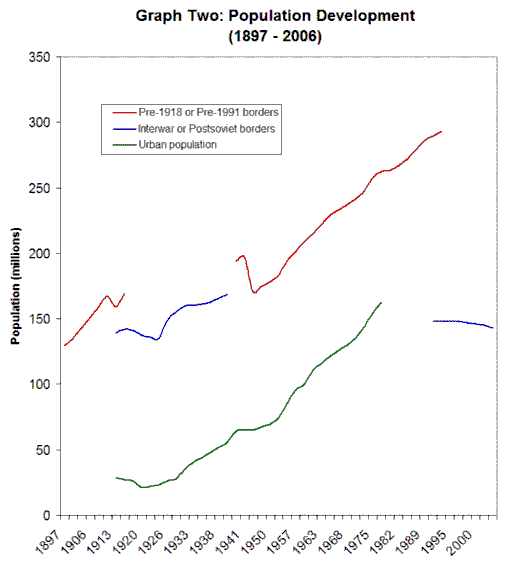
Thus, the Capitalist Transformation created a new general rule - a rule of power -, which step by step forced every traditional culture in the world to participate in modernization. In the Center, from which development proceeded, this led to heightened legitimacy. In the Periphery, legitimacy was undermined. The legitimacy that developed in the Center was bureaucratic, in the sense defined above - it arose out of a Deep, but mediated textural hierarchy, ultimately subordinated to the general rule of the World Market. Since the same general rule extended to the Periphery, legitimacy was here also potentially bureaucratic. But here the general rule was superimposed directly on tradition, with no intervening Density. The result was an unmediated hierarchy, where bureaucracy co-existed in constant tension with tradition and charisma.
A ripple in the outskirts of this vast movement was a coup staged by a group of activists in Petrograd, November 6-7th, 1917 - in which a Mass Party of Workers (numbering 76,000 and led by avant garde intellectuals), modestly took on the leadership of 169 million peasants, soldiers and restive minorities. But the Revolution was part of the Capitalist Transformation, not a product of ideology. It occurred in a country, which was definitely Peripheral, and it could not have occurred at all without pressure from abroad. Social structure in the Russian Empire was too archaic to produce Capitalism autonomously. The administrative hierarchy had hardly changed since Peter the Great (Durman 1983, p.40). Serfdom, which in the West was succeeded in the late Middle Ages by more flexible and efficient forms of exploitation (Anderson 1974b) survived until 1861-64, and even on the eve of the revolution only 20% of the peasants were in fact emancipated (Kerblay 1977, p.92-8). All classes had vested interests in the old order.87 The peasants resisted urbanization successfully, most of the bourgeoisie was anti-modernist, the state discouraged all change. Russia was a latecomer to modernization because there was no autonomous internal power strong enough to force the issue.
Modernization came in spite of this, as a result of pressure from abroad. By 1900, the world market had made substantial inroads: Russia had a 3.7% share in world industrial output in 1870, 5.5% by 1913. The factory labor force trebled to 3 million between 1895 and 1917. Cities grew, the need for capital increased and was met by loans and export of raw materials and foodstuffs (85-90% of exports in 1914 (Dobb 1948, p.37)). Economic infiltration was succeeded by military pressure, and when the State itself at last sponsored industry on a mass scale, it was because it faced an immediate threat: Social reform was introduced after catastrophic defeats in wars with capitalist neighbors, proving beyond doubt the inadequacy of the old order and its economic base.88 After the Crimean war, the emancipation of the serfs followed, after the Russo-Japanese war, the Stolypin reforms of 1906. Russia was in this respect a typical Developing Country - a feudal society forced to modernize, and racked by the attendant contradictions: Only 10% of the workforce was employed in industry, but enterprises were unusually large.89 Kerblay (1977) points out that large factories are a typical "shortcut" of late modernizers (p.173), and that their very size makes them unusually vulnerable to strikes (p.210). Similarly, Russia was the world's greatest grain exporter, but rural reform only strengthened the sedentary mir (Dunn 1967, p.11-12). Abolishment of serfdom produced millions of seasonal laborers, finding no security outside their village and drifting back to it after short-term employment elsewhere (Dunn 1967, p.10; Kerblay 1977, p.56). Living standards declined as over-population increased. Finally, the intelligentsia, as avant garde as the factories (and for the same basic reasons), was restive and more violently inclined than its counterpart in the West (Deutscher 1949, p.210).
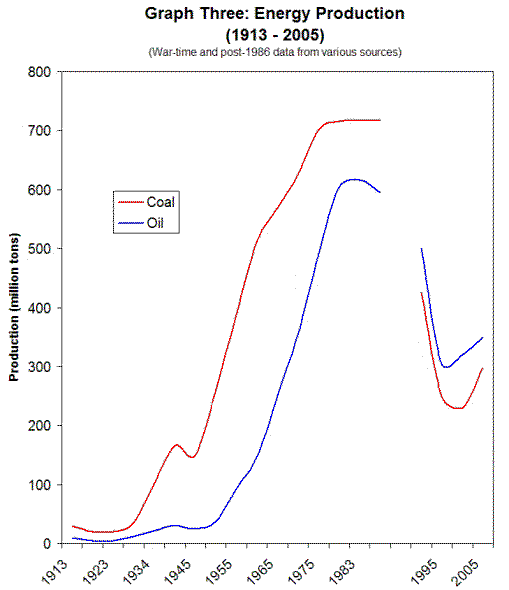
Beneath the old structures, a vast storm was building. And just as outside pressure created the storm, outside pressures released it - war with capitalist nations, in the throws of their next "pristine" transformation - which ultimately, as the saying goes, would "unify the world". Limbo is this Whirlwind. The bol'sheviki did not create it, and they could not govern it. Proclaiming freedom, they merely legitimized chaos in formal terms. Had they failed in this, they would have been swept away in few months, like Kerensky before them. All they could hope for, was to ride the storm till it was spent (Deutscher 1949, p.179).
Along the peripheries of the empire, independent national governments sprang up, mostly anti-Soviet. Cossacks marched against the Donbass, one of the bolsheviks' strongholds. The Ukrainian state blocked the relief. The Soviets attacked (Deutscher 1949, p.200). Foreign forces intervened, and the country plunged into civil war. Steel production sank to 5% of the pre-revolutionary level (Graph 5). In 1921, drought and famine struck. Grain harvests fell from 86 to 27 million tons (Graph 4). Forced requisitioning and peasant revolts followed. In 1918-19, 60% of the railroad mileage was in the hands of White armies (Dobb 1948, p.99). Provision transports failed, people fled the cities: Urban population fell by 25-30% (p.100). Direct population losses "...may have been in excess of 14 million, to which at least ten million lost births should be added" (Matthews 1972, p.10).
The bolsheviks were convinced that their role was to "hold the fort" till the real Revolution took over in the West. This view promoted loyalty and discipline, and justified many expediencies. Moreover, from a historical perspective it was in a sense correct: The Party was indeed the "vanguard of World Revolution" that it claimed to be, riding the Limbo-storm that Western Capitalism had created, professing an ideology developed in the heartland of the West. But it was not the vanguard of anything in Russia. The popular revolt it rode on the back of was itself reactionary, directed against the destructive forces of modernization. Only Marxism was progressive, foreseeing the demise of the old order and many characteristics of the new. But it mistook necessity for Utopia, evolution for progress. Mature Capitalism in the West, and State Capitalism in the East, with their mass institutions and mass culture, are the Communism of real life. All Marx's vision of the future lacks (though it is essential to his historical analyses) is power. In both real versions power is evident enough.
The fundamental question of Soviet history is thus not one of ideology, but of power. How was power sustained? How did legitimacy develop, and from what? I treat this question in three stages, describing in turn Charisma, Bureaucracy and Tradition.
A classical example of charisma is the Melanesian "cargo cult", which expects gods, ancestors, or, for example, President Johnson, to arrive on the Last Day with cargo - the produce of Western civilization. Such movements arise out of culture contact. An autonomous traditional order is supplanted by conflict between tradition and modern Western values. Wilson (1975) calls this dysnomy, which, in the Soviet situation, corresponds to Limbo. The charismatic leader is a Messiah figure who steps into the void, promising a new synthesis, a new Idea, and the dominant focus of legitimation is on this function of harmonization, rather than on the leader's person (Worsley 1957; 1968). The leader is thus "created" by the people's need, at times quite literally, as when a child, madman or dead person is leader. He is an impersonal focal point, a catalyst for a fragmented world, in whom the assurance of ultimate harmony is embodied. Charisma is thus inherently unstable. The leader demands faith and obedience of his disciples, who want signs and miracles to prove his status. If the last need gains the upper hand, the leader is discredited. If faith predominates, charisma is sooner or later "routinized" into a set structure. Only the tenuous bond of a shared mystery of expectation ties the leader to his disciples.
Charisma is therefore dependent not merely on a vision of a harmonious future, but on accentuating the disharmony of the present. It must be exceptional, must transcend and break all laws. Limbo is made universal, that the leader may be suspended in it. In this state of suspension his chimerical visions of a New Heaven and Earth become self-evident and inevitable. Charisma is syncretistic and transitional. It smashes worlds, and builds the New out of the shards left over, for the new cannot be built where the old survives. Lévi-Strauss (1962, p.16-36) has coined the term bricoleur - a handyman, assembling tools from whatever materials are available. The bricoleur is not a Messiah. The first is typical of Flat, Dense societies - an agent of traditional legitimacy, improvising because he has few specialized tools at his disposal. His tools and symbols are multifunctional, but stable. The Messiah arises in an Open Texture. He is absolutist and animist - balancing old and new against each other and charging symbols ex nihilo. His efforts spring from an acute lack of coherence and meaning in the world that surrounds him, and the tools - symbolic or real - that he creates, are functionally restricted and extremely fragile. They are dependent on instability, because their only content is the promise to do away with it - create the new Idea. We are on our way - to "the 'Promised Land' called the socialist world", and "only the Party committees can lead us as we should be led..."
In Russia the old order was crushed by pressure from abroad - war and the "imported" ideology of Communism. In a historical perspective this destruction increased mobility and made room for the emergence of a new, more powerful general rule. But until this rule was established, society hovered in a vacuum - Limbo - into which the intelligentsia stepped, the creators of the new Idea, kul'tura, the ideal of balance between state and people - the new massy and the old narod. The 20's - full of experiments, splintered values and shining hopes - saw the birth of this new Idea. Their catchword was mobility for its own sake - uncontrollable and free. Lidiya Fyodorovna called it a "thoughtless, lightheaded age".
"'I have... henceforth freed myself forever from human immobility, I am in constant motion' (Vertov). This is a culture of displacement, of changeable fortunes, of disequilibrium, of instability. This is 'eternal struggle, permanent revolution, the earth upturned'. It won't do to 'stand and sit, you must inevitably be drawn upward, downward to the depths, you must be drawn against your will' (Punin). Your eyes 'are forcibly attracted to those logical details that must be seen' (Vertov). This is 'the instant of a creative race, a rapid shift in forms, there is no stagnation, only energetic movement' (Malevich)." (Paperny 1982, p.45)
|
The architectural ideal of the 20's:
A flying city. (By G. Krutikov, 1928) |
Later, this release would be redirected into overarching channels, and the subtle emphasis on force in the quote be taken literally. But as yet, Limbo seemed to presage nothing but the glory of interminable freedom and change. The charismatic "balancing act" is essential to the Party's legitimacy. It has been said that the Slavophiles and Westernizers (cf. Chapter 6, Part D) were united in Bolshevism (Deutscher 1949, p.212), in which a "Western" avant garde placed itself in the forefront of a rebellion of "Asian" peasant masses, realizing the deepest hope of the Slavophiles by the opposite of their means. One of them wrote of this hope:
"The blind historical process has torn us loose from the people. Like all so-called civilized human beings we are alien to it, but we are not its enemies, for with our hearts and mind we are with it... Oh, that I might only flow out into the people's grey and coarse mass, drown myself without trace in it, but at the same time retain that light of truth and ideal, which I have attained precisely at the expense of the people." (N. K. Mikhaylovsky, in Kolstø 1982, p.77)
Bolshevism in its early form and the kul'tura of the 20's are expressions of this unstable balance of opposites. They spring from a charismatic base. They are syncretistic, not only in substance, but in form - as epitomized in the montage-technique of Eizenshtein's films. At the height of the Revolution, Aleksandr Blok wrote his poems Skify and Dvenadcat'. In Skify, Russia is history's sentinel, guarding Europe from the nomadic hordes. But,
"... from now on we are no longer your shield, from now on we go no more to war".
He calls to the Old World, which Russia loves and hates:
"... while you still live, while you still toss in sweet agonies" - come to us, "come to the brotherly feast of work and peace..." Or else, "we will watch... with our slanted eyes, while the furious Hun burns your cities, drives his flocks into your churches, and roasts the meat of white brethren on the fire!" (1918b)
In Dvenadcat', twelve hooligan Revolutionaries march through the flying snow of Petrograd, shooting at anything that moves, while the Old World snaps at their feet like a mangy dog.
A white figure appears "...before them - with a bloody flag, invisible in the blizzard, untouchable by the bullets, stepping tenderly upon the storm, as a pearly scattering of falling snow - before them goes Jesus Christ." (1918a)
This is Messianic syncretism on a grand scale. The Revolutionaries shall be the Apostles when East and West shall meet. It is beautiful, it is utopian, and it represents an intensity of commitment, which, in view of what followed, is directly painful to contemplate. Perhaps this is why Irina protested so violently when I suggested that the West might profit by assimilating something of Russia:
"No, there must be no synthesis! It is impossible. The West has the active life, Russia the life of prayer. The yearning for synthesis is the Tower of Babel. We are split and speak many tongues. We cannot reach heaven."
One try is enough for our age. As father Vasily said of Blok:
"He's a great poet, but dangerous. I used to think he was harmful, but now I see he was prophetic. He was a medium who passively mirrored the spirit of the people. But he is dangerous - for he had no strength of his own, he was just an expression. Light and darkness live side by side in him."
The importance of the Party lay in its extremism, its exclusiveness, in its difference from everything else. With no real stake in the tangled mass of contradictions that ruled the day, it could stand outside and represent the new Idea - kul'tura - the Messiah. The storm was too disunified for anyone but extremists to survive. And when the storm's power was spent, the extremists could not be unseated by such a fragmented population. They were unique. There was no other alternative to the formlessness and chaos of Limbo. As Trotsky said, on the eve of his own expulsion:
"The party in the last analysis is always right, because the party is the single historic instrument given to the proletariat for the solution of its fundamental problems. I have already said that nothing would be easier than to testify in front of the party that this is all [my] criticism, all the announcements, convictions and protests, - all of this was simply an error. But, comrades, I cannot say this, because I do not think so. I know that I cannot be right against the party. One can only be right with the party and through the party, since history has created no other paths to realization of historical justice. The Englishmen have a historical saying: my country - right or wrong. With even greater historical justification we can say: true or untrue on particular questions, in particular instances, but it is my party." (Trinadtsaty s"ezd RKP(b) 1924, p.158)
The party sprang from chaos, forced from without. No power could unseat it, because no unified mass movement ever existed. It would have failed in the West, where social homogeneity and class-consciousness were further advanced. Its existence depended on insecurity and fragmentation, and when Stalin set about establishing stable power structures, the utopian ideology could not be abandoned before stability was secure. But neither could anarchy be tolerated. Charisma had to be encouraged, but controlled - its autonomy and pluralism curtailed without lessening its force.
Worsley (1968) points out that charisma is often "routinized" by projecting Utopia ever further into the future. Stalinism was a projection in space. Utopia became a question of expanding or defending frontiers, and millenarianism was clothed in a military metaphor. Internally, moving civilization into the wilderness, conquering nature, was a condition for Communism. Externally, the threat from abroad was its prime hindrance. The party established discipline without endangering its charismatic base, by defining itself as a Warrior State. But its war was paradoxical: If it vanquished chaos before a stable power base was built, it would undermine the ground on which it stood. It was an army at war with Limbo - and dependent on perpetuating it. Its war was a "balancing act" - and in this form, charisma survives throughout the Soviet era.
War is the supreme metaphor of Limbo, and state legitimacy is intimately tied to its suffering and heroism. The Great Fatherland War rightly bears its name. It is a shared history, which the Soviet people as such claims as its own. Even as late as in the 80's, the army brings together all segments of society, providing a tough, but shared experience, creating the nucleus of a Soviet identity that crosscuts ethnic and local loyalties (Kerblay 1977, p.168). The War, besides, is a metonym (pars pro toto) of all the suffering that the Soviet Age brought about, much of which was unmentionable. As the universally revered Vladimir Vysotsky said in an interview:
"[A lot] is written about how I include war songs in my repertoire. That's not quite the way it is... You know we are all brought up on material from the war... Everyone in our country has victims, dead or wounded, among their close ones, the war touched us all. These are simple words, serious and clear... The songs are written by a person who lives now, for people who mostly haven't either been through all of that, ... so it's clear they must contain something that made me write them now." (Vysotsky 1983b, pp.198, 207)
Stalin's age was ruthless and arbitrary, its effects contradictory. But its primary result is clear: Out of years of Tsarist mismanagement and civil disorder, in spite of latter-day mismanagement on an even vaster scale and a second great war, an industrial superpower was built by 1953. Thirty years later, during my stay in Leningrad, the ferment and pluralism of the 20's seemed distant indeed, and the time more like that of the Tsars than that of Lenin. The program that accomplished this transformation was expressed succinctly by Nikolai II's Minister of Finance in 1900:
"International competition waits for no one: we must take energetic and decisive measures if our industry is to be able to satisfy the needs of Russia in the coming decades... The rapidly expanding foreign industrial enterprises are planning to establish themselves on our soil; our economic backwardness could increase our political and cultural backwardness." (Witte, in "Istorik - Marksist", No. 2-3, 1935, p.130)
Stalinism was a case of secondary evolution. It was the first "National Revolution" to arise from the Capitalist Transformation: a revolt against the West, closing its power out and modernizing the country on the basis of its own resources.
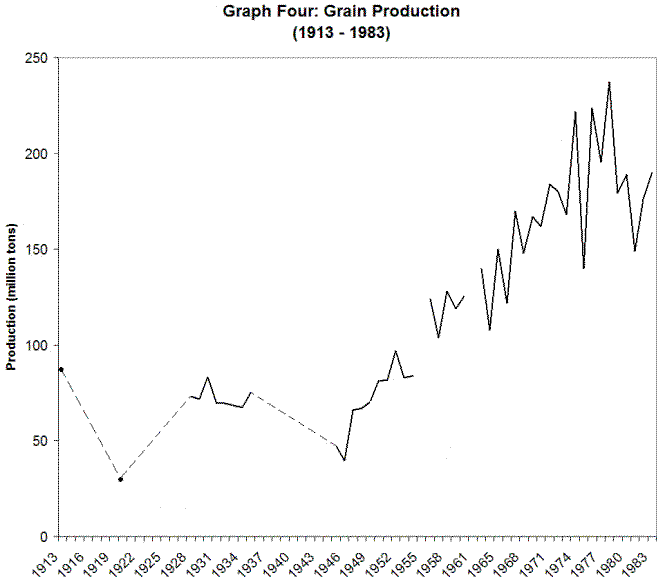
Stalin correctly realized that the accelerating Capitalist Transformation made modernization paramount to survival. In the long run, only by erecting a new general rule, by standardizing society and focusing its energies towards overarching goals, could one neutralize the pressures of violence from abroad, disintegration from within. The intelligentsia had welcomed the Transformation to Russia, mistaking it for a harbinger of worldwide Utopia. To Stalin this was illusion. Like other successful second-generation modernizers - in Germany, Japan, the USA - he embraced a policy of protectionism. Developing countries that attempt to compete on the World Market seem almost invariably to be reduced to dependency. Protectionism instead erects Barriers against the Market and attempts to establish modernity from within. Stalin's closure of the borders is an extreme expression of this theme. But protectionism cannot ward off modernity indefinitely. It gives a breathing space, which may be utilized to build the new general rule. But since secondary modernization has no internal impetus, this new rule cannot emerge spontaneously, "from below". It must be forced, and historically speaking it seems that only the state is strong enough to do so. Late modernizers may thus compensate for economic "backwardness" by political centralization (Gerschenkron 1970), and in this perspective, our analysis of state power in Chapter 2 (Part D) attains new meaning: The state replaces the aggregate order of the market - because it is the driving force of modernization, the agent of a "revolution from above".
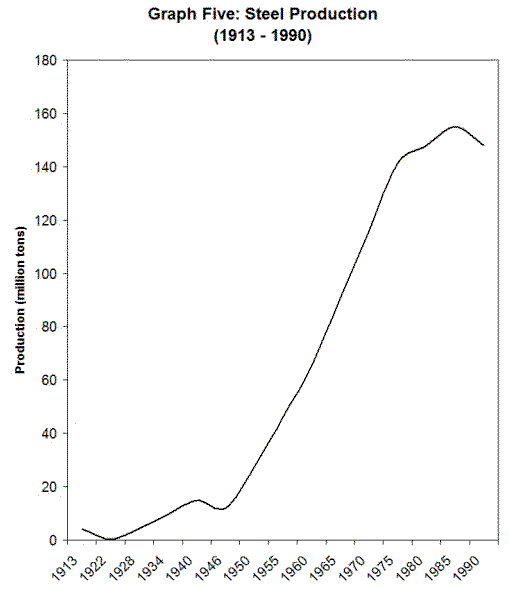
In the West, the market grew slowly, out of the increasing demands of numerous small-scale consumers with a wide variety of needs (cf. Habermas 1962). In Russia, there was only one monolithic consumer: the state. The state focused almost exclusively on enterprises of nation-wide standardization (defense and heavy industry), which developed at the expense of variety, small-scale units and the individual consumer's needs. Soviet modernization was completely dominated by the state's needs, and it was thus highly selective. While steel production increases rapidly throughout the age of Stalinism, grain production remains stagnant - and fluctuates erratically (Graph 4, Graph 5). Vast industrial conglomerates were "dropped from above" into an unurbanized hinterland: Even in the late 70's, 55.5% of the urban population lived in cities with more than 100,000 inhabitants, as compared to 40% in Western Germany; but with four times the population of the BRD, the USSR had the same number of small towns (pop. less than 10,000) (UN 1976, p.213, 236; Kerblay 1977, p.59).
Selective modernization thus generated an overarching infrastructure of vast institutional units, which was superimposed directly upon small-scale local communities. It produced a Deep Texture of rules without a Dense intermediate field: an unmediated hierarchy. The examples above reflect a systematic underdevelopment of all mid-range institutions and services. This, as we have seen in Chapter Three, corresponds to an incomplete sorting of acts, and a sparse and unstable inventory of mid-range roles and "offices". So although selective modernization was in a sense simply an attempt to "import capitalism" and "catch up with the West and overtake it", its results were too one-sided to produce stable bureaucratic legitimacy. In Western modernization, there was an intimate relationship between economic change and the transformation of basic values and attitudes - to time, morality and the individual's place in the community (cf. Löfgren 1979; Habermas 1962; Thomas 1971 etc.). The Western bourgeoisie first crystallized into a homogeneous class, and only then took over state power. In Russia, where no existing group had vested interests in modernity, people were forced to behave differently without changing their motivations. Massive movements of goods, people, ideas and information were brought about - by deportation, requisitioning and ideological pressure - in a society that lacked an overarching infrastructure in both material and spiritual terms. An integral part of this development was an attempt to "synthesize" a Western bourgeoisie, which could provide a stable source of bureaucratic legitimacy. The party thus built its own class basis. In Djilas's terms, it transformed itself into a "New Class":
"In earlier epochs the coming to power of some class... was the final event resulting from its formation and its development. The reverse was true in the U.S.S.R. There the new class was definitely formed after it attained power... It did not come to power to complete a new economic order but to establish its own..." (Djilas 1957, p.38)
As Foucault (1975) points out, an essential component of bureaucratic legitimacy is the examination system. This is a flexible and individualized means of determining a person's qualifications and loyalties, to "place him where he belongs" in the intricate web of "intermediate" roles and offices, which constitute bureaucratic legitimacy. Successive "exams" allow one to pursue a career, by advancing along a "ladder" of offices from the private sphere into positions of power in public. In this way, examination promotes not only individual freedom, but also social conformity. Examination, like the market, is a system of selection based on ordered competition.
Examination is an integral component of Stalin's New Class as well, but it lacks the autonomous dynamism of its Western counterpart. The New Class is bourgeois in that it unifies discipline with freedom. It is non-bourgeois, because its freedom is anarchic and charismatic, its discipline imposed by an external authority. Weber's "economic impulse within bounds" therefore does not aggregate spontaneously into an orderly bureaucratic whole. It is dependent on bounds set for it by the state, and disintegrates when these are threatened. As a result, the free competition for advancement through "exams" also loses its autonomy. The New Class is surrounded by Barriers, and admission to it is actively monitored by an external authority - which can override "exams", even at the expense of the requirements of the office to which one aspires. So if the ideal Western state is a unitary hierarchy of formal, bureaucratic offices, the Soviet ideal is dual: Bureaucracy is monitored by a second, controlling hierarchy - the Party. The Party's role, we note, is that of the gatekeeper, and this brings us back to the discussion of standardization and uniformity in Chapter 3, Part D: By imposing a system of controlled examination "from above", the Party is in fact not only promoting modernity and standardization, but co-opting the "purpose" of standardized tools as soon as they are built up, in order to defend itself as an Island. The basic reason for this is the weakness of state legitimacy, which necessitates a covert Quest for meaning side by side with the stated aims of modernization. But in its search for meaning, the Party undermines the logic of examination itself. Its Barriers are established not by competition, but by repetition, insistence, exclusion. The Party worker is not a bureaucrat, but an "absolutist".
The legitimacy of the New Class was thus a blend of examination and repetition. But its Quest for meaning often tends to overshadow the process of modernization. Since the old intelligentsia was too individualistic, it was exterminated. But the charismatic pathos of its kul'tura was too essential to the Quest for meaning to be abandoned. Instead, it was formalized and petrified by repetition into a rigid structure of "formulas" (official propaganda "art" derives from the once revolutionary style of futurism). Thus, a new kul'tura arose to fit the New Class - the massy. But the massy are not free, charismatic instigators of movement but victims of control, uprooted by an external force and tossed by it through history:
"Thus, people... lose their unattachedness in geographical space, but as a peculiar compensation, culture singles out specific persons who take on the heavy burden of movement, relieving all others of it... [T]he spectacle of a man torn from the earth creates an uneasy feeling... 'Locomotives tore across the country. A tormented whistle issued from their breasts: They couldn't keep up with the people. People took off, and nothing could stop them' (I. Ehrenburg). 'Time is condensed. It flies. It imprisons you. You must break loose from it, leap out of it. You must leave it behind. Time flew through them' (V. Kataev)." (Paperny 1982, p.50)
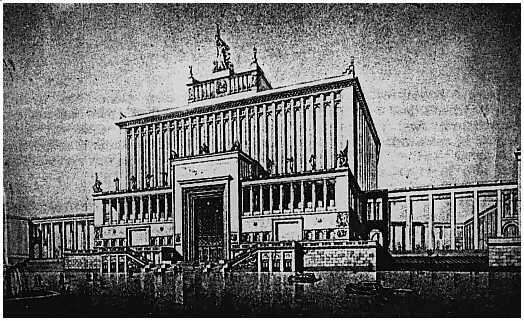
The architectural ideal of the 30's: Chained
to the ground.
(Paperny 1982, p.48)
The new kul'tura is an uneasy blend of charismatic freedom and absolutist control: a vision of potential balance, of a new Idea, but stabilized and suppressed - kept "within bounds" - by the external authority of repetition, which enables bureaucracy to survive. This is why cultural policy played such a crucial role in Soviet modernization, and often seems to weigh more heavily even than economy. For by gaining converts to kul'tura, the party swells the ranks of the New Class, and a new generation, more numerous and less independent, is raised to replace the old intelligentsia (Graph 6). But the opposition of freedom and control remains, and the self-image of the New Class is deeply influenced by its ambivalence. According to Kormer (1973), the latter-day intelligentsia had made opposition a lifestyle, which was simultaneously a symbiosis with the state:
"The entire being of the intelligentsia is pervaded by a deep-rooted dichotomy" - a "dual consciousness... Though the gulf remains unbridged intellectually, it is crossed existentially by a particular kind of skeptical or cynical behavior, involving successive switches of consciousness from one plane to another, and by the extraintensive erasure of undesirable memories." (Vestnik RSKhD, No 97, p.102-3)
Soviet legitimacy is thus a blend of controlled examination and militarized charisma. But a third factor has as great or even greater force: tradition. In the 20's, the old order was attacked by the charismatic ideologues. But traditional structures were vitally alive and resisted change. For modernization did not proceed from them, but from abroad. The consequences of this situation may be seen through an overview of rural, ethnic and family policy:
The 20's idealized city life and assumed that urbanization would follow as a matter of course. But in fact, urban population, after increasing from 9% (1860) to 18% (1913), stagnated or fell (Graph 2 and Graph 7). In May 1983 in Moscow, I spoke to the American historian Mark von Hagen, who had studied these questions in depth. He was convinced that there was hardly any urbanizing influence at all in the 20's: Contrary to what is often assumed, land reform did nothing to alleviate this trend - it may indeed have strengthened traditional rural society and hindered industrialization. By supplying subsistence agriculture with a secure economic base, it encouraged local self-sufficiency at the expense of state extraction and integration (von Hagen, p.c. 1983). In spite of the havoc wrought by the Civil War in rural areas, the result was therefore massive de-urbanization. The countryside offered greater security than the cities.
In the same way, ethnic policy failed at cultural modernization. True, written languages were developed for a score of Central Asian and Siberian peoples, and general literacy rose from 51% in 1926 to 81% in 1939 (Graph 6). But the intelligentsia were utopian internationalists: Since the World language would soon be English, alphabets were formed on a Latin basis. But modernization demands a standardized, national lingua franca, and Russian was the obvious choice for this purpose. By 1936 it was clear that World Revolution was not imminent, and Latin alphabets were exchanged with Cyrillic ones, nullifying years of painstaking effort. The process can, as L. I. Lavrov laconically remarks, "not be appraised unequivocally" (quoted in Bromley 1977, p.286).
Family policy shows the same trends: Aleksandra Kollontay proclaimed the emancipation of women, free abortion, divorce and marriage. Idealistic though they were, these reforms often reflected only stark necessity. More often than not, the reforms ran up against traditional values, with unpredictable results: In Vladimir a decree issued by the local sovet in 1918 made all women over 18 years the property of the state (Bach-Nielsen 1980, p.78). Free divorce was abolished in the mid 30's, after the rate had exploded to 440 per 1000 marriages, threatening the entire family institution (Table 9B). Mehnert's description of a youth collective illustrates the problems involved. Initially, "they were ready to start their human experiences at zero, 'like the first human beings'" (p.74ff). Everything was shared: sex, money, living space. They lived in true Communism. Then followed a gradual drift away from principles, forced by the exigencies of poverty and the need for order, and finally the Commune paired off into couples in the early 30's. Family policy threatened tradition without replacing it with modern alternatives.
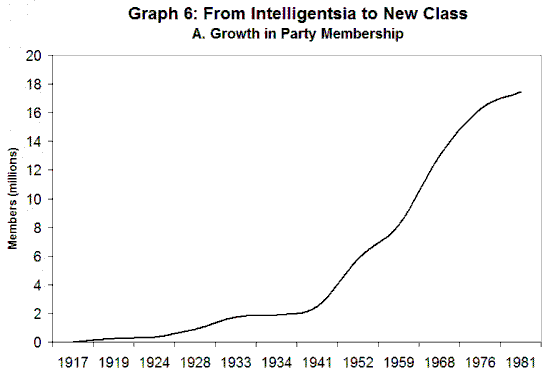
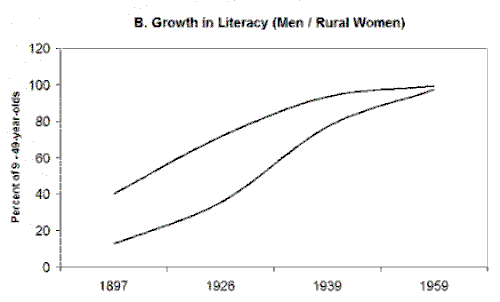
Under Stalin the attitude to tradition changed. True, all modernization destroys traditional divisions to make room for new general rules. But Stalin's selective modernization was highly inconsistent in this respect. Where tradition conflicted outright with high priority projects it was ruthlessly suppressed. Where there was no obvious conflict, or where society was too underdeveloped for modernization even to be attempted, it was left to evolve more or less at random. And where it might enhance state legitimacy, tradition was actively encouraged. Most importantly, selective modernization established a formal order legitimized by repetition and examination in the public sphere, and suppressed tradition into intimacy, after divesting it of its public (juridical, political and religious) structures. Conversely, under the extreme conditions of the time, people could only survive by upholding tradition in intimate life. Soviet ethnographic studies (e.g. Pimenov 1977; Arutyunyan 1980; Boyko 1977) confirm this view, and even indicate that tradition has experienced a resurgence in latter years. This corresponds to my own impression: In Dagestan, where religious rites were rarely practiced and claims to political autonomy never voiced, traditional family- and community-oriented rituals (weddings, funerals) were popular and admired - and on this level people showed national pride very explicitly. Thus, as Kerblay aptly puts it,
"Soviet society may be regarded as a two-tier society: Each person belongs to a national tradition and inherits its language, but at the same time that individual has the feeling of belonging to a far vaster community..." (Kerblay 1977, p.49)
Our understanding of intimate and public behavior thus acquires an underlying historical significance. The public order of the massy is imposed from above and without. It is modern, imported from abroad, sponsored by the state, divorced from the people, "cold" - and therefore formal. The traditional order of the narod is suppressed into intimacy, but divested of its formal trappings. It is necessarily informal. Modernity is a general rule, dominating the specific rules of tradition, but there is no mediation between the two - formality and informality belong (literally) to different worlds. They are separated by Limbo - the void.
Out of Limbo the charismatic hope may grow. Repetition co-opts the power of modernity and uses its formal rules to defend Islands. Expansion diffuses outwards from a tradition, which has "lost its formality", its inherent bounds. The "freedom" of expansion, its "twists and turns", its ungovernable ability to make things "come alive", are a result of precisely this: It has no internal formality, no rule of its own. Together, repetition and expansion - controlled examination and suppressed tradition - co-opt the whole project of modernization, undermining the search for power and turning it into a Quest for meaning, for kul'tura, for the new Idea. The "balancing act" of repetition and expansion in fact negates power, transforms a hierarchy of levels into Islands of meaning. When this balancing act fails, the massy and narod are reduced to a mob - the tolpa - as we saw in the parade on May 9th.
But the nature of this balancing act varies greatly from nationality to nationality within the Soviet Union. The contrast is most noticeable between the North and the predominantly Muslim South. The Northern countryside was ravaged by selective modernization, and its traditional formal order (as embodied in the patriarchal extended family and the communal authority of the mir), were nearly obliterated by collectivization and raskulachivanie (liquidation of the kulaks). It is often supposed that this campaign, involving forcible deportation of millions and arbitrary shootings of hundreds of thousands, was an attempt at modernizing agriculture by enlarging farms. I doubt this. Certainly, the first years of misguided, incomprehensible bestiality were a failure in any and every sense and policy was later revised (Table 2). But it may be argued that the goal was never to modernize agriculture, nor even to increase agricultural production, but to drain the traditional rural community of all resources - human, material and spiritual - and destroy any formal order which might effectively resist modernization:
A middle-aged man told about a friend who was deported as a kulak (or so he thought, the reason was never specified), along with his whole village. In mid-winter they were left by a river, in the heart of the taiga, without tools or provisions. Many died, a few escaped (distance was the only barrier), the rest survived in the miserable shelters they managed to erect.90
There is no conceivable constructive purpose behind the treatment of these people. If it had any purpose at all, it was consciously destructive, a frontal attack on a lifestyle too entrenched to die a natural death, yet not allowed to live. Deportation and hunger succeeded where the ideals of the 20's failed: They disinherited the peasant and forced him to leave for town. In a vast surge, urban population, at 18% in 1926, increased by 28 millions to 32% in 1939 (Graph 2). War struck again, but now people did not abandon the cities.91 The countryside was no longer safe. This more than anything indicates the bitter success of Stalin's policy.
This "success" was not only inconsistent, but based on inconsistency. The ostensibly "socialist" collective farm was nothing but a patched-up version of feudalism, designed for maximum exploitation without attendant modernization of agriculture. Kerblay (1977, p.92-8) observes that local sovets to this day carry on many functions of the traditional mir: distribution of internal passports (until 1981), corvee for upkeep of roads, collection of taxes, administration of local finances. Other aspects (which we have already discussed in Chapter Two) are even more striking: the weakness of money, prohibition of free movement, subsistence farmers cultivating the "lord's demesne" and keeping alive on tiny private plots worked in their free time. The survival of the family plot under conditions of "socialist agriculture" is often viewed as a contradiction in terms, but in fact it was a precondition for selective modernization. Without it, the peasants would simply have starved to death (see note 54).
This, among other things, is what is implied when we state that tradition was suppressed into intimacy. Formally it was denied, but informally it remained essential to both people and state. People were left to fend for themselves, and informal traditional networks of friendship and family became a prerequisite for life. This becomes evident when we contrast living conditions in the North and South:
Olya once took a cruise on the Volga. The ship docked at many villages and small towns, where people queued for margarine, and the waiters on board made shashlyki out of meat scraps, and sold them with a glass of wine for 1.5 rubles. People flocked around - for a taste of meat. "They don't even know what meat costs out there!" she exclaimed.
In Dagestan I was amazed to see common people living in (relative) luxury. I was told that living standards had improved vastly during the last twenty years, particularly in the 80's, when recession had racked the North, and (even more striking) in the countryside. Immense private homes were erected; cars, hand-woven carpets and other luxuries were commonplace. A man made a living repairing Western cars - Mercedes, BMW's etc. If roads weren't improved, he told an acquaintance of mine, he'd never worry about money. These differences have far-reaching demographic consequences (cf. Table 9A-D): In the North, families are small and divorce common. A Moscow survey shows that couples want more children (an average of 2.3) than they get (1.4). An important reason for the discrepancy is bad housing (50% of answers), which is also a major cause of divorce (Kerblay 1977, p.122, 126). In the prosperous South, families are large and stable. As a result, population is stagnant and rapidly ageing in the North, while still growing fast in the South. The economic consequences are serious, since industry is concentrated in the North, where labor shortages are chronic at any rate.
People's attitudes to the state also differed radically. In Dagestan the state was respected and admired, and similar impressions are conveyed by accounts from Central Asia92 (Krag 1984, p.23-4). In Leningrad everyone complained: workers, intellectuals, party members and dissidents. The dilemma of the North is that of selective modernization, which could utilize only the most easily accessible and developed resources. In human terms, these were found in the North, and particularly among Russians. Russians were on the whole more mobile and educated, more dedicated to the charismatic cause than most other groups. One might say that they were used - as an ethnic group, a tradition - as an instrument of modernization. They populated cities and manned factories, were sent as emissaries to the furthest reaches of the country (cf. Table 9G). Selective modernization overexploited such loyal and "developed" groups, and impoverished traditional Russian culture and living standards. "Russians have lost their roots," Nina Mikhaylovna said. "They're nothing but a mob (tolpa) now."
But as Vasya aptly put it, "all nationalities who live closer to the soil are better off." Many "backward" groups were left to themselves. They did not enjoy the scant benefits of modernity, but they escaped exploitation and control. Stalin evidently permitted an extensive black market in the Caucasus (Khrushchev 1970, p.284), and collectivization was not as rigidly enforced in the South (Arutyunyan 1970). Traditional networks therefore survived far better here. The prosperity of the South cannot be accounted for in monetary terms. Vasya confirmed the official fact that wages are lower in the South, but, he continued, it's easier to make a living "on the side". Mars and Altman's (1983) discussion of the role of tradition in Georgia's Second Economy confirms the view of a Danish specialist on Central Asia (Krag, p.c. 1983), that Southern prosperity was a product of informal barter, mutual help and family loyalties. In Dagestan as well, this seemed to be the case. Economy was a point on which people were consistently vague when asked (while they talked openly enough e.g. about politics), but great importance was placed on the honor and responsibility inherent in a large circle of "guest-friends" (kunaki) and a supportive family. And when the state (in the 60's) belatedly started giving priority to services and welfare, this contribution, though meager in itself, entered the traditional networks as an extra stimulus, and had far more noticeable effects than in the North.
Thus, selective modernization suppressed tradition into intimacy, where it survived in the informal organization of "friends and relatives". We have seen (in Chapter 2, Part B) how the Russian uzky krug diffuses into a wider field of informal contacts. The Second Economy is of course an important expression of expansion. But it is no secret that such "animistic" networks spread still further outwards, particularly in the South, where something very similar to a mafia (Blok 1974) permeates regional administrations, at least in the Caucasus (Mars & Altman 1983).93 The survival of tradition therefore has fundamental political and economic repercussions, and the difference between North and South is only one aspect of this theme. Every Soviet nationality experienced modernization differently, and in no case has standardization been consistently enforced. Its power has instead been co-opted by local absolutists, who have permitted expansion (e.g. as corruption) to flourish on the basis of traditional social organization, values and networks. Indeed, selective modernization has in many respects tended to accentuate cultural differences and utilize them for its own purposes. It has transformed ethnic groups into Islands, instead of standardizing them.94
Stalin's state therefore had no unitary basis of legitimacy. Policy was a charismatic "balancing act" between bureaucratic and various traditional legitimacies, one taking over when the others failed.95 Thus, Fairbanks (1978, p.144) shows that each member of Stalin's inner circle built his power on a personal Island, an extensive network of clientage based on mutual support and loyalty. These networks spread throughout the state structure, and bureaucratic legitimacy was undermined by personal "fiefdoms" or vedomstva, which were protected against central interference by their patrons. Fairbanks points out that regional and ethnic networks must have been more stable than those based on specialized institutions (e.g. ministries, the police), since their internal legitimacy was more deeply rooted.
Russians were the activists of the "Revolution from above", and represented a traditional legitimacy-base of great power. During Stalin's reign, legitimacy was therefore increasingly constructed on a Russian foundation - even the Orthodox Church was to some extent encouraged, and loyalty to the Soviet Union and Russia subtly blended. In a broader sense, however, the leader allowed each of his lieutenants to develop a partial, often non-Russian legitimacy in their personal fiefdoms, because the support thus gained would ultimately devolve on the state - but he could not permit this independence to go too far, not only because it threatened his own supremacy, but because it might lead to total dissolution of the formal, bureaucratic order. So Stalin balanced Russian nationalism against "internationalism" (i.e. various non-Russian legitimacies), his lieutenants against each other, and the whole patron-clientage system against the bureaucratic rationale of a modern state. In this Byzantine court of intrigue and counter-intrigue, he became the archetypical absolutist and animist in one. The Quest for meaning and legitimacy became an all-consuming concern, and the technical problems of practical modernization degenerated into squabbles for influence and prestige between the various groups he balanced against each other.
It is fascinating to read such documents as Khrushchev's memoirs in this perspective. Since the Ukraine was Khrushchev's fiefdom, he was responsible for combating the famine there after the last World War. The situation worsened, and Kaganovich was sent from Moscow to "help him" (a clear threat to Khrushchev's position). On one occasion he visited a kolkhoz, which practiced a method of "shallow plowing":
"(Y)ou'd have to know Kaganovich and how he talked. He roared at him, at that kolkhoz chairman: So, you plow shallowly, do you! But he answered him in Ukrainian, I later got to know this Mogil'chenko, he's really a man who knows his stuff, he says - I plow like I should plow - jist like Ah oughter. He talked to him in Ukrainian. Well, so he said, now you plow shallowly, later you'll be begging for grain from the government! No never, he said, I never, he said, asked the government for grain, Comrade Kaganovich, I send the government grain myself, that is...
Well, so you see, Kaganovich was very alarmed by all this. He said, later he said, you know, I'm afraid he really will get a good harvest with his shallow plowing. Now, you need to know that, well, Kaganovich had just recently taken up the fight against shallow plowing, and the so-called... at the time there were entire trials against the bukery. And so the bukery, those who supported bukero, that is, were even, I think, sentenced and convicted and destroyed, well, yes. And here he was suddenly confronted with, that this shallow plowing, this was also buker-plowing, that is, although that was just stupid, that is. At the time, I believe, this theory was popular, particularly in Saratov, this bukero, and there, I believe, some professor, I forget his name, I believe, he suffered, I believe, he was convicted, that is, - or went to jail or even worse than jail." (Khrushchev 1981, p.132-33)95a
Stalin could not be challenged, but each lieutenant strove to increase his power in his own fiefdom, and to control information between it and the leader - each was both animist and absolutist in his own right. Often, as in this example, they would sacrifice all bureaucratic rationality for the purpose of defending their Island (cf. also Khrushchev 1970, p.99, 291). Stalin himself was of course the chief absolutist, controlling all vital decisions, keeping information of national importance from even his closest advisors (p.154, 205). In latter years he hardly moved from his narrow Moscow circuit, where all threads converged. Within this uzky krug he was the master animist, whose rule was achieved by informal and unstructured manipulation of subtleties: "I doubt that there has ever existed a leader in a similarly responsible position who has wasted more time than Stalin did, simply sitting at the dinner table, eating and drinking," remarks Khrushchev with endearing naivety (p.124). Djilas, a subtler nature, dispels this impression:
"There were no set rules for which members of the Politburo or others in high positions were to be present at these dinners. The participants were usually people who worked on projects that at the time were in the foreground, or concerned some specific guest. The circle was clearly very limited, and it was a great honor to be invited... Such a dinner usually lasts six hours or more - from ten at night to four or five in the morning... In reality, much of Soviet policy was decided at these dinners." (1962, p.64-70)
The abundance of hidden motives and counter-information undermined the stability of bureaucratic offices completely and made the "personal responsibility" and "secret knowledge" (cf. Chapter 3, Part C) of an emissary of the state more or less unlimited (Khrushchev 1970, p.171-2). Khrushchev recounts how he discovered the reason for a series of mysterious horse-deaths during the war. Only by appointing three independent and mutually controlling commissions, did he succeed in discovering that the cause was not sabotage but wet hay:
"We had won more than a mere victory for agriculture. It was a moral and political victory," he exults. "But how many kolkhoz-chairmen, agronomists, breeding experts and scientists had not lost their heads as saboteurs before I [!] stepped in and took over leadership to solve the situation?" (p.109-111)95b
Soviet modernity was bought at a price we cannot comprehend: The Civil and First World War cost some 14 million deaths. Perhaps 7 million died from collectivization and hunger in the early 30's. Some 20 millions went to labor camps, and no one knows how many survived. Perhaps as much as 30 million died in the Second World War - some 1.0 - 1.1 million of these in Leningrad alone (Table 2, Graph 7). Modernization is always violent, and secondary modernization "from above" particularly so. But the needless suffering of Stalin's age cannot be explained by economic necessity alone. The crisis of legitimacy - leading to a virulent and destructive Quest for meaning, to perpetual squabbles for influence and prestige regardless of human loss - enlightens us somewhat in this respect. But only when we view these factors in conjunction, and add to them the pressure of invasion from abroad, do we begin to see how - if not why - the age of Stalinism could arise and endure.
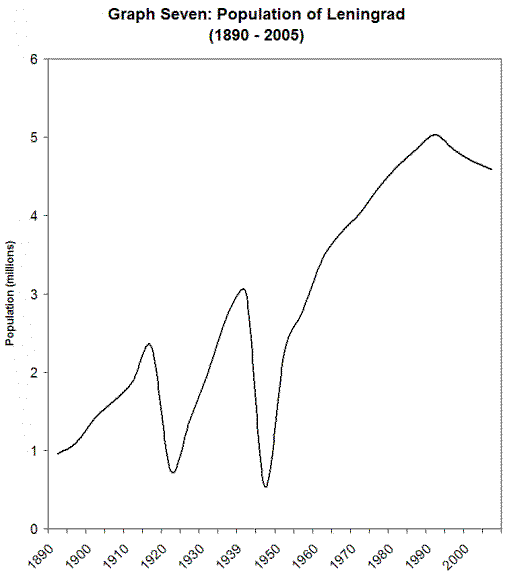
The legitimacy of selective modernization was a charismatic balancing act of suppressed tradition and controlled bureaucracy - expansion and repetition. In an ideal case, the three types of legitimacy might have followed each other in sequence - traditional society evolving into modern bureaucracy by way of a transitional, charismatic stage. But in the Soviet Union legitimacy was such a scarce resource that the three historical stages were cemented into a fixed organization of post-Stalinist society by three different principles. The "diachronic" sequence was compressed into a "synchronic" structure: Tradition was suppressed, and continued to function only informally. It remained rooted in the intimate sphere, from which it diffused by expansion into other areas of informal social organization (Limbo). Bureaucracy was seconded and over-ruled by a parallel hierarchy of control and privilege. The lifeless formality of its "foreign", modern rule was co-opted by repetition and came to dominate the public sphere. Secondary modernization did not integrate these two spheres, but polarized general and specific rules without mediation, increasing the violence and unpredictability of government and sucking tradition dry of its most vital resources. The Quest for meaning - where meaning was so scarce - accentuated this violence. But its essential rationale was one of balance and increased Density, rather than of power and Depth. Under less stressful international conditions, balance would perhaps have been achieved, Limbo might have been stabilized and the tolpa's energies would not have been wasted in bloodshed. But instead, Limbo - the social "vacuum" - remained inherently unstable, and only charisma could balance its opposed forces. Limbo, which arose out of revolution and cultural dysnomy, remains a battlefield to this day (i.e. 1986), even after the violent historical paroxysm has spent itself. It came to dominate the entire Texture of Soviet society, and was internalized by people as values and attitudes that shaped even their most personal lives. We must now take a closer look at how this internalization comes about.
Since modernization was to a large extent brought about by their efforts, the heritage of Stalinism is most forcefully felt today by Russians. But by exploiting Russians as a people, selective modernization has enhanced, not weakened their identity, their sense of mission and uniqueness. Though Russian language and culture is triumphant from coast to coast, Russians often feel (often with reason) that they have enjoyed few privileges as a result. But disillusionment springs not so much from contrast with other nationalities as from the direct effects of modernization on Russians themselves. In particular, the family has changed, and through it, the patterns of socialization:
Modernity effected Russian men differently from women. Men were the front-line soldiers in the battles of the Warrior State: In the Great Fatherland War and on the internal frontiers - building industry, filling the cities, digging the mines. They swelled the labor camps and prisons by the millions. This mass absence of males from their families has led to a general weakening of the male role, high rates of male alcoholism96 and increasing male mortality. As late as in 1959, the European parts of the country had only 44% males due to War losses and other calamities. The inequality was later reduced, but in the late 70's the recovery rate slowed again, and life expectancy for males soon started declining rapidly (Table 9F). Russian men remain the main agents of controlled bureaucracy. They staked their lives for the "formal" order of the state, and were struck most heavily when its "forms" turned out to be empty. Their traditional role as authority figures has been supplanted by one of "cold", "foreign" formality. They became the clearest exponents of absolutism. The patriarchal Russian family has thus been divested of its male head, and even when present, the man is rarely able to make his authority felt at home (see below, Chapter Five, Section B).
Women were also drawn into the public sphere, and the percentage of working women in the Soviet Union is among the highest in the world (Kerblay 1977, p.30). But they were never "drawn out" as completely as the men. Women generally have less qualified and prestigious jobs, work closer to home, keep more flexible hours, etc. (Kerblay 1977, p.128, 188-90). They are left with an exhausting double workload, keeping house and a job outside it, but have retained a real responsibility for the home, which men have very often lost. Women have thus retained strong roots in intimacy. They are agents through which tradition is perpetuated. The state does little to lighten their burdens or increase their independence,97 but has praised them as a locus of stability since the 30's. But since the traditional family has lost its formal order (e.g. its male head), they are also agents of informality and "warmth" - of animism.
The typical Russian urban family thus has a stable mother figure, a non-participating or absent father, one or two children, and very often a grandmother (babushka). In anthropological studies of urban black poor in the US, similar family structures - arising from many of the same causes - have been called "matrifocal" (Harris 1971, p.485-7). Primary socialization is thus more heavily dominated by females in Russia than in most of the West. One may object that parents, including women, have little time for children at any rate (Kerblay 1977, p.151-53). But this is not a valid objection, for two reasons. First, 25% of urban households are three-generational (vs. 5-8% in France) (Kerblay 1977, p.140-41), and in a majority of cases the grandparent is female. A Leningrad survey (Ruzhzhe 1983, p.49-50) shows that this figure is deceptively low, as cooperation between young couples and parents and grandparents is common, even when they do not live together.98 Secondly, women occupy the vast majority of jobs in kindergartens, children's groups, elementary schools and nursing (Table 9E). Bronffenbrenner sees this as an expression of greater continuity between home and school than in the US (1970, p.50).
The values emphasized in this primarily feminine sphere are "warm", "informal" and therefore inclusive and collective. (Several mothers I knew said they had to go to bed every night with their children to get them to sleep.)
"Russians are accustomed to close physical contact with children... They show exaggerated concern to protect the child from all bodily harm. Yet at the same time children quickly learn to consider outside adults as uncles and aunts... which helps to soothe the child when left with other people... [Children] tend to confide more in their mothers, but get more understanding from their fathers when contact can be established, and Soviet sociologists would like to see rather more paternal influence in order to produce emotional stability in children who are overprotected by their mothers." (Kerblay 1977, p.151-54)
The literature indicates that sanctions in the family are mostly informal. Punishment is usually indirect, with emphasis on the child's having "disappointed" the parent and lost the right to love. Withdrawal of affection and exclusion from the collective are recommended educational methods (Bronffenbrenner 1970, p.23). Collectivity and informality are thus typical features of Russian upbringing, that create a closed sphere of emotional intimacy around the child and conserve tradition in the intimate sphere, but at the same time weaken its formal authority (see Boym 1994, Mørck 1998). Home life is intensely alive, but often undisciplined. Without a khozyain, it is animistic.
But the continuity between home and school that Bronffenbrenner emphasizes is dramatically broken by the transition to the public sector and secondary socialization. At one moment the child is secure in the intimate sphere and believes the whole world to be like it. Then, without forewarning, he is "drafted" as a "soldier" of the Warrior State, confronted with the "cold" of the external world. It is hard to generalize about when this "break" takes place, but some situations seem to be typical: starting work and discovering that opportunities are not as golden as you thought; moving to the city; getting married early and seeing fluffy, romantic dreams dissolve in the trivial problems of daily life; confrontations with the authorities. The archetypical experience for men is military service (lasting 2-3 years, usually without leave).99 For this and other reasons, the "break" affects men more generally and violently than women - an important reason for the weakened male role (the archetypical "break" for women is probably having children, which, however, commonly involves the woman even more deeply in family obligations, and which is therefore perhaps, on the whole, a less uprooting experience).
The "break" casts you out into Limbo. The problems of "making a career", the aimless and tiring "hunt" for a "Place", the "enforced pluralism" of cramped living quarters, dubious neighbors, queuing and dangerous work conditions - are all expressions of the history of selective modernization that produced a dominant social Texture of unmediated polarization and weak mid-range institutions. The key problem, however, is not material, but spiritual. For Limbo has two separate and opposite interpretations: In one version, you are brought up in intimacy and later fight to preserve it. You are an animist who must learn to become an absolutist - protecting the inclusive freedom of expansion by insisting on the exclusive barriers of repetition. You may be sent to the furthest reaches on the most Kafkaesque missions, but you are a soldier defending your Island, and you will wait and endure. But at some point, many, perhaps most, people suddenly "fall through" this interpretation into another.
"Sooner or later a man confronts an injustice or a lie so glaring that he can't keep silent." Then he speaks his mind, blurts out all the pain, and "experiences an unusual and lasting feeling of freedom and omnipotence." This continues until he is called in by "Nikolai Petrovich or Sergey Ivanovich, or, if worst comes to worst, Vladimir Fyodorovich", who tells him: "'My little man, you cannot crush the hammer with a whip!'" (Bukovsky 1978, p.64-74)
In some sense (not necessarily ideological) you grasp that life is "not the way we've been told". It is this mental revolution that constitutes the "break". Suddenly, for you, personally, society is no longer legitimate. The balancing act is disrupted. The exclusion of absolutism no longer serves to defend the inner freedom of animism, and your Quest for meaning is revealed to be subordinate to power. You become a specialized cog in the machinery of standardization - nailed to a hierarchy instead of negating it. But the "machinery" doesn't work. The hierarchy is unmediated. There is no way you can "compromise" between general and specific rules, as in the West. So you crash through the fragile structures of meaning into the Unknowable. Stalin on his pedestal is toppled into his grave.
Once one has "fallen through" there is no way back, no "art of compromise", no mediation between disillusionment and innocence, because the battle myth is charismatic and absolutist. You either believe in it or not. If not, you desert, turn traitor, are forced back into intimacy - feeling all the time that this is to betray it. For neither the public nor the intimate sphere is self-sufficient. Tradition and modernity, animism and absolutism, are entwined, and to retain your belief in either, you must somehow encompass both. You must "unify the two times" - not by an "art of compromise", but - as Stalin with his lieutenants or Vitya in his delo - by a "balancing act", which creates meaning ex nihilo.
I shall conclude with a conversation I had with Misha, a man who came to Leningrad from a city near Moscow to work - in a factory similar to the one I described in Chapter One. To him, this experience was a clear "break". He was cut off from his family and left on his own - suspended in Limbo, bereaved of his ideals of "human" relations. Our talk conveys the atmosphere of this state of suspension - of the tolpa without the unifying Idea of kul'tura.
I had been in Leningrad with a group of young Scandinavians, and Misha and I spent a week partying: girls dancing in gossamer dresses, men laughing, drinking, relaxing - smiles, friendship, wine and warm embraces. It made an immense impression on Misha. Now we sat alone in luxurious chairs on the 12th story of a Swedish-built hotel. Below, the city shimmered in winter mist, and the sun lay red on the horizon as we opened the portveyn he had brought, then bottle after bottle from the bar upstairs, and early next morning, when all other alternatives were literally drained, the Danish "Solberry" I was taking home with me.
- "You drink this for its taste," I explained hopefully. "Pour a little in a glass and just sip..."
He nodded. Next day, when I returned from town, it was empty.
- "Can I have the bottle?" he asked. "It's beautiful... the tiny brass cup on it. They don't make these things here."
Sure, take the bottle! Then I understood: the fine and special thing was the container, the fascinating form from abroad - not its contents. It reminded him of the human beauty he had felt when the foreigners were here. But he couldn't take it before it was empty...
Last night I asked how he liked his new job. He was happy with it, he said: "Work gives life rhythm..." Then he turned to me, earnestly:
- "I want to leave this place. Run away from it all. It's so bad for us here... The work, all that, it's so complicated. And simple. I can't describe it. It would take days..."
But his friend Sasha had described it concisely: After military service in Leningrad, Misha decided he would stay here. It seemed unrealistic, but he was lucky and got a lousy job in construction. Then he maneuvered himself to this factory, where he was even promised good wages: 300 rubles monthly. After two weeks he got 25 - they told him it was an advance. At the end of the month he got another 50 and that was that. But the most "complicated" part was the people. Sasha had worked a while as a guard at Misha's work place. As one of two who didn't drink heavily (of the guards!), he got so popular with his employers that he had problems leaving when he needed to move on to a new job.
- "It's bad here, I tell you, bad to live here," Misha sighed.
I objected that there were some people who followed their convictions and lit up the drabness. He thought for a while:
- "Yes, there's Vysotsky. He's a new Pushkin. Vysotsky was honest. He was a saint... But he suffered! He had integrity and courage, all the rest were cowards... But no one understood him. They all think he wrote blatnye songs...100 How is that possible? They don't understand him at all. Vysotsky fought. He gave his life, but wherever you look otherwise - everything runs out into drunkenness. You just can't imagine how bad it is for everyone here!"
- "So why do you want to leave? You think things are better in the West?"
- "I'd just like to... rest for a while. And then - to war...! I want to associate with people simply and sincerely (prosto i iskrenno). I want peace of soul."
- "But do you really think it will be easier to rest there? Weren't the days we spent here with the girls an exception?"
- "Don't you understand...? We were just friends, people together. It's an ideal. They're just people, so I love them. I love you too, because you also came from there. And if it should turn out... that it's as bad where you come from, just as rotten... then it's better just to take one's life."
He switched on the TV. To get him onto another track, I asked if he knew anything about the besprizornye, wandering orphans of the 20's and 30's, which I had recently read about.
- "Never heard of them. They don't teach us history. They suppress the past."
The screen flickered, and we watched soldiers running through dense woods, a documentary from the War.
- "They keep showing that war. They live in the past - like my parents... My parents don't think of anything but the way it used to be, and how to survive today. They believe in that." He motioned at the screen. "I'm against the way my parents lived. It's terrifying to be so. I wrote to them about it and they answered - 'you don't read the kind of things you should'."
His father has worked in industry all his life. Fifteen years old he left his parents, who were peasants. He moved around, met his wife, moved to the city where Misha was born. They moved again, and again, and again, as the need for workers arose at the new factory sites. At last they came to Voronezh, where he is now a crane man.
- "I love my mother more than anyone," he said. "I have a younger brother. He works. Drinks and acts rough - never thinks about anything. It's easier that way. We have no contact, except through my parents. We're so few, and we hardly see each other..."
- "But you have friends?"
- "They all call themselves friend (drug), but few are. Most are just some kind of bottle sharers and acquaintances (sobutil'niki i priyateli). They're probably all lonely, but won't admit it."
"We live in hell, you live in heaven. But you're not living right, because you've forgotten about suffering."
(Tolya)
Secondary modernization did not kill the Russian tradition. It is still a living force, and Tolya once gave me the opportunity to catch a glimpse of its roots. Tolya is an academic with a good job and a large apartment. He and his wife are Orthodox Christians. He is sociable, always rushing to and fro, to the frustration of some of his friends - and to the relief of others, who benefit heavily from his extensive network. He says he is "very active", and also, with a sigh, "frightfully undisciplined". A mutual acquaintance shook her head and called him a "big baby". But he is kind-hearted and unusually outspoken, and in the midst of all the suspicions and conspiracies of the Leningrad intelligentsia, he is a refreshingly candid and honest person to know. His generosity knows no bounds, and in taking me along on the trip I shall soon describe, he showed not only openness, but also considerable courage. Had our errand been discovered by the wrong persons, it could very well have landed him in serious trouble.
What I liked above all in Tolya was his prostota. Before eating he would run through a prayer at breakneck speed, so I initially thought that it was a mere formality for him. But I soon realized my mistake. The speed of Tolya's recital was perhaps just another example of the "fast" behavior we have discussed above (see Chapter 3, Part E), and should, I think, be understood as an expression of his firm belief that God would hear him, no matter what voice he spoke in. This struck me on one occasion, when he continued after saying grace with another prayer, at the same breakneck speed, for two friends who had been sent to prison camp. He had himself once been interrogated by the KGB, and although he escaped punishment, there could be no doubt that he took the threat to his friends' lives very seriously.
Once he took me to visit a Christian physicist who worked as a stoker,101 having lost his job at the Academy of Sciences. They talked about nothing but friends and acquaintances who had been fired, harassed by the police or sent to jail. Common sentences are four to five years of camps and years of exile. The atmosphere was heavy with fear and rumors. "They say Father Pavel was killed by the police..." "They say Shura works for the KGB..." But I always felt the Church must have another face, less fear-ridden and more wholesome. I had been told of the starcy, hermits who are so famous for their wisdom and godliness that pilgrims flock to them for all manner of practical advice.102 Once, in the old days, merchants came to a starec and asked which road it would be profitable to take, left or right. The starec thought for many hours. The merchants got impatient and demanded an answer. "I cannot say," he explained. "God has not told me yet." So when Tolya invited me to a monastery outside Leningrad, I said yes. It is one of the few places where there is still an old starec alive (after 15 years in camps). "He never condemns," Tolya said. "He forgives everyone... I once saw a starec," he continued dreamily. "There was light coming out of his eyes. Clear rays of light."
Our train passed through green, undulating Russian landscapes, about which the guide book read: "There doesn't seem to be anything special [here] - open, scant fields, but they have both sadness and majesty. Here one feels very strongly the ties to the soil, which purifies a man and thereby strengthens him." There was something deeply and fatally Russian about it all. As Tolya said - pointing at a ruined tower: "The remains of Russia..." We stopped to go to service in a beautiful old church. Inside, it was suffocating: The congregation was old and feminine - wandering around and squabbling with more than usual indifference. Two young women stomped in on plateau shoes, bought candles, and left. None in the store, apparently. A huge, tasteless ikonostas blocked off the sanctuary. According to Tolya, it separates heaven and earth. Here it seemed unbridgeable, as if to punish the Church for its sins.
Tolya protested against my misgivings: "That's how my wife felt too. We came to church and there was a possessed girl there. She screamed like an animal, and my wife wanted to leave. I told her to wait. After a while, a white priest appeared from behind the ikonostas. We couldn't understand it, for priests do not wear white, only metropolitans (archbishops), and there was no conceivable reason why there would be a metropolitan in this unimportant, local church. Then the white priest vanished, and only the regular black one was left. 'There's your answer,' I told my wife. 'In the Church light and darkness are always together.'"
We were to spend the night with a friend of Tolya's - Father Peter. Peter lives with his wife and a retarded daughter in a big house with a garden. He had bought the house himself, tripled its size, built a septic tank and even an orangery. All the work (6-7 years of it) had been done by himself - with, as I later learned, one leg amputated at the knee. It was unprofessional and mostly unfinished, but clean, orderly (in that particular disorderly Russian manner) and very comfortable.
It was strange and rather shocking to browse through his books, for a priest can own books openly which others must hide away. Their living standard was above average, since priests are paid by the Church, not the state. The Church collects money from its congregation for salaries and upkeep of buildings, and in a large congregation the sums may be considerable. But churches may not assist each other, and charities are forbidden.
This duality was emphasized in stories I later heard. The former namestnik (administrative head) of the monastery was a strong, self-willed man, completely loyal to the church. Visitors were allowed to come and stay, and religious life developed freely. The monastery is rich, and spent money on bribes to the police. The namestnik befriended a local police boss who protected the Church. Then he was replaced. The monastery nominated its own candidate, but received a telegram from Patriarch Pimen, ordering them to elect one Aleksis. Protests were ignored. Later, one of the monks had spoken to Pimen, who inquired how Aleksis was. "You're a fine one to ask," the monk answered. "You sent him." But Pimen knew nothing and had not even seen the telegram. "He's a puppet of the KGB," Tolya said. "But it makes no difference. The Church lives the inner life. Anyone can believe what he wants, no matter what Pimen says." Aleksis abolished the old freedom; his lackeys beat up loyal monks and drove ten of them out of the monastery. I was told that he keeps two big, expensive cars - a black Volga, driven by his chauffeur, and a white one he drives himself. In town he has two luxury suites in the best hotel at his disposal for foreign guests. Once a general arrived at the hotel. There were no free rooms, so he was given one of Aleksis's suites. That day the namestnik himself came. He was enraged, and threw the general out on his ear.103 "He's bought by the KGB, that's clear," Tolya said. "That just goes to show," said Peter, "how independent the bureaucratic institutions are in this country."104
Father Peter looked young and strong, and bore himself with dignity. Behind a mane of black hair and the unshaven beard of a priest, his features were sharply cut, his eyes piercing. He greeted us with a wide, almost childish smile and conversed carelessly about his work and our trip. Then he noticed that the flowers on the table had lost some petals. He had combed the district for flowers to brighten his Church for Easter, and was displeased that he had not found nice ones. One of his retarded daughter's duties was to water them every morning - she must have forgotten. His anger was sharp and immediate. His daughter was terrified. Both she and her mother insisted that all had been done according to his directions. He did not give in: You must soak the pots, he told his wife coldly. Finally he felt the earth, and it was quite drenched. His temper evaporated as suddenly as it had appeared. He smiled and laughed at himself.
He made an overwhelming impression on me. Light, self-ironic humor. Disarming friendliness and joy in life. The wrath of a Biblical Patriarch. I have never felt so strongly the light of real holiness from any person. But behind this I seemed to sense a vast, sleeping power and watchfulness - something hardly ever used, which would spring to life at any moment he chose. He gave the impression that he could choose to be whatever he wanted - that he was the master of his feelings, not their slave. This in itself was frightening. No law can bind such a man, I thought to myself, only his will. And how do you know where his will may lead him? It made him seem secretive, impersonal, an unknown quality. This was an absolutist of another caliber altogether.
He spoke to peasants as confidently as to intellectuals. Indeed, there was much of the peasant in him, slow, massive, like a locomotive - hard to get rolling, harder to stop. In discussions he would react slowly, think things through, let us have our say, then make some devastating remark, which brought all objections to the ground. He listened when others spoke, but if their interests were irrelevant to him, he would continue where he left off when they finished. He seemed rooted in the soil, utterly concrete. This gave him a joy in simple tasks: his house, his church, his work. For he was also an animist, and all his work bore the improvised, pragmatic stamp of the autodidact. He sat for hours telling jokes, some (one might think) quite unfitting for a priest. Though he affirmed that he loved life, I felt somehow that he did not take his own life very seriously, that he could snap his fingers and leave it if need be, without looking back. And beneath it all - this cunning, almost evil strength. As a peasant watching the weather, asking himself "what will it do this time?", Peter seemed to watch society and people.
Narrow wrinkles spread from the corners of his eyes, stretching out straight, then falling abruptly. They were there when he laughed, when he concentrated, squinting, and (I sensed) when in great pain. The eyes were full of pain, in spite of their gaiety. In him I seemed to recognize the peasant, the patriarch and the martyr - an elemental force of authority and autonomy - absolutist and animist - totally opposed to all that is subjective.
"You see, it's like this: In the Soviet Union there's no unemployment, but there's a constant labor shortage. There's a labor shortage, but no one wants to work. Nobody works, but production just keeps rising. Production keeps rising, but there's nothing in the stores. The stores are empty, but the refrigerators are full. The refrigerators are full, but people complain. People complain, but everyone votes yes [for the Party]..." (The anecdote of the Seven Paradoxes of Soviet Life.)
I said I thought the paradoxes might give a certain freedom. "Yes, we have an enormous freedom," he said (and to this day I don't know if he was making fun of me). "There's something unhealthy about this life, of course, but I've grown so accustomed to it that I could probably never get used to the West. Speaking of freedom, have you heard about John the American and Ivan the Russian? John says: 'You don't have freedom. I can mount my horse, ride up to the White House and call the president an idiot!' 'That's nothing,' Ivan replies, 'where I come from, they call your president an idiot in the newspapers! Listen to the freedom we have: Can you come late for work whenever you want?' John is shocked: 'Of course not!' 'Can you sit at work without doing a thing for days? Can you go on a binge for weeks, without even notifying your boss...?'"
I asked him to tell me about the Church. He talked for hours, showing photographs of priests and starcy. One of his stories was about Vasily Minaev, a former atheist, who became a priest and was persecuted till he lost his mind. He was sent to an asylum, and wrote to his friends: "Things are bad with me, but I want to say one thing. If it's ever written or said that I renounced the faith, you shall not believe it, you shall defend me." Years later he was let out, restored in mind, but reduced in body. One day an article appeared in Pravda Vostoka. Peter laughed. "It's worth noting the name - pravda (truth). Once again - it's pravda!" The article listed names, among them Vasily Minaev's, claiming they had renounced Christ and their priesthood. Vasily marched to the editor's office in full ceremonials, and roared: "Who's Editor-in-Chief here?" "He's in an important meeting and can't be disturbed." He went to the meeting room and interrupted the proceedings: "Where is your Editor-in-Chief?" "It's me." "I must speak to you now." "Don't you see we have an important meeting..?" "It must wait. I shall speak to you now, in front of these others... Fall down on your knees and ask my forgiveness!" "Are you crazy? Don't you know I'm an atheist and don't believe in God?" "So that's how it is! Well, then don't. You see. I respect your belief. That's what decent people do. Sniveling liars don't. When they can't convince their opponent they slander him. You published an article in your newspaper with my name. You claim I have renounced the priesthood and the Cross. Do you see me? Here I stand in full ceremonials, the Cross round my neck. I want a correction in your paper tomorrow. Let me be perfectly clear. I've been to the nuthouse. I can't be held responsible for my actions. If there is no correction, I shall speak to you again, and I will not be as polite as now..."
The day after, there was a tiny correction in the paper, with Minaev's name. Peter said this was the only instance of its kind he had ever heard of. Even those who were rehabilitated after 25 years in the camps don't get a correction in the papers.
It was strange and sad to hear the stories and see the pictures of old faces in black gowns, long, white hair and beards, wrinkled and strong - all dead now. It was like being introduced to an ancient, widespread family, for this was how Peter spoke of them. But so much suffering! Again and again he would repeat: Father Evdokim - 25 years in Siberia. Mother Sofiya - six times to the camps. Father Boris - dead after 35 years in camps. And the same recurring theme: They were strong before - before that they were even stronger... An old starec, who had known the greatest holy men of the mid-nineteenth century, once said to a younger starec - now dead from age: "Even though our generation did not itself attain holiness, we at least had the opportunity to meet and learn from the great ones before us. I think of the young and pity them. From whom shall they learn?" - It was a family becoming extinct. A whole culture they had been taught to revere and love - crushed and annihilated, spat on and desecrated. No matter what sins the Church had to atone, why was this tranquil, deeply spiritual tradition of mystics struck down?
It is not strange if Peter himself feels drawn towards his dead, towards death itself. "My family is a vicious circle," he said. His grandfather was the director of a factory in Kiev. After the revolution, his factory was nationalized, but he continued on as director. Later, he was invited to go to another city and built up a new factory there. Then he returned to Kiev, but someone had informed against him to the local chapter of the NKVD. He was arrested, and two months later, he was shot. His son got no job because of his background. He became an actor, was arrested on trumped up charges and shot.105 Peter himself has had a hard life, and now "they" threaten his children: "'Don't forget, you've got a lot to thank us for - a house, a nice job and family[!]. Call us soon...' Of course I didn't call. That's the stupidest thing to do. My father died at 31. I'm 45, I have three children, I've seen them grow, I've experienced love and done something with my life. If death comes I don't think I'll be too sad..."
During Khrushchev's years in power he was sentenced to a Central Asian camp. It lay near a gold refinery, and the slag contained valuable trace metals, but it was economically unfeasible to utilize them. So the slag was loaded into great basins for storage. The prisoners laid plastic drainage pipes along the bottom of these basins. But there was no one to lead the work, so their real job was to burn the pipes to keep warm, since it was very cold. Peter needed a better job to feed his wife and children. He decided to risk it as a welder. "Let's say I learned that craft pretty quickly..," he smiled. Then he moved to the archives, looking up blueprints for thousands of specialized parts needed at the factory. Again he made do without qualifications, and when his boss left, he took over the design work as well. "A camp is a great place," he remarked laconically. "It shows just what kind of person you are immediately... The camp is inconceivably absurd. Just imagine - over the entrance was a sign reading: 'Welcome!' - and from there a long, straight road led through the camp, bordered by posters with good communist slogans. They were unbelievable: 'Mutual love may give a person great happiness. (Krupskaya.)' Over the exit from the camp hung another banner, reading: 'Return to freedom with a clean conscience.'"106
The inhabitants of the camp were split into four main groups: the young gang leaders - pakhany; the muzhiki - drivers who had been sentenced to long terms for causing serious traffic accidents; the nacionaly - uzbeks, tadzhiks and other Central Asians who had commited various crimes; and the administration. Camp life was based on a simple premise. As long as the three first groups - the criminals (blatnye) - balanced out against the administration, all continued fairly normally, but when this equilibrium was disturbed, life quickly became unbearable. Trouble started when the camp was reorganized. When Peter arrived, he found himself in a fairly large camp, with some 1,600 inmates. Now, most of these were removed, and only the worst cases, about 300 men, remained. Peter was considered to be one of these, and along with the rest, he was transported to another, much smaller camp, ruled by new boss. This man was "very strange, very unusual". Peter thought that there were few others like him. "He was unique - a real SS-type, who decided that he would break the back of the blatnye once and for all. He got rid of the worst guys by sending them off to prison, and then he turned his attention to the rest of us." A new group of nacionaly were brought in. These were violent criminals, who had previously cooperated with the camp administration. They had no scruples, and willingly cooperated with the boss's plans.
It was common in the camps to organize "special campaigns" (osobye akcii) around the great communist holidays, and since the anniversary of the October Revolution was approaching, the boss timed his actions in accordance with this. Around the 8th of November, the barracks were closed off. Then the prisoners were called out, one by one, and given into the hands of the newly arrived nacionaly, who were waiting outside. One by one they were beaten - "not beaten up, but beaten senseless", as Peter put it. "There were soldiers standing around, but they just stood there, watching. Each time the new guys had finished with a prisoner, the soldiers gathered him up, dragged him over to one of the isolation cells, and threw him in, on top of the other half-dead bodies. The cells were small, and there were only four of them. But they crammed nearly 100 people in there." People died, but when this happened, the administration would issue a certificate discharging them from imprisonment, so they could report to the authorities that "the prisoner died in freedom".
Peter himself was left alone. He ran around, desperately trying to help, but he was always too late. "It was impossible to understand what was going on," he sighed. At last he managed to grab a young boy before he was taken to the isolation cells, and carried his bleeding, half-dead body straight to the administration building ("prjamo v shtab"). It just so happened that on that day, a group of representatives from the regional administration of the GULag was at the camp on an inspection tour. "I think that was why they listened to me," he said, shrugging his shoulders. At any rate, the violence stopped. But then the inspectors left - and the time had come to take revenge...
While working on a construction site, a crane drove at him. He could not escape, but managed to throw himself off the rails, so only his leg was crushed. He was left to rot in a field clinic with no doctors. His wife got news of the situation, and by a miracle obtained a transfer to the central hospital in Tashkent. But before the doctors had time to do anything, the MVD removed him - a prisoner cannot stay in a civilian hospital. So his wife managed another transfer - to the camp hospital this time. But by then it was too late. He had gangrene, and his leg was amputated.
Nine months later, he was released and tried to get back to work as a priest. He traveled for months, but was accepted nowhere. So he came to Moscow. He made for Lyublyanka, the KGB headquarters, and asked for a specialist on Church affairs. "We have none." "Well, could I speak to someone competent in Church matters?" "Yes, if I can find anyone."
Finally, a plump, red-faced man came out, without a uniform. Peter told him his problem: "Shoot me now, or give me a job. It's my life to be a priest." "But we don't have a thing to do with these matters! The Church hires its own priests. Speak to the bishop. Peter explained that he had already done that. The man shook his head. "I think maybe the bishop didn't really understand you, speak to him again, and it will certainly all get sorted out." The bishop in Tashkent was a "very good person, very brave". He had taken on "a lot of problems" for Peter's sake and done everything he could for him. Now he greeted him with a warm smile: "Why are you running around in the capital? There's already a position ready for you..." There was a "Place" waiting for him in Central Asia.
Many years later he came to his present parish. His church is large and beautiful, but needs repairs. The problem is not money, but workers and raw materials. Peter in fact manages to collect an enormous sum, enough to pay for putting gold leaf on the ikonostas of his church. But getting permission to buy that much gold is even harder. He needs good contacts, since he is careful to do nothing illegal. To obtain boards for the floor he scoured the district for miles around - two planks at one kolkhoz, ten at the next... He does most of the work himself, lying on his back to lift the beams in place with his leg. Once in a rare while, he'll hire a black-market worker at black-market prices. But it's risky. If they do bad work there's no way to control it before it's too late.
His greatest asset in all these undertakings is his natural authority, his ability to talk to people and make them do as he says. Even if they're not Christians, the local people regard the church as "theirs". An old, wizened worker drove home with us, while Peter laughed at his dirty jokes and talked about the new church bells. He liked this, I think, but found too little time for spiritual work.
"I'm not afraid of death," Tolya said. "Twice I've experienced it as a real threat, and I was filled with joy! I think when we die we won't feel it as a loss. I only say this because I've experienced it. After death, the soul goes into timelessness. Since Judgment Day marks the end of time, the soul will experience the Resurrection immediately after death." Peter listened in silence, and then interrupted him in the middle of a sentence. "I don't know how to explain this," he said. He thought for a while, with Tolya energetically talking and gesticulating. Then he broke in again: "Maybe you're right that the soul will be outside time after death. But the body won't. And the soul will feel the loss of its body. That is the meaning of the dogma of resurrection of the body - soul and body shall be reunited in joy. When we die, we will feel the loss of our dear ones, of the earth itself - how can a man not mourn the soil he is departing?"
|
The khozyain of the family - the kozyain
of the country. |
What a talent they have for reflection and absorption, these beings who are
torn out of life and placed behind bars. The transcendent fills their minds, and the personality is unavoidably repressed into the background. When all is said and done, these are not people, but open steppes. Not personalities, but endless fields and meadows.
The natural boundaries of the personality are erased in contact with the infinite, the eternal. A biographical approach must be abandoned.
We must go straight through the biographical and start from the other side! If
you trust certain elementary traits of character you will find yourself on uncertain ground. The personality is a trap, a deep pit barely covered by the undergrowth of psychology, temperament and daily habits. I trip and fall into this pit when I take a step forward to greet a stranger coming to meet me.
(Abram Tertz (Andrey Sinyavsky) 1973, p.79)
The discussion in Chapter Four allows us to see the patterns of intimate and public behavior from a new perspective. Stalin's state was an instrument of selective modernization: Its ideology and economic goals were imported from abroad and pressed on an unwilling population. But without a stable base of legitimacy, the state was unable to change society deeply. It was a "power divorced from its object", a "purpose without a tool": simulating the market - without changing economic rationality; striving for centralized political control - but achieving it only rarely. In a sense, the state did not even define itself as part of society, but as an alien avant garde, an "outside force" of progress: imposing change on society, while reducing its people to passivity. This of course is why public behavior is "cold". Its formal order ultimately derives from a foreign source. It is an expression of external authority. Conversely, we see why intimate behavior must be "warm" and informal. Selective modernization reduced local cultures to "tools without a purpose", passive objects of state policy, not active participants. Tradition was stripped of its political, jural and religious structures - of all its formal trappings - and suppressed into intimacy. Intimate behavior thus per definition has no "formality" - no articulated internal order of its own. It is an inner freedom, unconstrained by rules, respecting no authority that does not come "from without".107
Inner freedom and external authority are mutually dependent. "Cold", formal authority is only meaningful when filled by "warmth" and informality, and the inner "free outpouring of the soul" must be restrained by an outer force. But at the same time there is no firm, pre-established connection between the two. They are not integrated in a mediated hierarchy. The Soviet state established a Deeper (more modern) social order than Tsarist Russia could have produced autonomously. It represented the massy of "the future", but since it was imported, not "grown from Russian soil", it was a "future without a past". Conversely, Islands are not only self-defensive refuges from chaos, but repositories of history, of the narod. Intimacy represents "the past" - traditional social structure and values. But since it surrounds itself with Barriers and resists modernization without offering an alternative vision of modernity, it is a "past without a future". Thus, intimate and public orders, freedom and authority, may be described as different lifeworlds, different "times", with opposed value systems. Tradition is encapsulated en bloc within modernity. It resists "translation" into modern terms and "explanation" in terms of rationality. There is no art of compromise. The abrupt transitions between public and intimate behavior, or the "break" between primary and secondary socialization, are leaps through (structural) time.
In the more Densely mediated hierarchies of the modern "West", past and future blend into a more or less stable and predictable (Dense) present, embodied in a multitude of mid-range roles and institutions. The "art of compromise" teaches us to mediate between general and specific rules, the abstract and the concrete. We are taught to see life as rational and consistent - to interpret it in terms of cause and effect. Elaborate philosophical systems support this interpretation and help us overcome its inherent contradictions: from existentialism, expressionist art and psychoanalysis, to modern youth culture, with its political, musical, and lifestyle-oriented movements. These are popularized as "culture myths" by the various institutions vying for our time and money - most obviously through the media. The importance of such "culture myths" lies in their explanatory power, their ability to interpret life in causal terms - as ordered, continuous growth. This interpretation makes it possible for us to choose between alternative futures, to seek the "why" of life by controlling its "how". Western freedom is thus inextricably bound up with the ability to chose among a wide range of pre-established options linked to relatively stable intermediate roles and institutions: movies, travel, clothes and fashions, political ideologies, music, religion, various careers. Each choice is a step towards a further growth that is neither quite private, nor quite a public matter. We advance through a shadow zone where we are both "free" and "controlled". Free: to choose among alternatives. Controlled: since all choices imply conformity with the needs of "society as a whole". Our freedom presupposes an internalized authority - an "economic impulse within bounds".
In the Soviet Union, tradition and modernity, past and future, do not fuse into a coherent whole, and freedom and authority thus have a different meaning. Mid-range roles and institutions are fragile and "abrupt", leaving little room for existential problems of anxiety, loneliness and doubt, for the hankering for beauty, the romantic, the otherworldly, that which goes beyond the routine of daily life. "There are no external social forms which can receive the spirit"; there is no emotionally satisfying "culture myth". Freedom is therefore not perceived primarily as freedom of choice, since the outcome of choice is unpredictable, and rational explanation is often quite ineffective. During fieldwork, I read some stories by Edgar Allan Poe, and found myself instinctively trying to explain his nightmare worlds in terms of two of the most famous Western "culture myths" - materialism and psychology - i.e. by cause and effect. At the same time I sensed that the whole point of the stories was to provoke these myths - to invite explanation but never wholly to succumb to it. My myths were threatened, and I imagined that this disquieting sensation might approximate a feeling that is more widespread in Russia, where all "culture myths" are weak. In Chapter Three I explained why this is true of materialism, and the same arguments apply to psychology: It promotes an a-moral and reductionist worldview that reduces "things" (e.g. dreams) to "tools" (for personal change). The "art of compromise", on which it is based, presupposes mediation of general and specific rules, thus cushioning its practitioners against this reduction. But where such mediation is weak, compromise serves rather to emphasize Limbo than to alleviate it. Tradition is encapsulated en bloc in modernity: The "rationality" of the future is dissolved from within by the "superstition" of the past. Rational explanation is therefore highly vulnerable to fantasies such as Poe's. One clings to rationality, erects Barriers around it and defends them against all odds, as an absolutist; but thereby it loses its rational character and becomes a postulate of repetition. Nature is not yet tamed and "disenchanted". It is animistically "alive" and spreads uncontrollably by expansion. It "speaks to you": kindly and softly, or with lurking threat:
Leonid came to visit Vera, and I dropped by. She was round-eyed with amazement: "Tell him!" she urged. "He's a foreigner - he ought to know such things exist!" So Leonid told about his grandfather, story after story, which I'm sure he - and maybe Vera herself - believed: Once his grandfather sat by a bonfire in the woods with a friend. They caught sight of two naked men among the trees, and decided to follow them. The strangers went to the river and got into a small boat. The friends climbed a hill and watched the boat from hiding. It lay at rest in the middle of the stream, and seated in it were two black dogs. Another time, the grandfather and his friend were riding through the woods. All at once the horses would go no further. All right, the friend said, let's not press them. They must sense that the mermen are bathing. They tethered their horses and proceeded quietly to the river. Sure enough, the mermen were there.
Clearly, most modern intellectuals will attempt to explain such "voices" by means of cause and effect. But even for intellectuals, such explanations may seem more or less convincing, depending on the circumstances. In the middle-class West, their explanatory power seems very great. We trust "the system". If life's "why" scares us, we see a therapist, who tells us "how" to make out. The therapist recites the psychological "culture myth" - exorcizes our fear by teaching us the art of compromise and free choice. Absolutists and animists must tackle the problem differently. They cannot compromise between general and specific rules, for the rules to which they relate do not form a stable, mediated hierarchy. There are either mermen in the river, or not. Rational authority is too distant and fragile to function consistently as an overarching standard of explanation. Subjective freedom is too intimate and anarchic - too informal - to submit to the power of abstraction and become a specialized tool in its hands. Freedom and authority, emotion and explanation, the subjective and the objective, are foreign to each other. They belong to different "times", separate and incompatible worlds. Animists and absolutists therefore do not compromise between the demands of different levels in a hierarchy, but negate the hierarchy altogether - supplanting the "art of compromise" with a "balancing act" between the "two times". Absolutists co-opt the "purpose" of standardization to build Barriers out of it. Animists expand specialized "tools" into multifunctional Islands. The balancing act transforms a hierarchy of power into an Island of meaning: a still point in the Eye of the Whirlwind. This venture is more personal and less active than pursuit of a career. No coherent "culture myth" of cause and effect can contain it. One does not ask "how" life is built up, so as to be able to manipulate and change it. One is engaged in a Quest for meaning, for legitimacy, for an answer to life's "why". Instead of controlling change, one seeks a meaning to that which cannot be changed. Winch (1970, p.104) points out that this contemplative attitude is not defeatist, but creative. To give the inevitable meaning is to free oneself from dependence on it.
Thus, freedom is not so much a matter of choosing and fitting into a pre-established role, as of finding a sheltered "Place" (an Island) where one may contemplate "the voices" and develop the strength to "twist" them into something meaningful, as Father Peter did - first moving from place to place, looking for a safe haven, then later finding it in the church where we visited him. This is an animistic freedom. But, as Peter also demonstrates, a secure "Place" may only be found by "returning to the past" and building a firm base in tradition. But tradition has been reduced to informality. It conforms to no rules, accepts no "bounds". Therefore it also denies the division into "two times", and reaches out - by expansion - across the Barriers sheltering it into the "other time" of modernity. Freedom undermines its own security. Therefore the "bounds" which enclose and order it cannot be perceived as internal. Only external authority can be legitimate. But the legitimacy of such an "outer force" cannot be defended rationally on the basis of freedom itself. Since it is "outside", authority is either accepted or denied. Its legitimacy is a matter of faith, not of cause and effect. It is a postulate established and fortified by repetition. Authority is absolutist.
Thus, you must have faith in the "outer" authority, which shelters your life. But you must also pour out your soul against its Barriers, reach out from tradition into Limbo - seek the unpredictable, the sudden windfall, a key to unite the "two times". Both the absolutist's faith and the free animistic search for a "key" are charismatic ventures. Together they involve you in an unstable and contradictory "balancing act". Only the "warrior ethic" of charisma can "unify the two times". The balancing act is a "war", and only by fighting it can one's inner freedom grow to accept and fill the external authority that controls and shelters it. Limbo's "danger" in a sense only becomes real when one does not fight it, when one "turns traitor", confines oneself to the intimate or the public sphere exclusively. Then one either freezes to death out in the "cold", or is suffocated by uncontrollable "warmth". One loses the charismatic sense of movement from past to future. Each "time" becomes meaningless without the other, and by choosing only one of them one is in fact casting oneself out of social time altogether, into the "timelessness" of Limbo. By accepting the social order as a hierarchy - by equating authority with power and freedom with submission - one is left suspended in a vacuum, like Misha. But by denying the hierarchy, building an Island of meaning in Limbo, one may use Limbo charismatically to create the new Idea ex nihilo. Vitya and Father Peter are - each in his way - examples of this: authoritarian absolutists and improvising animists in one.
As we have seen in Chapter Three and Chapter Four, the "balancing act" is as important in daily life as it is for the state. In both cases the search for power and utility - the search for "how", is transformed into a Quest for meaning and legitimacy - a search for "why". Still, there is a difference in emphasis between the two situations: We have affirmed that authority originates with the state - as a modern order, derived from Western models and imposed from without. But the state is an instrument of selective modernization, which only regulates people's gross movements. It cannot reach into intimacy and govern it in detail, and has little influence on values. Inside the intimate sphere, people must therefore depend on tradition alone to attain "balance". This implies that there must be an authority within tradition itself, which can regulate freedom. But, as we shall see, and as Peter's story indicates, this traditional authority is not conceived of as "internal" either. It is also an "outside force". In other words: Just as the state controls tradition from without, tradition has its own conception of an "outer" and "inner" world. It contains values, which are similar to, but independent of the modern ones. It too opposes external authority and inner freedom - and balances them against each other in a Quest for meaning. The composite legitimacy of the Soviet state is mirrored in the traditional values of the Russian people.
This may seem a contradiction, since we have just said that tradition is freedom. It would not have been suppressed into intimacy at all if it had not first been stripped of its formal, ordering frameworks. It cannot have its own conception of authority. Once again, however, selective modernization is paradoxical. Although traditional authority has been suppressed, it has not been eliminated. In certain contexts and areas Father Peter's absolutism remains a resource to be called on in time of need.
We briefly noted this composite nature of tradition in Chapter 3, Part E, in our discussion of "fast" and "slow" behavior. In one sense, this duality parallels that of "coldness" and "warmth", of modern, public formality and traditional, intimate informality. But in another sense both "tempos" have a place within tradition, within the narod. They reflect not only the exigencies of modernity, but an opposition within the traditional value system itself. We shall therefore assume that Russians not only live in "two times", but that "time past" itself is split in two. "Coldness" and "warmth", which we have hitherto seen exclusively as responses to the insecurities of modernity, are, from another perspective, expressions of traditional values of external authority and inner freedom. Absolutism and animism are not only modern roles. And just as tradition and modernity are "balanced" by charisma - tradition itself demands a similar "balancing act". The purpose of the following two chapters is to investigate this traditional duality of Limbo in Russian tradition. In Chapter Six we shall concern ourselves with its historical causes. Here I shall confine myself to its effects today. In these two chapters my conclusions are more speculative and far more tentative than they have been so far.
"External authority" is illustrated by the following story:
Edik and Ira are a couple in their forties with a young son. She is a doctor, he a professor of chess. One evening I overheard a phone call from one of Edik's students: Ira told me she was a young girl from an out-of-the-way spot in Armenia, who was "confused by the big city". But such considerations did not enter into Edik's long and one-sided talk with her: "You don't work!" he exclaimed. "You don't work, and you never will work. You are here just for the prestige. There's no sense in staying, all you ever get is 2's anyway [not a passing grade]. You don't even sleep at home! Either you're stupid as a log, or you don't work... Why do you lie to your teachers!? You told Vissarion Andreevich you're a chess player, but you know perfectly well that a chess player at least has to play good chess... I see! All the others are lying? Your teachers, your friends, your father. You're the only one telling the truth. I don't believe you! In the future I shall speak to your father only." He slammed on the receiver.
Actually, the conversation was much longer, but with the same consistent dualism throughout: He was abrupt, judgmental, formalistic and cold with the student. Each time she tried to get a word in, he broke her off and continued. Otherwise the atmosphere was informal and very friendly. We played cards, talked sport, Edik went out of his way to assist the many visitors who came to him for advice or help. While on the phone, he caught my eye and smiled, motioning with his hand from his heart towards mine, as if to say: "Disregard this. It doesn't concern our relationship. It's the job, not the heart." We have seen "cold" and "warm" behavior before, but this time there is a different emphasis: Edik is a "cold" absolutist, but he is not "self-defensive". He was not emotional at all, but acting consciously and with premeditation - just as Father Peter with his daughter - and in conformity with accepted standards of teaching in the Soviet Union. "I think students should be brought up," he explained. This is the absolutism of authority, the relation of teacher to pupil, leader to follower. Edik's "warmth" thereby also acquires a new meaning. It is not simply "informal", but connotes equality, the irrelevance of status - freedom:
A Norwegian acquaintance was taken by a Russian girlfriend to visit another couple. The girls talked, the men drank and got bored. Seeing a picture of the Russian man on the wall with a chessboard in front of him, the Norwegian suggested a game. His girlfriend poked him in the ribs. It emerged that the man was a leading chess master, a world-famous theoretician who had written 20-30 books on chess. My friend was amazed that this had not even been mentioned before. If the question of formal status had not cropped up by accident, it would never have been broached. It has no place among friends.
On this background, Edik's unwillingness even to listen seems still stranger. He would break his student off in the middle of a sentence or disregard what she said altogether. He was uninterested in her subjective motives. But in fact this was completely consistent. Authority is an "external force". It cannot "enter into" the Island of another person's freedom: To do so would almost be indecent. Being personal with the student would be like the chess master bragging to his guest. In intimacy, the "external force" is irrelevant. It can be applied only by "stepping out", by defining oneself as "external", as Father Peter did. But by doing this one loses one's own freedom for a while. One no longer partakes in prostota. This of course is why Peter reverted to "warmth" so abruptly. There is no intermediate state.
We must distinguish clearly between "coldness" as (traditional) external authority and as (modern) self-defense. Much may be explained as a defensive reaction to Limbo, as in Chapter Three. But there remains a "residue" which is not covered by such interpretations. "External authority" derives from tradition, from the patriarchal order of Russian rural society, rather than from recent Soviet history. It is "time past" rather than "time future" - a value in its own right, not a reaction to "danger". But in modern contexts the "two times" are completely merged. They exist as alternative rationales for any concrete instance of "cold" or "warm" behavior, and to unravel them from each other, and display the "two times" as separate, is a subtle and delicate analytical task. In fact, all the examples we have hitherto seen as "responses to danger" are simultaneously, from another viewpoint, expressions of traditional hierarchic values. The two versions flicker before our eyes, as in the following story:
Easter morning I went to Pushkino to make shashlyki with Seryozha and Olya. It's a tradition to go to the graveyard and drink vodka with the dead at Easter, and although they had no grave to visit, they had found a place nearby. By the time I arrived, hundreds of people were assembled, and vendors sold beer, vodka and sandwiches from little carts. Many stopped politely to wish me s prazdnikom, and, it being the 8th of May, it was hard to decide whether they were speaking of the traditional holiday today (Easter), or the modern one tomorrow (Liberation Day). Seryozha greeted me with a milk glass of vodka to down in one gulp, and Olya gave me a traditional colored Easter egg, saying, to my immense surprise: "Khristos voskrese!", the Christian Easter greeting.
They had taken along Vova and his girlfriend "Rebyonok", had lit a smoky fire, and were trying (rather clumsily) to skewer the meat Vova had brought. It was warm in the sun; the atmosphere was relaxed and comfortable. The men looked after the fire, hunted for wood and threw the axe at a tree. The girls sat quietly. Rebyonok lay back on a big rock and bared her white stomach to the sun. After a while they started teasing each other and play fighting. The men flirted with each other's girl, hugging and kissing them. When Vova (a strong and attractive guy) got his hands on Olya, Seryozha swarmed all over them both. "Seryozha!" Olya screamed in mock despair, "deliver me from this monster!" Part of the game was that the "right" man should "free" his woman from her "tormentor" - confirming his masculinity, her helplessness and sweetness. But when they started throwing water at each other, the game got out of hand. Seryozha wrestled with Rebyonok for the water bottle, and knocked her solidly in the eye, so her cheek swelled up in vivid black and blue.
This calmed them. Olya dressed the wound with a handkerchief soaked in vodka. Rebyonok was a good sport, but she was upset about next morning. Vova and she worked together, and since they had both shirked today, the women would gossip about how he had beat her while he was drunk. Seryozha talked endlessly about the accident, but Vova tried to make him stop, and got mad in the end: "Stop reminding her! Can't you see it upsets her?" She said nothing, and let him defend her.
People passing by wished us "happy holidays", and commented how nice it was that we were making shashlyki. Seryozha reacted obligingly, but Olya complained that there were too many dogs, kids and strangers: "It's worse than Nevsky!" Once someone stepped on my sweater, lying on the ground, and Olya threw a rude remark after him. Seryozha corrected her: "You don't need to do that. If there's a problem, just tell me, and I'll talk to him." As we were leaving, an army jeep started unloading food and people. Olya was defensive and sulky, but Seryozha acted the host, offering them the spot, and inviting them to use our (still smoldering) fire. The family father was a captain, celebrating the holidays in full uniform. He wished us "happy holidays - today - but particularly tomorrow!" Seryozha responded: "You probably went through the whole War?" The man laughed: "No, I was only ten at the time." "Well then I must say you've done a good job ageing!" The soldier laughed at the joke: "Let's see what you look like when you're fifty-three..."
At home, the girls watched TV, while the men sat in the kitchen smoking, drinking and discussing. Now the tension between Seryozha and Vova suddenly erupted. Seryozha accused him of mistreating Rebyonok. He had told her that he had slept with three of the bosses and three other girls at work. "You're insulting her by saying that! Keep it to yourself. That's what I do with Olya. Didn't you see she blushed and asked you to stop? You boasted to everyone around." Vova said he had only told Rebyonok, the rest just "happened to be there". He thought she should know, and anyway - what did Seryozha have to do with it? "How does it harm you? If I wanted to, I could say dirty things about you and Olya, but I don't. Do you want to wreck our relationship? What are you trying to do, anyway?" Seryozha drew himself up: "I want there to be Truth (pravda)!" Vova sneered back: "And since when did become such a lover of Truth?"
In this story we may discern a building tension between traditional and modern interpretations of "what's going on". Ambiguity is present from the outset, in the very framework of the interaction taking place: What holiday are they in fact celebrating - Easter or Liberation Day? More subtly, it is reproduced in the relationships between the actors, and in their ambivalent claims to authority, that revert into gestures of self-defense. A fairly obvious example is seen in Seryozha and Olya's different reactions to people passing our camp. Olya bitches and sulks. To her the strangers are intruders to be warded off. She is "cold", in the manner described in Chapter 3, Part B. Seryozha sees it differently: "If there's a problem, just tell me, and I'll talk to him." He is "being the man", but finds this not altogether simple. On the one hand, he must compete with Olya's defensiveness, and claim the traditionally male prerogative of exercising authority to solve disputes and decide which disputes are relevant. This is not a relevant dispute, he says. It is not an occasion for "coldness", but for hospitality and "warmth" - for freedom, as in his banter with the captain. And should the need for "coldness" arise, it would have an altogether different character and meaning than Olya thinks: It would demand (male, traditional) authority, not (female, modern) self-defense. Seryozha is therefore denying not only the relevance of "coldness" for this particular occasion, but also the need for "self-defensive" reactions in any and all occasions. This, however, is tantamount to a generalized denial of modernity itself, of the "danger" of Limbo and the weakness of the male role in the "matrifocal family". Seryozha, in effect, is redefining the situation, as belonging to the "other time" of tradition. He is claiming the authority of the peasant patriarch, welcoming guests to his home. But in this capacity, he must compete with Vova, who is a more self-assured and "successful" male than he, and he is doomed to failure.
These distinctions are subtle. Like its modern counterpart, traditional authority encloses, protects, gives security. But it does so by establishing order, not in self-defense. Its "coldness" is rather a firmness that supports by instilling character in the weak. This attitude (as Seryozha correctly sees) precludes self-defense: Olya's "coldness" is self-defeating if clear scales of priority are respected. If you can't be hospitable, you win no prestige, and your authority is undermined. Edik and Father Peter showed strong, successful authority. They are rooted in "time past", in tradition. The duality of their communication has little to do with the modern situation - the opposition of external authority and internal freedom is integral to tradition itself. Seryozha's authority commands little respect. He tries to free himself from the vulnerability of the modern situation by "seeking back" in time, but fails. He claims authority, when accusing Vova of hurting Rebyonok, but since he has just hurt her himself, his claim is obviously self-defensive. Nevertheless, the authority he tries to affirm is the same as in Edik's case: It judges people "from outside", according to set norms - without considering their motives, their inner, subjective freedom. It is "of the soul", not "of the psyche". There are pre-established norms for how students should behave, Edik says, and his student is behaving wrongly. It is uninteresting why. Authority as an external force thus presupposes the idea that there exists an "objective truth", independent of the individual. You do not choose your truth, but have (or find) The Truth. Ideally, authority merely expresses this Truth, seeking nothing for itself. "I want there to be Truth", Seryozha concludes, but the point falls flat, since he is unable to follow the "Truth" consistently himself. He is an absolutist, but through his own inconsistencies and mistakes his repetition is disrupted. His authority degenerates into self-defense - a way of acting which could only be justified by reference to motives. But since freedom is not a matter of choice, the motive-oriented ethic is unacceptable. Or as Borya replied, when I spoke of my need to "learn from my own mistakes": "Yes, but you get further if someone tells you what to do, so you avoid unnecessary mistakes."
An understanding of what is meant by "inner freedom" may be gained through a discussion of attitudes to work. It is a fairly common view that Russians are less dependent on a job to give meaning to their lives than Westerners. They need not take work seriously, so they have time to concentrate on what they personally consider important. This is an alluring, but in many ways unfair thought:
Nastya is a strong and independent woman, too proud and patient to complain or speak of leaving the country she loves. We were sitting quietly round the table eating when she rose abruptly from her seat. "I am declassed!" she pronounced, as if making a speech, her voice vibrant with anger. "They've taken my work from me. I am nothing. Nothing."
Work is thus central to freedom, but its meaning is different from what we are used to: In the Western ideal, the personal career - advancing "from office to office" - is an important area of "free choice" and self-realization. A job rarely supplies such opportunities in the Soviet Union. Most often it is dull, hard and underpaid, prospects of promotion are small. As a result, lack of work discipline is endemic. As a Vietnamese guest student put it:
"That's how the whole bureaucracy is here. Like the job was none of their business. Like someone forced them."
The collapse of work discipline concerned most of my informants deeply. Even Seryozha, Vitya or Rodya, typical "shirkers and parasites", were troubled. Even to people who undermine their own job, the value of work is thus essential. But working and having a job do not necessarily mean the same thing - as Vitya so clearly demonstrates. For him, work is not a disciplined conformity with the demands of a career, but a free outpouring of the soul, in "true creativity" (istinnoe tvorchestvo). The lack of work discipline reflects a moral dilemma, that the job does not permit creative freedom. Seryozha's story of why he quit work as a mining engineer (his profession) is instructive:
"I couldn't stand the incompetence. Once, we had a problem. Iron ore was shunted along a conveyor belt, and at one spot fell from a higher to a lower level. Tons of ore kept spilling off at the intersection, the administration was stumped for solutions. So I suggested that they thread the belts on the two levels together, making a figure eight at the intersection. It was obvious, and they stopped losing ore. You know - they gave me a medal! For that!"
Work is a freely accepted responsibility - a charismatic endeavor. A job is therefore either a personal commitment or a deadening burden - not a safe "office", a ready-made "form" you may step into quite simply - as it is, ideally, in the West. In the Soviet context this is not even the ideal. Work is an animistic venture, a free expansion into Limbo. I found myself liking this attitude in my friends. It did not make them freer politically. Certainly it made life no easier for them. But it produced an appealingly "uncoordinated", individualistic quality, an inability or unwillingness to "fit in" as a cog in the machinery. The "self-made" man, who works things out in his or her own, more or less exotic way, is an archetypical figure. Another expression of this deep-set individualism is the energy and dedication people put into idiosyncratic "hobbies", from stamp collecting and fishing, to Buddhist philosophy, poetry and rock music:
Andrey M. was a kindly man in his sixties, who, ever since he was nine had cultivated a hobby: He made paper soldiers, which he painted in minute and vivid detail with watercolors. By combing old books, he reconstructed the armor, uniform and horses of ancient Egypt, Medieval Arabia, Feudal Europe, 18th century Russia, and many other countries and ages. Great armies were stacked in a cupboard. Andrey was fond of children and would invite them to play at complexly choreographed historical battles, but they were not allowed to touch his real masterpieces. A battle between Greeks and Persians took up a whole room at the time of my visit, but the floor was too small, he explained, to show more than a quarter of the battle at a time. His enthusiasm and pride were contagious.
Andrey used to be an engineer, but considered himself "an artist at heart", and hated his work. Just before the war he showed his soldiers to a teacher at the Art Academy, and was admitted on a part-time basis. Later he got a job making animation films, which he has stuck with ever since. "My soldiers fought for me," he smiled.
In a non-trivial sense, Andrey is a man with a mission. He creates a small world of harmony and beauty and includes others in it. When I compared him to the Master, in Bulgakov's great novel "The Master and Margarita", he was clearly flattered, but struck, as I, by the underlying similarity.
The same personal and non-conformist attitude to work and freedom was brought out in another way by a working-class woman I met on the train, returning to Leningrad after several years in the West, and complaining bitterly about her experiences there.
"It was horrid!" she said. "My husband was unemployed, the police and social security people pursued us. They even poked in our icebox! They control and press on you psychologically. You can't run away anywhere... School is lousy. There's no discipline and no grades - the kids are two years behind Soviet schools. Many of them are even illiterate after 9th grade... And the pressure at work! I've never worked so hard in my life. You've got to be fast and efficient. They never leave you in peace. You can't survive without something in the bank - or in your head."
Seemingly, this woman is speaking in paradoxes: There is too little freedom (at work) - too little authority (at school). In fact, she illustrates very clearly the Russian attitude to these values. To be free, she says, one must be left alone, within the sheltered Barriers of one's Island. But in the West there was "nowhere to run away to" - no refuge, no Island of tradition and intimacy (uzky krug). For Western authority is not external. No Island can close it out - it impinges on you - demands to be internalized - cannot be dismissed simply as an "external force". It is a matter of choice and individual growth.
Freedom thus demands an "anchor" in traditional authority. Creativity must proceed from a stable base. You need an uzky krug to which you can retreat for security and support, for without this fixed point, the confrontation with Limbo will wear you out. But the "anchor" is not a permanent refuge. Freedom cannot be contained. Its essence is informality - prostota - and for this reason it denies the "formal" Barriers of its Island and "reaches out" into Limbo. The absolutist is subverted by the animist. This makes for a highly contradictory attitude to the authority, which protects and constrains you.
Rodya, after fooling me into a shady deal with illegal dollars and a Japanese cassette deck, offering to supply me with marijuana for the rest of my stay (an offer I declined), and telling me at length about his involvement in the black market, treated me to the following lecture: "People just want to live simply (prosto), humanly, without thinking about money. If you have a good job, like mine [he's a photographer and has lots of free time for "other things"], you can keep a minimal standard of living. But the most important thing is to have work. With Andropov a more sober spirit has come to the country, a better relationship to work. One must work excellently, with quality, with one's soul (ot dushi). Lately, that's been hard. In my own collective, I'm the only excellent worker, the rest don't give a shit. People used to live for the Revolution. They worked not only for themselves but for the victory of the working class all over the world. Then the ideals got lost in everyday trivialities - but they are still alive, God damn it! And with Andropov's help things will change. The last Party plenum made some important decisions. Now it will be possible to go straight to your boss and speak your heart, even if you haven't thought it all out so well beforehand."
Rodya rebels against authority, but realizes that he needs it. He reconciles these opposites by "pulling authority into" the intimate sphere - denying power and hierarchy, and postulating that society is "one big family" - an Island of meaning. "Now it will be possible to go straight to your boss and speak your heart". This is a common ideal, but obviously impossible to realize - except through charisma. When charisma fails, the hierarchy reasserts itself. Authority becomes external tyranny - freedom a dissolving, anarchic force from within, undermining all order and self-restraint.
"In the West you can do your own thing," Zina said. "That's impossible in Russia. Family and friends are always around. It's 'come when you like', and 'stay as long as you want'. People never get a chance to think things through and arrive at conclusions. Everyone just prattles away. Ideas aren't allowed to ripen, and so they have no consequences. It all dissolves in drunkenness and endless talk... People have to think things out themselves that have been common knowledge in the West for ages. You get a gap between the things you like, personally, and what's officially accepted. Let's say I'm asked to read a lecture on 'Socialist Realism'. I like some books, OK? But I talk about the 'principles of socialist realism'. I even see them at work in the books I like! But all the time I know it's totally illogical."
The thrust of Zina's invective is dual. She condemns the "external" authority of the state for constraining her freedom - and the "inner" freedom of others for disrupting her boundaries and self-discipline. Only charisma can resolve this conflict - by denying the hierarchy altogether - and this is where the deeper meaning of "work" becomes apparent. For if the external authority is freely accepted, it may establish an "objective truth", against which freedom does not need to rebel. Freedom now becomes a Quest for meaning, a "reaching out" into Limbo with the express goal of expanding the rule of authority - spreading the harmony and beauty of kul'tura in ever wider circles.
Kolya is a piano teacher at a music school for children, a middle-aged, unassuming man, with a passionate love for music, and a strong will to communicate this to others. One evening we were drinking tea at Georgy and Irina's, he started telling about his job. He had invited the parents to a meeting, and asked why they wanted their children to learn music. "Why... we bought a piano!" was one answer. Kolya tried to explain how important it was to learn "quality, not just quantity".108 It's not enough just to play, one has to put one's heart into it. He told about his fight to open classes, so parents, children from the street, "even dogs" could drop by and listen (such indulgence is unusual in Soviet schools). The two of us went out in the hall to smoke a cigarette. "It's a hard fight" he said. "The trick is to have as few habits as possible. A person has to be free."
Kolya is a Christian, but must keep his ideals to himself. He cannot influence his school fundamentally. But he is a believer and an improviser - bowing to the authority of his Idea, as an absolutist - extricating himself from it and "reaching out" into Limbo, as an animist. By balancing these two roles he becomes a charismatic missionary to the tolpa. His is the spirit of the intelligentsia of the 20's, the young avant garde spreading European Culture to the Asian hinterland. As a professor wrote to her pupil, an ethnographer on his way to years of "fieldwork":
"What shall you give the gilyaki? They need the sun, and you are coming to do scientific studies. But can you give them the sun? Can you make them smile, be happy? Try! For this you must have fire within you. But you have always been a citizen of the world." (Kreynovich 1926, p.13)
Charisma supplies a sense of destiny, an open prostor where one's energies find application. Without the freedom of this wider purpose, intimacy is beaten back into isolation and stagnates. Without the authority of the uzky krug, charisma exhausts itself. The "free outpouring of the soul" is in fact a delicate "balancing act". If you lose "balance", you are nailed to a hierarchy. The uzky krug becomes a prison cell, the state a paralyzing power:
Yura, a friend of Natasha's, lived in a kommunalka on the first floor of an old, drafty building. His one room had barely 10m2 of dusty floor space, but to compensate, its ceiling was 6 meters high. A narrow and unwashed, but very tall window showed out on a cramped, dark dvor, and threw a baleful light over piles of junk on the table, a battered cassette deck, a bookshelf of Western sci-fi, a couple of dust-covered speakers, a TV flickering uneasily, two wobbly chairs, and a tiny wash basin, into which someone had evidently once poured six kinds of paint to check if the drain was clogged. It was.
In his hey-day, Yura had built a loft, which, because of the room's enormous height, awarded him a full second floor. It held a third speaker (out of order), piles of books and cassettes, and a heap of dirty bedclothes.
Yura was one of the Soviet Union's countless artists and musicians who neither paints nor plays - an important category, which must be distinguished from those who are not allowed to play or paint, but still do. This may have been Yura's original problem too, but through the years it had become impossible to separate cause from effect. All he wanted now was to emigrate. In better days, he had been really productive, a daredevil, scandalizing parties and playing wild rock, but that was years ago, Natasha said.
While he rinsed glasses for tea, I gazed around. The place bespoke an immense confined energy, whirling round itself and finding no outlet. All walls were covered from floor to ceiling with posters, buttons and stickers - advertising Pepsi and Gibson guitars, concerts and rock albums. A section was papered with cigarette packs - Marlboro, Camel, Winston, Cool - at places covered with gin and whisky labels. Side by side hung a "No Nukes" button, one with "Vote Carter", and a third with Hindu lettering under a shining eye.
I turned to the scrapbook on the table. Yura had one love, which survived all misfortunes: Frank Zappa. The book was a homage which would have occasioned a worthy couplet from this greatest of modern sarcastics - had he only known. Here were snippets from newspapers and magazines in nearly every Western language, mostly copies, supplied by Western "friends" who couldn't face parting with the originals, and the owner had taken time to retouch several musty photographs with green and red pencil. Here and there a guest had made efforts to translate the texts to Russian (I tried my hand at Dutch), but the result gave only a vague idea of what it was all about.
Underneath lay an even more incredible item - the directory of Yura's cassettes. Each had a full page, on which he had fastidiously copied the original layout of the entire text on the cassette cover by hand, in four colors of magic marker - right down to "Dolby (copyright) Stereo Recording". This continued over some thirty pages. It was a treasure, representing days, maybe weeks of work. Just getting hold of the magic markers was no mean feat.
Yura returned with still misty glasses, glanced at the book: "Oh that! It's the stuff I used to have. The fucking cassette deck tears my tapes apart - and people borrow and never return. What I have is in the back." I mechanically turned the book over and stared at a couple of pages messily scrawled in pencil.
All too clearly, Yura failed to achieve the "balance" that made life worthwhile for Kolya or Andrey. He was unable to negate hierarchy, so he succumbed to power and was defeated in his Quest for meaning.
Authority and freedom are interdependent and conflicting terms. Only through faith in an Idea, as Kolya had, through charisma, may they be unified. Or as Ivanov put it:
"They tell you it was strategy that won the war. I say no. The war was won by faith. People had unlimited faith in Stalin. Obviously, there were some bad deviations, but they were mostly committed by his subordinates. Stalin's person was blameless. He was the perfect master (khozyain) in every way, although he had problems keeping control in the ranks. The country needed severity. It's true he went too far..."
I mentioned false accusations and suspicion.
"Yes, there was that. A friend of mine got 10 years for telling an anekdot - just one, mind you. But when they let him out, he said: 'So what? Just think how much he gave us in spite of it.' People need something to believe in." He kept on repeating this: "There's got to be faith."
"Stalin was a second God. When he died, people were out on the street, going to the store, having a haircut. When the news was publicized, they froze where they were standing. That was the one true mourning in Russian history. They stood like that an hour, even young people."
"During the war he issued a decree that no soldier should let himself be captured. It was war, you know. Stalin's own son was taken prisoner and the Fascists offered to exchange him for general Paulus. The eyes of the whole people were on him them, and he did not betray their trust. He refused. He said: 'I have no son. Only a soldier.' Later, during the repatriation, great mistakes were committed. Perhaps 50-60% of those who returned were sent to camps on false grounds. But we have to understand the position at the time, the chaos, the rebuilding of the country, the spies..."
"Even in those heavy days after the war he cut prices every year. The first time he halved them, just think of it! Today they're just rising and rising. Stalin let the people breathe. Now, they're suffocating. They live for the present, not for the future, as they used to. All life is about is practical trivialities. The husband comes home with butter one evening. His wife grunts contentedly: 'Oh, so you got butter!' The next day there's nothing."
"There were no politics in those days, like today - throwing shit at America. There was faith, not politics. During the war, people didn't believe it when the radio announced that the Germans were 28 kilometers from Moscow. That's how we believed in Him."
Ivanov is a manager in industry, well educated, widely read and critical.109 I was utterly amazed the first times I heard people of his kind defend Stalin so warmly. Even Dima, a Christian, with close friends and relatives who died or spent years of their life in the camps grudgingly joined in the chorus: "Stalin was a hard man (zhestok), but he appreciated good work." Countless times I have heard such views repeated: Without authority there is no faith, nothing to believe in. Authority is the basis of charisma. The statement seems loaded with contradictions. But the creative "reaching out" into Limbo must have a stable base. Stalin's image flickers before our eyes. He is a symbol of the Millennium, a focal point for the "building of Communism". But when the contradictions and instability of the synthesis he represents become unbearable he is also a "retreat", perfectly fitting the traditional role of family patriarch and tyrant.
Vitya and I were touring the city's bars. We had cleared off a greasy table, covered with half-rotten fish and spilled beer, and Vitya remarked: "Just look at it! They did their stuff, and that's that." It reminded him of the people working in his biznis. "Half the population of this country does nothing but drink. The other half whores."
A well-dressed man in his mid-forties asked if he could sit at our table: "Excuse me, I thought I heard you say half the people drank and the rest worked." We set him right, and entered on a long discussion. "I say people need alcohol," he said. "Life is so intense, we must ease the strain once in a while. But it always ends tragically." Vitya agreed: "You can't be creative without alcohol. You have to leap up and out of the flat grayness of everyday life. Creativity is impossible without enthusiasm, wholeheartedness." "Yes," our friend added, "but people have lost the enthusiasm. Work morality is disintegrating." Vitya assented: "It was different in the old days!"
We started quarreling about the reasons for this. After a while, our acquaintance said: "Let's be direct - it was democracy that wrecked enthusiasm." I protested that it was the other way around, but they disagreed: "There must always be a leader," the man said, and Vitya nodded. "When there's no leader, everyone in this country wants to be his own master." Without giving any clue to what he actually did for a living, Vitya managed to convey that he knew this from bitter experience.
The freedom of total commitment, pouring out one's heart, rising above "the flat grayness of everyday life", must be attained at any cost. But "it always ends tragically": Animism undermines the absolutism that protects and focuses it into a charismatic faith - authority kills freedom by over-exploiting it. There is thus a weakness within the concept of authority itself: "When there's no leader, everyone in this country wants to be his own master." To "be one's own master" (byt' sam sebe khozyain) is to act like a little tsar, a self-willed autocrat, without thought for the wider collective. Lack of work discipline, the mentality of petty bureaucrats, or just plain egotism, may all be characterized in this way. In a positive sense, it represents unwillingness to be governed, as in the English expression. The khozyain or master is the head of the family or the state, the tiller of the soil, the landowner. He receives guests (gost' and khozyain are complementary terms) openhandedly and generously. His will, for good or ill, is law. He must be a man.
The two men agree that there must be a master, or every man will want to be his own master. Authority protects freedom against itself: against society dissolving into anarchy.110 For this reason authority is conceived of as fragile, vulnerable, weak. It is common to hear people describe power holders almost as martyrs, holding back chaos with their own bodies.
When Andropov came to power, Seryozha hoped things would turn to the better, but hope had dwindled: "Andropov is so high up that he loses contact with what's happening among people. His subordinates do as they please. Our country will never have another Lenin. I'll tell you how it is here: I was on a trip for my job to a small town outside Leningrad. The local boss had put up a big sign on the main road, saying 'No through traffic'. The trucks disturbed him when he slept." "Every Russian wants to be a boyar like his forefathers used to be. Just travel around; you'll see that every Russian wants to be his own master. Each kolkhoz is a tiny government."
As we have seen in Chapter Two and Chapter Four, there is a certain objective basis for this view: Horizontal mobility is a mixed blessing; male dominance leads to alcoholism and early death; Russians, the ruling ethnic group, derive little benefit from their position; the State substitutes for the market - it is strong because its base is weak; and autonomous Islands spring from inefficient standardization.111 But we are now dealing with values and symbols, not the actual social order, and it is striking that the correspondence between the real and the ideal is so consistent. It indicates that the weakness of authority is not merely a political problem, nor confined to the modern situation. It is inherent in the traditional value system of Russians, and expresses itself in many situations in daily life:
We returned from Dagestan via Moscow - a French girl (Julienne), two Russian students (Vanya and Sonya), a Vietnamese (Dao) and I. Throughout our expedition, Dao (a small, lively man, the eldest of us, with a 9-year guerrilla warfare record) had been treated as an immature boy. He took it humorously, but must have resented it. In Moscow he wanted to stop over and see his sister, who had arrived from Viet Nam. Vanya and Sonya, who were responsible for us in our professor's absence, would not permit this. A heated discussion ensued. They were adamant, but did not argue with him - merely dictated "the Truth": "First of all," Sonya exclaimed, "you don't have a sister!" "This is the rule we have here," Vanya told him. "Everyone is supposed to come home from the expedition together, you understand?" The actual reasons why he should not stay were never stated - though they were convincing enough. He had no visa to Moscow. It might be hard to get a ticket back to Leningrad in time for the start of the semester. The professor was meeting us on the station and would be angry. Dao wasn't doing well in his studies, and risked being evicted from the University. Julienne and I wanted to discuss the pros and cons calmly, but at that, Sonya said: "There's been enough conversation! Nothing ever comes of talking anyway." She and Vanya turned their backs on us and walked off to the train. We followed, with Dao tagging behind. When we turned again, he was gone. When Sonya and Vanya discovered his "defection" they were disconcerted, but washed their hands of it: "We told him everything. Now it's his own problem."
Why had they not explained, been straight about it? How could they shake off responsibility so lightly, when they so obviously had failed to make their point? They hadn't even tried to get him on the train. They had spoken the "truth" in "code", used their "passwords" - and when Dao couldn't guess the riddle, they dismissed him. The story expresses the essence of the weakness of authority. It is valid, establishes "objective truth", up to a certain point, beyond that it is powerless. It must be accepted by faith. For Vanya and Sonya there was simply nothing more they could do. They could only hope to convince Dao by "entering into" his situation, investigating the subjective reasons for his acts, his motivations. They would have to work out a compromise by discussion. But this would imply an admission that authority was no longer an "objective" force - established from "without". The "truth" would dissolve in a haze of relativity and psychology, threatening their whole conception of order: "We told him everything. Now it's his own problem." It might have been Edik speaking to his student, or the woman on the bridge in Chapter Three telling me not to walk on the ice. Authority is weak, because it is based on a hazardous "balancing act", rather than a stable "art of compromise".
If Dao had understood the "code", no problem would have arisen. The "objective truth" is unproblematic if you have "faith" - if you share the "secret knowledge" of the collectivity to which the "truth" applies. Dilemmas arise when authority is interpreted as power, the overarching rule of a hierarchy integrating "multiple worlds". This of course is the role authority is forced to play in any modern, heterogeneous society. But on a more fundamental level, the problem is independent of modernity. As long as authority is conceived of as an outside force, it must always integrate multiple worlds. It is by its very nature conceived of as coming from "somewhere else", from "outside". Thus, hierarchy is inherent in the Russian authority concept - although its basic rationale is to deny hierarchy. Of course, the modern situation aggravates this paradox considerably. But modernity did not create it. The weakness of authority and its dependence on charismatic faith are part of tradition. But this has a further implication. If the dilemmas of modern society are presaged in tradition, tradition may contain clues to how the modern contradictions may be resolved - how the Quest for meaning may succeed today. This is indicated by the story of another of Natasha's acquaintances:
Igor' led a rock band, a group of friends who had stuck together more than ten years. He and his girlfriend had a room in a top floor kommunalka in the center of town. The place was clean and airy, decorated much as Yura's room, but with taste and sense of proportion.
Igor's group is popular throughout the country. They produce semi-professional tapes, a photographer friend does cover photos, and the finished product is sold through acquaintances at a nominal profit. As amateurs they must make a living on the side, in unqualified jobs giving little money or prestige. Their equipment is bad, their concerts rare. By joining the official "Rock Union" and going professional, they would avoid such problems, but lose their main asset - independence.
Igor' was a strong, idealistic man, who wrote and sang most of the group's songs. He was well informed on Western music, art and modern literature, and saw it as his mission to "communicate 35 years of Western musical development to the Soviet audience in 3-4 years".112 But his concern was for the spirit, not art for art's sake: "I used to be sorry that UFO's and mystical powers don't exist," he mused. We sat outside on the roof, one warm, white summer night. "Now I see it's more important to sense the fullness and beauty of simple things, like this piece of wood. In this way we expand our consciousness and transform ourselves and the world. It's like someone from way out in the country coming to town. He sees trolleybuses and Metros. They move about. It takes a while to understand that he can use them - that they exist for him too. In the same way, there's another world behind this one. When we see the richness of a piece of wood, we enter that world and leave our own behind... It's just recently I've understood how important the Beatles have been in my life. They changed me totally. They taught me that the Other World exists." He was captivated by Tolkien, and had read all his books. "I try to sift away his personal voice from the other voice, behind him, which he unconsciously transmits. I'm convinced that he expresses something real, which can help us see out of this world. Fantasy isn't an escape from reality. It's the modern world that destroys reality for us. Fantasy returns reality to us. It makes us see this world differently, and lifts us into the other world. I feel like Sam in Mordor."113
Igor' "reaches out" into Limbo to mold the new Idea, the charismatic synthesis. His is not just another case of delayed 60's romanticism. The powers opposing him are overwhelming, and could crush him without batting an eye if they ever felt the urge. The "missionary role", which we have seen in other examples also, is very real to him. He speaks to a world, which needs his voice:
He once wrote a song he liked, but not in any special way. Then he met some people in Moscow who said it had helped them off heavy drugs. "I didn't know what to say. It made me happy and awkward at once. After all, what do I have to do with it? I'm just an instrument. I can't choose the right words. When people tell me things like that, I know the Power has been working through me."
This is a charismatic speaking. In his underhand dealings, his ability to out-smart and out-guess the agents of control, his wide circle of contacts and acquaintances, Igor' is an animist. But in his convictions he is an absolutist, a Messiah:
"This world is coming to an end," he told me, smiling contentedly. "Good and evil will be separated, and the good will win. And I know for sure which side I'll be on."
But the free creativity of charisma demands a base in intimacy, an uzky krug of trusted friends. Through his base, Igor' was led towards tradition. Last time I visited him, he was reading Roza Mira, a book of mystical revelations. This was in keeping with his interest in Castaneda and fantasy. But through it he was influenced by the Church, and he now seemed to be moving towards Orthodox Christianity. He still spoke of himself as a mediator to the tolpa. But in younger days he had seen it as his role to transmit knowledge from the West. This he gradually came to see as knowledge of "another world", and now he was becoming a conscious mediator between God and men. There seemed to be no inconsistency between these roles. The "other world" which the Beatles showed him merged with that of the Orthodox Church.
Like many of my friends and informants, Igor' found something in tradition which gave him a firmer base on which to found his work. "Time past" has a symbolic content that allows it to overcome its own contradictions and confront the dilemmas of modernity as well. It remains to be seen what exactly Igor' found in tradition. What "tools" does it contain, which retain relevance to this day?
As we have seen above, the "balancing act" between freedom and authority need not have dramatic effects. On the contrary, it's most essential quality is precisely balance, finding harmony and inner peace "in the eye of the whirlwind". The underlying attitude is not one of active control of one's surroundings, but of passive contemplation - acceptance of the inevitable in order to understand and come to terms with its meaning. What it seeks is not a basis for action, as Westerners achieve through the "art of compromise" - not a political or technical, but a spiritual freedom. Just as economic rationality demands that one find a secure "Place" in the midst of Limbo, so the moral imperative is to negate hierarchy - to change the world by non-action, by creating a limited Island of harmony, order and grace, which will spread, in time, to the whole human community. This was Igor's attitude - and the attitude of the starcy that Father Peter described. It is not strange that the Western work ethic, with its emphasis on free choice, competition and the personal career, conflicts with this ideal fundamentally. Never has this been stated as clearly as in my conversations with Georgy and Irina, an Orthodox Christian couple, intellectual dogmatists, but with a very Russian warmth.
They have few friends, and keep mostly to themselves in their large, utterly bare apartment. "We live a closed life (zamknuto) in an uzky krug. I like to sit at home," she added. I saw them first at a "meeting", where, on the spur of the moment, I was to appear before 15-20 Christians, all highly educated and acute, to speak about "Christianity in Norway". After my "speech" we ate, and Irina took me aside to ask some questions. "It's hard to understand what you say," she mused. "Not because of the language, but I don't understand what you feel when you enter an Orthodox Church. How is it different from the West? How do you feel "connectedness" to other Christians - sobornost', as we call it." She then went on to tell me about her own life and faith. She thought very highly of the Orthodox archbishop of London, Anthony Bloom. "He transcends the enclosure (zamknutost') I sometimes feel in Orthodoxy." I asked what she meant by zamknutost'. She hesitated, then said, with longing: "The Eucharist - it's so holy, so secret, kept away from the congregation. Couldn't it come closer, be a little more human...? In Orthodoxy the greatest celebration is Easter. For Catholics and Protestants it's Christmas. We focus so strongly on spirituality, otherworldliness, Christ the Resurrected and His divinity. Western Christianity sees the living Jesus, His presence among us here and now... To us the inner life of prayer is so important that it becomes impossible to act. The Holy Fool114 is some kind of ideal. I feel this in my own life: I can't reconcile my inner and outer selves. When I pray in the morning, I'm a completely different person than at work. I don't recognize myself."
- "But isn't there something good in this otherworldliness?"
- "Good?! Oh, but that is the most lovely thing of all!"
They held firm to the conviction that without true faith in the true teachings, no good can be done at all. When God creates faith in a person, He may lead him or her to discover the "still point" within. The most important thing is to "guard your soul". Later, if God wills, He may act through the person.115
This is a far cry from the Protestant Ethic. Here, sheltered behind the authority of dogma, one can seek an Island of "inner freedom" independent of the surrounding world. It is a way of stillness and otherworldliness, which as Irina said, finds its most beautiful and dramatic expression in the Russian Easter Liturgy. The Easter Mass is also a vivid reminder of the deep-rooted power of tradition after sixty years of bloody persecution:
I left early, to be sure to get a place in the Church. At around 9 PM, all was quiet, but some 150-200 uniformed police were assembled outside, setting up barriers, which left a narrow gate into the enclosed churchyard. Civilian guards with red armbands milled around. Inside, there were few people as yet, and the ritual proceedings were quiet and contemplative. A lone, clear male voice chanted slow, interminable prayers. People shuffled around, praying and crossing themselves in front of icons, lighting candles for the dead, conversing in little groups. The towering barrier of the ikonostas glittered in the subdued light. The three gates leading through it to the sanctuary were closed. In front of the largest, central one, the King's Gate, an area was walled off with a low fence, leaving room for an alter, at which the priests would officiate.
Slowly the great nave was filled. Along one of the walls I noticed a row of long tables, overflowing with traditional Easter foods - cakes, breads and colored eggs. A priest walked slowly along the tables, sprinkling holy water on the offerings, and singing a simple, lilting melody, almost a folksong. When he finished, a multitude of grey babushki swarmed to the tables and collected their food, which they would take home and eat with the family. A new group laid their offerings out, and the cycle repeated itself.
The floor was so full by now that it was hard to move. A rude-looking official appeared at the door and elbowed his way through the dense crowd to the enclosure before the King's Gate. Opening the fence, he shouted threateningly: "No one goes in here! Seventy foreigners are coming." Soon, the tourist group filed in, well-fed, well-dressed, uncommonly arrogant-looking, carrying big, beautiful white candles, the like of which could not be obtained for any price in the church. They filled the whole enclosure, and the altar was hastily carried away above their heads by two priests - moved away from the people. In the mean time, the intensity of the ritual was increasing. The choir started singing long, soft hymns of anticipation and repentance. Christ has not yet risen. We are still alone.
Now the congregation joins the song, and as we sing, we light candles, spreading fire from hand to hand through the vast church (just like on the bus - I catch myself thinking for a second), and in front of the King's Gate the holy procession lines up, first golden banners, then (grotesquely) the tourists, then the priests carrying icons. The air is heavy with incense, candle smoke and music.
Slowly the procession moves through the packed multitude. The heavy doors open into the night and they go out through them, to the krestny khod, to circle the church and bless its four corners. As the congregation moves to follow, the doors are forced shut by police waiting outside. I knew this would happen. The masses are not allowed outdoors. I had seen it before. Still, the shock was violent. We were like one great body severed in two.
A wave of anger surged through the crowd, and for a moment I was afraid there would be a riot. But it subsided, and we continued singing, waiting, patiently, patiently, repeating the same refrain.
The procession remains outside for a long time, and the song subsides, but is picked up again and again, by a shrill female voice or deep men's basses. But it is nearly still in the church when the doors re-open, and the priests (without tourists!) enter again, singing the new refrain of resurrection and life. At that moment, all lights are turned on, the King's Gate is opened, we see directly through the barrier in to the Great Alter and the Holy Eucharist, and the choir joins the song: "Christ has risen from the dead! His death has vanquished death and given life to those who are in the grave!"
We are drunk on song and light. The choir cascades from chorus to chorus. Priests call out the Easter greeting: "Christ has risen!", and we answer: "In truth He has risen!"
Since the tourists did not stay for the Resurrection, the enclosure in front of the ikonostas is now opened to common people. A middle-aged woman, dressed up in rather bad taste, elbows her way through the crowd. Someone asks where she's going. "To such-and-such an icon," she says. "But that's over there!" "It is not!" No argument breaks out, but the woman crosses herself with an indignant sniff, and remains standing. It's nearly 2 AM when I leave, so I have to run to the bridge before it opens for the ships at night.
Tradition is an "anchor" for modernity, a reservoir of symbolic tools (as the dogma and ritual of the Orthodox Church), which one may use to cope with and understand the dilemmas of modernity. But since tradition is obviously only one half of the modern contradiction, its rationale is far from that of Western "culture myths". It does not state "how" to live, but "why". Within the modern context, it is an "anchor" - a point of departure and return for the free creativity of the charismatic.
But, as we saw above, if hierarchy is not negated, external authority must always integrate "multiple worlds", and as long as authority is external, foreign, it must fail in this attempt. It is weak. In order to function as a stable "anchor" for the Quest for meaning, authority must negate hierarchy. It must be accepted on faith, by free commitment, not as a constraining power. The authority of the absolutist is dependent on the freedom of the animist - and undermined by it. So the retreat to traditional authority gives no secure "anchor". Tradition itself contains Limbo, and demands a "balancing act" of its own. To find stable meaning and inner freedom, one must therefore retreat again, appeal to a still more deep-seated, but still external, still absolutist, authority, "behind" the authority of tradition. Again, this authority is weak, for the animist seeks an ultimate freedom - unbounded by any rule. So again there is Limbo within Limbo, and again one retreats... from "shell" to "shell" of external authority, guarding inner freedom, in an infinite regression. Tradition has no core. It is like an onion, or a Russian Matryozhka-doll, figure within figure. The outer shell is the authority of the Soviet state. Deeper in, authority becomes more intimate, but still, as it were, outside the "core", the "still point", which one is always attempting to establish: The snug little farm Vasya dreamt about, the last refuge of the Master and Margarita, the "guarding of the heart". One never touches firm bottom. Or, in Bukovsky's words: "One doesn't let a person live in peace in his little world." (1978) For this "little world" is the Eye of the Whirlwind.
So, since security collapses under their feet, people tend to see themselves more "from the outside" than we do in the West, less as subjective entities. This invites to comparison with other societies, where the personality is "hidden" behind a "mask" of honor and shame, conformity or non-conformity to the formalized ethic of a caste, status or order (Berger et al 1973, p.78ff.). Dagestan may serve us as an example of such a society. It reminded me of Russia in its insistence on authority, but the differences were fundamental. Dagestanis would say they were more individualistic than Russians. By this I think they meant that they were more concerned with honor and reputation. Ali, who had studied in Leningrad and liked it, was dissatisfied by the informality of Russian professors who came to lectures without a tie. "People must acknowledge and stand up to their social position," he said. "Dagestanis will see through any and every social game - since for us a good reputation is more important than anything." To me, Dagestan seemed an intensely theatrical society, centered on values of grace, formality and style. The haphazard intimacy of Russians has no place here. The Russian ethos seems more inward, more vulnerable and self-protective. A Dagestani does not protect himself, but boasts freely. Ali was intensely proud of his national poet, Rasul Gamzatov, whose songs - he said - are widely translated: "They are immensely powerful. The listener cannot possibly remain indifferent to them, no matter what nation he comes from. They always awaken love and hatred." In contrast, the Russian national singer, Vladimir Vysotsky, is widely considered by Russians to be incomprehensible to foreigners and impossible to translate.
Russian authority supplies an "objective", external definition of truth. But its objectivity is a "shell within a shell within a shell", a Matryozhka doll, and the contradictions between shells constantly threaten it with collapse. It must be defended and reconstructed, through a balancing act, a battle...
"For the fight is eternal - peace is but a dream..." (Brodsky 1965)
This does not mean that "objectivity" is a sham, a mere form, surrounding a deeper subjective, relativistic and Western value system. As Gorer and Rickman remark:
"The Great Russians neither possess the internalized ethical control [typical of the West], nor the relative freedom from unpleasant autonomous internal emotions... characteristic of those... societies which place their chief emphasis on shame [e.g. "Mediterranean" societies, such as Dagestan]." (1949, p.138)
The Russian ideal contains an internal tension between animism and absolutism, freedom and authority, inner and outer worlds. It dissolves such purely external conceptions as honor and shame, while confusing and blocking introspective and motivation-oriented morality. Russian authority is an external directive, which points out a narrow Path through the vast inward prostor of freedom. Don't look to the sides or back. There's no time for inquiring into your motives. The question is: Can you do it or not? "There's been enough conversation. Nothing ever comes of talking anyway." I received this advice from the most various people: "Ryt'sya ne stoit!" as Seva put it, "It doesn't pay to dig," who knows what your spade will turn up? In this chapter I have attempted to show that this attitude is more than an escape from "danger" (though that is also an important part of it). It is an admonishment to let well enough alone, to acquire stillness within, to guard one's heart, rather than dissect one's psyche or conquer the world.
|
Authority as an external force, an imported
rule: Lenin leads the masses from the turret of the armored train in which he
arrived to Petrograd in 1918. He has just arrived from exile in the West to
Finland station, where he still stands this February evening. |
Academician Khvostov was once asked "...why the most significant documents of [pre-revolutionary] Russian foreign policy are still concealed even from Soviet scholars. Khvostov, the notorious die-hard among historians, answered with great emphasis: 'This is because at that time Russian diplomacy faced similar problems as Soviet diplomacy is facing today; and in some cases took decisions which conform with those taken at present. We have no interest in letting these things be known.'"
(Karel Durman 1983, p.19)
We have approached Limbo, the Russian "enigma", from several angles: In Chapter Two and
Chapter Three I described it as an economic and political framework of present-day Soviet society and interpreted the "enigmatic" tendency to paradox and violently fluctuating behavior patterns as a more or less passive reaction to it.
Chapter Four extended this framework in time by seeking its causes in recent Soviet history. We noted that the "enigma" may be partly explained in this way, but in part its roots go further back, and are inherent in Russian tradition. In
Chapter Five I described the traditional values of (external) authority and (inner) freedom and related these to the dualisms of the "enigma". We noted the similarity between this traditional opposition and that of "warm" and "cold" behavior, which we had previously assumed to be a result of modern Soviet history exclusively. Now we shall double back again and ask how the traditional values themselves arose, how it came about that they are so similar to the patterns produced by modernization. In other words, we shall look for the causes of a striking historical continuity in values and behavior forms, extending far back before the Russian Revolution.116 But I shall not only inquire into the causes of continuity, but also delineate some of its consequences. For as we saw above, tradition is an "anchor" - in daily life as well as for state legitimacy. It assures a measure of stability, gives a secure point of reference - from which symbolic instruments may be gleaned for grappling with the contradictions of the present. Clearly, therefore, the internal configuration of this "anchor" must have far-reaching consequences for our understanding of modern Soviet society.
In Chapter One I referred to "anchoring" rules of this kind as Paradigms. I defined a Paradigm as an "imprint" of society in nature, which stabilizes the Centers which congeal out of Texture. Russia is a Center, "anchored" in its imprints in the internal (mind, emotions, body) and the external (physical, ecological, architectural) environment. Imprints "anchor" society because they cannot be changed without great expenditure of time and energy - and often not even then. (Old houses and old habits are often left standing since it is more costly to tear them down.) A society is as powerless to divest itself entirely of its physical infrastructure as it is to eliminate the deeply rooted emotional and psychological heritage of its people. In the early days of the Soviet Union, the charismatic Idea of total revolution attempted, but could not succeed, to free society from the past in this way. Later, Stalin was forced to let tradition live - even to base much of his power on it. And when Russians like Vasya and Father Peter today speak of the "soil" they are rooted in, this is what they are referring to: In part to a physical landscape and architecture formed by centuries of Russian history, in part to the emotional order which this landscape mirrors. When I describe the streets of Leningrad, as in Chapter One, I am therefore also referring to an emotional reality - an "imprint" of Russian history in the psyche.
Freedom and authority are Russian values that differ fundamentally from similar values that have developed historically in the West. Authority is not internalized, but absolutist and "weak", because it is "external". Freedom is not a matter of active choice, but a "passive" contemplation of things in the manner of the animist, who "twists" them into something "useful". Together they constitute a "balancing act", a Quest for meaning ex nihilo. The two values are thus interdependent but contradictory. Freedom needs authority to protect its intimate Island. But it respects no authority, leaves its Island behind, rebels against order, and thereby weakens authority still further.
This complementarity corresponds to the more general view voiced by Bateson (1942) that it is impossible to describe "national character" as a list of isolated "traits". One must at least make use of "bi-polar adjectives", denoting paired character traits interrelated by complementarity: e.g. "dominance-submission" (a group that is only "dominant", will have no one to dominate). The reason why Paradigms must be described in this way is that subconsciousness, in which they reside, seems to be unable to formulate exclusive terms. It does not prescribe specific behaviors ("do this, not that"), since it lacks a concept of negation (Bateson 1954). Instead, subconsciousness, much as dreams, describes or "patterns" certain typical situations, to which a range of different behavioral responses may be appropriate. The subconscious knows no value of "dominance" or "submission", but recognizes situations of "dominance-submission". It sees no difference between "dominating" and "being dominated". It is the conscious mind that makes the (exclusive) choice between the two alternatives. Similarly, Russian tradition contains a Paradigm of "freedom-authority". But what the Paradigm truly contains, is neither each one of these values separately nor both in union. The Paradigm "describes" or "models" a prototypical situation, to which either "freedom" or "authority" may be appropriate responses. This "situation" is Limbo - an "inner" anarchy governed by "external" rules - animism "contained" by absolutism. The concept of Limbo thus has a dual meaning. On the one hand, it describes the Texture, the "sum of all rules", of modern Soviet society. On the other hand, it is the "anchoring" imprint, the Paradigm, of this Texture. But the Paradigm is older than the Texture itself, since it is embedded in tradition. This naturally means that the Texture itself is in fact not as new as it seems. It is a Russian, not only a Soviet phenomenon.
Thus, secondary modernization has in a sense created Limbo, produced the insecurities described in Chapter Two and Chapter Three. In order to controvert these insecurities, people negate hierarchy and retreat to the "anchoring" authority of tradition when the authority of the modern Soviet state becomes too weak. But traditional authority is also "external" and "weak", since it too contains Limbo. It offers no stable "anchor". Indeed, these values are of such a nature that any authority must be conceived of as "weak", any freedom as anarchic. So one retreats again, from "shell" to "shell" of external authority, defining and governing an inner freedom that seeks meaning within its confines and undermines them. One searches eternally for the "guarded heart". This is why I compared the Russian "enigma" and the Paradigm on which it rests to a Matryozhka-doll (cf. Chapter 5, Part E). There are insecurities within insecurities; there is Limbo within Limbo. Only the "outermost" shell of authority is a product of the secondary modernization of Stalinism. Limbo, as we learned to know it in Chapter Two and Chapter Three, is only the most visible, external aspect of an inner reality. To understand the "enigma's" innermost nature - the Paradigm of Russian Identity - we must approach the patterned continuity of Russian history out of which it emerged.
Russian history repeats certain constant themes in a unique and typical way. This is an old, but poorly explored idea. My attention was drawn to it again by Vera, who told about Aleksey Tolstoy's novel "The Silver Prince". Tolstoy here describes Tsar Ivan IV ("the Terrible") and his irrational and paranoid policies in what is clearly an allegory of Stalinism. "You must read it!" Vera exclaimed. "It says so much about Russia - makes things so much more understandable." Tolstoy wrote in 1863. From this vantage point, he tied together the 16th and 20th centuries in a unifying vision.
The most obvious pattern of Russian history has been noted many times, by Russians and foreigners, historians and laymen. It derives from Russia's particular socio-geographic position on the Eurasian continent. To the West lies Europe proper, a powerhouse of evolution, which has extended its influence Eastward since the early Middle Ages. To the East, the open steppes of Central Asia spread from Eastern Hungary to Mongolia, a power center in their own right, but of a very different kind. Russia thus has no natural borders, neither to the east nor the west. It is itself a kind of "border", insulating two antagonistic social formations from each other, and being overrun by each again and again. Russia is liminal (Turner 1964) in its roots, and its origin and development have been dominated by this fact. By examining the two societies that surround it, we will appreciate the importance of this fact.
As mentioned in the Preface to this volume, Perry Anderson (1974a,b) argues that European evolution originated in the Early Middle Ages. Europe was a hybrid society, a melting pot where two contradictory institutional orders met and worked out an equilibrium. These orders were the West Roman city-state, based on slave labor and absentee landownership, and kinship-based Germanic tribes, governed by petty chiefs dominating the countryside with mobile personal retinues. The tension between these factors precipitated a headlong evolution, which may not be over even today. The Germanic conquerors consolidated feudal states based on control of agricultural land, mediated through a complex hierarchy of vassalage and sub-vassalage. In this system,
"... political sovereignty was never focused in a single center. The functions of the State were disintegrated in a vertical allocation downward, at each level of which political and economic relations were, on the other hand, integrated [i.e. each landowner was "king" of his estate, even maintaining a private army]. This parcellization of sovereignty was constitutive of the whole feudal117 mode of production." (Anderson 1974a, p.148)
The key to European development lies in the hypertrophied complexity of the feudal hierarchy. Authority was divided and sub-divided as it passed down the chain of command from state to local level. This resulted in ambiguous and incomplete central control and numerous interstices in the power structure. The weakened remnants of Roman urban society and the city-based Roman Church could survive in these lacunae. Freed from control by the rural elite, they developed into a truly autonomous political and economic force. For the first time in world history, an urban culture of traders and artisans confronted its rural rulers as equals. In this way, a dynamic conflict and interchange between city and countryside came about, which ultimately brought about the evolution of modern capitalism and the World Market. The evolution of power in Europe was thus based on extreme inner tension (Openness), focused and held at bay by two mechanisms:
- A "social truce" defining the freedoms and immunities of the parties involved. This developed into the ordered (Dense) political and jural systems of democracy and market trade.
- A policy of imperialism, which focused internal tensions (e.g. population pressure) outwards, creating new markets and sources of raw materials.
|
|
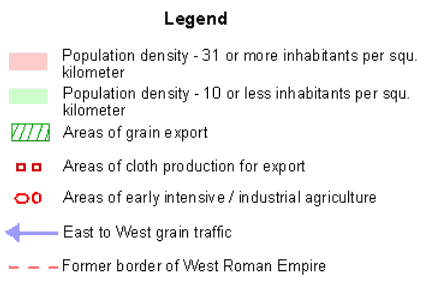 |
|
Map Two: Western Center, Eastern Periphery
in the Late Middle Ages |
Western evolution was thus pristine, in Fried's (1960) sense - it proceeded from internal contradictions: As the market developed, it changed the informal and personal relations of its participants, cemented them into a compact and self-conscious bourgeois "class for itself"117a (Alawi 1973), and toppled the crumbling edifice of the feudal state, in a revolution "from below". Classes developed into states (Habermas 1962). Three revolutionary "leaps" of particular violence occurred in the course of this development:
- The Feudal transformation, from 500 to 8-900 AD, produced the first Feudal states.
- The Late Feudal transformation (1300-1500) rebuilt Early Feudal states into Absolutist, Late Feudal states.
- The Capitalist transformation (1880-1945?) replaced a patchwork of Late Feudal and Early Capitalist states with a unified World Market, transcending political borders.118
These observations are significant for Eastern Europe119 and Russia for two reasons. First, Eastern Europe lacked a basis for pristine evolution, since it was never part of the West Roman Empire. Secondly, Eastern Europe was the earliest and most constant arena for Western imperialism. The Eastern societies were forced into a series of secondary evolutionary "leaps" to "keep up with" and defend themselves against their Western neighbors. In Chapter Four we analyzed the effects of the last of these leaps in Russia. From Anderson's and Gerschenkron's (1970) analyses I infer that earlier leaps had similar characteristics. They were accomplished under external pressure - with little preliminary "groundwork". They were state-led (the need for defense being first felt by the rulers, who had most to lose), selective (due to lack of resources and time), and violent (accomplished against popular opposition). Classes created states in the West. The state created classes (i.e. its own power base) in the East. Obvious effects were administrative centralization, a prevalence of vast economic units, a one-sided concern with defense, and the survival of far greater cultural diversity than in the West (since evolutionary change preceded internal standardization).
With each new wave of pristine evolution in the West, Eastern states "imported" the outer trappings of the new stage (weapons, means of organization and production, etc.), but not the inner tension that fired autonomous Western evolution. They thus took over a "hollow shell" of Western social order, without its inner content - formal structures divorced from their meaning and functions. This metaphor resembles that of the Matryozhka-doll, and suggests that traditional authority "from without" is ultimately of Western origin. In one sense at least this is true: Each new state apparatus was an authority enforced "from abroad". But if so, another conclusion follows: The "inner freedom" which authority governs is not a Western import.
Without the inner "driving force" of Western society, the Eastern states started "falling behind" as soon as they had completed a new revolutionary leap. There are two important reasons why the "driving force" was not imported, one common to the whole East, the other specific to Russia. I shall treat the first here, reserving the second (the "nomadic brake") for the next section. Although each new wave of Western influence was disruptive, it never completely destroyed the Eastern governments that the previous wave had installed - a "shell", once adopted, was never lost. In the East, the government emerged from each transformation as the most dynamic and powerful force in society, and from this vantage point it eliminated all organized opposition. Even on the rare occasions when government was annihilated by revolution, a new state of more or less the same kind would soon fill the gap left by it, since no other force was ready to take over.
But even the all-powerful State might perhaps have succumbed to Western pressure, had not this pressure itself been superficial. This is clearly seen from the channels by which it was transmitted: The Feudal transformation spread east along the Varangian trade routes leading to Byzantium (Map 3). But the Vikings were a peripheral outgrowth on the rising Western states, dependent on their riches for sustenance, on their (short-lived) weakness for freedom to exist at all. Their influence was not that of genuine feudalism but of its distant cousin: warrior chiefdoms instead of feudal vassalage, Byzantine Christianity instead of Roman city-states. They laid the foundation of the first Russian state (in Kiev, ca. 1000 AD), but did not enforce serfdom or create autonomous mercantile cities (Anderson 1974a).
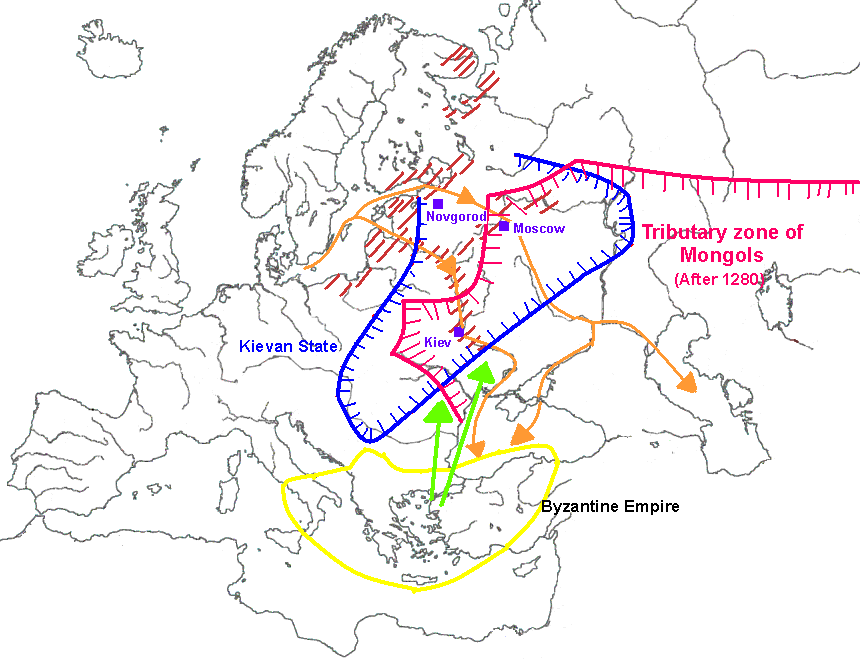 |
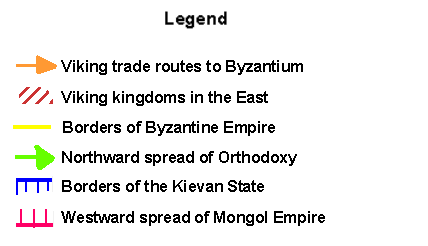 |
|
Map Three: The Early Feudal Transformation in Russia |
In the Late Feudal transformation the decisive influence was military conquest by the Swedish kings of the 16-17th centuries (Map 4), which led to social disintegration in much of Eastern Europe. But Sweden was not a full-fledged absolutist state; her conquests were not genuine bids for productive land, but expeditions for plunder and prestige. The evolutionary effect was therefore again limited: While Western serfs were "freed" for more efficient exploitation, the Eastern states were forced, and for the first time enabled, to introduce serfdom on the vast estates that fed the Western cities (Anderson, 1974b p. 195ff.). While a bourgeoisie matured in the West, Peter the Great curtailed urban development and installed a servile state bureaucracy.
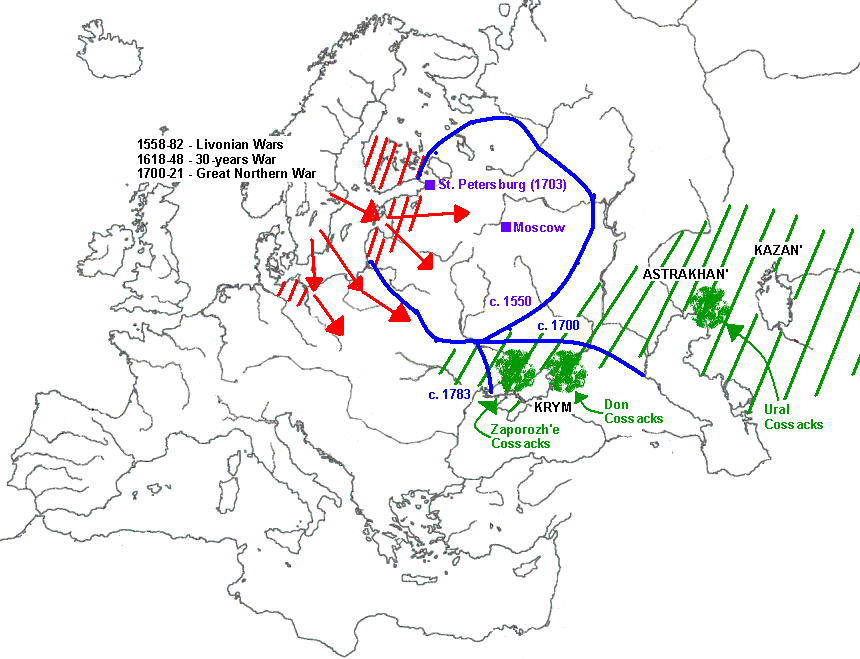 |
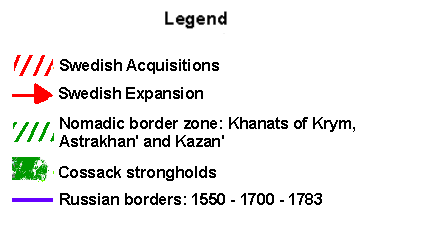 |
| Map Four: The Late Feudal Transformation in Russia (Source: Kinder 1964, p.202, 270 & 284) |
Finally, the Capitalist transformation conforms to the same pattern: For while the sources of power behind the two World Wars were economic and capitalist, the conquest Eastward was motivated by a (by now archaic) drive for land. The archaic motivation had an archaic source: Germany was the last great Western nation to be unified, and in its unification, highly modernized Western territories were brought together with areas of an Eastern type. So once again, the new Russia that grew out of the great wars was not fully a part of Europe, but a one-sided and weaker state, that closed itself off from the World Market instead of leading its expansion.
Thus, at each new stage, the source of Western pressure was peripheral to the true Western Center (Map 2). Attacks Eastward were launched in periods of Western weakness and instability, not prosperity and power. Western influence on Russia is therefore superficial - outdated before it is even assimilated. As an American visitor in Leningrad put it: "Being here is like going back in time to when I was a kid in the 50's." Thus, authority and power are enforced in Russia as a result of Western pressure - but the influence is incomplete and does not transform society deeply. Power is not only "external", but also "weak". Or as Vasya put it: "This place is nothing but a province of Anglo-American capital. Nothing but a Western European colony."
B. Central Asia120
For nearly two thousand years, the Eurasian steppes were the home of mounted warrior nomads, whose conquests influenced the whole continent deeply. Their most evident impact on Russia was the 200-year Mongol overlordship, but Russian and Central Asian history have been interwoven both before and after.
It has been pointed out that nomads may go through explosive bursts of evolution, only to reach a "ceiling" they cannot pass (Anderson 1974a, p.217). The reason lies in the nature of nomadic production. Flocks of animals must be kept in constant movement to avoid over-grazing. This impedes the development of cities, crafts, literacy and bureaucracy. It sets absolute limits to population growth, as economic efficiency cannot be increased beyond a certain point. By extension, nomads can conquer, but not govern a sedentary society. They may raid and exploit it (as in Russia), but to uphold it as a going concern they must abandon nomadism and become sedentary rulers. It is possible, however, for nomads and agriculturalists to live in symbiosis, exchanging produce and personnel, as in North Africa and the Middle East (Barth 1964; Haaland 1969), where the nomads adapt to the cities, since they are not the dominant force. But in Central Asia nomadic dominance persisted for centuries, and peaceful symbiosis alternated with devastating nomadic conquest (Anderson 1974b, p.513). We may perhaps speak of another kind of symbiosis here, where city adaptation to nomad pressure attains prime importance.
Conquest by nomads severely drains a sedentary state and imposes a "brake" on evolution. The reasons are evident. In times of peace Central Asian nomads spread out in small bands whose composition varied to accommodate changes in grazing conditions. Each band was under tight supervision by the heads of a small group of "aristocratic" families, and the leading families of all bands were related by traditional bonds, which defined their place in a large-scale military organism. In case of war, the bands could mass quickly into a compact army, without sacrificing flexibility in times of peace. It is evident that the general of such an army had no permanent coercive authority. Individual bands unified in the face of common threat or opportunity, but otherwise functioned separately (cf. Sahlins 1961).
The key to survival and prosperity for city-states faced with a constant nomadic threat lies in the ability to sedentarize conquerors and incorporate them in a stable state structure. Through long-term coexistence and adaptation to nomadic warriors, the cities of Turkestan (Map 3) perfected this ability. Three interrelated factors contributed to their adaptation:
- The cities disposed over concentrated resources, which made them alluring targets for settlement.
- They had extensive local autonomy, and functioned as well separately as within an overarching state. They could be conquered and administered piece-meal.
- Their culture seems to have been syncretistic, enabling assimilation of new rulers without fundamental conflict.
These three elements define the framework of a system of government, which I shall refer to as the Asiatic State.121 It was evolutionarily stable, experienced little increase in Depth over many centuries, and did not develop a high level of standardization. Foreign cultures were incorporated in it en bloc, without changing social structure or ideology.
The contrast to European society (and to Russia - to the extent that it adopted Western state and economic structures) could not be greater. Feudal cities were poorer and less compact. Their Christian culture was non-inclusive. They formed part of an integrated state and market, which were heavily dependent on standardization and coordinated rule. Nomadic invasion struck at the very heart of the feudal order. But the threat could be offset by adaptation to the nomads and development of social forms similar to those of the Asiatic State.
The paths by which the Asiatic influence made itself felt in Russia were complex: Western influence (and hence Russian feudalism) was weak at the outset. State integration was incomplete, and in the course of the Late Middle Ages social disintegration proceeded very far. Resistance to the Mongol invaders was therefore weak and uncoordinated. Each city fought alone and was conquered and exploited piece-meal. Paradoxically, this weakness was counteracted by nomadic conquest. Since the nomads were mainly interested in extracting tribute, rather than enhancing the efficiency of their rule, the rulers of Moscow were able to force the acceptance of themselves as sole middlemen to the other Russian cities. From this strategic position they established a power monopoly throughout the area, which served as a basis for their final victory and the lifting of the "Tartar Yoke" in 1480.
Feudalism thus seems to have been established in Russia not so much by Western influence as by nomadic pressure. But this is an illusory conclusion. What the rulers of Muscovy in fact achieved was not the flexible, conflict-wracked, multi-centered integration of feudalism, but a form of concentration, i.e. adaptation to nomadic pressure, a step along the road towards the Asiatic state. The new Russian state was thus a hybrid, combining a formally Western structure with an internal organization of the Asiatic type.
For this reason, the Asiatic influence did not end with the expulsion of the Golden Horde. On the Southern and Southeastern frontiers the nomads remained a source of constant unrest until the late 1700's (Map 4), and even after incorporation into the Russian Empire demanded great resources to be kept at bay. Moreover, Central Asian influence was not merely nomadic and military. Nomad, city and mountain cultures throughout the Ukraine, Caucasus and Turkestan all partook in a cultural synthesis dominated by or reacting to nomadic imperatives, whose functional logic is opposed to that of Europe. By assimilating this area en bloc, the Asiatic State was still further entrenched in Russia: As we saw in Chapter Four (Part D), North-South contradictions remain a significant source of socio-economic tension even today. The "Asiatic influence" is thus a factor in constant change. The military presence of the Mongols is today supplanted by the subtle but persistent pressure of ethnic heterogeneity.
I thus believe the adaptational ("Asian") imperative to have been as active a historical force throughout Russian history as the evolutionary impact of the West. The Asiatic State was incorporated into the Russian government and its methods of rule had an irreversible impact on the people governed, which frustrated later attempts at Westernization by more "progressive" rulers. Resources and power were concentrated in the hands of the state. A "syncretistic" policy of conquest loosely embraced a vast range of resilient and rebellious minorities. Extensive local autonomy was permitted for peasant communities (the mir) and local landowners. This casts a new light on Vitya's and Serezha's assertions that "when there's no leader, everyone in this country wants to be his own master" (cf. Chapter 5, Part D). Just as the West imposes a "weak" authority, permitting "inner freedom" to survive, Asia represents an informal freedom dependent on external authority.
Russia emerged under pressure from opposite forces: a European threat, forcing evolution, and a Central Asian threat, demanding adaptation towards the model of the Asiatic State. These two factors constitute the historical Paradigm of Russian society and identity. The bi-polar adjective of "freedom-authority" is derived from the cultural dichotomy of East and West. The nature of this duality must be envisioned in abstract terms:
The Western influence increases Depth. With each revolutionary leap a new general rule is imported to counter pressure from the Deeper, more powerful societies from which the rule is imported. The "shells" of the Matryozhka-doll thus originated as "Western" state-level rules of overarching standardization, and it is therefore natural that they are conceived of as external authorities. Three of them may be referred to by the names of the state structures from which they derived: Rus' (Early Feudal), Rossiya (Late Feudal) and SSSR (Capitalist/Communist). Today, the two archaic "shells" are suppressed into intimacy by the Soviet state and no longer wield formal power. But they survive in informal organization, as a traditional basis for absolutism. They also retain certain institutional elements: Rus' is embodied in the Orthodox Church, Rossiya in the values of the intelligentsia and the peasantry.
But all three "shells" derive from the West and have certain traits in common. The European influence is one of structure, form - i.e. rules. Organizational principles, concepts, tastes, are taken over and transplanted to Russian soil. Through the centuries such loans have become an omnipresent reality. The state has a formally democratic and bureaucratic structure. Ideology (from Christianity through the enlightened absolutism of Catherine the Great, to Marxism) is a Western import. Art and literature repeat European motives and stylistic guidelines. The ideal of kul'tura is Western in form. Even in daily life we recognize many of our own forms. The nuclear family, with its bourgeois morality. Ideals of kul'turny behavior. The way people dress, decorate their homes, serve dinner. Not to speak of counter-culture and opposition, which have repeatedly turned West in search of new direction. The smooth, efficient, aesthetical surface of Western culture has an unprecedented attraction.
Zhenya had a family of Baptists from Switzerland visiting. He marveled at the little girls, so neat, slim, well behaved and nicely dressed. With a sigh, he contrasted them with the kids he taught at school: "One becomes beautiful by associating with beauty..." He could not understand my own distaste at these smug and superficial Westerners.
As soon as we look beneath the surface, we realize that "our" forms have a different content for Russians than for us - our rules govern an alien flow. Just as Western feudalism was finally forced on Russia by nomadic, non-Western pressure, the Soviet state professes "Western ideals", but applies them in a way "the West" condemns. Dissidents idealize "the West" until they come here and discover, as Bukovsky "...that the West as such does not exist" (1982). And we remember Misha with the nice Danish bottle: The beauty of its wrapping, and the irrelevance of its contents... We sense that the Russian attitude to "the West" is external. They are attracted by its "packaging", its form. As a Westerner in Russia, it took me years to extricate myself from this surface attraction. I felt "used" as a bit of packaging from the West, a source of jeans, dollars and reliable information, while deeper and more dangerous communication was rejected. More tactful friends, conscious of the problem, showed a reticence, which was quite unnatural for them. With a few people, the barrier fell: I became "one of them", at least for a while. Such meetings were the reward of long and painstaking establishment of trust from both sides, and they are the part of my stay I am most grateful for and humbled by.
We might think of Russia as a "Western concept" describing and ordering a "non-Western reality", as a rule imposed on life "by the West". We share the "outlines" of culture, which, like the surface of a mirror, hide a deeper difference. He who travels to Russia goes, like Alice, through the mirror, he lives in mirror worlds, as a fragment and symbol of something more than himself. He who leaves Russia for the West becomes a shadow - form without content. In Tarkovsky's words from Nostalgiya:
"I no longer exist for my own country. They have canceled me, forced me to feel that I am nothing, only an image in the imagination, only a handful of air, not a human being, not a person, but something without any rights. This is what haunts me, to not exist, to feel like an abandoned prisoner, in silence, in rejection." (AP: 16/7-84)
If the West superimposes new general rules, new levels of power, upon Russian tradition, the Eastern influence increases cultural and ethnic diversity. The Asiatic State is a model for increasing the Density of this cultural amalgam, not by standardization, but by coexistence and inclusion, and in this sense it may be said, somewhat paradoxically, to increase freedom. If Europe contributes form to Russia, "Asia" supplies content to fill the forms - flow to be governed by Western rules. Concepts, ideologies and institutions derive from the West, their meanings and functions from "Asia". This has two important consequences:
First, "Asia" is seldom given overt recognition. People insist on being "part of Europe", but if they recognize that they are also "part of Asia", they as a rule deplore the fact. For if "Europe" connotes order, "Asia" often implies anarchy. But in a wider sense, "Asia" (often contrasted to Europe simply as "Russia"), is associated with freedom, expressed in positive terms as closeness to the soil, collective feeling, informality and self-sufficiency. If the West has the fascination of culture, order and efficiency, "Asia" has the attraction of life, exuberance, nature and strength. But its freedom is inadequately verbalized and controlled, since so many of the formal idioms in which it might be expressed are Western imports. Freedom is by its very nature informal - it is the wide-open prostor, a "space too large to be ordered". This leads to a rather confusing situation. We recognize many "Western" traits in the Soviet Union, but sense that their familiarity is illusory. People say one thing, and mean something else, most obviously in politics (cf. Bathurst 1993). Since Russians themselves often share our "Western" ideals, they may be quite as confused as we, and it is common to hear (from both Russians and foreigners) that Russians lie (the truth is "not theirs" - it comes from "without"), and that the Soviet state is a hoax. As Durman bitterly complains:
"If the Russians amplified their 'Oriental' mind by a 'Western' trait, then it has been in the refinement of the art of hypocrisy..." (1983, p.26)
The second consequence is that the content of any specific form (word or otherwise) is highly variable and dependent on which "Island of tradition" one speaks from. A "Western" symbol or institution with a fairly well defined range of meaning for modern "Westerners", has many mutually incompatible meanings in Russia. There exists no shared arena of discourse - except Limbo - and here the media of communication are insecure and ambivalent. Formal agreement or disagreement is thus a poor index of consensus - which is an important reason for the Russian mistrust of formality in personal relations.
An ethnographer explained, when I complained that there was little variation in scientific publications, that one had to know the author personally to understand what he or she was really saying. The person I talked to was a loyal Party member and did not regard this as a result of censorship.
This "Asian", animistic influence may be illustrated by showing its effects on an almost archetypal "Western" and absolutist form: the city. Ever since the first Varangian stockades along the rivers, the Russian town has been an Island of modernity, an instrument for subduing and controlling the "Asiatic" wilderness. It is a transplanted, foreign growth, not sprung from the soil it is built on, a "tool" for implementing "Western" policies. But through use, the tool takes on a new meaning. Sasha told this story about his native city:
Kislovodsk is an old Russian border town on the steppes approaching the Caucasus - a "Western" outpost against the nomads. Today it is a colorful multi-ethnic mosaic of large and small groups, each inhabiting a quarter or district. Local administration, health services, etc. are monopolized by a mafia from a small mountain tribe called Karachaevcy. Economy and trade are in the hands of local Armenians. Russians feel discriminated against, and Sasha told about bloody gang wars between them and the Karachaevcy. A few years ago, around 1980, things boiled over, a band of Russians got guns and swords and went to the Karachaevcy village (with the symptomatic name Mirny - peaceful), which they sacked, beating up its inhabitants and killing quite a few of them. The police arrived, but retreated when they were fired on.
On this background it is possible to draw some conclusions about the Russian Paradigm. Initially, the situation seems simple enough: the Western influence is an imported rule of power - a general rule for standardizing and coordinating the cultural diversity of "Asia". When a new wave of Western pressure reaches Russia, former Western imports are subordinated to it and suppressed into intimacy. But reality is considerably more complex. From the outset, Western influence is weak. Power is "divorced from its object". It is distant, alien, an "external force". It increases modernity and standardizes society to a certain extent, but its limitations are clear. Its power is therefore unmediated - arbitrary and weak - too "external" and "cold" to find any legitimate basis in society. For legitimacy to be established, the hierarchy must therefore be negated. Authority must be transformed from a rule of power to a rule of order. Russian absolutists co-opt Western instruments of standardization and use them as Barriers to defend limited Islands of meaning. "West" and "East" are therefore equal forces in Russian society and history, not levels in a hierarchy. As we saw in Chapter Five (Part A), authority attempts to integrate "multiple worlds" - but cannot succeed. We now understand that this metaphor must be taken literally. The "multiple worlds" are not only "two times", but two real and very different social formations, none of which can subjugate the other.
|
A miniature Matryozhka: The
grave bears the Communist Star (barely visible above the portrait), the
Orthodox Cross (lower left) and a handful of sweets (on top of the
gravestone) - as an offering to pre-Christian spirits. Note the benches
where one sits at Easter drinking vodka with the dead. |
Thus, "West" and "East" come to stand for different aspects of Russian society and identity: formal and informal orders, authority and freedom. The exigencies of Russian history compress this opposition into the Russian Paradigm: the driving force of Russian history. But the primary thrust of this force is not evolutionary, but adaptational. Another way of stating this is to say that modernization increases Openness, and thus leads to an imperative need for adaptation and Density. Absolutists and animists respond to this need by engaging in a "balancing act" - a Quest for meaning. When Western "forms" are imported into Russia, they are thus not only brought to govern non-Western flow. They also undergo a fundamental reinterpretation. At the outset they are rules of power, which force modernization, increase Openness and expand Limbo. But as they are assimilated into Russian culture, they are taken over by absolutists and animists, who gradually embed them in the imprints, which constitute the Russian Paradigm. Thus they are transformed into rules of order, which counteract Limbo. The essential function of authority, as reinterpreted by the absolutist, is not to wield power, but to promote clarity - to define and defend Islands of meaning by repetition. Conversely, the freedom of the animist "twists" the rules of authority - to create "multiple versions of the same thing", many overlapping rules governing the same Island, the same area of flow. Moreover, this quality of the animist has a historical significance. For when Western rules of power are transformed into rules of order and compressed into the Paradigm repeatedly up through history, we end up with a "Matryozhka-doll" of "shell" within "shell" of external authority governing inner freedom. It is essential to see that when this structure is "balanced", it is not a metaphor of power. The different "shells" do not constitute a hierarchy. They are overlapping rules, governing the same circuit of flow. According to the reasoning presented in Chapter One, the Russian Paradigm is therefore a model of Density and flexibility.
Once again, however, we must not over-simplify. The "balancing act" is highly unstable, and the Paradigm is therefore only potentially Dense. It actually becomes so, only when the Western influence is assimilated slowly enough to be transformed from power to authority, from an instrument for standardizing "Asia" to an instrument for ordering it. The Paradigm is only able to "anchor" society and promote its stability as long as "Europe" and "Asia" are successfully "balanced". If one is allowed to dominate the other, equilibrium is lost, the "anchor" fails, and the instability and "danger" of Limbo spreads throughout society. The Western "art of compromise" may all too easily have this effect. Since it seeks a "middle road" between general and specific rules, it implicitly presupposes hierarchy. Its "compromises" tear down the order of authority, and turn it into an unstable and explosive structure of oppression and dominance, as we have seen in Chapter Four. But when the "balancing act" succeeds, and hierarchy is successfully negated, the Paradigm will "anchor" society and provide tools for the modern Quest for meaning and legitimacy. It not merely contains Limbo, but overcomes it. It is not a driving force of evolution, but a nucleus around which meaning may congeal - the still point in the Eye of the Whirlwind.
The essential problem posed by the Russian Paradigm is one of balance. If either Western or Eastern influence is allowed to increase beyond certain limits, Limbo expands, and society dissolves in disorder. Coping with disorder and converting it into order is therefore a constant theme of Russian culture, repeated throughout history, and on every level of integration, from the state to the intimate and personal. Two distinct and typical situations may arise from this:
First, when disorder exceeds a critical limit (as a result of external pressure), the Paradigm is unbalanced. All outside influence then threatens to "over-load the system", and is closed out as far as possible. This might be called paranoia. Its basic rationale is clear enough, but it may often seem out of proportion to the real threat involved, and hence "absurd". At its highest pitch, as in Stalin's years, it leads to arbitrary tyranny. Any deviance from the norm, or even plain, factual disagreement, then tends to be seen as a threat to the very basis on which meaning and legitimacy rest. But paranoia is not limited to state policy; it may be found in intimate relationships as well. Indeed, every Island is beleaguered from without and can react in the same way.
The second situation occurs when critical limits are not exceeded and "balance" is more or less secure. Paranoia is then replaced by a startling receptivity, an exultation in the Open spaces of the prostor. This openness towards both West and East results from the strongly experienced need for outside impulses to work out and stabilize inner contradictions - the need for Western rules to understand and organize reality, and the need for Eastern flow, "life-experience", to fill the empty interstices of the existing structure. Receptivity thus rests on the realization that to be Russian means nothing else than to be composed of both "West" and "East". This is expressed with great beauty in Blok's poem "The Scythians":
| You [Europe] may be millions - myriads are we, | ||
| Just try to fight us! | ||
| Yes, we are Scythians! We are Asians, | ||
| With slanted, hungry eyes! | ||
| Eons for you, for us 'twas just an hour. | ||
| We, like submissive slaves, | ||
| Held up a shield between two racial enemies | ||
| Mongols and Europe! [...] | ||
| Russia's the Sphinx. In triumph and agony, | ||
| And drenched in black blood, | ||
| She gazes, gazes, gazes at you, | ||
| In hate and love!.. | ||
| Yes, love like ours, like our blood loves, | ||
| Not one of you has known for ages! | ||
| You have forgotten that the world has love | ||
| That burns and destroys! | ||
| We love it all - the icy ciphers' fire, | ||
| The gift of heavenly vision, | ||
| We listen to all - the sharp Gallic wit, | ||
| The obscure Germanic genius... | ||
| We remember all - the hell of Paris' streets, | ||
| The cool of Venice, | ||
| The distant fragrance of lemon groves, | ||
| The smoky vastnesses of Cologne... | ||
| We love the flesh - its taste and color, | ||
| Its suffocating, deathly odor... | ||
| Are we to blame if your bones are crushed | ||
| In our heavy, fondling paws? [...] | ||
|
(Blok 1918b) |
||
The Russian Paradigm is a Matryozhka: shell upon shell of Western form enclosing Asian content. The modern charismatic challenge is anticipated in tradition. In spite of the intensity of its contradictions, Russian identity is therefore uniquely equipped to face them. Its Paradigm is "adapted to mal-adaptation". It has rested so long in the field of tension between Europe and Asia that a vast complexity of dominant symbols has congealed around it. Through communication with these symbols (cf. Chapter One) the contradictions of Limbo may be faced and utilized. For such symbols and symbolic tools are Centers congealing at the very heart of Russian Identity. The roles of absolutist and animist, the passive ethics of "guarding the heart", the aesthetics of Tarkovsky's zona, are examples of such tools which I have referred to above.
The historical process through which this dominant symbolism has developed, is a cyclical alteration between "paranoid" and "receptive" phases - as the internal instabilities of the Paradigm have waxed and waned. Yanov (1978) lists "at least" seven periods when "hard", convulsively paranoid regimes supplanted "softer", more liberal and receptive ones. The two most famous "hard" phases were under Peter the Great and Stalin. Both coincide with intensified Western pressure and attendant institutional breakdown and revolutionary change: in the wake of the Late Feudal Transformation in the 1600's, and during the Capitalist Transformation of our own century. In both periods, tolerance of outside influence was supplanted by Russian nationalism, coinciding with an intensive implementation at home of "foreign", Western, tools of modernization. Yanov claims that the "soft" periods were characterized by frozen immobility.122 Resolution of basic problems was postponed, and tensions built up which were only released in the next "hard" phase. I differ from Yanov's opinion on two counts. First, he disregards that "hard" revolutions are the result of pressures from the West. He is correct in assuming that evolutionary problems are not resolved in "soft" phases. But the reason for this is that Russia never acquires an autonomous impetus to modernization. And if tensions indeed "built up", as Yanov assumes, they would constitute such an autonomous internal dynamic that would resolve itself in revolutionary change, without being forced by external pressures. Secondly, and most importantly, the "soft" periods are far from passive. What is accomplished only looks passive in comparison to the headlong evolution of the West. The "soft" phases are periods of adaptation, in the course of which the "Western" hierarchy is negated, through introspection and gradual assimilation of cultural diversity. But this process is extremely slow - like the growth of Vasya's Idea (cf. Chapter 3, Part D) - and it is disrupted each time balance is destroyed by a new wave of Western pressure, forcing a new phase of modernization and tyranny.
In the course of this cyclical process, we may note many examples of how Limbo is utilized and governed by balancing the Paradigm. Notable is the case of the Russian peasantry. The main obstacle facing the Tsars in the turbulent centuries of Swedish intervention was an insecure productive base. Ivan IV and Peter the Great could not secure their rule without the nobility surrendering political autonomy; but this was unthinkable without economic compensation in the form of secure income from the land. This in turn necessitated tying the laboring peasant masses to the soil by enserfing them. Without secure borders, this was impossible. At the time of Ivan IV the whole border area from the Ukraine to the Urals was in an indefinite state of flux, due to constant nomadic raids. When oppression got too hard on the estates, peasants could simply pack and leave, heading South and East, where they would presently be in no-man's land, i.e. in Limbo, free to do as they pleased. Hundreds of thousands fled in this way, and eventually developed a unique culture of their own, the Cossacks (Map 4). In the Southwest, they founded the autonomous state of Zaporozhye and waged regular war against the Tsars for many years. Until the end of the 18th century, violent peasant rebellions led by Cossacks and Old Believers123 who found refuge with them, shook Russia (Anderson 1974b; Gerschenkron 1970, p.25). Cossack culture was an autonomous, "subcultural" adaptation to Limbo. No state extended its influence to the border zone, and autonomous processes could therefore take place unhindered. But in the long run, Limbo was a resource for the state itself. The Cossacks were pacified after long and bloody wars, but their independence and fighting spirit remained useful, and they were organized to form the elite corps of the Tsar's army.
As the borders were gradually closed, up through the 18th century, these autonomous peasant cultures were supplanted by semi-autonomous subcultures, surviving in the interstices and peripheries of society, some to this very day: Notable was the exclusive "caste" of blatnye or thieves, with extensive rituals, strict rules of conduct, even their own language. The "thieves world" traces its roots back to Peter the Great and his bloody reforms and survived until it was obliterated in Stalin's camps in the 1950's (Skachinsky 1982, p.3-5).123a
Finally, the bol'sheviki themselves were a product of Limbo, springing from an amorphous mass of underground conspirators, rebellious peasants and criminal elements. Indeed, the slang word blatnoy denotes not only criminals but also members of the Party bureaucracy. It is not therefore not at all surprising that the Party still has interests in perpetuating Limbo, as we saw in Chapter 2, Part D.
In time, Limbo has been internalized and diffused, embedded ever deeper into the core of the Matryozhka-like Paradigm. What used to be a physical battleground was later embodied in subcultures, and is today a pervasive influence throughout the culture and economy. But the same basic themes are constant throughout Limbo's history. Both Cossacks, blatnye and the bol'sheviki were absolutists and animists - arising out of Limbo, and engaged in the Quest for meaning. Limbo thus remains a threat and a reservoir of unknown potential.
The same themes come to the fore in another of its products, the intelligentsia. The origin of this unique group - out of which the New Class later emerged - goes back to the 18th century, when, after defeating the Swedes, closing the Eastern borders and pacifying the peasants, the Tsars enjoyed a long period of peace and "stagnation": Peter's reforms had been successful, and were hardly altered until the Revolution. But it was also a period of receptivity. The tastes and ideologies of the Western bourgeoisie were taken over by the elite, to the extent that French became the regular spoken language of the nobility. The paradox is evident. An archaic and stubbornly feudal state was enamored with capitalist and bourgeois ideologies of a consistently anti-feudal nature. The contradictory synthesis of Europe and Asia repeats itself, and comes to a head at the time of the Revolution, when a European ideology (Communism) became the ordering backbone of a mass movement whose real aims were strictly non-European.
The intelligentsia was a splinter group of educated individuals of diverse origin, sharing a highly contradictory attitude to their own nation and state. Their values, though Western in form - in their explicit and conscious aspect, were "Asian" in their implicit and subconscious content. This led from the first to a radical dualism, expressed by the opposed "parties" of Westernizers (zapadniki) (advocating development and rationality), and Slavophiles (preaching return to the soil, religious values, the symbolic and irrational). More fundamentally, it found expression in the "dual consciousness" shared by both groups, in spite of their overt conflicts (cf. Chapter 4, Part C). "Dual consciousness" marks the intelligentsia's attitude towards state and people on the one hand, to "West" and "East" on the other. The dilemma follows from the social position of the intelligentsia. It was not of the People, since its origin was upper- or middle-class and it owed its existence to Western values. It was not of the state, since it had little political influence and was often persecuted. Confined to contemplation of the paradoxes of its own situation, it worked out complicated, often irrational, sometimes brilliant, but always impractical solutions to its own and Russia's Janus-existence. This was not the "rational" discourse of a latent Western bourgeoisie, but a dialogue about Limbo. The intelligentsia was a class of absolutists and animists, experts at understanding and manipulating Limbo's powers.
In this perspective, the relationship between the two "parties" attains new meaning. The Slavophiles asserted that Western solutions were not applicable. The West was the demiurge of evil, corrupting the purity of the Russian soul. The intelligentsia was to remove the corruption, freeing the People spiritually to be themselves. But this implied cleansing the intelligentsia itself as well, since its corruption ran even deeper. In a sense, therefore, the Slavophiles defined themselves as a non-group, a vanguard of a nation that had not yet come to be. In this picture, the state assumed an ambiguous role. The Slavophiles were conscious that they shared the state's origin and many of its values. Opposition either had to be total, an anarchic return to the soil, a peasant existence without state, cities or bureaucracy; or a halfhearted love-hate relationship. So many chose to see the state as a savior, expressing Russia's power and right to empire, the autocratic and Orthodox alternative to degenerate Western democracy and the tyranny of "Rome". The Westernizers, in contrast, asserted that Russia was backward, its "corruption" was a result of exactly that, the solution was progress and democracy, and the ultimate aim - freedom from autocracy and ignorance, and justice to the people. Peter the Great would be a prototype of their ideals had he not been a tyrant. But "the people" neither wanted nor understood progress. For, as Peter the Great demonstrated and an anonymous present-day samizdat manuscript asserts: Liberal, Western ideas are transformed into their authoritarian opposites in Russia.122a They must be enforced by power. In opposition to the people for "the people's own good", the Westernizers also found themselves opposed to the state, whose privileges were threatened by the reforms they proposed. All the same, the state itself was a Western instrument of modernization, founded on the Westernizers' ideals, and in Russia only the state might actually realize these ideals.
Thus, both parties found themselves repelled by and drawn towards both state and people. Those who preferred the "West" labeled that which they opposed - in both people and state - Russian, Asian, backward; that which they supported in both was (or was to become) Western, European and progressive. Those who preferred the "East" did the opposite. Both, in fighting for the people, also fought against it. Opposing the state they supported it.
If symbols are capable of manipulation as "empty forms" (a view I criticized in the Introduction), both parties are patently impotent, locked in a double-bind. Their significance and power may only be appreciated if one agrees that their dialogue has real, historical content. They are the Russian Paradigm in action. "East" and "West" are not arbitrary symbols, but cultural, historical and political realities, with which the intelligentsia seeks to come to terms. The intelligentsia is itself a "balancing act". Though a tiny minority, it engages in discourse about dilemmas common to the nation. It is unique merely in being an extreme and articulate version of the typical. Symbolically, the Slavophiles proclaim the animistic archetype, the Westernizers that of absolutism. Separately, the two parties are impotent. In conjunction, however, they are a historical force. Their conflict stems from the fact that each expresses only one half of the Paradigm. The Westernizers reify the formal impact of "Europe", the Slavophiles single out the informal influence of "Asia". Only when they are balanced against each other, does their discourse encompass the whole content of "Russia". Only in unified action could they attain power. When this occurred, as with the bolsheviki, it swept all obstacles before it, in a blinding, charismatic upheaval. But as this example shows, both the obstacles and risks involved are great. For if the symbolism of the intelligentsia expresses the socio-economic dichotomy governing Russian history, the contradictions of that dichotomy also govern and dominate the symbolism. If the "balancing act" is disrupted and the imperatives of "European" modernization eclipse the more subtle, "Asian" need for adaptation, the Paradigm becomes a despotic tool of power - as under Stalin. Synthesis, as Irina pointed out (cf. Chapter 4, Part B), is thus both great and terrible. But the true Quest for balance and meaning is a charismatic "outreaching" of creativity, the means to freedom and inner stillness - of "guarding the heart".
Limbo "contains" Russia in embryo. It is the Texture out of which Russian identity emerges, and the Paradigm on which it rests. It is an inestimable resource, because its contradictions express the truth. Centuries of discourse about Limbo - political, economic and cultural - have generated a rich symbolic vocabulary by which meaning may be created and sustained ex nihilo.
A Snail on the Mountain - a novel by the brothers Strugatsky (1972) - is a fragment of this discourse as it continues in our own days. It is a parable of a world split in two, and of the Quest of two people for a road to unity. The story is told in two parts, in alternating chapters. One part takes place in the Forest, an enchanted swamp, seething, decaying, fermenting. People live in little villages and are totally dominated by the woods. Everything around is alive. Trees leap, villages are overgrown with slimy vegetation every night, clothes are cultivated like plants. There is one outsider, Molchun (his true name is Candide), who tries to think. This is nearly impossible in the swampy vapors, where all thought is reduced to endless babbling repetition of the same phrases. Molchun remembers that he crashed in a helicopter, and that he came here from a biological research station on the Cliffs of the Devil. He keeps one thought clear - he wants to get to the City. To everyone else this is inconceivable. They are terrified by the Forest and unable to move out of their isolated villages (cf. the title quote of Chapter Two). At last he tears himself loose and discovers a "City", a tall hill surrounded by dense, violet mist. In and out of it, as in some painting by Bosch, insects, leeches and other animals are "breathed" in rhythmic, pulsating movements. He discovers that the woods are ruled by beautiful, wise and powerful women in intimate contact with nature, who despise men and their works. The women control all living things, create and change life and death, and the woods themselves are made by them. They work to accomplish "Possession - Stillness and Flowing Together". Village women are captured one by one and led into boiling mermaid lakes, where they are transformed to become as the Rulers. They learn to reproduce themselves without men, by bathing in the lakes, and the men become lifeless slaves. As the program is completed in a village it sinks into the ground, leaving a triangular lake. Molchun tries to awaken people to fight against their fate, but their thoughts dissolve into mist. His only weapons are his own mind, which is constantly threatened, and a scalpel, from which living things recoil. At last he gives up, and sets off on his own to find the Cliffs of the Devil.
The other part of the book takes place at the giant research station on top of the Cliffs. The function of this center - the Administration - is ostensibly to study and/or exploit the Forest, but in reality little is done, although there are plans to destroy the Forest altogether. The Station is an outpost of a highly technological civilization - the Materik124 -, which we hear about but never see. It seems distant, unreal. The setting is very Soviet - muddy roads with big puddles, corrupt and decadent bureaucrats, queues, people shirking their jobs, slogans. Here the Forest is a source of fear and fascination. Myth and rumor cluster round it - of mermaids and leaping trees - and although officially all this is denied, the great hero of propaganda posters is shown in mortal combat with a leaping tree. According to tradition he was killed by it, and himself became a tree, but the modern, progressive interpretation asserts that the tree became a man. Here is another outsider, Perec, a romantic linguist from the Materik. He came here because he always had dreamt about the Forest and wanted to learn to know it. But no one really knows anything. Perec is not let into the woods, he can't get a propusk. At last he wearies of the meaningless life around him, where all people do is work in an incomprehensible, Kafkaesque apparatus of power, play chess, flirt with the girls and get drunk - on kefir. He tries to get a propusk to go home, but is once again thwarted by bureaucracy. Then, suddenly, he is sent to the Forest - but when he sees it, he realizes that it is too foreign; he can never even understand whether it is good or evil. So he returns. He is seduced by a beautiful woman, and through her becomes involved in political intrigue. Pursued by unknown enemies, he is chased into the chair of the Director himself. He becomes the Director, and with power in his hands tries to halt the secret plans for destroying the Forest. But soon he understands that there is nothing the Director can do. The Administration has its own logic and inertia. It cannot be changed, and in trying to do so he makes a mass murderer of himself.
The two outsiders, each striving to escape from his own world into that of the other, never succeed. Both seek understanding, and both fail, because they never meet, never even know about each other.125 By growing together, Perec and Molchun might have had power to change their worlds, or at least to become free themselves. But they are defeated, Perec by the sterile rationality of power, Molchun by the unbreathable and irrational intimacy of nature. The dilemma of "dual consciousness", the opposition of West and East, state and people, modernity and tradition, authority and freedom, is vividly evoked.
But the symbolism goes still deeper, striking at the heart of the Paradigm itself. For all these oppositions are superimposed on a struggle between male and female principles, between Yang and Yin - rules and flow. The essential statement in this book is that neither principle may be fulfilled without the other. The Forest is dominated by women, pure, wise and strong, but warped. Theirs is a world without sharpness of focus or definite limits, which by its nature excludes masculine interference. In this world, Molchun is the absolutist. He seeks authority and rules - the sharpness of the scalpel. On the Cliffs, masculine dominance creates an arid, impersonal world, enslaved by the machines that serve it. It has rationality and authority, but lacks the freedom Perec seeks. Perec is the animist, seeking a hidden way out of enclosing formality. Out of the deadlock of their two worlds, Molchun and Perec attempt to balance Yang and Yin, Authority and Freedom, West and East. Only in synthesis can they find Truth - but synthesis eludes them. Thus, the story is a parable of adaptation - it is a dominant symbol "anchored" in the Russian Paradigm.
When the "balancing act" fails, the Cliffs of the Devil are divorced from the Forest - Molchun and Perec are trapped in a malignant hierarchy and excluded from the Quest for meaning. The underlying dilemma of the story is thus a lack of communication. This was a problem to which my friends would constantly return. Indeed, it may well have been their greatest cause of bitterness and complaint. "We're imprisoned here in our concrete bunkers," Vasya exclaimed. Islands protect people, but also close them off from each other, impede freedom, limit the open prostor. Absolutists and animists strive to reconcile these opposites, to stabilize Barriers by the authority of "repetition", while at the same time enhancing their flexibility through the freedom of "expansion". When they fail, the Paradigm loses equilibrium, and communication breaks down:
On the Cliffs of the Devil, the Forest lies far below, wrapped in myth and fear. Authority is expelled altogether from intimacy. It is so "external" that it can no longer perceive or understand what it governs at all. Repetition loses its stabilizing effect, and becomes a paranoid and haphazard insistence on control, enforced by random application of violence, which undermines the stable consensus on which all communication must rest. A story Vera told illustrates this pointedly:
As a student, she was strolling down Nevsky Prospekt with a girlfriend and two pilots, newly returned from Viet Nam. The pilots' stories shocked the girls, and they all started shouting: "Down with the war in Viet Nam!" The police arrested Vera's girlfriend, ignored the pilots since they were on leave - and let Vera go. She protested, but they would not take her. Her girlfriend spent a terrifying night in an ice-cold, over-crowded cell full of prostitutes, and got sick from exposure. At the trial, Vera was called as a witness. She explained what had happened and why they had acted as they did, insisting on her own share of the blame. "I probably just made it worse," she sighed. "I was that young and naive." The girl was suspended from the University for a year, for "dishonorable conduct in a public place". Even now, after many years, her relationship to Vera is strained. She can't understand why she was not arrested, and suspects her of having "done something" to save her own skin.
Only "treachery" could explain what happened. When balance fails, people are cut off from each other by paranoia and communication is swallowed in silence. Simultaneously, in the Forest, freedom is completely enclosed by its Island. It loses the "outreaching", charismatic sense of purpose, and is reduced to an anarchy that dissolves all clarity and rule. This is expansion without control, nature gone rampant, a Forest, or as most of my friends referred to it - a boloto - perhaps the closest one can get to a popular image of Limbo. Here the "warmth" of intimacy becomes an emotional invasion, violating your personal integrity and peace of mind. We remember Zina's complaint that everything "dissolves in drunkenness and endless talk". There is no longer any basis for trust, where all norms are obliterated:
Seryozha and Olya took me to a birthday party at some friends of theirs. There was singing, and a friendly, light humor, very calming and pleasant. Seryozha promptly got drunk and disappeared, but Olya stuck around, and when she saw me enjoying myself, started hinting that she was bored and tried to take me home again. I gave in at last, and we left. But we did not go straight home. "Come!" she said, angrily. "I'll show you what life here in Leningrad is like. I'll show you a filthy woman!" She dragged me into the apartment of a couple in their mid-thirties. The man looked forty-five at least. The woman, fat, coarse and ugly, looked ten years older. When we came, they were calmly watching TV, and he was fixing an iron. She was slightly drunk, but there was really nothing "filthy" at all. But Olya's words haunted me. What did "friends" mean to her if she showed them off like monsters in a zoo?
When the balancing act fails, communication is undermined by unpredictable rules and ungovernable flow, by fear and mistrust. The hierarchy can no longer be negated. This is Limbo, as I have described it before. But we now see its dilemmas more personally and painfully. Fear cuts people off from each other into tiny factions, suspicious of each other's motives. The calm certainty of Father Peter becomes a paranoid mistrust of all outside influence. Most Russians I know are therefore wary and suspicious of strangers. It was nearly impossible for me to introduce two of them to each other.
"My friends and I live in a narrow uzky krug," Lena told me. "We choose people with great care, and know each other so well that we immediately know if the others will like a new person. We never make mistakes. But take Anna [a mutual friend from the West]. We've been friends a long time, and when she introduces us to people from her own country, we find we like them. But she's never pleased us with Russians! Several times she's brought along friends, and I immediately saw that they were nothing but opportunists... There's a concept - svoy chelovek. A person is either svoy or not svoy."
Strangers rarely meet across these Barriers. Of course there is the "meeting in Limbo" that I have discussed in Chapter Three (Part C), the unpredictable, flash encounter, the heart-to-heart talk on a Metro or over a bottle of portveyn, but this is rarely followed up. For the whole point of such meetings is their limitation and anonymity. No trust is needed, and people take care never to ask about the "wrong things". When more serious meetings are arranged, when something is truly at stake, people often show extreme caution and circumspection. The underlying tensions are obvious, and they are clearly afraid that the whole situation will suddenly explode and turn into a skandal - something I have also witnessed once or twice. "Cultured" people carefully respect your privacy until explicitly invited into it, and avoid all dangerous issues, anything that might create misunderstandings or quarrels. Language is painstakingly exact, clearly signaling that one in no way wishes to "use" the other person or take advantage of him.
Many of my friends were very conscious of these problems, and saw it as a duty to society and a deep-felt personal need to look for new ways of communicating.
"We have to learn to converse in a new way," Zhenya said. "When I make some statement, there's a certain kind of person who always wants to discuss it. I tell him: 'It was sure beautiful down by the beach today.' He looks at me, and objects: 'But this big sailboat came by!' My statements cannot be contradicted. They must stand for themselves. They may be elaborated and enriched, seen from other points of view. But all I can say to these objections is 'yes, it might be that way too - that's also possible.'"
It is worth noting that for Zhenya "communication" does not mean "discussion". He wants to "tell stories" and "listen to stories" - not work out a "middle road" which might serve as a basis for constructive action. Communication is a "balancing act", not an "art of compromise". Once again we sense the basically passive rationale in this. What my friends and informants sought was not so much a practical or political solution to their problems, as a sense of harmony and beauty. This is also true of Vitya. Practical as he might seem, his deepest concern was with personal relations, not with profit and loss. His delo was an aesthetical vision, a Quest, which might give meaning and coherence to his own life and that of his friends. The Baptist group to which Vera belonged was more explicit about this, as we shall see. Father Peter spread his faith by beautifying his church. And this was also what struck Misha so profoundly with my Scandinavian tourists - and what he sought in the Danish bottle - beauty.
Beauty cannot be discussed. It is not subject to the "art of compromise". It is a product of adaptation, of the "balancing act" between rules and flow, form and content, "Europe" and "Asia". The "new form of communication" is an endeavor of absolutists and animists. It seeks to balance the Paradigm, to banish paranoia and find a still point of receptivity. The Western "art of compromise" contradicts this ideal. It asserts hierarchy - the ascendancy of "Europe" over "Asia", subordinates one half of the "balance" to the other, and thus transforms authority and faith into power and subservience. Nonetheless, "the West" has an urgent and far from trivial attraction for many Russians. Our "compromises" seem so harmonious. They are so easily confused with "balance", and their power and applicability is very real. They are sharp tools, a "scalpel", with which one may cut through the undergrowth and attain clarity of vision.
Darya got a letter from Baptist friends in Great Britain. "They sense us so well!" she said. "They discovered exactly what we needed, what can help us out of our rudeness. They sent a quote from Schiller about the ideal person in each of us: 'What is more important than gold?' the serpent asks. 'Light,' is the answer. 'And what is more important than light...?' 'Conversation.'"
But the Western solution cannot be directly transmitted to Russia. For Darya's British friends, their Baptist faith is a chosen field of activity. For Darya herself it is a "found" field of rest, a "Place" of contemplation and harmony. I met many people (like Yura, see Chapter 5, Part C), for whom "the West" had become something close to a disease. It was the solution, not part of the solution, and as a Westerner, I was entrusted with the most absurd, illegal or impossible missions, as if my intercession alone could change life radically. But the power of Western "forms" must be co-opted, torn out of its hierarchical context of origin and superimposed on an Island of meaning. This, I think, is what I experienced with people who knew and trusted me, and by whom I was offered a different role - more demanding and more dangerous. My ability to "compromise" became a sort of "security net", which permitted them to experiment with roles and meetings they otherwise kept away from. This was an important element in many of my Russian friendships, and I feel that it is somehow typical of the influence "the West" may have on Russia. When it was pressed on me, as was often the case, it became intolerable and humiliating for both me and them. But when it was controlled from both sides it was a fascinating and deeply human experience. An instructive example was my presence at a "meeting" between a group of Orthodox Christians and a group of Baptists.126
Several years before, I had introduced Darya and Vera to Lyosha, one of my Orthodox friends, and they had met at uneven intervals ever since. Through Darya, Lyosha was introduced to Zhenya, and the two men immediately fell to arguing about the relative merits of their convictions. So Lyosha suggested that they arrange a meeting, "for my benefit", to discuss the relationship between Orthodoxy and Baptist Christianity. Zhenya said no. I asked why. "I don't want to discuss with a brick wall. Besides, I'll be a 'representative of something'. If people dislike me personally, it will discredit my faith in their eyes."
In spite of such misgivings, it was decided to hold the meeting. A date was set and people were invited. It turned out that I would be out of town that day. The date was changed. Again, I couldn't come, and the meeting was postponed. It became obvious that they were waiting for me, although the discussion, strictly speaking, was of greater importance for them. At last the day arrived, and eight of us sat crammed together in Darya's hospitable little kitchen.
Zhenya and Lyosha were the main speakers. Both held long and very wordy introductions and were constantly broken off. During the discussion itself, tempers flared, but were kept in check - mainly, it seemed, because I was there as a neutral court of appeal. It was striking that these people, educated, intelligent and well disposed towards each other as they were, lacked the most elementary discussion techniques. I acted almost as an interpreter: "He means that..." "Wait, he hasn't finished, he hasn't gotten to the point..." "Yes, you can talk now..." Afterwards, several of them told me that they could never have met if I hadn't been there.
I doubt that my personal merits explain this episode. The point is rather that the "art of compromise" is part of my upbringing as a Western intellectual. I could function, so to speak, as a "medium of exchange", a "mode of intercourse", because I have been trained to do that since childhood. As a "fragment of the West", I could penetrate Barriers between Islands and contribute to communication. A similar role was played by the Beatles in Igor's life, by the Gibson guitar posters on Yura's walls - or by Misha's bottle. As a stimulus to order, a catalyst, a sleek, soothing beauty, the power of "the West" is great.
But power is dangerous. Western tools - symbolic or real - may be introduced to break down Barriers, but they soon acquire another content. Barriers are there for a reason - and when I leave, the need for them will reassert itself. In the mean time, the opening I forced may have harmed fragile and essential defenses. My mere presence in Russia holds in it the evidence of superior power. I can come and leave, as I like. They cannot. This may seem trivial, but it is in fact highly symptomatic. The West cannot be trusted. Its influence is too sporadic and weak. We are unable to truly introduce our "art of compromise" to Russia. All too easily, our forms become partisan standpoints, tools of dominance and power, a one-sided, absolutist influence. They are taken seriously, more seriously than we take them ourselves, because their potential is so great. Ideas and principles, which in the West connote democratic and free life forms are reinterpreted as authorities defining "objective truth" - charismatic Ideas to live and die for. In the hands of an unchecked absolutist, they may be transformed into dogma - paranoid and inflexible Barriers.127 In the hands of the state, they may become weapons of oppression. Their power must be co-opted and used sparingly if they are not to be disruptive. But when balanced against animism, their value may be great. I once brought a cheap Western journal of women's fashions to Nastya, a fashion designer. She is a serious, intellectual woman, but she touched those pages like relics of a saint. I knew she would use the journal, leaf through it, absorb every mite she could learn. To her it was a tool like Molchun's scalpel - sharp, deadly, potent.
"The West" is supremely, sometimes fatally, "useful". "Loans" are not simply practical "tools", but instruments of harmonization or oppression. They may tie together a fragmented world, iron out conflicts, impose discipline, legitimize power or restore beauty. But for this very reason they are dangerous, promising simple ways out, where simplicity is impossible. Their potency is almost too great, and they are often resisted. He who allies himself with me (or hangs a Western poster on the wall), declares himself a potential outsider. For there is a war going on between West and East - a Quest for meaning. And the point is not to win this war, but to balance the opponents against each other, and find a still point in their midst. You become a deserter by depending on one side or the other. In this sense, Vera, Igor' or Nastya are prophets and traitors. They reach out to the West for "forms" to enhance communication. But every import is an implicit invasion. When I asked Igor' if he wanted me to bring along something next time I came to Leningrad, he smiled: "Bring some good English tea! If I'm going to subvert Soviet Power, let me do it with tea." The dilemma, of course, is to use the West without becoming dependent on it - to co-opt its power without becoming its slave. In his practical way, Vitya saw this clearly. He wanted no zippers or shoelaces from the West, for the simple reason that he did not want his biznis to become dependent on imports. Even when the risk was greater and quality inferior he preferred to "deal locally". The West must be a tool for change in Russia - as Vera so clearly understood. If it is not, you will be exiled - figuratively, by those surrounding you, or literally, by the state. "They say we're some kind of dissidents - that we don't love our people," Misha said. "It's terrifying..."
"Maybe there is some special meaning to this endless isolation of ours, our endless sufferings. Maybe a special kind of strength is supposed to grow out of it."
(Vera)
Vera and I were brought together by a book. I had heard from a friend that there was a woman in Leningrad who had tried for years to get hold of Mikhail Bulgakov's "The Master and Margarita". It had recently been re-published in a Soviet edition and might be bought in the beryozka for a few dollars. I was in the city only a couple of days, but I found the book, called Vera, and we agreed to meet at the statue of Pushkin in the center of town. Giving books to Russians is almost always a moving experience, but Vera with "The Master and Margarita" is a scene I shall never forget. A whole world of emotion flashed over her earnest features. She held the volume tenderly, as if it were a living thing, which might suddenly leap out of her hands and disappear as unexpectedly as it had come. It was a nippy spring day as we walked restlessly along the canals together, talking endlessly - and very politely - about the book we both loved, about life and Russia and the soul.
Vera seemed a serious, care-worn and kind-hearted person. Like so many Russian women, she had not taken good care of her body, which was heavy and drably dressed. This made her look older than the 36 she was at the time. But her face was intensely alive, especially her eyes - clear, intelligent and attentive - surrounded by faint but distinct lines of concentration or pain. In the years to come, as we learned to know each other better, she told about some of the experiences that had marked her in this way.
She was the daughter of a Russian doctor, stationed in a remote mountain village of Georgia. With her sister and two brothers she grew up in this hardy and romantic country of fierce tribes, droves of sheep, thundering rivers and soaring cliffs. After high school she came to the flat marshes of Leningrad to study. She married a man as exotic and fascinating as her place of birth. Viktor was part Russian, part Bashkir, part Lithuanian, and part Armenian - "quite a kokteyl", as she put it. Their one child, Pavlik, received severe brain damage in an automobile accident just months after his birth, and as a result could not walk, hold his hands steady or see straight. From the day of the accident, the relationship between Viktor and Vera deteriorated. They were divorced, but because of the housing shortage had not yet (after almost ten years) moved apart.
Pavlik was a rewarding, but demanding charge. No nursing aid was to be obtained, but Pavlik needed the presence of a grown-up throughout the day, and most of this work fell on Vera. Monetary support was inadequate. Vera received 25 rubles a month, but this miserly sum had to be used all on one purchase, and the receipt returned to the social security office on the same day - so parents wouldn't use it on liquor! Nor did her troubles end at this. Viktor was an exacting man, with a depressive streak and a violent temper. He loved his son fiercely and jealously, but was proud and distrustful, and it took long for an outsider to appreciate the depth of his feeling. With Vera he could be rude, inconsiderate and scathing; more often he controlled himself and retreated into his room. She kept house and made food for him, but they rarely exchanged a word except about practical things. "He thinks a woman should be completely subordinate," Vera said, "like a slave. But I don't do very well as a slave, do I?" I doubt that this was actually what Viktor thought, nevertheless it was clear that he and Vera had reacted to their common predicament in very different ways: he sought to control the situation through strict self-discipline and social isolation, she to create a space within it for freedom and sociability. For an outsider like myself, it was therefore far easier to get to know Vera and to understand and sympathize with her point of view at first. Vera herself was conscious of this, and as I got to know her better, she would encourage me to speak to him and get to know him as well. Only gradually did I come to realize some of the complexity of the emotions - the love, bitterness, respect, loyalty, tenderness and despair - that tied this couple together.128
Once Vera and I sat in the kitchen while Viktor coached Pavlik in physics in the other room. Suddenly we heard him reprimanding the boy - there was something he hadn't understood properly. He went on for a long time. Once in a while, Pavlik would respond with a whimper, but Viktor would break him off and continue. "This is nothing," Vera whispered to me. "Sometimes he'll simply scream at him, and it's no help talking to him, that just makes it worse... That's how he lets off tension - instead of drinking. He doesn't know how to rest... He writes poetry. It's strict, like steel. It mirrors his character perfectly... I used to go around singing at home, but he forbad me to do so. He can't stand listening to it... It's the fight with him that's wears me out... That's a barrier (stena) I can't break through... But I try to develop strength in myself. I used to be crushed by his rudeness - now I just let it pass."
Two years later, when I confronted Viktor with this incident, he was at first silent, and I was afraid I had insulted him. After a while he gave me a sad look. "You see," he said, "it's got to be that way. Pavlik can't be a baby all his life. His parents won't be with him forever. He's got to have skills to manage on his own, and he's got to have strength to fight."
The word "strength" (sila) was repeated again and again in our conversations. I once arrived in Leningrad after a humiliating experience in customs, which, due to my own stupidity, might have had a high cost for several of my friends. Vera listened to my story anxiously, then gave me a straight look: "You have to be strong when you meet them - strong, you understand? You've got to choose: either you learn strength, or you stop doing things that demand strength. Use your sense of humor. It'll help you to see that they're only people. If you're lucky they may even understand it themselves. These experiences are tests and warnings. We all have an angel over our heads who sends little tests to prepare us for the real troubles which are to come." One of the first times we met, she told me how this applied to her. "It's significant that we get to know each other now - we're marking the end of a period in our lives. I've gotten over the fear now, the fear of being alone. I've found my own strength."
Strength was not only a keyword in Vera's life, but a quality of all three members of her little family. Viktor, in spite of a serious chronic heart condition, worked long days at an exhausting job, and spent his free time tutoring Pavlik in the subjects he would need to gain admission to the University, and drilling him in the physical exercises that made it possible for him to walk and write. For Pavlik himself, trapped and physically immobilized in the intense field of emotion between his parents, strength was no less essential. He was about eleven when I first met him, a spindly creature, with thick, black hair and enormous eyes peering questioningly out at you from behind thick glasses. In spite of his disability, his face was strikingly beautiful, especially in repose. Mentally, he was alert, concentrated, questioning - with an intensity and originality all his own. Having grown up with hardly any friends his own age, he tended to speak and act like a grown-up. Sometimes this was merely amusing, but at times his perception was uncanny. Once, out of the blue, he exclaimed:
"A new age is coming... oh, it's terrifying!"
Vera tried to reassure him: "But Pavel, what's so terrifying about that?"
"There'll be new people... and they'll be angry with us."
His mind was full of fantasies, dreams and visions, fed by the books he read, and his endless, lonely ponderings. People from books visited him - Pushkin, the poetess Marina Tsvetaeva, Indira Gandhi. Sometimes they were friendly, but more often they enticed him into their "nets". Indira promised wonderful things, then turned into a demoness, beating him, telling him terrible things about himself, and scaring him badly.
Pavlik was thirteen when we got to know each other, and formed a strong and loyal attachment to me, telling me about his visions, and - when he felt up to it - discussing the real problems of his life: parents, school, puberty, the operation he would soon go through, his fear of standing on his feet. But Pavlik was not just a little boy. He had learned that he must stand on his own, if not physically, then at least emotionally. In his family he was in many ways as deciding a factor as Vera or Viktor. I was shocked to a realization of this by one incident:
Vera had her "group" of Baptists over, and we were sitting in the living room drinking tea and talking. It was getting late, and Pavlik had been put to bed on the couch beside us. I sat on the rug at his bedside, while he whispered a story to me. Then Viktor came in from the neighboring room. He was shaking with rage: "Get out immediately! You've been here hours and hours. What are you thinking of - it's way past the boy's bedtime and you're keeping him awake! He has lessons to do tomorrow..." The others got up without answering and made for the door as fast as possible. After they left, Viktor noticed me. We had only met once or twice before, and hardly knew each other. He glared at me: "So you think you can do anything you like just because you're a foreigner! I don't want to see your face again in my home!" Pavlik started crying. I got up, stammered that I was sorry if I had kept Pavlik awake, and that I had no illusions of grandeur because I was born in the West. He continued accusing me. When I left he slammed the door.
Vera and the others were waiting in the hall, talking softly. After a few minutes, the door opened again, and Viktor reappeared. He faced me squarely: "I have just spoken to Pavel. He says you are his friend and talk to him. I apologize for the misunderstanding. You are welcome to come and visit him any time." Then he went back in. Vera was speechless. I was deeply impressed by the man's integrity, and perhaps even more by Pavlik himself, who, scared and upset, took my side and spoke up to his father.
But I still had no idea why Viktor reacted so violently to Vera's "group". No doubt he considered it frivolous and an irresponsible waste of energy that should be reserved for serious purposes. Still his reaction seemed excessive. A few months later, however, I realized that there was more to the story than this. The "group" was not very clearly bounded, and it attracted a number of persons whom Vera did not know very well. Some of these considered Pavlik to be an occult medium, and one woman had on several occasions taken the boy aside and questioned him as an oracle. Pavlik had taken this very seriously. He had spoken to Pushkin and Gandhi, and started having nightmares about being unable to fulfill his "responsibility" to this woman. Finally he asked me what he should do, and I spoke to his parents. When the woman was pointed out to Viktor, he was furious: "How could you - a grown woman - burden a defenseless child with the problems of your personal life? You should be ashamed of yourself! (Kak vam ne stydno!)." Vera was no less shocked, and broke all contact with the woman after this. Still, from Viktor's point of view, if Vera had been less "irresponsible" this would never have happened in the first place.
As I learned to know Vera, I understood that she differed from her husband in one vital respect: the sad and serious person I had met at first concealed a pert trickster - curious, generous and funny. "I know I want to do something totally unusual some time," she said one evening. "Maybe I'll never do it, but the will is there. I love the high mountains, to leap across wild gorges from cliff to cliff... to tear out of everyday monotony." Later she told me about a dream she had. She went berserk and did all the weird things she could think of. She went to visit a friend who is very stiff and formal and started unheard-of scenes with him, after which she jumped out the (sixth-story) window. She took off all her clothes, rolled her sweater into a muff, held her hands inside as if she was freezing, and strolled down the street roaring with laughter. She chopped a hole in the ice, and got all the people around to come wash their feet in the water. It was a wonderful dream. She laughed all through it. "I felt drunk when I woke, and kept that feeling all day." We sat quietly for a while. She lit a cigarette, and suddenly started giggling again. "It's absurd the way everything is in this world - the hand moving down and lifting the cigarette... the table... that idiot tea kettle...!"
Vera's Island stifled her freedom. Once she dreamt she was nailed in a barrel with Pavlik, floating on the sea. "You see, I'm really a very ambitious person," she told me. "But none of my aspirations in the outer world have ever come true. I've been forced to turn inwards, towards spiritual goals. I stand alone now, the field of battle is only me, my self. I'm glad of that, but sometimes I feel so drawn towards the other way."
If strength was important for Vera, the ability to see, penetrate to the truth in spite of all obstacles, was equally so. Anything new and different appealed to her. She was one of the few Russians I met who attempted to understand life in the West on its own terms. She never tired of listening, and when I complained that I could not explain some complicated theme well enough in Russian, she would wave it off: "It doesn't matter. When someone tells me something, I see it, even if they use simple words." A corny French film from the 50's was shown on TV. She watched intently, eyes never swerving from the screen. The film got worse and worse, and at last she turned to me: "You see, when films come from the West, we always expect something new. Even though they romanticize reality, they at least give a certain picture of what it's like there." I sensed that she collected thousands of fragments of information and pieced them together into a coherent and often very discerning picture of the whole. "There's a barrier (stena) between us and reality," she once said. "You can work to overcome it through meditation." She had experienced instants of total clarity, more vivid than reality itself. "Once I meditated over the words 'I am', which signify the essence of the Self. Suddenly I saw a mountain landscape with a river and green mist rising from it. The river flowed in a chasm with sheer walls, cutting straight through the mountains. Through this corridor, I could see into an open, undulating landscape. At the end of the chasm was a small room cut into the wall, with an old, black, rotting wood door in front of it. It dangled insecurely from one hinge, and I knew that I, my identity, was inside that room, and as soon as the hinge tore loose, I would be free." The importance of this kind of experience was inestimable to her. The vision points out a road to freedom, to strength and self-knowledge. It breaks out of isolation into a wider world. This is where Vera's Quest begins. It is her way of seeking "a new form of communication".
The "group", despite all its weaknesses, was an essential part of this Quest. She was brought into contact with the Baptists through Zhenya. Originally they had both been part of a larger and better organized, but rather authoritarian group. There were conflicts, and in the end Vera, Zhenya, Darya and Borya set up a group of their own, on a less dogmatic and more pleasurable basis. I followed their "meetings" through six months, and it seemed obvious that the main focus of their activity was to discover each other and develop their personal relations. The atmosphere was humane, open and tolerant. Once when I commented to Vera on how isolated people often seemed in Russia, she said: "Yes, but look at our group. We're all so different. But see how well we live together anyway! If there's any hope for the world, it must lie in such little groups, meeting in the spirit of brotherhood."
One of the first days after I arrived in Leningrad in 1983, I agreed to meet Vera outside the Russian Museum and go see the icons. I arrived early, and sat on a bench watching people go by. I thought to myself that there was no one I saw I would ever care to know; they looked so wrapped up in their own lives. Then I noticed a woman with a little boy. They stood waiting, then a man joined them. It would be nice to know them, I thought. Five minutes later Vera came running, and it turned out that the man and the woman were Zhenya and Darya, whom I had never seen before.
We spent the day together, strolling, talking and looking at the wonderful old icons, two of which impressed us in particular: one of the Archangel Mikhail, in red - the other, in turquoise, of the Archangel Gavriil. A week later, I went to see Vera again, and she told me that she had a dream after our visit to the museum. She was in a great city, which was all built by her and her friends. The houses were beautiful, the people friendly, and there were little stores in the cellars with fresh fruit and many delicious things. Anyone could come and help himself. Through the city, a clean, peaceful river flowed. On either side towered a vast, unfinished monument: Mikhail in red enamel on one bank, Gavriil in turquoise on the other. Spanning the river was a marble temple with colonnades and balustrades. In the center of town stood a sacred grove of cedars. Everywhere it was quiet and light, the air filled with sweet scents and birdsong. This, I felt, was her inner vision of the group, realer than reality, seeing behind the tired people, the queues, the waiting and trivialities. The city was Leningrad, transformed by the Quest.
The group used to meet once a week at Vera's. We would start with prayer and meditation over two short texts - the first was always the same, the second changed through the year with the liturgical calendar of the Lutheran Church. Then we would read aloud either from the Bible, from a sermon or from any other religious or philosophical text they had on hand. Their selection of readings during the time I spent with them was broadly eclectic, and often intellectually demanding. Often the text was first read through in heavily accented German or English, then translated more or less inexpertly into Russian. The readings were generally slow, with frequent breaks for questions and discussion. Often the text was full of obscure references, which no one really understood, and its significance remained vague. People would latch on to single sentences and expressions, and apply them to their own lives. After going through the text in this way, we again prayed and meditated. At last we read a chapter from the Gospels. Then we ate a nice meal and spent the rest of the evening talking.
The discussion was lively and impressionistic. I would take active part, but it was apparent that we approached the texts very differently. They seemed uninterested in the literal meaning of the words. Their approach was poetic and associative - the truths they sought aesthetical. Vera would get caught up in some unintelligible Greek term, tasting the sound of the word for its own sake - "I can feel what it means - the sounds aren't arbitrary."129 But more important than the beauty of the texts was the possibility of reinterpreting the modern world through them in a more beautiful and harmonious way. Once we read a piece from Goethe on the senses and how we perceive reality on many levels. Zhenya broke in at one point and remarked that so many things in the modern world were ugly. "They are spirits of darkness, we are spirits of light. People must close themselves in behind a shell to survive among them."130 Borya had been to Siberia, and they asked what people there were like. He described them as straightforward and rough, quite unreflective - with no relationship to the spiritual. They nodded - this was how one became from living in a world of machines. "How are we to meet this world?" was the next question. They agreed that if you were only strong enough, you could draw a "magic circle" round the "evil spirits", to ward off their grey uniformity and avoid becoming like them yourself.
There was a lot of pure fun in the discussions. They let their imaginations loose, freed themselves from daily worries and responsibilities. The texts were in a sense useful because they were useless. They gave space and detachment, and hence the opportunity to develop a "new form of communication". The element of regularity and measure was also of prime importance. Coming to the meetings every week, repeating the same routines, and relating to each other on that basis, rather than as a self-defensive little uzky krug kept together by fear and necessity - all this had an energizing and organizing effect on their lives as individuals and as a group. When asked why they went to meetings, their answer was unanimous: "It's fun. We feel better afterwards". They disarmed a Western "loan" by playing with it, and as a result, their Baptist faith became a liberating influence, by imposing a structured, orderly form on their relations.
As we have seen, there were also dangers involved in their convictions. As Viktor feared, when the Island's Barriers were controverted its activities lost focus and became "irresponsible". On the other hand, if the power of the Western form was too heavily stressed, it might end up defining another closed Island, another self-defensive stance against the world. At times the group tended to personify and absolutize the "evil spirits". Zhenya's "mythology of bulldozers" became a demonology. This was especially true in their attitude to the state. Once, someone noticed a large advertisement for a lottery. "666,000 rubles" were promised as the grand prize, in magnum type across the back page of a newspaper. This was interpreted as the sign of the Beast 666 in the Apocalypse, foreshadowing the reign of Anti-Christ. The fact that the Soviet state is deeply Russian, that it in some respects attempts to solve desperate economic and political problems in rational ways, was uninteresting. I discussed this with Zhenya. He said that he experienced "them" (the state and its representatives) as antipodes to himself. When I protested that the goal must be to gain control over the state by assimilating and understanding its functions, he shook his head: "It's easier to relate to the antipode if you regard it as demonic."
But as a rule, the group used the Western influence as part of a very subtle "balancing act". "I get so sick of people who do nothing but complain," Vera said. "It's immoral!" During one of the meetings, these problems were discussed in a very interesting way. Again, the subject was perception. We only sense part of the world, one level of reality, was the thesis. With greater openness, we might sense it all. The reason why we do not is that when we perceive the material world, "corpses" are formed inside us; we "die a little" each time. These "little deaths" anchor the body to the material world. It is possible to cut the anchor chain, sense the totality, transcend into the world of pure spirit. But, they agreed, it is wrong to do so. One must first become a perfect human being, master the material world, before transcending. It is not enough to attain higher knowledge of absolute beauty. One must convert understanding into the strength to live. Zhenya compared it to a theater: you watch the performance, but if you interfere with the action, you wreck it. Art is a teacher not only because it opens our eyes to beauty, but because it attaches us to real life.
The absolutist and exclusive influence of Western ideas must be balanced against an animistic sense of inclusion, freedom and concreteness. This is essentially Father Peter's insight. The soul cannot fly away on its own. Torn loose from its body, it will "mourn the soil it is departing." By balancing the influence of Western Baptism against the Russian attachment to the soil, the group attained perspective and courage to face the real world and grapple with its problems. They found ways to cope with bitterness and mistrust, and seek a new form of communication. Of course, their success was limited. There were conflicts and lapses of trust, even within the group's tiny nucleus. But all in all, this was one of the most cheering experiences I had in the Soviet Union. It was strange to see them in summer, when Baptists from the West came to visit - often for weeks at a time. There were lectures by the foreigners, courses in religion - personally I found it slightly exasperating. It seemed to me that the visitors had more to learn from my friends than vice versa, and I couldn't understand how Vera and Zhenya could lap it up so avidly. When I spoke to Vasya about it, he was scornful - the foreigners were plebeian, ignorant, couldn't be taken seriously - just like Vera and Zhenya. This, of course, was not what I had meant at all, and for some time I was rather confused about my own reactions. But in the end I decided that I was taking the Westerners too personally. To Vera and Zhenya this was simply a continuation of their Quest. They sought "tools" in the foreigners. But the tools were to be used in a Russian context, and the "Western" norms I applied to judge them were irrelevant. As Vera said, with a strange mixture of emotions: "These summers are intensive lessons. So much is written about work discipline in the papers these days. But at the same time, we've experienced such an unbelievable freedom this summer - half of Europe has been here. But it's probably just a breathing space. We'll pay for it later."
So we moved, and they, in a formal pattern,
Along the empty alley, into the box circle,
To look down into the drained pool.
Dry the pool, dry concrete, brown edged,
And the pool was filled with water out of sunlight,
And the lotus rose, quietly, quietly,
The surface glittered out of heart of light,
And they were behind us, reflected in the pool.
Then a cloud passed, and the pool was empty.
Go, said the bird, for the leaves were full of children,
Hidden excitedly, containing laughter.
Go, go, go, said the bird: human kind
Cannot bear very much reality.
(T. S. Eliot, "Burnt Norton")
My discussion draws towards its close, and the time has come to ask how I should conclude it. Reading through my manuscript I am struck by two things. There are too many loose ends left untied, and too few. The firm and subtle consistency, which I posed as an ideal in
Chapter One has not been achieved. In the end, through want of time and patience, I simply put up some rather crude and obvious
road signs along the way, to point out where my little prospekt leads, through the dense dvory of minor examples and unfinished ideas. At times, even these markings have not been clear enough, I am afraid. So there are too many loose ends left over. On the other hand, there are far too few to do justice to the real human complexity I have tried to portray. In my descriptions of Vera, Vitya and Father Peter, I have attempted to give at least an idea of the intense and poignant humanity of Russia - of how vulnerable, but at the same time rock solid the people were that I met. "These are not people," as Sinyavsky writes, "but open steppes." Yes, I agree. But in emphasizing this dimension in them, I have perhaps underplayed that they were also persons, living real lives, which they never mastered more than partly.
Both these shortcomings in my work - the analytical and the personal - are intimately connected with the one really lasting insight I feel I have acquired in the course of my experiences, first in Russia, and later, while writing: that life is fragile. Human beings, ideas, even societies are ephemeral entities, "Centers", which we are able to construe and give meaning for a while, only out of a far vaster, more lasting and powerful Texture. The influence that each of us may have on this Texture is usually very small. Indeed, we spend most of our time merely safe-guarding our own reality, convincing ourselves that we and our values and ideals are in fact real. My thesis is in this sense a fragment of Cosmos congealing out of Chaos - just as Russia itself is, on another, infinitely greater and more enduring scale. On the most fundamental level, both the analysis and its object face the same basic problem - creating a meaningful and consistent world out of a Texture of occurrences, emotions and power.
I started this thesis by describing Russia and Russians as paradoxical - "enigmatic". They seemed to express themselves and act in contradictions. We have since come to see that what is involved is not as much an ideal of paradox for its own sake, as an ideal of balance - a Quest for meaning. It is the extreme fragility of this "balancing act" which creates the impression of Russia as enigmatic. Actually there is nothing enigmatic about it at all. It is an expression of the most essential and universal of all human endeavors. The Russian Paradigm is, as we have seen, a Western rule governing Eastern flow, an external authority ordering inner freedom. It is inherently unstable, because its rule and the flow governed by it are disjointed, contradictory - and for this reason, all Centers congealing out of Limbo are infirm, forever threatening to break up and dissolve. The heart of the Paradigm, and the goal of the Quest, is to counteract this fragility. It is to establish balance out of imbalance, strength and perception out of fear and disorder, harmony out of disharmony, legitimacy and Density out of unpredictability and Openness. The moral imperative of the Quest is one of adaptation. It is an unlikely search for meaning, ex nihilo.
In fact, Western society is a lot more "enigmatic" than Russia. For the Western Paradigm is a focused imbalance, Openness surrounded by Density, mediated polarization. We exult in the polarization of power and free will, abstract and concrete categories, and in our ability to mediate these opposites, the "art of compromise". Ever since the medieval monks proclaimed the ideal of ora et labora - "prayer and work" - Western society has developed more and more ingenious "compromises", practical "golden means" and "working hypotheses", out of which an immense productivity has sprung. As we saw above, feudalism originated in an "open" field, full of disorganized energies and conflicts, which was tightly surrounded by "density" on all sides - except one. The energies of the "open" field were therefore compressed, and only allowed to escape in focused productive activity - or war (a fitting metaphor might be an internal combustion engine). This is the essence of Western culture, its Paradigm: Split the world into opposites, trap them in a Dense web of "controlled circumstances" and see what grows out of the resulting conflict.131 Democracy, analytical science, alienated production and the free market all follow this logic. Polarization of general and specific rules is absolute, but mediated. We use contradiction for productive purposes. In contrast, Russian polarization is non-instrumental - "useless". Where "the West" seeks to change the world through action, Russia seeks to give it meaning through contemplation. As Westerners, we take meaning for granted, and concentrate on applying it. We subordinate contemplation to action, meaning to instrumentality, the value of the thing itself to its usefulness, Density to Depth - the very opposite of the Russian tradition.
Depth and Density may fundamentally be understood as two different forms of knowledge - instrumental and affective - knowledge of the how of things, and of their why. The distinction may be illustrated with a metaphor chosen by Zhenya. If you watch a theater performance and experience its significance for yourself - why it is important and makes a difference in your life - then this is knowledge of why. If you go behind the scenes and observe the machinery moving props into place, the actors putting on makeup and costumes - you are inquiring into the how. The eye (the ability to see) is an instrument of attaining knowledge of why. The telescope, increasing the scope and/or quality of vision, is an instrument for knowing how. What is obvious in the theater metaphor, is that the audience is not supposed to know how, only why. Similarly, in life it is necessary to know why one lives before one learns how it is done. The telescope is of no use to a blind person. Furthermore, it is clear that if we increase our knowledge of how, we will need to know more of why. If we are to encompass both the play itself and the happenings behind the scenes in our enjoyment of the performance, this demands a deep and thorough experience of the nature and values of the theater itself, as an art form and a way of life. "Human kind cannot bear very much reality."
It is therefore quite unusual when noted authorities of the Western tradition classify the instrumental, "telescopic" knowledge as the most real and important kind. We seek to know more things without knowing the meaning of each of them. We "simplify", by learning how to do things faster, with less effort, so we can increase the number of things we do and experience (thus complicating our life considerably), instead of doing fewer things, each more thoroughly and with deeper experience. So we learn about more things than we are able to appreciate truly. But once we learn how, we cannot escape our knowledge. We cannot return to innocence or restore millions of light years of burning galaxies and freezing gas to the primal image of star gods peering down on us from the fixed firmament. We have looked behind the scenes, and the performance will never again be the same for us. We have disclosed too many secrets. We are left with a discrepancy between our ability to know and our ability to comprehend.
Still, because we do know how, we must continue doing, even though we do not know why. This may be the most fundamental dilemma of Western Civilization, a civilization, which produced both the ideal of a longer, happier and kinder life, and the means to eliminate life entirely. For along with all the other things we have learned how to do, is to spread our own knowledge of how to all other cultures. But our missionaries do not spread salvation, but the knowledge of sin - the knowledge of what's going on "behind the scenes". I recently re-read Kipling's The Jungle Book (1894-5), and was unexpectedly struck by this inveterate colonialist's deeply humanitarian bent. He really believed in "the White Man's burden" - the duty to spread civilization and rationality throughout the world. The man actually thought it would be possible to change a vastly complex and exceedingly foreign world, simply by going in there and acting without understanding.
The fact is, of course, that by our headlong activity, our pursuance of the ideal into the real at any cost, we make ourselves vulnerable to powers beyond our control. Whatever the intention behind Kipling's colonialism, its effects are undisputable. It served the interests of the World Market, pulled vast areas of extreme cultural complexity into the vortex of uncontrolled modernization, and subjected these cultures - and ourselves - to the resulting conflicts. By "compromising" between general and specific rules, subordinating Density to Depth, we have reduced ourselves to instruments of Power. By seeking the instrumental how, we may destroy all meaning, all life and dignity. Our heritage is thus a responsibility we are too young to bear. For if anyone can save the modern world, it must be we who created it. Only the West had had a chance even to try to understand its why, only the West has had time to attempt to solve the problem. Aside from all the telescopes we have mass-produced, we have managed to evolve a few new eyes as well. But our lives are frayed by the multitude of things we do. We are "spread so thin", that we stand in danger of altogether losing the knowledge of what why means. We hardly see through the eyes we have. We do before we know, in fact, any knowledge is seen only as a means to action, not as worthwhile in itself.
Thus we, as the Russians, are embedded in Texture, and the Centers we build out of it - motivations, ideals, the search for profit or power - are not its masters, but its instruments, subject to its violence. But because we are experts at the art of compromise, we seldom notice this fact. We can comfortably bracket the problems of why, taking meaning for granted.
In the Russian Texture of Limbo, this is not possible. One is confronted with the unmediated vacuum, across which power can strike, the blind and uncontrolled power of Culture taming an untamable Nature. It strikes suddenly, unpredictably and purposelessly, and any structure of meaning one manages to build up is constantly threatened by it. So one cannot compromise. One must seek balance. One retreats to one's Island, defends its Barriers - acts the authoritarian (or paranoid) absolutist. Or one ventures out into Limbo, with the receptive (or anarchic) freedom of the animist. When these two movements find equilibrium, the Quest for meaning is fulfilled - the new Idea is found. This basic duality permeates the entire Texture of Russia. It is inherent in state legitimacy as well as personal life, in the remote past as well as the immediate present. Of course, as this account has also shown, this continuity does not preclude change. The paradigm, of which we are speaking, is not a straightjacket that forces Russia into a rigid mold. It is rather a dancing spirit at the core of a turbulent and creative history - out of which the greatest vices and the greatest virtues may arise and express themselves in innumerable styles - while at the same time remaining timelessly and genuinely Russian.
Thus, the balancing act does not reduce the factors it balances to a "common denominator", but allows them to co-exist as autonomous realities, without dominion and subordination. As we have seen, this results in a passive, waiting mentality - non-instrumental and non-practical. This does not necessarily mean that Russian culture is pacifist. Stalin's Quest for meaning denied utility to the point of denying humanity.
But Vera, Vitya and Father Peter were also engaged in a Quest for meaning, and for them this implied bringing unity into their lives, spreading harmony and balance to the world around them through a "new form of communication". They did not seek to impose their Idea on others, but to let it spread, slowly and unnoticeably, in the little ways they could manage. Of course, their Quests are very different. Vitya is a creature of Limbo, a Stalker, subtly moving in and out of the zona, feeling his way among its traps, seeking day-to-day solutions for himself and his friends through mastering the "real world" of people, things and power. He is the archetypical animist, a force of innocence, reaching out into Chaos to find meaning in it, and being beaten back from it by the Power he encounters there. To find balance, he must learn to retreat with dignity and self-esteem. He must find the security of the absolutist. Vera reaches out to the West. She is tied to a tiny Island, her creative power and freedom are tamed by keeping still, by turning from the outer world to "spiritual goals". Her animism "crosses the great water" - seeks to understand and assimilate the foreign and new - in order to widen and deepen her inner world, to fill the absolutist Barriers surrounding her with life, and transform her prison into her strength. Father Peter is a rock in the river of history, subject to its brute force, but his river-carved beauty cannot be imagined anywhere else. He is a vast strength, a primordial absolutist, impeded and reduced to passivity by forces weaker than himself - by the trivial self-defensiveness of bureaucrats and police. He cannot act directly. He must "twist" reality, act the animist, and by firmness, consistency and gentleness, his power will make itself felt.
So there are deep similarities between these three people - or, more correctly, between the three ideal types I have constructed in this book, on the basis of my limited knowledge of three real people - in spite of their differences. To all, the balancing act is of prime importance. They are absolutists and animists, believers and anarchists; they understand the importance of both West and East in their own lives. The West, if for no other reason, then because they met me and spoke to me. The East, because they all understood the differences between me and them. They were Russians - and knew it, and knew - for good or evil - that this was where they belonged. All three are "materialists", in that they realize and accept the real challenges of life around them. All three are "spiritualists", in the sense that their deepest concern is moral. In different ways, and from different angles, they are all engaged in the same Quest.
This makes it all the more tragic that their ways were so incompatible on the surface. I could not help thinking that people such as these would benefit from each other's company. These people seem to me much like Perec and Molchun in the Strugatsky brothers' fable. They seek each other, but do not know each other, and probably never will. In a famous analysis, Max Weber (1922) compares the ethics of the Protestants with the "economic impulse within bounds" of capitalism, and cites the former as a condition for the emergence of the latter. Often in my association with Vitya and Vera I thought of this theory. Obviously, her spirituality and his practicality both demand a similar discipline. They might represent complementary sides of a developing bourgeoisie. But the comparison may only be stretched so far. Vera (though technically a Baptist) is not a Protestant, Vitya (though a biznismen) is not a businessman. They are charismatics - mystics and magicians - absolutists and animists. Their lives are "balancing acts", not the "art of compromise" out of which the bourgeoisie arose. They do not seek a compromise between East and West, but a harmony of opposites - do not barter for the "useful", but Quest for the "meaningful".
This, I think, is where the West may have something to learn, indeed something essential and invaluable to learn, from Russia. In personal life as in politics, Western Civilization leaves little room for what Bateson (1967, p.145ff) has called "wisdom". This might be said to imply a civilizational "need for peace", a need to stay still for long enough at a time to see what we are actually doing. In T. S. Eliot's words, we have followed the children's laughter too often, paid too little heed to the wise bird. Russia represents a tradition, which at its core is contemplative, passive. It seeks a still point in the Eye of the Whirlwind. It seeks Density, meaning, because it has seen what Openness and Chaos imply. It knows the value of balance, since it is - like us - fundamentally unbalanced. Through Russia, we too may learn to value meaning - and realize the deeply rooted imbalance and irrationality of our own civilization.
Thus, Western Civilization may need Russia as profoundly as Russian Civilization needs the West. There must be no synthesis - as Irina insisted. Neither can we expect to tear down the Berlin Wall over night.132 The historical pressures which erected it are still too great for either party to handle. But there can be a growth in interchange, a development of tolerance and communication - from which we ourselves would benefit fundamentally. It is important to realize, however, that for this to happen today, the political initiative must be firm in the modern "Western" Capitalist nations. Russia is a more fragile, and politically far more vulnerable society than our own. Its Paradigm is volatile and unstable. It needs and seeks balance, and with the accelerating economic crisis in recent years, balance becomes all the more essential to attain - as Gorbachev seems to have realized. But there can be no balance as long as Russia is under pressure from abroad. Historically, Western attacks on Russia have (as we saw in Chapter 6, Part A) originated in peripheral regions and periods. But this does not mean that they are atypical. It rather shows that the deeply seated imbalances of Western Civilization have surfaced most readily in periods and regions where Density was weakest. Control is lost (as consciousness, when we dream) and for a while "the West" openly declares its "inner self". Two World Wars are not an exception in European history. On the contrary, they may express the innermost rule of all - that our own society is based on violence. In the Soviet Union our "forms" are superimposed on an unmediated hierarchy. They become instruments of harmony or tools of violence. Our hidden self is chained to a Procrustean bed. Russia is, in a sense, our "mirror image". We can learn to know ourselves by looking in this mirror.
But if we do not pay attention to the mirror's fragility, it may burst in our face and destroy us. As we saw in Chapter Six, Part C, "hard" and "soft", paranoid and receptive periods have alternated throughout Russian history, as the internal imbalance of the Paradigm was affected by external pressures. In the twentieth century, a "hard", evolutionary period has dominated, but it seems probable that it will be superseded by a "softer", more liberal and open phase, if the Western threat is neutralized, since the crisis facing the Soviet Union today is very grave. The crisis must be solved by increased adaptation, by harmonizing the Paradigm - "balancing" the modern, public sphere and the intimate sphere of tradition. But increased Western pressure and international tension might have the opposite effect - an explosion of irrational paranoia from a regime, which has "nothing to lose".
This is brought forth with sobering clarity in Yanov's account (1978) of modern Russian nationalism. In part, this is an intellectual reorientation of religious and quietist nature, in which many of my friends took part. In part, it is a movement in explicit opposition, as in Solzhenicyn's case. But in another guise it gathers support from top-notch officers of the army and KGB, advocating expansionist and chauvinistic policies of "national bolshevism". One officer had two busts on his desk - one of Stalin, the other of Hitler. He considered it the greatest tragedy of modern history that the two had ever quarreled...
So I end my study of Russia and the Russians on this cautionary note. Russia brings together tyranny and anarchy, authority and freedom, West and East, in a complex, violent, often inhuman amalgam. Its historical mission is to "unify Europe and Asia" - as Vera did, as Blok foresaw, and as the general with the two busts hopefully never will...
The Russian Quest for Meaning, and my own quest for the meaning of Russia, did not come to an end in 1986, when the first version of this text was completed. The changes in Russia and throughout Eastern Europe have been overwhelming, and have altered the circumstances of life for the people I have described above dramatically. My own understanding of Russia has also changed, in part because Russia has shown us a new and unknown face during the last 16 years, in part simply because time has passed. Both my Russian acquaintances and I have grown older, and although we have perhaps not become much wiser, we have at least seen more of life, as our lives have either grown closer or drawn apart. Much of what seemed dramatic - or "enigmatic" - to me at age 23, when I first set foot in Russia, now seems commonplace. Much of what now seems dramatic went unnoticed at that time.
Some of my closest friends have died, some have moved out of the country, some have bettered their circumstances, others worsened them. A new generation is growing up, with no direct knowledge of the Soviet system. What will remain of that past in 20, 50 or 100 years? Will the "paradigm of Russian identity" that I claim above (rather overoptimistically) to have found, still be discernible?
Looking back at my description of Russia and Leningrad after all these years, I am sometimes embarrassed, sometimes impressed, by my own audacity. I doubt that I would have expressed myself quite so categorically if I were to have written this text today. Please do not misunderstand me. I rarely disagree with the opinions I express and the conclusions I draw above. But, as I see it today, the description I offer is often too schematic, too mechanical, too - one might say - neat. There is nothing neat about coming home and finding your father's body dead on the ground below the 8th story window from which he leapt. Or being sold into slavery in the Caucasus for defaulting on a loan and returning a beaten, toothless wreck, to wander up Nevsky prospekt in nothing but a ragged overcoat. Or about being persecuted, once again, because your opinions - once again - do not suit the powers that be.
In 1994, when I first heard the song "Rodina" sung by DDT (1992), the great Soviet-era rock band, it was perhaps one of the saddest experiences in my life. Few years before, I had seen friends' lives wasted, their hopes dashed, the empty shelves facing them in the supermarkets. I still heard the echo of motorcycles racing up and down between the vast apartment complexes of the outer reaches of Vasilevsky Ostrov at 12 o'clock at night, their roar echoing between the concrete walls.
Black headlights at the neighbor's gates,
Manholes, handcuffs, torn mouth.
Countless times my head, rolling from the
Overfilled block, has come to a stop here
in my...
Motherland! I'm going to my motherland.
They may call her a monster.
But we really like her,
Though she's hardly a beauty.
She'll trust any gangster, and as for us...
tra la-la-la la-la-la la-la-la...
Hey, boss!
It seemed so fatal, so much a repetition of an age-old Russian pattern of political instability and disputed geographical and moral boundaries. It was at about the same time that I read a long article by Egor Gaidar in Izvestiya (09-10.11.94), which also seemed to repeat a well-worn theme:
"The most radical revolution in human history did not in the least upset the Bronze Horseman of Russian history. The ideals of the imperial state emerged from the fire of the revolution transformed and strengthened." And: "It is the eternal Russian problem. 'We are lagging 50-100 years behind the leading countries. We must cover that difference in ten years.'" (09.11.94: 5)
Above, I have suggested that these (and other) very persistent Russian culture myths are anchored in Russia's structural, geopolitical position, which has been a constant in Russian history since the Early Middle Ages. However, one hardly reduces the feeling of fatality by tracing the economic and political necessities from which it springs. My own work in Russia was no consolation. Indeed, there was something eerie and not altogether wholesome about how the fall of the Soviet Empire seemed to confirm the ideas about Russia I had tried to express in this my book. It was as if my ideas had been twisted in evil ways. Where Vasya had spoken of a "new Idea" growing forth, a new Christianity - we see the growth of rough and tumble, Wild West consumerism, of new standards of excellence and a new openness toward the outside world, but also of the terrible price being paid for all this millions of common people. There has been a radical change, as Vasya foresaw. But where is Vasya now? I've been variously told that he's dead or crazy.
It's not so neat. "Rules" and "flow" are all very well, but these terms unavoidably bias our mind toward systematism, and thence towards inevitability and fatalism. Despite all the talk about social change in the preceding pages, there is more than a little truth to the observation of one reader, that my "analysis seeks only to be a snapshot of Russian society at a particular time and place." This, I think, is the text's greatest weakness - but also its greatest strength.
I believe that my description, however schematically and at times naively, catches something of "the mood" - "the drone" - "the Texture" - of Leningrad during the last years of the Soviet Union. By then, in Shlapentokh's (1989) words, most people had "retreated from the public sphere" - to a personalistic life that from the standpoint of the 1950's or 1920's must have seemed egotistic and degenerate. They were engrossed in small cliques and uzkie krugi, obsessed with strange ideas and hobbies and "spiritual pursuits". There was a slightly stuffy feeling to the air, a feeling that nothing had happened for a very long time, except that things were very slowly, very gradually falling apart. I myself, driven by some degenerative impulse of my own, fell in love with this soft, grey, gentle-but-terrible world. Its Tarkovskian esthetics pleased and charmed me. Indeed, I had to remind myself constantly of how despotic and depressing such a world might be to its permanent residents. This self-conscious effort to document the "real life" behind the vivid words and seductive images and dreams is undoubtedly one reason for the "neat" schematism I have accused myself of above. I have been so obsessed with understanding my Russian experiences that I have not allowed myself to describe their true complexity.
But again, the author's self-consciousness is also his most important asset. It is essential that the reader perceive the author constantly in this text, since the author has fallen in love with the field he wished to study, and everything he tells the reader about Russia is marked by the fantastic realism of his love. (The two new appendices provided with the AnthroBase version of this text will assist the reader in seeing precisely this - see Appendix One and Appendix Two.)
As Soviet civilization slowly fades into history, as its real passions and habits fade, it becomes more and more difficult - and more and more essential - to keep its sensual reality in mind. Real historical experience is easily reduced to nostalgia. Recently, I was reminded of this again, when a young post-Soviet man described his childhood memories of Soviet society (he was 11 in 1990). The first thing he said was: "I remember it was all grey..." The oppressive weight of this grayness, the ubogii mir, ubogoe soznanie (the wretched world, the wretched consciousness) that Vitya described, these are aspects of Soviet society that rarely show through in my account. It is obvious why. I was a carefree Western student in St. Petersburg, with a monthly scholarship more than twice as high as the Soviet medium wage, and 4-5 times as high as the scholarships of our Russian roommates. Not only was I unable to hold a job within the Soviet system (the closest I got was dealing with the University bureaucracy, which was itself rather impressive), I was rarely allowed to see a Soviet workplace. In short, my direct knowledge of Soviet life was limited, mostly, to its more pleasant aspects. Though I spoke to people like Father Peter, I of course had no real understanding of what he had gone through. This I realized at the time, but I tended to forget that my understanding of, for example, Vitya, Vera or Serezha was equally spotty and incomplete.
Nevertheless, I maintain that my account does more than give a "snapshot" of certain discourses that were prevalent in Leningrad in the early 1980's. It strives, in addition, to take part in these discourses on equal terms with Soviet residents. It is not merely an academic analysis, but a systematic expression of a set of opinions about Russia and Russians that I have voiced many times in (often heated) discussions with Russians. My argument thus relates not merely to a Western anthropological or social scientific discourse, but to a discourse within the Russian intelligentsia. What I argue, viz. this discourse, is that it is possible to discern a particular Russian or Soviet style (or Texture) of action, emotion and thought. A style of this kind has no intrinsic content. It is morally and politically neutral. This makes it an ideal point of departure for an exploration of the wider ramifications of Russian identity, which is definitely not neutral in any sense of the term.
I thus contend that if we hope to gain an understanding of Russia, and of the seemingly fatal dynamics that seem endemic to Russian history, we have to position ourselves outside that history, outside (or perhaps in the eye of) the whirling storm. Pure esthetics, devoid of moral or political judgment, might seem to provide a basis for such an outside view. This is the underlying meaning of the Theory of Social Texture that I propose in Chapter One. By focusing on Russia as a movement of near crystalline patterns and forms, we may draw an image of the "shape of Russia", which may guide us in our search for an understanding of the political, economic and social problems that underlie and engender this shape, this pure beauty.
We all now stand upon the shore at last,
And I am one of those who lays the nets out
When immortality in glittering shoals swims past...
(Arseny Tarkovsky 1941-66)132a
Paper presented at the seminar
Anthropology in Baltic-Nordic space: Challenges and prospects (Riga, December 13-14,
2003)
The fieldwork
The value of the study
Ethical paradox and its results
A model of Soviet society and Russian identity
A model of social complexity
Alternative models of social complexity
Preliminary responses to the book
Alternative understandings of Russia
Conclusions
This is the story of an anthropological field project I conducted in Leningrad during the late 1970's and early 80's - about its methods, its conclusions and its results. The project was written up in a book-length manuscript, which was finished in December 1986, but only published a few weeks ago - 17 years later.
It is also a story about anthropology - as a scientific, but also an existential quest, about a search for understanding and the consequences of that search - on scientific, ethical and personal levels. As such, the lecture is a declaration of allegiance to anthropology - with all its paradoxes and their eventual, but always partial, resolution. Our knowledge is always partial, I suggest, but that makes it more real, not less, and leads us to value above all the process by which knowledge is attained.
In the following, I shall discuss my project, the fieldwork on which it was based, the understandings of Russian and Soviet conditions that I arrived at and the theoretical instrumentarium I developed in order to deal with my material. Finally, I will say a few words about the recent publication of my book - in Russian - under the title: Glaz buri. Russkaia identichnost' i sovetskoe nacional'noe stroitel'stvo. Poiski smysla v sovetskoi metropolii - a direct translation from the original English: The Eye of the Whirlwind. Russian identity and Soviet nation building. Quests for meaning in a Soviet metropolis.
While my work on Russia holds center stage in the following, I shall also focus on some more general issues, which I will now outline:
1. The ethics of anthropological inquiry: My fieldwork was carried out secretly, with no research permit and without the knowledge of the majority of the people I studied. Under Soviet conditions, no other approach seemed possible. But this approach blurred a number of boundaries between the researcher's Self and the Others under study. I shall explore some of the ethical issues that arose from this.
2. The study of socio-cultural complexity: The reality we refer to as "society" and/or "culture" stretches from micro- to macro-levels of scale, from individual emotions and the meanings of words to global power structures and economic forces. Moreover, all levels of this immensely complex system are autonomous from each other and constantly interacting, in variable and unpredictable ways. How, I ask, do we develop theoretical tools to grasp this non-deterministic complexity?
3. Social constructions and the real world: Since the mid-1980's, it has been fashionable in anthropology to affirm that "social constructionism" is the golden road to an understanding of socio-cultural systems. This standpoint implies that what surrounds human beings is a world created by society - a social construction - and that anthropology, correspondingly, can give no other image of the worlds it explores than a socially constructed, and hence arbitrary, one. I shall contest this view.
I will return to these points below. But first, let us turn to the fieldwork itself, which is what these general questions arose from.
My fieldwork was carried out in fits and spurts over several years. It might be said to begin in 1974, when I started learning Russian and was fascinated by Russian culture. The first time I actually traveled to Russia was in 1978, when I spent six months in Leningrad, studying Soviet ethnographical literature on the Nenets, while privately and unsystematically playing at fieldwork on the side. Later, I worked for some years as a tourist guide to Russia. In this way I gradually acquired a circle of friends and acquaintances in Leningrad as the city slowly opened up and became familiar to me.
In 1981, I was looking for a site for my first fieldwork, and I started thinking that it could be Leningrad. No one I knew had done anything like this before. All reason seemed to indicate that it would be impossible to do fieldwork under Soviet conditions. But I had spent quite a lot of time in Leningrad by now. I knew the situation fairly well, and I could see no serious obstacles to carrying out my plan. I discussed it with friends in Norway who had also studied at universities in Russia, and they agreed: It was just to do it. As long as I was discrete about it, no one would notice. There was just one problem: My project would have to be absolutely secret. But this did not seem to be a major concern at the time.
For the next year or two I traveled regularly to Russia on shorter visits, got to know people better, and gradually built up my network. I was assisted in this by the fact that several of my friends in Norway had spent time in Russia before and had their own circles of friends, which they shared with me. Social conditions at the student dormitory (obshchezhitie) where I had lived in 1978, where my friends had lived, and where I would be living when I returned for the fieldwork I was planning, were in this respect, inadvertently, ideal for me. Relationships between locals and foreigners at the dorm were generally good, but the unspoken rule among the foreigners was that your contacts "in the city" were private, not only from the Soviet students at the obshchezhitie, but from other foreigners as well. The rationale behind this retentiveness was that any Soviet might be an informer and any foreigner a blabbermouth - but the effect was that every foreigner was out there making friends "in the city" on his or her own. As a result, the few foreign students at the dorm collectively knew surprisingly many, surprisingly different Leningraders. The small group of Norwegian students I knew who had lived in the city could therefore introduce me to a large number of Soviet people.
I returned to Leningrad in 1983 for another six months - officially to study Soviet ethno-sociological literature, but also to do undercover anthropological fieldwork, making use of every contact I had managed to obtain.
Fieldwork was easy. I met all kinds of people, from professors and chess masters to the manager of a large enterprise, from Orthodox Christians to Baptists, from factory workers and teachers to black-market dealers and whores. I met artists, handicapped people, musicians, criminals, film makers, Intourist workers, stalwart Party members and men and women who had survived the blockade and decades in concentration camps. Everyone was interested and friendly. They gladly discussed their lives with me, the problems of their country, the relationship between East and West, the existence (or non-existence) of God, the nature of the Russian soul, the importance of vodka for spiritual survival, the mechanics of network building, the frequency of abortion, the production and circulation of illegal books - and illegal shoes, the price of butter and the policies of Andropov. Data was pouring in.
I had decided to focus on a particular problem, which I found reflected in much of the literature on Russia and the Soviet Union - a duality, which has been described by sociologists such as Kerblay (1977) and Shlapentokh (1989), as the "two-tier society", in which the private sphere and the family were opposed to public life and the state. I found it intriguing that the way people behaved in their daily lives seemed to correspond to this imagery: They were "cold" and "formal" in public, but "warm" and "intimate" in the private sphere. Even more conspicuous was the seeming correspondence between these abrupt behavioral shifts, and many descriptions of pre-Soviet Russia that noted a similar dualism:
"There is only the breadth of the split hair between cruel, coarse, abject brutality and the greatest warmth and tenderness," writes one such authority on the ur-Russian. "The peasants will curse the Virgin Mary, and a moment later kiss the hem of her dress." (Quoted in Mead & Metraux 1953, p.206)
What was the relationship between these three factors, I wondered: the macro-scale social structure of the Soviet Union, the micro-scale behavioral patterns in a Soviet city, and the nineteenth-century literary and journalistic accounts of "typically Russian" behavior? I decided to make this question the object of my inquiry.
The finished study had the format and ambitions of a classical monograph. It describes, first, an image of Leningrad, as a city of prospekty and dvory - the grand, straight boulevards and the labyrinth of mysterious passageways and back yards that crisscross between them. There is an opposition, I posit, between the ideal of order that the streets represent, which is ultimately an embodiment of state power, and the reality of the closed and intimate worlds. In this sense, Soviet society was an archipelago of self-defensive Islands at war with a surrounding sea of unpredictability, creativity, disorder and chaos. I called this sea Limbo, and found it most distinctly embodied in the large and complex Soviet criminal world (the world of the blatnye), and in the oppositional-and-conformist world of the Russian intelligentsia. But families and circles of friends also formed Islands in Limbo. So did factories and schools, bureaucracies and institutions, classical literature and illegal business ventures. Even the Soviet state as such perceived itself as an Island, which, like all other Islands I found, waged a perpetual battle against Limbo, but could never overcome it.
In general terms, the reason for this eternal defeat is that no system can exist in isolation from its environment. An Island must admit resources and information from without, or die. So Islands surround themselves with Barriers, but the Barriers always have Gates - official or inofficial, heavily guarded or not. Once you pass the Gate and leave the Island behind, you must move like a hunter through Limbo along precarious Paths, until you reach the safety of the next Island. Through fear and uncertainty and with eyes open for falling rafters and sudden windfalls, you pass (for example) from home to work - and once in a while you "catch" (lovit') two kilograms of oranges.
This image of a fragmented society, loosely sewn together by informal networks and marginal public communicative codes, was expanded in my work to an analysis of Soviet economy and political power, of Soviet and Russian history, and of Russian traditional values. But the heart of the text remains a detailed empirical discussion of behavior patterns in public and private contexts in Leningrad.
When I did my study, I was concerned, indeed passionately concerned, to demonstrate three things:
First, that the totalitarian theory of Soviet society was wrong, that the Soviet state was not all-pervasive, but weak, and though normal people often led hard lives and were sometimes persecuted by the state, their lives were as full, as interesting and creative as lives in the West. Soviet people lived, not as robots under the oppressive yoke of an omnipotent state, but as human beings, with dignity, creativity, sensuality and humor, under circumstances that were different for historical reasons, but not unrecognizable for a Westerner.
Secondly, I was concerned to argue that anthropological theory should be expanded and elaborated so it could grasp a world that was simultaneously macro-economic and micro-emotional, a world where power and meaning, economics and esthetics were inextricably entwined - because each of these dimensions was realized in the same way, through the concrete activity of human beings. With this goal in mind, I developed a general theory of society and social practice, to which I shall return shortly.
Finally, I wanted to make an active contribution to the discourse on Russian identity in which so many Russian authors and critics - and so many of my informants - were passionately engaged. I found myself in vehement disagreement with some of the key assumptions of this discourse and convinced of the veracity of others, and I saw it as my role, as an outsider, to try to sort these issues apart in a more or less dispassionate way.
What I did not guess at the time was that the Soviet Union would soon be history, and that my book would attain the illustrious status of being the only anthropological field study ever to be carried out in a Soviet urban context. Today, this is necessarily the book's greatest value - as a historical document of a world that has passed away. I myself, however, feel that my original goals are still quite as topical as when I first addressed them. Anthropologists still need to develop the sophistication of their analytical tools, dispassionate arguments about Russia's destiny are still far from common - and the West still needs to see its neighbors to the East as something other than the embodiment of political and/or economic malaise: Recently, an editorial in a leading liberal Danish newspaper unquestioningly identified Putin's views on the Russian Duma elections (November 2003) with the views of "the overwhelming majority of Russians", which are contrasted to the "democratic" views of "Western Europeans". It is astonishing how this otherwise intelligent writer completely ignores not only the lively and informed Russian opposition, not only the silent majority that did not vote at all or voted "against all parties" (as one may in Russian elections) - but also the fact that "democracy" is not exactly secure these days in the "West" itself. Such rhetoric is still uncomfortably close to that of the Cold War, and I still feel entitled to oppose it.
I have outlined the goals of my project and the way in which it was conducted, but I have not yet touched on a parallel story that has run as a counterpoint throughout the history of my study.
I have mentioned that my fieldwork was conducted in secret - not only from the authorities, but also from the people I studied. Only 3-4 of my closest friends were ever told of my intentions, and even they were simply informed that I was going to "write a book about Russia".
I have also mentioned that the social atmosphere at the student dormitory where I lived was conductive to such a research strategy. It was so in more than one respect. First, as I have explained, each foreign student had his or her own, jealously guarded group of "friends in the city". In this respect, I was in exactly the same position as the other foreigners living with me. Secretive behavior was expected by the Soviet students, who had lived with Western students before and were used to being discrete. Though I returned home late every night for weeks on end, my Russian roommate never inquired where I had been or whom I had seen - nor why I always hid that ever-growing bag of notepaper under my pillow at night...
As the last example suggests, the student hostel was a place of considerable paranoid potential. Many foreign students imagined that they were in touch with oppositional Russians who had entrusted their lives to them, and whose trust they might betray by a single misplaced word. The Soviet students, on the other hand, were obliged to report incriminating behavior to the authorities, but avoided doing so by pointedly ignoring and never mentioning anything they saw. Toward the end of my stay I had a very uplifting talk with one of my Soviet co-students at the dorm about this state of affairs. She was a perceptive young woman from the Northern Caucasus, whom I had learned to trust after seeing her regularly for nearly six months. I told her some stories about people I knew "in the city", without mentioning names, occupations or other distinguishing traits. She was astonished by what she heard. At first she would not believe me when I told her how some of my acquaintances lived. Then she accepted my stories, became very thoughtful and came up with several examples of her own. But this case was an exception. With regard to relations outside the dorm, the foreigners and the Soviet students were almost hermetically segregated, and the Barrier between their spheres was guarded carefully. And this clearly made it easier for me to conduct my fieldwork without outside interference.
Thus, at the dorm, secrecy and paranoia were considered normal. "In the city", however - among Leningraders who were not part of the dorm or other legitimate arenas of foreign contact - expectations were different. In the city people lived on what I came to call "Islands". Islands were self-defensive and deeply suspicious of each other, and between them secrecy and paranoia were as common as at the dorm. But within each Island, behind the protective Barriers of families and closed circles (uzkie krugi), the expectation was trust and truthfulness. Indeed, these values were critical to people's existence, which depended on closely-knit solidarity within primary groups, and on networks of trust, crisscrossing the chaotic seas of Limbo. The secrecy of my research was not at all unproblematic here.
This was forcefully driven home to me by an incident that accompanied me on my arrival to Leningrad in February 1983. I had, as mentioned above, built up a long list of contacts in the city before this date, and had noted down their addresses and phone numbers in my address book. The book was old and crammed with names from all over Europe and the USA, and my Russian entries were inserted in code in between the other entries. Still, it was a shock when I was stopped in customs and the address book was confiscated. It was returned to me 20 minutes later, but I was a broken man by then. I had put all of these people's lives in danger, just because I was bent on doing this idiotic project! Of course they couldn't decipher my code in 20 minutes, but they had had sufficient time to copy every page, and soon now they would be knocking on people's doors.
Just a few days ago, I recounted this story to a Swedish colleague, Tova Höjdestrand, who has done fieldwork among homeless people - BOMZhi - in St. Petersburg (see Höjdestrand 2005). She looked at me strangely and laughed: "But are you sure they even had a Xerox machine?" I must admit, she had me stumped. They very well may not have, but that thought had never entered my mind during the last 20 years, in spite of the absence of Xerox machines everywhere else in the Soviet Union. Paranoia indeed ruled the field.
After this incident, I arrived in Leningrad with a radically revised plan: I would contact every person in the address book immediately, starting with the most endangered individuals. I would tell them exactly what had happened, in hopes that there was something they could do to help themselves. Then I would return directly to Norway and never cause any more trouble again. I proceeded with my plan, but absolutely no one took me seriously. One or two friends gave me a lecture on the importance of resisting impositions from the powers that be, but they all told me not to worry. Nothing would happen. And nothing did.
I was utterly in earnest in declaring my intentions to leave for home, and I could not forgive myself for my irresponsibility. Nevertheless, my actions, as seen in retrospect, served as a perfect smokescreen for my secret project. I had introduced myself, quite honestly, and therefore quite convincingly, as a naive, but well-meaning person who took my acquaintances' predicament seriously. And that was indeed what I was. But all the time I was also an anthropologist doing fieldwork.
The paradox caught up with me about four months into my stay in 1983, when I became involved in a family tragedy that has followed me until today. I was happily collecting data, when it suddenly happened. Suddenly the precariousness of my friends' lives became real to me, and I developed bonds of trust that were quite as demanding as any I had at home. And suddenly, I could no longer write field notes. The paradox was too strong. It took a month to force myself to write again, and my notes from then on are laconic and fragmentary.
But it was only when I got home that the real force of my dilemma hit me. How was I supposed to write up this material? My goal all along had been to give a "human" picture of Soviet society to the West, and to contribute actively to Russian discourses. This I could only do by describing people publicly. But how could I publicize the lives of people who had trusted me so willingly, and, some of them, so deeply? How could I describe their actions and opinions, when most of them were involved in dealings that were illegal or immoral, and, some of them, in things that might put them in prison for years. I struggled with the text endlessly. Then one day, I realized the simple truth: Write it any way you want! No one is ever going to read it. Perhaps after you are dead, but then who cares...
So that was how I wrote it. Sometimes I even made fun of people I really shouldn't have made fun of - because... who cares? No one will ever read it. The text was finally "published" - in ten numbered copies, with a warning against copying, quoting or distributing the text printed on every page.
Then the Wall came down, and the world changed.
With the recent publication of this book, I feel that the ethical dilemma that this project has always involved has been - at least partly - resolved. I have paid back something of what I once received. But it has taken two decades to achieve this resolution. Clearly, the choice I made had its price...
I often ask myself if I would have done it all again, had I known what my project would lead to. My answer depends on my state of mind; nevertheless, I suspect that I might have chosen to go through with it, particularly in the light of the changes that have since occurred in Eastern Europe. I believe firmly in the importance of remembering history, not as a moral fable about the present, but as a real world that was once inhabited by real, living people. Not to remember is to forget that one could oneself have been different. We should not condemn the blind spots of the past. Instead, they should encourage us to look for blind spots of our own. The knowledge of "real history", of the fact that "then" was not fundamentally different from "now", is the only antidote we have to our own lies and self-deceptions.
The insights that may be gained from my book today are mostly of this kind. I believe that I have captured certain truths about Soviet society that are almost completely ignored in the dominant political rhetoric about the Soviet Union today. I emphasize the weakness of the Soviet state, its fundamentally disintegrative structure, the contortions through which the state went under Stalin - when it was transformed into a roiling mafia in internal conflict. I describe the economy of shortages, the weakness of infrastructures, the lack of exhaustive information about society, the complexity of informal organization. I discuss the state's unpredictable and selective strategies of control, the paradoxes of political legitimacy encountered by normal people, the enclosed, quasi-feudal, Island-like constitution of families, workplaces, and power cliques. I document the texture of everyday public and private life in Leningrad during the late Soviet period and note the uncannily visionary predictions of many of my informants that their society was in crisis and would soon be transformed.
I describe Soviet society somewhat like a pressure cooker, enclosing a multitude of "Islands", each striving to attain autonomy and self-defensively reaching out to distance itself from other Islands. The centrifugal pressure exerted outwards from each Island would have blown society into fragments, but for the state - the rusty old pressure cooker - that held it all in place. Under this pressure - davlenie, as many Russians called it - the "fluid" between the Islands boils and seethes, forming the Limbo I have described above. But I try to document that Limbo is more than an external state of affairs. The model of Islands swimming in a pressurized ocean applies not only to the institutional sphere, but to the micro-sociology of public communication as well, where sudden pockets of intimacy are instantly established and abolished, where miniature paths are improvised: as in cues, or when passing money for tickets through the over-filled bus.
As Bourdieu would have said, what I was trying to do was to establish the roots of a Soviet habitus. The institutional structure left its imprint on the material world through which people moved, thus shaping their actions and giving them a recognizable, embodied form. This habitus, or embodied style of motion, could in its turn not fail to influence the symbolic world that people constructed and in which they lived. I describe this symbolic world as the world of culture - kul'tura - of polite behavior, good taste, great art and literature, but also of not diverging from the norm, of doing whatever everyone else in the village expects of you - passing the money on through the bus and passing the tickets and change reliably back again. I try to show that the world of kul'tura is similarly structured as the institutional and behavioral worlds I have described above. Kul'tura is also a world of self-defensive Islands, boiling in Limbo under pressure - it is a world of ideas that are Island-like: closed, self-defensive, autonomous, self-creative. Culture, indeed, is itself an Island - an ideal Island, hedged off from reality, representing all that should be, but is not, here.
Similar ideas have since been explored by such authorities as Svetlana Boym, Svetlana Drakulic, Caroline Humphrey and Katherine Verdery. Culture, as these authors see it (though they are writing about such different places as Russia, Yugoslavia and Romania) was an intrinsic quality of Soviet life, and a key to an understanding of many of aspects of Soviet-type societies: from state legitimacy to changing fashions. While kul'tura is vividly evoked in Drakulic's autobiographical account and examined in its everyday complexity by Boym, Verdery and Humphrey relate culture to the institutional structure, and their inquiries therefore overlap considerably with mine. Indeed, on all major points that I have outlined above, Verdery's analysis and my own are in agreement, and the major difference between us is that she focuses in depth on the intelligentsia, while I ground my analysis in geopolitical history and traditional Russian values.
On this background, I would like to draw one very general conclusion. If Verdery and I, independently of each other, could develop such similar models of the same social reality - does this not suggest that fieldworkers working independently may arrive at the same results? Anthropologists are often criticized for drawing general conclusions on the basis of unique and unrepeatable data. In this case, however - and as another paradoxical result of my study's secrecy - we have a documented instance of two generalizations on the basis of singular data, which arrive at very similar conclusions. My suggestion is that this is a relatively strong indication that the model I have proposed, while of course far from complete, captures elements of what we might call an "objective truth" about the Soviet Union.
It is not fashionable to claim knowledge of the "objective truth" today, nor was it when I commenced my study, in 1981. Still, I argued then, and I argue now, that there is a real world out there, which we cannot possibly "construct", either socially or technologically. I believe, furthermore, that human symbolism is an expression of certain aspects of that world, and that symbolic expressions may thus contain "true" statements about the real world.
I believe that when Russians speak of being caught between the West and the East, they are speaking metaphorically about many things - the relationship of people to state, nature to culture, male to female. But they are also speaking literally: of 30 million dead in the Second World War; of wars from the West and wars from the East throughout history; of constantly falling behind the West - economically, technically, militarily - and having to "catch up" in violent and destructive "spurts" of modernization; and of the state that implemented these policies over the dead bodies of its people.
If we want to understand Russia, I think, we must encompass its centuries-old geopolitical position in the same statements as when we speak of the depths of the Russian soul.
I have stated that one of the goals of my project was to construct a general model of socio-cultural reality that would allow us to speak of Russia in such terms. This was no simple task, and I mobilized everything I knew about anthropology, history, economics, literature and other themes, to create this model.
There are two aspects of this model that I would like to emphasize here. First, it asserts that:
"No complexity of scale or history is relevant to analysis unless its consequences are present here and now in the behavior of real people. Social systems are concrete, not abstract: society is human action."
This insight, which has been most clearly stated by Fredrik Barth, is, I think, a fundamental precondition for all sociological analysis. What it does not mean, and where I perhaps diverge from Barth, is that all this complexity is necessarily detectable for human observers in the individual act. Any act is packed so densely with complexity that we cannot possibly disentangle it all:
"So it must be approached indirectly, through studies of macro-scale structures and long-term history that are later referred back to 'real people' in the here and now."
Here the key term is "referred back". When we know the distant things, we may seek to deduce from them those aspects of the act, which we cannot discern without such knowledge, but which may become visible when we know "what to look for".
To give an example, we might return to my discussion of kul'tura above. If we observe its expressions in isolation from its practice - from its "presence here and now in the behavior of real people" - we might deduce that kul'tura was an ideal world, a state of not-hereness, with categories too brittle to survive in practice. And we would be right, I think. But if we look out, into the institutional structure of Soviet society, we see that this society was built out of Islands. Returning our attention to kul'tura, we see that "culture" is itself an Island, and as such may be expected to share the self-defensive quality of other Islands. Finally, we may look onwards, to people's concrete actions, to determine whether self-defensiveness is in fact betrayed in the enactment of kul'tura. We might for instance, as I did, interpret the following story as an indicator of the self-defensiveness of kul'turnost':
"I went for a pleasure stroll on the ice of one of Leningrad's canals. A woman spied me from a bridge and started yelling: 'What are you doing on the ice?! Come up here immediately! Nobody else walks on the ice! You're going to slip and break a leg.' The attack was so sudden and unexpected that I was struck dumb, and just stood there staring at her. In the end she turned and stomped away: 'Well! He deserves it. If he's that stupid!'"
The second point I want to emphasize in my model of social complexity is my attempt to break with the bipolar continua and dichotomies that permeate anthropological theorizing - from "primitive and modern" through "dialectics" to "Self and Other". I did this in a simple way, by superimposing two bipolar continua at right angles to each other. This gave me the opportunity to differentiate four, rather than two, basic types of social and cultural integration. This is a simple trick, but it is surprising how strongly it changes our perception. By expanding the linearity of evolutionism and structuralism to a two-dimensional field, the Soviet Union is seen to be a fully modern society, but poorly integrated, its legitimacy fragile.
I am convinced that the fundamental reason why the social sciences fail to grasp the complexity of society and culture is that our models are too simple. The preference for bipolarity in the most diverse social theories should give us cause to consider. Even Lévi-Strauss, one of the greatest anthropological thinkers of all times, reduces all complexity to transformations of simple dichotomies. But why should complexity always be reducible to simplicity? One lesson of Chaos theory and mathematical models of complexity is precisely that many recognizable patterns in nature can only be generated by endless, meaningless reiteration of same formula. That is a long shot from the stylish elegance of Ockham's razor.
The transition to two, rather than one, bipolarity is an improvement. But I think we need to increase the complexity of our explanatory models considerably beyond what I suggest in my book. A primary challenge is to imagine theoretical terms that are themselves in motion. A step in this direction is made in my book, when I suggest that we imagine the flow of social action as music. Rhythmicity is no doubt a fundamental human quality, and it is an old thought, stemming from Durkheim's idea of "effervescence", that collective social action can be meaningfully pictured in the form of quasi-musical harmonies and disharmonies.
Such metaphors have the advantage that they tap a highly sophisticated artistic tradition, with complex norms of esthetic quality and an analytical terminology of its own. In music, for example, there are a lot more than two styles, and it would be meaningless to reduce them all to a bipolar continuum. Furthermore, by according society the dignity of an art rather than the digital determinism of machines, we are awakened to the fact that people live their lives - also under Soviet conditions - as artists, rather than as economic men or other automata.
So, to stick with the non-bipolar and many-stranded character of the present presentation, let us return to the book itself, as it lies in front of me.
The book has not been out for very long, and though I have recently spent six days in Russia, distributing it to friends and colleagues, I was not there long enough to hear more than a few preliminary responses. One such response from a close friend is worth noting here. He told me that my book was an example of a neklassicheskii podkhod - a non-classical approach - and proceeded to explain the distinction between classical science and esthetics, and their non-classical versions - from relativity to cubism.
I was so concentrated on following his complex argument in my rather rusty Russian, that it did not occur to me until later that anthropology is in fact a purely non-classical science, since its classical versions bear hardly any relation to the new science that arose in the 1920's.
But this was not my friend's concern. He pointed out that "culture" in Russia was maintained on embattled Islands, and that it was essential that these Islands were not subdued, so culture could continue. The culture he was speaking of was classical culture. My book was non-classical, and I think he disliked this. Or perhaps that is the wrong way to say it. "It is essential to develop scientific tools that can grasp the social world," he told me. "The tools we have are too primitive." This seems to imply, however, that the new tools must be non-classical, and in this sense he may agree with the purpose of my work, though he may regret its necessity.
The same man gave me a book as a return present, Lidia Ginzburg's Literatura v poiskakh real'nosti. He specifically pointed out the last essay in the book, where Ginzburg describes Leningrad during the 900-day blockade in the Second World War. As you know, the blockade of Leningrad was by far the worst wartime calamity in any city in history. More than a million people perished, mainly from cold and starvation. Ginzburg describes everyday life during the blockade in terse, clear phrases, avoiding drama; simply recounting the way people lived. As ethnography it is impeccable, as philosophy it is wise. I think my friend's gift was designed to remind me of both of these aspects: If you want to describe reality, here is a model. And if you want to understand the reality in which we live, you must realize that this - life during the blockade - is its defining parameter.
This brings me to the question of how I would have written my book today, 17 years after it was actually completed. Would I have depicted the Soviet Union and the Russians differently? The answer is both yes and no. I would not exchange my understanding of the material for another understanding. Though there are details I would change, some of which I comment on in footnotes in the published text, I would still defend my basic concept. But if I were to write it again, I would attempt to give a picture that was more organic, more sensual, more in-depth than the one I gave back in 1986.
The reason for this is in part that I myself have grown older and learned to see the world in greater nuance and multidimensionality. But mainly, of course, Russia itself has changed, and any general statement made about Russians in 1986 must necessarily be challenged by the Russia that has emerged since then.
On a personal level, several of my friends did not survive the transition. My presence at their funerals and deathbeds, my relationship to their families, have deepened my understanding of the Russian sensibility. This does not imply that I think that my descriptions of Russian values and behavior styles are "wrong". But they are, at times, too schematical. In my book I am trying to piece together the Russian puzzle, and perhaps I try just a little too hard. There is a depth of sorrow and an intensity of commitment to this Russianness - whatever it is - that does not fit easily into schematic diagrams - even if they do contain two bipolar continua...!
And tragedy is only half of the problem. Russia is also a place of surprisingly animated cultural creativity. The energies that lay dormant until perestroika, are now escaping outward from the enclosure of the pressure cooker. A vast diversity of voices is the result, as the Soviet training in acceptance of pluralism is taxed to its limits.
So if I was going to describe Russia today, as it was then, I think the depths of tragedy and the creative force bubbling up through all cracks and crevices in society - would occupy an even more prominent place that they do in the present volume.
I promised at the beginning of this paper - or rather, this rambling narrative, as I am afraid it has become - to address three more general issues in the discussion of my Russian project and its ramifications. I have touched more or less explicitly on all of these questions above. Now I offer some concluding remarks on each of them:
1. The ethics of anthropological inquiry: The story of my study seems to show that ethical paradoxes have a tendency to multiply without necessarily harming anyone but the researcher himself. I am convinced that if I had published my thesis in 1986, some very uncomfortable things might have befallen some of my friends. Perhaps not, but that was not enough to base a decision on. But I did not publish. I did not harm anyone. Nevertheless, I was affected by moral dilemmas, which it has taken considerable time to extricate myself from.
The lesson to be drawn from this is perhaps that ethical dilemmas in anthropology should be viewed in terms of the cost of the clean-up, rather than in moral terms.
An interesting example of this has recently emerged in Norwegian and international media. A talented young journalist, Åsne Sejerstad, has written a documentary about a bookseller in Kabul, whose family she lived with for several months. The book, which makes some rather tactless remarks about the internal relations of this easily identifiable Afghan family, has since been attacked by its main protagonist, the bookseller himself, who traveled to Norway to raise a lawsuit against the author. If the potential costs are so high, why do it? But if you still do it - you must pay the cost, as this young Norwegian seems unwilling to do.
2. The study of socio-cultural complexity: Gregory Bateson, towards the end of his life, formulated the dictum: "Two eyes see differently (not more) than one." I think it is a very healthy principle in the social sciences to develop more than one "eye", to see the world through the prism of multiple theories, to change one's theoretical outlook at regular intervals. For far too long, anthropologists have insisted on various versions of theoretical purism (don't mix your structuralism with evolutionism, your marxism with hermeneutics!).
I would propose, instead, that we cultivate theoretical diversity and fluidity. With what is clearly a "non-classical approach", I suggest that we train our students to shift theoretical perspective constantly, in order to achieve a more multidimensional understanding of the social and cultural world.
3. Social constructions and the real world: The B52's, a band I admire, sing as follows:
There is a moon
Up in the sky
It's called the moon
And everybody's there
This very exactly captures the final thought I want to convey. The moon is there because it's called the moon - i.e. it is a social construction. But "everybody's there" is also a social construction. How are we expected to distinguish between the two, when our experience tells us that (a) the moon is actually there, but (b) everybody is most likely not there. Though I admire Derrida, Foucault, Lyotard and Bourdieu, I am not, and have never been, a postmodernist. I believe in a real, physical, sensual world, which we have not and cannot have constructed socially. I believe that cultural relativity stops somewhere, when we reach the stratum of a common humanity. People live in this real and non-relative world, their bodies and minds adapt to it. It is their primary home, their destiny. As anthropologists we should respect the reality it represents.
I also believe that culture - in the anthropological sense - is not a mere construction. In Russia I have been confronted by a common humanity, but also by deep barriers of misunderstanding, by fundamentally different styles of sociality and communication. You can call it culture, or habitus, or ethos, or identity, or X - but I am convinced:
a) That there are real differences in behavioral and communicational styles between people with differing cultural backgrounds, and:
b) That these differences can always be bridged, even when life experiences and value orientations differ fundamentally – it is, as they say, just a matter of trying...
A paper presented at the Workshop
A Micro-Perspectives on Post-Soviet Transformations (Helsinki, March 14-16,
2003)
A partial model of Soviet society
Methodological entanglements
The case of the lazy student
Undermining boundaries
Ideological geographies
Stalin as an ideological prototype
Inversions and bifurcations
Instead of a conclusion
In 1978, and again in 1983, I did informal - and illegal - anthropological fieldwork in Leningrad. My interests were broad. After all, I was exploring completely uncharted territory - as far as Western social anthropology was concerned - and I made an effort, heroic, but doomed from the start, to create a holistic description of Soviet society and Russian identity, on the basis of the voluminous, unsystematic and nearly illegible fieldnotes (written in code) that I smuggled home to Norway by way of acquaintances at various foreign embassies.
Today, my monograph, which is presently under publication in Russian (a kind of dream or nightmare come true, I cannot decide which), seems both visionary (in the sense that my informants had a vision of the society they inhabited that was almost completely at odds with the prevailing Western Soviet Studies orthodoxy), and megalomaniac (in a double sense: first, that my holistic ambition presupposed - as I knew - a breadth and depth of knowledge that I had not achieved; and secondly, that theoretical developments in anthropology had been denying the possibility of any holistic account since well before my thesis was completed).
Nevertheless, my text has certain merits, not the least of which being that I can revisit it today and point out problems that I have later gained a more mature understanding of. This paper will explore one such problem. Its relevance for this workshop on the micro-effects of the post-Soviet "transition", is that it attempts to describe part of the background that determined, and, I believe, continues to determine (albeit in modified form) the trajectory of the "transition".
I use a chapter of my monograph to discuss Russian conceptions of freedom and authority, and devote much time, throughout the text, to discussions of related questions of power and resistance in Soviet everyday life. To recapitulate briefly, my main argument revolves around Soviet behavioral modes in private and public contexts. I discuss (in Chapter Three) the (often described) contrast between the cold, formalistic, at times aggressive facade that one met in stores, on the Metro, in bureaucratic offices - and the warm, inclusive, informal welcome of the family and the uzky krug. An analysis of empirical cases of "warmth" and "coldness" leads me to the conclusion that there exists a dearth of stable roles to guide action within the public sphere. There is no cushioning, so to speak, between personal and public life. People therefore inhabit a world, which, from a West European's point of view, seems sharply dualistic: One either includes or excludes. People are either svoi or ne svoi. There are very few standards for "intermediate behavior", of the kind referred to in classical Western ideology as "politeness" - behavioral forms that blend public functionality with "a personal touch". Concommitantly, there is no tretii sektor, no intermediate, civil society.133
Such considerations lead me to the idea of Soviet society as fragmented into ordered Islands in a sea of chaos - a zona, as in Tarkovsky's film and the brothers Strugatsky's novel. This concept resonates with countless statements - by informants, in Soviet media, and in other written accounts - to the effect that Soviet society was fragmented into semi-autonomous institutions: "fiefdoms" or "icebergs", in Verdery (1991) and Humphrey's (1991) words; vedomstvennost', in the words of the Soviet media. The fragmentation of the economy into vedomstva was presented as a major problem in Soviet public discourse, while at the same time it was acknowledged that the devolution of central power to the vedomstva was in many ways inevitable, and in some respects even desirable (see Chapter Two). Other studies indicated that Soviet political organization was fragmented along similar lines - I discuss Stalinism as a paranoid patron-clientage system, and examine the significance of the Soviet national republics and large national institutions as power bases for patrons (Chapter Four, Part D). Finally, my own field research confirmed that on a personal level as well, society was fragmented into closed circles, uzkie krugi - families, friends, cliques - that often viewed each other with distrust or even hostility.
A fundamental organizational principle of Soviet society thus seemed to be a distinction between "inside" and "outside" - the vedomstvo, the fiefdom, the uzky krug.
Standing on a late evening Leningrad Metro - with most people pointedly ignoring each other amidst of the roar, shake and roll of the trip - the sight of a young couple - heads bent close, talking fast and intimately but for others inaudibly - vividly evokes the dualism I propose.
The problem I shall address here concerns the relationship between these conclusions, which have been fairly well confirmed by later research, and Russian concepts of authority and freedom. In my monograph, I suggest that the above behavioral forms may in part be explained as a passive response to life conditions in the Soviet Union, but that there remains a residue that cannot be explained in this way. It seems that the "inside-outside" dualism is not merely a response, an adaptation to the inevitable and unchosen, but also, to some extent, a reflection of a Russian value system, which has positive motivational force for Russians, and therefore transcends the negative, reactive interpretation I at first propose.
Freedom and authority are elements of this value system (see Chapter Five). In Russian, there seem to be no unambiguous linguistic labels for these values. Freedom has a range of synonyms, including svoboda, volya, privol'e, which express various sides of a complex phenomenon. Authority is even less monosemantic. The meaning of the term as I use it, is partly contained in such terms as vlast' (power), vlasti (the powerholders) and gosudarstvo (the state), but partly also in words such as khozyain (host, household head, boss), or even, at times, muzhchina (man). Another cluster of terms applies to authority as experienced by the governed - such verbs as pritesnit' (enclose, hem in) or davit' (press on, oppress), come to mind. My analytical terms - freedom and authority - thus impose a univocality on phenomena, which, from an emic Russian perspective are highly multivocal. For the purposes at hand, however, I do not consider this to be a problem. We must merely keep in mind that the emic terminological complexity encompassed by my etic terms refers to semantic fields, which to a Russian are highly differentiated. Analytically, my terms invite an exploration of this differentiation.
Before returning to these themes, however, I must make some remarks on methods. As Louis Dumont (1966) points out, in societies with egalitarian ideologies (i.e., as Dumont sees it, all Western societies), people have problems conceptualizing existing social hierarchies in an explicit and legitimate way. If the basic ideological premise is that we are all equal (or if we are not, we should be) it becomes problematic to provide a legitimate cultural model governing interrelationships between hierarchically ordered groups (which do not, or should not, exist at all). Hence the ideological narratives of the self-made man, of governance by the people, of rational, humanistic politics, which seek to bridge this gap.
An egalitarian ideology thus blinds people to the hierarchical social relations that pervade the society they inhabit.
We might carry Dumont's thought one step further, by posing the methodological question of how an anthropologist with a background in egalitarian ideology will perceive the hierarchical social relations of a foreign society that professes an egalitarian ideology of a different kind than the one the anthropologist knows.
Specifically, I am a Norwegian, reared in a society that prides and derides itself for its egalitarianism. The so-called "Jante's Law", formulated by the Danish-Norwegian author Axel Sandemose (1933), specifically proclaims as its first rule that, "Thou shalt not believe that Thou art anything special". Such a "leveling mentality" is, as the ethnographic record shows, in some respects universal to peasant societies around the world. Still, this general observation should not lead us to disregard the differences between various "peasant egalitarianisms", e.g. in various parts of Europe. In Denmark, for example, "Jante's Law" is as widely cited as in Norway, and equally considered a part of a unique, national heritage (neither Danes nor Norwegians are generally conscious of the fact that the Law forms part of the other country's heritage). However, its practical implementation is often radically different. Danish behavior that to a Norwegian might seem liberal and uninhibited, might, by Danes themselves, be understood as slavish conformity to "Jante's Law".
These differences may be traced historically to the respective configurations of the Danish and the Norwegian peasantry. The Norwegian peasantry was never reduced to serfdom. Due to extreme isolation, low population density, and the country's marginal economic and political significance in Europe, the landed aristocracy that died out during the Black Death was never replaced, and local communities retained an autonomy that was unthinkable in most of mainland Europe. Norwegian egalitarianism is therefore an expression of the autonomy of the local group, of its mistrust of the representatives of a distant and impotent colonial state, and of the minimal cooperation enforced on its members by the marginal living conditions shared by all. For the enserfed Danish peasantry, in contrast, the autonomy of local communities was dramatically curtailed and the importance of co-operation within a collective under pressure from landlords and kings was dramatically increased. Where Norwegians - to express myself in stereotypes - are most equal when each family is on its own, the Danes are most equal when they meet and work together.
We must acknowledge, however, with Michael Harkin (1996), that in empirical societies, several different conceptions of power and authority will coexist. Even societies with a strong ideological bias toward egalitarianism, may thus be expected to harbor subsidiary ideological themes that are hierarchical. Noblesse oblige, even in Norway, and in Denmark, which the peasantry co-inhabited with a full-fledged feudal hierarchy, this is all the more true. It follows, if we keep to Dumont's dictum, that the Danes, with their more developed subsidiary hierarchical ideology, are better prepared than Norwegians to gain a realistic conception of existing social hierarchies. Danish discourse acknowledges hierarchy, but decries its existence. In Norwegian discourse, hierarchy's very existence is denied.
But to return to my methodological theme. As an anthropologist brought up within the dominant egalitarian Norwegian ideology, one might suspect that I was rather badly equipped to understand the relations of equality and hierarchy prevailing in my own or another culture. Indeed, one might legitimately ask whether I was not particularly badly equipped to understand these questions in the Soviet Union, which had its own, complex and highly ambiguous relationship to egalitarianism and hierarchy. For a person of my background, I seem to have made an uncommonly bad choice of a research agenda.
I shall briefly sketch the historical background for the Russian case. As in the Scandinavian examples reviewed, egalitarian ideology in Russia is rooted in peasant society. Historically, the Russian peasantry consisted of tightly and collectively organized groups, exhibiting an unusual propensity for revolt and resistance, but in time and by degrees being subdued to near-slavery. While these conditions favored an egalitarian ideological climate, the power of village elders was more prominent than in the Scandinavian cases, producing a far more coherent hierarchical ideology on a local level (in addition to the hierarchy of nobility - from landowner to czar). Thus, in the Russian case, hierarchy seems to play a strong and independent role. Indeed, one might ask whether egalitarianism was ever in fact dominant in Russia. Perhaps the core of Russian peasant ideology was instead a near-equal coupling of hierarchical and egalitarian principles.
This contrast, moreover, is overlain by the rather different brand of egalitarianism that was enforced by the communist regime in Russia during the 20th century, and that has no real equivalent in Scandinavian history. Soviet ideology is similar to Russian peasant ideology, in that it contains strong elements of both egalitarian and hierarchical extraction - indeed, in the image of Stalin as the absolute leader and the "little father", under which all the rest of us are equals, this similarity is explicitly invoked. Though the terrible violence of Soviet history has not, I believe, discredited this image of fused opposites in the public imagination, it has undoubtedly sharpened its contradictions further.
In methodological terms, this means that Russian discourse on hierarchy and equality, authority and freedom, was highly charged, never neutral, and the subject of intense, and opposing opinions. Understanding these problems, in Leningrad in 1983, was, in other words, not at all easy, even for an observer not biased by an upbringing in one of the most consistently egalitarian ideological climates in Europe.
Predictably, therefore, my understanding of questions of authority and freedom back in 1986, when my monograph was written, left a lot unsaid. Predictably, too, many of the thoughts I have had about Russia since that time have revolved around precisely these themes. It took years, for example, before I realized the importance of class background in the lives of my informants. Indeed, it was only when the young son of some friends of mine came to spend a week with me at the place of another of my Russian friends, due to problems in his family, that I started to realize that class - in this "classless" society, proclaimed by both Western and Soviet ideologues to be a uniform monolith, lacking "colorful and interesting distinctions of class", as one of my older informants put it - that class was, in this society, painfully inscribed on the bodies of its members. My young friend's shame at being dependent on our well-educated hosts, his humble self-effacement, came as a shock to me.
And perhaps this is the methodological lesson I primarily want to draw here. For a person with a background in egalitarian ideology, the meeting with hierarchy behind an egalitarian facade is necessarily a shock. Some Westerners have been led by this shock to denounce Russian values or the Soviet system morally. However, my interest is not in morality, but in understanding patterns of behavior that - after nearly thirty years' exposure to Russia - still seem mysterious to me. The shock has therefore led me to intensify my search for understanding.
In the following, I shall return to my field notes from Leningrad in the late 70's and early 80's, and re-examine some of my data on authority and freedom. I shall begin with an example.
During the early days of my fieldwork in 1983, I visited a couple in their late thirties with a young son. He was a university professor, she a doctor. We drank tea and vodka and talked into the wee hours, as I had become used to doing with Russian friends. The atmosphere was relaxed, relations between the family members were friendly and unstrained, and while I spent this first evening with them, it became obvious to me that this household was the center of a complex web of social relations. People dropped by and the phone rang until late at night, and most of the calls were about business.
A typical case was the neighbor's boy, who came to ask the professor to help write an article in Leningradskaya Pravda to denounce his driving teacher, who took bribes. The professor's questions were direct and to the point:
Prof.: Do you have witnesses?
Boy: Yes, three.
Prof.: That's not enough. You have to have at least five, or else he'll come up with twenty witnesses against you. Nobody will try that with five witnesses.
Here, as in most of the other cases which I was introduced to that night, the professor showed a firm, but reasonable authority, giving his mature opinions on a complicated situation, and finally agreeing, after all factors had been weighed, to stand behind the boy's letter. Though for an anthropological eye it seemed clear that this was an example of small-scale, benevolent patronage in action, nevertheless, I found nothing in this behavior to "shock" me. But then the telephone rang again.
This time it was one of the professor's students, a young girl from the Caucasus who had come to study chess in the big city, and seemed to have more taste for its attractions than for academic work. As soon as she introduced herself, he started off:
"You don't work! You don't work, and you never will work. You're just here for the prestige. There's no sense in staying at school, all you ever get is 2's anyway. You don't even sleep at home! Either you're stupid as a log, or you don't work... Why do you lie to your teachers!? You told Vissarion Andreevich you're a chess player, but you know perfectly well that a chess player at least has to play good chess... I see! All the others are lying? Your teachers, your friends, your father. You're the only one telling the truth. I don't believe you! In the future I shall speak to your father only."
He slammed on the receiver. Actually, the conversation was much longer, but with the same tone throughout: He was abrupt, judgmental, formalistic and cold with the student. Each time she tried to get a word in, he interrupted her without listening, and continued.
While on the phone, he caught my eye and smiled, motioning with his hand from his heart toward mine, as if to say: "Disregard this. It doesn't concern our relationship. It's the job, not the heart."
"It's my opinion that students should be brought up," he explained afterwards. His anger had evaporated as soon as he put the receiver down. He explained that he regretted having made the girl unhappy, that he understood her situation, but if he wasn't able to knock some sense into her soon, she would be thrown out of school, even if he was a friend of her father's.
Two things strike me particularly about this situation. First, the pedagogical ideals it implies, and secondly, the abruptly shifting behavior that the professor exhibited. As far as pedagogics is concerned, it is striking that the professor did not listen to the student. Every time she started saying something, he would break her off and launch into another harangue. The student's motivations, her psychological state, her inner world, simply did not concern him. He was speaking to her "from the outside" - exerting an external authority - and in the process contradicting everything I had ever learned to think of as good pedagogics.
However, he was not a bad pedagogue. On the contrary, he was very concerned with his students' success and loved by them, and, as his conversation about the driving teacher shows, willing to put out his neck to defend a just and reasonable cause.
In Soviet or Russian terms, I think the professor was probably a very good pedagogue. Russians I have spoken to who have experience with the Western education system have been unanimously critical of its permissiveness, its lack of structure, and the lack of a firm authority that might guide the children. This indicates that "cold", external authority is - at least in pedagogical contexts - seen as an ideal among Russians.
Moreover, seen in context with the easygoing warmth of our conversation around the table and the professor's disarming gestures towards me, the story of the lazy student suggests that the ideal of external authority alternates with a complementary ideal - of inner freedom. Within the circle of intimacy, within the uzky krug, the Island, emotional warmth is freely played out, but authority is excluded. In order to change into an authoritarian mode, it is necessary to engage in abrupt code switching, as when the professor alternated between disciplining his student and gesturing to me. One must, in effect, transpose oneself out of the intimate sphere, in order to exert authority over it.
And as one moves out of freedom, into an external position of authority, one simultaneously moves from an egalitarian to a hierarchical context. A situation of unlimited equality is enclosed by hierarchy. A protective, hierarchical barrier is drawn around it.
Returning to Dumont, this corresponds very well to his description of how hierarchy works. An ideology of hierarchy does not in fact conceive of itself as a system of social inequality, but as an encompassing, nourishing, protective movement, in which social life is sustained by the boundary-maintaining force of authority. In Dumont's analysis of the Indian caste system, he describes a full-fledged structure of successively more and more encompassing hierarchical orders. In Soviet society, where a strong ideology of egalitarianism constantly challenged the hierarchical rhetoric of encompassment, no such complete system could exist. But the basic structure of egalitarian inclusion and hierarchical exclusion, of inner freedom and external authority, seems, on the basis of the above example, to be at least plausible.
The professor wields his authority successfully. He takes on the responsibility, stands outside to enclose or exclude from the inner circle of spontaneity and freedom. Another acquaintance once praised a colleague who had spent years in a leading University position:
"He was a real man (nastoyashchaya muzhchina). When he got papers from the Ministry, he'd consider them, and the ones he didn't like he simply filed away. Stupid directives would soon enough be repealed. He showed administrative fearlessness (administrativnaya smelost')."
This, I think, was the ideal toward which the professor also aspired. My second example shows external authority being exercised with less success, and brings some nuances into the picture so far drawn.
A friend of mine, a teacher, invited my to his dacha out by the sea. When I arrived, he had a 25-year-old girl visiting. The girl had a problem and had come to seek his advice. Like many thoughtful young people at the time, she had converted to Orthodoxy. Her parents wanted her to live a good, safe, traditional, communist life like everyone else. But she wanted more than that. She wanted God. But she dared not tell her parents, since she feared that her mother would have a nervous breakdown.
She felt that she had the choice between a conscious lie and a useless conflict.
The teacher's reaction was similar to the professor's above. He was paternalistic, moralistic, did not listen to the story he was being told and interrupted Nadya again and again before she got to the point of her story.
"You must honor your parents...," he said. But when I reminded him that this would mean that she had to continue to lie, he changed his mind. "You must never lie..." She should face the conflict with her mother, and sooner or later, her "mother's heart" (materiinskoe serdce) would come around and accept her choice. Such well meant, but generalized platitudes formed the substance of his speech.
Later, I talked to Nadya alone. It took me minutes to get her story clear, and we were soon in the midst of an interesting conversation on Problems With Parents, and how they may be resolved. Along the way, I suggested a few more down-to-earth platitudes of my own - like: It's possible that your mother will manage better than you fear; or: You know, all people go through problems like this.
Without overestimating my contribution, I think there can be no doubt that the girl got more practical advice about her situation from me than from the teacher. He was not as proficient as the professor at this game. But even he, speaking from his secure outside status as "elder, male, teacher, father figure", may in fact have managed to project a soothing calm onto the situation, which may in the end have been more crucial for the girl than anything I said.
The fact remains, however, that my notion of equality is, in this situation, actively undermining the teacher's hierarchical position. I am, in fact, as shocked by the teacher's external authority as I was by the professor's phone conversation, but since I am dealing with a far less proficient practitioner of external authority, I do not hesitate in this case (as a practitioner of internalized, Western authority) to let my shock result in action.
Now, consider a third example. I was, for several years, acquainted with a group of Leningrad Baptists, several of whom were close friends of mine. In the summer, they were often visited by members of a group of West German Baptists, who saw their role as pedagogical, and (for example) held seminars about what constituted a good Christian life.
I spontaneously reacted against these people. I did not like them, and I kept my distance. In part, this was perhaps because they were intruding on my territory (never an anthropologist's dream) - but more substantially, as I now realize, it may have been because I viewed them as vulgar, as belonging to the petit-bourgeois lower class. I - now, no longer as a Norwegian, but as a "cultured European" - was applying hierarchical boundaries to exclude these Germans, the boundaries of "distinction" that Bourdieu (1979) has so eloquently described.
The reaction of my Russian friends, therefore, was disquieting. They liked the intruders very well indeed, and spoke of them nostalgically for weeks and months after they had left. How was it, I asked myself, that my interesting and intelligent Russian friends could not see through the worn facade of these contemptible, low-brow Westerners?
As I see it today, there is a striking parallelism between the two last examples. With the teacher and the girl, I undermined a hierarchical boundary erected by them - by disregarding it (because it was not part of my own concept of hierarchy). With my Baptist friends, it is I who erect a boundary and they who undermine it - and they do so, as I myself did, by disregarding it as irrelevant.
At this point, it is appropriate to note that the idea of external authority and internal freedom is based on a spatial metaphor. As such, it is, as Bourdieu (1972) might say, an expression of habituated practices that have been inscribed in the actor by his or her movements through a physical and symbolic landscape: of crowded apartments and empty streets, private proximity and public distance. As cognitive linguists have theorized, a number of elemental linguistic or conceptual notions are in all societies anchored in metaphors pertaining to universal human biological conditions and principles of spatial organization. The notions of up and down, in and out, light and dark, male and female, living and dead, are expressions of such primary, basic human imperatives, a solid ground of necessity, to which, typically, an ideology will anchor its most basic and crucial concepts. If Russian ideals of authority and freedom are indeed anchored in such conditions, that may therefore be a sign of the fundamental role they play in Russian ideology.
To gain an appreciation of the metaphorical spatial landscape, which Russian concepts of authority and freedom inhabit, I will now considered a more explicitly geographical expression of these themes - Vasilii Shukshin's film Kalina Krasnaya.
Briefly, this is a story of a man who is excluded from the collective and sent off to prison camp for a serious offense. As the film opens, he has completed his sentence and is released from camp. He tries to locate a woman he has exchanged letters with, and finally finds her and moves in with her in a small village. As a former criminal, the village does not accept him, but after many humiliations, he slowly wins their trust. At one point, he leaves the woman and the village. He needs a prazdnik, he explains, to celebrate, to party. Perhaps he will never return. She understands. She will wait for him. But when he travels to the city and tries to pull off a big party, it is a failure. He returns to the village, where he is finally included. But his criminal past catches up with him. Some former convicts demand that he do a job for them, which he refuses. Then, despite the support of the reborn village, they kill him.
This film is, among other things, a story of the relationship between "inside" and "outside":
Note that these terms are not only geographical, but also gendered. They metaphorically tie the body to the physical world, thus establishing a doubly naturalized legitimization.
We also begin to notice a certain reflexivity in these terms. The prison camp is an "inside", from which he is let out. But his release is simultaneously a return "into" society, and in that sense, the prison camp is "outside". More fundamentally, we notice that there exist two forms of freedom and authority in this story. There exists a freedom that is "within", that is a result of being included. But there also exists a freedom "without", the freedom the hero sought in vain when he left in search of a party, the freedom exercised by the criminals who kill him. In both cases freedom is governed by external authority, but in the case of the criminals, authority is exerted "from the outside" in predatory fashion, onto another group.
The wild, evil, outside freedom was often connected to the West in Soviet discourse. I knew a kind, middle-aged academic, who would never mention the name of his colleague who had emigrated to the West. This man was, in his view, a traitor - the ultimate outsider. (His reticence might also to some extent be a result of his fear of governmental reprisals, but this can hardly be a sufficient explanation, since others did mention the man.)
In contrast, true inner freedom is always governed by a benevolent force that voluntarily places itself outside the collective (in a form of martyrdom) for the purposes of governing it. Countless times I have been assured by Russians that society cannot govern itself - "there must be a leader" (dolzhen byt' lider). When I asked why, the response was almost invariably the same. If there is no strong leader, everyone will want to be his own leader (sam sebe khozyain). If the center collapses, society will fall apart into personal fiefdoms. "Every Russian wants to be a boyar, like his ancestors before him," one working-class friend explained to me. He gave me a graphic example of the local party boss in a provincial town, who closed the road through the town for lorries, since their racket disturbed him when he slept.
This example brings out a further trait of external authority. It is personal, subjective, willful - samovlastny. When my friend stated that "there must be a leader", he was not alluding to some abstract principle of governance, but to a person with sufficient harshness, fairness and strength to put his personal will into practice. Like many of my informants, this man chose Stalin as the prototype of such a person.
To understand his reference to Stalin, however, we should recount some of the context in which this reference was made. The conversation started when my friend and I went to a bar, where we met a man who joined our conversation. The two Russians started a long discussion about alcohol and how necessary it was for human beings. "Life is so intense," said the stranger, "that you need to relax. But then it always ends tragically." The two agreed that alcohol was a primary condition for the creative process (tvorcheskii process). In order to be creative, a person must be able to lift himself out of the flat, grey trivialities and boredom of everyday life. The creative process was characterized by enthusiasm, wholeheartedness.
There used to be a lot of this enthusiasm in society, the two continued, but today you mostly have to drink in order to feel it. People have become disillusioned. The work ethic has declined catastrophically. But in the old days there was enthusiasm!
"I'll be direct about it," said the stranger. "It was democracy that destroyed enthusiasm."
I protested, it was the other way around. Stalin destroyed it with the terror. But neither of my interlocutors was convinced. Stalin was a strong man, who created order. Stalin was strict, and kept people's work ethic up. The Soviet Union needs the cruelty (zhestokost') of a strong man, or else everything will fall apart, like it doing today. There were bad mistakes made in Stalin's time, no doubt about that - they both recounted several terrible stories - nevertheless, Stalin was a good man. He was not to blame for the terror, but his subordinates, particularly Beria. "After all," concluded my friend, "even Stalin could never have had a complete overview over this gigantic country."
Again, the central metaphors of this paper are brought together, and new dimensions of multivocality are added to them. Stalin's external authority protects society against dissolution and allows internal freedom - creative enthusiasm - to flourish. Without that authority, inner freedom can only be found by seeking the collective trance of the prazdnik, the party - à la Dmitry Karamazov, with food and drink, speeches from the heart, whores and fights. But as the hero of Shukshin's movie discovered, the party is over. "It always," as the stranger in the bar explained, "ends tragically." But the example brings out a further detail. Part of the reason why Stalin's authority was "external", was that he was "distant" from his people. And part of the reason for this "distance" was that subordinates fragmented and corrupted his power, his benevolent and unitary will, with terror as the result.
We have described a structure of "distant" authority surrounding and protecting an "inner" freedom and intimacy. "There are only two kinds of people," explained one acquaintance. "The svoi (ours) and the ne svoi (not ours)." If you are svoy, you belong, you have access to the inner freedom of the collective. If you are chuzhoy (other, foreign) you are either a harbinger of danger, disruption and death, and sometimes a traitor, or you are the leader who has exiled himself from his people in order to govern them (or, though my friend did not mention this possibility, you may be both).
This spatial scheme, however, is an oversimplification. Consider the following quote from the essayist Dmitry Likhachev's poetic evocation of Russian national character - Zametki o russkom (1984).
"For Russians nature has always meant freedom, liberation, free abundance [svoboda, volya, privol'e]... Volya - is not being worried about tomorrow, it is carelessness, blissful immersion in the present. The wide-open spaces [prostranstvo, prostor] have always compelled the hearts of Russians. They are embodied in concepts and ideas, which other languages lack. How for example, to you distinguish volya from svoboda? Volya [the word also means "will"] is unconstrained, it is svoboda united with wide open spaces, space unbounded. The concept toska [nostalgia, sadness, longing], on the other hand, merges with tesnota [enclosed, crowded, narrow, straight], the loss of open space. To oppress someone [pritesnyat'] is above all to bereave him of space, to crowd him" (Likhachev 1984: 10).
"Carelessness, blissful immersion in the present," sounds very much like the "creative enthusiasm" of the men in the bar, or of the party sought by Shukshin's hero. But in terms of "ideological geography", this freedom is situated not within an enclosed space, but in the wide-open prostor, and enclosure is closely related to oppression.
My informants confirmed this version as well. A Christian woman discussing the relative merits of Orthodoxy and Protestantism pointed out that in Orthodoxy there was almost too much distance from the individual to God. The Eucharist was hidden, secret, the central mystery was the Resurrection. In contrast, the Protestant God was close and personal, as was the primary Protestant celebration of Christmas. In Orthodoxy, she continued, this otherworldliness might lead to a personal feeling of enclosure (zamknutost"), a sense of being exiled in the world and divorced from it. In contrast, Protestantism engaged with the world. As in Likhachev's statement, enclosure is here equated with oppression - stemming from the perceived "externality" of authority and its "distance" from its object.
But freedom is here equated with escape from enclosure, rather than with the protection enclosure affords.
Michael Harkin makes the point that several alternative cultural models of power and authority may coexist within the same society. If this is true of the small, "traditional" Kwakiutl tribes he describes, it is obviously all the more so in as complex and composite society as Leningrad in the early 80's. Postmodern anthropologists are often content to label such differentiation "multivocality" and leave it at that. However, this presupposes an eclecticism in human culture-building that I find highly unrealistic. We may be bricoleurs in all we do, in the sense that we work with whatever material we have at hand, but that material itself is hardly arbitrary. It is a product of its history, a textual structure to be interpreted by a leap of imagination (Ricoeur 1971). Furthermore, when we select material for our ideological constructions from this symbolically and historically charged repertoire, we do so according to a particular "logic of necessity". We try to fit things together as comfortably as possible, to obscure blatant contradictions, and gloss correlation as causality. I see it as a valuable contribution of anthropology, if we succeed in describing the systematicity of this practical logic.
What this means, is that the spatial metaphors we have been considering so far must be reconsidered. What we have described is a landscape of "places", most clearly evoked in the film: the prison - out there, the village - in here, the party - out there, the woman - in here. Though there are many vital "places" still missing from this simplified chart (prominently, the "place" of war, to which the man departs, leaving the woman to wait), we may already note a fact of considerable interest:
We have previously considered authority and freedom as if they were literally "situated in" particular places on this map. But the map mirrors a landscape, and ideological qualities are not fixed to this landscape, any more than a rainstorm is fixed to a real landscape. Freedom and authority metaphorically "inhabit" the landscape we are evoking. They move through it. They have their haunts and hideouts and habitual paths. Freedom may inhabit the enclosed spaces, or migrate out of them into the wild. Authority may oppress by enclosure or exclusion. Indeed, such movements are explicitly portrayed in the film, as when the village first excludes, then includes the hero.
What this means, I think, is that the ideological terms authority and freedom are in fact best described, not as "values" that motivate particular kinds of action, but as indicative of a complex style of action, as habitus, as "strange attractors" in a social game, as a delicate play on authority and freedom.
What is the difference between "sadness" (gore) and
"tragedy" (beda)?, inquires a classical Soviet anecdote.
Answer: Brezhnev walks along the top of the Kremlin wall. He falls and dies. That is a tragedy for the entire Soviet people. The sad thing is that he did not fall.
This paper is now rapidly running out of time and space. Rather than conclude, I would like to indicate some directions in which my discussion might be extended.
1) We can, first, expand the discussion of the "game of authority-and-freedom" by considering language use, particularly terms of intimacy and formality, in which the Russian language is particularly rich. On closer inspection, we find a number of contradictions within this linguistic repertoire, which indicates that its use value is a function of the actor's proficiency – in effect, that in this "game" we are dealing not with a logical, rule-based dynamic, but with an intuitive, inconsistent skill, something akin to art.
2) Further complexities may be added by considering the gendering of freedom and authority. While it is clear that Russian men may gain authority by symbolic identification with the village elder of old, the khozyain, Stalin, there is clearly a complementary female source of authority, and the relationship between the two has been rapidly transforming throughout the 20th century. This instability has no doubt fundamentally weakened the consistency of ideological conceptions of authority more generally.
3) Finally, we might ask what relevance this discussion might have for the transition and the present-day situation in Russia. It is clear, to stay with the terms used above, that the center has broken (centr rukhnul). Accordingly, as my informants foresaw, everybody is his own leader - sam sebe khozyain.
What does this mean in practice? A clue may perhaps be found in a conversation I had with a Russian émigré in Scandinavia many years ago.
"In the West", she said, "You can do your own thing. That's impossible in Russia. Family and friends are always around. It's 'come when you like', and 'stay as long as you want'. People never get a chance to think things through and arrive at conclusions. Everyone just talks and talks. Ideas aren't allowed to ripen, so they have no consequences. It all dissolves in drunkenness and endless conversations."
Here freedom is outside again, and oppression is within. Perhaps the "transition" will ultimately lead to a reconciliation of the two.
|
|
| Table 1: Growth in Secondary Education and Service Sector | |
| Table 2: Population Growth, Urban population, Major Population Losses | |
| Table 3: Industrial Output: Oil, Coal | |
| Table 4: Grain Production | |
| Table 5: Industrial Output: Steel | |
| Table 6: Indicators of Growth of New Class: | |
| Table 7: Population Development, Leningrad | |
|
|
| Table 8: Indicators of Economic Recession in the 1980's | |
| Table 9: Population Dynamics in the North vs. the South
|
| A: Pupils in school | 1914 | 1928 | 1940 | 1959 | 1975 | ||
| Primary & secondary schools, mill. pupils | 9.9 | 12.0 | 37.2 | 36.3 | 49 | ||
|
0.152 | 0.170 | 2.5 | 2.8 | 16.3 | ||
| High-school students, mill. pupils | 0.127 | 0.169 | 0.811 | 2.15 | 4.7 | ||
| Students per 1000 inhabitants | 8 | 12 | 40 | 102 | 187 |
(Source: Kerblay 1977: 148-9)
| B: Occupational groups | Soviet Union (% of total pop.) | USA (% of active pop.) | |||
| 1913 | 1939 | 1970 | 1900 | 1960 | |
| Peasants | 78.1 | 49.8 | 20.0 | 37.6 | 6.3 |
| Workers(*) | 14.7 | 32.5 | 55.0 | 35.8 | 39.6 |
| Office Workers & Specialists | 2.3 | 17.7 | 25.0 | 21.2 | 51.3 |
| Total | 94.1 | 100.0 | 100.0 | 94.6 | 97.2 |
| (*) In the Soviet Union, state farm hands are considered "workers", however, more typical industrial workers in rural areas are often considered "peasants". All in all, it is probable that there are more "peasants" than the figures seem to show. | |||||
(Source Kerblay 1977: 212)
| Years | Total Population (mill.) | Urban
Population (% of total population [millions]) |
Major
Population Losses (mill.) (mostly estimates) |
||||||||||||||||||||||||||||||||
| Pre-revolution
or Post-1940 borders |
Inter-war borders or Post-Soviet borders |
||||||||||||||||||||||||||||||||||
| 1860 | 70 (a) | 9 (b) | |||||||||||||||||||||||||||||||||
| 1880 | 68 (c) | ||||||||||||||||||||||||||||||||||
| 1897 | 129.2 (l) | ||||||||||||||||||||||||||||||||||
| 1910 | 16 (b) | ||||||||||||||||||||||||||||||||||
| 1911 | 167.0 (l) | ||||||||||||||||||||||||||||||||||
| 1913 | 159.2 (a) | 139 (d) | 18 (e) |
|
|||||||||||||||||||||||||||||||
| 1914 | 169 (f) | 142 (f) | |||||||||||||||||||||||||||||||||
| 1920 | 137.7 (l) | ||||||||||||||||||||||||||||||||||
| 1922 | 136.1 (a) | ||||||||||||||||||||||||||||||||||
| 1923 | 135 (f) | ||||||||||||||||||||||||||||||||||
| 1926 | 148.7 (l) | 18 (f) | |||||||||||||||||||||||||||||||||
| 1929 | [27.6 mill.] (p) | ||||||||||||||||||||||||||||||||||
| 1931 | "approx. 159.5" (f) | ||||||||||||||||||||||||||||||||||
| 1933 | [40.3 mill.] (p) | ||||||||||||||||||||||||||||||||||
| 1937 | 162.5 (l) | ||||||||||||||||||||||||||||||||||
| 1939 | 168.5 (l) | [55.9 mill.] (p) | |||||||||||||||||||||||||||||||||
| 1940 | 194.1 (a) | 33 (b) | |||||||||||||||||||||||||||||||||
| 1941 | 196.7 (l) | ||||||||||||||||||||||||||||||||||
| 1946 | 170.5 (l) | ||||||||||||||||||||||||||||||||||
| 1950 | 178.5 (i) | 39 (i) | |||||||||||||||||||||||||||||||||
| 1955 | 194.4 (i) | 44 (i) | |||||||||||||||||||||||||||||||||
| 1959 | 209.0 (l) | 48 (e) | |||||||||||||||||||||||||||||||||
| 1960 | 50 (b) | ||||||||||||||||||||||||||||||||||
| 1965 | 229.3 (i) | 53 (i) | |||||||||||||||||||||||||||||||||
| 1970 | 241.7 (g) | 56 (b) | |||||||||||||||||||||||||||||||||
| 1971 | 244.0 (d) | ||||||||||||||||||||||||||||||||||
| 1975 | 258.0 (a) | 60 (e) | |||||||||||||||||||||||||||||||||
| 1979 | 262.4 (c) | 62 (k) | |||||||||||||||||||||||||||||||||
| 1985 | 272.0 (l) | ||||||||||||||||||||||||||||||||||
| 1990 | 148.1 (m) | ||||||||||||||||||||||||||||||||||
| 1991 | 293.0 (l) | ||||||||||||||||||||||||||||||||||
| 1995 | 148.3 (m) | ||||||||||||||||||||||||||||||||||
| 2002 | 145.2 (n) | ||||||||||||||||||||||||||||||||||
| 2006 | 142.8 (o) | ||||||||||||||||||||||||||||||||||
|
(*) The reasons for the halt in population growth at this time are evident from Table 4. Collectivization reduced grain production from 83.5 million tons (1930) to 67.6 million tons (1934). Nonetheless, export was kept up until 1932 at least. |
|||||||||||||||||||||||||||||||||||
| (a) Kerblay 1977:40 (b) Kerblay 1977:55 (c) Kerblay 1977:37 (d) Kerblay 1977:33 (e) Bromley, 1977:146 (f) Matthews, 1972:4-15 |
(h) Posev, 1983/12:43 (i) Matthews, 1972:16 (percentages calculated) (j) Salisbury, 1969:595 (k) AP:1979, 24/4 (l) Demographics of the Soviet Union (Wikipedia entry) |
(m) Kingkade, W. 1997. Population trends, Russia. US Dept of Commerce (http://www.census.gov/ipc/prod/ib96-2.pdf) (n) Russian census 2002 (Wikipedia entry) (o) Johnson's Russia List (Interfax), #3 - JRL 2006-9 (http://www.cdi.org/russia/johnson/2006-28-3.cfm) (p) Wright 1941. |
|||||||||||||||||||||||||||||||||
| Years | Coal | Oil | |
| (mill. tons) | |||
| 1913 | 29.1 (b) | 9.2 (e) | |
| 1928 | 35.5 (a) | 11.6 (a) | |
| 1940 | 165.9 (a) | 31.1 (a) | |
| 1950 | 261.1 (a) | 37.9 (a) | |
| 1960 | 513.2 (a) | 147.9 (a) | |
| 1970 | 624.1 (h) | 353.0 (*) | |
| 1975 | 701.3 (h) | 490.8 (*) | |
| 1978 | 723.3 (h) | 571.4 (*) | |
| 1979 | 719 (h) | ||
| 1980 | 716 (h) | 603.6 (c) | |
| 1981 | 704 (c) | 609.0 (*) | |
| 1982 | 718 (f) | 613.0 (*) | |
| 1983 | (**) | {604} (d) 616.3(*) |
|
| 1985 | 595 (g) | ||
|
(**) Estimated to be lower than 1982 |
(d) Posev, 1984/4:9 {may be mistaken} |
||
Figures in [square parentheses] are semi-official.
A few plan-goals are inserted in {parentheses}.
The first 1913-figure applies to inter-war territory.
| Years | Production | Export | Years | Production | Import |
| 1913 | [80-82]
(d) 86 (m) |
1961-65 | 130.0 (n) | ||
| 1962 | c. 140 (*) | ||||
| 1921 | 27.02 (b) | 1964 | c. 108 (*) | ||
| 1928 | 73.3 (h) | .010 (i) | 1965 | c. 150 (*) | |
| 1929 | 71.7 (h) | .130 (i) | 1966 | c. 122 (*) | |
| 1930 | 83.5 (h) | .490 (i) | 1967 | c. 170 (*) | |
| 1931 | 69.5 (h) | .502 (i) | 1968 | c. 148 (*) | |
| 1932 | 69.6 (h) | .180 (i) | 1969 | c. 167 (*) | |
| 1933 | 68.4 (h) | 1970 | c. 162 (*) | 2 (l) | |
| 1934 | 67.6 (h) | 1971 | c. 184 (*) | ||
| 1935 | 75.0 (h) | 1972 | c. 180 (*) | ||
| 1938-40 | 77.9 (g) | 1973 | c. 168 (*) | ||
| 1940 | 96.5 (a) | 1974 | c. 222 (*) | ||
| 1945 | 47.3 (a) | 1975 | 140 (o) | 16 (l) | |
| 1946 | 39.6 (b) | 1976 | 223.8 (o) | ||
| 1947 | 65.9 (c) | 1977 | 195.7 (j) | ||
| 1948 | 67.2 (c) | 1978 | 237.4 (j) | {250} (p) | |
| 1949 | 70.2 (c) | 1979 | 179.2 (j) | ||
| 1950 | 81.2 (c) | {127} (d) | 1980 | 189.1 (j) | 28 (l) |
| 1951 | c. 82 (*) | 1981 | [149] (j) | ||
| 1952 | 97 (f) | 1982 | [176] (j) | ||
| 1953 | c. 83 (*) | 1983 | c. 190 (k) | ||
| 1954 | c. 84 (*) | ||||
| 1955 | ">100" (e) | ||||
| 1956 | c. 124 (*) | ||||
| 1957 | c. 104 (*) | ||||
| 1958 | c. 128 (*) | ||||
| 1959-63 | 124.7 (e) | ||||
| 1959 | c. 119 (*) | ||||
| 1960 | 125.5 (n) | {180} (f) | |||
|
(*) Dewdney, 1982 (estimates from a graph) |
(k) Posev, 1984/5: 5 |
||||
| Years | Production (mill. tons) |
| 1913 | 4.2 (b) |
| c. 1922 | c. 0.26 (g) |
| 1928 | 4.3 (a) |
| 1940 | 14.9 (a) |
| 1946 | 12 (f) |
| 1950 | 27.3 (a) |
| 1960 | 65.3 (a) |
| 1970 | 115.9 (c) |
| 1975 | 141.3 (d) |
| 1978 | 151.5 (g) |
| 1979 | 149.1 (d) |
| 1980 | 147.9 (d) |
| 1981 | 149.0 (d) (*) |
| 1985 | {168 (plan)} (e) {155(CIA)} (e) |
|
(*) Preliminary figure |
|
(See also Table One)
| A. Growth in Party Membership | ||
| 1917 | 23,600 (a) | Under Lenin |
| 1919 | 251,000 (a) | |
| 1924 | 350,000 (a) | |
| 1928 | 914,307 (a) | Under Stalin |
| 1933 | 1,769,773 (a) | |
| 1934 | 1,874,488 (b) | |
| 1941 | 2,490,479 (a) | |
| 1952 | 5,853,200 (a) | |
| 1959 | 8,200,000 (c) | After Stalin |
| 1968 | + 13,000,000 (d) | |
| 1976 | 16,240,000 (e) | |
| 1981 | 17,480,000 (e) | |
| (a) Kerblay 1977: 246 (b) Djilas, 1957: 49 (c) Mehnert, 1958: 40 (d) Matthews, 1972 (e) Kerblay 1977:248 |
||
| B. Growth in Literacy | |||
| Men | Women | Rural women | |
|
(Percent of 9 – 49-year olds) |
|||
| 1897 | 40.3 | 16.6 | 12.7 |
| 1926 | 71.5 | 42.7 | 35.4 |
| 1939 | 93.5 | 81.6 | 76.8 |
| 1959 | 99.3 | 97.8 | 97.5 |
(Source: Kerblay 1977: 148)
| Years | Millions of inhabitants |
| 1775 | 0.166 |
| 1800 | 0.220 |
| 1850 | 0.487 |
| 1870 | 0,682 |
| 1880 | 0.843 |
| 1890 | 0.954 |
| 1900 | 1.418 |
| 1905 | 1.635 |
| 1910 | 1.881 |
| 1915 | 2.315 |
| 1920 | 0.740 |
| 1925 | 1.379 |
| 1930 | 2.010 |
| 1935 | 2.716 |
| 1939 | 3.015 |
| 1940 | 2.920 |
| 1942 | 2.432 |
| 1943 | 0.622 |
| 1944 (*) | 0.546 |
| 1945 | 0.927 |
| 1946 | 1.541 |
| 1950 | 2.258 |
| 1955 | 2.797 |
| 1959 | 3.390 |
| 1960 | 3.432 |
| 1965 | 3.777 |
| 1970 | 4.027 |
| 1975 | 4.356 |
| 1979 | 4.588 |
| 1980 | 4.635 |
| 1985 | 4.844 |
| 1989 | 5.024 |
| 1990 | 5.035 |
| 1995 | 4.838 |
| 2000 | 4.694 |
| 2002 | 4.598 |
|
(*) According to Salisbury (1969) there were some 1.0 – 1.1 million casualties in Leningrad during the Second World War. |
|
(Source: Eliseeva, I.I. & E.I. Gribova 2003: 16-17)
| A: GNP – Growth Rates and Comparison to USA | ||||
| Years | NMP | GMP | Soviet real GNP | |
| Growth rates, percent | %
of US GNP |
%
of US GNP (per capita) |
||
| Official | CIA estimate | |||
| 1965 | 45.5 | 35.3 | ||
| 1966-70 | 7.7 | 5.3 | ||
| 1970 | 53.7 | 45.5 | ||
| 1971-75 | 5.7 | 3.8 | ||
| 1975 | 58.2 | 49.3 | ||
| 1976-80 | 4.2 | 2.7 | ||
| 1980 | 54.3 | 46.4 | ||
| 1981 | 3.1 | 1.8 | 54.2 | 46.7 |
| 1982 | 3.9 | 2.0 | (56.4 | 48.6) |
| 1983 | (54.5 | 47.0) | ||
(Source: Hanson 1984: 18, 21)
| B: Growth Rates in Industry and Agriculture | ||||
| Years | Industrial output | Agricultural output | ||
|
Growth rates, percent |
||||
| Official | CIA estimate | Official | CIA estimate | |
| 1928-40 | 16 (a) | |||
| 1966-70 | 8.5 | 6.3 | 3.9 | 3.6 |
| 1971-75 | 7.4 | 5.9 | 2.4 | 2.2 |
| 1976-80 | 4.4 | 3.4 | 1.7 | 1.4 |
| 1981 | 4.0 | 2.0 | -1.1 | 0.1 |
| 1982 | 2.8 | 2.5 | 5.6 | 0.3 |
| (a) Kerblay 1977: 178 | ||||
(Source: Hanson 1984: 18, 21)
| C: Growth Rates (annual) in Consumption, Per Capita | |||||
| Years | Total Consumption | Food | Durable Goods | Services | |
| Household (*) | Communal (**) | ||||
| Growth rates, percent | |||||
| 1951-60 | 4.3 | 3.4 | 14.2 | 3.9 | 2.4 |
| 1961-70 | 3.8 | 3.0 | 6.8 | 5.0 | 3.5 |
| 1971-79 | 2.5 | 1.4 | 7.6 | 3.8 | 1.5 |
| (*) Housing,
transportation, utilities, communications, repair and personal care,
recreation. (**) Education and health. |
|||||
(Source: Schroeder 1983: 312)
| D:
Rising Prices on Consumer Goods, Examples (in rubles) All prices as reported by informants. Observed increases marked with *. |
||||||||||||||||||||
| Item or service | Price increases | |||||||||||||||||||
| Rugs |
|
|||||||||||||||||||
| Cars (Moskvich) |
|
|||||||||||||||||||
| Newspapers yearly (Pravda) |
|
|||||||||||||||||||
| Coffee |
|
* | ||||||||||||||||||
| Gasoline |
|
|||||||||||||||||||
| International telegrams |
(price increased by 7) |
* | ||||||||||||||||||
| Price paid for "extra living space" in apartment exchanges |
(price pr. m2 increased by 10 in 1983) |
|||||||||||||||||||
|
|
|||||||||||||||||||
| A: Family Size and Divorce (1970) | ||||||||
| Area | Number of Children per family | Divorces per 1000 inhabitants | ||||||
| Soviet Union | 2.4 | 3.5 | ||||||
|
|
|
||||||
|
|
|
||||||
| Northern areas | ||||||||
|
1.97 | 3.7 | ||||||
|
|
|
||||||
|
|
|
||||||
|
1.94 | 4.2 | ||||||
|
2.35 | 1.8 | ||||||
| Southern areas | ||||||||
|
2.62 | 1.0 | ||||||
|
5.9 | 1.1 | ||||||
|
5.95 | n.d. | ||||||
| (*) Average Leningrad family
size (1979) was 3.1 persons. (a) NKhL, 1981:27 |
||||||||
(Source: Kerblay 1977: 122-24)
| B: Divorce Rates Historically and Comparatively | ||||
| Year | Soviet Union | France | USA | UK |
|
Per 1000 marriages |
||||
| 1910 | 46 | 87 | 20 | |
| 1935 | 440 [!] (*) | |||
| 1940 | 167 | |||
| 1960 | 104 | 82 | 259 | 100 |
| 1967 | 303 | |||
| 1970 | 320 | |||
| 1979 | 340 | 266 | ||
| (*) The magnitude of this figure must be considered on the background of regional differences. In 1935, divorce was unheard of in the South, so the real Northern rate was considerably higher. | ||||
(Source: Kerblay 1977: 123)
| C: Population Growth in Selected Areas | |||||||||
| 1969-70 (a) | 1970-73 (a) | 1970-79 (b) | |||||||
|
Percent per annuum |
|||||||||
| USSR | 1.34 | 1.0 | 0.9 | ||||||
|
|
|
|||||||
|
|
|
|||||||
| Norway | 0.9 | ||||||||
| Turkey | 2.3 | ||||||||
| (a) UN, 1976: 236,222,199 (b) Feschbach 1982: 29 |
|||||||||
| D:
Ageing of the Northern Population Age-groups in % of total population. Children under 9 years, versus men over 60, women over 55. |
||||||
| 1959 | (1950) | 1970 | (1970) | 1979 | (2000) | |
| 0-9 years | 60 years or more | 0-9 years | 60 years or more | 0-9 years | 60 years or more | |
| USSR | 22.20 | 10.4 | 18.61 | c. 15.0 | 16.61 | 19.1 |
| Russian Fed. | 21.92 | 16.36 | 15.0 | 14.80 | 22.0 | |
| Tadzhikistan | 30.75 | 33.51 | 30.29 | |||
(Source: Feschbach 1982: 33-34)
| E: Women in Socialization-Type Jobs | |||||||
| Years | Public health | Teachers (*) | |||||
|
Total |
Doctors |
Total |
1-4th grade | 5-7th grade | 8-10th grade | Elementary school directors | |
|
Percent women in each category |
|||||||
| 1958 | 85 (a) | 75 (b) | 70 (a) | 87 (a) | 75 (a) | 68 (a) | 69 (a) |
| 1970 | 85 (a) | 72 (c) | |||||
| (*) Figures for the whole
Soviet Union. The percentage of women in education is higher than this
in the North, since there are generally few woman teachers in the
Southern areas, e.g. Dagestan. (a) NKhSSSR 1959: 820 (b) NKhSSSR 1959: 880 (c) Kerblay 1977: 127 |
|||||||
| F: Percentage of Men in Population.(*) Life Expectancy | |||||
| Years | Total Soviet Union |
Northern Areas |
Southern Areas |
||
| Russian Federation | Estonia | Georgia | Tadzhikistan | ||
| 1913 | 49.7 (a) | ||||
| 1940 | 47.9 (a) | ||||
| 1951 | 44.0 (a) | ||||
| 1959 | 45.0 | 44.6 | 43.9 | 46.1 | 48.7 |
| 1970 | 46.1 | 45.6 | 45.7 | 47.0 | 49.2 |
| 1979 | 46.6 | 46.0 | 46.2 | 47.1 | 49.4 |
|
Life Expectancy at Birth (Soviet Union / Russia) |
|||||
| Men | Women | Difference | |||
| 1965/66 | 66 years | ||||
| 1971/72 | 64 years | ||||
| 1979-80 (d) | 61.5 years | 73.0 years | 11.5 years | ||
| 1984 (f) | 61.7 years | ||||
| 1987 (f) | 65.0 years | ||||
| 1990 (g) | 63.8 years | 74.4 years | 12.9 years | ||
| 1995 (g) | 57.5 years | 71.0 years | 13.5 years | ||
| 1999 (d) | 59.7 years | 72.2 years | 12.5 years | ||
|
2001 (c) |
59.0 years | 72.0 years | 13.0 years | ||
|
2006 (**) (b) |
60.45 years | 74.1 years | 13.65 years | ||
| (*) Male deficit is increased
by regional differences, due to the following factors: (a) cultural
differences between North and South; (b) large industrial conglomerates
employing mostly one sex; (c) migration patterns, by which men are
overrepresented in pioneer regions, e.g. Siberia. (**) Estimate. (a) NKhSSSR 1975: 8 (b) CIA World Factbook 2006: https://www.cia.gov/cia/publications/factbook/geos/rs.html#People (c) Population Reference Bureau. 2001 World Population Data Sheet. Washington, DC: Population Reference Bureau, 2001: http://www.deathreference.com/Ke-Ma/Life-Expectancy.html (d) Andreev, E.M. n.d. "Did the economic crisis cause the mortality fluctuation in Russia in the 1990s?" The IUSSP XXIVth General Population Conference, Session 44 The demography of Central and Eastern Europe: http://www.iussp.org/Brazil2001/s40/S44_01_Andreev.pdf (f) Titova, I. 2003. "Russian Life Expectancy on Downward Trend". (St. Petersburg Times.) Johnson's Russia List. 2003. #14 - JRL 7023. (g) London School of Hygiene and Tropical Medicine. 2004. "Adult mortality in Russia": http://www.lshtm.ac.uk/ecohost/projects/mortality-russia.htm |
|||||
| G:
Russians in Exodus Population of Russians and local nationals in non-Russian cities and regions (%) |
|||
| City | Russians (1979) | Nationals (1959) | Location |
|
Ufa |
63.2 | 20.5 + 5.4 | Bashkiriya |
|
Kiev |
22.9 | 60 | Ukraine |
|
Tallinn |
35.1 | 60.5 | Baltic |
|
Tbilisi |
13.9 | 48.5 | Caucasus |
|
Rustavi |
31.6 (1959) | 44.3 | Caucasus |
|
Baku |
27.7 | 33 | Caucasus |
|
Ashkhabad |
42.6 | 29 | Central Asia |
|
Samarkand |
33.1 (1959) | 36.1 | Central Asia |
|
Tashkent |
40.8 | 33.9 | Central Asia |
|
Dushanbe |
42 | 18.9 | Central Asia |
|
Frunze |
66.1 | 9.5 | Central Asia |
|
Alma Ata |
70.3 | 8.1 | Central Asia: Kazakhstan |
|
Karaganda |
74.4 (1959) | 8.7 | Central Asia: Kazakhstan |
| Region | |||
|
Western Siberia |
68 (1897) | ||
|
|
85 (1959) | ||
|
Far East |
57 (1897) | ||
|
|
92 (1959) | ||
(Source: Kerblay 1977: 47,64)
| H:
Rural Migration – an Example from the North From a survey of the Nechernozemnaya zona, 1966-69 |
||||||||
| Type of village | Number of villages | Inhabitants per village | Total inhabitants in them | Percent of permanent population migrating
|
Net
emigration: Persons (Percent) |
|||
| 1: Fully supplied with cultural and service institutions | 2 | 539 | 1078 | 22.1 | 25.5 | + 35 (+3.2%) |
||
| 2: Villages with store, 8-year school, library, "service centre", meeting house, permanent movie theatre | 14 | 135 | 1893 | 23.2 | 21.1 | – 40 (-2.1%) |
||
| 3: Villages with store or shop, club, mobile movie theatre | 37 | 140 | 5211 | 27.5 | 18.9 | – 448 (-8.6%) |
||
| 4: Villages without any of these amenities | 234 | 32 | 7575 | 29.3 | 9.9 | – 1470 (-19.4%) |
||
| Total | 287 | 55 | 15756 | 27.5 | 15.3 | – 1993 (-12.2%) |
||
(Source: Staroverov 1976)
This "survey" was conducted after my return, on the basis of scattered and incomplete references in my field notes. It therefore gives a rather sketchy picture of my informants' living conditions; still, it is better than nothing, and gives an indication of how representative my group is of the Soviet Union totally. See the Introduction for a short assessment of the data. The total "sample" comprises 64 people (66 in §6), 34 of them men, 30 women; one child (14 years old) and two women over 80.
(age estimated when not known)
| Persons | Persons | ||
| Total sample | 64 persons | ||
| under 20 years | 1 | 40-44 | 13 |
| 20-24 | 6 | 45-49 | 4 |
| 25-29 | 2 | 50-54 | 6 |
| 30-34 | 11 | 55-59 | 2 |
| 35-39 | 14 | more than 60 years | 5 |
|
Average age of group |
38.9 years |
||
(For comparative data, see Table 9D.)
| Persons | Couples | |
| Total sample | 64 | |
| Mar. status unknown | -10 | |
| Under age | - 1 | |
| Total cases | 53 | |
| Unmarried | - 8 | |
| Total unions | 45 | 35 |
|
Living in steady relationship |
6 | 4 |
| Married | 41 | 31 |
| Marriages | 41 | 31 |
| Marriage continues | 27 | 17 |
| Marriage terminated | 14 | 14 |
| Spouse deceased | 2 | 2 |
| Fictitious unions | 2 | 2 |
| "Real divorces" | 10 | 10 |
| Remarried | 1 | 1 |
| Moved into steady relationship | 2 | 1 |
Summary of §2:
41 out of 53 known cases were married (77.4%).
12 out of 31 known marriages were terminated by divorce (38.7%, or 387 per 1000 marriages), 2 of these were fictitious unions, organised for residence reasons.
Comparative data:
The Leningrad divorce rate (1980) was 5.9 per 1000 inhabitants. The Soviet divorce rate (1979) was 340 per 1000 marriages. (cf. Table 9A and Table 9B.)
Young marriages are typical of the group. This reflects a growing tendency in latter years to young marriages (Kerblay 1977: 120).
| Couples | Children | |
| Total married couples | 31 | |
| Fictitious unions | - 2 | |
| Unknown number of children | - 2 | |
| Total sample | 27 | |
| Number of children in these | 33 children | |
| Distribution of children in couples | ||
| None | 7 | |
| One | 14 | 14 children |
| Two | 5 | 10 children |
| Three | 3 | 9 children |
| Average number of children per couple | 1.07 | |
Comparative data:
The mean size of Leningrad families in 1979 was 3.1 persons. The mean number of children in Soviet families (1970) was 1.97 children. (Cf. Table 9A.)
| Women | Men | Total | |
| a: Persons 45 or younger | 52 | ||
| Under age | - 1 | ||
| Unknown | - 3 | ||
| Total | 18 | 30 | |
| Changed jobs | + 4 | + 10 | |
| Students | - 4 | - 3 | |
| Total cases | 18 | 37 | 55 |
| Work status | |||
| 0. Unemployed | 2 | ||
| Long-term illegal employment | 2 | ||
| A. Industry | 4 | 7 | 11 (20.0%) |
| B. Services | 9 | 15 | 24 (43.6%) |
| C. Academics, professional artists, officers, managers | 9 | 12 (21.8%) | |
| Priests | 3 | ||
| D. Qualified workers, mid-range specialists | 4 | 1 | 5 (9.1%) |
| Known to have participated in remunerative "deals" (legal or illegal), beside regular job - services, crafts, arts, etc. (cf. §7) | 7 | 23 | 30 (54.5%) |
| b: Persons 46 or older | 14 | ||
| Unknown | - 1 | ||
| Total | 7 | 6 | |
| Pensioners | - 3 | ||
| Changed jobs | + 4 | + 1 | |
| Total cases | 8 | 7 | 15 |
| Work status | |||
| A. Industry | 1 | 2 | 3 (20%) |
| B. Services | 5 | 1 | 6 (40%) |
| C. Academics, etc. | 2 | 4 | 6 (40%) |
| c: Parental jobs (total sample) | |||
| Total number of parents | 66 x 2 = 128 | ||
| Parent's work unknown | - 114 | ||
| Total number of cases | 22 | 22 | |
| Work status | |||
| A.
Peasants Industry etc. |
4 3 |
7 (31.8%) | |
| B. Services | 5 (22.7%) | ||
| C. Academics, etc. | 10 (45.5%) | ||
| Total sample | 64 |
| Birthplace unknown | - 30 |
| Total cases | 34 |
| Born in Leningrad | 16 |
| Born outside Leningrad: | 18 |
| Moscow or environs | 5 |
| Ukraine | 5 |
| Caucasus | 4 |
| Baltic | 1 |
| Siberia | 2 |
| Other | 1 |
| a: Persons 29 years or younger | 9 | |
| Unknown | 3 | |
| Children | 1 | - 4 |
| Total cases | 5 | |
| Private | 1 (20%) | |
| Own apartment | 1 | |
| Communal | 4 (60%) | |
| Kommunalka | 2 | |
| Dormitory | 1 | |
| With parents | 1 | |
| b: Persons 30-45 years | 38 | |
| Unknown | 9 | - 9 |
| Emigrated | 1 | - 1 |
| Changed living status | + 4 | |
| Total cases | 32 | |
| Private | 16 (50%) | |
| Own apartment | 12 | |
| Cooperative | 2 | |
| House or dacha | 3 | |
| Communal | 16 (50%) | |
| Kommunalka | 12 | |
| With parents | 4 | |
| Dormitory | 1 | |
| With divorced spouse | 2 | |
| c: Persons 46 or older | 17 | |
| Unknown | - 4 | |
| Changed living status | + 2 | |
| Total cases | 15 | |
| Private | 11 (73.3%) | |
| Own apartment | 11 | |
| Communal | 4 (26.7%) | |
| Kommunalka | 2 | |
| With children | 2 | |
| d: Living conditions for young couples (20-44 years) | 45 | |
| Unknown status | - 7 | |
| Total cases | 39 | |
| Without children | ||
| Private | 7 | |
| Communal | 13 | |
| With one child | ||
| Private | 9 | |
| Communal | 2 (a) | |
| With 2-3 children | ||
| Private | 6 | |
| Communal | 2 (b) | |
|
(a) Divorced and later moved in with a girlfriend. His wife kept the child and is now living with her parents. (b) Moved during my stay to an apartment. |
||
Summary of §6:
Out of a total of 52 known cases, 28 (53.8%) resided in some kind of private living quarters, 24 (46.2%) lived communally. Young people clearly have a harder time finding a place to live of their own, and it seems that couples hesitate to have children before they have found a place.
Comparative data:
Living space per inhabitant in Soviet cities is scant, but has increased dramatically, as the following table shows:
|
Living space per inhabitant in cities |
||||||
| 1910 | 1940 | 1960 | 1970 | 1975 | 1980 | |
| Soviet Union | 7.3 m2 | 6.5 m2 | 8.9 m2 | 12.2 m2 | ||
| Leningrad | c. 7.5 m2 | 9.7 m2 | 13.3 m2 | 14.4 m2 | ||
(Source: Kerblay 1977: 55; NKhL 1981: 23-4,78)
| Unknown | - 45 |
| Pensions etc. | - 2 |
| Persons with two wages (changed jobs or pay) | + 4 |
| Total cases | 21 |
| Rubles per month | Number of cases |
| 60-99 | 9 |
| 100-149 | 4 |
| 150-199 | 4 |
| 250 | 1 |
| 300 | 1 |
| 350 | 1 |
| 550 | 1 |
| Average wage in group | 157 r/month |
Comparative data:
The official Leningrad average wage (1981) was 161 r/month (NKhL: 32). In 1979, the Soviet average monthly wage in all sectors was 163.3 rubles (Kerblay 1977: 87-88). This amounts to 168.14 US$/month., compared to 361.64 $ in France and 606.71 $ in the USA (Kerblay 1977: 131). In 1974, approximately 1/3 of Soviet families had a per capita monthly income of 50 rubles or less, which by some economists is considered a limit "below which basic needs can no longer be met" (Kerblay 1977: 131). The question of the prevalence of poverty in the Soviet Union is discussed by Matthews (1986) on the basis of émigré data. His findings on official and "total" income per capita in Soviet families are shown in Graph 8. ("Total income" includes earnings in the "second economy".)
Adler, Patricia A. 1993. Wheeling and Dealing. An Ethnography of an Upper-Level Drug Dealing and Smuggling Community. New York: Columbia University Press.
Aksakov, Konstantin. 1855. Quoted in Teoriya gosudarstva u slavyanofilov. St. Petersburg, 1898.
Alawi, Hamza. 1973. "Peasant Classes and Primordial Loyalties", The Journal of Peasant Studies, Vol. 1, No. 1, p.412-448.
Alliluyeva, Svetlana 1967. Dvadcat' pisem k drugu. London: Hutchinson.
Anderson, Benedict. 1983 [1991]. Imagined Communities: Reflections on the Origin and Spread of Nationalism. London: Verso (revised edition).
Anderson, David G. 1993. "Civil Society in Siberia. The Institutional Legacy of the Soviet State", in Hermine G. De Soto & David G. Anderson (ed. The Curtain Rises. Rethinking Culture, Ideology, and the State in Eastern Europe, p.76-96, Atlantic Highlands, N.J.: Humanities Press.
Anderson, Perry. 1974a [1978]. Passages from Antiquity to Feudalism, London: Verso.
Anderson, Perry. 1974b [1979]. Lineages of the Absolutist State, London: Verso.
Andreev, E. M. n.d. "Did the economic crisis cause the mortality fluctuation in Russia in the 1990s?" The IUSSP XXIVth General Population Conference, Session 44: The demography of Central and Eastern Europe. Downloaded from: www.iussp.org/Brazil2001/s40/S44_01_Andreev.pdf, 30 March 2007.
AP: Aftenposten (Norwegian newspaper) (1978, 08/19). (Article)
AP: Aftenposten (Norwegian newspaper) (1978, 12/08). (Article)
AP: Aftenposten (Norwegian newspaper) (1979, 04/24). (Article)
AP: Aftenposten (Norwegian newspaper) (1981, 09/19). Hellberg, Lars & Kjell Dragnes; "De to supermaktene kjemper begge med jordbruksproblemer: USA sliter med enorme overskudd. Sovjet lider av sløsing og svikt"
AP: Aftenposten (Norwegian newspaper) (1982, 03/20). Holte, Elisabeth; "Vietnam betaler krigsgjeld med arbeidskraft til Sibir"
AP: Aftenposten (Norwegian newspaper) (1982, 01/25?). Dragnes, Kjell; "Katastrofalt små kornavlinger i Sovjet"
AP: Aftenposten (Norwegian newspaper) (1984, 05/22). Scheutz, Bobo; "Sovjets energiproblemer, I: Russerne oppfordres til sparing"
AP: Aftenposten (Norwegian newspaper) (1984, 05/23). Scheutz, Bobo; "Sovjets energiproblemer, II: Sløseri, svindel, svikt i planene"
AP: Aftenposten (Norwegian newspaper) (1984, 07/16). Hegge, Per Egil; "Uønsket i Kreml"
Appadurai, Arjun. 1986 [1995]. The Social Life of Things: Commodities in Cultural Perspective, Cambridge: Cambridge University Press.
Appadurai, Arjun. 1996. Modernity at large: Cultural dimensions of globalization. Minneapolis: University of Minnesota Press
Armstrong, John A. 1968. "The Ethnic Scene in the Soviet Union: The View of the Dictatorship". In Goldhagen, Erich (ed): Ethnic Minorities in the Soviet Union, New York.
Arutyunyan, Yuliy Vartanovich. 1970. Sovetskaya derevnya v velikoy otechestvennoy voyne. Moskva.
Arutyunyan, Yuliy Vartanovich. 1980. Social'naya struktura sel'skogo naseleniya SSSR. Moskva: Mysl'.
AYa. 1979. Erik Bulatov. AYa, No. 1.
AYa. 1980. (Front page photo of AYa, No. 2).
B-52's. 1979. "There's a moon in the sky (called the moon)". The B-52's. Warner Brothers.
Bach-Nielsen, Erik. 1980. Sovjetunionens historie, København: Munksgaard.
Barron, John. 1974. KGB - The Secret Work of Soviet Secret Agents. Bantam.
Barth, Fredrik. 1964. "Competition and Symbiosis in North East Baluchistan", Folk, Vol. 6, No. 1, p.154-160.
Barth, Fredrik. 1967. "Economic Spheres in Darfur". In Raymond Firth (ed.): Themes in Economic Anthropology, Oxford: Association of Social Anthropologists of the Commonwealth.
Barth, Fredrik (ed.). 1969 [1970]. Ethnic Groups and Boundaries. Oslo, Bergen: Universitetsforlaget.
Barth, Fredrik. 1981. Process and Form in Social Life. Selected Essays of Fredrik Barth. Vol. 1, London: Routledge.
Bateson, Gregory. 1942 [1976]. "Morale and National Character". In Steps to an Ecology of Mind, New York: Ballantine.
Bateson, Gregory. 1955 [1972]. "A Theory of Play and Fantasy". In Steps to an Ecology of Mind, p.177-193, New York: Ballantine.
Bateson, Gregory. 1967 [1976]. "Style, Grace and Information in Primitive Art". In Steps to an Ecology of Mind, p.128-152, New York: Ballantine.
Bateson, Gregory. 1970a [1976]. "Form, Substance and Difference". In Steps to an Ecology of Mind, p.448-465, New York: Ballantine.
Bateson, Gregory. 1970b [1976]. "Ecology and Flexibility in Urban Civilization". In Steps to an Ecology of Mind, p.494-505, New York: Ballantine.
Bateson, Gregory. 1971 [1976]. "The Cybernetics of 'Self': A Theory of Alcoholism". In Steps to an Ecology of Mind, p.309-337, New York: Ballantine.
Bateson, Gregory. 1979. Mind and Nature - A Necessary Unity. Bantam.
van Bath, B. H. Slicher. 1960 [1963]. The agrarian history of Western Europe, A.D. 500-1850. London: E. Arnold.
Bathurst, Robert B. 1993. Intelligence and the mirror. On creating an enemy. London: Sage.
Beardsley, Tim. 1993. "Trends in Russian Science. Selling to Survive", Scientific American, February, p.68-80.
Bely, Andrey. 1913-16 [1978]. Peterburg. Moskva: Khudozhestvennaya literatura.
Benedict, Ruth. 1934 [1959]. Patterns of Culture. Boston: Houghton Mifflin.
Benet, S. 1952. Song, Dance and Customs of Peasant Poland. New York: Roy.
Berger, Peter and Thomas Luckmann. 1966 [1979]. The Social Construction of Reality. Harmondsworth: Penguin.
Berger, Peter and Brigitte Berger, Hansfried Kellner. 1973 [1981]. The Homeless Mind. Pelican.
Berman, Marshall. 1982. All that is Solid Melts into Air. The Experience of Modernity. New York: Simon and Schuster.
Birman, Igor'. 1980. "The Financial Crisis in the USSR", Soviet Studies, 32/1 (January).
Birman, Igor'. 1983. Ekonomika nedostach. New York: Chalidze Publications.
Bloch, Maurice. 1986 [1993]. From Blessing to Violence. History and Ideology in the Circumcision Ritual of the Merina of Madagascar. Cambridge: Cambridge University Press, Cambridge Studies in Social Anthropology, No.61.
Bloch, Maurice and J. Parry (eds.). 1989. Money and the Morality of Exchange. Cambridge: Cambridge University Press.
Blok Aleksandr. 1918a. "Dvenadcat'". In Sobranie sochineniy v shesti tomakh, Tom 3, p.233-243. Moskva: Biblioteka Ogonek, Izdatel'stvo Pravda.
Blok Aleksandr. 1918b. "Skify". In Sobranie sochineniy v shesti tomakh, Tom 3, p.233-243. Moskva: Biblioteka Ogonek, Izdatel'stvo Pravda.
Blok, Anton. 1974 [1975]. The Mafia of a Sicilian Village - 1860-1960: A Study in Violent Peasant Entrepreneurs. New York: Harper and Row.
Bogoraz, Vladimir G. 1904. The Chukchee. Leiden: Brill.
Bohannan, Paul. 1959. "The Impact of Money on an African Subsistence Economy", Journal of Economic History, Vol. 19, p.491-503.
Bourdieu, Pierre. 1972 [1993]. Outline of a Theory of Practice. Cambridge: Cambridge University Press.
Bourdieu, Pierre. 1979 [1989]. Distinction: A Social Critique of the Judgment of Taste. London: Routledge.
Boyko, Vladimir Ivanovich. 1977. Social'noe razvitie narodov nizhnego Amura. Novosibirsk: Nauka.
Boym, Svetlana. 1994. Common Places. Mythologies and Everyday Life in Russia. Cambridge, Mass.: Harvard University Press.
Brodsky, Iosif. 1965. "I vechen boy". In Stikhotvoreniya i poemy. New York: Inter-Language Literary Associates.
Bromley, Yuliy (ed.). 1977. Sovremennye etnicheskie processy v SSSR. Moskva: Nauka.
Bronfenbrenner, Urie. 1970. Two worlds of childhood: U.S. and U.S.S.R. New York: Russell Sage Foundation, 1970.
Brunner, Ernst. 1983. Dans på rovor. Stockholm: Bonniers.
Bruno, Marta. 1997. "Women and The Culture of Entrepreneurship". In Mary Buckley (ed.): Post-Soviet Women. From the Baltic to Central Asia, p.56-73, Cambridge: Cambridge University Press.
Buchowski, Michal. 1994. "From Anti-Communists to Post-Communist Ethos. The Case of Poland", Social Anthropology, Vol. 2, Part 2, July, p.133-147.
Bukovsky, Vladimir (1978): 'I vozvrashchaetsja veter...', New York: Izdatel'stvo 'Khronika'.
Bukovsky, Vladimir (1982): Det gjør vondt å være fri, Oslo: Cappelen.
Bulgakov, Mikhail Afanas'evich. 1929-40 [1978]. Master i Margerita. In Romany. Leningrad: Khudozhestvennaya Literatura.
Bulgakova, Elena Sergeevna. 1998. Vospominaniya o Mikhaile Bulgakove. Moskva: Sovetskiy pisatel'.
Bunin, Ivan. 1918-19 [1991]. Okayannye dni. Dnevnik pisatelya 1918-1919 gg. Leningrad: Tvorcheskoe ob"edinenie Leningradskikh literator, Izdate'stvo Az".
Burawoy, Michael and Katherine Verdery (eds.). 1999. Uncertain Transition. Ethnographies of Change in the Postsocialist World. Lanham, Md.: Rowman & Littlefield.
Câmpeanu, Pavel. 1986. The origins of Stalinism: From Leninist revolution to Stalinist society. (Translated from the French). Armonk, N.Y. : M.E. Sharpe, 1986.
Camus, Albert. 1942 [1960]. Der Mythos von Sisyphos. Ein Versuch über das Absurde. Munchen: Rowohlt.
Chayanov, Alexander. 1919 [1991]. The Theory of Peasant Co-operatives. London: I. B. Tauris.
Chukovsky, Korney. 1901-1929 [1991]. Dnevnik 1901-1929. Moskva: Sovremennyi pisatel'.
Chukovsky, Korney. 1930-1969 [1994]. Dnevnik 1930-1969. Moskva: Sovremennyi pisatel'.
CIA World Factbook. 2006. Downloaded from: https://www.cia.gov/cia/publications/factbook/geos/rs.html#People, 31 March 2007.
Clark, Katerina. 1995. "Aural Hieroglyphics? Some Reflections on the Role of Sound in Recent Russian Films and Its Historical Context". In Nancy Condee (ed.): Soviet Hieroglyphics. Visual Culture in Late Twentieth-Century Russia, p.1-21, Bloomington: Indiana University Press.
Cohen, Abner. 1974 [1976]. Two-Dimensional Man. An Essay on the Anthropology of Power and Symbolism in Complex Society, Berkeley: University of California Press.
Creed, Gerald W. and Janine R. Wedel. 1997. "Second Thoughts from the Second World: Interpreting Aid in Post-Communist Eastern Europe", Human Organization, Vol. 56, No. 3, p.253-263.
de Custine, Marquis Alphonse. 1843 [1989]. Empire of the Czar: A Journey through Eternal Russia. New York: Anchor Books, Doubleday.
DDT. 1992. "Rodina". Aktrisa vesna. Ekaterininburg, Russia: UEP.
Dellenbrant, Jan Åke. 1986. "Soviet National Security Decision Making: Rethinking the Bureaucratic Model", Nordic Journal of Soviet and East European Studies, Vol. 3, No. 1, p.79-97.
Demographics of the Soviet Union. (Wikipedia entry.) Downloaded from: http://en.wikipedia.org/wiki/Demographics_of_the_Soviet_Union, 31 March 2007.
d'Encausse, Hélène Carrère. 1979. Decline of an empire: The Soviet Socialist Republics in revolt. New York: Newsweek Books.
Deutscher, Isaac. 1949 [1976]. Stalin. A Political Biography. Pelican.
Dewdney, J. C. 1982. USSR in Maps. London: Holder and Stoughton.
Dickinson, Jennifer. 1995. "Building the Blockade: New Truths in Survival Narratives from Leningrad", Anthropology of East Europe Review, Vol. 13, No. 2. Downloaded from: http://condor.depaul.edu/~rrotenbe/aeer/aeer13_2/Dickenson.html, 1 April 2007.
Dicks, Henry V. 1952. "Observations on Contemporary Russian Behaviour", Human Relations, Vol. 5.
Djilas, Milovan. 1957 [1974]. The new class: An analysis of the Communist system. New York: Holt, Rinehart & Winston.
Djilas, Milovan. 1962. Conversations with Stalin. London: Rupert Hart-Davis.
Dobb, Maurice. 1948 [1972]. Soviet Economic Development since 1917. London: Routledge and Kegan Paul.
Dostoevsky, Fëdor M. 1868-9 [1973]. Idiot. Polnoe sobranie sochineniya v tridcati tomakh; tom VIII. Leningrad: Nauka.
Dostoevsky, Fëdor M. 1875 [1972]. Podrostok: Roman v trekh chastyakh. Moskva: Khudozhestvennaya literatura.
Douglas, Jack. 1976. Investigative Social Research. London: Sage.
Douglas, Mary. 1966 [1978]. Purity and Danger. London: Routledge & Kegan Paul.
Douglas, Mary. 1975. Implicit Meanings: Essays in Anthropology. London: Routledge and Kegan Paul.
Drakulic, Slavenka. 1992. How We Survived Communism and Even Laughed. London: Hutchinson.
Dumont, Louis. 1966 [1980]. Homo Hierarchicus: The Caste System and its Implications. Chicago: University of Chicago Press.
Dunn, Stephen P. and Ethel Dunn. 1967. The Peasants of Central Russia. New York: Holt, Rinehart and Winston, Case Studies in Social Anthropology.
Durman, Karel. 1983. "The 'Russian Heritage' in Soviet Foreign Policy", Bidrag til öststatsforskningen, Vol. 11, Nr. 4, p.18-57.
Elfimov, Alexei. 1997. "The State of the Discipline [of Anthropology] in Russia: Interviews with Russian Anthropologists", American Anthropologist, Vol. 99, No. 4, p.775-785.
Eliot, Thomas Stearns. 1935 [1943]. "Burnt Norton". In Four Quartets. London: Faber & Faber. (The full text of the poem may be read online at many locations, e.g. at: www.artofeurope.com/eliot/eli5.htm).
Eliseeva, I.I. & E.I. Gribova, eds. 2003. Sankt-Peterburg 1703-2003: Yubileyny statisticheskii sbornik. St. Petersburg: Sudostroenie, p. 16-17. Quoted in: http://demoscope.ru/weekly/2004/0163/tema01.php. Downloaded 31 March 2007.
Erofeev, Venedikt. 1973 [2000]. Moskva - Petushki: Poema. Moskva: Vagrius.
Fairbanks, Charles H. 1978. "National Cadres as a Force in the Soviet System: The Evidence of Beria's Career, 1949-53". In Azrael, Jeremy R. (ed.): Soviet Nationality Policies and Practices. New York: Praeger.
Fardon, Richard (ed.). 1990. Localizing Strategies: Regional Traditions of Ethnographic Writing. Edinburgh, Washington DC: Scottish Academic Press and Smithsonian Institution Press.
Featherstone, Mike. 1990 [1993]. Global Culture: Nationalism, Globalization and Modernity. London: Sage Publications, A Theory, Culture and Society Special Issue.
Feld, Steven. 1982 [1990]. Sound and Sentiment: Birds, Weeping, Poetics, and Song in Kaluli Expression. Philadelphia: University of Pennsylvania Press, Second Edition.
Feschbach, Murray. 1982. "Between the Lines of the 1979 Soviet Census", Problems of Communism, Vol. 31, January-February.
Foucault, Michel. 1961 [1995]. Madness and Civilization: A History of Insanity in the Age of Reason. London: Routledge.
Foucault, Michel. 1975 [1977]. Discipline and punish: The birth of the prison. London: Allen Lane.
Fried, Morton. 1960. "On the Evolution of Social Stratification and the State". In Stanley Diamond (ed.): Culture in History, p.462-478. New York: Columbia University Press.
Fuglerud, Øivind. 1986. I løvens tegn: Myteproduksjon, kommunalisme og politisk legitimitet i Ceylon. Oslo: Hovedfagsavhandling, Institutt for sosialantropologi, Universitetet i Oslo.
FØ: ( Norwegian journal Forum Øst; later: Nordisk Øst-Forum) (1984, 3: 43).
Galeski, Boguslaw (ed.). 1976. Rural Sociology in Poland. Warsaw.
Galich, Aleksandr. 1975. "Nochnoy dozor". In Krik shopotom. Oslo: Arne Bendiksen.
Geertz, Clifford. 1963. Peddlers and Princes: Social Change and Economic Modernization in Two Indonesian Towns. Chicago: University of Chicago Press.
Gerschenkron, Aleksander. 1970. Europe in the Russian Mirror: Four Lectures in Economic History. Cambridge: Cambridge University Press.
Getty, J. Arch and Oleg V. Naumov (eds.). 1999. The Road to Terror: Stalin and the Self-Destruction of the Bolsheviks, 1932-1939. New Haven: Yale University Press.
Giddens, Anthony. 1979. Central Problems in Social Theory: Action, Structure and Contradiction in Social Analysis. London: Macmillian.
Ginzburg, Lidiya. 1942-83 [1987]. "Zapiski blokadnogo cheloveka". In Literatura v poiskakh real'nosti: Stat'i, esse, zametki, p.334-392. Leningrad: Sovetskiy pisatel', Leningradskoe otdelenie.
Godelier, Maurice. 1978a. "The Concept of the 'Asiatic Mode of Production' and Marxist Models of Social Evolution". In D. Seddon (ed.): Relations of Production. London: Cass.
Godelier, Maurice. 1978b. "Infrastructures, Societies and History", Current Anthropology, Vol. 19, No. 4, December, p.763-771.
Goffman, Erving. 1967. Interaction Ritual. Essays on Face-to-Face Behaviour. Harmondsworth: Penguin.
Goody, Jack and Ian Watt 1968. "The Consequences of Literacy". In J. Goody (ed.): Literacy in Traditional Societies, p.27-68. Cambridge: Cambridge University Press.
Gorer, Geoffrey and John Rickman. 1949 [1962]. The People of Great Russia: A Psychological Study. New York: Norton.
Gotaas, Nora. 1992. Den poetiske middelvei: Fleksibilitet og modernitet blant middelklassen i Praha. Oslo: Hovedfagsavhandling, Institutt og museum for antropologi, Universitetet i Oslo.
Grant, Bruce. 1995. In the Soviet House of Culture. A Century of Perestroikas, Princeton: Princeton University Press.
Greenfield, L. 1990. "The Formation of the Russian National Identity: The Role of Status Insecurity and 'Ressentiment'", Comparative Studies of Societies and History, Vol. 32, No. 3, p.549-591.
Grey, William G. 1969 [1971]. Magical Ritual Methods. London: Helios.
Grossman, Gregory. 1977. "The 'Second Economy' of the USSR", Problems of Communism, September-October.
Grossman, Gregory. 1985. Inflationary, Political, and Social Implications of the Current Economic Slowdown. Berkeley: University of California (Photocopy).
Haaland, Gunnar. 1969 [1970]. "Economic Determinants in Ethnic Processes". In Fredrik Barth (ed.): Ethnic Groups and Boundaries: The Social Organization of Cultural Difference, p.58-73. Oslo: Universitetsforlaget.
Habermas, Jürgen. 1962 [1989]. The structural transformation of the public sphere: An inquiry into a category of bourgeois society. (Translation of: Strukturwandel der Öffentlichkeit: Untersuchungen zu einer Kategorie der bürgerlichen Gesellschaft, 1962.) Cambridge, Mass.: MIT Press.
Habermas, Jürgen. 1973 [1975]. Legitimation crisis. (Translation of: Legitimationsprobleme im Spätkapitalismus, 1973). Boston: Beacon Press.
von Hagen, Mark, p.c., 1983, Moscow.
Halpern, Joel Martin. 1956. Social and Cultural Change in a Serbian Village. New Haven: Human Relations Area Files.
Halpern, Joel Martin. 1967. A Serbian Village. New York: Harper & Row.
Halpern, Joel Martin and B. K. Halpern. 1977. A Serbian Village in Historical Perspective. New York: Holt, Rinehart & Winston.
Halpern, Joel Martin and David A. Kideckel. 1983. "Anthropology of Eastern Europe", Annual Review of Anthropology, Vol. 12, p.377-395.
Hann, Chris M. 1980. Tázlár. A Village in Hungary. Cambridge: Cambridge University Press.
Hann, Chris M. 1992. "Market Principle, Market-place and the Transition in Eastern Europe". In Roy Dilley (ed.): Contesting Markets. Analyses of Ideology, Discourse and Practice, p.244-257. Edinburgh: Edinburgh University Press.
Hann, Chris (ed.). 1993. Socialism: Ideals, Ideologies, and Local Practice. London: Routledge, ASA Monographs No. 31.
Hanson, Philip. 1984. Brezhnev's Economic Legacy. Brussels: NATO Economic Colloquium on the Soviet Economy After Brezhnev. NATO, Economics Directorate.
Harkin, Michael. 1996. "Carnival and Authority: Heiltsuk Cultural Models of Power", Ethos, Vol. 24, No. 2, p.281-307.
Harris, Marvin. 1971 [1975]. Culture, People, Nature: An Introduction to General Anthropology. New York: Thomas Y. Crowell.
Hedlund, Stefan and Harald Ståhlberg. 1984. "Soviet Agricultural Policy and the Myth of the Private Plot", Nordic Journal of Soviet and East European Studies, Vol.1, No. 4.
Hernes, Gudmund. 1978. Forhandlingsøkonomi og blandingsadministrasjon. Oslo: Universitetsforlaget.
Hewett, Ed. A. 1982. "Near-Term Prospects for Soviet Natural Gas Industry, and the Implications for East-West Trade". In Soviet Economy in the 1980's: Problems and Prospects, Part 1. Washington DC: Selected Papers submitted to the Joint Economic Committee, Congress of the United States, US Government Printing Office.
Hinterhuber, Eva Maria. 2001. "Between Neotraditionalism and New Resistance - Soldiers' Mothers of St. Petersburg", The Anthropology of East Europe Review: Central Europe, Eastern Europe and Eurasia, Vol.19, No.1 (Spring), p.139-152. Downloaded from: http://condor.depaul.edu/~rrotenbe/aeer/v19n1/Hinterhuber.pdf, 1 April 2007.
Hivon, Myriam. 1994. "Vodka: The 'Spirit' of Exchange", Cambridge Anthropology, Vol. 17, No. 3, p.1-18.
Hobart, Mark (ed.). 1993. An Anthropological Critique of Development: The Growth of Ignorance. London: Routledge.
Hojer, Maja. 2004. Reforming Habitus, Reordering Meaningful Worlds: Soldiers' Mothers and social change in postsocialist Russia. University of Copenhagen: Masters thesis Nr.339, Institute of Anthropology. Published on AnthroBase at: www.anthrobase.com/Txt/H/Hojer_M_01.htm.
Humphrey, Caroline. 1983. Karl Marx collective: Economy, society and religion in a Siberian collective farm. Cambridge: Cambridge University Press.
Humphrey, Caroline. 1991. "'Icebergs', Barter, and the Mafia in Provincial Russia", Anthropology Today, Vol. 7, No. 2, p.8-13.
Humphrey, Caroline. 1996-97. "Myth-Making, Narratives, and the Dispossessed in Russia", Cambridge Anthropology, Vol. 19, No. 2, p.70-92.
Humphrey, Caroline. 1998. Marx Went Away - But Karl Stayed Behind. Ann Arbor: University of Michigan Press. Revised edition of Humphrey 1983.
Humphrey, Caroline. 2002. "Russian protection rackets and the appropriation of law and order". In The Unmaking of Soviet Life: Everyday Economies After Socialism, pp. 99-126. Ithaca: Cornell University Press.
Hunter, Holland and Deborah A. Kaple. 1982. "Transport in Trouble". In Soviet Economy in the 1980's: Problems and Prospects, Part 1. Washington DC: Selected Papers Submitted to the Joint Economic Committee, Congress of the United States, US Government Printing Office.
Höjdestrand, Tova. 2003. The Soviet-Russian production of homelessness: Propiska, housing, privatisation. Published on AnthroBase as: www.anthrobase.com/txt/H/Hoejdestrand_T_01.htm.
Höjdestrand, Tova. 2005. Needed by Nobody: Homelessness, Humiliation, and Humanness in Post-Socialist Russia. Stockholm: Unpublished doctoral dissertation, Department of Social Anthropology, Stockholm University.
Inf: Information (Danish newspaper) (1986, 01/24): Smale, Alison: "Sovjetiske kunstnere vågner op til kamp mod censur og pampere".
Inf: Information (Danish newspaper) (1986, 02/14): Siren, Robin: "Sovjet: USA og Vesten skyld i kaos på oliemarkedet".
Inf: Information (Danish newspaper) (1986, 08/22): Nielsen, Hans-Jørgen: "En bitter samtale ved Huang He".
Ivínskaya, Olga. 1978 [1979]. A Captive of Time. My Years with Pasternak. Glasgow: Fontana-Collins.
Izvestiya (09-10.11.94): Gaidar, Egor: (Two-part article).
JEC: Joint Economic Committee (1982a): Soviet Economy in the 1980's: Problems and Prospects. Part 1: Selected Papers submitted to the Joint Economic Committee, Congress of the United States. Washington DC, US Government Printing Office.
JEC: Joint Economic Committee (1982b): Soviet Economy in the 1980's: Problems and Prospects. Part 2: Selected Papers submitted to the Joint Economic Committee, Congress of the United States. Washington DC, US Government Printing Office.
Johnson's Russia List (Interfax). Russian population shrinks to 142.8 million. JRL 2006-9 #3. Downloaded from: www.cdi.org/russia/johnson/2006-28-3.cfm, 31 March 2007.
Jung, Carl G. 1964 [1978]. Man and His Symbols. London: Picador/Pan.
Kapferer, Bruce. 1988. Legends of People, Myths of State: Violence, Intolerance, and Political Culture in Sri Lanka and Australia. Washington: Smithsonian Institution Press.
Keesing, Roger M. 1976. Cultural Anthropology: A Contemporary Perspective. New York: Holt, Rinehart and Winston.
Kerblay, Basile. 1977 [1983]. Modern Soviet Society. New York: Pantheon.
Khrushchev [Khrusjtsjov], Nikita. 1970 [1971]. Khrusjtsjov minnes. Oslo: Cappelen.
Khrushchev, Nikita. 1970. Khrushchev Remembers. With an Introduction, Commentary and Notes by Edward Crankshaw. Boston: Little, Brown & Company, Translated and edited by Strobe Talbott.
Khrushchev, Nikita Sergeevich. 1979. Vospominaniya: Izbrannye otryvki. Tom 1. Sostovatel' V. Chalidze. New York: Chalidze Publications.
Khrushchev, Nikita Sergeevich. 1981. Vospominaniya: Izbrannye otryvki. Tom 2. Sostovatel' V. Chalidze. New York: Chalidze Publications.
Khrushchev, Nikita Sergeevich. 1997. Vospominaniya: Izbrannye fragmenty. Tom 3. Moskva: Vagrius.
Kideckel, David A. 1995. East European Communities: The Struggle for Balance in Turbulent Times. Boulder: Westview Press.
Kinder, Hermann and Werner Hilgemann. 1964 [1974]. The Penguin Atlas of World History, Vol.1: From the Beginning to the French Revolution. Harmondsworth: Penguin.
Kingkade, W. 1997. Population trends, Russia. US Dept of Commerce. Downloaded from: www.census.gov/ipc/prod/ib96-2.pdf, 31 March 2007.
Kipling, Rudyard. 1894-95 [1967]. The Jungle Book. London: MacMillan.
Kligman, Gail. 1981. Calus: Symbolic Transformation in Romanian Ritual. Chicago: University of Chicago Press.
Koehler, Jan. 1999. "The School of the Street: Organizing Diversity and Training Polytaxis in a (Post-)Soviet Periphery", Anthropology of East Europe Review, Vol. 17, No.2, pp. 39-51. Downloaded from: www.oei.fu-berlin.de/en/projekte/cscca/downloads/jk_pub_schoolofthestreet.pdf, 1 April 2007.
Koestler, Arthur. 1940 [1980]. Darkness at Noon. London: Folio Society.
Koestler, Arthur. 1954. The invisible writing: An autobiography. London: Collins.
Kolstø, Pål. 1982. Tolstojanismen: Et russisk sosialreligiøst system, Oslo: Magistergradsavhandling i idéhistorie, Universitetet i Oslo.
Kon, Igor' Semenovich. 1973. Obshchestvo i molodezh'. Moskva: Molodaya gvardiya.
Kon, Igor' Semenovich. 1980. Druzhba: Etiko-psikhologicheskiy ocherk. Moskva: Politizdat.
Konrád, György & Iván Szelényi. 1979. The intellectuals on the road to class power. Brighton: Harvester Press.
Kormer, V. F. (Altaev, O. A.). 1973. "Dvoynoe soznanie intelligencii i psevdokul'tura". Voprosy filosofii, 1989, No.9.
Kornai, János. 1980. Economics of Shortage. Amsterdam: North Holland.
Kornai, János. 1992. The socialist system: The political economy of Communism. Princeton: Princeton University Press.
Krag, Helen. p.c., 1983, Oslo.
Krag, Helen. 1984. "Sovjetisk Centralasien - et nyt kraftcenter?", Forum Øst, Nr.3, p.20-26.
Kreynovich, Erukhim Abramovich. 1926 [1973]. Nivkhu: Zagadochnye obitateli Sakhalina i Amura. Moskva: Nauka.
Landa, Janet Tai. 1994 [1997]. Trust, Ethnicity, and Identity: Beyond the New Institutional Economics of Ethnic Trading Networks, Contract Law, and Gift-Exchange. Ann Arbor: University of Michigan Press.
Lane, Ann. 1982. "USSR: Private Agriculture on Center Stage", in Soviet Economy in the 1980's: Problems and Prospects. Part 2. Selected Papers submitted to the Joint Economic Committee, Congress of the United States. Washington DC: US Government Printing Office.
Larsen, Tord. 1977. Negotiating Identity: The MicMac of Nova Scotia. St. Johns: ISER Books, Memorial University of Newfoundland.
Larsen, Tord. 1980. Prosjektbeskrivelse, (Photocopy).
Latour, Bruno. 1991. We Have Never Been Modern. New York: Harvester Wheatsheaf.
Ledeneva, Alena V. 1996-97. "Between Gift and Commodity: The Phenomenon of Blat", Cambridge Anthropology, Vol. 19, No. 3, p.43-66.
Lemon, Alaina. 1998. "'Your Eyes are Green like Dollars': Counterfeit Cash, National Substance, and Currency Apartheid in 1990s Russia", Cultural Anthropology, Vol. 13, No. 1, p.22-52.
Lévi-Strauss, Claude. 1962 [1970]. "The Science of the Concrete". In The Savage Mind. Chicago: The University of Chicago Press.
Likhachev, Dmítriy. 1984. Zamétki o rússkom. Moskva: Sovétskaya Rossíya.
Liltved, Per. (forthcoming). Civil society and consumer socialism in Poland. [Working title.] Oslo: manuscript.
London School of Hygiene and Tropical Medicine. 2004. "Adult mortality in Russia". Downloaded from www.lshtm.ac.uk/ecohost/projects/mortality-russia.htm, 31 March 2007.
LP: Leningrádskaya Právda (1983, 01/25): Tilyashov, V. "Khuligán v kvartíre."
LP: Leningrádskaya Právda (1983, 02/15): Grigor'ev, V. et al. "Ostry signál. Zatvorílis'..."
LP: Leningrádskaya Právda (1983, 02/27): Rozhdestvenskaya, E. "Chelovék prishël v uchrezhdénie. Kogdá ne khvatáet chútkosti."
LP: Leningrádskaya Právda (1983, 03/12?): Likhachëv, V. "Nrávstvennaya síla kollektíva lúchshe vsegó proyavlyjáetsya tam, gde vysókaya trébovátel'nost' k lyúdyam sochetáetsya s postoyánnoy zabótoy o nikh".
LP: Leningrádskaya Právda (1983, 03/16): Rendel', K. "Udóbno stálo vsem. Kak vas obslúzhiváyut?"
LP: Leningrádskaya Právda (1983, 06/12): Mironov, B. "Fel'etón: Deficít chútkosti."
LP: Leningrádskaya Právda (1983, 06/26a): Evdokimov, E. "Ekonómiya - probléma kómpleksnaya: Dorogíe neuvyázki."
LP: Leningrádskaya Právda (1983, 06/26b): Panovko, Ya.; "Chitáya redakciónnuyu póchtu: Délo o propávshem rublé."
LP: Leningrádskaya Právda (1983, 06/26c): Rozhdéstvenskaya, E.; "Gde na sirénevom bul'váre sirén'? Nash górod - my egó khozyáeva."
LP: Leningrádskaya Právda (1983, 08/4): Kavtorin, Vladimir; "Nezakónchenny spor. Razmyshléniya pisátelya."
LP: Leningrádskaya Právda (1983, 08/11): Tolmachev, E.; "Khozyástvenny mekhanízm - na nóvuyu stupén'. Hacénka za... védomstvénnost'."
London School of Hygiene and Tropical Medicine. 2004. "Adult mortality in Russia." Dowloaded from: http://www.lshtm.ac.uk/ecohost/projects/mortality-russia.htm, 1 April 2007.
Löfgren, Orvar and Jonas Frykman. 1979 [1981]. Den kultiverade människan. Lund: Liber Läromedel.
Maclean, Fitzroy. 1949. Eastern Approaches. London: Cape.
Magerøy, p.c., Oslo, ca. 1992
Malinowski, Bronislaw. 1922 [1972]. Argonauts of the Western Pacific. London: Routledge.
Malinowski, Bronislaw. 1935. Coral Gardens and Their Magic. London: George Allen & Unwin Ltd.
Malish, Anton F. 1982. "The Food Program: A New Policy or More Rhetoric?" In Soviet Economy in the 1980's: Problems and Prospects. Part 2. Selected Papers Submitted to the Joint Economic Committee, Congress of the United States. Washington DC: US Government Printing Office.
Markowitz, Fran. 1997. "Reflections of Consistency and Projections of Ease in Russian Teenagers' Life Stories", The Anthropology of East Europe Review, Vol. 15, No. 1, p.36-42. Downloaded from: http://condor.depaul.edu/~rrotenbe/aeer/aeer15_1.html#Markowitz, 1 April 2007.
Mars, Gerald and Yochanan Altman. 1983. "The Cultural Bases of Soviet Georgia's Second Economy", Soviet Studies, Vol. 35, No. 4, p.546-560.
Marx, Karl. 1844. Estranged labour. In Economic and philosophical manuscripts of 1844. Downloaded from www.marxists.org/archive/marx/works/1844/manuscripts/labour.htm, 31 March 2007.
Matthews, Mervyn. 1972. Class and Society in Soviet Russia. London: Allen Lane, The Penguin Press.
Matthews, Mervyn. 1986. Poverty and Patterns of Deprivation in the Soviet Union. Berkeley-Duke Occasional Papers on the Second Economy in the USSR, Paper No. 6.
Mauss, Marcel. 1923-24 [1970]. The Gift. Forms and Functions of Exchange in Archaic Societies [Essay Sur le Don]. London: Cohen and West Ltd.
McEvedy, Colin (1961 [1973]): The Penguin Atlas of Medieval History. Harmondsworth: Penguin.
McEvedy, Colin (1972): The Penguin Atlas of Modern History (to 1815). Harmondsworth: Penguin
Mead, Margaret and Rhoda Métraux. 1953. The Study of Culture at a Distance. Chicago: University of Chicago Press.
Mehnert, Klaus. 1958 [1959]. Der Sowjetmensch. Versuch eines Porträts nach dreizehn Reisen in die Sowjetunion, 1929-1959. Stuttgart: Europäischer Buchklub.
Mimica, Jadran. 1988. Intimations of Infinity: The Mythopoeia of the Iqwaye Counting System and Number. Oxford: Berg.
Moore, Robert Ian (ed.) 1981. The Hamlyn historical atlas. London: Book Club Associates.
Mønnesland, Svein. 1984. "Begrepet 'Øst-Europa'", Forum Øst, Nr.2.
Mørck, Anna Birgitte. 1998. "Ned med kjøkkenets diktatur!" En studie av hverdagsliv og personkonstituering blant kvinner i Moskva. Oslo: Universitetet i Oslo, Hovedoppgave, Institutt og museum for antropologi.
Nielsen, Finn Sivert. 1981. Sovjetisk minoritetsforskning: To eksempler. Antropolognytt, Nr.4, 1981. Published online at: www.fsnielsen.com/txt/art/sov-min.htm.
Nielsen, Finn Sivert. 1984. "En stemme fra tausheten. Vladimir Vysotskij og Russland", Forum Øst, Nr.3, 1984. Published by AnthroBase at: www.anthrobase.com/Txt/N/Nielsen_F_S_01.htm.
Nielsen, Finn Sivert. 1987-96. "The Morality of Mythical Worlds: Critical Reflections on Narrative Form." To be published as Chapter One in Nielsen, Finn Sivert (in press). Published online at: www.fsnielsen.com/txt/mir/mirrors-ch1.htm.
Nielsen, Finn Sivert. 1994. "Soviet Culture, Russian Kul'tura", Paper Presented at the Research Seminar: Continuity and Change in Post-Soviet Societies, October 1994. Published by AnthroBase at: www.anthrobase.com/Txt/N/Nielsen_F_S_02.htm
Nielsen, Finn Sivert. 1996. "Nærmere kommer du ikke..." Håndbok i antropologisk feltarbeid. Bergen: Fagbokforlaget.
Nielsen, Finn Sivert. 2004. Glaz buri: Russkaya identichnost' i sovetskoe nacional'noe stroitel'stvo. Poiski smysla v sovetskoy metropolii. St. Peterburg: Aletheia.
Nielsen, Finn Sivert. (in press). In Worlds of Mirrors. Models of Complex Societies and Anthropological Complexity. Oslo, Tromsø, Copenhagen.
Nietzsche, Friedrich. 1887 [1976]. Also sprach Zarathustra. In Werke, II, Frankfurt am Main: Ullstein.
NKhL (1981): Naródnoe Khozjástvo Leningráda i Leningrádskoj óblasti v 10 pjatilétke: Statistíÿeskij sbórnik. Leningrad: Lenizdat.
NKhSSSR (1959): Naródnoe Khozjástvo SSSR za 1958 god. Moskva.
NKhSSSR (1976): Naródnoe Khozjástvo SSSR za 1975 god. Moskva.
Nove, Alec. 1977 [1984]. The Soviet Economic System, London: Allen and Unwin.
Nowak, Stefan. 1981. "Values and Attitudes of Polish People," Scientific American 245:1 (July 1981).
Nørgaard, Ole. 1986. "From Totalitarianism to Corporatism: The Ungovernability of Developed Socialism", Nordic Journal of Soviet and East European Studies, Vol.3, p.1.
Ortner, Sherry B. 1984. "Theory in Anthropology since the Sixties", Comparative Studies in Society and History, Vol. 26, No. 1, p.126-160.
Orwell, George. 1949 [1961]. 1984: A novel. New York: New American Library.
OTA: Office of Technology Assesment (1982): Technology and Soviet Energy Availability. Boulder, Colorado: Westview Press.
Otkrovénnye rasskázy stránnika dukhóvnomu svoemú otcú. 1880 [1973]. En rysk pilgrims berättelser. Stockholm: Natur och Kultur.
Ozhegov, S.I. 1952. Slovár' rússkogo yazyká. Moskva: Gosudárstvennoe izdánie inostránnykh i nacionál'nykh slovaréy.
Pahl, Ray and Paul Thomspson (eds.). 1994. "Meanings, Myths and Mystifications: The Social Construction of Life Stories in Russia". In Chris M. Hann (ed.): When History Accelerates: Essays on Rapid Social Change, Complexity and Creativity, p.130-158. London: Athlone.
Páperny, Vladímir. 1982. "Kul'túra 2". AYa, No.4 (1982), pp.45-53.
Páperny, Vladímir. 1996. Kul'tura dva. Moskva: Novoe literaturnoe obozrenie.
Pesmen, Dale. 1995. "Standing Bottles, Washing Deals, and Drinking 'for the Soul' in a Siberian City", Anthropology of East Europe Review, Vol.13, No.2. Downloaded from: http://condor.depaul.edu/~rrotenbe/aeer/aeer13_2/Pesman.html, 1 April 2007.
Piki, A. I. & B. B. Prokhorova (eds.). 1994. Netradicionalizm na rossiyskom Severe: Etnicheskoe vozrozhdenie malochislennykh narodov Severa i gosudarstvennaya regional'naya politika. Moskva.
Pímenov, V. V. 1977. Udmúrty: Opyt komponéntnogo análiza étnosa. Leningrad.
Polanyi, Karl. 1944 [1957]. The Great Transformation: The Political and Economic Origins of Our Time. Boston: Beacon Hill.
Polanyi, Karl. 1957. "The Economy as Instituted Process". In K. Polanyi, C. Arensberg, H.W. Pearson (eds.): Trade and Markets in the Early Empires: Economies in History and Theory, p.243-270. New York: The Free Press.
Population Reference Bureau. 2001. World Population Data Sheet. Washington, DC: Population Reference Bureau. Downloaded from: www.deathreference.com/Ke-Ma/Life-Expectancy.html, 31 March 2007.
Posev (1980, 07). "Zabastóvki v Gór'kakh, Tolyátti" (?).
Posev (1981, 08). "Zabastóvka v Kíeve" (?).
Posev (1981, 11?). "Zabastóvka v Tártu".
Posev (1982, 09). "Soobshchéniya SMOT." (Item 5).
Posev (1982, 11). "Soobshchéniya SMOT." (Items 7-20).
Posev (1982, 11b). "Volnéniya v ráznykh gorodákh".
Posev (1983, 02). "Soobshchéniya SMOT." (Items 11-23).
Posev (1983, 11). M.N.; "Prodovó'stvennoe polozhénie".
Posev (1983, 12). "Pokorénie gólodom. K 50-létiyu mássovogo istrebléniya
krest'yán".
Posev (1984, 04). "Ekonomícheskie nóvosti" (Item 2).
Posev (1984, 05). "Ekonomícheskie nóvosti" (Item 1).
Posev (1984, 08). "Ekonomícheskie nóvosti." (Item 4).
Posev (1984, 09). "Ekonomícheskie nóvosti." (Item 3).
Rappaport, Roy A. 1968. Pigs for the Ancestors: Ritual in the Ecology of a New Guinea People. New Haven: Yale University Press.
Ricoeur, Paul. 1971. "The Model of the Text: Meaningful Action Considered as Text", Social Research, No. 38, p.529-562.
Ries, Nancy. 1997. Russian Talk: Culture and Conversation During Perestroika. Ithaca, N.Y.: Cornell University Press.
RNP. 1982. Rússkie naródnye pésni: Melódii i téksty. Moskva: Múzyka.
Rosaldo, Michelle Zimbaliste. 1980 [1987]. Knowledge and Passion: Ilongot Notions of Self and Social Life. Cambridge: Cambridge University Press, Cambridge Studies in Cultural Systems.
RS. n.d. Rysska Songar. Uppsala (Photocopy).
Russian census (2002). (Wikipedia entry.) Downloaded from: http://en.wikipedia.org/wiki/Russian_Census_(2002), 31 March 2007.
Rúzhzhe, Véra L'vóvna, I. I. Eliséeva & T. S. Kadibur. 1983. Struktúra i fúnkcii seméjnykh grupp. Moskva: Finánsy i statístika.
Ryazanov, El'dar. 1982. Vokzal dlya dvoikh. Mosfil'm.
Sahlins, Marshall D. 1960 [1970]. "Evolution. Specific and General". In Marshall D. Sahlins, Elman R. Service (eds.): Evolution and Culture, p.12-44. Ann Arbor: University of Michigan Press.
Sahlins, Marshall D. 1961. "The Segmentary Lineage. An Organization of Predatory Expansion", American Anthropologist, Vol. 63, April, p.322-343.
Salisbury, Harrison E. 1969 [1970]. The 900 Days. The Seige of Leningrad. New York: Avon Books.
Salisbury, Harrison E. 1978. Russia in revolution, 1900-1930. New York: Holt, Rinehart and Winston.
Sampson, Steven L. 1982. The Planners and the Peasants. An Anthropological Study of Urban Development in Romania. Esbjerg: Sydjysk Universitetsforlag, Monographs of East-West Studies Vol. 4.
Sampson, Steven. 1985-86. "The Informal Sector in Eastern Europe", Telos, Vol. 66, p.44-66.
Sandemose, Axel. 1933. En flyktning krysser sitt spor: Fortelling om en morders barndom. Oslo: Tiden.
Sanders, I. T. 1949. Balkan Village. Lexington: University of Kentucky Press.
Schroeder, Gertrude E. 1983. "Consumption". In Abram Bergson & Herbert S. Levine (eds.): The Soviet Economy: Towards the Year 2000. London: George Allen and Unwin.
Sejersted, Francis. 1973 [1976]. Historisk introduksjon til økonomien. Oslo: Cappelen.
Servan, J.M. 1767. Discours sur l'administration de la justice criminelle.
Seymore-Smith, Charlotte. 1986. Macmillan Dictionary of Anthropology. London: Macmillan.
SI: (1983, 01/23): (article). Socialistícheskaya Indústriya.
Shegloff, E.A. 1972. "Notes on Conversational Practice: Formulating Place". In P. Giglioli (ed.): Language and Social Context. Harmondsworth: Penguin.
Shelley, Louise. 1980. "The Geography of Soviet Criminality", American Sociological Review, Vol. 45, February.
Shlapentokh, Vladimir. 1984. Love, Marriage, and Friendship in the Soviet Union. New York: Praeger.
Shlapentokh, Vladimir. 1989. Public and Private Life of the Soviet People: Changing Values in Post-Stalin Russia. New York: Oxford University Press.
Shukshin, Valiliy. 1974. Kalina krasnaya. Mosfil'm.
Shukshin, Vasiliy. 1980. Rasskazy. Moskva: Moskovskiy rabochiy.
Sinding-Larsen, Henrik. 1983. Fra Fest Til Forestilling. Et antropologisk perspektiv på norsk folkemusikk og -dans gjennom skiftende materielle, sosiale og ideologiske betingelser fra nasjonalromantikken og fram til i dag, Oslo: Magistergradsavhandling, Institutt for sosialantropologi, Universitetet i Oslo. Publication on AnthroBase planned at: www.anthrobase.com/Txt/S/Sinding-Larsen_H_01.htm.
Sinyavsky, Andrey (Abram Tertz). 1973. Goloz iz khora. London: Stenvalley Press.
Skachínsky, Aleksándr. 1982. Slovár' blatnógo yazyká. New York: Silver Age Press.
Smith, Hedrick. 1976 [1977]. The Russians. London: Sphere.
Solzhenicyn, Aleksandr. 1974. Pis'mo vozhdyam Sovetskogo Soyuza. Paris: YMCA Press.
de Soto, Hermine & David G. Anderson (eds.). 1993. The Curtain Rises: Rethinking Culture, Ideology, and the State in Eastern Europe. Atlantic Highlands, N.J.: Humanities Press.
Southall, Aidan W. 1993. "The Problems of Socialism: A Reappraisal of the Orthodox Texts". In Hermine De Soto & David G. Anderson (eds.): The Curtain Rises. Rethinking Culture, Ideology and the State in Eastern Europe, p.43-60. Atlantic Highlands, N.J.: Humanities Press.
Stahl, Henri H. 1958-1965 [1980]. Traditional Romanian Village Communities: The Transition from the Communal to the Capitalist Mode of Production in the Danube Region. Cambridge: Cambridge University Press.
Stalin, Yosif. 1905 [1946]. Rabochie Kavkaza, pora otmostit'! In Sochineniya, Tom 1 (1901-1907), pp.74-80. Moskva: OGIZ. Gosudarstvennoe izdatel'stvo politicheskoy literatury.
Starovérov, B. I. (ed.). 1976. Sociál'naya struktúra sél'skogo naseléniya. Moskva. (Page numbers are from handwritten notes from the book.)
Stewart, Michael. 1992. "Gypsies at the Horse-Fair. A Non-Market Model of Trade". In Roy Dilley (ed.): Contesting Markets. Analyses of Ideology, Discourse and Practice, p.97-111. Edinburgh: Edinburgh University Press.
Strathern, Marilyn. 1988. The Gender of the Gift: Problems with Women and Problems with Society in Melanesia. Berkeley: University of California Press.
Strugatsky, Arkady and Boris Natanovich. 1972 [1984]. Ulitka na sklone. Orfey.
Strugatsky, Arkady and Boris Natanovich. 1984. Piknik na obochine. In Za milliard let do konca sveta: Povesti. Moskva: Sovetskiy pisatel'.
Tarkovsky, Andrey. 1975. Zerkalo. Mosfil'm.
Tarkovsky, Andrey. 1979. Stalker. Mosfil'm.
Tarkovsky, Andrey. 1983. Nostalgiya. Radiotelevisione Italiana.
Tarkovsky, Arseniy. 1941-66 [1982]. "Zhizn', zhizn'". In Izbrannoe: Stikhotvoreniya, Poemy, Perevody. Moskva: Khudozhestvennaya literatura.
Thomas, Keith. 1971 [1984]. Religion and the Decline of Magic. Harmondsworth: Penguin, Peregrine.
Tishkov, Valery A. 1992. "The Crisis in Soviet Ethnography [with comments from a number of Soviet and Western anthropologists]", Current Anthropology, Vol. 33, No. 4, p.371-393.
Titova, I. 2003. "Russian Life Expectancy on Downward Trend". (St. Petersburg Times.) Johnson's Russia List. 2003. #14 - JRL 7023. Downloaded from: www.cdi.org/russia/johnson/7023-14.cfm, 31 March 2007.
Tolstoy, Aleksey Konstantinovich. 1863 [1966]. Knyaz' Serebryanny: Povest' vremen Ioanna Groznogo. Moskva: Khudozhestvennaya Literatura.
Topol', Eduard & Fridrikh Neznansky. 1981. Zhurnalist dlya Brezhneva, ili Smertel'nye igry: Detektiv. Frankfurt/Main: Posev.
Treml, Vladimir G. 1985. Alcohol in the Soviet Underground Economy, Berkeley-Duke Occasional Papers on the Second Economy in the USSR, Paper No.5, December.
Trinadtsaty s"ezd RKP(b). 1924 [1956]. Moskva: Gospolitizdat.
Tumarkin, D. D. (ed.) 1999. Repressirovannye etnografy. Moskva: Vostochnaya literatura.
Turgenev, Ivan Sergeevich. 1862 [1975]. Otcy i deti. Kiev: Izbrannye proizvedeniya, Izdatel'stvo khudozhestvennoy literaturoy Dnipro.
Turner, Victor. 1958 [1977]. "Symbols in Ndembu Ritual". In The Forest of Symbols. Aspects of Ndembu Ritual, p.19-47. Ithaca: Cornell University Press.
Turner, Victor. 1964 [1977]. "Betwixt and Between. The Liminal Period in Rites de Passage". In The Forest of Symbols. Aspects of Ndembu Ritual, p.93-111. Ithaca: Cornell University Press.
Turner, Victor. 1969 [1977]. The Ritual Process: Structure and Anti-Structure. New York: Cornell University Press.
Turner, Victor. 1987 [1988]. The Anthropology of Performance. New York: PAJ Publications.
Udgaard, Nils Morten. 1977. Sovjet-Unionen - den rådville kjempe. Samfunn, kultur, opposisjon. Oslo: Aschehoug.
UN: United Nations. 1976. World Statistics in Brief. New York: United Nations Statistical Pocketbook.
Verdery, Katherine. 1983. Transylvanian Villagers: Three Centuries of Political, Economic, and Ethnic Change. Berkeley: University of California Press.
Verdery, Katherine. 1991a. National Ideology under Socialism: Identity and Cultural Politics in Ceausescu's Romania. Berkeley: University of California Press.
Verdery, Katherine. 1991b. "Theorizing Socialism: A Prologue to the 'Transition'", American Anthropologist, Vol. 18, No. 3, p.419-436.
Verdery, Katherine. 1993. "Ethnic Relations, Economies of Shortage, and the Transition in Eastern Europe". In Chris Hann (ed.): Socialism: Ideals, Ideologies, and Local Practice, p.172-185. London: Routledge, ASA Monographs No.31.
Verdery, Katherine. 1995. "Faith, Hope, and Caritas in the Land of the Pyramids: Romania, 1990 to 1994", Comparative Studies in Society and History, Vol. 37, No. 4, p.625-669.
Verdery, Katherine. 1996. "A Transition from Socialism to Feudalism? Thoughts on the Postsocialist State". In What was Socialism, and What comes Next? p.204-228. Princeton, N.J.: Princeton University Press.
Vestnik RKhD, No. 97.
Volkov, Solomon. 1979 [1981]. Testimony. The Memoirs of Dmitri Shostakovich, as related to and edited by Solomon Volkov. London: Faber.
Voznesenskaya, Yuliya. 1985 [1987]. Zhensky Dekameron. Tel'-Aviv: Zerkalo.
Vysotsky, Vladimir. 1983a. Román o dévochkakh. In Vladímir Vysótsky: Pésni i stikhí. Tom 2, pp. 151-192. New York: Izdátel'stvo Literatúrnoe zarubézh'e.
Vysotsky, Vladimir. 1983b. Vladímir Vysótsky: Pésni i stikhí. Tom 2. New York: Izdátel'stvo Literatúrnoe zarubézh'e.
Wagner, Roy. 1986. Symbols That Stand for Themselves. Chicago: University of Chicago Press.
Wallerstein, Immanuel. 1979. The Capitalist World Economy. Cambridge: Cambridge University Press.
Wax, Rosalie H. 1971. Doing Fieldwork. Warnings and Advice. Chicago: Chicago University Press.
Weber, Max. 1922 [1976]. Wirtschaft und Gesellschaft: Grundriss der verstehenden Soziologie. Tübingen: Mohr.
Weber, Max. 1927 [1950]. "The Evolution of the Capitalistic Spirit". In General Economic History, Chapter XXX, pp.352-69. Glencoe: The Free Press.
Wedel, Janine R. 1986. The Private Poland. New York: Facts on File.
Wedel, Janine R. (ed.). 1992. The Unplanned Society: Poland During and After Communism. New York: Columbia University Press.
Wedel, Janine R. 1998a. Collision and Collusion: The Strange Case of Western Aid to Eastern Europe. New York: St. Martin's Press.
Wedel, Janine R. 1998b. "Informal Relations and Institutional Change: How Eastern European Cliques and States Mutually Respond", The Anthropology of East Europe Review, Vol. 16, No. 1, p.4-13. Downloaded from: http://condor.depaul.edu/~rrotenbe/aeer/aeer16_1.html#Wedel, 1 April 2007.
Wilhelm, Richard and Cary F. Baynes (eds.). 1950 [1984]. The I Ching or Book of Changes. Princeton University Press.
Wilson, Bryan R. 1975. The Noble Savages: The Primitive Origins of Charisma and its Contemporary Survival. An Essay on Charisma - the Rehabilitation of a Concept. Berkeley: University of California Press.
Winch, Peter. 1970 [1973]. "Understanding a Primitive Society". In Bryan Wilson (ed.): Rationality, p.78-111. London: Basil Blackwell.
Worsley, Peter M. 1957. "Millennarian Movements in Melanesia", Journal of the Rhodes-Livingston Institute, Vol. 21, p.337-352.
Worsley, Peter M. 1968. "Introduction to the Second Edition. Theoretical and Methodological Considerations". In The Trumpet Shall Sound, p.9-69. London: McGibbon & Kee (second edition).
Wright, John G. 1941. The Crisis in the Soviet Union. Fourth International, Vol.2 No.1, January 1941, pp.17-34. Downloaded from: www.marxists.org/history/etol/writers/wright/1941/01/ussr.htm, March 30, 2007.
XX. 1985. (Figures based on graphs compiled in connection with a Norwegian research group's work. Supplied under condition of anonymity.
Yampolsky, Mikhail. 1995. "In the Shadow of Monuments. Notes on Iconoclasm and Time". In Nancy Condee (ed.): Soviet Hieroglyphics. Visual Culture in Late Twentieth-Century Russia, p.93-112. Bloomington: Indiana University Press.
Yanov, Aleksandr. 1978. The Russian New Right. Berkeley: University of California International Studies.
Zdravomyslova, Elena. 1999. Ot social'noy problemy - k kollektivnomu deystviyu: Pravozashchitnaya organizaciya "Soldatskie materi Rossii". In V. M. Kostyusheva (ed.): Obshchestvennye dvizheniya v sovremennoy Rossii: Ot social'noy problemy k kollektivnomu deystviyu. Sankt-Peterburgsky filial Instituta sociologii RAN.
Zinov'ev, Aleksandr. 1976. Ziyayushchie vysoty. Lausanne: L'Age d'homme.
Østerberg, Dag. 1988 [1963]. Metasociology: An inquiry into the origins and validity of social thought. Oslo: Norwegian University Press.
1 The study was finished in 1986, and is published without substantial changes, as it was originally written. It is based on anthropological fieldwork carried out mainly in Leningrad over a period of about 15 months between 1978 and 1984. Due to the political situation at the time and the sensitive nature of the knowledge I accumulated, fieldwork was carried out clandestinely (only a few close friends knew what I was doing), and the finished study could not be made public. When the prospects of publication began to seem realistic in the early 90's, I started revising the text to make it more readable, simplifying its theoretical superstructure and removing some of its most obvious stylistic flaws. I have strived, however, to keep its main argument and conclusions intact. For a more substantial discussion of the methodological and ethical dilemmas posed by this study, see Appendix One.
2 We tend to forget how much more bloodily things could have turned out, and to underestimate the political acumen of Gorbachev, to whom we owe many of the crucial decisions that ensured the (so far) relatively peaceful transition.
3 This is at least often the point of view of the "natives" themselves: Witness the ideological identification of e.g. the Baltic countries, Czechia or Slovenia with "Western" or "Central" Europe, the former Central Asian republics with the Islamic world, or the increasing participation of Soviet indigenous peoples in global indigenous movements. As the last case implies, a dissolution of the region as such is motivated as much by present-day global (particularly economic) regionalizing pressures as by traditional cultural differences.
4 An Internet version of the Anthropology of East Europe Review (AEER) is located at the following address: http://condor.depaul.edu/~rrotenbe/aeer/.
5 This should by no means be construed as a blanket critique of post-Communist anthropology as such. The "magic of culture" is brilliantly described in Alaina Lemon's (1998) study of the extra-economic symbolism of money in post-Communist Russia, and a similar theme is brought out in Caroline Humphrey's (1996-97) study of the "dispossessed" of the ex-Soviet Union, which makes extensive use of a model similar to Verdery's. Verdery herself, particularly in her later work (see e.g. her 1995 study of the Caritas pyramid scheme in Romania) has demonstrated an ability to engage intimately with her informants' lifeworlds and draw conclusions from this engagement that are relevant to her overall theme. Each of these examples, however, are concerned with the post-Communist phase, and pre-perestroika East Europe is still most often viewed "from a distance".
6 The reader should note that the idea of "the West" plays a complex and often implicit role in this study, and affects my argument in at least three different ways (see also note 52). First, "the West" or "Europe" is an emic Russian and Soviet term: evoking a set of stereotypes and ideals that go back to early Russian history and continue in modern versions as an important component of my informants' discourse. Secondly, "the West" expresses the point of view of the ethnographer and author of this book. Since the "Soviet Union" and "Russia" are constantly contrasted with this version of "the West" in my study, my particular point of view is clearly of importance. This "West" is quite different from the "West" that Russians describe. It derives from my own experience with Western culture, as a well-traveled, urbanized, more or less classically schooled "Western" intellectual who grew up in the 1960's and 70's in semi-rural Norway (see Appendix Two for a discussion of one of the methodological consequences of this situation). In this second meaning, "the West" reflects the vicissitudes of an individual's life history, while in its first meaning it reflects the collective history of the life of a people. Thirdly, "the West" in this text is a sociological construction of venerable lineage. The great nineteenth century sociologists (Marx, Durkheim, Weber, Tönnies) developed sophisticated theories of "Western" capitalism and modernity, which have later been extensively developed and criticized by scholars from such diverse fields as philosophy (Simmel, Benjamin, Wittgenstein, Foucault, Habermas, Lyotard), history (Polanyi, Finley, Hobsbawm, Benedict and Perry Anderson) and anthropology (Frazer, Malinowski, Lévi-Strauss, Bateson, Bourdieu, Latour). In theoretical discourse, moreover, the concept of the "West" breaks down into various regional and historical "Wests": e.g. bourgeois, nineteenth century London, Chicago in the 1890's, Switzerland during World War Two, postmodern Europe and Ancient Greece. In the present historical phase of "Western" modernity, a socio-cultural configuration that was originally developed in Western Europe, makes hegemonic claims to be a "global cultura franca", to which Soviet "culture" for a while proposed a functioning alternative (see Nielsen 1994). It is clear that these various sociological senses of "the West" have a number of similarities, both with each other, and with the two experiential meanings outlined above. But it is also clear that the discrepancies are many, and this may at times cause my argument to seem ambiguous.
7 Peter's story is told below. In the following, I refer to informants by name (pseudonym), without going into their circumstances in detail. A few will later be described, but in these cases as well, every attempt has been made to disguise names, places and circumstances so as to make their identities untraceable. In the case of the three stories of Vitya, Peter and Vera, which are recounted in some depth, explicit permission was given for publication. (For purposes of comparison, some aggregated statistical data on my informants are collected in Appendix One.) In the case of Father Peter, a public person, whose life has been described elsewhere, I have retained the pseudonym, but otherwise recounted the facts as I learned them. For further information about Father Peter, see www.fsnielsen.com/fp/.
7a The quotations in the following are derived from notes taken down hours, sometimes days, after a conversation, on the basis of rapidly jotted notes in a miniature notebook I always carried with me. These had the form, mostly, of long, and unusually detailed diary entries; indeed, some of the notes are copies of private letters I sent home during fieldwork. Obviously, the quotes above are therefore not always verbatim. In such cases, I have tried to approximate the meaning and the tone in which a statement was made.
8 Even at that time, however, a fair number of travelogues and memoirs had been published in the West, which, collectively, give a far more nuanced view of social conditions in the Soviet Union than much of the more scholarly Western literature. See e.g. Maclean (1949), Koestler (1954), Mehnert (1958), Djilas (1962).
9 The status of the social sciences varied considerably throughout the Eastern European region. In Poland in particular, a rich, indigenous sociological tradition evolved, which utilized methods similar to those of Western social anthropology (see Wedel 1992 for an overview). I have briefly discussed some of this literature in the Preface to this edition.
10 The interdependence of Western and Soviet trends is fundamental, since most Western knowledge about the Soviet Union is gleaned from (official) Soviet sources. Three other important sources are "unofficial" communications from dissidents or others (e.g. Matthews 1986), studies conducted on émigrés (e.g. Treml' 1985, Grossman 1985, Mars and Altman 1983), and literary and memoir-type texts published more or less "officially" in the Soviet Union (e.g. Erofeev 1973).
11 This is most clear in the Soviet Union itself. In ethnosociology and sociology for instance, research had by 1980 produced much data (e.g. Arutyunyan 1971; Staroverov 1976; Boyko 1977; Bromley 1977; see also Kon, e.g. 1973, 1980); but the first attempts at more sophisticated theory building emerged only in the late 70's, even though state policy had by then become more restrictive (Nielsen 1981). During the late 80's a number of important sociological works started appearing in the Soviet Union (see Shlapentokh 1984, 1989). For two recent comments on the condition of anthropological research in Russia, see Tishkov (1992) and Elfimov (1997). Even today, Russia remains understudied. Thus, according to researchers at the Center for Independent Sociological Research in St. Petersburg (www.cisr.ru), their institute – in 2002 – poses as one of its long-term goals to develop conceptual tools that are able to describe the social structure of present-day Russia. As yet, such tools do not exist, and Western concepts have limited applicability for the Russian situation.
12 Samizdat - "self-publish" - is the word used for illegally published literature in the Soviet Union.
13 Since glasnost' the number of works in this category has virtually exploded. For some notable examples, see the memoirs of Elena Bulgakova (1998) and the diaries of Ivan Bunin (1918-19) and Korney Chukovsky (1901-29, 1930-69).
14 In 1999, this is no longer true. In anthropology, the work of Verdery (1991, 1996) in particular, represents a coherent attempt at formulating a radically new view of "socialist society" (see the Preface to this volume).
14a A widely used student’s encyclopedia of anthropology defines holism as: "A term used to describe doctrines or tendencies which emphasize that social or historical phenomena must be understood and interpreted in terms of the total context which encompasses them" (Seymore-Smith 1986).
15 This argument seems to me even more timely in the early years of the 21st century than when I originally wrote this text. Since the mid-80's the postmodernist approach has attained a dominant position in (Western) anthropology, and as a result, it is very often asserted that symbolic expressions are mere "essentializations" of arbitrary "social constructions".
16 In this vein, Ricoeur (1971) points out that the act is a "text" which the actor himself must "interpret", Jung that "a symbol is always the best possible expression of a relatively unknown fact" (1949, p.601 in Turner 1958, p.26).
17 Developments in Western anthropology since the mid-80's have in gone a long way towards satisfying my objections on all of these three points. Excellent work has been done on processes of globalization (e.g. Appadurai 1986, 1996, Featherstone 1990) and long-term historical change (e.g. Bloch 1986, Kapferer 1988), along with a wide range studies that problematize various aspects of the human body (notably gender, see Strathern 1988), and its relationship to nature (e.g. Feld 1982, Mimica 1988).
17a "Nasha strana ochen' strannaya" - there is a pun in this expression, which disappears in translation, but sounds very funny, coming from a little boy.
18 I've never seen a Russian apartment with a name on the door. This is perhaps symptomatic of a rather deep skepticism to the public sphere.
19 Spoken Russian is very elliptical, and sometimes hard to understand for the uninitiated.
19a Limbo is an old Latin word, which was used by Dante in Divina Commedia to denote the place to which the great pre-Christian philosophers were consigned after their death. It is neither heaven nor hell nor purgatory, but an awkward place in between, a grey, shadowy place, with the primary characteristic that is "neither-nor", "on the border", "liminal" – as the anthropologist Victor Turner (1964) puts it, or – as a Russian might say: nicheynaya polosa - the strip (of land) that belongs to no one.
20 When speaking of "my stay" in Russia without further reference to the time, I am referring to this stay - from February to August, 1983.
21 After the 1991 revolution in Russia, this statement may seem thoroughly outdated - the Soviet state is gone, the Soviet empire has disintegrated, and the future of Russia now depends on altogether different factors than I imagined in 1986. Nevertheless, I think my judgment of the situation at that time retains a certain relevance. First, I understand and sympathize with Gorbachev's (perhaps utopian) attempt to save the Union, though obviously what has been done cannot be undone. Secondly, and this was perhaps my main point at the time, I do not believe that the Soviet past can or should be denied, as the pre-Soviet past or the Stalin era once were. Renaming streets and removing statues of Lenin seems to me a poor substitute for assimilating and learning from the reality that was. For a somewhat similar argument, see Yampolsky (1995).
22 Secrecy during fieldwork has a certain tradition in anthropology and (perhaps in particular) in qualitative sociology (see Douglas 1976, Wax 1971). Nevertheless, today it is generally frowned on and considered an immoral research strategy. Students (including my own) are recommended to be as open about their intentions as possible, for ethical reasons, but perhaps even more importantly, because of the problems and misunderstandings that may result from hiding one's intentions. In my own case, the research could not have been done at all except in secrecy, and today it is quite possible that I would not have been allowed to do what I did by my teachers. My own opinion today is that there may be circumstances that necessitate secrecy in anthropological field research, but in general, secrecy is not desirable and should be avoided. Lies breed lies - and once you start hiding your research activities from your informants, you may easily end up hiding other aspects of your person and intensions that cannot be hidden without undermining the basis of human communication. These problems are discussed in greater detail in Appendix One of this volume. (For further discussions of these and other methodological issues, see Nielsen 1996.)
23 The group is rather haphazardly chosen, so the facts must be treated not as typical of Soviet society, but, on the contrary, as an indication of how my group conforms to the norm. The 64 in the sample include all my most important informants, and a random selection of "others", whom I happen to have relevant data on. See Appendix Four for details.
24 The larger, 4-5-person families all had high income and superior housing. According to official statistics, many early divorces are attributed to poor living conditions (19.5% of reasons), or conflicts with parents (18.3%) (Kerblay 1977, p.118).
25 Official figures (NKhL 1981, p.24). Some informants claim there are as many as another 1 million illegal immigrants.
26 The growth of the middle strata is reflected e.g. in the increasing spread of secondary education (Graph 1; see also Chapter 4, Part C).
27 As an instrument of State power, the prospekt has a lot in common with Michel Foucault's "Panopticon" (1975) - the ideal prison, where the doings of inmates are always open to unseen inspection. But the Nevsky is a place to "be seen" in another sense as well, as Marshall Berman brings out in his study of classical St. Petersburg culture (1982). It is interesting to compare Berman's description with my own (composed independently), because of striking similarities in style and atmosphere, but also because of Berman's almost opposite emphasis. He contrasts the prospekt and the palace, describing the street as a political meeting place, which the public must conquer and make its own. A similar idea is developed in Chapter 6, Part E, of the present volume, so I do not disagree with Berman. Our differences are instead a result of our historical points of departure: the pre-Revolutionary time of change (for Berman) vs. the last stage of post-World War II stagnation (for myself).
28 Both words are discussed in Chapter Three.
29 Here as elsewhere in this text, "today" refers to the ethnographic present of my description, i.e. the first half of the 1980's. The density of traffic, as well as so many other things, has changed dramatically since that time.
30 Stalker is based on a book by the Strugatsky brothers (1984): for unknown reasons an alien civilization makes its appearance in a small town in a country reminiscent of Russia. The area becomes uninhabitable, full of dangerous "traps". It is cordoned off and entering it is made a capital offense. The Stalker makes a living by leading people into the zona (zone), or - in the novel - by bringing out mysterious contraptions from it and selling them on the black market. In the book he is a tough criminal, in the film a seeker and mystic. In both cases he stakes his life in the zona and defies society by entering it. But he continues to go, attracted perhaps by the danger itself, by the freedom, by the silent beauty of civilization overcome by nature, or by the rumors that there exists an object deep in the zona which fulfills your innermost wish. (For a more detailed description and discussion of the film and book, see Nielsen 1987-96 (published at: www.fsnielsen.com/txt/mir/mirrors-ch1.htm)
31 This (perhaps true) statement is once again symbolic - evoking thoughts of rivers in the unconscious, or the river Lethe. (In the mid-90's Tamara Ivanovna's fears were confirmed: along the Northern stretch of Line 1, between the stations "Lesnaya" and "Ploshchad' muzhestva", precisely such an "underground river" broke through into the tunnel, causing a local breakdown of Metro traffic that has still not (in 2006) been repaired.)
32 On the basis of later experience since this book was written, I still feel that the argument here proposed is valid. However, my consciousness of its limitations is also stronger today, see the Epilogue for some elaboration of this theme. Discussions of methodological issues posed by my study are offered in Appendix One and Appendix Two. In particular, some of the limitations inherent in my position as a Norwegian in Russia are treated in Part 2 of the second appendix.
33 I have presented this theory in greater detail elsewhere (Nielsen in press, Chapter 4). At present I shall restrict myself to those aspects of a Theory of Texture that are most directly relevant to the material at hand.
34 In a seminal article, Ortner (1984) has referred to these efforts collectively as "practice theory". But while Ortner mainly discusses American practice theorists, their movement clearly coincides with several continental, particularly French post-neo-marxist tendencies, most prominently represented by Bourdieu (1972) and Foucault (1961, 1975 etc.).
35 This usage of the term "rules" is derived from Giddens (1979).
36 This idea is very clearly put in Barth's classic anthology Ethnic Groups and Boundaries (1969), particularly in Haaland's (1969) contribution, where the constant movement of goods, services and people across the ethnic-economic divide between (sedentary) Fur and (nomadic) Baggara, is shown to reproduce both groups' sense of identity and difference.
37 My debt to Marx's classical analysis of alienation (1844) should here be obvious.
38 Specialized roles are ready-made, interlocking "offices", which must be stable and independent of the person of their bearer for the hierarchy to survive. Specialization is thus pluralistic, but standardized. It would therefore seem that Deep and Open societies (as the Soviet Union) could not exist, since their offices would dissolve. In Chapter Four and Chapter Six however, we shall see that they may arise from external pressure.
39 Splitting of acts is treated in greater detail in Chapter Three. I particularly refer the reader to the discussion of how split acts are "sorted" by adaptation into stable roles and institutions.
40 This analysis of Soviet institutions in the pre-perestroika period concentrates heavily on the informal aspect, since that is what confronted the people I knew most directly in their everyday lives. For good overviews of formal institutions in the same period, see Kerblay (1977) (general) and Nove (1977) (economy). In present-day, post-Gorbachev Russia, many the trends here described have been strengthened, as is abundantly documented in the literature. Due to the virtual collapse of central authority, Limbo has expanded rapidly, and its inherent violence has come to the fore in a way that would have been unthinkable in the early 1980s. A graphic description of this situation, as seen from the periphery (Ulan-Ude in the Buryatskaya ASSR) is given by Humphrey (1991). Several of the conclusions drawn in this chapter have a wider application to other countries of the former Soviet block, although the Soviet case was probably extreme. Anthropologists will recognize, moreover, that similar conditions are common in many of the less developed economies of the world (cf. for example Hobart 1993, Blok 1974, Adler 1993).
41 It is into this sphere, obviously, that the burgeoning "mafia" of the post-Soviet era has stepped. As we shall see, however, in this chapter and in Chapter Four and Chapter Six, the Russian mafia has roots that go back to pre-Gorbachev, pre-Brezhnev, and even pre-Soviet times, and at no point in history has its power over Limbo been anywhere near complete. Mafia-type organizations, as Blok (1974) has shown of the Sicilian case, are parasitic on the power-vacuums they utilize.
42 The story of Lysenko's dominance in biology is a well-known example. Mitya, a young Christian academic, told about a woman, whose job it had been, during the Stalin era, to cut out micro-photographs of chromosomes from Western journals before their release to Soviet researchers. The antiquated system of information management in the Soviet Union has often been seen as one of the main reasons for the collapse of the system, in the face of increasing Western technological superiority in the so-called "Information Age". Be this as it may, it has been amply documented that Soviet enterprises and research establishments have suffered severely from Western competition in the years after the transition. In part, this is due to the inferior quality of their products; but even elite establishments have often lost control over valuable and innovative patents and technologies because they have lacked access to expertise in handling multinational corporations (cf. Beardsley 1993).
43 No doubt the figure is even higher, since much "shopping" is rather unofficial, and not included in official statistics. If my own informants are typical, a high percentage of this time was taken off during regular work hours.
44 This deadline was later moved still further ahead, and in 1994, a solution to the problem was still not in sight.
45 In the post-Soviet era this situation has deteriorated still further, and widespread malnutrition now prevails in many areas.
46 On the background of the burgeoning privatization of the Russian economy during the 1990's, this judgment might seem to have been premature. It might be argued, however, that what we see in Russia today (in 2000) is in many respects comparable to the "primitive capitalism" that first arose in Western Europe in the 1500's. (Indeed, Verdery compares the Russian social order to feudalism.) See the Epilogue in this volume for a brief discussion of this question.
47 See Geertz (1963) for a classical anthropological demonstration of this.
48 In the USA, agriculture produces such vast surpluses, that a 15% cut in wheat producing areas was contemplated in 1981 (AP: 19/9-81). In 1980, the Soviet Union imported 28 million tons of wheat (Table 4). In periods of economic crisis, Western countries face problems of under-employment, the Soviet Union faces labor shortages: some 0.5 million Vietnamese workers were to be imported to Siberia in 1981-85 to alleviate this problem (AP:20/3-82).
49 One man who had traveled a lot, told me about Ukrainian peasants who had 40,000 rubles or more under their pillow. Such savings are probably common, and Birman has attempted to include them in his estimate.
50 This is not wholly true. Market elements are found within restricted spheres, but they are undermined by the surrounding society and kept within bounds by the state. I argue below that the "Second" economy is not an incipient market.
51 Since this book was originally written, a rich anthropological literature discussing these and related questions cross-culturally has appeared; for examples, see e.g. Appadurai (1986), Bloch & Parry (1989) and Landa (1994). A similar discussion on the basis of Russian Material is given by Lemon (1998).
52 As I remark above (see note 6), "the West" is an ambiguous concept in this volume, and when it refers to actually existing societies it is most often described in rather schematic and idealized terms. In practice, the degree of mediation in Western hierarchies varies greatly. This is obviously the case when we compare various more or less central localities, which may differ significantly (Northern Norway versus New York; Harlem versus Downtown Manhattan). More fundamentally, however, even very Densely integrated hierarchies may contain lacunae and strata that are extremely Open, and all the more intractable for the people facing them, in as much as they are often unprepared for situations of this kind (sudden Thatcherist layoffs in an established British welfare state). In "the West" there exists, moreover, a complex, historically determined pattern of structural contradictions and fissures of Openness that cut through the very heart of Western institutions and culture. Historically, these deep and lasting lines of tension have played a fundamental role in the historical evolution of Western Capitalism (as marxian writers such as Perry Anderson point out; and as I have mentioned above and shall argue in some depth in Chapter Six). Elsewhere (Nielsen, forthcoming) I have addressed these issues in depth. In the present context, and in Chapter Three, I emphasize the relative Density of "Western" Texture as a whole, as compared to its Soviet counterpart, in order to bring out some of the more salient contrasts between the two cases.
53 Before the war, this was common, and the tendency towards payment in money was reversed again during the war and probably for several years after it (Arutyunyan 1970, p.82). With the collapse of the Soviet Union many peripheral regions have seen a return to an almost completely non-monetary economy (see e.g. Piki & Prokhorova 1994, Grant 1995, D. Anderson 1993, Hivon 1994).
54 Thus the much-disputed "private plot" (producing 1/4 of the total Soviet agricultural output on 3% of its land) is not a nascent capitalist enterprise. Work is manual, labor-intensive, carried out on free time by women and old people, and the produce dependent on inputs from the public sector in many respects. Through much of Soviet history, this was the only means of survival for millions of peasants, and rarely a source of profit. So when living standards are alleviated and peasants receive a reasonable share in the produce of the public sector, production on private plots does not rise, but falls (from 31.5% in 1965 to less than 25% in 1979) (Hedlund & Ståhlberg 1984; Arutyunyan 1970; Lane 1982; Nove 1977, p.127; Dunn 1967, p.56).
55 By carefully (often by hand) bringing small quantities of goods to town, peasants avoid the inevitable spoilage of official channels. Though profitable, the volume of this trade is limited, since it by definition bypasses the heavy-duty channels of high-level infrastructure. As Vitya pointed out, these limitations are most obvious precisely where profit is greatest: Farmers close to urban centers have no transportation problem, and often make fortunes, as do peasants in the South, whose produce is so scarce that it brings immense gains, even in small quantities.
56 Average for the whole country. Since labor is very stable in the South, mobility is much higher in North-Eastern (predominantly Russian) regions (cf. Kerblay 1977, pp.232,191).
57 Two of my friends came to Leningrad in this way, and I heard of other cases. One girl was offered several thousand rubles by an Armenian for such a deal. (He had economic transactions to take care of.) The dangers are great, for a legal spouse has a right to your zhilploshchad' (living space), and you may lose it, or a lot of money, or both, in the inevitable divorce. Marriage deals are as complicated as housing exchanges. One mythical (?) couple in the country divorced and re-married friends in the city, wife and husband, who also divorced for this purpose. After a while the fictitious unions were terminated, and the original couples married again.
58 A permanent propiska is given after 10 years of work. For details on the propiska system, see Höjdestrand 2003.
59 It's common to hear that in obsluzhivanie you're all set - particularly as a butcher! (Meat is scarce.) After a stormy criminal career (collecting debts on 70% commission by robbing the debtor's apartment), Volodya was nearly rounded up by the police, but escaped to a job as a butcher, which he bought at high cost and through influential contacts.
60 In post-communist Russia, this seems obvious, since the state has so conspicuously failed in this endeavor. In classical "totalitarianist" theory however, the state's omnipotence was taken for granted, and its subsequent collapse could only be explained as a result of ideological bankruptcy.
61 Vitya's conclusion is supported by the work of Soviet criminologists (reported in Shelley 1980), which indicate that crime is heavily concentrated in medium-sized cities, rather than in rural areas (where traditional methods of control are often still active), or in metropolitan centers, which are under intensive police surveillance. In the post-Soviet era, the relative control of criminality in large cities seems in many cases to have been seriously eroded, as a consequence of the general breakdown of centralized control.
62 Needless to say, the computer technology needed for surveillance of this kind, though it may by now have been developed, did not exist at all in the early 1980's.
63 In a provincial town such as this, jeans are still a symbol of subversive Western influence and degenerate youth culture (the local black-market price is at least 80-100 rubles a pair). The police therefore assumed they would have other items worth investigating.
64 The absurdity of this story is emphasized by the church being involved, for what privileged protection might it expect from a government of militant atheist persuasions?
65 The massive and costly wave of strikes that started almost immediately after the onset of perestroika, clearly indicate that these priorities were well founded.
66 Arthur Koestler, traveling in Central Asia, remarks that the GPU (KGB) "is an omnipresent organization which one is dependent on in everything one does, and the only one that manages to get anything done," by "keeping up a minimum of order in the midst of Chaos" (Koestler 1954, p.61). This describes the situation in the 30's, when chaos was far worse than today. Still, it sheds some light on the informal logic of this institution. An overview of the formal tasks of the KGB is given by Barron (1974, p.95f).
67 Many years later, he told me, in the same tone: "It was a poverty-stricken world. A poverty-stricken consciousness. (Eto byl ubogii mir. Ubogoe soznanie.)"
68 Delo (from delat' - to do) - occupation, business, pursuit, concern, work, act, matter, deal, case, fact, duty. Vitya preferred this word when speaking of his black-market enterprise.
69 Upon reading through this text many years after the events described, Vitya's first and most unequivocal comment was: "You underestimate the creative aspect of this delo." I was surprised. If there was one thing I felt that I had tried to describe clearly in this essay, it was precisely that - the creative, artistic spirit in which he approached his delo. I continue to wonder what exactly he meant by his comment, but my best guess is that he felt that my presentation romanticizes his activity and implicitly underestimates what he was up against. He was being creative, not merely esthetically, but in practical terms, in terms of building his society. He took pains to point out to me that in principle he had never done anything unlawful. Small-scale entrepreneurship of the kind he engaged in was provided for by Soviet law, and indeed, was common in certain spheres (cf. the "private plots" described in Chapter 2, Part B). In practice, however, his activities, if discovered, would have been treated as illegal. He assured me that one of the most important social problems in the Soviet Union had been these discrepancies between law and legal practice. "Gorbachev solved that problem," he stated. "Suddenly everyone was trading on the market." But the quality was too low. They didn't care about quality, and the dynamics of the post-perestroika Soviet market did not encourage quality production. So a lot of the more serious people who started businesses gave up, moved abroad or started doing something else. Suddenly there were no more Russian-produced goods on the market. All the wares came from India. Then they started coming from China - and the Chinese producers won out, because the Chinese were conscious of quality, and their goods got steadily better and better. The Chinese worked for one tenth of the salary that a Russian could survive on. There was no way one could compete. "The Russian production collapsed. All that was left was trade." The only field where Russian production might still have a chance was in furniture.
What Vitya is explaining here, I think, is the importance of context. As we have seen, his vision of his delo was explicitly guided by a vision of quality. Quality was the key. He had seen it then, and events had proven him right. In this sense it is clear that I do "underestimate the creative aspect" of his delo in my text. I do not appreciate the creative vision that allowed him to see this. I see his work in too narrow a context.
70 The discussion of these terms in this and the following chapter may be thought of as a contribution to the comparative study of Eastern European culture, and of the experiential "absurdity" of the interface between public and private realms that seems ubiquitous throughout this region. Throughout Eastern Europe we find economic and political circumstances that are similar to (but by no means identical with) the "framework" described in Chapter Two. Public and private spheres are juxtaposed in ways that are reminiscent of the Russian case, but the details of this configuration, and people's responses to it vary significantly. Two examples from among my own students' work may here be mentioned: Gotaas (1992) describes Czech public communication and political discourse as a "flexible" play of understatement, irony, and implicit meanings; Liltved (forthcoming) discusses the intensely emotional power of Polish "civil society", during the period of its resurgence in the 1970's and 80's. In the Polish case, public-private tensions seem constantly to hover on the verge of resolution, and collective action is a more predictable and powerful force than in Russia; in Czech culture, an emphasis on individual independence and fluid self-control generates more restrained and politically neutral forms of expression.
71 These are not synonyms, but share a certain field of reference. Prostota (prostoy, prosto) is by far the most important. According to Ozhegov's dictionary (1952) it may mean: "Of uniform constitution... Uncomplicated, not difficult, easily accessible to understanding... Unsophisticated... Less than first class, of coarse quality... Good-natured, simple-minded, frank unceremonious... Completely common, in no way differing from others... Belonging to the unprivileged, exploited classes, not aristocratic (archaic [sic!])." The meaning is exceedingly complex, including the whole associative range of "simple" in English, from its positive to its negative extremes. But the association to the "natural", and therefore unblemished, pure, powerful, rooted in the soil, is stronger than anything English can convey. Prostoy is a very common word and often used by Russians to describe themselves.
72 "Love, hatred, even melancholy are all secondary passions," remarks Svetlana Boym (1994, p.131), "they usually translate into love of dwelling space (zhilploshchad'), hatred for those who have it, and melancholy for lost housing".
73 Dressing codes in St. Petersburg (at least among the young) have gained significantly in sophistication since the collapse of the Soviet Union.
74 Also, in the literature, one can find many stories that seem to confirm this, see e.g. Voznesenskaya (1985).
75 Such examples are consistent with the general perspective on Russian identity portrayed in this book, but obviously do not even begin to do justice to the complexities of Russian gender relations.
76 This was not as innocent as it might seem. When she returned the next day, her husband was furious and accused her of being "irresponsible" (as she no doubt had been). Her escapade was a declaration of independence.
77 Oppression and enclosure thus have the same root: -tesn-. Moreover, ideas of narrowness, crowdedness merge with straightness and limitation, as in the expression v tesnom smysle ("in a strict sense"): to be "free", therefore, the prospekty must be wide. Thus there is a built-in affinity in the language between oppression, anonymous stifling crowds, and formality. But tesny may also be used of a "close friendship", indicating a different associative linkage: of (over-)protection by the intimate circle and loss of freedom.
77a It is perhaps interesting that my Russian friends only stopped worrying about my behavior on the street after traffic in (today's) St. Petersburg had increased to the point where crossing the street had in fact become dangerous...
78 This atmosphere is poignantly conveyed in such Soviet "road movies" as Riazanov's Vokzal dlya dvoikh (1982).
79 A classical diatribe against Russian "monotony" may be read in de Custine (1843 [1989]). A perceptive modern discussion of "sameness" in Soviet ideology, and its relationship to the regime's claims to permanence and timelessness, is given by Yampolsky (1995). Humphrey's (1996-97) discussion of similar themes is also noteworthy. On the background of both of these texts, it is possible to say that it is in the very nature of Islands to postulate that they exist outside of history. This is the logic of absolutism (see below).
80 This opposition is related to what is often referred to as the "Cartesian dualism", which has been extensively discussed from the point of view of the social sciences by such authors as Bateson (1971), Lévi-Strauss (1962), Bourdieu (1972) and Latour (1991).
81 The ritualistic character of modern Western society is elaborated in the work of such authors as Goffman (1967), Turner (1969), Cohen (1974) and B. Anderson (1983).
82 Both terms have established meanings which must be distinguished from my usage: Absolutism is used by historians to denote a form of government in pre-modern Europe (cf. Chapter 6, Part A), animism by anthropologists of religion to signify "a belief in in-dwelling spirits in natural objects and phenomena" (Keesing 1976, p.548).
83 Aleksandr Galich (1975) has written a haunting song about old statues of Stalin waiting in dusty attics to be let out.
84 The reason is not only fear of state sanctions. No fear was shown when telling a good story of subversive nature. What bothers people is the discussion itself, of topics which are important, but cannot be solved.
85 Examples of the first category: Vniz po matushke po Volge; Ne shumi ty, mat', zelyonaya dubravushka (RNP, p.30,23). Of the second: Vdol' da po rechke; V tyomnom lese (RNP:28,65). Of the third: Metelica; Kalinka (RS, p.13,3)
86 Traditional Easter is often celebrated around this time (on the 8th in 1983), and there is considerable overflow of symbolism to the newer holiday: The similarity between the Resurrection of Christ and of the Russian people is too obvious to be ignored. The tradition of visiting the graves of relatives Easter Sunday (cf. Chapter 5, Part B) is also appropriate on the day commemorating the end of a war that killed perhaps 30 millions (cf. Table Two).
87 Since Gertsen, the opposite has often been assumed: In the West, revolutions were "unsuccessful" because popular movements were co-opted or suppressed by rulers supporting the status quo. In Russia, revolution "succeeded" because no group supported the state. This argument is a-historical. No revolution is "unsuccessful" if it in fact occurs and change results from it (as in France or Russia). If it does not produce Utopia, this merely indicates that expectations were unrealistic. It is more to the point to observe that Western revolutions were "pristine" - results of internal contradictions, while in Russia the driving force was "secondary", driven by external pressures (Fried 1960). This is why Soviet modernization was so violent: It was forced on the people from without (cf. Section D below).
88 The military consumed an average of 29% of the national budget in 1900-13 (51% during the 1905 war!) (Kerblay 1977, p.209).
89 44% of Russian workers were in plants with more than 1000 employees, as compared to 21% in the USA, and 15% in Germany (Kerblay 1977, p.173; Dobb 1948, p.34,36).
90 Materials from the archives of the Central Committee of the KPSS that were made partially public in the late 1990's, demonstrate that the number of deportees from any given locality was in many cases simply laid down as a "norm" by the central administration, without regard or even interest for the identities or social statuses of the deportees, beyond vague categorizations such as "kulaks" or "potential kulaks" (Getty and Naumov 2000).
91 This is not true of Leningrad (cf. Graph 7), where conditions were extreme due to the 900-day Blockade.
92 The situation was different e.g. in Georgia, where nationalism was strong. My impression, however, despite d'Encausse's (1978) argument to the contrary, and despite the much publicized ethnic conflicts that did occur, is that nationalism did not become a strong force in most of the Soviet South until after perestroika. Moreover, Koehler's (1999) research has shown that even in Georgia the nation building potential of ethnic nationalism was less than that of the combined forces of the post-Soviet nomenklatura and the Soviet criminal tradition.
93 Every few years, a selection of Georgian Party bosses are brought to trial, but everything very soon returns to normal. Friends with contacts in the black market or the Caucasus gave descriptions of these goings on. A detective novel published by knowledgeable émigrés vividly portrays connections between petty crime and high-level corruption in Azerbaidzhan (Topol' & Neznansky 1981).
94 Armstrong (1968) emphasizes the central role played by "mobilized diasporas" (Jews, Armenians), with high mobility and educational levels. Since both qualities were at a premium in the Soviet Union, their ethnic identities were emphasized, not erased, by modernity.
95 Note the similarity between my argument here and in the following, and Verdery's (e.g. 1991b, 1996). Cf. the Preface to this volume.
95a Khrushchev's memoirs came to the West in the 1960's, probably in the form of a number of dictated audiotapes, although there seems to be some uncertainty surrounding their exact history. The tapes contain a rather rambling and disorganized monologue, and when the memoirs were originally published - in English in 1970 - they were therefore heavily edited. Some time later, Valerij Chalidze attempted to gain permission to publish the original Russian transcripts in full, but due to a "prohibition from an unknown source" (neizvestno ot kogo iskhodyashchii zapret) (Chalidze, in Khrushchev 1981, p.3), he was only allowed to publish selected parts of the transcripts. These have hitherto appeared in three volumes: Vospominaniya: izbrannye otryvki, Volume 1 (1979) and Volume 2 (1981), and later Vospominaniya: izbrannye fragmenty (1997). These texts are very incomplete, so while the above quote has been translated from the Russian original (in Khrushchev 1981), the two following quotes have been found in the English version only.
95b The compressed account above in fact offers an alternative understanding of the Soviet state system that has validity even today (2006). I shall therefore recapitulate my argument here in some detail, and bring it up-to-date with reference to recent political developments in Russia. As I will argue later on (Chapter 6), the Russian Tsarist state system may be classified as a form of feudalism, which reiterated such traits of classical feudalism as isomorphic authority structures on all levels of organization (from the individual rural estate to the government itself) and bonded serfdom (though, as in all versions of late feudalism, military power was monopolized by the state). The Soviet state that grew up after the Revolution, continued many of these organizational principles, though it clothed them in a new, "Communist" terminology (e.g. replacing estates with collective farms) and constructed a modernized infrastructure of political control and economic circulation that permitted more extensive centralized extraction of production surpluses. .............
96 In 1976 40,000 persons, largely working age males, died from acute alcohol poisoning. This is more than 88(!) times the US rate per 100,000 (Feschbach 1982, p.31).
97 Contraception is another shortage (many of Natasha's friends had 5-6 abortions before age 30), and, as we have seen above several times, many young unmarried mothers are left to fend for themselves under very heavy conditions.
98 On the average in the sample, visits occurred between grandparents and their children 5 times weekly. Assistance with child rearing was a major reason. 52.6% of grandmothers assisted in caring for grandchildren under the age of 3 years (p.53).
99 Conditions in the army have gained public attention since perestroika, mainly thanks to the efforts of the Soldiers' Mothers organizations that have sprung up all over Russia in defense of draftees (see Zdravomyslova 1999, Hinterhuber 2001, Hojer 2004).
100 Blatnoy yazyk is a language of convicts, which Vysotsky uses, both humorously and in earnest. For a discussion of Vysotsky and his role in the Soviet context, see Nielsen 1984 (published online as: www.anthrobase.com/Txt/N/Nielsen_F_S_01.htm)
101 Several people informed me that in Leningrad this job is monopolized by ostracized intellectuals - artists, poets and Christians.
102 The tradition is still alive: Tolya's mother asked a starec if she should change apartments. Tolya asked if it was right for him to practice yoga and read Hegel.
103 Today, it is possible to recount another chapter in the story of namestnik Aleksis. Sometime around 1990, Tolya tells me, as the Church increasingly became master of its own affairs, Aleksis was removed from his position at the monastery, promoted to Bishop, and sent off to a distant parish in Siberia. There he continued his high-handed behavior, until "the people" (narod) finally beat him up on the street. He was then removed from his see, and sent off "for correction" to a newly opened monastery on an island in Lake Ladoga, not far from St. Petersburg. After several years there, he was sent back to Siberia, where he now "perhaps has cooled down a little".
104 The reader will note that Father Peter is here voicing a general view of Soviet society, which corresponds closely to my own (a society of Islands), and is also close to views expressed by Verdery, Humphrey, Wedel, and other prominent Western anthropologists of postsocialism (see the Preface to this volume). Peter's perceptiveness, here as elsewhere, is striking.
105 Both men were officially rehabilitated after Stalin's death.
106 Years later, Peter told me, he had observed another example of this absurd rhetoric. Over the desk of the chief prosecutor in a provincial city hung a picture of the fence surrounding a camp, with the text: "If you have not been sentenced, that is not your merit, but a sign of our poor work". (Esli Vy ne byli sudimy - eto ne Vasa zasluga, eto nasha nedorabotka.)
107 As we have seen in Chapter Three, however, what is "within" and what is "without" is relative. It is thus, for example, quite possible to internalize an external authority, indeed, this is what the absolutist does. We are dealing here with very general "patterns of culture" (Benedict 1934), and the ways in which these patterns - or esthetics - are realized in practice vary immensely from person to person, from situation to situation, from generation to generation. I do contend, however, that we are dealing with a recognizable pattern. The internalized authority of absolutism in Russia differs in important ways from the internalized Western morality, as it has been described e.g. by Habermas or Foucault. The difference, as I have tried to argue below, consists, I think, in that the Russian pattern is more "shell-like". It constructs the world in terms of more or less stable "external authorities" sheltering and defining "internal freedoms". The classical Western European pattern, in contrast, constructs the world in terms of a "control in movement", in which the distinction between freedom and authority is erased (Dumont (1966) makes a similar contrast between what he calls "hierarchy" and "equality"). In previous chapters, I have described the Western pattern in terms of simultaneous textural Depth and Density, in which (as in Western materialism, see Chapter 3, Part D) it is assumed a priori that power is mediated. These questions are discussed in greater detail in Appendix Two.
108 A play on a slogan from Andropov's campaign for economic efficiency.
109 He had Solzhenicyn's collected works standing openly in his bookcase, but told me that the famous dissident was way ahead of his time. Maybe it would be possible for common people to read his work in another 80-100 years, but not today.
110 As mentioned in the Introduction, it is a common view that infants should be swaddled to protect them from destroying themselves.
111 In Tarkovsky's film Zerkalo ("The Mirror") these themes are united in the image of a chain of suffering, infinitely patient Russian soldiers holding back a Mongolian-looking horde.
112 Note the similarity to Stalin's slogan: "We must catch up with and overtake the most advanced capitalist countries, or die. We are lagging 50-100 years behind, we must cover this distance in ten years." (Kerblay 1977, p.175)
113 Sam is one of Tolkien's "hobbits", who travels with his friend and master to the realm of evil and darkness, Mordor, to undo evil at its point of origin. Mordor is a ruinous, smoke-blackened, ugly place, and may easily be interpreted as a metaphor of modern, industrial society.
114 The Holy Fool (svyatoy yurodivy), "has the gift to see and hear what others know nothing about. But he tells the world about his insights in an intentionally paradoxical way, in code[!]. He plays the fool, while actually being a persistent exposer of evil and injustice. The yurodivy is an anarchist and individualist, who in his public role breaks the commonly held 'moral' laws of behavior and flouts convention." (Volkov 1979, p. xxvi) Dostoevsky's Idiot and Bulgakov's Master are two well-known literary examples.
115 The mantra-like repetition of the "Jesus-prayer" is a time-honored way of attaining Stillness and "guarding the heart", developed by the Haesychastic movement in Orthodoxy. ("Otkrovennye rasskazy..." 1880)
116 I am not a historian, and the historical discussion that follows is therefore exclusively (but faithfully) based on secondary (or even tertiary) sources. As several historians, most notably Dmitry Pospielovski of the University of Toronto, have kindly pointed out to me, there is disagreement among historians about several of the points I here take for granted, indeed, some of the views and data I cite are quite controversial. Nevertheless, in going through this text and editing it for publication, I have decided to retain its historical naivity, rather than to revise my presentation (and thereby complicate it further), since I believe its main argument to be valid, even though it may be incorrect in details.
117 Anderson understands Feudalism as a narrowly European phenomenon, explicitly excluding Asian, African etc. communities, which lack the fragmentation and evolutionary dynamism of Europe.
117a Alawi is here referring to the distinction introduced by Marx between a class "in itself" (an sich) and a class "for itself" (für sich). The former does not have consciousness of itself as a class, while the second is conscious of its collective interests and struggles to realize them.
118 The periodization is my own, supported only by a conviction that these are indeed the most dramatic formative periods in European history. In Chapter Four, I have argued briefly why I believe that the Capitalist transformation should be dated as I do here.
119 The East-West split of Europe is often resented as a post-World War II neologism and a capitulation to Soviet dominance. Other divisions (e.g. North-South) are claimed to be more appropriate (Mønnesland 1984). Anderson does not deny the importance of these divisions (indeed, he explicitly incorporates them into his model), but points out that Capitalism emerged in the "West" (more specifically, in Holland, Southern England, Northern France and North-West Germany) as a result of economic, political and cultural conditions prevalent there since Antiquity. He thus includes in the Western Center only those areas, which were part of the West Roman Empire's North-Western periphery and were later overrun by Germanic tribes. To the North, South and East of this Center lay Peripheries that were in various ways subject to European imperialism. Eastern Europe (including the "non-Roman" German territories) is the largest, least developed, most autonomous, and therefore most important of these Peripheries (see Map 2).
120 The problems raised below have not been thoroughly explored. My conclusions are highly tentative, more or less educated guesses. Much of my data on Central Asia (not the speculation) derives from lectures at the Department of Ethnography and Anthropology, University of Leningrad in 1983.
121 This term is my own, and has no relation to the neo-Marxist debate on the "Asiatic mode of production" (see e.g. Godelier 1978a; Anderson 1974b, p.462-550).
122 It was similarly claimed, during and after perestroika, that the Brezhnev era was a period of "stagnation". As I argue in the Preface to this volume, this view is a gross oversimplification.
122a Fragments of this manuscript were read aloud for me by a priest with whom I was briefly acquainted. I had no opportunity to note down the text or even its title at the time, and therefore cannot give any exact reference to it.
123 The Old Believers were a schismatic sect of Orthodox Christians, which (to simplify history greatly) arose when the modernizing Tsars of the 16th and 17th centuries attempted to reform and control the Church in a kind of state-enforced, upside-down Reformation. They may be said to have sprung from the same roots as the Cossacks: increased exploitation resulting from modernization (Gerschenkron 1970, p.15-45).
123a According to other sources (e.g. Humphrey 2002), the Thieves' World has continued to survive into the postsocialist era. Skachinsky's point, however, is that the integrity and autonomy of vorovsky mir was destroyed by Stalin, so only remnants remained - thus, there may be no contradiction between the two statements.
124 I.e. "Mainland", a word sometimes used ironically or jokingly about the Western, "civilized" part of the Soviet Union, as opposed to the peripheries.
125 It is significant that only one half of the story - "The Forest" - was ever published officially in the Soviet Union; I read the other half in a samizdat edition lent to me by Vasya.
126 There is a fairly large Baptist community in the Soviet Union, with roots going back to pre-Revolutionary times. Since the 60's, extensive missionary work has been carried out and the group has grown to become one of the largest and most active Christian denominations in the country. The Baptists were at first seriously harassed by the state, but since the mid-70's tolerance has increased. The Baptist Church has the advantage, in a Soviet context, of having a fairly simple liturgy and dogma. It has therefore typically appeals to young, lower middle class Russians, without previous religious experience, rather than to the intellectuals and traditionalists typical of the Russian Orthodox Church. This "populist" appeal was enhanced by the Church's charismatic - and "modern Western" - missionary style. The group that Vera, Darya and Zhenya belonged to was in this sense rather atypical: Several members had artistic or intellectual leanings, and although they maintained contact with the larger Baptist community in Russia and abroad, they were quite non-denominational in practice. The four "permanent" members of the group were formally baptized into the Church, but among its more peripheral adherents it counted Orthodox Christians, agnostics or even practicing occultists.
127 This may explain the opinion that Western ideas are taken to their extremes in Russia - a classical stereotype, and the theme of Turgenev's Fathers and Sons (1862). Conversely, it may allow us to understand Zina's frustration that "ideas... have no consequences" in Russia (cf. Chapter Five, Part C). Not only are the ideas themselves absolutized, but the absolute is demanded of them.
128 Here, I must stress the words "some of". As a close friend of Vera's family said to me many years later: Nobody knows the whole story, not even the participating parties themselves. He went on to recount a love story of such passion and sadness that I was long in doubt whether to include this description in my text. "Their relationship was perfectly described by Shakespeare," he concluded. "It's the story of Romeo and Juliet all over again."
129 They had no reference works to refer to, so Vera's approach was not only natural to her, it was the only one possible.
130 This conversation is referred to in Chapter Three, Part D.
131 A similar idea has later been developed, in greater sophistication and more complex detail than here, by Latour (1991).
132 Later events might seem to discredit this judgment completely. In 1989, the Berlin Wall was indeed dismantled overnight - picked apart by individuals from both sides of the divide. But as the Germans say, even today, more than a decade later, there remains the "Mauer im Kopf", the wall in the mind. If this is true of East Germany, the most dramatically and consistently Westernized part of the former Soviet block, it is all the more true of Russia, which has seen so many changes since I wrote this book, but which is still separated from the West by mental, as well as economic and political Barriers.
132a The quote is from Arseny Tarkovsky's poem Zhizn', zhizn' ("Life, life") (1941-66 [1982]), which Vera copied by hand and gave to me when I left the country in 1983.
133 As David Anderson (1993) and Vladimir Shlapentokh (1989) point out, and as other material in the present volume demonstrates, this is an over-simplification, since a number of "bridging" institutions did exist in Soviet times. Nevertheless, these institutions were clearly marginal, and in my analysis of behavior in personal and public contexts it is unnecessary to take it into account.