Political Action in a Post-Socialist Society
An Anthropological Analysis of the Hungarian Telecottage Movement
Mimi Larsson
Department of Anthropology and Ethnography, Århus University
MA Research Thesis
|
To download, print, or bookmark,
click: http://www.anthrobase.com/Txt/L/Larsson_M_02.htm. |
Introduction
Overview of the Thesis
I. Transition and Democratisation in Hungary
I.1 Post-Socialism: Transition or Transformation?
I.2 Conceptualising Transition to Democracy
I.3 Hungarian NGOs and (Non-)Politics
I.4 Democracy, Civil Society and NGOs
II. The Hungarian Telecottage Movement
II.1 Background: History and Mission
II.2 MTSz – Educator and Lobbyist
II.3 The Daily Life of Telecottages: Fields of Action
- IST Access And Skills - Information Society
- Public Forum, Civic Virtues, Civil Society, Democracy
- Social Services, Equality, Filling The Gap
II.4 Sensing the Politics of Telecottages
III. Conceptualising Political Struggles
III.1 Collective Action Theory - Theoretical Roots
- Political Process Theory
- Marxist Theory
- New Social Movements
III.2 Social Struggles
III.3 Culture of Politics - Politics of Culture
III.4 Hegemony and Cultural Production
III.5 Culture, Practice and Social Change
III.6 Politics and the Political
IV. The Political Life of HTM
IV.1 Social Practices - Social Struggles
IV.2 Political Service Provision
IV.3 Creating Political Facts
IV.4 Inventing New Political Practices
V. Social Change, Culture and Politics
V.1 Theoretical Implications and Perspectives
- Culture And Social Change
- Democracy And Democratisation
- Political Science, Social Anthropology And Politics
V.2 Conclusion
Literature
Translation notes
Notes
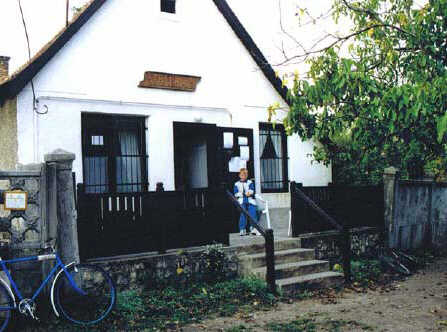
The first Hungarian Telecottage
To all the wonderful people in the Hungarian Telecottage Movement, who have shared their thoughts and plans about Hungarian society with me and allowed me to become part of their impressive efforts to make their dreams come true. To Gabriella Benkõ, Erika Bánszky and Krisztina Üveges for being my personal friends and trouble-shooters in Hungary. To Rune Drewsen for designing the cover page. To Kai Schafft, Tom Wormald, Mary Beaton and Szilárd Molnár for sharing their work, their contacts and their native language skills with me. To everyone at the Information Society and Trend Research Institute in Budapest for taking me in. To Ole Nørgaard and the Demstar project at the Political Science department at Århus University for inspiring me and taking an interest in my research. To my advisor Martijn van Beek who constantly inspires me to do more thorough research, to make stronger arguments and to write with greater clarity.
| DemNet Democratic Network (also the popular name for FDDR) EC European Commission EU European Union FDDR Foundation for Development of Democratic Rights HTM Hungarian Telecottage Movement ICT Information and Communication Technology IKB The Government Commissioner’s Office for ICT (Informatikai Kormánybizottság) IST Information Society Technology MTSz Hungarian Telecottage Association (Magyar Teleház Szövetség) NGO Non Governmental Organisation SME Small and Medium-sized Enterprise USAID United States Agency for International Development |
The people who inspired this thesis are individuals with clear opinions about societal developments in their country. They are acting on the basis of Hungary’s situation since 1989, when state socialism was irrevocably rejected. They want to have a say in the shaping of a new kind of Hungarian society, based on democratic ideals. And they take matters into their own hands and establish institutions, practices, and rules to live and act by in order to secure their desired developments. In my mind their actions are political in the sense that they are based on a particular vision for society. Still, these people claim to be non-political and most of them will not even think about becoming active in a political party or other political organisations. This thesis springs from my own personal confusion and frustration over a seeming conflict between my own observations and the statements of my informants. When I discovered that many studies of politics and democratisation came to largely the same conclusion as my informants - that actions of the kind they undertook were not political – it inspired this theoretical analysis of their activities.
In the following chapters I investigate collective political action in post-socialist Hungary based on an extensive study of one empirical case, namely the Hungarian Telecottage Movement (HTM). It considers questions about what it means to take political action in a post-socialist democracy; and how a social movement can influence the formation of order in a society where values, norms, right and wrong change radically for the second time in a life-time. In answering these questions, the thesis aims to bridge existing theoretical gaps between political science and social anthropology. At the same time, it deals with structuralist and system oriented analyses of political processes and proposes instead a ‘cultural’ approach that focuses on social practices and change. I choose the cultural approach because it can better grasp the different and emerging forms of political action, which are important to understand the shaping of a new order in society at large as well as the changing character of political action.
Post-socialist transition includes processes of rapid change, making it an obvious object for studies of cultural and political transformation. Studies of transition can provide us with a better understanding of the mechanisms of social and political change. Democratic transition is a particularly interesting phenomenon because it claims consensus on the goal of society’s change, namely democracy. Furthermore, democracy building has politically and, to some extend, scientifically been taken as a question of copying existing models (Pickel 2002). However, processes of democratisation do not always live up to expectations as people and institutions act differently than planned. It is often described as a democratic deficit when newly democratised masses fail to vote at national elections and interest organisations do not openly challenge politicians (Krastev 2002:40, 48, Lovel 2001). Indeed, one often gets the impression that citizens of post-socialist countries are utterly disinterested in – and even suspicious and hateful towards - politics. Such democratic ‘short-comings’ are typically explained by ‘socialist legacy’, or as the result of a temporary economic set-back and disappointment caused by neo-liberal reforms of the economic system (Krastev 2002:42-43, Lovel 2001). I believe the distaste for politicians and political systems make many people take their political interest and energy elsewhere, to a sphere where they feel less helpless and more influential. This is why I look for a broader conceptualisation of political struggles.
|
The Hungarian Telecottage Association (MTSz) - and individuals active in it - make an effort to state their independence from the political sphere and the non-political nature of their activities. I nevertheless argue that the Hungarian Telecottage Movement (HTM) is an actor with political objectives - and influence - in Hungarian society. I base this argument on an analysis of their activities and organisation, which I find are clearly related to a set of shared values. At the same time, their activities are deliberately aimed at changing power structures in society by defining, for example, what is ‘truly democratic’ and what is the ‘right’ way to build Hungarian information society. Therefore I claim we cannot but consider them political in nature. Some contemporary social movement theory takes a ‘cultural’ approach to politics that offers insights into the mechanisms of collective action in societies with little confidence in political parties and a general distaste for formal politics. I use this approach to analyze political agency in Hungary and the particular problem that I wish to investigate, namely how the HTM participates in Hungarian society’s political struggles through their stated non-political activities. In my analysis of HTM activities, I identify innovative political action in practices conventionally understood to be non-political. I argue that system-oriented analysis of democratic political action, that celebrates a particular set of institutions and practices, leads to a failure to understand the changed character of political action. Such analysis fails to appreciate the new forms of political action emerging in new democracies. |
 |
Chapter I is a short introduction to the history of democratic transition in Hungary that serves both to contextualise my argument and to conceptualise the process of democratic transition itself. In chapter II the reader is introduced to the Hungarian Telecottage Movement, its central organisation and their main areas of activity. Chapter III is mainly a theoretical discussion of political struggles and social movements leading to a conceptualisation of political action and, particularly, the relationship between politics, culture and practice, which is central to the thesis’ argument. In chapter IV, I demonstrate how the HTM - through the production of social practices - enacts considerable political agency despite claims to be non-political, and I will argue that the movement’s activities, institutionalisation and public discourse have significant influence on cultural and political currents in Hungary. Finally, chapter V outlines some theoretical perspectives implicated by my analysis before summing up the main conclusion.
Throughout the thesis end-notes [Translation notes] are marked in Roman numerals and are exclusively used for the original Hungarian text, which has been translated in the thesis. Footnotes [Notes] contain explanations and clarifications with direct reference to the text in question. The original Hungarian acronyms are used when relevant and a full list of acronyms is provided in the beginning. All personal and place names have been changed to secure the anonymity of my informants. Exceptions are Budapest, Csákberény, public political figures and the former president of the Hungarian Telecottage Association Mátyás Gáspár who is both my informant, a public figure and the author of literature used in this thesis - his multiple roles being a point in itself.
The fall of the Berlin Wall in 1989 initiated a comprehensive and complex process of change in the whole Eastern bloc, where it had become irredeemably clear that socialism had failed and needed to be replaced by another system of rule. Hungary was the first country to open its borders to the West, putting the East German power-holders in an awkward position where they could do little except open their own borders. In the light of Gorbachev's reform policies (e.g. perestroika and glasnost) and the success of Solidarity in Poland, a forced closure of Hungarian borders was no longer a realistic option (Holmes 1997:23-27). The opening of the borders in Berlin, with masses of ecstatic people flooding into West Germany, became the starting signal to formally dismantle the Soviet Union. There was a loud call for democracy and leading figures such as the Polish Prime Minister Tadeusz Mazowiecki, talked about 'returning to Europe' - an expression that soon became a popular slogan in the rhetoric of new East European governments up through the 1990s (Hyde-Price 1996:8).
In the years after the Berlin Wall came down, East European countries were busy writing constitutions, establishing political parties and drawing up reforms. In Hungary reforms had already been underway during the 1980s and even before the Wall fell legislation was passed in the Hungarian parliament (and accepted by Gorbachev), which allowed for multiple political parties. On October 23rd, 1989 a thoroughly amended constitution(1) was instituted as a result of the roundtable discussions between the Communist Party and the united opposition. In this early version of the revised Hungarian constitution the country's name was changed from ‘the People's Republic of Hungary’ to ‘the Hungarian Republic’ (Holmes 1997:65-68). But the compromise between old communist and western oriented reformist views was still obvious:
the Republic of Hungary is an independent democratic constitutional state where the achievements of both bourgeois (western type) democracy and democratic socialism prevail. (Elster et al. 1998:96 my emphasis).
Following the elections in 1990 the new parliament - which had only 9% Communists - further amended the constitution nine times during the first year, thus erasing all references to socialism from the constitution (Neuhold et al. 1995:32, Paczolay 1993:21-25). The first major reforms to be enacted under the new government were related to privatisation of the economy and decentralisation of public administration. As a result of the first local government act in 1990 (Act LXV) virtually every settlement in Hungary gained autonomous, locally elected governments (Soós et al. 2002). This means that there are today 3168 municipal units, of which 1510 operate a municipal office (KSH 2004). The smallest municipality has a mere 14 inhabitants (www.nyilvantartas.hu).
The system change(2) from a one-party socialist system to Parliamentary democracy, and from plan economy to market economy, was experienced as a completely new and chaotic environment for people to live their lives in. An environment filled with challenges, uncertainties and opportunities. The economic system under socialism offered a high level of security for its citizens: a free and universal health system; (formally) no unemployment; subsidised housing and consumption items - to name a few examples. In contrast, the first years of market economy brought about high and rising unemployment, racing inflation and stark demands to production rates - all combined with declining social security (Offe 1996:225-227). The picture is one of increasing uncertainty for citizens of post-socialist states, as they cannot know what the future will bring. Many have been highly disappointed with the harsh realities of market economy that looked so promising from behind the Iron Curtain (Holmes 1997, Offe 1996, Verdery 1996, Sampson 1996).
However, there was - and is - a strong sense of consensus about the direction these societies should be moving in. Indeed, no system change occurs in an historical or ideological vacuum. In the words of Klaus Offe ‘East Central European transformations take place in the dual context, or cognitive frame of reference and comparison, of ‘the West’ and ‘the past’.‘ (Offe 1996:230). Simply put, the large majority seems to agree that the socialist past must be abandoned in favour of a brighter future modelled on western ideals as it is indeed reflected in the constitution.
The final goal of transition is democracy and thus the post-socialist process of change is politically and popularly conceptualised and as one of ‘democratisation’. Political scientist Pickel comments on early transformation debate, noting that
… an almost universal consensus quickly emerged that the central problem was the practical problem of transition from the Communist system to the liberal capitalist system. It was widely assumed, moreover, that solving this practical problem did not pose any serious problems for social science since the relevant scientific knowledge was presumed to be available. (Pickel 2002:111)
Most significantly, Pickel points out that the need for a ‘theory of transformation’ derives from practical concerns of economic, social, and institutional nature that arose in the process of transformation itself. He explains that, because the project of post-socialist transformation was from the beginning essentially a political one, defined as the rejection of communism in favour of liberal capitalism, democracy and a ‘return to Europe’, western economists and political scientists were assumed to possess the needed knowledge. In this way, the problem of post-socialist societal change was broadly defined as a transition from one definite order to another, rather than an open-ended process in a particular time-space setting (Pickel 2002:112, Sampson 1996).
The terms ‘transition’ and ‘transformation’ are often used interchangeably, but there can be an important point to using one rather than the other. Using the word ‘transition’ indicates a definite idea of the outcome of a process of change (that being for example ‘democracy’ or ‘market economy’). ‘Transition’-studies typically consider macro-processes of change in political and economic systems but the underlying assumptions can be identified in other types of studies as well, and - in its most outspoken form - in popular and political discourse on democratisation. Thus, the very notion of ‘democratisation’ implies a well-defined and obvious goal – namely ‘democracy’ - of an ongoing process. The process of transition from post-socialism to democracy is conceptualised as a linear, evolutionary process suitable for measurement of a kind that can determine the ‘degree’ or ‘stage’ of democratisation in a given society. The yearly ratings by Freedom House is one of the most extreme example democracy measurement. Freedom House operates with ratings of ‘political rights’ and ‘civil liberties’, where political rights include for example the right to vote and compete for public office. In this way the organisation produces yearly ratings – in numbers - of the degree of ‘freedom’ in all the world’s countries (Freedom House 2004).
‘Transformation’, on the other hand, alludes to the understanding that processes of change in general - and the post-socialist process of change in particular – are not linear and predictable. Broadly speaking, ‘transformation’ is change into something new and unknown whereas transition is change into something known and defined (Verdery 1996:14, Berdahl 2000:2)(3). This is an important difference, not because it is necessarily better to do open-ended research, but because the outcome of societal change is always unpredictable. These lines by Katherine Verdery outline how encompassing and unpredictable a process post-socialist change is:
I believe the postsocialist change is … a problem of reorganization on a cosmic scale, and it involves the redefinition of virtually everything, including morality, social relations, and basic meanings. It means a reordering of peoples’ entire meaningful worlds. (Verdery 1999:35)
This reorganization, as Verdery points out, goes beyond the institutional reorganisation of the political system and involves making sense of malleable terms such as ’democracy’; knowing what is ’good’ and ’bad’ behaviour; and conceptualizing the relationship between state and individual. All this happens whether anyone intends it to or not, as people are bound to perceive an order in society, to have ideas about the ’rules of the game’ and common norms, because this enables them to make choices and to orientate themselves socially and develop dispositions - in short, to live their every-day lives. However, the process of reordering is influenced by various agents, some individual and some collective, such as social movements. Steven Sampson also points to the fact that transition in Eastern Europe is influenced by many actors and do not necessarily follow the Western European recipe:
Transition in Eastern Europe is not a fundamental, irrevocable social change along Western lines, nor is it the controlled transfer of western experience to the east. Rather, the transition is a social space in which various resources - material, organizational, human, symbolic - are manipulated and reconstituted by a variety of actors in an organizational setting of global character. (Sampson 1996:122)
Nevertheless, most scholars stick to the term ‘transition’ even while ascribing to the conceptual framework of ‘transformation’ (e.g. Verdery) as there seems to have emerged a general acknowledgement of the former as the more general term of the two(4). While general consensus has emerged within the social sciences that post-socialist change must be conceptualised as an open-ended transformation, the idea of a transition to western style democracy is still the politically dominant conception.
I feel it necessary to make one last note on the debate about transition versus transformation. I believe that the best argument for sticking with the term transition is that this is how most implicated actors view the process. There is a definite (even if imagined) goal of the process, namely democracy, and actors aim at this goal by following (more or less rigidly) existing models (whether or not these are well interpreted or well represented). Therefore, the process is not seen as a transformation into something new and unknown, but as transition into a particular model. It is this process we must seek to understand when we scrutinize ‘democratic transition’ as an object of study. Post-socialist, democratic transformation is brought about by actors so determined to make it a transition, that this becomes our object of study: a transformation claiming to be a transition. Let me underline that viewing democratisation as transformation has no implications as to the success or failure of the project, neither does it state anything about how closely new democracies resemble old ones. Transformation is merely the most plausible framework of the two for any conceptualisation of processes of social change, because the concept of transition implies something far too linear, structured and static to cover those societal processes of change which we call transitions.
Today, Hungary has established a formal democracy, understood as a set of rules, procedures and institutions (e.g. multi-party elections, ombudsman, separation of the legislative, the judicial and the executive power) and for the most part modelled upon western European examples. While this formal system is now firmly in place, both popular and scholarly discussions about the state of Hungarian democracy are often centred around the realisation of what some call substantive democracy. For example, Mary Kaldor and Ivan Vojevoda write:
We consider substantive democracy as a process that has to be continually reproduced, a way of regulating power relations in such a way as to maximize the opportunities for individuals to influence the conditions in which they live, to participate in and influence debates about the key decisions that affect society (Mary Kaldor et al. 1999:3-4).
This view underlines that democracy – as any other type of society - is not a final or static state of being but a ’process that has to be continually reproduced.’ Such processes of social reproduction take place all the time in all societies, but during the transitional period from one type of society to another, they become far more explicit as new concepts are introduced into daily language; new practices are established; the whole logic of political life (not to mention daily life) is and must be redefined; and at the same time there is a lack of natural authorities to provide clear answers about what the ’new order’ is, or should be.
While political discourse on democratisation gives the impression that we are talking about a well-defined and shared sense of order, only the most hard-core structuralist political scientists have a very clear and delimited definition to offer. At a conference at the Johns Hopkins Institute a professor of political science demonstrated such certainty, when he ended our discussion on the nature of democracy by stating that as soon as there were popular elections in a country this is a democracy(5). Other analysts are more nuanced and will grant it that democracy can mean – and is by most people taken to mean - far more than that. To different people democracy is also a question of ‘political culture’ (Putnam 1993); equality in access to the decision-making process; a free press; of ‘civil’ mentality and behaviour (Carter 1998); a vibrant ‘public sphere’ (Habermas in Calhoun 1997); the level of ‘trust’ in a society (Lovel 2001). Finally, several of my informants believe that democracy requires a certain level of living standards or even a welfare state that ensures some redistribution of resources, before people will have the surplus and the independence required to claim their rights and voice their opinions. Árpád Nyári, who holds a degree in social politics and works for the NGO DemNet (to be introduced in detail later) expresses his view:
So, a country can be very democratic but if it is economically weak it will function according to those very systems of [personal] relations on the basis of which Hungary is indeed functioning in many cases. So you have to strengthen the market, because the market is a basic pillar of democracy. […] Because anyone can be bought, so you can’t say that you have rights but no job, because it won’t work - then you are in a situation of dependence on someone...’(i) (Interview with Árpád Nyári June 26, 2000)
Post-socialist transition has attracted many scholars investigating processes of change. Over the past five to 10 years we have seen a growing body of anthropological literature on post-socialism focusing on the challenges and options of everyday life for individuals living in the times of system change. A few prominent scholars on socialist countries set the stage with outstanding analyses of life under socialism and some preliminary guesses at what comes next (e.g. Hann 1993 and Verdery 1996). A range of studies have since emerged on the everyday life of post socialism, touching upon issues such as consumption (Caldwell and Patico 2002, Fehérváry 2002), rock music (Szemere 2001), gender roles (Gál and Kligman 2000) and village life (Hollos 2001).
One of the most renowned post-socialist scholars is Verdery, who has carried out numerous extensive studies in Romania before and after the system change. In her conception post-socialist transformation is an open-ended process that entails altering landmarks (e.g. tearing down or replacing statues), repositioning dead bodies(6), rewriting history, forming new political arenas, redefining morality and basic values and much more – ‘a reordering of people's entire meaningful worlds’, as Verdery herself puts it (Verdery 1999:35). I agree with the now common notion that social change and redefinitions happen all the time in all societies. What makes post-socialist transformation exciting is the overall political and public agreement that profound changes must be made and are taking place. At the same time great uncertainty and controversy prevails regarding the practical implementation of principles such as democracy and free market economy and their implications for people’s everyday life. In this situation every person is eligible to have an opinion on ‘the new’ versus ‘the old’ order and change is indeed a constant topic of conversation in all parts of society as people experience more - and less - significant alterations of everyday life experiences and circumstances. Because, obviously, wide consensus about the necessity and desirability of democracy in no way ends the discussion about what democratic society looks like. Exactly because the concept of democracy is generally so vaguely defined, it is immensely powerful as a political symbol – powerful because it is at the same time widely celebrated and holds the capacity to evoke a multitude of understandings(7).Thus actors in the transition also participate in a struggle to ‘utilise’ the concept of ‘civil society’, as Sampson has phrased it (Sampson 1996:124). What Sampson aims at here, is that the widespread consensus about the desirability of democracy and civil society is not simply a matter of a sudden change in morals. Such orientations are also a product of heavily supported projects in the name of democracy and civil society, the available resources creating strong incentives to become a devotee (Sampson 1996:124).
My own interest in transition studies started in 1997 when I spent four months in Hungary and started to learn Hungarian. A year later I returned for six months to improve my language skills and in 2000 I carried out seven months of fieldwork as a volunteer with the Foundation for Development of Democratic Rights (FDDR). The organisation was originally set up as a programme office for USAID to administer a programme called the ‘Democracy Network’ programme, from which the organisation still carries its popular name ‘DemNet’.
The original focus of my fieldwork was the relationship between donors and recipients in the world of NGOs. Specifically, I looked at how conceptions of democracy and civil society were developed, transferred, interpreted and put into practice in the chain connecting foreign and international aid organisations to small NGOs in the Hungarian countryside. I interviewed representatives from DemNet and from organisations that received their grants - and one representative of USAID. In a way I expected people from local NGOs to be quite political in outlook, to have visions for society – after all, as members of the NGO community and grantees of DemNet they were supposedly all involved in efforts to ‘build civil society’ and ‘enhance democracy’ in Hungary (DemNet PR material 2000). It therefore struck me as quite peculiar that many of these people and NGOs, who were all skilful users of international political buzzwords, often seemed uninterested in political developments and they all refrained from political affiliation. Although everyone had their own private idea about what was good about the transition and what should be different, these viewpoints were rarely connected to any direct political activity. Even the efforts of NGOs were usually kept at the level of solving very local problems by providing services that would otherwise not be available. The idea of combining their efforts with advocacy work and political lobbying for more general changes was typically refused. One explanation I was given was that such efforts were futile because the system was not ready for ‘real’ democratic behaviour. Many of the NGOs felt morally raised above the public system, since they felt officials used their positions for their own personal benefit and not in the interest of the people. Very often people just did not want to be enmeshed with the political system because they said officials were corrupt, ineffective, uninterested and nepotistic. It was continuously pointed out that many politicians started their carrier in the socialist system and now continue unaffected by the changes as party leaders and ministers in the democratic system. In 2002 the new Prime Minister Péter Megyessy was heavily criticised in public media as it was revealed that he had worked as a secret agent under the socialist rule. The opposition argued that he should step down because he was unreliable as a representative of the democratic Hungarian state but Megyessy stayed on(8).
In 1997 DemNet had provided support for 30 NGOs to establish telecottages and after visiting some of them I decided to focus on this particular type of initiative. The NGOs behind telecottages were different from other DemNet recipients, first of all because they were united in the international Hungarian Telecottage Association(ii) (MTSz). This was unusual according to DemNet staff, who experienced it as a general problem that Hungarian NGOs are unwilling or unable to unite in parachute organisations. Staff explained this with a general lack of trust and a sense of competition among NGOs. Several scholars and other commentators have also noted the poor success and missing efforts to create umbrella organisations or to unite around campaigns (e.g. Kúti et al. 2000). But here was an association with an idea that had in 2000 already attracted around 100 independent NGOs. What attracted NGOs to the MTSz was of course access to funding, but the same NGOs could have applied for funds without entering the MTSz. The association had something more. In 1997 the idea of telecottages in small Hungarian villages was highly innovative - to some it even sounded unrealistic - and many of the NGOs that were interested needed the expertise MTSz could offer. There were also members who had started something similar at an earlier point and they felt that in the MTSz they could meet and work with like-minded individuals. An NGO in a small village near the Slovakian border had already established a meeting place reminiscent of a telecottage when they heard of the MTSz and joined in order to share experiences. In fact I quickly observed a strong sense of brotherhood especially among the initial 30 organisations, and this raised my interest in what telecottage leaders were starting to refer a to as the Hungarian Telecottage Movement (HTM). When I visited telecottages I was almost always presented with the telecottage book and video film ‘Telecottages and Distance Work in Hungary’ (Bihari 1999) and people enthusiastically told me about the vision behind their efforts. Everyone I talked to emphasised that telecottages are not just about technology, their mission involves strengthening local democracy, empowering citizens and establishing a new ‘civil’ culture. The computers were just a tool to bring all this to the small communities. I found it exciting to finally meet some people who wanted to have a say in Hungary’s future and who actually had an idea of what they wanted Hungarian society to look like in 10 or 20 years. This was an association of people who did not only try to solve the immediate task at hand in their particular settlement, they actually saw their efforts in a greater perspective, they united and they had a vision for the future. However, just like other NGOs, the telecottages also claimed to be ‘non-political’ in outlook, their activities being ‘free of politics’ and themselves unwilling to participate political struggles. And still, they all had strong opinions about what society should look like and how the telecottages should contribute to this process. This struck me as a dilemma: on the one hand, these individuals and their national organisations all carried well-defined ideas about society, and what needed to be changed. They also worked night and day to make these changes real through their telecottage activities. Yet, they claimed not to be interested in the world of politics and not wanting to engage in political struggles.
In the first five to 10 years after the collapse of the Soviet system, transition studies were dominated by economic and political scientists, who typically focused on formal changes within the system of government and social and economic reforms, with the general objective to evaluate the speed and quality of democratisation in different countries (e.g. Diamond 1999, Elster et al. 1996, Kaldor et al. 1999, Soós et al. 2002). In such studies the ‘pace’ or ‘degree’ of democratisation is measured on the basis of a structuralist understanding of politics as something going on within clearly defined formal institutions, thus excluding actors outside this formal system as not properly ‘political’. This approach has been criticised by Alvarez and Escobar, among others, who challenge what they see as too strong a focus on ‘measurable aspects’ leading to a disregard of ‘the less visible effects at the levels of culture and everyday life’ (Alvarez and Escobar 1992:7). Instead they propose a focus on practice and small-scale changes to balance the overload of surveys ‘testing’ democratic institutions.
There is criticism among academic and political observers that the bulk of NGOs do not address or articulate political or social issues and, especially smaller NGOs, tend to pursue a highly ‘de-politicised’ approach (e.g. Lovel 2001, Grunberg 2000, Kúti 1996). The renowned Hungarian NGO scholar Éva Kúti notes that ’Foreign observers are often surprised and disappointed by the prevalence of the pragmatic, problem-solving approach in Hungary’ (1996:137). She herself observes that NGOs generally do not try to challenge policy makers directly and only rarely concern themselves with legislation or political programmes. Instead they act as ‘alternative policy makers’ carrying out new types of (or better) services and lobbying for state donations or contracts for their particular organisation (Ibid:139). This means that problems are addressed locally and there is little confrontation of the local or national government. Instead, problems are solved for the individual (group) on the local level, but the overall structures of inequality remain unchallenged. A woman who developed social and educational programmes (e.g. organisation of a foster home network, education of social workers in family counselling, etc.) in cooperation with both NGOs and social authorities was frustrated with what she felt was a general lack of perspective and political ambition:
The problem is that in Hungary many times they just cater the tasks but not the problem.(iii) (Conversation with Gabriella Nyikos September 20, 2000)
In my own studies of Hungarian NGOs – including telecottages - I have also observed this tendency to refrain from engaging in ’politics’. This attitude is expressed in a strong aversion to affiliations with political parties and their programmes, and NGO staff typically insist that their activities are ’non-political’. And not only are they opposed to affiliating with parties and formal politics, they also do not use such methods such as demonstrations, sit-ins, mass mailing, letters to the editor, etc. to put pressure on politicians and government administrations.
Observers of NGOs in other post-socialist countries have noted similar tendencies. Laura Grunberg did a study of women’s NGOs in Romania and explains their ‘politics of anti-politics’ as the result of a ‘long tradition… of treating politics as something apart from society, even shameful’ (Grunberg 2000:310). She also notes the lack of a ‘formal lobby’ to influence policy-makers and points out that ‘women’s NGOs are busy helping women but not emancipating them’ (Grunberg 2000:314). While this is probably a correct analysis from the point of view taken, it nevertheless ignores two essential questions: does the Romanian women’s movement have to be about emancipation (as understood in other – Western - women’s movements) in order to be political in scope? Is lobbying and confrontation through the established system the only way of enacting politics? The theories that lay the ground for Laura Grunberg’s criticism have been developed in political science departments of those countries we may now call old democracies and the 'success criteria' they lay out for developing democracies are based on a particular historical and societal context. Thus theories ‘take for granted a particular form of society, that of the modern West’ (Escobar 1992:410). I argue that this bias in important ways makes them unfit to grasp the way in which NGOs in post-socialist states, specifically Hungary, do indeed engage in political struggles.
Contrary to the studies mentioned above, my findings show that the activities of NGOs – specifically telecottages – are bursting with politics, even though political struggles are not primarily fought through the official political apparatus. The MTSz has developed distinct lobbying techniques for the purposes of achieving state-funding and influencing the policy of changing governments – without engaging in ‘politics’ understood as public political discussions, direct public challenges or appraisals of government policy or any adherence to political parties. In connection with a research internship at the Demstar research project in 2001, I did a pilot study of the MTSz’s lobbying techniques, which revealed that the MTSz has close ties to a range of political decision-makers in the central government. The main conclusion of my study was that the MTSz performs extremely targeted lobbying, which is co-ordinated and carried out mainly by the lead character Mátyás Gáspár. While he performs most of the direct negotiations with ministries and other potential donors, other actors are encouraged to feed the same institutions with positive statements about the telecottages. Thus, for example, the director of the Information Society and Trend Research Institute where I worked in 2002 revealed how his timing of telecottage appraisals to ministerial representatives had been co-ordinated with Gáspár. My most important finding was, however, that the relationship developed through lobbying is best compared to the relationship between business partners and therefore theories of political lobbying were not easily applicable. In an effort to familiarise myself with a ‘political science’ rather than an ‘anthropological’ approach I had decided to study the MTSz lobbying techniques using a highly system oriented analytic framework, which had clearly defined indicators for lobbying success or failure (for example, the strongest indicator of political influence was participation in law formulation and execution)(9). However, because these indicators do not correspond very well to the objectives of the MTSz lobby, my research design could not properly grasp the effects of their activities. The MTSz offers programmes to the state in a manner which is quite similar to that of a contractor and they hope to influence state policy and investments by convincing the authorities to provide resources for telecottages. In this way the current goal of lobbying is to sell a product rather than to formulate or change laws, thus measuring effectiveness as a question of influence on law making proved to be a misguiding choice.
My point is that - even though studies of formal political institutions are valuable and important - we cannot properly understand the changing character of the political - which is an inherent part of transition in Hungary and other post-socialist states - unless we turn focus to look for political agency in activities not conventionally understood as such. Looking at transition merely from a system oriented understanding of ‘the political’ does not allow us to see how new social practices and cultural innovation shape the reordering of society and reshape relations between state, civil society and the individual. Lovel uses surveys on people’s confidence in politicians and the political system to show that many post-communist societies are lacking a crucial ingredient, namely trust, and therefore there is a ‘gap of varying widths between institutions and appropriate behaviour throughout postcommunism’ (Lovel 2001:28). He finds that whereas democratic institutions are in place, the democratic behaviour is still lacking because of a lack of trust in politicians and officials. He explains this as a result of ‘communist legacy’ and proposes the level of trust as a measurement for democracy (Lovel 2001:33). I find it ironic how Lovel’s analysis stands in opposition to my informant’s viewpoint that it is the system which is not yet ready for real democratic behaviour. Apparently it does not occur to Lovel that maybe it is the institutions which are not ‘appropriate’ for the people. The problem with Lovel’s approach is that he fails to ask where people place their trust if not in the political system. First of all, to claim that people had no trust in each other during communism disregards the existence complicated and widely extended personal networks for exchange of favours and goods, which demanded quite a high level of trust in other people’s willingness to keep their eyes shut to illegal activities (Hollos 2001). Secondly, turning focus from the gap between newly established democratic institutions and people’s ‘inappropriate’ behaviour, to look at political action in a broader perspective proves more fruitful if the goal is to detect democratic political activity. Explaining current problems by ‘legacy’ usually proves to be an over-simplification, a point made convincingly by Krastev, who also suggests a turn of focus away from institutions towards people’s everyday life and experience in his area of expertise, the Balkan region:
It is time to adopt a perspective that focuses on citizens and treats their experiences as the key to understanding Balkan politics. Democracy, in this view, is less a matter of institutional settings than of the relations between governments and citizens. Democracy means not only that people can vote in free and fair elections, but that they can influence public policy as well. What people think matters at least as much as what governments do. (Krastev 2002:45)
As I have already pointed out, I find that the activities performed in telecottages are deliberately aimed at changing basic values, norms and even power structures in society, based on clear conceptions of how they believe society should develop and what the ’true’ meaning of democracy is. Therefore I hold that it is simply foolish to consider them void of politics, even if they do not behave ‘appropriately’ in relation to the new political system. Katherine Verdery proposes a more embracing definition of politics that I find more useful to conceptualise post socialist political behaviour:
I see politics as a form of concerted activity among social actors, often involving stakes in particular goals. These goals may be contradictory, sometimes only quasi-intentional; they can include making policy, justifying actions taken, and creating or manipulating the cultural categories within which all of those activities are pursued. (Verdery 1999:23)
When NGOs unite in the MTSz with the outspoken intention of establishing a whole new set of institutions – arguing that they are instrumental in the country’s successful transformation from socialism to democracy, from traditional to information society - this is most certainly a ‘concerted activity’ with ‘stakes in particular goals’ as Verdery puts it. While system oriented approaches miss (or dismiss!) this kind of politics, I choose to work with a sense of politics and political agency that is closer to Verdery’s conception. I do so because I believe this approach allows me to say much more about post-socialist political agency and the transformation of post-socialist societies than will a study of the model political system and its conventional actors.
With a theoretical basis in the Latin American school of New Social Movements (e.g. Alvarez, Dagnino and Escobar 1998) I identify a sense of ‘political agency’ in practices conventionally understood - by analysts as well as practitioners - to be non-political. I find this an especially relevant study in the post-socialist context because of the so far prevalent tendency to dismiss NGO activities as politically inconsequential by political and social science scholars alike. Other post-socialist scholars have taken steps in this direction considering, most notably, the politics of gender and gendered politics (Gál and Kligman 2000) and the politics of repositioning dead bodies (Verdery 1996). However, to my knowledge, no studies have yet explicitly combined the Latin American school of new social movement theory with the study of post-socialist politics and political agency. I use this approach for a more explicit investigation of the character of post-socialist political agency, because I find it an obvious choice all the while the Latin American school of new social movements is centred around the question of cultural struggles as political struggles (Alvarez, Dagnino and Escobar 1998).
I will return to more elaborate discussions of theories on ‘politics of non-political activities’ in the following chapters. For now, I claim that telecottage activities in Hungary are in fact clearly ‘political’ in the sense that they do address general ideas about what the Hungarian society should look like and almost always exist as a critique (explicit or implicit) of existing practices in their field(s) of operation.
I believe it is important to properly understand the changes happening in post-socialist societies, lest we blindly accept the widespread - but mistaken - assumption underlying the political project of ‘post-socialist transition’ that changes in one time-space setting (post-socialist countries) can be carried out as a direct mimicking of former developments in a different setting (Western countries). This would not only be poor science but also leads to misguiding policy recommendations and useless spending of resources. In my own experience the many presumptions inherent in standard models for democratic society channelled through the world of NGOs do not reflect the reality of transitional societies. Thus it rang hollow when American experts told Hungarian NGOs to become more independent and sustainable by diversifying their sources of income. A recurrent suggestion was to opt for donations from private companies as NGOs do in the United States. But the two things are not comparable: In the United States the tradition for company donations to NGOs emerged when bourgeois women started organisations to distribute food for homeless people, organise orphanages and the like. Their husbands were typically the directors of local enterprises or banks with a tight connection to their local environment and an intimate relation to the NGO activists. This could not be further from the situation in rural Hungary, where NGO leaders are school teachers, university students and pensioners and local enterprises are non-existing or quickly loosing business to multinational companies whose directors have no personal ties to or interest in the local environment.
Transition discourse of international development projects frames post-socialist transformation as a question of one-directional transfer of models from West to East (Sampson 1996). This leads to an enormous waste of resources, for example when western specialists fly in to deliver their standard lecture to Eastern European NGO staff, who know all the points but cannot use them because reality looks entirely different than the model or setting the expert is grounded in (Sampson 1996). Krastev voices a similar frustration with what he sees as a predominant focus on ‘why things are not working out as they should (according to that paradigm’s ideal)’ instead of ‘finding out why things are happening as they are’ (Krastev 2002:45). In my attempt to take this approach I refrain from judgements about whether or not actors behave in the ‘appropriate’ democratic way ascribed by an arbitrary democratisation paradigm, instead I concentrate on the notion of political action.
Generally accepted theories about democratisation follow a logic according to which the civil sector, made up primarily of NGOs, will monitor the state and provide services that guarantee equality among citizens (i.e. fill in the social ‘gaps’ left by the state). Also they will foster ‘political activity’, thereby securing the basis for representative democracy. These largely political assumptions have their roots in political science theories reaching back to Alexis de Tocqueville who observed civil organisations in the USA in the middle of the 19th century (Tocqueville 2000). One political scientist writing specifically on processes of democratisation is Larry Diamond, who defines civil society with strong emphasis on organisation as
…the realm of organized social life that is open, voluntary, self-generating, at least partly self-supporting, autonomous from the state, and bound by a legal order or set of shared rules. (Diamond 1999:221 emphasis in original)
Keeping in line with a long tradition of theoretical thought on democracy and civil society - and similar to other contemporary theorists like Andrew Arato and Jean L. Cohen (1992) and Robert D. Putnam (1993) - he argues that civil organisations promote democratic development and consolidation because they carry out a range of vital functions in democratic society, which can be summed up as follows: civil society limits and controls state power (through challenges by the free media, interest organisations, etc); organizational life stimulates political participation and deliberation by constituting small-scale, practical ‘schools for democracy’ (which ‘teach the democratic ways’ and fosters professional politicians); civil society mediates between the individual and the state (e.g. through conflict mediation and dissemination of information) (Diamond 1999:218-260). These ideas lay the ground for efforts to support the enhancement of civil society in democratising states. As this excerpt from an EC communication shows, civil society is considered fundamental to democratisation:
A flourishing civil society, able to draw on an independent and impartial legal system, plays a fundamental role in holding governments accountable and denouncing human rights abuses. (EC 2001:16)
These few lines also bring out an emphasis on formal institutions (‘an impartial legal system’, ‘governments’ and ‘human rights’) typical of democratisation programmes, which must be measurable in future evaluations of the programme’s results. According to the same communication, approximately 100 million Euro has been allotted to EC’s European Initiative for Democracy and Human Rights (EIDHR) to support ‘human rights, democratisation and conflict prevention activities’. Such activities are to be realised through ‘partnership with NGOs and international organisations’. OECD aid statistics reveal that the total amount of aid granted to the Central and East European Countries and the former Soviet states in 2002 amounted to 8331 million US dollars. Out of this app. 898 million(10) were designated for ‘government and civil society’. The largest donors of aid to the same region are by far the EC with 39% and United States with 26%. Hungary is still among the region’s top ten recipients with 471 million US dollars in development support in 2002 (OECD 2004).
In the first years of democratic rule Hungary saw a virtual explosion of NGOs(11) - along with enormous expectations to them as key actors of ‘civil society’. Civil society remains a cornerstone of democracy in western political thinking, in all its different readings. The transition from one system to another and the development of democratic institutions after the ‘velvet’(12) revolutions in East Central Europe were aided by USA and EU member states. Thus, also in Hungary development agencies like the USAID provided professional and financial support for social and economic reforms and strengthening of civil society. Sampson has observed how Danish democratisation projects in Romania have a tendency to measure democracy in numbers of NGOs (Sampson 1996:124,128). In the same way USAID’s support for Hungarian civil society translated into programmes that supported NGOs. It was one such programme that caused the establishment of the organisation where I did fieldwork. According to their mission statement, DemNet
…serves democratic civil society development in Central and Eastern Europe through design and management of innovative programmes that strengthen non-profit(13) sector sustainability and improve social institutional structures. (DemNet PR material 2000).
Apart from the assumptions about purely democratising effects of civil society outlined earlier, other ideas about the role of NGOs in the transitional process also play an important role in grant distribution. The NGOs that received support from DemNet in 1998-2000 had applied within one of four thematic areas, namely ‘advocacy’, ‘rural development’, ‘niche social services’, and ‘Roma entrepreneurship and education’ (DemNet informational pamphlet 2000). These areas were laid out by USAID as a general framework to guide grant distribution(14) and thereby the donor had already defined these four areas as central to their conception of civil society. Grantees in the ‘niche social services’ area were partly selected on their objectives to address issues of social inequality – or ‘gaps’ - and organisations that received support typically offered very specialised social services, one example being a day care centre for disabled children. There was thus a general expectation that NGOs can take on a significant role in an emerging ‘free market’ of social service provision. This is also reflected in an analysis of the Hungarian NGO sector performed by Kúti on behalf of the World Bank in Hungary:
…the nonprofit institutional form is generally considered to be an appropriate means of facing the numerous social and economic challenges of the transition period. (Kúti et al. 2000).
One of my informants was an American woman who worked with fundraising and internal procedures at DemNet. She also voiced the view that NGOs were not just the building blocks of civil society but also important contributors to a reformed system of social institutions:
… that's why we think the non-profits are the key to improving things in Hungary. If we can get them to a point where they are professional organisations that work professionally in a transparent way, providing quality services. Then they have a huge ability to bring in outside resources… (Interview with Cindy Graham June 15, 2000)
DemNet serves as an example of how political objectives to build democracy through the strengthening of civil society are put into practice, and how these practices effectively shape and cement the conventional wisdom about ‘proper’ civil society. More importantly (for my discussion), the DemNet example also illustrates an inherent contradiction in NGO/civil society discourse as it unfolds in a Hungarian post-socialist settting: NGOs are conceptualised, at one and the same time, as nurseries for deliberative democracy; a counterweight to state power; and as service providers that engage in a direct relation (often as state contractors or grantees) with that same state to fill in social gaps left by reform policies.(15) I think it is obvious that the sector has a problem living up to all these expectations simultaneously and sometimes it creates difficult dilemmas for organisations that feel they cannot voice critique of government policy in fear of loosing vital support. At a monitoring visit with a relief organisation for children with Down’s syndrome, the DemNet representative asked the daily leader how much support the organisation receives from the state. She grasped the opportunity to express her viewpoint that NGO’s were actually supporting the state, not the other way around, because her organisation carried out services which the government would pride themselves of ‘in Bruxelles’(16). However, if she were to voice her opinion in public it would be sure suicide for the organisation, which was partly dependent on public contracts and grants. So, although she felt it would be much better if the number of users determined how much support a place got (which, she argued, would imitate a free market mechanism, putting similar places – public and private - in competition for clients), she assessed that actively advocating this viewpoint at a political level was not in the organisation’s best interest. Therefore, she decided (like many others) to focus on delivering high-quality social services hoping that their efforts might help raise general standards.
Telecentres have been identified internationally as powerful tools in poverty reduction and development projects because information and instant communication are to information society what labour and raw material was to industrial society – so goes the argument (e.g. OECD 2001, WB 1999). The information society demands different investments than did industrial society and both state, interstate and private organisations have designed strategies and programmes to address the problem of a ‘digital divide’ emerging between populations with and without access to information and communication technology (ICT) or, with the more encompassing term which I prefer: Information Society Technology (IST) (e.g. USAID 1997, EC 2002, WWF(sic!) 2002). The main argument for investing in IST in developing countries is that the technology is instrumental for economic development in the information age when knowledge and information are the most valuable resources. This excerpt from the 1998/99 World Development Report by the World Bank expresses well the hopes vested in this the 21st century’s most promising development tool:
KNOWLEDGE IS LIKE LIGHT. Weightless and intangible, it can easily travel the world, enlightening the lives of people everywhere. Yet billions of people still live in the darkness of poverty—unnecessarily. (WB 1999)
The first telecentres were established in the late 1980s in Norway, Sweden and Denmark in order to make it possible for farmers and small entrepreneurs placed in distant locations to benefit from new technology and ease communication with the world around them. With the Internet they could acquire almost any kind of information just by going the short distance to the local telecentre. This was (and still is) deemed of especially great importance for those living in small villages in the mountains or distant costal areas (Qvortrup 1989, Latchem and Walker 2001, OECD 2001).
In Hungary a few librarians, some community development workers, teachers and other people were inspired by this Scandinavian idea soon after the system change in 1990. They saw in it a great potential to help their own isolated villages become again economic communities instead of sleeping towns where elders and unemployed dwell in oblivion. In 1992 the first attempt was made to start a telecentre but a lack of funding quickly closed it down and only in 1994 a more durable one opened in the town of Csákberény in Western Hungary. Its founder, Mátyás Gáspár had worked in community development for years in a Budapest district administration, and he brought together the small town citizens to discuss needs and shortcomings of their village, to which he had moved. A partial answer was the Telecottage of Csákberény, which secures local citizens access to information and technology they would otherwise have to go a long way for and might not know exist (Gáspár 2003, Murray 2001).
Gáspár and a few other people quickly decided to establish a national association for telecottages, the MTSz which works for the establishment of ever more telecottages in Hungary and their continuous improvement. With this act they acknowledged that their project is larger than the simple question of one village gaining access to computers. In Gáspár’s words the telecottage is a ‘cultural turning disc’(17) and they address a problem of cultural conflict and change:
You could say that the telecottage mission is to lead the small communities and their members into the information society, so that they can benefit from its opportunities. I usually say that the information society and the traditional culture collide frontally. Like in a car accident.(iv) (Interview with Mátyás Gáspár October 11, 2000)
Gáspár further explains that there is a great contrast between ‘traditional’ culture, which is lived out in villages and the demands and opportunities of the information society. First of all, it is a question of how one obtains information: for example people should learn to use the Internet for correct and adequate information rather than relying on the casual knowledge of fellow townsmen. However, the ambitions are higher than just teaching individuals about the splendour of modern technology. Studying informational pamphlets, books or course material for ‘telecottage managers’ produced by the MTSz, one learns that a telecottage should be a public meeting place; it should instigate local debate and activity; and it should ease the adjustment to a new system in Hungary and EU. The following excerpt is from a Serbian/English language book on telecottages, which was published to celebrate the establishment of 60 Yugoslavian telecottages, a project financed by USAID and carried out jointly by the MTSz and DemNet.
The telecottages ‘bring’ the information to local people and provide opportunities to use the information in different ways: to work, to learn or to play… A telecottage is also a community center where local people can meet with each other to organize events. Telecottages are relevant tools for sparking community development programs and through their services, may develop and strengthen local communities from the ground up. (Nizák and Pálvölgyi 2002:11)
This excerpt is a reformulation of Hungarian telecottages’ general mission and it refers to three core objectives of Hungarian telecottages, namely to secure broad access to information; to provide centres for community activities; and to instigate rural development.
The MTSz was established as a forum for the growing amount of people interested in the telecottage concept and since the beginning it has functioned as a professional and fundraising organisation. After the first telecottage was established with private funds it was used as a ‘showcase’ for potential donors and when the first ministries and international sponsors provided funds, they were dealing with the MTSz. Today the MTSz is a large and diverse association offering many services to its members. There is a webpage with general information about membership, announcements of meetings, courses, conventions, new grants, ideas and advice on the successful operation of telecottages and much more. The telecottages have their own news service, both in the form of daily news pieces on the webpage, a print newspaper and a radio programme. The MTSz further handles all major telecottage grants including applications, monitoring, instruction of new telecottageers and composition of teaching materials. Finally, the association represents the telecottages to the world, sending representatives to international conferences to spread the ‘Hungarian experience’. This year (2004) the MTSz was the driving force in the establishment of the European Union of Telecottage Alliances (EUTA).
The MTSz has meant that rather than a few people merely being inspired by each other to establish telecottages and the like, people from all over the country can come together as a community with clearly formulated objectives and a diverse set of tools (resources, organisation, experience) to reach them. There can be no doubt that the association plays a key role in the nurturing of a telecottage movement and to many the association is the movement.
Probably the most effective tool to secure certain standards and a sense of unity among operating telecottages are the training sessions (often compulsory when receiving a grant administered by the MTSz); they include practical information about the daily operation of a telecottage (how to keep a register of visitors and services, how to balance the cash holdings, etc.), advice on ‘critical’ issues for telecottage establishment (how to identify the right person to operate the telecottage, how to negotiate cooperation with other organisations, how to secure long-term operation, etc.) and, most importantly, a thorough introduction to the ‘Telecottage Minimum’ containing six overall ‘Operational principles’(v) and ten ‘Basic services’(vi). The six operational principles are also listed and explained in the book ‘Telecottages and Telework in Hungary’ (Bihari 1999), a basic reader on Hungarian telecottages which can be obtained free of charge and is on the shelf of every telecottage. In short, the operational principles are:
In the further explanations of these points, it is emphasised that the telecottage must exist at the service of the community. It must investigate and be sensitive to specific needs of local residents, organisations and enterprises. Furthermore, the telecottage must secure a public meeting place and instigate public debate, ‘civic virtues’ and free access to information. Besides the general operational principles the material also lists ten basic services:
The ten basic services underline that we are not just dealing with internet cafés , even though six of them refer specifically to provision of IST (3. Internet access, 4. electronic mail for residents, 7. office services, 8. multimedia use, 9. computer games, 10. computer related work). The first basic service listed is: ‘1. civil organisations’ service centre’. This reference to the enhancement of civil society was heavily emphasised in the initial applications to USAID, which focused on supporting small NGOs. In the later years this has fallen in the background as a less topical issue. The second point: ‘2. Assistance [with official procedures]’ reflects the view that many citizens are at a loss when dealing with public authorities, because information is scarce and service in public offices(19) is poor. Therefore it is a constant objective to secure instant access to relevant and correct information and, for example, help people retrieve needed forms and fill them in. Finally, two points define the telecottage as responsible for dissemination of local information: ‘5. Public information’ and ‘6. Local centre for announcements and news’. For the uninitiated, this may seem a bit off target, but in the villages where telecottages were typically founded during the first years the situation often called for more effective dissemination of very local information – about the local school, city council decisions, municipality opening hours, local sports activities, cheap potatoes, etc. The only media one is sure to find in very small villages is a bulletin board in front of the Municipal office, administered by municipality staff.
A telecottage is basically a building or a room with computers, a telephone line, Internet connection and various other office equipment and new technological appliances. Members of the MTSz are required to follow the prescribed principles and provide the specified minimum of equipment and services outlined above(20). Apart from this, they can have quite different profiles, as some focus more on areas like social problems, children, minorities (generally Roma), SMEs(21), computer literacy, NGO support, local democracy, empowerment, etc.
In the following I will outline the main issues that telecottages relate to and define their profile against. As I will later show, it is exactly the telecottages’ practices in these fields that define them as political actors, because they position themselves clearly in relation to existing practices and specific policy formulation.
IST Access And Skills - Information Society
All telecottages provide access to computers and Internet(22) and some form of introduction or training in the use of these new technologies. In many places the telecottage cooperates with the local school, which may send pupils for computer courses or if the school has a computer room the telecottage may use that for group training courses. Such courses may be organised for the employees of local municipal offices, typically as part of the agreement that grants the telecottage free use of public premises. There are also courses for which anyone can sign up, and these may be aimed specifically at beginners, elderly people, SMEs or introduction to specific computer programmes. People can also benefit from individual assistance when they use the computers in the telecottage and kids first get acquainted with the technology by playing games or drawing on the computers after school.
Some examples of what local IST access has meant for individual users may provide some insight into the significance of telecottage initiatives: In the small town of Kútibagos in the economically backward eastern part of Hungary, a candy maker receives orders from retailers in Slovakia by e-mail. He has an agreement with the local telecottage that they call him up whenever there is a new e-mail. When a new order has been placed the telecottage also prints labels for the candy that has been ordered. This arrangement allows for greater flexibility and low cost for the candy maker. In the telecottage he receives the services he needs and thus he can benefit from IST without making overwhelming and insecure investments. Kuruc, who founded a very successful telecottage in a nearby settlement of Szentpuszta and now operates an educational centre for unemployed people and telecottageers explains how great a thing it was to introduce the e-mail in her village:
The Internet was unimaginable a few years ago: that you could retrieve a piece of information in just one minute! The e-mail is very exciting and people are happy to use it, they are still in awe when their relative or friend in America or Canada gets their letter in two minutes, and half an hour later the answer is already here.(ix) (Interview with Ildikó Kuruc July 27, 2000)
A final example serves to underline that it is not just individuals and small businesses which have gained access to new information and opportunities through the telecottages. In many cases, the telecottage also cooperates with local or regional municipalities in organising events and programmes or securing funds. In Börcs, located in western Hungary, telecottage staff are deeply involved in the establishment of and fundraising for a ‘Forest School’, where school children come for camp and learn about nature and ecology(23). And in Elke the telecottageers look out for grant proposals on behalf of the local municipality, which does not have access to the Internet(24).
It is the aim that these IST access and skills enhancing activities help ease the transition from the ’traditional’ culture to a global ‘information society’ by securing universal access to IST and providing people with basic IST skills, which are a necessary requirement for many new jobs (Bihari 1999). Originally, the movement focused on rural areas because they were concerned with the ‘digital gap’ (i.e. the inequality in IST access and skills) between rural and urban areas. By now, many telecottages are placed in urban areas, where they typically seek to serve areas with large minorities or other disadvantaged populations.
Becoming able participants in a global information society is considered of crucial importance to secure people’s livelihood and the further development of Hungarian economy (Bihari 1999), but it is also a question of opening up to the surrounding world. The latter objective has found an expression in the words of a popular Hungarian poet, which are put up on the wall or webpage of several telecottages as an everyday reminder of their mission:
We must bring the whole world here, we must bring here all that is beautiful, noble and worthy [of being brought here](x) (Péter Veres see for example www.telehaz-del-alfold.hu)
Public Forum, Civic Virtues, Civil Society, Democracy
Among other things, telecottages must function as a public forum and instigate both public debate and community initiatives. In effect, a widespread telecottage service is the publication of a local paper or newsletter, which carries information from the local council, the school, news pieces on land reforms or other legislative changes relevant to rural dwellers, and small articles about current events in the area. In many settlements this is the only source of community news other than the one or two public bulletin boards. In this way telecottages seek to realise a minimal level of efficiency in information dissemination.
In Szentpuszta, telecottage founder Ildikó Kuruc took the initiative to make a special issue of the telecottage newsletter when local elections were coming up: all candidates for the local council were invited to submit half a page text and a picture of themselves. The paper was distributed to all houses in the village. This raised peoples’ interest for the elections considerably and when the campaign paper was followed up with a public meeting in the local culture house people had to stand along the walls(25). The little campaign paper was a simple way to give citizens some idea of candidates’ plans and skills for their town’s government and this enabled them to make an informed decision at the elections.
As this example shows, telecottage activities for the enhancement of democracy carry an inherent idea of the need for empowerment. Many telecottageers feel that providing a forum for public debate, enforcing citizens’ rights, and empowering people are very important issues in the transition from socialism to democracy and a free-market economy.
This is also part of a strategy to develop and strengthen local democracy. In a chapter on the ‘National Telecottage Strategy Concept’ in the book ‘Telecottages and Telework in Hungary’ we find a list of ‘telecottage answers’ to local issues, one of them reads:
By way of community development and planning services we must foster the realisation of community values, principles, new functions (e.g. … the operation of democratic institutions, independence, self-sustainability, self-protection…) especially with regards to servicing local civil organisations and civil self-governance. We uphold our commitment to local public telecottages under civil control.(xi) (Bihari 1999:29)
The argument is that because the larger part of the population has lived all or most of their lives under Socialist rule, they simply do not possess the attitude and skills demanded for successful survival in this new situation, which demands large amounts of personal initiative and responsibility. A stark contrast to life during socialism, when you were better off not questioning orders given and everybody had their designated role in society (for good or bad). There is also a general feeling that the transition has resulted in a lack of solidarity among people as privatisation and the free market made some people millionaires while growing numbers are living on the streets(26) (Offe 1996:225-227, Sampson 1996, Verdery 1996).
By now Hungarian society struggles with the contrast between generations marked by socialism and the young, who are oriented towards the West and have little understanding for the often apathetic attitude of their parents and grandparents. Zoltán Kállai, who is the daily leader and co-founder of the telecottage in Elke, explains:
You have to teach democracy somewhere. You have to teach them that we had a Communist regime and now hopefully we have democracy. You must teach people to exploit the opportunities, their own opportunities… Earlier, right, you couldn’t have a civil organisation, because that wasn’t possible in the communist era. If 20 or 30 people gathered, that was immediately suspicious and they kept an eye on that and they would say we were organising against the system. Well, that’s why, even though it’s not like that now, it’s still in the older generation – ok it’s subconscious but it’s there somewhere and they can’t easily free themselves from it, because they grew up in it. But the generation growing up now will not be like that.(xii) (Interview with Zoltán Kállai October 21, 2000)
An important part of the telecottage mission is to mediate between the old and young generations and secure a smooth transition to democratic life. This is sometimes posed as a matter of unlearning socialist patterns of behaviour from people’s routines and teaching new democratic behaviour. The need to teach people how to help themselves, how to grasp opportunities and claim their rights is a recurrent theme. It reveals the concern with social marginalisation which also plays an important role to many telecottageers. The concern is that the free market, democracy and the information age together create so massive barriers to old and uneducated people that they will become marginalised and Hungarian society will be socially divided into have-alls and have-nots.
Social Services, Equality, Filling The Gap
Especially those telecottages that gained support in the first DemNet grants round and, later, from the Hungarian Ministry for Regional Development and from the Ministry of Social and Family Affairs have focused heavily on basic social services (e.g. organising food delivery and gardening help for elderly people) and unemployment programmes. These were pressing issues because the economic reforms meant that many social problems were no longer solved by the state and unemployment was rising. Telecottage staff thus assist large or poor families(27) to obtain social benefits or special grants that they are eligible for but either had no knowledge of, or they did not know how to enforce their rights. In the same manner unemployed people come to the telecottage to learn about their opportunities and rights. Sometimes telecottage staff will then refer to the public job centre and sometimes they will themselves try to place the person in a new job or suggest skills-enhancing training, such as language or computer courses. Telecottageers typically believe that they carry out these services in a better and more efficient way than existing public institutions. Just as the woman from the organisation for children with Down's syndrome mentioned earlier, they carry out their activities as parallel – competing - alternatives rather than attempting to improve the system already in place.
It is repeatedly explained that telecottages must be a friendly and helpful alternative to public offices, which are generally considered to be bureaucratic, dismissive and insensitive to the individual. Tünde Karay works in the Szentpuszta telecottage and she feels her main task is to help people ‘find their way in the bureaucratic maze’(xiii). Kuruc further explains that in the municipal office people do not receive any assistance but are simply told to write applications and fill in papers, regardless of whether they can read and write. In the telecottage staff listen to people's problems and will even help them write up a formal letter, retrieve an application form or call-up public authorities for information on their behalf. In public offices, Kuruc explains, they have neither the time nor the right mentality for these kinds of services:
It's also a question of time because in the offices they undertake official matters, they have a lot of work. The other thing is that they don't really understand the burden for this person, that he cannot solve the problem on his own, that's why he turned to them for help. But […] those who work there have turned into clerks [bureaucrats] and they don't think that it's their job. […] This is very sad because it shouldn't be like this… and it became like this over the centuries.(xiv) (Interview with Ildikó Kuruc, July 27, 2000)
It is up against this picture that Kuruc and many of her fellow telecottageers define their role in society: they represent another way of doing things - a culture of openness and helpfulness - and they propose this as a model for interpersonal relations in the community. Telecottages address a need to re-establish solidarity and provide self-help:
This is why telecottages are necessary: for people to help each other and themselves with the strength and support of the community(xv) (Bihari 1999:3)
My meeting and engagement with the HTM is the immediate source of this thesis. When I went to Hungary in 2000 to do fieldwork at DemNet, I wanted to investigate donor-recipient relationships between NGOs as well as the emergence and conceptualisation of ‘civil society’ - a powerful buzzword in political discourse and something that was conceived of as an instrumental ingredient in the ongoing democratisation of Hungarian society(28). During this fieldwork I was introduced to 30 telecottages, which all received grants from DemNet. After a while, I realised that despite enormous differences between specific objectives in the NGOs behind each telecottage, they were all united around the telecottage concept and embraced a kind of ‘telecottage feeling’. Initiators and leaders of telecottages called themselves ‘telecottageers’(xvi) and, clearly, they felt a sense of community, something which I later learned was the result of the many events, publications and other activities aimed at exactly this goal: to create a sense of community and unity in mission. As mentioned, this sense of larger community struck me as atypical among NGOs in Hungary. I was surprised to see that a rather large number of NGOs could unite around the idea of a ‘telecottage’ and so I concentrated the last part of my fieldwork on the emerging movement.
My own participation in movement activities included visits to telecottages; establishing contacts to foreign partner organisations; giving presentations on the Hungarian telecottage model at 5 international conferences; writing an application for a study trip to Denmark; designing a major survey of telecottage services and equipment (Kas and Larsson 2001); and working as a telecottage specialist for a Hungarian company involved in an EU project to improve broadband access in rural and maritime areas(29). This involvement secured me profound insight into the movement’s life and dynamics. One thing that always disturbed me was activists’ insistence that their activities were not – and should not be – political. Ildikó Kuruc thus explained that she does everything in her power to keep the telecottage ‘free of politics’ because political involvement could jeopardise their independence and future livelihood - since friendly affiliations with one wing will cost dearly if power shifts(30). Such statements were typical and were also clearly reflected by the leadership of MTSz.
This claim of being non-political puzzled me for a long time: it was in such stark contrast to the fact that those very same people explained their activities in the telecottage (association) in opposition to status quo in Hungarian society and they considered their own initiatives (better) alternatives to those services (or lack of same) provided by the state and local public institutions. For example, it was explained to me many times that telecottages constitute service-minded, competent and technologically well-equipped alternatives to public offices, which were criticised for being inefficient, unfriendly and old-fashioned. I asked Kuruc why she thinks people come to the telecottage instead of going the municipal office and her answer clearly demonstrates how she thinks telecottages are different from – and better than – public offices:
... Probably also because it is not a public office and it doesn’t operate like a public office... while people only go to the public offices in the very last instance, they find it natural to come into the telecottage. They have learned that it is here for them. And probably this is why they like to use it.(xvii) (Interview with Ildikó Kuruc July 27, 2000)
Kuruc may or may not be right in her assumption, the point that puzzled me was that everyone were so keen on comparing telecottages to public offices. Why did they do that? They did not have to position themselves as better or worse than the local municipal office in order to bring technology, education and information to rural communities. Clearly, this was in some very subtle way also an attack on the old bureacratic system, which still operated through official procedures and old habbit.
Furthermore, an MTSz paper from 2003 relates the HTM directly to the system change in 1989-90 and the process of transition. A timeline shows HTM’s history in brief and starts with the five dates shown here:
"1989-90 – the attention of the state, politics and economics focused on the change in system, while concerns developed about the challenges posed by an information society, civil thinking and free and responsible action.
1992 – librarians introduced the telecottage concept, but nothing came of it as the change in system brought on more important and immediate concerns.
1994 – The first Hungarian telecottage was established because of a local community development initiative supported by the Ministry of Social Affairs.
1995 – The Hungarian Telecottage Association came into existence through private initiative.
1997 – USAID supported the first major
telecottage program – 30 telecottages and the development of the first
National Telecottage Program.’
(Gáspár
2003:2)
In this way, the HTM is staged as an answer to those ‘concerns’ which were prominent in Hungarian society at the time. The confusing contrast between a claim to be non-political and the – to me – obviously political reasoning and objectives behind telecottage initiatives was intriguing and demanded further investigation. After some time, I realised that I am not the only one to have noticed this phenomenon, rather it is a common observation in many post-socialist studies. Laura Grunberg in her study of Romanian women’s NGOs finds that
"Many Romanians refuse to acknowledge that they are now involved in politics or political acts. They have a long tradition, in fact, of treating politics as something apart from society, even shameful… " (Grunberg 2000:310)
Grunberg concludes that the women’s movement in Romania is ‘relatively weak’ because organisations focus on ‘meeting practical needs rather than strategically addressing the broader issues of gender relations’(ibid:324). Other contributors in the book draw similar conclusions. However, I cannot stop at such a conclusion for the HTM – even though their struggle is not articulated in political programmes and their only attempt to introduce a bill of legislation has failed(31). Yet I find that the HTM does indeed address broader issues of power relations and have some influence on the future (politics) of Hungarian society. In the following chapters I will argue how this is so. The next chapter is a theoretical discussion of collective actors and political struggles, which will lead to a working definition of social movements as well as a broader analytical framework for the investigation of ‘alternative’ political agency.
This chapter is a presentation and contextualisation of new social movement theory, including introductions to important theoretical currents and conceptual roots. I find in social movement theory some powerful tools to conceptualise and investigate collective political actors and their role in changing society. I also find it necessary to position my thesis firmly within the framework of social movement theory, because my findings touch upon central issues in current social movement discussions – particularly discussion on new social movements. Most obviously, whether or not ‘cultural’ struggles can and should be understood also as ‘political’ struggles.
Social movement theory constitutes a central research topic within collective action theory and is a popular subject for contemporary researchers especially within the social and political sciences. To Alain Touraine sociology should be conceptualised as the study of change and he proposes two possible approaches, which clearly demonstrate the centrality of social movements in his theoretical framework:
For some, one must first give up the idea of a social system in order to acknowledge that everything is change and that social movements are the agents of change; for others, to the contrary, one must keep the idea of social system but one must reconstruct it on the basis of an analysis of social movements… (Touraine 1988:63)
Touraine here points out that whether one takes the structuralist approach to societies and view them primarily as systems or one sees everything as change, social movements remain central to societal change.
Social movement theory has for a large part focused on movements as entities or units – organisations – rather than on processes of change. This is often reflected in a focus on the emergence and organisational characteristics of movements with little emphasis on their role in the reconfiguration of society (Alvarez and Escobar 1992:317-18). Scholars who try to understand social movements as a dynamic phenomenon– as the term surely suggests – may be frustrated and confused by this tendency that investigations of social movements are usually concerned primarily with organisations to be explained as outputs of social situations. The word and the concept of an organization imply something that is established, organized and ordered – a sharp contrast to ‘movement’, it would seem. Nevertheless, organizations are popular objects of study for scholars, like myself, who are interested in social movements understood both as expressions and agents of change, innovation and redefinition. I wish – along with many other scholars – to ask what is being changed, how and by whom. Thus I focus on the movement’s role as an agent of social change. The concept of social movement here refers not to the formal entity of an organisation but to a more fluid constellation held together by organizational, coordinating activities (some scholars therefore conceptualize social movements as networks). Organisations are seen to initiate and direct social movements and it is this, which makes them attractive objects of study. According to Gramsci organisation is necessary to create a (‘class’ or ‘group’ with a) culture (that can become hegemonic) or, in some sense, an awareness of the group’s place in the system. This is essential to the creation of counter-hegemony that can be the first step to enact social change (Crehan 2002:132).
The importance of organisation for a social movement has lead many scholars to confuse one for the other, but it is of crucial importance that we maintain a clear distinction between the association as an organisational unit and the movement as the analytical concept referring to a specific kind of collective actor. Otherwise we run the risk of considering all organisations to be social movements, whereby the very concept of social movement loses its analytic value. Of course, the two overlap in the empirical reality I write about, but my references in this thesis to the MTSz and the HTM should not be seen as interchangeable.
Collective action was first analyzed as deviant behaviour in the 1950s’ and early 60s’ structuralist theories, which explained the phenomenon as a reaction by restrained groups that had not yet benefited from modernization(32). Collective action was seen as irrational and a sign of disorder because the legitimate object of research were institutions and therefore it was seen as an anomaly when actors by-passed conventional politics (Melucci 1989:18, Offe 1985:838-9, A. Scott 1990:2, 38). The Marxist tradition offers a different approach, taking as its starting point the transformation of society rather than the stability of institutions. In this view the labour movement was a ‘natural’ reaction to capitalist domination over the workers’ class (A. Scott 1990:38).
Some newer studies in particular concentrate more on social movements as agents in social and political processes of change (Alvarez, Dagnino and Escobar 1998), many of them drawing also on the thoughts of Gramsci and the much later social constructivist school represented, for example, by Michel Foucault, Ernesto Laclau and Chantal Mouffe. In the rest of this chapter I will introduce some of the most prominent scholars within social movement theory and present those theoretical approaches that I draw on, particularly the analytic framework of Alain Touraine and Antonio Gramsci.
Those theorists still firmly grounded in structuralist theory typically seek to explain how movements emerge, finding explanations in the conditions of the surrounding (political) environment. This approach is especially dominant within resource mobilization and political process theory and is represented in contemporary academia by authors such as Sidney Tarrow and Doug McAdam. Their ‘political opportunity thesis’ is very popular among some social movement scholars. It states, in short, that social movements gain influence when acting on ‘political opportunities’ that emerge in the political environment. In the last instance, the explanation for movement formation is found in changes within the institutionalised political system (McAdam et al.1996:3). As pointed out by Goodwin and Jasper the political opportunity thesis makes most sense when political opportunities are defined narrowly and in this case it can be used only to measure how movements can enter the already institutionalized political scene. On the other hand, if the concept is broadened out to include all that might influence movement emergence, it becomes tautological by implicitly stating only that ‘movements cannot emerge where people are unable… to associate with one another for political purposes’ (Goodwin and Jasper 1999:30). Another crucial weakness of their approach is tied to the implicit ‘success criteria’ for social movement activities. Movements’ strength is measured in ability to influence policy and gain access to the formal political system. Hereby, a strict definition of the political is presupposed and the role of social movements is confined to interaction with existing institutions of government. The main problem with this approach is its inability to question the nature of ‘the political’ or to study social and political transformation. Alain Touraine pinpoints the dilemma between the constitution of order and the dynamics of change:
A society is formed by two opposing movements: one which changes historicity(33) into organization, to the point of transforming it into order and power, and another which breaks down this order so as to rediscover the orientations and conflicts through cultural innovation and through social movement. (Touraine 1981:31)
Thus, by studying that which is already organized and ordered, e.g. society’s formal political institutions, one is rejecting the processual approach and cannot consider the opposing innovative movement, which is transforming society (and its political institutions). This problem is described as the ‘structural bias’ by Goodwin and Jasper (1999) in their extensive critique of political process theory and the book by McAdam et al. in particular(34).
Marxist theories of social change, on the other hand, are about socio-political organization and the transition from one type of society to another. The workers’ movement is ascribed significant agency in this process as the main vehicle of social change. Rather than being an anomaly, the social movement is seen as the driving force of society’s transition from capitalism to socialism. This basic understanding, which I find is in essence the most important contribution of Marxism to social movement theory, can be traced in many contemporary works, maybe the most obvious example is Alain Touraine’s book ‘Return of The Actor’, in which he treats social movements as - in his own words - ‘agents in the structural conflicts of a social system’ (Touraine 1988:69). Touraine refutes historical and social determinism as well as the strong focus on structure prevalent in traditional Marxism and he talks of the workers’ ‘movement’ rather than working ‘class’ exactly to distance himself from Marxist thought (Touraine 1995:240). In Marxist analysis a social movement is based on class relations and the question of class has remained a crucial point of discussion in new social movement theory, which in many ways draws on Marxist and neo-Marxist ideas. Critics have pointed out that Touraine is limited in his analysis because of such a bias. I will return to this criticism below.
New social movement theory was first formulated as a reaction to the emergence of what was seen as a new type of movements that have emerged since the 1960s. The ideal type of a new social movement is often described as a single-issue interest-group, which focuses on cultural rather than political issues, addressing matters of identity before economics and refraining from directly challenging the state. Classic empirical examples are the civil rights, the feminist and the green movement (e.g. Offe 1985, Melucci 1985, Touraine 1988, 2000).
The novelty and significance of ‘new’ movement characteristics has been a central issue of debate ever since the term ‘new social movements’ was first coined. There are two main trends in new social movement theory, one is seen in a focus on changes in society and explains social movements in terms of reactions to or mirrors of these changes. Another trend argues for a definition of social movements based on their role as agents of social change.
Alberto Melucci finds that contemporary ‘complex societies’ create new needs, powers and risks because ‘postindustrial societies no longer have an ‘economic’ basis; they produce by an increasing integration of economic, political, and cultural structures’ (Melucci 1985:795). In this context movements are ‘signs’ from society and collective action is ultimately the construction of collective identity. Therefore the answer to movement formation should be found in individuals’ involvement. Melucci distinguishes sharply between the private and the political and he claims that, since the major conflicts of complex societies are related to individual and everyday life this creates an increasing distance of movements’ activities from formally organized politics (Melucci 1985).
Jürgen Habermas analyses social movements as a reaction to changes in society, which he describes as an increasing state intervention in the private realm characteristic of late capitalism. He finds that new social movements are about protecting civil society from state intervention that turns private concerns into state issues through a politicization of questions formerly thought of as private (e.g. poor family members, health care, mental care) (A. Scott 1990:69-71).
Claus Offe approaches the matter in a sense from the opposite viewpoint, claiming that ‘new social movements politicize the institutions of civil society’ placing agency with the movements rather than the state, but he agrees that the role of movements is a reconstitution of ‘a civil society that is no longer dependent upon ever more regulation, control and intervention’ (Offe 1985:820, 826). One main difference between Offe and Habermas is that the latter understands the role of social movements as one of avoiding politicization and thereby securing privacy, whereas the former argues for an understanding of movements as a means of politicizing private issues in order to oppose state control. Offe further finds that new social movement values, such as autonomy and identity, are ‘not in themselves ‘new’ but are given different emphasis and urgency within the new social movements’ (1985:829). As such, they belong to a ‘new political paradigm’, that replaces the ‘old’ one, which was dominant from the post war years to the seventies and was focused on issues of economic growth, distribution, and security. The new themes do not ‘fit’ institutional politics, because they cannot easily be defined as either ‘private’ or ‘public’ in the conventional terms. Therefore, they come to represent a ‘space’ of non-institutional politics and in this way they challenge our very understanding of the political (Offe 1985).
Alain Touraine identifies fundamental changes from the societal conflicts of industrial society to what he refers to as the ‘programmed’ society – changes that are reflected in the social movements of each societal type. Touraine identifies major changes in the material base of the ‘programmed’ society’s economy – which is no longer so material:
The production and distribution of knowledge, medical care and information, and therefore education, health and the media are to the programmed society what metal-working, textiles, chemicals and even the electrical and electronics industries were to industrial societies. (Touraine 1995:244)
This change is creating a new generation of societal conflicts, which are reflected in the organization and activities of social movements. Touraine's ‘diagnosis’ of the economic basis for contemporary society is in fact perfectly in line with popular conceptions of information society economy that lie behind much of the international support for telecentres. International actors thus argue that today’s most important resource is knowledge and access to information, which is why the trend of establishing telecentres has become a primary development tool (e.g. WB 1999, EC 2001). In my view, it is therefore not surprising that the HTM emerges at this time struggling for control over one of the most important resources of our time - IST.
Touraine rejects a structuralist approach, which focuses on organisations that are, in his view, the very outcome of social struggles. He places focus instead on the struggles and those actors that influence the processes of social continuity and transformation. So what are social struggles in contemporary Hungarian society? What I have observed in the HTM is not an attempt to start a revolution, it is not even a refusal of government policy. On the contrary, it seems the lobbying efforts of the MTSz are aimed at finding mutual standpoints with the government in order to be able to argue for the telecottage model. Yet, it would be unfair to suggest that the HTM is merely implementing government policy. Rather, they address the government's guiding principles of for example ‘democracy’, ‘equal opportunities’ and ‘information society’ and tie this in with issues of rural-urban inequality in access to IST, education and public services. Thus, they argue that the telecottage model is the best way to secure democracy, equal opportunities and the building of an information society, because it provides near universal access to crucial resources (IST, education and public services) (Bihari 1999, Gáspár 2001, Átjáró 2000).
Touraine claims social movements ‘fight over historicity’ in an effort to define ‘social forms’. This is elaborated in his book from 1988, where he states that:
A social movement is a conflictual action through which cultural orientations, a field of historicity, are transformed into forms of social organization defined by general cultural norms and by relations of social domination. (Alain Touraine 1988:66, my emphasis)
It should be noted that Touraine’s concept of a social movement is defined as action, the aim of which is the transformation of ‘cultural orientations into forms of social organization’. ‘Social forms’ are the organizational shape given to the major principles shared by society's adversaries. Thus, in Touraine's classic example the actors are ‘entrepreneurs’ and ‘workers’, who shared the fundamental principle of industrialism. This means that both entrepreneurs and workers argued for an industrialised society, but they had entirely divergent visions of how such a society should be organised (Touraine 1988:8-9). In the same way we may consider democracy a major principle for the ongoing transition in Hungarian society, a principle that is shared by the major actors of societal struggles. The HTM addresses the principle of democracy to argue for particular changes in the social forms of democracy, but they do not argue to alter the principle itself. In the same way they argue alongside their adversaries for the building of an information society, but they disagree on the most effective way to reach the goal – and they also disagree on what is the desirable organisation of such a society. The strong focus on community rather than individual access is tied in with visions of a strong civil society, equal access to resources and a transparent and service-oriented public system. This, it is argued, may all be realised through the telecottage model and this is the kind – the social form - of information society the HTM advocates (Bihari 1999, Gáspár 2001). It is also argued that community access is the quickest and cheapest way to reach the ‘critical mass’ of users for the effective functioning of information society, which in turn is crucial for Hungary’s competitiveness in the globalised future – that is, a purely economic argument (Gáspár 2002a-c).
However, the point is that the HTM is trying to influence much more than the economic performance of Hungary in the information age. They also try to shape the social taxonomy and relations of domination in this future society. One clear example is the question of rural versus urban access to IST. HTM argues that rural areas and small communities can and should be equal participants in information society and therefore efforts must be directed at securing access to IST even in very small settlements. Their adversaries oppose the telecottage model with various arguments. One argument is that a true competitive information society requires individual rather than community access to IST and therefore policies should focus on securing internet access and computers for individuals who already use IST. This argument is frequently heard in Budapest where access is not a technical problem as it still can be in rural settlements. Arguments about the need for individual access have been answered by a campaign in 2002 that offered state subsidised broadband connections to private households. Another initiative that reflects this line of thought was a state campaign in 2001 in which large families could apply for a free computer and Internet connection. Approximately 1000 computers were distributed in this way.
HTM’s case illustrates disagreements about the form of information society that should be developed, not about the desirability of information society per se. We may understand this through Touraine’s notion of ‘general values and social orientations’. He argues that social movements are not necessarily set on overthrowing power-holders or systems, but may challenge social domination ‘in the name of general values or social orientations which it shares with its adversary’ (Touraine 2000:90 my emphasis). In Touraine’s view social struggles are thus not defined by a total rejection of oppositional actors, rather it is a particular form of action. He formulates a definition of a social movement, which clearly draws the line between ‘social movement’ and other forms of social action:
The notion of a social movement is useful only if it allows us to demonstrate the existence of a very particular type of social action: a type of social action that allows a social category(35) – and it is always a particular category - to challenge a form of social domination that is at once particular and general. (Touraine 2000:90)
Touraine believes the concept of social movement is inseparable from that of class - or social category - and one of his points is that most of the so-called new social movements are not based on ‘social category’ and do not challenge a form of social domination and therefore they should not be considered social movements. I believe the question of ‘class’ is futile in my discussion and I find much more relevant the general concept of ‘social domination’ as a defining parameter of a social movement. In the case of telecottages, the struggle is waged on behalf of underprivileged groups that are best defined as ‘marginalised citizens’. The social relations that are most obviously challenged are the domination and priority of urban over rural populations, and the rights of citizens against the state. Thus, it is not a struggle between ‘classes’ in a Marxist sense, but I argue that it can be seen as a struggle between ‘social categories’, namely those of marginalised citizens and political and administrative power holders.
The Marxist legacy has left social movement theory struggling with the issue of class - specifically the question of whether social movements are class-based or not is a recurrent theme of discussion. I find that his insistence on the idea of class or social category in some ways keeps Touraine from taking the full consequences of his own conclusions. While first seeming to distinguish sharply between economic, political and cultural movements (which he claims are the characteristic movements of industrial, modern and contemporary societies, respectively) he later claims that economic and political struggles may well be based on movements of cultural identity (Touraine 2000:89 and 109). He also identifies a rather pragmatic problem of newer movements in relation to playing a role politically: whereas the old labour movements were directly involved with or even incorporated into the labour party, new social movements typically maintain a declared independence from political parties and therefore, he claims, they do not constitute as great a political force (Touraine 2000:97).
In his effort to distinguish between social movements and other kinds of collective action, Touraine argues for the concept of ‘societal movement’ to replace the conventional term ‘social movement’. This new term reflects the conception that they ‘challenge society’s general orientations’ (Touraine 2000:90). This is set in contrast to ‘cultural’ movements, which have emerged since the 1960s and are centred around ‘the assertion of cultural rights’ and ‘historical’ movements that challenge the élites in control of social change. His conclusion is that too many of contemporary movements are not full social movements because they are mainly concerned with ‘non-political’ themes and ‘are not trying to create a new type of society’ (Touraine 2000:109). His explanation for the lack of social movements that he identifies is that industrial society was built on class membership, and the programmed society is built on the individual’s quest for success – and social movements are built on classes as actors, therefore the programmed society has a problem to produce social movements.
I see in this a central weakness of Touraine’s thesis as a theory of new social movements. Specifically, I find two problems with his conclusion: first, his critical assertions about ‘cultural movements’ seem to be directed at empirically existing organizations (he mentions for example student and patient organizations) rather than the analytical concept defined, by himself, as action. Second, and more importantly, he fails to pursue the implications of his own conclusions about how changes in society are reflected in movements of a given historical period, which means that the social movements of each historical period operate according to the dynam time. Rather than exploring the dynamics of new social movements in relation to their societies, I find Touraine’s analysis to be wound up in comparing contemporary movements to the labour movement of industrial society. Thereby he largely (dis)misses the politics of new movements on the basis of a comparison with the old movements’ direct interactions with the institutional political system. In this way, he is himself close to falling into the structuralist trap because his point of comparison is, ironically perhaps, the order (the existing political system and the workers movement) already fossilized in society rather than the social movement (the changes in politics and social movement dynamics) which changes society’s orientations (Touraine 1981:31. See quotation by Touraine on page 46). In this way Touraine fails to explicate the real significance of new social movements, namely their role in changing politics rather than their role in influencing conventional politics.
Changing the focus from overall societal trends and how they are specifically reflected in social movements to a more direct and general investigation of the nature of social movements across time would allow Touraine to better investigate the central role new social movements play in ‘challenging forms of domination’. He is frequently close to making the step, for example in these two excerpts:
… these movements mobilize categories that are not socially defined… (Touraine 2000:102)
As what I call ‘demodernization’ gets under way, its demise leads, not to the disappearance of social actors and movements, but to their profound transformation… (Touraine 2000:103 my emphasis)
But, because Touraine’s later books are first of all an analysis of contemporary societal trends and not specifically of social movement agency, he refrains from a deeper exploration of the political role played by new social movements. Instead, he merely indicates a changed relationship between topics of cultural, economic and political nature to be more integrated and he identifies a tendency for movement struggles to refer to the Subject rather than to the structural relations of social groups. Thus, even though he does accept the cultural struggles of, for example, Latin American movements to be also economic just ‘embryonic’ social movements because their scope is too narrow and does not directly challenge social domination (Touraine 2000:109).
In conclusion, Touraine provides a concept of social movement that is useful for my analysis because it leaves out mere interest groups or ‘passive cultural consumers’ making it a defining criterion that they challenge ‘social domination’ and address ‘general values’ (Touraine 2000:90-100). Moreover, he provides a framework in which social movements share general values with their adversaries - rather than starting a revolution, the aim is to shape the ‘social forms’ of those shared values:
… a social movement is an attempt on the part of a collective actor to gain control of a societies ‘values’ or cultural orientations by challenging the action of an adversary with which it is linked by power relations. (Touraine 1995:239)
I use Touraine’s analysis to investigate the central struggle engaged in by HTM, taking it as a guide to identify those values and general orientations that the HTM shares with its adversaries and to discuss the social forms that are the objects of those struggles. I will demonstrate how the HTM addresses the general orientations of democracy and information society. The movement proposes equal access to IST and calls for the use of IST as a tool for economic and democratic development. Doing so, they challenge major inequalities in Hungarian society, most notably the gap between rural and urban populations in access to information and technology, which the movement argues is increasing the widening economic gap between rural and urban populations.
Touraine would probably not acknowledge the HTM as a ‘full’ social movement’ and exactly because of this problem with his conceptual apparatus - that it all too easily disqualifies movements that engage in societal struggles in different ways than the more or less implicit proto-type labour movement – I expand my view in other directions. Therefore, I turn to the Latin American school of Politics of Culture in order to better grasp the way the HTM engages in societal struggles. Because even though Touraine conceptualizes social movements as ‘action’ and explicitly treats them as ‘agents in the structural conflicts of a social system’ (Touraine 1988:69) he is less than optimal for a genuine understanding of HTM as a political actor. The reason is his tendency to lock the analysis in a comparison with ‘old social movements’ and what I characterize as his failure to take the full consequence of his own conclusions about the ‘profound transformation’ of ‘social actors and movements’. And thus his analysis effectively freezes in too sharp a distinction between ‘political’ and ‘cultural’.
As it should be clear by now, one thing that is central to all the theories of (new) social movements presented here is a focus on the concept of politics/the political and the relation between social movements (sometimes coined as ‘representatives of civil society’) and the state. As this thesis will demonstrate, it is exactly in the discussion of the political versus non-political (private/civil) that new social movement theory is justified and the area in which the most exciting analyses have been made in recent years, because new social movement theory brings forth important changes in this relationship. Only if we understand the politics of activities traditionally understood as non-political, can we hope to grasp the central conflicts and actors of transition processes.
Most scholars that characterize new social movements as ‘cultural’ movements concerned with ‘identity’, make this conceptualization in opposition to ‘political’ movements (made up of class-based groups and struggling over means of production). This distinction between political and cultural is obvious in a formulation by Melucci:
Contemporary social movements, more than others in the past, have shifted towards a non-political terrain: the need for self-realization in everyday life. In this respect social movements have a conflictual and antagonistic but not a political orientation, because they challenge the logic of complex systems on cultural grounds. (Alberto Melucci 1989:23)
Such sharp distinction between the cultural and the political can be explained as a legacy of the structuralist tradition with its limited definition of politics, on the one hand, and the Marxist and neo-Marxist school with its tendency to compare contemporary – ‘new’ - social movements with the prototypical labour movement on the other. However, the distinction is not very useful for my project because it sheds little light on the problem I wish to investigate: the political aspects of the HTM’s stated ‘non-political’ activities. This is the reason why I turn to a ‘cultures of politics’ approach for a more thorough investigation of the enactment of ‘politics’ that I claim is characteristic of the HTM and other post-socialist movements.
According to numerous critics, the distinction between ‘old political’ movements and ‘new cultural’ ones does in fact lead focus away from what is most important, namely the role of social movements, which is unchanged in at least one essential way (e.g. Goodwin and jasper 1999, Olofsson 1988, A. Scott 1990), here formulated by A. Scott:
New movements carry on the project of older movements in a vital respect: they open the political sphere, they articulate popular demands and they politicize issues previously confined to the private realm (A. Scott 1990:155).
A. Scott does not find the changes in movement characteristics to be of crucial significance because he is mainly interested in movements as agents of social change, and since this sense of agency is included in his very definition of social movements as ‘collective actors… concerned to defend or change society’, the question of different types of movements becomes secondary as long as they live up to the general definition of a social movement as being ’concerned to defend or change society, or the relative position of the group in society’ (A. Scott 1990:6). Guidry is also mainly concerned with ‘how movements can contribute to broader processes of political change’ and distances himself from ‘the usual picture in movement research, which emphasizes movements as organizational outcomes to be explained’ (Guidry 2003:493). In this endeavour he is much inspired by studies on politics of culture.
In the nineties the new theories emerged arguing that ‘cultural’ struggles of new social movements should rightfully be viewed as political. The school around Sonia E. Alvarez, Evelina Dagnino and Arturo Escobar challenges the conventional, structuralist understanding of the political and open our eyes to culture as politics. This school draws heavily on Gramsci and post-structuralists Laclau and Mouffe as well as Foucault - all with roots in Marxism and its general focus on social change rather than continuity.
Most simply put, the central argument is that ‘culture is political because meanings are constitutive of processes that, implicitly or explicitly, seek to redefine social power’ (Alvarez, Dagnino and Escobar 1998:7). The question of whether or not a given social movement actively interacts with the established political system is besides the point, because their aim is rather ‘to reconfigure the dominant political culture’ (Alvarez, Dagnino and Escobar 1998:8) and therefore their struggles are about claiming the right to define what is political - not so much about engaging with existing power structures. From this point of view social movements are about establishing social practices and systems of meaning that can challenge hegemony in a given field. Escobar has formulated the role of social movements like this:
Social movements, in sum, bring about new social practices which operate in part through the constitution of spaces for the creation of meaning. To the extent that they are inevitably concerned with matters of economic and social transformation, they link together economic, social and political problematics within an overarching cultural field. (Escobar 1992:408)
This approach, then, ascribes considerable agency to social movements as the producers of social practices and, indeed, culture - the creation of which, they tell us, is in essence political. In this way we can start to understand HTM activities as efforts to establish citizen oriented service culture and a culture of civicness. Many of these insights, as we shall see in the following, derive from the conceptual framework of Gramsci.
Anthropologists have found in Gramsci some important new tools to analyze relations of power. I find that Gramsci’s theoretical framework allows for deeper understanding of the relationship between politics, culture and collective agency. His concept of hegemony has been widely accepted as a term that describes a relation of domination upheld through both consent and coercion. The concept has been found especially apt to describe domination by small elites over large groups of ‘subalterns’ as Gramsci named the under-privileged classes. There is much controversy about the exact definition of Gramscian hegemony. In her book on Gramsci and his particular relevance in anthropology Kate Crehan presents a useful summary of the discussion and suggests in conclusion that
…hegemony for Gramsci simply names the problem – that of how the power relations underpinning various forms of inequality are produced and reproduced – that he is interested in exploring. (Crehan 2002:104).
The way he analyses this relation is by consideration of processes of both consent and coercion. It is first and foremost a methodological distinction with which he tends to link coercion primarily to the use of military, judiciary, institutional or other forms of power monopolized by the state. The notion of consent is linked to institutions of civil society that create a willingness and acceptance towards the power-holders and elites. Empirically, however, matters are intertwined.
As a description of Gramscian hegemony, probably the first section of this excerpt is the most frequently quoted in anthropological literature:
The ‘spontaneous’ consent given by the great masses of the population to the general direction imposed on social life by the dominant fundamental group; the consent is ‘historically’ caused by the prestige (and consequent confidende) which the dominant group enjoys because of its position and function in the world of production.
The apparatus of state coercive power which ‘legally’ enforces discipline on those groups who do not ‘consent’ either actively or passively. This apparatus is, however, constituted for the whole of society in anticipation of moments of crisis of command and direction when spontaneous consent has failed. (Gramsci 1971:12)
Especially the notion and process of how subalterns consent to and thus ‘allow’ or even help enforce their own domination has inspired many interesting studies. For example James C. Scott in his renowned books Weapons of the Weak (1985) and Domination and the Arts of Resistance (1990) draws heavily on Gramsci and his concept of hegemony for an analysis of how the relationship between dominant and dominated is upheld (also) through an acceptance on the part of subalterns of the elite’s arguments and ideology. J.C. Scott also criticises Gramsci’s concept of hegemony, particularly what he describes as a tendency to reduce the peasant masses to ignorant followers of the elite, who do not rebel against their own domination because they cannot see through the dominant hegemony and reveal its oppression. The problem arises with Gramsci’s argument that hegemony creates consent through the establishment of a ‘theoretical consciousness’ in the ‘man-in-the-mass’ which explains his (subordinate) place in society in a meaningful way. Gramsci’s claim is that this ‘theoretical consciousness’ can be in direct opposition to the consciousness implicit in activity and this creates a ‘moral and political passivity’ (Gramsci 1971 quoted from J.C. Scott 1990:90-91). J.C. Scott points out that, contrary to what Gramsci claims, subordinate classes are in fact usually less constrained in thought than in activity. This may well be illustrated by the example I mentioned earlier: the leader of a relief organisation for children with Down’s syndrome had no problem opposing political leaders in thought and she could easily imagine a different system, which would create less dependency and more stability in her own and the organisation’s work. But in her activity she is restrained from voicing her critique towards the power holders, because this would have undesirable consequences. Likewise, HTM activists can easily imagine a society in which all villages would have broadband connections, all forms and rules to do with the official system would be available online and all citizens would have equal rights and equal access to information, education and public resources. But they do not confront power holders with demands to realise these visions. Instead, they hook on to policy initiatives that are moving in their direction – or could be moving in their direction – and try to influence them through lobbying efforts. They identify topical themes in the ministries and play into these themes offering telecottage programmes designed especially to reach the specified objectives. Thus a large contract was signed with the Ministry for Social and Family Affairs in 1999 to build ‘social telecottages’ which were aimed at reaching out to elderly people, the unemployed and families. These telecottages are like other telecottages open for anyone to use and their staff receive the same education as others. In this way the HTM secures their vision continues to be the base of their operation. The ‘social’ aspect is a matter of an increased focus on social issues and, for example, the state’s ‘family counsellors’(36) can use telecottages as office space and for consultations, a psychologist will be available for consultation on a weekly basis, efforts are made to coordinate cooperation with the regional unemployment centre, etc.
The MTSz has concluded that agonistic confrontations and demand-making towards those politicians that may be helpful in creating the kind of society the HTM is advocating, will not bring them closer to its realisation. Therefore, the strategy is one of playing into objectives that the HTM shares with politicians – generally abstract visions of democracy, equality and competitiveness – and make the argument that these objectives can be reached with telecottages. Thus a report from MTSz president Gáspár was presented immediately after the publication of the new governmental plan in the summer of 2002. The title of the governmental plan was ‘Action Now and for All’(xviii) and a major slogan in the election campaign had been ‘Equal Opportunities’(xix). Gáspár’s report was titled ‘What can the Information Society do to Enhance Equal Opportunities?’ and it outlined how society has changed towards the information age and the important role that small settlements (and thus telecottages) play in the building of a democratic and competitive information society for the future (Gáspár 2002c). In this way HTM exploit government discourse in an attempt to hold power holders onto their promises and to have a say about the concrete content of promised efforts.
J.C. Scott finds that the subordinate peasants he studies operate with two separate transcripts (discourses): one official and one hidden. The official transcript follows the dominant hegemony and the hidden is reserved for like-minded, family and friends and may well express opposition to power-holders. His argument is that subordinates’ use of official transcript does not mean that they approve of it. Rather it demonstrates a skill to address power-holders and even use their own arguments to gain rights and resources. This is exactly what the HTM does when they use the government’s own objectives to argue for increased support for telecottages and the HTM model for citizens’ service, information society and democratic enhancement. J.C. Scott claims that paying lip-service to power-holders is part of a general strategy to be heard:
Strategic action always looks upward, for that is the only way in which it will gain a hearing. (J. Scott 1990:93)
J.C. Scott’s problem with Gramsci is primarily that the latter treats the subordinate as ignorant, while the analysis J.C. Scott performs shows that what looks like ignorance and ‘moral and political passivity’ is in fact strategic action (J.C. Scott 1990:90-94). This is an important contribution to the understanding of the ‘spontaneous consent’ given by the masses to their own subordination.
For my purposes the concept of hegemony is important because it provides a framework within which to understand societal change and collective political agency through a lens of essentially cultural processes. Gramscian hegemony refers to a dialectical understanding of power and dominance that affords large room for agency of change. Gramsci challenged original Marxian and Hegelian analysis, which emphasized the explanatory power of economic determinism. He refuted this sense of teleology and argued that social change in a particular direction (socialism) can be obtained but it requires both awareness and agency. There are some underlying conditions (capitalist society) which make possible such changes but nothing is determined to happen (Crehan 2002:78):
But the existence of objective conditions, of possibilities or of freedom is not yet enough: it is necessary to ‘know’ them, and to know how to use them. And to want to use them. (Gramsci 1971:360)
What is needed is an awareness, on the part of subalterns, of their role in society and the ‘possibilities of freedom’. Even though Gramsci probably does underestimate the intellectual capabilities of subordinates, he also ascribes enormous agency to collective actors. The point I wish to underline is Gramsci’s notion of the production of culture as a tool for social struggle. Subordinate groups must take action and produce the kind of society that is in their interest lest other actors create or maintain those relations of power most beneficial to themselves. This is to be achieved through the creation of a counter-hegemony, which can challenge and finally replace the existing hegemony. Laclau and Mouffe are heavily inspired by Gramscian hegemony and Mouffe explains that it is when objectivity and power seem to become one that we may speak of ‘hegemony’. This implies that the goal of creating counter-hegemony is to win full legitimacy (as the ‘objectively right’ ruler/solution/model/argument/etc.) (Mouffe 1999:752-753).
The creation of counter-hegemony is best understood as the creation of counter-culture. Gramsci understood culture not as something static or primordial but simply as the way people live. In this way, a new culture means a new way of living and seeing oneself in the world; the creation of new practices and narratives. He provided at least one short definition of the term:
I give culture this meaning: exercise of thought, acquisition of general ideas, habit of connecting causes and effects. For me, everybody is already cultured because everybody thinks, everybody connects causes and effects. (Gramsci 1985:25)
Culture is simply what we do and how we make sense of it. Since we are humans with a will, we also have the ability to change and direct our culture – it is nothing more (and nothing less) than changing what we do and how we think of ourselves in society. This is reminiscent of Verdery’s conceptualisation of democratic transition as a ‘reordering of people's entire meaningful world's’ mentioned earlier. To Gramsci, challenging existing relations of power and replacing existing hegemony with a counter-hegemony means the creation, nurturing and (re)production of culture (Crehan 2002:156-161). This helps us see how HTM’s mission to introduce a new citizen-oriented service culture is potentially very forceful as a way to change power relations. From HTM's perspective the struggle stands between the dominant ‘bureaucratic culture’ and the ‘telecottage counter-culture’. In ‘telecottage culture’ every person is a citizen with legal rights and it is the staff’s responsibility to help him/her enforce these rights. In the bureaucratic culture lived out in public offices the person is primarily understood as a subject, who must fulfil his/her duties towards the system, which may then grant some benefits. The difference is between the understanding of the relationship between state and citizen. In the bureaucratic culture it is predominantly the state that holds rights against the citizen whereas in the telecottage culture the citizen holds rights against the state. Thus telecottages are trying to alter the state-individual relationship in a way that grants the citizens relatively more power over the state. The change happens at the same time in the minds and the actions of people. Touraine also provides a useful empirical example of ‘Gramscian’ counter-culture produced through organisation and establishment of group identity:
… the workers’ movement was the creation of skilled workers who were defending Labour and its autonomy, that their action was positive rather than negative and that they were inventing a different world rather than merely criticising capitalism and scientific management. A social movement is at once a social conflict and a cultural project. (Touraine 1995:240 emphasis in original)
This excerpt clearly reveals the view that collective struggles are about cultural production. A social movement, Touraine explains, is not merely a demonstration of social inequalities. Such criticism may well be brought forward within the existing hegemony without changing existing relations of domination in society. A social movement produces new categories such as ‘skilled workers’ within new frameworks of understanding that grant workers the right to better working conditions and higher wages. Thus the social movement produces an alternative worldview which encompasses an invention of a new order and new power relations among social groups. In a similar way, the HTM has participated in the construction of the ‘distance worker’ as a category of worker in Hungary. The distance worker lives wherever he likes and performs his work duties on a telecottage computer linked to his workplace via the Internet. In this way people can enjoy the benefits of village life without loosing their job (Bihari 1999). In the beginning such ideas about having people work in telecottages for an employer several hundred kilometres away was met with scepticism and ridicule. However, EC policies on the development of European information society gave the idea renewed legitimacy and by now the ‘distance worker’ has become a much courted concept in Hungarian information society discourse (Schneider 2002:20-23). The HTM now benefits from the fact that they were among the very first to address the issue. Telecottages have produced examples like the translator who lives in Szentpuszta and takes on translating jobs from anywhere he can. He distinctly chose to live in this particular village because it had a telecottage where he could correspond via email and fax with his employers(37). His life is the same whether or not he is categorised as a ‘distance worker’, but the establishment of this category and the authority to define it is useful in struggles over resources. Since it has become a political goal to increase the number of distance workers in Hungary, telecottages no longer have to argue so aggressively for the necessity of distance working places. Now telecottages are brought up by the authorities as places where distance work can be carried out (IKB Széchényi Terv 2000, FMM 2004). Thus they are naturally eligible for state subsidies for the establishment of distance working places.
Arturo Escobar takes the Gramscian approach when he states that: ‘To live differently, to assert one’s difference, is to practice cultural innovation and to engage in some sort of political practice…’ (in Alvarez and Escobar 1992:70). His view of culture is thus very close to Gramsci, but he operates with a much clearer emphasis on practice that I find useful to analyse my own findings:
Culture is not something that exists in the abstract; it is embedded in practices, in the everyday life of people. Culture is (made of) people's practices…When people ‘practice’ their everyday lives, they are thus reproducing or creating culture. (Alvarez and Escobar 1992:70)
In this view social change seems simple. Considering again the case of HTM: if all the people involved in the movement start doing things in a new way they create a new (telecottage) culture. What makes it complicated is the question of creating the collective actor – a social movement – with the ability to produce a counter-hegemonic culture and thus challenge domination. Viewing the educational efforts and event-making practiced in the HTM in this perspective helps us understand their importance. The fact that telecottage staff sit next to each other in courses and learn about the vision behind telecottages creates a strong sense of community. They learn how to handle practical matters such as budgeting; creating back up systems of computer files; how to attract users; and how to carry out surveys of people’s needs in their village. But at the same time they also learn the principles and importance of creating an open environment for debate; of treating all users in the same way; how to counteract problems between ethnic groups; how to negotiate with local authorities – and how to be different from them. Through education telecottage staff is introduced to the ‘telecottage culture’, understood as a set of practices and a particular morality. Many of them start to identify with it, because what they are told is in accordance with the needs and problems they see in their communities.
Put succinctly, creating a collective actor is a question of having everyone adhere to (almost) the same values and understanding of themselves as a group in society – and act accordingly. To this end, Gramsci believes organisation is necessary, and in one of his articles in the socialist newspaper Avanti! he encourages to ‘organize culture in the same way that we seek to organize any practical activity’ (Gramsci 1985:25). The goal of organisation is a kind of ‘socialisation’ through which subalterns as a collective become aware of their role in society. I have chosen two rather lengthy quotations that I believe together provide insight into how Gramsci viewed the relation between organisation, agency, awareness and the production of counter-hegemonic culture:
Culture… is organization, discipline of one’s inner self, a coming to terms with one’s own personality; it is the attainment of a higher awareness, with the aid of which one succeeds in understanding one’s own historical value, one’s own function in life, one’s own rights and obligations. But none of this can come about through spontaneous evolution, through a series of actions and reactions which are independent of one’s own will… above all, man is mind, i.e. he is a product of history, not nature. (Gramsci 1977 quoted from Crehan 2002:74, her emphasis)
Creating a new culture does not only mean one’s own individual ’original’ discoveries. It also, and most particularly, means the diffusion in a critical form of truths already discovered, ’socialisation’ as it were, and even making them the basis of vital action, an element of co-ordination and intellectual and moral order. (Gramsci 1971:325)
The first quotation emphasises the need for organisation of a particular understanding of what I will call one's place in society. Gramsci's point is that all people are ‘cultured’ in the sense that they have ideas about their own place in society. But the production of counter-culture as a tool to overcome domination demands organisation of these ideas into an understanding of ‘one's own historical value … one's own rights and obligations’. The main point is that such an understanding will not come about automatically as a result of natural social evolution, it is to be created in the minds of people. The second quotation alludes to the practical process of creating a collective actor. Creating culture, Gramsci states, is not simply a question of rethinking one's society. More importantly it is a process of ‘socialisation’ - that is, a process of spreading out a particular understanding (‘truths already discovered’) and making this a basis for collective action, as it takes place in HTM.
Gramsci’s concept of ‘intellectuals’ and their role in the production of counter-hegemonic culture is essential for a full understanding of his conceptual framework. First of all he distinguishes between ‘traditional’ and ‘organic’ intellectuals. Very boldly stated, a ‘traditional’ intellectual is a person with a bright intellect, educated in the sciences and maybe politically engaged – as in the conventional understanding of the word. The ‘traditional’ intellectual will typically serve the existing hegemonic culture, simply because he is predisposed by way of his schooling and professional affiliations in the institutions that represent the hegemonic culture (Crehan 2002:131).
An ‘organic’ intellectual, on the other hand, is not necessarily formally educated at all. What characterises his role as an ‘intellectual’ is the ability to comprehend the situation of a particular class (the subalterns) and formulate their role in relation to other classes in order to raise in the masses this particular awareness and thus to lead them in their own interest. In Gramsci’s view, basically, all people are intellectuals because they think, but not all have the function of intellectuals. To be able to take the role of an intellectual who leads a class, it is necessary to have a direct relation to this class and know their way of life - their culture, if one will. Only then is it possible to formulate their awareness and ‘socialize’ the masses (Kurtz 1996:105-111; Crehan 2002:128-164). Gramsci is not referring here to particular individuals but is outlining analytic concepts. Of course, the role of traditional or organic intellectual is acted out by real, living people and Gramsci accords a great deal of agency to individuals who can fulfil this role. But what is crucial is the way he conceptualised the role – and function - of intellectuals in the process of organisation and socialisation of the masses – i.e. in the production of counter-culture. In Gramsci’s words the relation between intellectuals and the organisation of a collective actor, a social group (class) as an agent is formulated as follows:
A human mass does not ‘distinguish’ itself, does not become independent in its own right without, in the widest sense, organising itself; and there is no organisation without intellectuals, that is without organisers and leaders, in other words, without the theoretical aspect of the theory-practice nexus being distinguished concretely by the existence of a group of people ‘specialised’ in conceptual and philosophical elaboration of ideas. (Gramsci 1971:334)
What Gramsci describes here, is exactly what the leaders of the MTSz sensed intuitively from the very beginning of their project. Even though they never aimed at overthrowing the regime, they nevertheless wanted to change, or at least guide – i.e. ‘lead’ – the way and direction of societal change. They wanted to set a norm and show the way for the rest of society regarding a few important issues in the process of transition, articulated in one place as ‘information society’, ‘civil thinking’ and ‘free and responsible action’ (Gáspár 2003:2 see also quotation on page 41, Bihari 1999:19-26). And they wanted to challenge social inequality and domination of the urban, the well-educated, the resourceful, the bureaucracy, and the government over the rural, uneducated, poor, dependent, and uninformed that were being consistently marginalised in the process of transformation. In order to establish a strong enough position to effectively make a difference, they organised and created a sense of ‘community’ among telecottageers to make them speak with one voice. By creating an association with articulate and charismatic leaders, which functions as professional, educational and fundraising centre for telecottage activists, I believe they have established the kind of organisational background needed to ‘create a new culture’ through ‘the diffusion in a critical form of truths already discovered’ and make them ‘the basis of vital action’ (Gramsci 1971:325 see quotation above).
I find Gramsci’s concepts immensely useful to explain some of the dynamics I have observed in Hungary. Especially useful is his concept of culture, which allows us to analyse cultural struggles and the production of culture as politics. Generally, I find that Gramsci has meant a great deal to anthropological theory in helping to develop a more processual concept of culture to effectively challenge the disciplines’ traditional bias towards presenting culture as something alluding to primordial, static and structured systems(38). With Gramsci, culture is conceptualised as a tool for social change -rather than the object or the outcome of social change - in a way that also ascribes a considerable degree of agency to collective actors in society.
Touraine provides a framework for the conceptualisation of political struggles that affords room for an overarching adherence to shared values among adversaries. This is essential if we want to understand political struggles beyond revolutionary struggles over the power to rule reminiscent of autocratic systems. Touraine's model allows us to analyse political struggles in a situation of broad consensus about the basic principles of rule. In this optic, the political struggle in transitional Hungary stands over what ‘democracy’ and ‘democratic’ (and ‘European’, ‘information society’ and other promising concepts) might mean in different areas of social life – it is not a discussion of whether it should be a democratic society or not, but a struggle to determine how ‘democratic values’ are applied to child rearing, the workplace, education, the service in a restaurant, one’s personal development, the job description of clerks in public offices, etc. I believe a collective actor’s targeted participation in defining what is ‘properly democratic’ is well conceptualised as ‘struggles over social forms’ (Touraine 1988:8). The next chapter will make it clear how the HTM participates in this struggle through the establishment of new social practices. The impact of establishing new practices is conceptualised with Gramsci’s notion of producing counter-culture: by collectively creating new practices, these new practices effectively challenge existing practices and the counter-culture can become the dominant one (Crehan 2002:156-161).
One might still ask why it is so important that we see HTM as a ‘political’ actor. I say that we must avoid making the mistake of disregarding alternative types of political action as non-political with the conclusion that there are no (or very few) collective political actors in Hungary or other post socialist countries. Not to realise and comprehend the kind of political agency exercised by the HTM would be a grave mistake caused by a theoretical bias that only acknowledges Western political traditions of the 20th century as truly ‘political’. But how can we consider as non-political a movement that explicitly attempts to influence relations of power through a systematic production of culture with the of outspoken intention to shape the future society in their own picture?
The discourse exercised by HTM combines arguments of democracy and social inequality with questions of access to social services and IST. In this way they have been successful in linking the key issues of developing Hungarian information society with issues of social inequality. This linking can be conceptualised within the framework of cultural production as politics. Escobar, Alvarez and Dagnino argue that the production of culture is a political activity because it includes economic and social problematics and has the potential to challenge society’s order through the constitution of alternative interpretive frameworks. This cultural production takes place through practices of everyday life, since ‘everyday life involves a collective act of creation, a collective signification, a culture’ (Escobar 1992:409). Taken to its extreme, this approach will lead to the conclusion that everything is politics and, indeed, Escobar and Alvarez come close to this very conclusion:
… ’politics’ and ’the political’ encompass a broader array of power relations embedded in the cultural, social, economic, and quotidian as well as the ‘conventionally’ political spheres. Politics, in short, permeates all social relations. (Escobar and Alvarez 1992:325)
Here they make the important point that ‘politics’ and ‘the political’ must be looked for in other spheres of social life than the ‘conventionally’ political ones. However, their definition of ‘the political’ becomes rather vague as something to do with ‘social’ or ‘power’ relations.
A. Scott operates with a more conventional conception of ‘the political’ as something directly related to established political systems. He finds that social movements can have both ‘social’ and ‘political’ functions in ways that overlap and therefore studies of social movements are most valuable if they consider both aspects. Thus while his concept of ‘the political’ is closely tied to the political system, he finds that in order to ‘realistically assess the effects of social movements upon their environment’ we must view them as ‘political phenomena related to more ‘institutional’ expressions of political interest’ (A. Scott 1990:132). This is also how he reaches the conclusion that new social movements ‘open the political sphere’ by politicizing issues not previously considered political (A. Scott 1990:155 see also page 57).
To Touraine, social struggles are greater than politics and definitely greater than the political system. Social movements ‘fight for control over cultural models’ and this conflict may lead to ‘a break up of the political system or to institutional reforms’ (Touraine 1988:66). Thus, while social movements may indeed exercise pressure on political actors and hereby participate in political struggles, the very definition of a social movement implies a struggle on a more ‘general’ level:
… the social movement is much more than interest group or a tool for bringing political pressure to bear; it challenges the modality of the social use of resources and cultural models. It is in order to avoid any confusion between this type of collective action and all the rest, which many are too quick to call 'social movements', that I will speak here of 'societal movements', in order to make it clear that they challenge society's general orientations. (Touraine 2000:90)
As previously noted, Touraine's change from the term ‘social’ to ‘societal movement’ implies his view of the changed relationship between movements and the political system. Whereas the ‘old’ social movements - most notably the workers’ movement - were directly tied to political parties, trying to influence political outcomes the ‘new’ societal movements maintain clear independence from the political system. It is exactly this distance-taking from the political system which Touraine identifies as their main weakness (Touraine 2000:98). But obviously this is also their strength, for it is exactly the independence from the political system which allows contemporary social movements to produce new political practices.
But how do we avoid the dissolution of the concepts of ‘the political’ and ‘politics’? Mouffe formulates a distinction between ‘the political’ and ‘politics’ that contributes some conceptual clarity:
... by ‘the political’, I refer to the dimension of antagonism that is inherent in all human society, antagonism that, as I said, can take many different forms and can emerge in diverse social relations. ‘Politics’, on the other hand, refers to the ensemble of practices, discourses, and institutions which seek to establish a certain order and organised human coexistence in conditions which are always potentially conflictual because they are affected by the dimension of ‘the political’. (Mouffe 1995:262 and Mouffe 1999:754)
Within this framework, we may conceptualise the issues raised by HTM as ‘political’ simply because they are antagonistic with reference to society. And we may consider HTM practices, discourses and telecottages as ‘politics’, because they ‘seek to establish a certain order and organised human coexistence’. This returns us to A. Scott’s defining characteristics of a social movement as a collective actor trying to defend or change something in society (A. Scott 1990:6). And, more to the point, it is reminiscent of Verdery’s definition of politics presented in the beginning of this thesis (Verdery 1999:35 see page 9). Verdery sees ‘politics as a form of concerted activity among social actors’ the goals of which ‘can include making policy, justifying actions taken, and creating or manipulating the cultural categories within which all of those activities are pursued’ (Verdery 1999:23). Essentially, this thesis demonstrates that the HTM is one such social actor involved in politics. The distinction provided by Mouffe allows me to clarify the distinction between the following things: on the one hand, ‘the political’ as an abstract term and general condition of human social relations based on the fact that social relations are always exactly that: relational - and therefore open to (re)negotiation. On the other hand, ‘politics’ refers to the ways in which different political interests are mediated, how political actors participate in political struggles. Laclau and Mouffe claim that the political is essentially a matter of agonistic struggle played out in all spheres of social life. The central thesis of their book Hegemony and Socialist Strategy from 1985 is that ‘social objectivity is constituted through acts of power’ and, writes Mouffe, ‘this implies that any social objectivity is ultimately political’ (Mouffe 1999:752). Thus political struggles are about constituting or defending the legitimacy of ’social objectivities’, be that an actor (e.g. HTM) or a cultural/political problematics (e.g. information society). In short, their thesis argues that there are no pre-given objectivities, and political struggles are in the last instance struggles over the constitution of objectivities (Mouffe 1995:261). Following this line of thought, I claim that only by considering ‘the political’ can we grasp the changing nature of ‘politics’ and political actors. Thus in any particular context one must look for the political issues, i.e. the concerted or agonistic issues, in society in order to identify the relevant political actors and the different ways of performing politics (i.e. mediation of political interests). The kind of democratisation studies that I criticised in the beginning of the thesis pursue the matter in reverse, so to speak: starting from a clearly defined model of politics they look for the kind of political actors and behaviour the model prescribes. Even though this is of course an over-simplification, I do believe many studies reach faulty conclusions about the lack of political interest and agency in post socialists societies, because of their strong bias towards existing political systems.
In official MTSz publications telecottages are posed as an answer to a range of challenges facing Hungarian society at the turn of the century (e.g. Bihari 1999:19-26). In the following I will focus on two of these challenges which the HTM addresses: democratisation and building information society.
In chapter II, I presented an example from an MTSz paper that showed how the emergence of HTM is related directly to the system change with its extensive political and socio-economic reforms (see page 41). The ‘National Telecottage Strategy’ also outlines different challenges facing small Hungarian villages and then it is explained how telecottages present ‘answers’ to such challenges. This first excerpt describes one challenging aspect of political decentralisation:
In the approaching world self-administration(39) is not just a possibility, it becomes the very element of existence for the small communities. The basic representative democracy will be gradually broadened, completed and replaced by the elements of direct participatory democracy. A civil politics – based on direct responsibility to the community, built from below - will gradually take the place of ideological party-politics. The small communities in collaboration with the local governments can institutionalise their public benefit operations. It is achievable that the power be centred in the hands of those who really wish to serve the common good. There will be a chance of this when the civil organisations turn strong enough, influential enough and become capable of action in the local community.The coming decade will be critical for Hungary with respect to strengthening the civil sphere.(xx). (Bihari 1999:25-26 emphasis in original)
This is an example of the reasoning behind a range of different activities arranged by telecottages - for example local newspapers, local election campaign papers, servicing of NGOs as well as the general efforts to secure equal access to information. In the next section of the National Telecottage Strategy it is described how telecottages provide ‘answers’ in the local setting. Here it is explained that telecottages help build a base for ‘community control’ of local governmental institutions by providing a ‘local public forum, community memory and media centre’(xxi) (Bihari 1999:29). Finally, this is again directly related to the Hungarian transition process and the role played by telecottages and it is spelled out in no uncertain terms that telecottages are envisioned as instrumental to democratic transition:
In the system-changing [i.e. transitional] Hungary – drawing also on the help of telecottages – there is a good chance that relations of power and economy will evolve which are at least locally transparent.(xxii) (Bihari 1999:29)
Hungarian telecottage publications are full of references to democracy and civil society similar to those presented above and the funding they received for the establishment of the first hub of telecottages (30 places) came from DemNet in 1997, through a programme for the enhancement of civil society. This reinforced the focus on civil society issues. In 1998 the Ministry of Communications financed another 40 telecottages and the Ministry for Regional Development provided resources for 120 in 1999-2000 (Gáspár 2003:3), with a particular focus on regional economic development (e.g. unemployment projects, village tourism, organic farming).
This demonstrates that the HTM positions itself in relation to major issues on the public agenda, in these examples namely democracy and decentralisation, while at the same time they play into topical discourse and problems that are emphasised by potential donors. By promoting concrete answers (telecottages) to abstract goals (democratisation, decentralisation, equal opportunities), the HTM is effectively participating in ‘the struggle over social forms’ (Touraine 1988:8). Thus when the HTM fights for the telecottages to take over public services, they are not simply trying to make as many contracts with the state as possible to ensure their own sustainability (although this is of course an important factor). The effort to move citizens’ service from municipalities to telecottages is an effort to shape the organisation of public service distribution. The vision behind this is to ensure that the execution of as many functions as possible will be in the hands of civil organisations – ‘under civil control’ (Bihari 1999:29).
Around 2000 the official focus of the movement turned a little more towards the transition from ‘traditional’ to ‘information society’. Though this has been a main pillar of their mission ever since the establishment of the MTSz in 1995, telecottages are now ever more strongly emphasised as building blocks of information society and references to democratisation are somewhat toned down. Thus in the telecottage strategy for the years 2002-2006 the telecottage mission is formulated like this:
The telecottage is the community’s answer to the challenges of information society. Its mission is to secure equal opportunities for all to exploit the new possibilities, to make the material, cultural and other obstacles surmountable and abate the risks that come with the changes. The telecottages also contribute on a societal scale to bring Hungary into line with the developed world. They secure that the more and more indispensable (and not only informatic) services quickly and profitably have reached not only the privileged few but also those many living under frugal conditions.(xxiii) (Átjáró 2000:5)
This slight shift of emphasis should be viewed as an attempt to play into the political agenda. 2000 is the year when the liberal-conservative government started to voice a standpoint on information society issues. In the course of this year the government launched a national economic strategy called the ‘Széchényi Plan’. The Széchényi Plan was from the beginning strongly promoted through media campaigns as a long-term national development project and now in 2004 there are still calls for proposals within that framework. The target areas are
employment
home improvement
tourism
research, development and innovation
highway construction
regional economy
information Society and economy
(MeH
2002:1 – my emphasis)
The Széchényi Plan was never designed as an coherent subsidy structure or roadmap, rather it was a concept that presented some policy areas that were considered especially significant for Hungary’s economic development. Subsequently different ministries have issued programs, policies and subsidies with this heading (MeH 2002). The IKB also issued a contribution to the IKB Széchényi Plan with the subtitle ‘Plan for Information Society and Economic Development’ (IKB Széchényi Terv). In this document the government acknowledges a responsibility to coordinate and initiate necessary steps in the building of Hungary’s Information Society and in the plan they identify a range of obstacles that must be overcome in order to secure a successful transition. A primary challenge is reaching the ‘critical mass’ of IST users and securing IST schooling and re-schooling of Hungary’s labour force (IKB Széchényi Terv 2000:20-26, 33-38).
The telecottage movement argues that community access is the best way to ensure a quick and smooth transition from ‘traditional society’ (with its large numbers of agricultural and manual workers) to the coming ‘information society’ that demands a labour force with, predominantly, IST knowledge and skills (Bihari 1999). This argument does not stand unchallenged. Some interest groups (e.g. the Informatics Enterprises’ Association(xxiv)) argued in the beginning of the 1990s that only measures to increase individual home access to computers and the Internet could secure the ‘critical mass’ of IST users(40). Many of my personal friends who lived in Budapest and were not involved in telecottage initiatives argued that NGOs (telecottages in particular) could not provide sufficiently professional introduction to the new technology. Community access should instead be provided by libraries and schools. There were even viewpoints that rural dwellers had no use for IST.
However, it would seem that the HTM struck a nerve and managed to influence political discourse on the subject. The IKB Széchényi Plan was first presented in 2000 and mentions telecottages no less than eight times, despite the fact that the word itself did not exist in Hungarian until 1994. In the IKB Széchényi Plan telecottages gain a prominent place in a chapter entitled ‘The programme for the amelioration of equipment and access’(xxv). At a time when only 4 - 5% of Hungarian households have access to the Internet, telecottages are here referred to as a way to secure access and digital skills for people with no prior IST knowledge and a general lack of resources (IKB Széchényi Terv 2000:21). In fact the HTM is even heralded for its success in spreading IST to small settlements:
The telecottage movement, securing opportunities for inhabitants of small villages, has advanced Hungary to the international frontline in respect of community access.(xxvi) (IKB Széchényi Terv 2000:21)
The inclusion of telecottages in the IKB Széchényi Plan most importantly demonstrates the movements’ success in legitimising ‘community access’ in general and ‘telecottages’ in particular as tools to build the information society: not only are policymakers convinced that community access constitutes a feasible solution to the emerging gap between digital haves and have-nots. Furthermore, telecottages have been acknowledged as exemplary institutions for community access.
After elections in 2002 the new social democratic government outdid their predecessors by establishing the new Ministry for Informatics and Communications. This opened to new proposals from the MTSz, who nurtured the relationship with prominent representatives of the Ministry. Gáspár - in his capacity of founder and intellectual initiator of the HTM - was even asked by the Minister of Informatics and Communications Kálmán Kovács to draw up a working model for an idea of his: The Public Network(xxvii). The Public Network is a physical infrastructure of institutions connected by broadband Internet, that provides public services and information to citizens. Naturally, this idea is based on the example of the HTM and it proposes telecottages as proto typical ‘endpoint institutions’ (Gáspár 2002a-b). In his proposal Gáspár emphasises the network’s importance in securing equal opportunities for all.
The general objective of the Public Network is to spread out community access to the whole country, with broad societal cooperation in the interest that every little community will have at their disposal modern information and communication technology and services. With these instruments they can reach the traditional as well as the new network [based] public services. Creating equal opportunities, strengthening the local communities, mobilising resources will enable the broadest circles of society to benefit from the proffered possibilities.(xxviii) (Gáspár 2002:12, my emphasis)
Emphasising ‘equal opportunities’ is a way to directly address the governmental programme which was presented only a month or two earlier (the new government took over office in May 2002). The title of the governmental programme is ‘Action now and for all!’ and the focus is set on social equality using the expression ‘equal opportunities’(xxix) many times in the programme and, before that, as a slogan in the election campaign. Other major themes in the programme are modern governance and decentralisation to which I will return below.
In this section I have described how the HTM positions itself through discourse in relation to central issues and ongoing political debates in Hungarian society, whereby - I argue - they express political agency understood as agency to challenge existing power relations and propose structural solutions. I have shown how the HTM openly positions itself in relation to two of the most topical political issues. But if we want to fully understand the way the HTM participates in a struggle to ‘politicise issues previously confined to the private realm’ (A. Scott 1990:155) and ‘reconfigure the dominant political culture’ (Alvarez, Dagnino and Escobar 1998:8) we have to look more carefully at the production of new social practices. Because, as it was explained in chapter III, (re)production of social practices is the (re)production of culture and production of culture is a key to social change.
HTM’s success in influencing or becoming included in official policy (e.g. IKB Széchényi Plan, Public Network) can be viewed as an indicator of how convincing their new practices are. The real struggle was fought with the establishment of telecottages and posing them as solutions for a range of Hungary’s current problems. This is a process which has been going on since 1992 - well before telecottages were (or could be) included in official political policies of any kind. I believe the alternative practices carried out by stubborn personalities is what has enabled HTM to convince some people to follow their example and others to finance the project. In chapter III (page 65) I quoted Escobar for the last part of this statement, which links the personal choice to live differently with cultural innovation:
Said succinctly, the personal is political and cultural. To live differently, to assert one’s difference, is to practise cultural innovation and to engage in some sort of political practice… (Escobar in Escobar and Alvarez 1992:70)
It is in this optic - as cultural innovation - that we must understand HTM activities as political. However, because we cannot define all practice as political, I have introduced Mouffe’s distinction between ‘the political’ and ‘politics’ above. In her view ‘politics’ is the practice, institutions and even discourse through which ‘the political’ is mediated, ‘the political’ being the ‘antagonism inherent in human society’ (Mouffe 1995, 1999). Thus, what Mouffe implies is that, looking for ‘politics’, we should open our eyes to any kind of practice that mediates social antagonism. This last message is echoed in the words of A. Scott, who claims that a social movement is ’concerned to defend or change society, or the relative position of the group in society’ (A. Scott 1990:6).
I myself argue that any thorough investigation of the changing character of political action must encompass social struggles fought through everyday practice and the production of culture. Escobar underscores the significance of the collective actor in this process. It is through everyday practices that people collectively change their culture:
Everyday life involves a collective act of creation, and collective signification, a culture. It is out of this reservoir of meanings (and thus, a ‘tradition’) that people actually give shape to their struggle. (Escobar 1992:71)
This is central to a conceptualisation of the production of social practices as political activity: when we start to see the small changes in individual behaviour within the framework of ‘collective signification’ - a relating to shared meanings - we understand how the social movement works as an organisation of cultural production and through that as a political actor.
At the local level telecottage staff introduce new practices, and thereby they conduct cultural innovation. For example, telecottageers put great pride in a practice I have named ‘citizens’ service’. In the educational material I mentioned in chapter II (page 32) the second ‘basic service’ reads as follows:
2. Assistance in official matters: the effectively accessible information must be used to settle citizens’ matters in the most simple, least costly way with as little hassle as possible.(xxx) (Unpublished teaching materials 2002:2)
With this description of a basic telecottage service we get a sense of the ‘servicing culture’ that telecottages attempt to brand themselves with. On a list of suggestions on how to make the individual telecottage more attractive to potential users such points are mentioned as ‘quick service, fluent administration’, ‘friendly atmosphere, the positive attitude of the staff’ and ‘accuracy’(xxxi) (unpublished teaching materials 2002:2). These may come across as no more than simple principles of customer care, but in the given context they signal far more than that. In the local communities of small towns where the telecottage is placed opposite from the local municipal office (often both in symbolic and physical terms), practicing this kind of citizen-centred, friendly service is indeed a mission. Ildikó Kuruc explains:
... what [the users] get [in the telecottage] is personal help, that is the friendliness and compassion, which is most important to solve the problems. If someone goes into a public office with this problem, they don't solve it, they don't write the application necessary. Instead they tell him to write it, get it done. But if he knew how to do that, to write the application or the formal letter or what ever it is, then he would have already done it. The public offices very rarely take it on. In the telecottage, on the other hand, the colleagues pick up the telephone and call the appropriate organ, institute or office, and see to the client’s matter. And when it comes to the point that they know everything they need to solve the problem, then they write the application or letter or whatever for the client - but together with him. [...] And when the client agrees and accepts it, then the job is done and the letter is printed out [...] The difference is that in the public office they tell him to solve the matter in whichever way he is capable. [In the telecottage] they take care of it and help him as well.(xxxii) (Interview with Ildikó Kuruc July 27, 2000)
Here Kuruc is talking in what J.C. Scott calls ’hidden transcript’ criticising local clerks and the bureaucracy of the entire public system. She is revealing to me a lot of the criticism which she cannot voice in the ’official transcript’ used in grant applications, negotiations with the town council or in official MTSz publications. To further explain how the ’citizens’ service’ is practiced and the significance it has for people, let me provide an example. A woman had recently lost her husband and she was now unable to provide for her five children. Because the family had come from the Hungarian minority in Romania they were still Romanian citizens and therefore she had no legal right to claim social benefits in Hungary. She had tried to get help from the municipality but the clerks could not do anything for her. When she came to the telecottage her case became a mission for the staff, who did everything they could to uncover all aspects of her legal situation. This included finding someone who could translate her official papers from Romania, using the telecottage network to find specialists that would help and writing many letters to various public offices. In the end the woman was granted a pension and this is considered a victory not only for her but also for the telecottage(41). What is important to see from this example is that the woman had already looked for help from the authorities, but the clerks had not managed to solve her problem. She was told the matter exceeded their powers because she was Romanian. In the telecottage focus was turned from her status as Romanian citizen to her overwhelming problem. During the process the woman was treated kindly, making her feel less miserable about having to ask others for help. Indeed, the effort to make the telecottage a friendly place so people will feel comfortable seeking assistance is emphasised often enough. While this example is quite extreme, more ordinary cases of citizen’s service include giving instructions in filling in tax forms, providing assistance to apply for a pension, and finding answers to legal questions about land reforms, etc.
And the efforts are effective. Kuruc and many other telecottageers report increasing numbers of people going to the telecottage before they even bother to frequent a public office – in many places the public office even sends their clients to the telecottage for information and help. A survey of 625 users in 25 telecottages was carried out in 1999. It showed that while 85% use the telecottages’ office equipment, the second most popular reason to frequent telecottages is meeting friends (70%). 50% seek advice while 34% come for assistance in official matters (Kitzinger and Molnár 1999:17)(42). The two last categories best reflect what I call ‘citizen’s service’.
What is most important to my argument is that the ‘citizens’ service’ practice is not casual but clearly defined within the HTM as the proper way of dealing with telecottage users. This definition expresses opposition to public office clientelism and patronism while orienting itself towards values of democracy, transparency, citizen rights and customer care. We have to turn again to the personal interviews and the hidden transcript for a good understanding of the telecottages’ relationship to public offices. Gáspár explains the focus on servicing citizens’ needs with information and assistance in their official matters, and he compares the atmosphere in public offices in Hungary to that of (how he imagines) Western public offices:
well, primarily [it is about] information - if something is right. For example, someone gets a reply from some public office and he wants to know if there is more he can do, or if [the decision] is according to the law or not. It is mostly a support in the relationship with the public offices. It is a help for people to enforce their rights. […]
[In Hungary] the public offices don't operate like those in the West where the client is treated like an emperor, with complete information. Instead, they are in a power position because in this respect the system change is not entirely completed. They are power bastions. The client comes in, as I usually to put it: he slides in under the doorsill, ‘excuse me for living, please’. He doesn't even dare to speak. This is what the public offices are like, for a large part.(xxxiii) (Interview with Mátyás Gáspár October 11, 2000)
This statement brings out the otherwise unspoken opposition to a dreaded clerical culture which was many times explained to me as another legacy of socialist times. The criticism of public offices is not voiced in a political context neither is it directly stated in any of the HTM publications, it remains indirect or orally communicated among telecottage activists. Thus, for example at a yearly convention Gáspár formulated the role of telecottages in relation to public services like this:
We introduce the new culture of municipal services…In the telecottages we don’t conduct business behind the rampart of power but standing on the same side of the barricade [as the client], we don’t see cases instead people, we don’t put down the pencil at the end of office hours (we don’t even know when that is)…(xxxiv) (Gáspár 2001:8)
In local settings telecottageers have introduced a ‘citizens’ service’ practice in the face of (what they present as) the local municipality’s bureaucratic and hostile approach to their clients. Thus, there is an unspoken (and sometimes outspoken!) ‘competition’ between public authorities and the local telecottage. In Kútibagos where the candy maker from chapter II lives, telecottage leader Zsuzsa Énekes had a long struggle to win over the trust and cooperation of the local municipal office. When her NGO first took over management of the town’s cultural centre(43), all the furniture had disappeared from the place. The culture house belongs to the town but NGOs can obtain the right to manage it and Énekes’ organisation had also gained resources to renovate the building and buy computers through one of the MTSz’s programmes. However, it was a great and unpleasant surprise to her that all the furniture had been removed by the municipality, and she decided to take up the struggle with the municipal office to get it back. After these initial clashes the telecottage and the municipal office now cooperate and when I visited the town in 2000 I had a friendly meeting with the town’s notary together with Énekes. They both explained that their initial disagreements were caused by municipality staff feeling threatened by the idea of having a competitor and critic just across the street. By now there is an understanding that the telecottage is not trying to do the notary’s job, the mayor’s job or even the bureaucratic clerks’ job, nor is the telecottage trying to take the cultural centre away from the community. Rather, the NGO behind the telecottage wanted to bring new possibilities to the community and even to assist the municipality in its projects. The telecottage now cooperates with the Municipal office and has, for example, organised meetings between mayors and telecottages in the area in an effort to coordinate development efforts and grant applications.
But there is a kind of struggle or competition going on. In the example above Énekes and her staff wanted to invigorate the more or less abandoned culture house and contribute with new technology and programmes for the benefit of the whole community. But municipality staff saw the telecottage as an enemy that was taking resources away from the municipality. The village of Hajdúbagos only has a few thousand inhabitants and the municipality has a petty budget. An NGO that works for community development can be a true blessing in such a place because NGOs are eligible for grants that the municipality cannot get near – for example those distributed by DemNet. But in the Municipal Office they operated with a different framework of understanding in which Énekes’ NGO did not fit - except as a threat. She had to introduce an entirely new framework of understanding in her village. According to this framework different actors in the community may contribute to the common good, including NGOs and private people. However, the thought that someone would work for the common good seemed suspicious to many and definitely to staff in the municipal office, who thought the community’s well-being was their concern alone. Only when Énekes practiced what she preached did she gain the confidence of the municipal office and other sceptical towns-men. This was a process through which the telecottage kept inviting municipality staff for meetings; they organised workshops for the whole village to learn computer skills, wood carving, painting, and more; they arranged for collective transportation to the theatre in a larger town; and they made a youth club where youngsters can hang out after school and practice their dance moves. As a result, Énekes’ telecottage has now educated municipality staff in computer use and they are all on friendly terms. At the same time the telecottage offers the kind of citizens’ service which is indeed a competitor to the bureaucratic procedures known from across the street. But the competition is a competition between mindsets and practices, and by now not simply a battle between institutions. The fact that the municipal office sends its staff to the telecottage to learn computer skills is perhaps the most obvious sign that telecottages play a role in changing everyday life. Less easy to observe are the imperceptible changes in behaviour and attitude, but I dare claim that the approach to citizens’ service that is practiced in telecottages has an effect on local bureaucracy. As locals agree that the friendly attitude practiced in the telecottage is the right way to deal with people, it becomes an example to follow. Cultural struggles are on worldviews and values and the ‘winner’ is the one that creates followers and receives moral support and finally becomes the ‘trendsetter’. The telecottages succeed in this in many places where both municipal workers and private people use the new technology and the new services offered here.
For a more sophisticated analysis of this process, let me return to Gramsci: Gramsci believed social change and a new hegemony in society demanded the creation of counter-culture. As the counter-culture spread and won broader legitimacy it could become hegemonic. Though Gramsci was referring to revolution and taking over governmental powers, his model is well fitted also for this analysis of more limited hegemonic struggles. In Gramsci’s framework the process is not predetermined by economic structures as in the orthodox Marxist analysis, rather it demands strong agency and organisation of a collective actor as the producer of counter-culture. Returning to the HTM, we also see that the production of new practices can be considered neither casual nor predetermined. On the contrary, new practices are modelled and introduced through the telecottage network by comprehensive organisation, education and literary production. Another excerpt from ‘Telecottages and Telework in Hungary’ underlines the intention to set an example – the effort to produce counter-culture:
We wish to develop the telecottages, as the primary community relations network that knows the clients personally, into an institutional system that sets an example for Hungarian client service culture.(xxxv) (Bihari 1999:33)
The power of creating new practices is confirmed by the popularity of telecottages in the local community and the acceptance of them - even by local authorities. As I have mentioned, Kuruc and other telecottage staff are finding that the authorities refer their clients to the telecottage, because they can provide the service which the public clerks are unable to (for lack of time, education, willingness or access to information). When I have visited the telecottage in Szentpuszta I talked to people coming in and I listened to their conversations. It was striking how many dropped by just to get the latest gossip and a lot of information was passed in this way. One woman came in for no particular reason, but in the course of conversation it became clear that she had recently been fired from her job in a candy shop. The staff informed her that the legal procedures had not been followed and the woman could actually claim a compensation. The telecottage staff immediately found the forms and paragraphs and started helping the woman(44). Telecottage users in Szentpuszta and elsewhere have told me that this attitude is exactly what makes them go to the telecottage with almost any kind of problem. They do not expect to be turned down. An amusing side-effect is that pub owners in several settlements complain that since the local telecottage came about, fewer people use the pub as a place to gather during the day.
The governmental programme (Kormányprogram) of 2002, which I mentioned earlier includes objectives to enforce and develop ‘modern governance’. In a section titled ‘Decentralised and depoliticised modern governance and municipalities’(xxxvi) this is explained as a system with less bureaucracy, more transparency, no corruption, increased decentralisation of resources and better institutional power balances (Kormányprogram 2002:8-9). The battle against unnecessary bureaucracy is emphasised and coupled with the use of IST in ‘digital governance’:
State regulation is a type of public service which only fulfils its goal if it does not transgress the definitely necessary measures. Therefore the government wishes to give an impetus to the deregulation and the restraint of unnecessary regulation and bureaucracy. Now the government will be stringent: it will not only thin out the great mass of minor regulations, but will from the outset build on the principle of rationality and the prevention of over-regulation. The local authorities will be simplified and the quality of state public services will improve. The scope of so-called electronic government will expand, informatics becomes part of everyday life and digital, Internet based services are turning ordinary.(xxxvii) (Kormányprogram 2002:9 my emphasis)
In a situation, when local municipalities are faced with demands from the central government to assume a ‘modern’ citizen-centred, non-bureaucratic attitude to their administrative tasks – and to their clients - it is likely that, on the local level, they will look to the telecottages for practical examples of how to carry this out in real life. I mention my speculation as an example of the potential role telecottages may again play in the shaping of political outcomes. Just like telecottages have become the prototype for community access points ensuring - and shaping - the political goal of universal access to IST, they may now become trendsetters for the practical development of the modern state in local settings.
I am not arguing here that the HTM played a significant part in developing the government’s political goal of a ‘modern state’ (even though they may well have). But the HTM as a collective actor has its own political goals and these goals are pursued in their own alternative institutions, the telecottages. And the fact that telecottages already exist as institutions which practice a distinct and organised servicing culture make them obvious examples to follow or, at least, learn from (for good or bad). Their influence is in many ways imperceptible because the changes they affect in local settings seem ‘natural’ once they happen. This is why cultural change can be so difficult to pick up on in the process – people’s changed behaviour simply seems a natural answer to a changed context. But we easily forget that something changed the context as some actors posed new models for behaviour and morality. The telecottages introduce a new standard for a range of things: most obviously for access to technology and use of technology. This sets a new standard for the level and speed of information acquisition and communication. Telecottages also set new standards for citizens’ ability to negotiate with the system, because not only do they provide the technology to reach information - telecottage staff also encourage and assist people to enforce their rights against the system. Likewise, they encourage people to start up initiatives for the benefit of the community, to participate in public discussions, to share information and to take more responsibility for their own lives. These are the reasons the MTSz is not simply a technology pusher running the errands of the IST industry. The vision behind telecottage activities and the values that are incorporated into the institutions make it a social movement and a political actor.
Even though the telecottages gain access to public resources as service providers, the buyer – in this case the state - receives a package with added content, the added content being a particular set of practices and worldview. I will call this phenomenon ‘Trojan service provision’. Local telecottage staff may not think of their activities in terms of politics, but the organisation of telecottages as a collective actor - based on a shared vision for society - makes the collective effort politically significant. Once again, it is important to distinguish between ‘the political’ as societal antagonism and ‘politics’ which refer to the ways of mediating such antagonism.
In any case, there can be no doubt that the establishment and popular acknowledgement of an entirely new set of institutions, namely the telecottages, with their distinct objectives and new set of practices has become what María Pilar García refers to as a ‘political fact’ (García 1992:150-170). This is the topic of the following section.
Since the opening of the first telecottage in 1994 an increasing number of studies have been carried out on the topic. Telecottages are frequent research topics for MA and PhD students in such disciplines as public management, sociology, political science (Lukács 2001), adult education (Schneider 2002) and urban planning (Beaton 2002). Schneider identifies the HTM as a ‘pioneering information society project reinforcing rural development’ (Schneider 2002:19-20). Beaton looks at telecottages as an alternative strategy for the improvement of telecommunications infrastructure within a perspective of national economic development. Finally, Lukács scrutinises the relationship between democracy and information society, emphasising telecottages’ objective to decentralise power and build a democratic society. Publications intended for a broader public also treat telecottages as an important factor in different areas. For example, the first popular book on the challenges of e-governance in Hungary (Budai 2002) contains 22 pages outlining the history of telecottages in Hungary, the services they offer and their potential role in fostering distance work. In short, telecottages have become impossible to ignore in Hungary.
García explains how the Venezuelan ecology movement has achieved the establishment of ‘the environmental’ into a political fact. The network of organisations that constitute the ecology movement have been able to make the environment a political matter, an object of political discussions and the theme of political campaigns (García 1992:150). She points out that the Venezuelan ecology movement - much like the HTM - is characterised by dissociation from political parties and their strategy to obtain influence is a combination of alternative proposals and the cultivation of cooperative relations with government officials (García 1992:152, 159-161). She ascribes the effective creation of political facts to skilful use of ‘symbolic systems’ (primarily the media), through which the movement has established ‘a space, autonomous from the government and the parties’ and thereby they ‘have allowed for the transformation of the environmental problematic into a new political fact’ (García 1992:158). In much the same way, the HTM has established ‘telecottages’ as a political fact influencing discussions on civil society, because their very existence always invokes the issue of ‘community access’ and rural-urban inequalities in discussions of information society development. Because of their shear prevalence telecottages must be mentioned whether one discusses the question of ‘last mile’(45), economic barriers to IST use or generational and educational problems in acquiring IST skills. In this way, I argue that even the mere existence of telecottages as well as negotiations about their role and objectives constitute influential positions in major political debates and, in the last instance, in official policy development.
García’s notion of political facts is similar to Laclau and Mouffe’s concept of ‘nodal points’, which they derive from linguistic theory and the conceptual framework of psychoanalyst Jacques Lacan. Mouffe explains that nodal points are ‘partial fixations which limit the flux of the signified under the signifier’ (Mouffe 1995:260). That can mean, for example, that a term is introduced which has the ability to structure or otherwise influence terms and discourse around it. This is based in the total rejection of essentialism, which stands at the centre of Laclau and Mouffe’s theoretical work. As I outlined earlier, they state that all objectivities and standing points are relational and only make sense contextually. ‘Nodal points’ are partial fixations of objectivities that express and shape temporary relations among actors and issues.
I argue that HTM’s influence on IST policy has operated heavily through the shaping of discourse around the nodal points ‘universal access’ and ‘critical mass’ successfully adding ‘telecottage’ to the vocabulary. ‘ Community access’ and ’telecottages’ have thus become new nodal points in information society discourse in Hungary, something that is clear from the mentioning of telecottages as best practice examples in the IKB Széchényi Plan. Mouffe emphasises that nodal points are not fixations that remain in place, rather, they can become blurred and finally obliterated when new nodal points take shape. Their determining characteristic is that they shape things around them, as these gain meaning from reflection in or association with the nodal points in case (Mouffe 1995:261). It is in this sense that we may understand how nodal points can become ‘political facts’ and thus assume political impetus. When we go beyond pure linguistic discourse and consider nodal points as practice, it becomes possible to understand how telecottage practices also operate as nodal points in social life: Telecottages’ practice of ‘citizens’ service’ can function as a nodal point in the development of the ‘modern state’, which serves the citizen – not because telecottages are mentioned in discourse about the modern state, for they are not – rather, ‘citizens’ service’ practice in telecottages may become a ‘nodal point’ in local social life as a shaping factor for the new practices to be developed in order to live up to the political objective of a modern, serving state.
By now it should be obvious why the mere establishment of telecottages is in itself politically significant. Because if there is no such thing as a telecottage, it is impossible to make political strategies or statements about their kind. The existence of hundreds of telecottages constitutes a norm against which the government can position their policy and say ‘we don’t need that’, ‘or we like the idea and support it’, or ‘we want to do it even better’ (in which case the movement has achieved the most politically). Thus telecottages have gone from alternative proposals to constitute political facts in García’s terms or, in Laclau and Mouffe’s optic, they are nodal points in social life and in political discourse about developing information society and securing equal opportunities.
Before turning to the concluding chapter, I wish to demonstrate how activities of the HTM - the cultural production taking place through new social practices - include the invention of new political practices, the development of a new political culture.
I explained in chapter I that scholars have noted a tendency for NGOs and activists to perform a sort of ‘non-politics’, characterised by an unwillingness to cooperate with political parties or use the established political apparatus to reach their goals. This does not mean, however, that they are necessarily in total opposition to conventional political actors or refrain from any negotiation with them. Indeed, the MTSz strongly encourages member-organisations to make agreements with their local city-council, in order to obtain support for the telecottages – and in most cases, an agreement is reached that allows the telecentre free use of government buildings, and sometimes expenditures for staff and utilities are covered in the same way. Such negotiations also take place at the national level, for example when the MTSz strikes a deal with the Ministry for Social and Family Affiars to support the establishment of a number of telecottages that will then serve as specialised ‘social telecottages’.
The general views of political parties and politics that I find prevalent in the HTM, namely a lack of confidence in politicians and a slow, bureaucratic and corrupt system, parallel those of social movements in Latin America discussed by Fals Borda, who finds this attitude to be the very instigation for political innovation:
This critical attitude toward parties is serving the important purpose of demystifying them. Many activists are discovering… that parties are not the only possible forms of organization for political action… The more advanced movements present a far-reaching challenge in regard to the conceptions, structures, and procedures of parties. (Fals Borda 1992:306)
Anti-sentiments towards ‘politics proper’, Fals Borda argues, has brought about entirely new ways of addressing power-relations, social inequalities and distribution of resources – i.e. central, political issues. In the same way, aversion to - or a lack of confidence in - the formal political system in Hungary has brought about a different way of carrying out political struggles. Thus, what I have called ‘non-politics’ is better conceptualised as ‘alternative’ or ‘innovative’ politics, which should be understood as the establishment of new political cultures as conceptualised by Escobar (Escobar in Escobar and Alvarez 1992:83).
In the book ‘Telecottages and Telework in Hungary’ the role of the state in relation to the telecottage movement is formulated in one place as one of ‘supporter’ and ‘service purchaser’(xxxviii) (Bihari 1999:33) and never as politically responsible to secure the needed preconditions - for example the infrastructure, education, etc. required to build a well functioning information Society. I find this attitude symptomatic and typical of ‘nonpolitical’ movements: they have formulated their own strategy for societal development, but rather than protesting and calling upon decision makers’ responsibilities they simply propose their solutions as something that can be ‘supported’ or even ‘purchased’ by the state. The mentioning of telecottages in a national development plan showed that the HTM has successfully guided the development of Hungary’s information society – which also means that telecottages are secured continued support and resources. But it is always the state that supports the HTM and not vice versa! The state can buy telecottage solutions (by granting financial resources) and HTM’s struggle is about convincing it to do so. But the HTM does not offer support for political parties. Neither do they make demands to the government to take political action, even though telecottages in small settlements have been struggling for years with problems of infrastructure that called for political intervention(46).
So the movement, at one and the same time, wages a political battle over the social forms of society’s dominant orientations and – as an inherent, but less obvious, part of this battle – they produce new political practices. The very approach of creating solutions alternative to those offered by the state must be understood as a new way of practicing politics. The movement does not try to directly challenge state policy by formulating its faults and shortcomings, rather it simply creates its own solutions and offers them not only to policymakers but to the population. In this, indeed very subtle way to wage a political battle the movement has proved very successful in influencing the political agenda both at the local and the national level.
The HTM’s approach to politics and the political system is best exemplified through their lobbying techniques. MTSz’s lobbying practices demonstrate very well some of the particularities of alternative political action that is so typical of the movement: lobbying is ’selling solutions’ rather than using the pressure of mass mobilization or media attention. In the study of the MTSz’s lobbying techniques that I performed in 2001, I found that negotiations with policymakers are rarely about changing laws, proposing legislation, or suggesting policy areas - rather it is a question of defining a problem or task under a given ministers jurisdiction, and then present a ‘telecottage-package’ as a good and easy solution. This is how the Public Network programme came about: the government had decided to do something drastic about information society development and they were looking for good ideas. Therefore Gáspár and other members of the telecottage lobby sat down and scrutinized the new governmental programme and laid out a project proposal that addressed the government’s objectives. This has been the general modus operandi throughout the years of HTM growth. The MTSz has acknowledged that changing governments like to nurse their own image and they are often reluctant to hand over a prestigious project in the development of information society to a nongovernmental actor. After all, politicians must show results to win election campaigns. Gáspár is especially sensitive to this and he explained to me how he seeks to design his ‘packages’ in a way that will grant politicians a chance to create an image for themselves. He also uses this to press for more resources. In one interview Gáspár explained how he organised a programme to establish 200 new telecottages and secure education for their staff. In 2000 he had negotiations with the Government Commissioner’s Office for ICT (IKB), which wanted to initiate an information society programme that would be striking and quick. One politician proposed to finance the establishment of 100 telecottages, which counted as a lot. At the time 200 telecottages already existed and Gáspár suggested that it would be a much stronger statement to finance another 200 because it would actually double the number in just one year, which sounds very impressive. In 2001 the programme was launched to establish 200 new telecottages and provide training for their staff. The MTSz managed the entire programme(47). Gáspár revealed this tactical game for me at a Budapest fair for agriculture and regional development, the EXPO 2001 where the telecentre model was presented on IKB’s stand. In fact the whole IKB stand was one big telecottage demonstration flanked by IKB logos. This setup was quite surprising to me and several of the participating telecottageers expressed discomfort with the situation. They did not feel it was right to present telecottages in this way where they looked as if they were IKB’s achievement. They felt that their image as independent civil organisations was threatened if people started to see them as a governmental project. However, it was a price they were willing to pay to stay on friendly terms with the government.
Negotiations between the MTSz and governmental actors are about the price and content of the package, more than the larger political aspects of using telecottages as solutions to the various problems they address. The goal is to reach a mutually beneficial agreement through negotiation and in this process ideological hard-headedness is not a strong card. The general viewpoint seems to be that it is better to be reformist – even conformist – than to lose access to resources altogether. Pressure through public confrontation or mass-mobilization is avoided in fear of having doors shut for future negotiations. It is typically rated more important to protect a personal connection in the ministry than to raise a critical issue in the press, which will only drown in the constant stories about corruption and scandal filling the media.
As social researchers we have to open our eyes to this kind of ‘non-political’ deals that the MTSz and their members strike with national and local authorities as political, because solutions envisioned in the HTM are ‘sold’ to those authorities and actually incorporated into political strategies - even if this happens without any explicit reference (positive or negative) to government or party policy. Therefore, the ‘non-political’ activities performed by the HTM need to be understood rather as new forms of political practice. This shows that the political innovation of the HTM is significant - if we start to consider the politics that go on outside the conventional system and procedures that we know to be ‘properly political’. When the MTSz proposes ‘packages’ of solutions to various ministries this may be understood as simple service provision. The state needs a job done and the telecottages sell a service. But the interesting thing is that being a telecottage is usually not a good business. The same as most other NGOs they are always looking for the next grant to cover operating expenses. Of course acting as service providers allows the MTSz access to resources which they cannot claim otherwise. But I find that the service provider attitude is just as much a strategic way to avoid conflict. Making negotiations a matter of the exchange of services for money, turns focus away from discussions about the political outlook and societal visions that HTM stand for. By working on contracts to fulfil a task for one ministry or the other, focus is on that task and meanwhile the telecottages remain free to practice exactly the kind of citizens’ service and introduce the kind of information society culture that they see fit. This is the Trojan aspect of their service provision by which telecottages spread out their worldview: the government indirectly supports the particular political content of the packages, but it does so without necessarily taking any clear position on it.
Scholars of Latin American movements have noted a tendency to uphold a distinct autonomy from conventional political actors while, at the same time, effectively exercising influence on policy strategies through the alternative ways of politics they have themselves established. This simultaneous ability to keep a distance from, and engage with, the political system is explained by Escobar and Alvarez as a ‘fluidity in movement practices’. I believe this is another key to understanding the politics of negotiation explained to me as ‘non-political’ by Hungarian telecottageers.
Particularly at the local level, the line between ‘new’ and ‘old’ ways of doing politics appears to be more fluid and less rigid than envisioned in much of the early literature on contemporary social movements.
And that fluidity in movement practices, shaped by the interface of ideological and pragmatic considerations, is characteristic of local movement organizations that succeed in obtaining concrete goals or securing social rights. (Alvarez and Escobar 1992:322)
Fals Borda describes what he calls a move from ‘protest to proposal’ in Latin American movements' negotiations with the authorities. He describes how movements - in the face of parties’ and governments’ lack of legitimacy - propose structural changes for society by ‘filling gaps’ locally and regionally, combined with broader coordination and networks (Fals Borda 1992:305-6). One point is that a lack of confidence in the authorities demystifies parties and formal politics. Another important point is that, with time, these social movements gain increasing power and legitimacy as political alternatives - often despite the fact that they refrain from organising as a political party.
In 2002 serious steps were taken to engage more directly in policymaking with the government. As mentioned, Gáspár and the MTSz proposed that the state establish the Public Network(xxxix). This would make it possible to provide the same services in small settlements as in the cities and effectively speed up e-government, online citizens’ service as well as universal Internet access – all issues that were at the top of the government's agenda. The telecottages already in place could serve as the institutional backbone of such an initiative and the MTSz was gambling high trying to secure participating telecottages a place on the fiscal budget. The efforts were highly successful in the way that a major programme was launched in 2003 called the eHungary Programme (eMagyarország-program), which includes the establishment of a Public Network with a budget of 300 million Hungarian Forints (app. $1.5 million or Euro 1.2 million) in 2004 (www.magyarország.hu October 10, 2003). All this is largely based on the ideas presented by Gáspár and the MTSz but the proposed legislative changes that would have secured telecottages a place on the state budget were not taken any further and the MTSz never received any public credit for the whole idea. But 300 telecottages are included in the initial 2004 (!) planned end-points that will be provided with a broad-band connection this year (www.magyarország.hu October 10, 2003). This idea is being realised securing key services to rural populations in a way that telecottageers have been arguing and practising for years. Initial negotiations about the Public Network took place as meetings with the Minister of Informatics and Commuication Kálmán Kovács and Secretary of State Ferenc Baja among others. The MTSz had called in a handful of specialists, including this Danish university student impressed by telecottages(48) to advise the policy-makers and argue for the benefits of the Public Network solution on the basis of an extensive document worked out primarily by MTSz president Mátyás Gáspár (Gáspár 2002). Effectively, this group could only try and convince policy-makers and point them in the direction we felt was right. We had no means of pressing for our model, there was no mob of activists standing outside ready to invade the building if things were not decided in our favour. And to be sure this would have been neither appropriate nor effective. What the MTSz had earned at this point, was the right to negotiate, to present viewpoints and to participate in the formulation of political strategies on their own initiative. They had earned this with a significant statement: the establishment and operation of several hundreds of telecottages, and an effective system for professional, educational and monitoring activities. The telecottages did not receive all the credit many felt they deserved for the public network idea. But it was the MTSz that delivered the idea to the government and acted again as a Trojan service provider. The government made sure that in the eyes of the public the Public Network is their project, but at the same time the whole concept is modelled on the telecottage network example.
At the local level, telecottageers have also learned the noble art of negotiation with municipality politicians on the clear call of the MTSz, who recommend that negotiations with the local municipality be initiated at as early a stage as possible (typically while composing applications for initial expenses – a declaration of intent from the local municipality makes the application much stronger). In Jókisúj the municipality and the telecottage cooperate on many issues and the telecottage leader Béla Liszt is on the city council since 2002. When I visited the telecottage I was shown around the whole town, including the municipal building which had recently been renovated with money that the telecottage staff helped apply for. When the telecottage wanted to move to a larger abandoned building the town turned over the place to them, knowing that money had already been raised both for the renovation and an unemployment program that would employ three or four local residents. Even though in most cases the NGO behind a telecottage can convince the municipality that their operation will be good for the settlement and for the municipal office, these relationships are not always unproblematic. Kuruc, who started the Szentpuszta telecottage was then already working for the municipality as manager of the cultural centre. The village council granted a room for the telecottage in the cultural centre, but the telecottage was to be operated by an NGO also headed by Kuruc. The village council allowed her to operate the telecottage during her work hours in the cultural centre. As one can easily imagine this arrangement caused many problems as the NGO operating the telecottage – and especially Kuruc – often felt that the municipality took credit for all the work carried out by the NGO. This was especially obvious when representatives came from other municipalities for regional coordination meetings and the mayor proudly presented the telecottage as ‘our work’. When Kuruc’ wages were lowered she finally decided to leave her job at the cultural centre, and now she has raised the money to run an educational centre for telecottage staff and unemployed people in a neighbouring town.
Another clear indication that telecottages are not ‘just’ private initiatives is that in the HTM vision the telecottages are understood as a public good, helping the positive development of society and therefore it is only right that public authorities support them. And so they do, in most cases at least. My point is that the official recommendations of the MTSz – and the typical behaviour of telecottageers – are to propose the establishment of telecottages and argue for the general benefit it will bring in order to negotiate as favourable a deal as possible. What they should not do is to start protests against policy-makers or squat the local cultural centre to force the municipality to let them have it for their telecottage. Such an approach will create irredeemable and unnecessary confrontations and a bad environment for future cooperation, it is argued.
Also at the local level, telecottageers have won political credibility through their activities and in the 2002 elections a fairly large number of telecottageers were elected representatives in their local city council. Of course, we do not know whether the same number of people from the HTM performed this kind of political duty before and this is not an attempt to make a statistic argument. What is interesting (and highly confusing, at first, for this student of anthropology, who had just learned that telecottageers did not want to engage in formal politics), is the fact that these elections were generally a cause for celebration in the movement with announcements and notes of congratulations on the official website of the MTSz.
Escobar has called for more anthropological research on social movements, exactly because they ‘take place at the intersection of culture, practice (collective and everyday), and politics’ and, clearly influenced by Gramsci, he also conceptualises political struggles as, essentially, cultural ones (Escobar 1992:396-7). As already mentioned, Escobar’s contributions are interesting because they highlight the importance of practice in the conceptualisation of culture as politics. In this chapter I have shown how the HTM is producing culture through the establishment of new practices – thus enacting a cultural politics. I have also demonstrated how they address topical issues on the political agenda and in this way talk into the power-holders’ own discourse about desired developments. By offering services to public authorities, telecottages gain access to public resources at both the local and the national level. I have analysed this service providing approach as a way to realise the telecottage movement’s own political goals without engaging in direct political negotiations with power-holders. Finally, I have conceptualised this practice as an alternative way to enact political agency.
The above chapters have demonstrated how the HTM, through the production of new social practices and new political facts ‘link together economic, social and political problematics within an overarching cultural field’ (Escobar 1992:408). My own study contributes to this discussion with an empirical example of a social movement enacting a ‘cultural politics’ through the production of culture in dedicated areas of social life. Through this case, I aim to further the understanding of what seems to be a general phenomenon in both post-socialist societies and Latin America – and an emerging one in Western Europe and USA – namely a tendency for social movement actors to distance themselves from political parties and to perform a seemingly new kind of politics in entirely new spaces, created largely by themselves.
Specifically, the HTM links economic and social inequalities, questions of education (particularly in the area of IST), economic and political development (‘transition’) through essentially cultural categories such as ‘information society’, ‘civil thinking’ and ‘citizens’ service’. I have also pointed out their success in establishing new spaces for political articulation and new political facts that function as nodal points shaping discourse and practice. To sum up my conclusions on the relationship between politics, culture and social change that follow from this thesis, I briefly consider some theoretical implications.
From Gramsci we learned that culture is the way we live - what we do - and social change, including the relative position of groups in society (relations of domination), can be obtained with the production of counter-culture through organisation and cultivation of ways of living and seeing oneself (one’s group) in society. Thus culture and cultural production conceptualised as production of social practices are tools for social change rather than static phenomena resulting from predetermined evolution. In the Gramscian perspective collective actors are agents of social change - producers of counter-culture with the potential to redefine the hegemonic order.
Touraine also rejects economic, evolutionary determination in processes of cultural and social change. He affords large room for collective agency, something which is clearly underlined by this short quotation:
We are not being swept away by a flood we cannot control, and we do not simply have to try to survive as best we can. (Touraine 2000:112)
Alvarez, Dagnino and Escobar argue along the same lines as Touraine and Gramsci that cultural struggles redefine social power through the establishment of meanings and practices. ‘When movements deploy alternative conceptions of woman, nature, race, economy, democracy, or citizenship that unsettle dominant cultural meanings,’ they claim, movements ‘enact a cultural politics’ (Alvarez, Dagnino and Escobar 1998:7). Only culture that is being practised effectively exists and because social relations are inherent to cultural practices, the cultural production of collective actors can bring about social change because, again in Touraine's words:
…the society's cultural orientations are not above it like the sun in the sky. They are inseparable from the social form they are given by the state of social conflict. (Touraine 1995:241-242)
We may also consider again Mouffe’s conceptualisation of hegemony as the situation of perfect accordance between ‘objectivity’ and ‘power’, which is tied in with an analytic framework in which ‘objectivities’ are always relational and open to negotiation. This approach is clearly expressed in the concept of nodal points, which I have used to explain the creation of political facts. I have found Mouffe’s concepts useful for an analysis of social struggles because they open to a broad conceptualisation of agency in processes of cultural and political change. Most significantly, Mouffe makes it possible to understand how social struggles take place through the constitution of meaning.
It is the very process of democratisation, and assumptions about democratic societies which have instigated this study. One of my preoccupations with democratisation projects around the world is exactly that they fail to ask what democracy is and should be in a particular setting. Focus is on systems and models that are called democratic because of their alleged or actual function in a so-called democratic society. I argue that we must instead focus on defining the goal of democratic transformation in a more contextually based and substantive way. Questions about what democracy is and when a society is becoming more democratic must be recast in a way that looks beyond the kind of simplified models that turn the notion of civil society into numbers of NGOs. In fact the theoretical framework I have chosen for my analysis includes a range of implications for the conceptualisation of democracy and - especially - studies of democratisation.
Escobar and Alvarez most directly consider the relationship between social movements and democratisation and they call for closer attention to the ‘politics of the possible’ in order to acknowledge the democratising role played by social movements:
… we must also acquire new appreciation of the ‘politics of the possible.’ Small transformations in power relations of daily life and in the practice of institutional politics promoted by social movements, are in evidence today. At the most basic level, social movements must be seen as crucial forces in the democratisation of authoritarian social relations. (Escobar and Alvarez 1992:325-326)
Even though Escobar and Alvarez are referring here to systems that are in many ways entirely different from the Hungarian democracy, the appreciation of everyday transformations is an important point for the study of any democracy, new or old. They emphasise the mediating role that social movements play between communities and party systems as one important democratising aspect of social movement activities, thus implying that citizen access to political systems is a valid criteria for democracy (Escobar and Alvarez 1992:326).
Touraine points out the significance of societal movements for political mediation, thereby providing another strong argument for the study of social movements in relation to democracy and democratisation:
The main point is that it is impossible to divorce the formation of societal actors, and therefore societal movements, from the political mediation. The last such a central an indispensable element in democracy. (Touraine 2000:117)
Touraine here puts ‘political mediation’ at the centre of democracy or, democratic politics, if we use the distinction between ‘the political’ and ‘politics’ proposed by Mouffe (Mouffe 1995, 1999). For it seems Touraine thinks of democracy mainly as a political system with assigned actors. This is why he poses contemporary social movements’ independence from political parties as a weakness - but mainly a weakness for the functioning of the system we call democracy:
What makes the present situation serious is that it is more difficult now than it was earlier to build a representative democracy, precisely because the new social movements are less directly political than the old ones. (Touraine 1988:152)
However, exactly because he conceptualises social movements as, primarily, societal actors referring to society's ‘cultural orientations’, rather than political actors referring to a political agenda, Touraine's theoretical framework can also be used to argue that social movements may change the very institutions and practices of politics. Thus, social movements can also influence the (trans)formation of democratic systems. We must keep in mind that it is ‘political mediation’ which Touraine views as central to democracy, not a specific political system. In fact, he claims that the very nature of societal movements is democratic, because they always struggle to allow those ‘who have no voice… to take part in the shaping of political and economic decisions’ (Touraine 2000:117). Thus Touraine provides quite a strong argument against dismissing new political practices as ‘undemocratic’ if this is done simply on the grounds that these practices take place outside the established democratic system. This implies that new political practices and actors may well be just as ‘democratic’ as traditional democratic practices and institutions (e.g. parliamentary elections, representative democracy and political parties), the question of democracy lies for Touraine in the process of ‘political mediation’.
This is why, in order to understand democratic systems, we must consider everything as being potentially political. This does not mean that everything is politics, nor that everything has equal bearing on the constitution of political actors and objectives. But it does mean that for a full understanding of political struggles we must include analyses of discursive processes that establish powerful political facts and actors. And we must include analyses of social movements –even when they define themselves as non-political. Gramsci’s theory on the production of culture as a political tool and the socialisation of masses into a collective actor fits neatly into this line of thought. If we take seriously the notion that classes and groups do not simply exist but must be created, we realise that it is in the organisation of culture and identity that the political potential of collective actors lies. In order to come together as a strong political actor, the masses have to establish themselves as a collective actor with a constituted (shared) identity which enables them to claim rights against other groups.
As a consequences of the above conclusions it must be acknowledged that if we want to analyse the ‘success’ or ‘failure’, the ‘pace’ or ‘degree’ of new (or for that matter old) democracies we have to think more deeply about democracy than simply as an already fixed system for political participation and decision making. What this study - along with many others - implies, is that democracy has many faces and any attempt to study, build or evaluate democratic societies purely on the basis of some systemic model that we have taken from any (imagined or actually existing) context called a ‘democracy’ is to ignore the fact that human societies constantly change and no two settings are alike. Naturally, we can compare phenomena, processes, theories, etc. and gain insight into the mechanisms of human social existence, but we cannot become lazy and think that every new democratisation project is a swim in the same river. We must acknowledge that the different histories, cultures and social dynamics of every single country define another set of circumstances for democracy. This implies the need for and production of entirely unique institutions, actors, discourses and practices.
Political Science, Social Anthropology And Politics
In 1992 Escobar argued for ‘a type of anthropological research that is informed by recent social movements theory and research’ because he thought it has special relevance for the discipline of anthropology. He argues that new social movement struggles are as cultural as they are political and, furthermore, they are well-suited to challenge anthropology’s traditional bias ‘towards synchronic, static and objectivist modes of inquiry’ (Escobar 1992:395-97). Escobar also outlines some of the, historically speaking, more recent areas of ethnographic and anthropological inquiry connected to collective action:
These classic norms, as it is well-known today, are eroding, and ethnographers are now studying issues that were previously excluded or marginalised, including processes of rapid change, questions of cultural heterogeneity and interculturality, peasant resistance in the context of global economic forces, and so forth. But the organised aspects of collective resistance still prove elusive for anthropology. (Escobar 1992:397)
I believe my thesis heeds this call for anthropological investigation of ‘the organised aspects’ of collective action in a way that well illustrates the production of culture as a political tool and the link between culture and politics. Rather than comparing Hungarian transition and the HTM’s role in it with existing or ideal models of democratic society, I have focused on their activities to ask what they are in fact doing and in which way this may be conceptualised as political action. I have chosen this focus in order to be able to say something about the changing character of political action. In my endeavour I have drawn heavily on theory of social movements as I have also found it particularly apt for my investigation of the relationship between culture, politics and collective action. In particular, I find that studies of the production of new political practices and political innovation are equally important in anthropology and political science. And it is definitely an object of study that may serve to open up these two disciplines towards each other for mutual benefit.
The history of political science as the study of political systems and institutions has created a general bias in the discipline towards system-oriented and structuralist analysis. This does not suggest that political scientists cannot or do not break with such traditions, but I believe it is an inherent characteristic of the discipline’s theoretical legacy that one should not ignore. Anthropologists struggle with a similar ghost, namely the idea of cultures as bounded entities which can be clearly defined, observed and described. My thesis is grounded in a recognition of both tendencies and I have pursued a transgression of their limitations through a strong focus on social change and collective actors and a systematic rejection of essentialist interpretations of both ‘politics’ and ‘culture’.
I have demonstrated an approach to political struggles that not only includes cultural change through the production of social practices, but in which the organisation of cultural change is itself understood as a political act. This makes it possible to better grasp the changing character of the political, the creation of new political practices.
With my analysis I have shown how the Hungarian Telecottage Movement participates in the shaping of Hungarian society and politics. They do so by establishing new social practices and institutions, which effectively challenge those already existing or being proposed by other actors, including the state. They are actors in societal struggles as conceptualised by Touraine, who states that competing actors agree on society’s general values and ‘cultural orientations’. The central struggle is over the ‘social forms’ of the culture (Touraine 2000:90-100). The movement gains access to state resources and shapes the policy of changing governments by convincing policymakers and other state officials of a particular solution (in the form of telecottages) to a general challenge (transition to democracy and information society).
The HTM avoids conventional forms of political struggles such as support of or opposition to political parties, mass demonstrations and other tools for political influence that are considered defining parameters in structuralist analyses of political action. They do so because they have little confidence in the political system, which is generally considered corrupt, inefficient and bureaucratic. Instead, they focus on the production of social practices, the establishment of a particular kind of institutions with a particular culture. The aim is to influence the future order of Hungarian society, understanding ‘order’ very broadly to encompass power relations, morality and economy.
The production of culture, according to Gramsci, is a way to change relations of domination in society. Gramsci’s model ascribed social movements with significant agency in processes of social change. He believed history offers certain possibilities for change, but there is no deterministic relation between the socio-economic realities and historical evolution. Social change requires organisation and necessitates the persuasion and organisation of the masses. To Gramsci, this process is a matter of creating a new culture. In essence, Gramsci understands political struggles as cultural struggles that aim at establishing a counter-hegemony that may become dominant (Crehan 2002:132).
This creation of a new culture, the ’socialisation’ Gramsci prescribes is one of the corner stones of the telecottage movement’s philosophy. Through education, training, organisation, big events, and shared media, the leaders pursue the creation of a ’telecottage culture’, which is build up around a set of shared values and a common vision. The goal is not only to educate telecottage staff for technical functions, but also to work in the ideology through practice and inculcate in users certain values.
Alvarez, Dagnino and Escobar's conceptualisation of culture as the production of social practices has clarified how cultural struggles become political struggles - particularly how culture (and cultural production) may be conceptualised as a political tool in processes of democratisation. They explain that social power is embedded in culture and cultural categories and therefore, the constitution and redefinition of culture is political. In this optic it is unimportant whether or not a given social actor interacts directly with the formal political system or not, as focus is placed on the reconfiguration of the dominant (political) culture. Like Touraine and Gramsci they take their theoretical outset not in political systems but in processes of social change.
Following this analytic approach I have identified the political aspects of the HTM and showed how they do indeed address popular ideas about the future of Hungarian society. I have demonstrated how they address political goals such as democracy, information society, and social inequality in a cultural way by producing social practices that directly or indirectly change or (re-)establish the very categories involved in these issues. For example, the very existence of telecottages has shaped discussions about the information society problematic and created a strong focus on problems of social inequality among different groups in society (e.g. urban-rural, educated-uneducated, young-old). In this way the HTM has effectively tied in discussions about technological development with those of democratic and economic development and inequality. Finally, the HTM’s activities constitute a highly innovative approach to political practices. While dismissing conventional political tools as undesirable, the movement has managed to invent new forms of political action.
Thus, by taking a step back and viewing political agency as the act of taking a position on the central problems of society and acting with the intention to change or preserve the present state of society, I have gained a deeper insight into the reshaping of political action. The cultural approach to political action that I have demonstrated may also be applied to an analysis of the changing character of political action in established democracies. Current tendencies in western countries show a declining interest and emerging distrust in formal politics, tendencies that are in important ways similar to the situation in Hungary and other post-socialist countries. A better understanding of the changing character of the political and of different forms of democratic behaviour can prove invaluable for a better understanding of political behaviour.
These conclusions beg us to pay attention to small-scale changes in individual and group behaviour and look for collectively shared values, orientations and intentions in order to understand how social movements act as organisations of cultural production and thus as political actors.
Alvarez, Sonia E. and Escobar, Arturo (eds.) 1992. The Making of Social Movements in Latin America. Identity, Strategy, and Democracy. Boulder, San Francisco, Oxford. Westview Press.
Alvarez, Sonia E., Dagnino, Evelina and Escobar, Arturo (eds.) 1998. Cultures of Politics, Politics of Culture. Colorado & Oxford. Westview Press.
Arato, Andrew and Cohen , Jean L. (eds.) 1992. Civil Society and Political Theory. Cambridge Massachusetts. MIT Press.
Átjáró 2000. Átjáró – Nemzeti Teleház Stratégia és Program 2000-2006. Teleház Kht. Budapest.
Bagguley, Paul 1992. Social Change, the middle class and the emergence of ‘new social movements’: a critical analysis. Sociological Review, vol.40 no.1:26-47.
Barret, Michéle 1991. The Politics of Truth – From Marx to Foucault. Cambridge. Polity.
Beaton, Mary 2002. Addressing Dualism: Exploring Hungarian Regional Economic Development Policies to Create Modern Spaces. New York. NY Thesis to Columbia University.
Berdahl, Daphne et al. (eds.) 2000. Altering States – Ethnographies of Transition in Eastern Europe and the Former Soviet Union. Michigan. The University of Michigan Press.
Bihari, Gábor (ed.) 1999. Teleházak és Távmunka Magyarországon. Budapest.Teleház Kht.
Blom-Hansen, Thomas and Stepputat, Finn (eds.) 2001. States of Imagination. Durham and London. Duke University Press.
Blom-Hansen, Jens and Daugbjerg, Carsten (eds.) 1999. Magtens Organisering – Stat og Interesseorganisationer i Danmark. Aarhus, Denmark. Systime.
Bozóki, András et al. (eds.) 1992. Post-communist transition, emerging pluralism in Hungary. Pinter Publishers.
Budai, Balázs Benjámin 2002. E-Government. Budapest. Aula Kiadó.
Butterfield, Jim and Sedaitis, Judith B. 1991. Perestroika From below - social movements in the Soviet Union. Oxford. Westview Press.
Caldwell, Melissa L. & Patico, Jennifer 2002. Consumers Exiting Socialism: Demographic Perspectives on Daily Life in Post-Communist Europe. Ethnos, vol. 67(3):285-294.
Calhoun , Craig (ed.) 1997. Habermas and the Public Sphere. Massachusetts and London. MIT Press.
Carter, Stephen L. 1998. Civility - Manners, Morals, and the Etiquette of Democracy. New York. Basic Books.
Crehan, Kate 2002. Gramsci, Culture and Anthropology. London and Sterling, Virginia. Pluto Press.
DemNet 2000. DemNet. The Foundation for Development of Democratic Rights. PR Material with general information about the organisation. Budapest. DemNet.
Diamond, Larry 1999. Developing democracy, toward consolidation. Baltimore and London. Johns Hopkins University press.
Diani, Mario 1992. The Concept of Social Movement. Sociological Review vol.40, no.1:1-25.
EC 2001. eEurope+ Action Plan 2003. European Comminsion and Candidate Countries. http://www.cimu.gov.mt/documents/e_europe.pdf. Downloaded September 25, 2004.
EC 2002. Towards a knowledge-based Europe. The European Union and the information society. European Commission. Bruxelles.
Elster, Jon et al. (eds.) 1998. Institutional design in post-communist societies rebuilding the ship at sea. Cambridge. Cambridge University Press.
Epstein, Barbara 1990. Rethinking Social Movement Theory. Socialist Review vol.20, no.1:35-65.
Escobar, Arturo 1992. Culture, Practice and Politics. Critique of Anthropology vol.12(4):395-432.
Fals Borda, Orlando 1992. Social Movements and Political Power in Latin America in The Making of Social Movements in Latin America. Identity, Strategy, and Democracy. Ed. by Sonia E. Alvarez and Arturo Escobar. Boulder, San Francisco, Oxford. Westview Press.
Fehérváry, Krisztina 2002. American Kitchens, Luxury Bathrooms, and the Search for a ‘Normal‘ Life in Post Socialist Hungary. Ethnos vol. 67(3):369-400.
FMM (2004) A Foglalkoztatáspolitikai és Munkaügyi Minisztérium Tanulmánya a Távmunkáról. Report on distance work from the Ministry of Employment and Labour. http://www.telework.hu. Visited September 28, 2004.
Freedom House (2004) http://www.freedomhouse.org/research/freeworld/2004/methodology.htm. Visited September 28, 2004.
Gál, Susan and Kligman, Gail 2000. Reproducing Gender. New Jersey & West Sussex. Princeton University press.
García, María Pilar 1992. The Venezuelan Ecology Movement: Symbolic Effectiveness, Social Practices, and Political Strategies. Pp. 150-170 in The Making of Social Movements in Latin America. Identity, Strategy, and Democracy. Ed. by Sonia E. Alvarez and Arturo Escobar. Boulder, San Francisco, Oxford. Westview Press.
Gáspár, Mátyás 1998. Some Tips for Creation of National Telecottage Programs – the Hungarian Experience. Paper delivered at Seminar on Multi-Purpose Telecentres in Budapest. http://www.itu.int
Gáspár, Mátyás (ed.) 1999. Teleházak és Tázmunka Magyarországon. Budapest. Teleház Kht.
Gáspár, Mátyás 2001. Rajtunk Múlik? Opening speech of debate at the Telecottages’ National Convention in 2001. http://www.telehaz.hu
Gáspár, Mátyás 2002a. Kisközösségek a Vonalban. Proposal for cooperation presented to the Ministry of Informatics and Communications.
Gáspár, Mátyás 2002b. Közháló Program, a közösségi hozzáférés kiteljesítésének és közcélú hasznosításának stratégiáját és programjait megalapozó tanulmány. Study presented to the Hungarian Ministry of Communication and Informatics.
Gáspár, Mátyás 2002c. Mit tehet az információs társadalom as esélyegyenlõségért? Report presented to the government.
Gáspár, Mátyás 2003. Telecottages in Hungary – The Birth of a National Program, its Institutionalization and Perspectives. http://www.telehaz.hu
Goodwin, Jeff and Jasper, James M. 1999. Caught in a Winding, Snarling Vine: The Structural Bias of Political Process Theory. Sociological Forum vol. 14(1):27-54.
Gramsci, Antonio 1971. Selections from the Prison Notebooks. Ed. By Q. Hoare and G. Nowell-Smith. London. Lawrence and Wishart.
Gramsci, Antonio 1977. Selections from Political Writings 1910-1920. Ed. by Q. Hoare. Lawrence and Wishart. London
Gramsci, Antonio 1985. Selections from Cultural Writings. Ed. by D. Forgacs and G. Nowell-Smith. London. Lawrence and Wishart.
Grunberg, Laura 2000. Women’s NGOs in Romania. Pp. 307-369 in Reproducing Gender. Ed. By Susan Gál and Gail Kligman. New Jersey & West Sussex. Princeton University press.
Guidry, John A. 2003. The Struggle to Be Seen: Social Movements and the Public Sphere in Brazil. International Journal and Politics, Culture and Society, Vol 16, No.4:493-524.
Hann, Chris (ed.) 1993. Socialism – Ideals, ideologies, and local practice. London & New York. Routledge.
Hollos, Marida 2001. Scandal in a Small Town. New York. M.E. Sharpe Inc.
Holmes, Leslie 1997. Post-communism, an introduction. Cambridge. Polity Press.
Hyde-Price, Adrian 1996. The international politics of East Central Europe. Manchester and New York. Manchester University Press
IKB Széchényi Terv 2000. Széchényi Terv – Információs Társadalom- és Gázdaságfejlesztési Program. Gazdasági Minisztérium Sajtótitkársága. Budapest. http://www.gm.hu. Visited August 2004.
John, Peter 1998. Analysing Public Policy. London and New York. Continuum.
Kaldor, Mary and Vojevoda, Ivan (eds.) 1999. Democratisation in Central and Eastern Europe. London. Pinter Publishers.
Kas, Kinga and Larsson, Mimi 2001. Global Survey of Hungarian Telecottages. Internal report produced for the Hungarian Telecottage Association (MTSz).
Kauffman, L.A. 1990. The Anti-Politics of Identity. Socialist Review vol.20, No.1:66-80.
Kitzinger, David and Molnár, Szilárd 1999. Teleház Kutatás ’99. Survey report produced for Teleház Kht.
Kormányprogram 2002. Cselekedni Most és Mindenkiért! Governmental program for 2002-2006.
KSH 2004. Központi Statisztikai Hivatal. The Central Statistics Office in Hungary http://www.ksh.hu. Visited September 2004.
Krastev, Ivan 2002. The Balkans: Democracy Without Choices. In Journal of Democracy vol.13 (3):39-53.
Kurtz, Donald V. 1996. Hegemony and Anthropology. Critique of Anthropology vol.16(2):103-136.
Kúti, Eva 1996. The Non-profit Sector in Hungary. Manchester & New York. Manchester University press.
Kúti, Éva et al. 2000. NGO Stock-Taking In Hungary. World Bank Regional Office Hungary. NGO Studies No. 1.
Laclau, Ernesto and Mouffe, Chantal 2002. Det radikale demokrati, diskursteoriens politiske perspektiv. Ed. by C. Jensen and A. D. Hansen. Frederiksberg. Roskilde Universitetsforlag.
Larsson, Mimi 2002a. Civil Society in a New Democracy – a Look at Local Realities. Demstar Research Report No.7. http://www.demstar.dk
Larsson, Mimi 2002b. The Democratic Trinity Doctrine. Paper presented at the Fourth Nordic Conference on the Anthropology of Post-Socialism. http://www.anthrobase.com/Txt/L/Larsson_M_01.htm
Latchem, Colin and Walker, David (Eds.) 2001. Telecentres: Case Studies and Key Issues. The Commonwealth of Learning. http://www.col.org/telecentres/
Lovel, David W. 2001. Trust and the politics of postcommunism. In Communist and Post-Communist Studies 24:27-38.
Ludwikowski, Rett R. 1996. Constitution-making in the Region of Former Soviet Dominance. Duke Durham NC. University Press.
Lukács, Katalin 2001. Informácios Társadalom és Demokrácia. Thesis to ELTE University, Budapest.
Magyarország.hu 2003. 2004-re 2004 Internetpont. Article from October 10. http://www.magyarország.hu. Downloaded June 2004.
McAdam, Doug et al. (eds.) 1996. Comparative Perspectives on New Social Movements. Cambridge. Cambridge University Press.
MeH 2002. Miniszterelnöki Hivatal. Tájékoztató a Széchenyi Terv pályázati rendszerének vizsgálatáról. Document to ThePrime Minister’s Office about the inquiry into the Széchényi Plan subsidy system. http://misc.meh.hu/ letoltheto/kancel_szolg_doku/tajekoztato.doc. Downloaded September 25, 2004.
Melucci, Alberto 1985. The symbolic challenge of contemporary movements. Social Research 1985 52:789-816
Melucci, Alberto 1989. Nomads of the Present. Ed. By John Keane and Paul Mier. London. Hutchinson Radius.
Molnár, Szilárd 2000. The Embedded Telecottage. Information Society and Trend Research Institute study. http://www.ittk.hu/english/docs/the_embedded_ telecottage_istri.pdf
Mouffe, Chantal 1995. Post-Marxism: Democracy and Identity. Society and Space vol.13:259-265.
Mouffe, Chantal 1999. Deliberative Democracy or Agonistic Pluralism? Social Research vol.66(3):745-758.
Murray, Bill 2001. The Hungarian Telecottage Movement. In Latchem and Walker (Eds.) Telecentres: Case Studies and Key Issues. The Commonwealth of Learning. http://www.col.org/telecentres/
Neuhold, Hanspeter et al. (eds.) 1995. Political and Economic transformation in East Central Europe. Boulder, Colorado. Westview Press.
Nizák, Péter and Pálvölgyi Péter (eds.) 2002. Telecottages in Yugoslavia. Budapest. FDDR-DemNet.
OECD 2001. Organisation for Economic Co-operation and Development. Information and Communication Technologies and Rural Development. http://www.oecd.org. Downloaded September 2004.
OECD 2004. Organisation for Economic Co-operation and Development. OECD Aid Statistics. http://www.oecd.org. Downloaded September 2004.
Olofsson, Gunnar 1988. After the Working-class Movement? An Essay on What’s ‘New’ and What’s ‘Social’ in the New Social Movements. Acta Sociologica vol.31(1):15-34.
Offe Claus 1985. New Social Movements: Challenging the Boundaries of Institutional Politics. Social Research vol.52(4):817-868.
Offe, Claus 1996. Modernity and the state – East, West. Cambridge. Polity Press.
Paczolay, Péter 1993. The New Hungarian Constitutional State: Challenges and Perspectives. Pp. 21-55 in Howard, A.E. Dick (ed.) Constitution Making in Eastern Europe. Washington D.C. Woodrow Wilson Center Press.
Pickel, A. 2002. Transformation Theory: Scientific or Political? Communist and Post-Communist Studies 35:105-114.
Plotke, David 1990. What’s so New About New Social Movements? Socialist Review vol.20(1):81-102.
Putnam, Robert D. 1993. Making Democracy Work: Traditions and Modern Italy. Princeton N.J. Princeton University press.
Putnam, Robert D. 2002. Democracies in Flux: the evolution of social capital in contemporary societies. Oxford. Oxford University Press.
Qvortrup, Lars 1989. The Nordic Telecottages – Community teleservice centres for rural regions. Telecommunications Policy. March 1989:59-68.
Sampson, Steven 1996. The social life of projects: importing civil society to Albania. Pp. 121-142 in Civil Society, Challenging Western Models. Ed. By Chris Hann and Elizabeth Dunn.
Schneider, Martin 2002. Implementing an Information Society in Central and Eastern Europe – The Case of Hungary. Working Paper No.38. Research Centre for East European Studies, Bremen.
Scott, Alan 1990. Ideology and the new social movements. London. Unwin Hyman.
Scott, James 1985. Weapons of the Weak, Everyday Forms of Peasant Resistance. New Haven and London. Yale University Press.
Scott, James 1990. Domination and the Arts of Resistance. New Haven and London. Yale University press.
Soós, Gábor et al. (Eds.) 2002. The State of Local Democracy in Central Europe. LGI. Budapest.
Szemere, Anna 2001. Up from the Underground – The Culture of Rock Music in Postsocialist Hungary. Pennsylvania. Pennsylvania State University press.
Touraine, Alain 1977. The Self-Production of Society. Chicago. University of Chicago Press.
Touraine, Alain 1981. The Voice and the Eye: an Analysis of Social Movements. Cambridge. Cambridge University Press.
Touraine, Alain 1988. Return Of The Actor. Minneapolis. University of Minnesota Press.
Touraine, Alain 1995. Critique of Modernity. Massachusetts. Cambridge University Press.
Touraine, Alain 2000. Can We Live Together? Cambridge. Polity press.
Tocqueville, Alexis de 2000. Democracy in America. Ed. by Harvey C Mansfield and Delba Winthrop. Chicago. University of Chicago Press.
USAID 1997. Strategic Plan (revised in 2000). http://www.dec.org. Downloaded September 2004.
Verdery, Katherine 1996. What Was Socialism And What Comes Next? New Jersey. Princeton University press.
Verdery, Katherine 1999. The Political Lives of Dead Bodies. New York. Columbia University press.
WB 1999. World Bank. World Development Report 1998/99. World Bank. http://econ.worldbank.org. Visited September 2004.
WWF 2002. World Wildlife Foundation. Sustainability at the Speed of Light. WWF Sweden. http://www.wwf.se. Downloaded August 2004.
All translations are mine except for standard terms that are officially translated in a particular, most notably the translation of ‘teleház’ into ‘telecottage’. Interviews were carried out in Hungarian and in one instance (with an American employee of DemNet) in English. While I have made a great effort to translate all excerpts into meaningful and comprehensible English sentences, it has not been a high priority to make very exact translations. It is my intention to be as loyal to the original statements as possible, but direct translations of Hungarian formulations often become highly confusing or outright incomprehensible in English. I have consulted a native Hungarian speaker educated as interpreter between Hungarian, Danish and English, Réka Szamos, to ensure that my translations have not changed the meaning of any statements used in this thesis.
i Tehát lehet egy ország nagyon demokratikus, ha gazdaságilag gyenge, akkor ugyanolyan kapcsolatrendszerek alapján fog működni az az ország, mint ahogy sok esetben Magyarország is működik. Tehát a piacot azért kell fejleszteni, mert a piac az egy alappillére, szerintem a demokráciának alapja. […] Mert pénzzel mindenkit meg lehet fogni, tehát nem lehet azt mondani, hogy neked jogaid vannak de ugyanakkor nincs munkád, mert akkor ez nem fog működni - akkor te kiszolgáltatott helyzetben vagy valakitől…
ii Official translation: Magyar Teleház Szövetség.
iii Az a baj, hogy Magyarországon sokszor a feladatokat látják el és nem a problémákat.
iv Azt lehet mondani, hogy a teleház küldetése az, hogy a kisközösséget és annak a tagjait az információs társadalomba bevezesse. Hogy annak a lehetőségei ki tudják használni. Ugyanis, én azt szoktam mondani, hogy az információs társadalom és a hagyományos kultúra az frontálisan ütközik. Mint egy autóbaleset.
v Működési jellemzők.
vi Alapszolgáltatások.
vii 1.Közhasznuság, ‘civilség’, társadalmi kontroll. 2.Nyitott, az igényekhez folyamatosan igazodó profil. 3. Közösségi szintér és memória, a nyilvánosság fóruma, katalizátor. 4. Lakóssági szolgáltatások mindenkinek. 5. Felelős, önálló, kompetens szervezet, vezető, szolgálat. 6. Korszerű információs és kommunikációs technológia.
viii 1. Civil szervezetek kiszolgálása, központja. 2. Ügyintézési segítségnyújtás. 3. Internet elérési lehetőség. 4. Elektronikus levelezés a polgárok számára. 5. Közhasznú tájékoztatás. 6. Helyi hirdetés, hírközpont. 7. Irodai szolgáltatások. 8. Multimédia használat. 9. Számítógépes játék. 10. Számítógépes munkák elvégzése.
ix Az internet az elképzelhetetlen volt egy pár évvel ezelőtt, hogy egy perc alatt bárhonnan információt, vagy bármit megkaphat. Az e-mail nagyon érdekes és nagyon szívesen használják és még mindig rácsodálkoznak hogy az Amerikában vagy Kanadában élő testvér, rokon, barát két perc alatt kapja a levelüket és egy fél óra múlva már itt van a válasz.
x Ide kell hoznunk a nagyvilágot, ide kell hozni mindent ami szép, ami nemes és amit érdemes.
xi A közösségfejlesztési, szervezési szolgáltatások keretében közösségi értékek, elvek [note], új funkciók (pl… demokratikus intézmények muködtetése, az önállóság, önfenntartás, önvédelem, önkiszolgálás…) megvalósulását kell elősegíteni, különös tekintettel a helyi civil szervezetek, a civil önkormányzás [note] kiszolgálására. Továbbra is fenntartjuk elkötelezettségünket a helyi társadalmi, civil kontroll alatt muködő teleházak iránt.
xii A demokráciát kell megtanítani valahol. Azt, hogy nálunk kommunista rezsim volt, most remélhetőleg demokrácia van, meg kell tanulniuk az embereknek élni a lehetőségeikkel… Menedzselje a saját életét, így is lehet fogalmazni, tudja meg, hogy mik a lehetõségei, éljen azzal és próbáljon kiteljesedni. Régen ugye nem lehetett ilyen civil szervezet, nem lehetett a kommunista érában, mert mindjárt gyanús volt, azt mondták, hogy a rendszer ellen szervezkedünk. Ha egy 20-30 ember összegyûlt, az mindjárt gyanús volt, azt figyelték. Na most e miatt van, most már nincs ez, de az idõsebb generációban jó, lehet hogy tudat alatt, de ott van valahol, nem lehet tõle könnyen szabadulni, mert ebben nõttek föl. De a felnövekvõ generációnál ilyen külsõségei nem lesznek.
xiii Interview with Katalin on September 5th 2000. In Hungarian: … az emberek eligazodjanak a bürokrácia útvesztõiben.
xiv Idõrõl is szó van hiszen a hivatalban hatósági ügyeket intéznek, sok a feladatuk sok a munkájuk. A másik pedig az hogy nem is igazán érzik át annak a súlyát hogy ez az ember nem tudja megoldani, ezért kért segítséget, ezért fordult hozzájuk, hanem itt már talán az hogy nagyon bürokrátikusá vált a… hivatalnok-a váltak az ott dolgozók és azt gondolják hogy ez nem az õ feladatuk ez nem az õk területük. Úgy oldja meg ahogy akarja. Csak abban segítenek ami kötelezõ ami feladatuk. Ez nagyon szomorú mert ennek nem lenne szabad így lennie… és az év tizedek során alakult így.
xv Teleházakra azért van szükség, hogy az emberek egymásnak, önmaguknak segíteni tudjanak a közösség erejével, támogatásával.
xvi Teleházasok.
xvii Talán amiatt az is hogy nem hivatal és nem hivatalként működik... és míg a hivatalba az emberek csak nagyon végső esetben mennek, nem szívesen, addig a teleházba természetes módon jönnek, hiszen megszokták hogy az értük van, az nekik szól. És talán emiatt van hogy szívesen veszik igénybe.
xviii Cselekedni most és mindenkiért!
xix Esélyegyenlõség
xx A közelgő világban a demokratikus önigazgatás nem csak lehetőség lesz, hanem a kisközösségek lételemévé válik. Az alapvetően képviseleti demokráciát fokozatosan a közvetlen, résztvételi demokrácia elemei fogják kiszélesíteni, kiegészíteni, felváltani. A pártelvű, ideologikus politizálás helyébe fokozatosan a civil – a közösség iránti közvetlen felelősségen alapuló, alulról építkező – politizálás lép.
A kisközösségek az önkormányzatokkal együttműködve intézményesíthetik közérdekű, közhasznú működésüket. Megvalósítható, hogy a hatalom azok kezében összpontosuljon, akik valóban a közjót kivánják szolgálni. Erre akkor lesz esély, ha a civil szervezetek elég erősekké, befolyásosakká, akcióképesekké válnak a helyi közösségben. Magyarország számára az elkövetkező évtized kritikus lesz a civil szféra megerősödése szempontjából. (Bihari 1999:25-26 emphasis in original)
xxi közösségi kontroll, helyi nyilvánosság fóruma, közösségi memória, médiaközpont.
xxii A rendszerváltó Magyarországon – a teleházak segítségét is igénybe véve – jó esély van arra, hogy legalább helyben átlátható hatalmi, gazdasági viszonyok alakuljanak ki.
xxiii A teleház helyi közösségi válasz az információs társadalom kihívásaira. Küldetése az, hogy egyenlő esélyeket biztosítson mindenkinek az új lehetőségek kihasználására, hogy leküzdhetővé tegye az anyagi, kulturális és más akadályokat s csökkentse a változásokkal járó veszélyeket. A teleházak társadalmi léptékben is hozzájárulnak a fejlett világhoz történő felzárkozásához, ammenyiben a jobb körülmények között élő kevesek mellet rendkívül gyorsan és gazdaságosan jutattják el az egyre nélkülözhetetlenebb (és nem csupán informatikai) szolgáltatásokat a szűkösebben élő sokakhoz.
xxiv Informatikai Vállalkozók Szövetsége (IVSz).
xxv Az ellátottság és hozzáférés javítását célzó alprogram.
xxvi A kisfalvak lakóinak esélyt biztosító teleház-mozgalom a közösségi hozzáférés tekintetében Magyarországot – népességarányosan – a világ élvonalába emelte.
xxvii Közháló
xxviii A Közháló megvalósításának általános célja a közösségi hozzáférés kiteljesítése az egész országban, széles társadalmi összefogással annak érdekében, hogy minden kisközösség rendelkezzen a korszerű információ és kommunikációtechnológiák eszközei és szolgáltatásai igénybevételének lehetőségével. Azok segítségével elérjék a hagyományos és az új hálózati közszolgáltatásokat. Esélyegyenlőséget teremtve, a helyi közösségeket erősítve, erőforrásaikat mozgósítva a társadalom legszélesebb köre ki tudja használni a kínált lehetőségeket.
xxix Esélyegyenlőség.
xxx 2. Ügyintézési segítségnyújtás, közreműködés: A hatékonyan elérhető információkat fel kell használni arra, hogy a polgárok ügyei a lehető legegyszerúbben, legolcsóbban, a legkevesebb utánjárassal intéződjenek el.
xxxi gyors szolgáltatás, gördülékeny ügyintézés, barátságos légkör, kollégák pozitív hozzállása and pontosság.
xxxii …amit itt kap meg az a személyes segítség, tehát az a barátság az az együttérzés, amelyik a problémáinak a megoldásában azért az elsődleges. Ha bemegy a hivatalba egy problémájával, akkor ezt nem megoldják, nem megírják azt a kérvényt vagy azt amire lenne szüksége, hanem azt mondják hogy írja meg, csinálja meg, de ha ő megtudná csinálni, megtduná írni azt a kérvényt vagy azt a hivatalos levelet vagy akár mit, akkor már megtette volna. Ahivatal ezt nagyon ritkán vállalja fel. A teleházba pedig a kollegák veszik a telefont hívják a megfelelő szervet, a megfelelő intézetet vagy irodát ahol elkezdik az ügyfélnek ügyét intézni. És amikor oda kerül a sor hogy már mindent tudnak ami szükséges a probléma megoldásához, akkor az ügyfél helyett megírják ezt a kérvényt vagy ezt a levelet vagy bármit, de az ügyféllel együtt... És amikor az ügyfélel egyeztetnek és az ügyfél azt mondja hogy így most már jó lesz, akkor van befejezve és akkor kinyomtatja... Ez a különbség hogy a hivatalban felhívják a figyelmét hogy meg kell oldani, csináljon meg ahogy tudja. Itt pedig megoldják és segítenek neki is.
xxxiii Hát leginkább a tájékozódás, hogy tényleg úgy van-e az, tehát választ kapnak akármelyik hivataltól, hogy akkor most tehetnek-e valamit még, jó, nem, törvényes, nem törvényes, inkább a hivatalokkal való kapcsolatban egy támasz. Egy segítség, hogy ők a jogaikat tudják érvényesíteni. […] Nálunk a hivatalok nem úgy működnek mint nyugaton, hogy teljes információ és az ügyfél az a császár, szóval nem így, hanem hatalmi pozícióban, merthogy ezek a rendszerváltás ilyen értelemben nem ment még végbe. Ezek hatalmi bástyák, jön az ügyfél, bejön, azt szoktam mondani, bejön a küszöb alatt, bekúszik, bocsánat, hogy élek, tessék nekem, meg sem mer szólalni, tehát nagyrész így működnek a hivatalok.
xxxiv A közszolgáltatás új kultúráját honosítjuk meg… A teleházakban mi nem a hatalom sáncai mögül intézzük ügyeiket, hanem a barikádnak ugyanazon az oldalán állva, mi nem iratot látunk emberek helyett, mi nem tesszük le a ceruzát, ha a munkaidőnek vége (nem is tudjuk, mikor van vége)…
xxxv A teleházakat mint elsődleges közönségkapcsolati hálózat, mely az ügyfeleket személyesen ismer(het)i a magyarországi ügyfélszolgálati tevékenség, ill. kultúra példaadó intézményrendszerévé kivánjuk fejleszteni.
xxxvi Decentralizált és depolitizált modern kormányzás és önkormányzatok.
xxxvii Az állami szabályozás egyfajta közérdekű szolgáltatás, amely csak akkor éri el célját, ha nem lépi túl a feltétlenül szükséges mértéket. Ezért kíván a kormány új lendületet adni a deregulációnak, a felesleges szabályok, a bürokrácia visszaszorításának. Most szigorú lesz a kormány: nemcsak megrostálja a zömmel alacsony szintű jogszabályi rendelkezéseket, hanem eleve a túlszabályozás megakadályozása, tehát az ésszerűség jegyében építkezik. Egyszerűsödik a hatósági tevékenység, javul az állami közszolgáltatások minősége. Kiterjed az úgynevezett elektronikus kormányzás hatóköre, az informatika beépül a mindennapi életbe, általánossá válik a digitális, illetve az internet alapú ügyintézés.
xxxviii támogató and szolgáltatásvásárló.
xxxix Közháló
1 In Hungary an entirely new constitution was never formulated. Instead the 1949 Socialist constitution was revised maintaining only a few of the original formulations, for example the one stating that Budapest is the capital of Hungary (Paczolay 1993)..
2 ‘System change’: the expression is a direct translation of the word used in Hungarian (rendszerváltás) and is used several times in this thesis because it illustrates the actual process better than the more hazy term ‘transition’.
3 For more on this discussion see, for example, Verdery 1996, Berdahl 2000, Pickel 2002.
4 Anthropologist Katja Murray recently pointed out to me that the term transformation is highly controversial among Polish scholars. Apparently, they see it as a derogatory term implying a failure to reach ‘real’ democracy like that in Western countries.
5 The conversation took place at the conference ‘The Roads to Democratization: Detours and Freeways’ at Duke University in October 2001.
6 The theme of Verdery’s book ‘The Political Lives of Dead Bodies’ is reburial in a post-socialist context.
7 See Verdery 1999:31 on ‘civil society’ as a similar political symbol.
8 Megyessy answered the opposition’s attack with patriotic rhetoric explaining that he had only worked as an agent in Hungary’s interest. He claimed his work only implied spying on foreign countries and that he had never spied on other Hungarians.
9 The particular methodological and theoretical framework for my study was based on the Network approach as described in John (1998) and Blom-Hansen and Daugbjerg (1999). This approach focuses on the network of actors involved in political decision-making and my study considered the forms, the content, the intensity, the scope, and the effectiveness of the political network in which the MTSz lobby participates.
10 This amount is calculated as an average of spendings in 2001 and 2002.
11 Between 1989 and 1994 the number of registered NGOs jumped from 8796 to 40159 (KSH 1998).
12 The term ‘velvet revolution’ was coined by former Czech president Vaclav Havel about the generally peaceful disintegration of communist regimes in East-Central Europe (Holmes 1997:77).
13 In Hungarian ‘non-profit’ has been accepted as the common term for NGO.
14 Interview with DemNet project manager at Pál Puskás June 28, 2000.
15 This problematic has also been pointed out by Sampson (1996).
16 Fieldnotes May 25, 2000.
17 My translation: ‘kulturális fordítókorong’. The ‘turning disc’ refers to the shunting mechanism to turn train carriages 180 degrees at the end of the tracks. The expression can also be found in Bihari 1999:27.
18 The original word used here is ‘ügyintézés’, which is most precisely translated as ‘taking care of matters’. It usually refers to formal and bureaucratic procedures in relation to public authorities.
19 The word for public office is ‘hivatal’, which refers to an ‘official’ place and bears very formal and bureaucratic connotations. As an adjective ‘hivatalos’ can mean both ‘official’ and ‘formal’.
20 Some telecottages that offer only some of the services outlined in the Telecottage Minimum may still be members of the MTSz. They are categorised as ‘Telehuts’ (telekuckó) or satellites (aliroda) to indicate their limited range.
21 Small and Medium-sized Enterprises.
22 During the first years of telecottage establishment some of them could not provide Internet access because of a lack of physical infrastructure, by now all telecottages should be able to provide this service.
23 Interview with telecottage manager Erzsebet Vonatos July 10, 2000.
24 Interview with telecottage volunteer Zoltán Kállai October 21, 2000.
25 Conversation with Ildikó Kuruc, July 2000.
26 Such viewpoints were expressed in many conversations and interviews during 2000, e.g. Zsuzsa November 10, 2000; Erzsebet Vonatos July 10, 2000.
27 ‘Large families’ constitute a particular category eligible for special social benefits and assistance in Hungary.
28 The results of my fieldwork are presented in an unpublished field report and two conference papers (Larsson 2002a and 2002b).
29 The name of the project is Rural Wins, my work was carried out for the Hungarian participant IQ Soft and included commenting preliminary findings, giving advice and delivering a conference presentation about telecottages.
30 Interview with Ildikó Kuruc July 27th 2000.
31 In 2002-2003 the MTSz tried to convince the government to introduce a bill of legislation, which would place the telecottages on the annual state budget. The decision-makers opted instead for the introduction of new policy programmes for the development of Hungarian information society. This included the ‘Public Network’ programme (to be introduced later) which is modelled on the telecottage network.
32 See for example N.J. Smelser Theory of Collective Behavior (New York Free Press1963). See also Offe in Maier (ed) 1987.
33 Touraine’s concept of historicity is best understood in opposition to deterministic and static conceptions of societies – two approaches he repeatedly distances himself from. Historicity, in contrast, refers to societies’ inherent dynamic of change; their ability to ‘intervene in their own functioning’, and thus the concept calls for an understanding of societies that does not require ‘internal or external events’ for their transformation. Historicity is manifested through a circular process in which ‘activity becomes meaning and meaning once more becomes practice’ (Touraine 1977:15, 17).
34 See also Polletta and Jasper (2001).
35 Touraine makes a shift in his later books to talk about ‘social category’ rather than ‘class’ as the basis of social movements. This is a direct consequence of his analysis of what he calls ‘demodernization’, which is ‘defined by the breaking of the links that bound together personal freedom and collective efficacy’ (Touraine 2000:25). In contrast to modernisation, in which the idea of the national society bound together the individual's desires with the project of the collective.
36 Family counsellor (család segítõ) are social workers specifically designated family counselling.
37 Fieldnotes September 7, 2000.
38 See Crehan 2002 for a discussion on the evolution of culture as a concept within anthropology and the largely structural bias that still haunts the concept as a analytical tool.
39 The Hungarian word ‘önkormányzat´ is directly translatable to self-adminstration but is also the word used for ‘self-government’ and ‘municipality’ to which I have translated it in other places.
40 Correspondence with Mátyás Gáspár July 26, 2004.
41 Interview with Tünde Karay September 5, 2000.
42 The numbers reflect the percentage of users who said they used the service, each respondent could list any number of services. In Hungarian the categories are 85%: Irodai szolgáltatásokat igénybe venni. 70%: Barátkozni, ismerősökkel találkozni. 50%: Tanácsadást igénybe venni. 34%: Hivatali ügyeket intézni (adóbevallás, stb.).
43 Almost every settlement in Hungary has a cultural centre (művelődési ház) where citizens can gather for festivities, cultural events, political meetings or other purposes.
44 Fieldnotes September 5, 2000.
45 The expression refers to the problem of reaching the end-user. In many places the so-called ‘backbone’ – typically fibre optic cables - are already laid out along highways but the connecting cables to towns and individual houses are still not in place.
46 For example, it has been a serious problem that many small towns did not have telephone lines that were suitable for digital communication and some did not have telephone lines at all. Telecommunication companies were unwilling to afford the insolvent project of securing all settlements good telephone lines and therefore the problem had to be solved through state intervention.
47 Interview with Mátyás Gáspár May 12, 2001.
48 I derived more authority from being Danish than for being an anthropologist and ‘telecottage scholar’, because Denmark is thought to be very successful in the development of information society.