Lives in-between
Encountering Men in a Tobagonian Village
Brigt Dale
Department of Social Anthropology, University of Tromsø
MA (Cand.Polit.) Dissertation
Contents
Title page
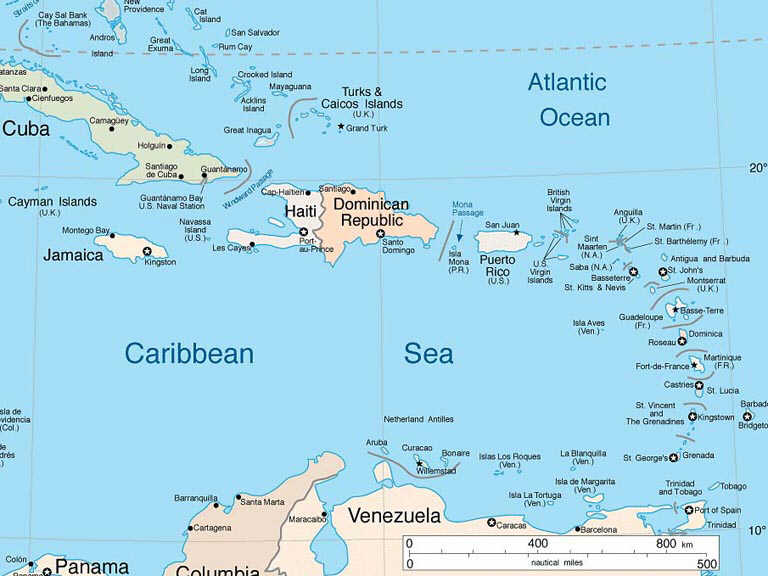
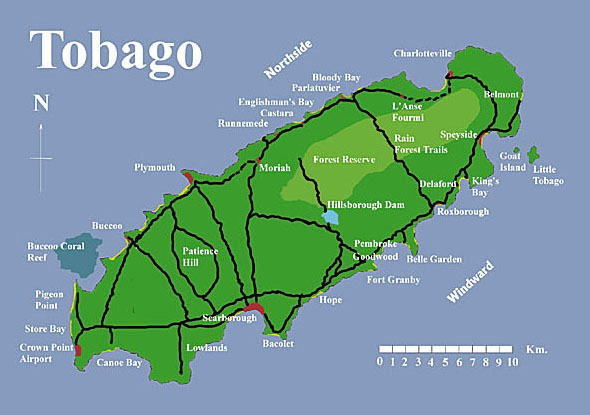
Maps
Acknowledgements
Introduction: In-betweenity as identity
1.0. The field
1.1. Preliminary considerations
1.2. Field methods
1.3. Tobago
1.4. Other fields, other places: Theories and comparisons
2.0. Lives lived
2.1. Situational adaptations
2.2. This place and foreign: Moral dualism and beyond
2.3. Individual stories of adaptation
2.4. Analyzing in-betweenity
3.0. Living it and filming it: Some reflections concerning methodology, film and text
3.1. The gendered ethnographer
3.2. Self-presentations and representations - with a camera
3.3. Reflexivity and film: Representations revisited
3.4. 'Film-or-text' or 'film-and-text'?
Closing arguments
References
Notes
 |
You see me, if I feel to come in, I come in. I feel to go out, I go out. I feel to let all me colour drain out, I just let it go. Far. Deep blue in me head. Cool all the while. King'a the block, man'a the ghetto, I got juice. Respect. Respect I, man, 'cause I is the real juice, blue juice. Me. Spreading far. Chipping with the breeze, shining-back the sun, doing what the hell I want. Big black waves when I vexing, still clear glass when I chilling. Versatile all the while. I is me own boss.
Oonya Kempadoo: Tide Running
|
|
Ethnographies have two plots; there's the story of the ethnographer's experience in the field - a tale too often
untold (...); and there are the stories of the lives of the people studied - tales all too often poorly told! As
many critics have pointed out, anthropologists need to become better storytellers and find a way to tell about
their experience in the field as well as to tell convincing and moving tales of those they studied.
Jay Ruby: Picturing Culture
|
 |
(in no order whatsoever)
Anne-Cath. Holten, Sherina Olivierre, Hogne Øian, Zerihun Abebe, Lars Øyan, John Williams, Sarge, Peter I. Crawford, Anders Askelund, Rossella Ragazzi, Ida Jack, Bjørn Arntsen, David MacDougall, Britt Dyrnes, Louis Gay, Kjersti Benjaminsen, Regina Sankar Øyan, Aldon Forde, Marit Gjertsen, Trond Waage, Espen Marius Foss,Chris Peterson, Bror Olsen, Jonny Nordhus -
Teachers and students at Plymouth Angican School, the staff (and volunteers) of Environment Tobago and PRDI, my parents and inn-laws for their everlasting support, and for visiting us in Tobago, students and staff at ISA & VCS at the University of Tromsø -
I thank you all, for your support, presence and for being for real.
|
This work is dedicated to my family: |
|
Oda
Idun
Kjersti
|
Tears and fears and feeling proud,
to say "I love you" right out loud
Dreams and schemes and circuscrowds -
I've looked at life that way
But now old friends are acting strange.
They shake their heads, they say I've changed
Well, somethings lost but something's gained in living every day.
J.M.
|
This thesis is, together with the film "Boys Will Be Boys: A Fieldwork
Diary" (Dale 2002), the end product of an analytical process which has
taken me more than 2 1/2 years to complete. I returned from fieldwork in August
2001 after a six-month stay in Plymouth village on the island of Tobago in the
Caribbean, much in doubt as to what I had accomplished. I had, after my wife
and daughter had left for home, spent the last two months in the field feeling
very much alone, spending (I felt) too much time by myself, often thinking I
was only scratching the surface of 'da real Tobago life'.
And when I did manage to establish contacts I constantly felt like I was the
one being observed, and that the discussions were just as much about me and
my family as about 'them'. I had realized quite early that trying
to guide conversations with pre-formulated questionnaires only ignited suspicions
as to what I was really doing there. But most importantly, I became aware of
how my behaviour was interpreted and evaluated according to ideals of manhood
that I felt very uneasy about complying to. As a foreigner, a white man, with
a family, I was of course categorized as something different than any local
man, but I never felt comfortable with it. I felt access to specific social
fields would be limited for me if I was to be labelled as 'white'
- which in practice was the equivalent to 'tourist'.
How very wrong I was, because as it turned out, it was my constant rebelling
towards their categorizations that made me unmanageable and seem a bit
odd, at best. Most people in the village couldn't care less, of course
- as they had their own lives to worry about - but there were those who
spent time with me and tried to teach me 'the moves, the way to behave',
both directly and indirectly, by explaining to me the difference between how
they perceived themselves as opposed to 'dem tourists', but
also to other meaningful (and often intertwined) oppositional categories, like
'Trini's' and 'money people', to
mention but a couple here.
Thus, this thesis is about a few young men and the environment in which men
seek their opportunities, face constraints, work, eat, make love, drink, flirt,
quarrel... and laugh. But it is also about my learning process, and about
what I learned, and how my presence - as an observer, camera man,
student, white-man-with-money, husband and 'ad hoc pardner'
- played an important part in the learning processes which we all were
part of. In other words, focus will be on what produced meaning right there
and then, and me meeting a few people over a period of six months back in 2001
may in this respect be seen as an example of how modern lives intertwines for
a while, producing social actions and meanings which both reflects upon and
in some ways change 'culture'.(1)
This is not to say that no 'real' difference exists anymore, that
we all float around in a post-modern, globalised reality of equal rights and
opportunities, where all things matters the same way to all people, and that
no baggage exists. On the contrary, my experience has taught me that there are
some real differences out there, to be experienced, to be felt, reflected upon
and to respect.
The ethnographic stories presented are about people whom I came to know quite well - all things considered - and are examples of individual lives within a context which was rapidly changing, and where manoeuvring through a complex web of opportunities were a part of the daily activities. None of them would brake radically with popular consensus about proper behaviour, but were part of a society where the definitions of what proper behaviour was no longer felt absolute (if they ever did). I will refer to these men as being affiliated with groups which I have loosely named barmen and beach boys, which in one sense will refer to the social field where I had most of my encounters with them, but in another it also refers to their relation to tourism and to local idioms of morality and dualism. However, it is important to emphasize that these categories are not of an emic character, and that there are no clear boundaries around or between these categories; they are simply introduced as (analytically constructed) entities which serves an explanatory purpose; that of identifying generalized ideals expressed by persons who may be seen to "fit the categories".
Before entering the field then, I wish to emphasize that the stories here are told by me, and that I alone are responsible for the analysis and interpretations that are presented. Therefore my perspectives, my ideals and my relationships will be presented as well, both for the purpose of comparison and to be able to claim a certain degree of representational sincerity.
In the following, I will introduce the term 'in-betweenity', which is much used in public discourses in the Caribbean, a concept I feel is fruitful when trying to analyze the processes of change constantly taking place in any society.(2) A critique of the (in Caribbean anthropology) classical dualism has been its lack of precision when it comes to identifying the actual shifting from one moral realm to the other. Thus my focus on temporality as derived from Miller (1994) (see page 26-29) and on 'in-betweenity' as an identity marker that indicates that any individual at all times will refer to a number of cognitive models. In-betweenity, literally "somebody or something that falls between others", is meant to describe many facets of human life, and provides an insight into individual, social, political and historical processes. My aim is not to replace any of the analytical tools at our disposal, but rather to utilize them all combined whenever I find it necessary.
While there are indeed some regional cultural traits in the Caribbean which can be identified and might help understanding regional adaptations to processes of modernity, there are also a constant need for new (or re-adapted) concepts which are capable of capturing (one or several of) the seemingly endless different adaptations to these 'cultural traits'. And, most importantly, I believe there is a need for a focus upon how adaptations to and understandings of globalized structures (like for instance tourism) make their mark on and are marked by individual lives. Indeed many of the writers I will be presenting here have done just that, and my presentation of one more concept (which is not new, by all means, but rather adapted to the setting of my fieldwork) should be regarded as one of many possible ways of analyzing the material.
Eric Williams, in his book on the history of the people of Trinidad and Tobago
(1942/1993), devotes a chapter to describing what he calls Tobago's
"... state of betweenity (in which)... the people of Tobago...
did not know where they were going from day to day" (ibid.: 51). Whilst
Williams used the term in explaining the colonial history and the competition
between the colonial powers for the domination of the island, I will argue that
the term 'in-betweenity' is useful in order to incorporate
both the dualism, pluralism and individual adaptations of the present era, whilst
taking into account the possibilities and restraints of the surroundings at
a particular moment in time. Thus the concept is adaptable to both the multiple
varieties of Caribbean everyday life as it has been described, and in accordance
with my impression of peoples own perception of their situation.
There are at least four identifiable ways the term may be used as an analytical tool in local discussions on Caribbean society:
i) In-betweenity may be used to describe the way in which the Caribbean
has been treated historically, as a place "between the modern (i.e. western)
world and the others", as what Troillot calls "an undisciplined region"
(1992: 20).
ii) On the political scene, the image of in-betweenity is used to describe
both the imagined lack of concrete power of local authorities, but also to describe
the position of many of the countries of the Caribbean in the ever-ongoing process
of emancipation. It is for instance quite common for newspaper columnists to
explain constitutional shortcomings by blaming the judicial and political system
inherited from the colonial power, and that their society still is 'in transfer'.
iii) Socially, 'people in between' often refers to those who maneuver in both
a 'local' and a more 'global' (in lack of better concepts) spheres, in the same
way as Williams saw the people of Tobago maneuvering "between national
flags" historically (Williams 1942: 51). In my material I have found this
to be most prolific in dealings with tourists, where one's capability to balance
moralities and worldviews is essential for success. I will be asserting that
this maneuvering is something common for all people, everywhere, but that some
are entrepreneurs in this game and are more explicit in their maneuvering than
others, to such an extent as to be able to base their income on their abilities.
iv) Finally, there's the individual level, where, as suggested, one treats
the moral dualism as part of a cognitive map, and exposes it to evaluation,
to redefinition and reestablishment. In this way, in-betweenity, understood
as a repertoire of skills, may serve as a poignant and useful tool with which
the individual learns to understand others, him/herself and the society around.
My main point here is that with reference to these suggestions on how to live
- provided by one (or a combination of several) cognitive model(s) - the individual
will choose her or his path, based on prior experiences, socialization, love,
desires, financial means, abilities (for instance the individual power to go
through with it), and - dare I say it - 'free will'.
While I see points 1 and 2 as a backdrop to the society I encountered, I will be most preoccupied with points 3 and 4, and will be discussing the fruitfulness and validity of the concept of in-betweenity through the analysis of my own material, and with the support of the other analytical tools which have been used in other ethnographic works from the region and beyond.
The reasons why I'm going to focus on men in this thesis are many: First
of all, I am a man, and my experience from the field was that 'they' approached
me, and I approached 'them' in very gendered manners, that is, in the very first
conversations and social encounters I had with Tobagonians, great emphasis was
put on gender, theirs and mine (not to mention my wife's), and how - if at all
- I was able to conform to core ideals of manhood. Methodological and ethical
issues concerning both the fieldwork itself and the constant re-evaluation and
finally representation of anthropological findings will be discussed from this
point of view. Secondly, I believe that the way in which descriptions
of Caribbean men have become stereotypical, has much to do with how men are
perceived when engaged in somewhat superficial, short time relationships, where
one's ability to describe and conform to the masculine ideals are important.
I believe that there are many other ways of being a man in the Caribbean, and
I believe I have the material to indicate that not only do men behave very differently,
they are also constantly redefining and reshaping these core ideals. In short,
not only do they rarely conform to them, they also keep on changing them. In
short, many men lead lives of in-betweenity, where constant renegotiations
are needed in order to balance the requirements from family, friends and outside
influences. As social behavior is a creative process which influences norms
and regulations in a society, new ways of defining moralities will of course
be an interesting aspect of this thesis.
When deciding on focusing on the everyday life of men in the Caribbean island
of Tobago - a decision that was evident as most of my informants and friends
in the field were indeed men - I soon came upon ''the gender problem'; that
is, I had to decide on whether I should focus on the construction of male gendered
identities, or on 'other' aspects of male discourses, concerning for instance
power relations, discourses on ethnicity or racial relations, or simply the
survival strategies of men in a village where one's sources of income are somewhat
limited. I realized that these kinds of discussions would turn out to be fruitless
if the aspect of how a man sees himself and is judged by other men (and by women)
as a man is left out. Discussions on power, religion and ethnicity -
they all must include real actors, with situated identities, created and recreated
in constant flux as human social life is played out. One of the most dominant
features of one's identity is the gendered one, that is, the actor's socially
constructed gendered identity. In addition, a man's ability to act upon the
ideals of manhood will in many ways predetermine his possibilities.(3)
The identity of a person is not a fixed entity, created by his or her upbringing
and education, rather it is a process of endless representations and evaluations,
played out in specific social settings:
"Perhaps instead of thinking of identity as an
already accomplished fact... we should think, instead, of identity as a 'production',
which is never complete, always in process, and always constituted within, not
outside, representation." (Hall 1990: 222 in Gutmann 1996:17)
The aim will not be to describe what men do in general, but more specifically,
and following the advice of Matthew C. Gutmann (1996: 17), "what men
say and do to be men". This will, in other words, be a thesis where
I try to capture the men-as-men aspect of attitudes expressed in conversations
and actions, and how these are connected to certain ideals, certain cognitive
maps, to which one adapts locally on an individual basis, by utilizing individual
skills connected to living in-between.
Practically though, this cannot be done without touching upon the question
of local / global dichotomies and in the introduction to "Globalisation:
Studies in Anthropology", Eriksen (2003) shows how the many realities
of the 21st century rarely are treated with the proper thoroughness they deserve.
Rather, he sees the way processes of globalisation are described as an ongoing
oversimplification of the processes of interculturalism:
"The appropriation of Western modes of production
and consumption, Western rights concepts and notions of personhood, appears
inevitable and irreversible (...) Whether Western or not, empirical work on
globalisation does little to counter claims that this body of research largely
deals with the dissemination and recontextualisation of, and resistance to,
modernity." (Eriksen 2003: 2)
Eriksen goes on to claim that the apparent homogenisation of social life worldwide has led to confusion as to the importance of a thorough investigation of culture, place, locality:
(4)
"... although there are doubtless aspects of social organisation and symbolic universes in virtually every society that conform with these notions of globalisation - statehood and citizenship, monetary economies, modern mass media and so on - their actual realisation is always local and embedded in locally constituted life worlds and power relations." (Ibid: 3)
I will strive to remain true to some of the ideals of anthropology that have
prevailed in spite of (both real and imagined) 'crises' of the trade, be it
of a representational, methodological, ontological or political kind. If anthropology
is to survive in the ever-growing conglomerate of neo-, post- and interdisciplinary
studies of 'the complex world out there', it must keep insisting on broad, detailed,
experience-near representations based on (if possible extensive) fieldwork.
People always live locally - or in several localities - in relationships
with others, and the images created of the processes of globalisation, the
effects of the seemingly victorious modern project of neo-liberalism and capitalism,
western style, must be nuanced by curious and critical representations of these
lives as lived. In people's adaptations, reinventions, internalisation of and
influence on World History in the making one has the opportunity to grasp the
multiplicity of human organisation and adaptations.
Now, these initial words open for a task way beyond the limitations of this
thesis, and must therefore be read as statements which serve to clarify my standing
as to what I believe to be the task of anthropology writ large: As a
body of produced knowledge about "us-and-them", it still serves
as a corrective to oversimplifications and -generalisations, it is still based
on curiosity about difference and similarities (both "here-and-there"),
and finally; it claims authenticity and authority (real and imagined)
based on ideals of "being there". However, it can never be
the task of one anthropologist alone (let alone one student of anthropology)
to investigate all the possible localities, communities, (sub)cultures, age-cultures
and so on connected to the place (s)he has chosen as field of study. Instead,
the aim should rather be to search to describe (in a manner true to his/her
experience) the reality (s)he found while conduction fieldwork. For instance,
the absence of descriptions or analysis of religious praxises is but one example
of how the limitations of the realities of fieldwork and the scope of the thesis
combined necessitates a limited selection of data on which the analysis presented
is based.
My story will include situational descriptions of places and characters I got familiar with, stories and tales handed over to me by generous helpers who patiently spent more time with me than I deserved, and written (and filmed) narratives from books, libraries, TV, radio and newspapers. It will consecutively be analysed and compared to examples of anthropological work that may help me shed analytical light on my material, both from the Caribbean region and beyond. The focus will be on the lives of a few young men - and the social sceneries in which they live out their lives - and how the everyday life of any one of them is an ongoing process of reinvention and adaptation to the surroundings. I wish to show how these adapting skills have been described other places (and times) in the region - and thus that these men in many ways still conform to inherited cultural ideals, but also that much of the reality surrounding these lives has been thoroughly changed since the time of Wilson's Providencia (1973), Abrahams' Tobago and St. Vincent (1982) and even Miller's Trinidad (1994) (see below).
To sum it up then, I will in the following aim at showing how an ethnographic approach to the study of ever changing localities is effective in order to understand the processes which produce seemingly unlimited varieties of modern life, and that this situated knowledge produced in the meetings of ethnography in itself is a part of the exchanges that feeds cultural change, and makes the processes of life so dynamic and unpredictable. Individual lives are creative processes, where the generalized cultural ideals of what it means to be a man can often seem both vague and oppositional. I will especially focus on understanding the gendered identity of men in relation to the complex reality of the village of Plymouth, a community where links to the outside world are becoming closer and closer and now form an important part of the daily lives of many. As for the many new influences on gendered identities, my main focus will be on the effects of the growing tourist industry on the local reality. I will also place emphasis on how what Tobago men refer to as 'their culture' is mediated, transformed an utilized in terms of marking one's masculinity, and how the identity of the 'Caribbean man' is connected to certain local practises which have become (and have been influenced by) a global imagery of the region. Finally I will analyse what effects, if any, the (geographically) extended relationships people have (due to tourism and migration labour) on the redefining of 'the social lives of men' in the village.
I will follow up on these considerations by describing the setting; the Tobago I have learned to know. I have chosen a somewhat 'autobiographical' approach to introducing the field because I think it is important to acknowledge the importance of my personal rationale for 'being there' and my relationship to the island and some of its inhabitants. Secondly, I will discuss how both local reflection, adaptation and re-invention of both 'local' and 'global' trends are expressed in social settings via ethnographic descriptions of small-scale social events. Then follows an introduction of my two main 'informants' from the field, - two young men who, in their very different ways, helped me realize just how much space there were in their lives for individual adaptations. In Chapter 3 I will consider some of the methodological reflections derived from my fieldwork experience, which also included doing ethnography with a camera. The focus will be on the impact of the filmic experience on my fieldwork; how it generated a self-awareness both in me and in those to be filmed, and to what an extent a reflexive mode of engagement in the field played a role in the production of the end products, - this thesis and the film " Boys Will Be Boys" (Dale 2002).
The story here told is based on a six-month long fieldwork, conducted on the island of Tobago in 2001. I went there with my wife and then four-year-old daughter, wishing to establish our unit as one amongst others. That is, we wanted to live there as a family, trying to adapt to local ways of being a family. As anyone even slightly familiar with the difference in family modes between Norway and the Caribbean might have guessed already, this approach may have it's moral virtues, but is close to impossible to implement. As I was a student assigned to the Visual anthropology programme in Tromsø I carried with me a video camcorder, intending to shoot as much footage as possible, both for the purpose of data collection and for the production of an ethnographic film. The usage of the camera had a profound impact on what I learned in the field, and thus has a major role in this story (see chapter 3). Further, I carried with me a minidisc-recorder, for recording of conversations and sound to be used in the film, as well as a laptop for my field notes (which was rarely used, as the small memo books I bought in a local shop which fitted nicely in a pocket provided me with just the right tool when it came to note-taking!). I rarely took notes while talking to people, as I soon felt that many would respond quite differently to a person with a note-pad, but also because much of the 'fieldwork was conducted in a relaxed atmosphere, on a street corner or in a bar, on the beach liming(6) or on the balcony... I was rarely the 'interviewer' and the other 'the protagonist', - I would rather try to participate in conversations as a whole being, and not solely as a recording device.(7) I also believed that it would be disturbing the performative nature of many of the conversations I witnessed and participated in to ask for pauses so that I could write things down. I would strive to record what I found to be important as soon as I would be alone, and often found myself writing in small rum shops, or outside one of the shops in the village.
Besides these obvious tools for the recording of data, I realised that the importance of how I was percieved could not be underestimated. I worked hard all the way through fieldwork to try to convey an image of myself which I believed would be both "true" and beneficial for my studies, but suffered - as so many has done who has travelled far - from a lack of understanding of the stereotypes my behaviour was met with, and of the way my appearance reinforced these stereotypes.
Anthropological fieldwork is about presence. It's about meeting the methodological challenge of "being there", of learning with all senses over time. Kirsten Hastrup (1992) has described fieldwork as "...situated between autobiography and anthropology. It connects an important personal experience with a general field of knowledge" (p.117). The ideologies of early social science, of objectivity and holism, structure and absolute difference has (at least within anthropology) lost ground to studies of the particular, of the processes of change, of the flexibility and constraints combined which makes up human existence. And the focus is on the impact we all have on each other, that is, with studies on how both global and local processes leaves their mark on - and are influenced by - local life. The method I resolved to was to enter the fields as an adaptation of my own social self, - still the same guy, same attitudes, but very self-indulged, preoccupied with acting respectfully and consciously, as not to breach any of the secret social codes yet to be discovered. I soon learned that this approach led to many misunderstandings and frustrations, and even though it lead me to understand much about "us-and-them", I still wonder if another approach might have made fieldwork easier, if not with such interesting results.
I spent a considerable amount of time during my fieldwork reading, especially newspapers but also Caribbean novels and articles of interest, be it on anthropology, sociology, history or musicology. I visited the Library at the University of West Indies in Trinidad, only to find that the literature collected on Tobago was rather scarce compared to that of Trinidad(8). Besides this small collection of scientific studies, novels produced in the region has played an important part in my search for clues on how to describe a Caribbean reality. V.S. Naipaul's authorship must of course be mentioned, but it is the carnevalesque, detailed and emotional descriptions of individual life stories in Earl Lovelace's novels "Salt" and "The Dragon Can't Dance" that has truly inspired me, especially in his portraits of male identities. Finally, Oonya Kempadoo's novel "Tide Running", about a young couple's encounter with the village of Plymouth, Tobago and the 'rude boy' called Cliff, has helped me recollect, over two years after fieldwork, many a detail about what it meant to be a stranger from foreign(9) visiting the village.
For my presentation of the island, of the village and my fieldwork entry, I have chosen an autobiographical form, thus paying attention to what Okely (1992) refers to as the "...links between the anthropologists experience of fieldwork, other cultures, other notions of autobiography and ultimately the written text (p. 1). I believe that the curiosity, the approach, the "cultural baggage" and the embodied personal experience of fieldwork inevitably puts its mark on the analysis and thus on the product(s). I have tried to avoid the pitfalls of mere narcissism, and focus my attention on the personal experiences which I consider to be of importance for the production of ethnography and analysis.
Visiting from Trinidad, we could never have seen the darkness of this island. The strength of it overpowered and silenced you. Only after moving here did the calm become unsettling. Traces of resentment under the skin of proud faces, in the gait of mobile bodies.
Oonya Kempadoo: Tide Running
For the visitor, the island of Tobago may well have seemed like a tropical paradise, especially when strolling along any one of the many (relatively) unspoiled beaches, more or less alone (relative to most other Caribbean destinations, or any other mass-tourism resort, for that matter), with a certain calmness about it's managing of business and a friendly atmosphere. However, this idea is far from new when Tobago is concerned: During the 19th Century, there was a saying in the financial circles of London - "rich as a Tobago planter" (Johnson 1998: 2) - which focussed on the profits that Tobagonian planters made from their crops, - a prospect which surely must have seemed 'paradisial' to the average colonialist at the time. Another notion linking Tobago to ideas of 'paradise' is the well-spread rumour (still utilized by the tourism industry) that Tobago was indeed the island of Robinson Crusoe; that Defoe had visited the island and found it to be perfect for his story of how (civilized) man tamed 'nature'. Another factor is probably that the slaves of the island rarely made life less troublesome for the white planters than in other West Indian territories (Williams 1993: 62).
Both locals and visitors would describe the island as a paradise, but whilst the affection of the tourist often was unconditional, there was a certain ambivalence in the manner which locals would use the term, in how they defined what a paradise was and for whom. In talks between a 'beach boy' and a tourist, one could often hear both parties praising Tobago's unspoilt nature and free-spirited people, and agree that to visit something like this, seemed like going to a 'paradise'. One should not forget that ideas of 'paradise' - in addition to being unspoilt - also include notions of a 'natural life', as opposed to 'modern' or 'developed', and that the people living there in a sense are 'closer to nature', happier and less bothered by the problems and responsibilities of modern life. As we shall see, I believe these notions to be far from the truth, and that locals most of the time will refer to their island as 'paradise' as a means of adopting to the global discourse on what a Caribbean island should be, not as a description of a genuinely percieved local reality.(10)
I first visited the island in 1996, as a backpacker-tourist, wanting to rest up after a four-month trip through Ecuador, Colombia and Venezuela. My girlfriend (later to be my wife) and I took the ferry from Port of Spain, Trinidad - a six hour crossing in calm seas with beautiful views of the north-western tip of Trinidad, then only turquoise seas and blue skies for hours before spotting the green luscious hills surrounding the island capital of Scarborough. We had been given the name of a lady with accommodations available in the basement of her house, and thought to be set up for the night. In South America there always seemed to be rooms available whenever one turned up, - it was a matter of finding the right place and price, and then bargain for it. We were not prepared for the kind of tourism Tobago catered for, - people flying in for a week or two, pre-ordering rooms for the whole period. We had come to a totally different place all together. We had a hard bargain in front of us, not with the lady we originally planned to stay with - she was all out of rooms for the rest of the season - but with her neighbour, who in the end offered us an apartment at least five times the price we had paid for accommodations in Venezuela - the most pricey of the countries we had visited in South America.
As most backpackers, we were primarily concerned about two things; prices and authenticity, and were naïvely unaware of the pragmatic approach of most of the Tobagonians involved with tourism towards visitors. Being successfully involved in tourism locally demands a lot of knowledge about the visitors, their similarities (what all of them wants) and differences (what some of them would absolutely love and others despise). The attitudes of many a tourist guide or 'beach boy' resembles that of a cosmopolitan(11); open to the world and its many facets, free from cultural boundaries, roaming the global web of interpretations and expressions, recognizing subtle differences vital to the construction of different personalities. With this knowledge they meet the different requirements of tourists with a remarkable accuracy that intrigued me.
It was during this first visit to the island that I ended up in quite a vicious quarrel with a taxi-driver who had taken us from the popular Sunday-school fete(12) back to our rented apartment. We were six people altogether, and had been hijacked by two drivers while walking up from the village of Buccoo - where the party is held every Sunday - towards the main road of the south-western part of the island. Both taxis were unlicensed, which basically meant that they were cheaper than the registered one's because they didn't pay any taxes on their income. We negotiated a prize for the fare, and the driver of our car promised to take us there in 'no time' (a promise he would have been able to keep, had it not been for the boring realities of friction and resistance of physical movement). When we got out of the taxi, I handed him a 'blues' ($100 TT bill, - the equivalent of 250 NOK or around $35 US at the time), but he told me that he didn't have any change. I then said that none of us had any other money, except for a twenty-dollar bill, - maybe he could take that and return in the morning for the rest? He didn't think that was a good idea, instead he suggested that he 'd take the 'blues' and return later with the change. I told him that that was out of the question, he knew where we lived and could go off and get a hold of the change he should have had in the first place, before getting paid. He then explained to me that he hadn't had any money when he started driving, and that we were his first fare of the night. He worked himself into a frenzy, his language changed from the polite, tourist-adapted Creole to what I felt was an unjust abusive attack on me personally; he yelled at me that I did not understand how to behave when visiting his peaceful island, in fact, I was no other than a 'fuckin' racist', making sure that poor black people never got the upper hand by constantly keeping them down. I completely lost my cool, yelling back at him that he didn't have a clue as to whether I was racist or not, and that it was really unfair of him to immediately connect my physical appearance to a specific behaviour. I told him (quite loudly, I'm afraid) that me not wanting to give him the 'blues' was not a "black-and-white-thing" but a matter of a transaction where he should be able to give me the change I was supposed to have back. Fortunately, the rest of our party arrived, with plenty of change, and the driver took off, still cursing my arrival on his island.
There are in this story several themes that continued to annoy me after I had gone back home. I told it to both friends, family and fellow students on several occasions, and it was more often than not seen as an example of what we then named 'reverse racism', a regular theme of discussion at the time. My uneasiness about my own behaviour did not disappear, however, and the more understanding I met amongst my piers, the more I started to wonder about why he got so angry. If he was trying to scam me, he certainly had overplayed his part, and it somehow didn't fit the overall image I got of him. But why, then, did he get so upset, and why had it been such a surprise for me that he activated the black-white dichotomy?
Six years later, on the plane from London to Tobago, with my extremely
exited four-year-old daughter by my side (and a wife not too keen on flying
half asleep in the next seat), on our way to fieldwork, I still felt uneasy
about the incident, and envisioned the moment when I would stand face-to-face
with the same driver, having to have the same discussion all over again. In
fact, I dreaded the next six months, wondering how many similar discussions
I would have to get through. I was beyond the naivety of my first encounter
with the Caribbean discourse on colour, and knew all to well that no matter
what I said and how I said it, I would be met with stereotypical ideas about
who I was.
Standing in the customs line, in 90% humidity and 35 degrees Celsius, tired after a ten-hour flight, my worries shifted from the possibility of meeting the infamous taxi driver towards worrying about the luggage, which contained - amongst the usual clothing and a pram for Oda, our daughter - the film gear with which I was to record the material for a film, and of what to do if we didn't get the three-month visa which we counted on. Everything ran smoothly though, and Jango, a handyman employed at a youth hostel where we had rented a room for a week, picked us up. He was talkative and friendly, and was the first man I shared a flask(13) with, and what he told me about his wishes and possibilities for obtaining them spurred my curiosity on young people's situation on the island. In my field notes from January 15th, 2001, I wrote the following paragraph about him:
"Jango's a newly married man, no children, somewhat of a fixer, made contact with me almost at once, asked about who we were, what we were going to do here. He got the message that we're here to do some other things than most tourists, but he's obviously so used to talking to tourists that he keeps pushing tourist sites on us. We should go to this and that place - nice pictures. He's been several times to Europe, twice in Norway, and has friends there.
On a trip to the Lowlands, and whilst there, Jango told me about their situation. He's not pleased with having to work for others - "them", that is, those who ran a business (with tourists). They took all the money and didn't pay good salaries (the general level of prizes had risen considerably the last few years). He'd been given a small spot of land by his grandfather, and was in the process of building a small house for himself and Marilyn, his wife. Next to their spot was a piece of land owned by Texaco, unused land, and this he burned down to grow cash crops - tomatoes, sweet potatoes, cucumbers, herbs and spices. He said Texaco didn't care, "and as long as they're not gonna use tha area, it's me right to use it", Jango explained. "We got plenty land here on Tobago, but no one lets us use it - land should be used for something, you know". In addition to growing cash crops, he had several ideas for projects that would help him become a "free man", he wanted to buy a bus for the money they had put aside in an insurance fond, they paid about 150 TT a month to this fond. In addition, he talked about starting up production of honey, which was supposed to be quite a lucrative business, but one that demanded some serious investments, importing the material needed for production, and obtaining a license, "And then there's the government, you have to bring in new stuff, not used, because of hygiene regulations", he explained
I never got out of him what his profession was, he just did "all t'ings, boy!" and was full of ideas. He adapted to the possibilities of the moment, and adjusted his work load in such a way that he could both accumulate some money, and maintain a lifestyle which - even though he spent much time with tourists - he claimed was typically Tobagonian, - in his own words, he was just a local guy trying to get by, taking care of his family and enjoying a lime every now and then, thus meeting the expectations of his male companions.
We spent a week in the hostel, acclimatizing and roaming the area for a village in which to settle. Ideally, I wanted to stay in a village that was situated on the outskirts of the most touristy area, and we found Plymouth to be perfect for our purposes. When Jango heard about our choice, he told us it would be better if we stayed closer to the tourist area, but when I inquired about it, he wouldn't specify why he felt this would be better for us. After he heard that we were to stay in one of Miss Ida's apartments, he seemed assured that things would be ok, and agreed to take us there in the van.
In these two meetings with two different young men, five years apart, many of the themes of which this thesis is going to be about are presented, or at least hinted at. In the story about the quarrel with the taxi driver, there is of course a "black-and-white-thing"(14), even though I wouldn't admit it at the time, there's the presence of a writer (myself) who - through his lack of understanding of the social and cultural setting - provokes responses to his actions which, even if they are unpleasant and even disrespectful, helps him in producing knowledge - or at least triggers his curiosity - and finally, there's the performatory aspect of the quarrel, where the mastering of bickering and not wanting to loose face was something which we had in common, but which was a skill in which he outwitted me quite easily.
Jango, on the other hand, introduced me to topics that were related, but in a quite different manner, in which I would ask initial questions, but where he would simply keep on talking. No doubt his long experience with tourists had provided him with an audience which was more than happy to be taught something about 'the natives', but he also seemed to be quite frank in his descriptions of the realities of his life. He would talk about how he worked in order to obtain his 'freedom', how he didn't feel like he was treated as an equal. He insisted on 'knowing the world' because of his many travels to Europe, full of great deeds and masterfully elaborate stories on 'them'(15). He was also one of many who talked about the importance of farming, and expressed deep concern about the future of the island if they were to rely on tourism alone.
In discussing his own relationship with a street vendor in Sri Lanka, Malcolm Crick writes about to what an extent the random process of "choosing" chief informants(16) (or maybe they choose us..?) influences the outcome of the fieldwork (1992: 186). What he calls the "wager character" of anthropological fieldwork, where a mutual dependency develops - or at least some kind of reciprocal exchange of goods and services - surely has an impact, but the "unknown factor" is also an interesting aspect of the process of obtaining knowledge about "the others". My main informants where chosen more or less based on their interest in us, individually and/or us as a family. The reflections on fieldwork by Crick must be regarded as emphasizing the subjectivity and unpredictability of fieldwork, and thus serving the purpose of reminding us of the very intimate and personal quality of the experience, from which - quite ironically - we are to draw more or less 'objectifiable' conclusions:
"We need to be aware of the extent to which our ethnographic subjects are themselves indigenous ethnographers (Clifford 1983:139; Marcus 1980; McKean 1976: 12). But we have also to be aware of the large range of pragmatic motives that might attract an informant to such a strange identity as an anthropologist; we need to be aware, in other words, of how the informant is 'reading' the anthropologist." (ibid.: 180)
Crick reminds us that 'we' (meaning ethnographers) are under the same scrutiny as we put on 'them', a reminder which - combined with the personal memories of an awareness of this scrutiny - has led me to include myself as an active participant in social situations in the text, thus focusing on the immediate and fluctuating quality of ethnographic descriptions, and the impact my presence had on the findings presented here.
The various reasons why I decided to conduct my fieldwork in Tobago were, interestingly enough, multiple, contradictory and based on both prior knowledge in certain areas and curiosity about others. I decided early on in my fieldwork to put great emphasis on spending time with people in the vicinity of my home, in Plymouth, and let the talks and observations from the village guide me towards my research topics. Thus, my most interesting material are the small stories, the individual lives lived; not necessarily because I believe that they tell everything, neither that I believe that the broader, political discussions that people themselves also take part in are of no importance to people's lives, or that the history of the island is without importance, but simply because these were the stories that came to me, that people revealed, and finally, because my own personal story - as a fieldworker, man, husband - intertwined with the other stories in such a way that they simply forced me to take notice.
Plymouth village
In his book "Man-Of-Words In The West Indies", Abrahams (1983: 7)
describes the village of Plymouth on Tobago as an active, vibrant, lively village
where communal and street activities are poignant. Conducting fieldwork in the
1960's and early 1970's, his focus was on how public performances
both shaped, reshaped and exemplified (though often in an exaggerated manner)
the ideals of the society, and how a man's reputation very much depended
on his skills as a performer(17). Particularly
important was the performances connected to ol' mas bands, a rarity
of Tobago, where bands meeting on the streets would start a mocking fight, and
where one's ability to create rhymes and lyrics of whit and temperament
determined his status as a performer, and thus as a man. The Plymouth I came
to know, was very different from the publicly social village described by Abrahams.
Plymouth anno 2001 was very much a sleepy place, most of the shops that used
to line the main street of the village (as described by both Abrahams in his
book and by Plymouth people themselves) were gone, and most people who had a
job worked outside the village, and the description of a village with employment
possibilities for everyone and where fisheries from the beach still was a major
source of income for most families simply didn't fit any more. As a general
comment, I will claim that the village described by Abrahams was very different
from the one I was visiting some 30 years later. An important factor of life
which didn't seem to be of importance to the story Abrahams wanted to
tell us from Plymouth, are the stories about survival, about managing. These
factors where extremely important in most of the lives I became involved in,
and the constant battle between financial difficulties and an ideal of freedom
(especially for young men) was almost always present, and determined what kind
of choices people made. Therefore I will be focusing on describing and analyzing
day-to-day strategic choices, and how these choices in fact (re)define masculine
ideals. The world is an ever-changing place, and my critique of Abrahams and
others is not done with the intent of degrading their work. Rather it is a conscious
effort to try to live up to the ideals of empirical (not empiricist!) science;
to test and attempt to falsify hypothesis and generalizations, or at least to
modify them within time and space, - in other words not to accept the accuracy
of any categorizations or preconceptions beforehand.
As early as in the 1600's, the Courlanders (Latvian farmers) put up a trading station and started cultivating the areas where Plymouth today lies, laying the foundation for the establishment of the two large plantation estates, Courland and later Arnos Vale. This makes Plymouth the oldest European settlement on Tobago, a fact that helps sell the otherwise rather sleepy village as a tourist destination. It was a quiet place, the streets looked almost deserted in mid-day with most people working in Scarborough, the island capital, the Bon Accord area where most of the tourist industry is located, or in the hotels and apartment venues located in the close proximity, in the Grand Courland Bay area.
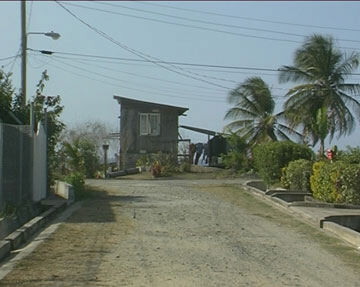
In Plymouth most of the houses were built on quite spacious lots of land, but one soon noticed that there was still an evident difference between rich and poor; some of the roads had luscious gardens, and well kept houses, but just a few meters away one could find the most shabby of shacks, surrounded by bush. There were small children out in the front yards (in the more touristy Bon Accord area they were not present at all after dark), and small gatherings continually formed and dissolved outside the small shops, which also functioned as rum shops in the afternoons and evenings, as they were both equipped with a small table and some home made chairs. These rum shop/ groceries were small, but well stocked with essentials. Together with a gas station and a postal office, these shops provided the village with the most basic of community functions. A bus route from Scarborough had Plymouth as its final destination, and the route was run with large, modern buses during rush hours, and older less spacious ones the rest of the day. There were two beaches within a few minutes walking distance. There was one on the northern side of the village, with tough waves and currents, where local boys with homemade surfboards would play. The one lying southeast of the village was a long beach reaching as far as the small village of Black Rock, a few minutes away by car. On this beach, called Turtle Beach, one could find the most visual sign of tourism in the vicinity of the village; the Turtle Beach Hotel was with its 200-odd rooms (at US$ 180 - 250 a night) a visual expression of the might and impact tourism had - and still has - on the area. Villagers worked at and by the hotel, some as waiters, barkeepers and cleaning personnel, others had the beach as their base for selling tourist items like home made carvings and jewelry, clothing and tapestry. There was some fishing being done from the beach, mostly by using nets, and the fish was sold to the shops and to individuals in the village, to the hotels close by or, more commonly, at the fish markets in Scarborough or at Mt. Irvine.
Plymouth village itself was less touristy. There were some rental apartments to find, most of which are build in the yard of the owner's house, or as a part of the house itself. There was a hotel called the Cocrico Inn - owned by our landlady, Miss Ida, situated hundred meters or so from the football field, in the northwestern part of the village. It provided reasonably prized accommodation for visiting foreign tourists (most of whom were just passing through the village on their way around the island), for Trinidadians on weekend trips or extended holidays, and - to the satisfaction of the owner - to quite a few reappearing groups of natural scientists.
Thus, the most obvious appearance of the village was that of one mostly asleep, which meant that most people living there worked somewhere else. I was told that until only a few years before, the village was one of the most lively and prosperous on the island, with several shops selling hardware, clothes and electronics - there was apparently also a more active local cultural scene, with drum-groups, dance acts and steel bands. The Village council, a body entitled to comment on political decisions being made that concerns the village, was actively taking part in the formation of village life. In 2001, the council was not operational, and this was put down to some individuals and their lack of ability to cooperate with others. Isaac, a local man in his mid-twenties, saw it like this:
"Yuh know, this used to be a place like Scarborough, plenty stores and everythin', now all dat moved to Scarbro', all dem people work there now. Now, nobody here does anythin', all yuh find here are dem beachbums an' dem."
In 2001 then, Plymouth had a rather sleepy appearance daytime, but come nightfall, the streets were for a brief period filled with people walking the streets, either out for a stroll, or on their way to a friends house, a street corner where one's pardners could be found, or any of the four or five rum shops. This lasted only for an hour or two, and then the streets were again quiet and empty, as the people had reached their destinations. Most weeknights, the rum shops closed early (around eleven), and most people went to bed early, as the hours just after sunrise were considered valuable, because of the cool temperature.
Plymouth had it's drug peddling street, called Freedom Street, and this was, as I would find out later, well known all around the island as one of the places to get one's hands on some ganja or crack cocaine (the two most common illegal substances in Tobago), and as the village had quite a few young unemployed young boys roaming the streets, there was a potential for recruitment to the milieus engaged in trafficking and/or abuse. Most men in the village didn't worry too much about the ganja, - many were on-and-off users - but expressed deep concerns about the crack cocaine, considered to drastically change people's behavior in violent and degrading ways. The drug trafficking and abuse of crack seemed to divide the male population of the village in the sense that most of the more mature grown-ups showed nothing but contempt for the selling and abuse of crack, whilst there were quite a large group of "socially active" young men - that is, men who were out on the streets, taking part in the male scene - who were users and traffickers of crack. More often than not, the appearance of crack was put down to being part of bad outside influence, either from Trinidad or from foreign, but also that some of these men were nothing more than "stupid, ignarant Plymouth people, keepin' theyself down".
Summing up then, one can say that the Plymouth I came to know was a place which was considered by many to have it's days of glory behind it and that this diminishing of importance was a source of sad reminiscences of how things were, and how things still should have been. But, simultaneously, patriotism would often shine through, and the importance of not forgetting one's roots was emphasized when one's identity was under scrutiny, especially when there was talk about going away or settling elsewhere on the island. Discussions like these would reveal how there existed a multiplicity of possible belongings, where ideas on locality were seen in light of discourses of global trends and ideals. Personal identity was more than where one came from, but simultaneously grounded in local life, in the community in which people had grown up.
From this rather personal description of the island and the village of my fieldwork experience, I turn to some other anthropological works that have had an impact on how this thesis has been fashioned. These will include short descriptions of some of the important works of Caribbean anthropology, a run-through of some of the important analytical tools derived from studies of masculinities, a discussion of perspectives on the local - global dichotomy, and finally an introduction to the term in-betweenity, which I suggest will be of use in the analysis to follow.
In the following, I wish quite briefly to introduce some of the works from which I will extract tools for analysis and ethnographic descriptions for comparisons. The descriptions are by no means meant to be exhaustive, and should be viewed in light of the main purpose of this thesis, which is to analyse the material from my fieldwork.
The global and the local
The public debates on globalisation and modernity tend to focus mainly on two
attributes rather than the process itself; one is the effects of (western) capitalism,
the other the (presumed) homogenisation of "culture". The first point,
the spread of western capitalism - and especially the development of the
colonial empires, has undeniably been an important vehicle for the development
of what we might call a global system of exchange and the exporting of certain
institutional traits. The other is, as for example Englund and Leach (2000)
has shown, a matter of analytical preferences. Local life is understood to be
one possible 'modernity' and thus subject to classification according
to the logics (and ideals) of the modern project. In this way, the identifiable
likeness of all places - exported from a centre to the peripheries - is acknowledged,
and personified local life merely examples of different levels of modernity.
This idea, the authors wish to contest by focussing not only on local adaptations
to 'modernity', but on local perceptions of 'modernity:
..."we insist that the uniqueness of the ethnographic method is at stake in the current fascination with multiple modernities. Studies of multiple modernities celebrate diversity against their authors' understandings of the similarity underlying or even generating that diversity. Sociocultural anthropology merges into cultural studies and cultural sociology, and ethnographic analyses become illustrations consumed by metropolitan theorists" (p. 238).
I believe that Englund and Leach point to an important theoretical discussion
concerning how we perceive of difference in the world, and that they often are
imagined, reproduced and systematized according to the specifics outlined within
the discourses of modernity. However, their critique does not imply, as I see
it, a rejection of the ideal of comparison or of an emphasis on any locality
as one being-in-the-world, and Foster (2002) modifies their critique by pointing
out that most ethnographic accounts of today focuses on both continuities
and discontinuities, highlighting "...those elements of Western modernity
that have been subsumed in local projects of value..." (p. 238).(18)
Daniel Millers "Modernity: An Ethnographic Approach" from 1994, is an attempt to reclaim for anthropology the methodology necessary to really understand and meet the many local expressions of modernity found globally, - the 're-embedded' modernity in Giddens' terms (Foster: 2002).(19) Based on ethnographical fieldwork in Trinidad, Millers focus is on descriptions of local expressions of modern life, allowing these tales to be juxtapositioned with theories of modernity, derived from the European experience. Miller warns anthropologists about falling into what he calls "primitivist assumptions" (p. 60) about "the others", and points to the fact that anthropology itself was founded upon such a dichotomy created between the assumed agents of modernity (colonizer) and the tribesmen (colonized, enslaved) of the field in question. Thus, the kind of models of modernity described by Miller is not one that focuses on recognizable characteristics from, say eighteen-to-twentieth-century Europe, but rather on the dynamics of change that the descriptions of modernity provides. There are indeed recognizable processes which can be utilized in order to understand changes globally, but the "cultural stuff", the actions, morals, ideals, institutions these processes bare might vary greatly. Miller also makes it clear that, through the usage of ethnography, we might indeed find that there are real differences in the world, differences that can be systematically represented by utilizing more sophisticated analytical tools.
From Wilson to Wardle
Discussing issues of modernity and globalisation one tends to focus on the processes of homogenisation, processes propelled by the revolution in mediation (through different media) of what might be called a global capitalist culture. This understanding is however far from adequate, and as many scholars has shown us, more a requiem over western ideas of 'us and 'them', of a way of arranging the world by posting what Michel-Rolph Trouillot labels "gatekeeping concepts":
"...hierarchy in India, honour-and-shame in the Mediterranean etc., a manoeuvre that, in my view, reflected as well the West's ranking of certain Others" (1992: 21).
These concepts were and, according to Troillot, are still posted in order to be able to portray a cultural homogeneity that would ensue that the society described would fit into the notion of "difference" by which western modern culture defined others.
I believe the main gatekeeping concept of Caribbean anthropology to be 'dualism', a cultural trait believed to originate (and thus be as close to something 'original' - historically - as anything one might find in the Caribbean) from the relationship of the plantation/slave owner and the enslaved population. Odd Are Berkaak (19??) describes this 'original difference' like this:
"Most perspectives seem to conceive of this original difference both as an institutional and a cognitive dichotomy implying that different sets of values are correlating to different institutions and practices" (p.1).
Pursuing Michel Troillots idea of modern science, including anthropology, as
producer of certain gate-keeping concepts for the differentialization of 'others'
from the western world, I wish here to present some important analytical tools
of Caribbean anthropology, to be able to show - in light of ethnography - that
even though social 'patterns' of thus kind might be found, the amount of (conceivable
and real) discrepancies and deviations from the patterned social life are prolific,
and that they in reality are ideals (or simply ideas) within the cognitive web
in which social life is interpreted in the Caribbean. The importance of these
concepts as ways of describing 'the others'' as fundamentally different from
'us' (i.e. the rational west), thus justifying western dominance, is hereby
also acknowledged. I do, however, believe them to be of purpose for an analysis
of local life, assuming that their 'gate-keeping' abilities are tested empirically
and - if possible - adjusted.
Wilson's (1973) tale from Providencia and his description of the ideologies of reputation and respectability have indeed become important for the durability of the gate-keeping concept of dualism. Wilson himself was aware of the oversimplification of the endeavour, but insisted on the importance of directing attention to the informalness of Caribbean life which structural analysis of households, the most common theme for anthropologists studying in the Caribbean, could not grasp. Earlier descriptions had focussed on the Caribbean as a society which was stratified, and where the moralities inherited from the colonial power were sought: religious piety, class dependency and family values. Now, Wilson wanted to emphasize that many aspects of life is often lived without reference to the structures with which most social science prefer to explain societies:
"Yet, if study after study tells us that real people, living in communities representative of the way of life of the majority of a given national, tribal, ethnic, or cultural population, fulfil their lives through each other in ways that the anthropologist chooses to call informal, parallel, supplementary, interstitial, secondary, subordinate, loose, flexible, or even quasi - then, there is something cockeyed somewhere" (ibid.: 5).
The importance which others ascribed to institutions exported by the colonial powers as means of describing Caribbean life was balanced by a focus on the basis for peoples classifications of themselves and others, and that its in the process of living in-between the ideals of reputation and respectability that life is built. However, Wilson connected the moralities a little to tightly to attributes of male and female life respectively, and other anthropologists who followed him in his quest for understanding of the moral dualism also emphasized to a larger extent the individualistic approach to living within this dichotomy, and that the approach of any particular person would depend upon situational and relational actualities.
Thus, Miller proposed - in his ethnography from Trinidad (1994) - a new dichotomy to replace Wilson's' namely that of 'transience' and 'transcendence', where the former refers to the temporality of life celebrated during Carnival, whilst the latter describes processes of continuity most prolifically expressed during Christmas:
"On the one hand, there is a celebration of an ephemeral present that in its absolute form appears to deny all possibilities of sociality, through an exhilarating sense of freedom within the maelstrom (celebrated during Carnival - my comment). Opposed to this is Christmas, the time for constructing a sense of roots and tradition, also associated with planning for the future and family descent. Christmas provides a sense of continuity" (ibid: 132).
Miller argues that people refer to different cognitive maps in order to manoeuvre towards ideals that might seem totally oppositional, but which are compatible because of their temporality. Additionally, he argues that if one accepts the notion that Christmas and Carnival indeed celebrates ideals prolific in the Caribbean society, then traces of these cognitive models should be traceable in everyday life as well. In my own field, I found that people regularly referred to both maps - that is, to ideals of continuity, conformity and moral and to ideals of freedom, promiscuity and adaptational skills - but rarely complied fully to any one of them at any particular time, and in this sense blurring the very notion of any absolute 'border' between the ideals.
The final contribution to the discussion of pluralist modernities in the Caribbean to be presented here, is Huon Wardle's introduction of a threefold model as an alternative to the analytical pairs of reputation and respectability and transience and transcendence, which is that of ambiguation, disjuncture and commitment (Wardle 2002). Wardle writes more generally of the cultural trait here labelled 'creativity', and I believe this to be an interesting approach towards an understanding based on empirically observed actions of lives lived. For example, when writing on the issue of commitment, mostly understood as family ties, he emphasizes the inclusivity (and not exclusivity) and "open-endedness" (p. 497) of the local understanding of kinship and family structure, and the "...ability of those who draw on its idioms to stretch and combine the values it entails (p. 497). In this sense, even the most conservative ideals defiant to change may in this sense be seen as an institutionalisation of what would otherwise be regarded as deviant behaviour. Examples from my fieldwork that could be mentioned are child shifting, often simply called adoption, or relations between women who have children by the same man. The tensions of moral dualism is thus incorporated in and part of ideals of conformity and continuity.
Due to the limitations of this thesis, I will not engage in a discussion of the difference between Millers transience and transcendence and Wardles ambiguation and commitment respectively, other than hinting at Millers tendency (in his ethnographic material concerning Carnival and Christmas) to institutionalise the concepts separately, whilst Wardle regards them as (cognitive) components in the creative process of everyday life. Further, I read in Wardles usage of the term ambiguation a focus on the personal adaptations to - and of - the variables of ideals and expectations which are present at any given time, and a sensibility towards the ideals of opposition and freedom which thus makes adaption a task characterized by a specific reluctance which should be sought after empirically.
Wardles most interesting concept for my purpose though, is disjuncture, which refers to the geographical extensiveness of Caribbean culture.(20) Both historically and in the present, the reference of other places - be it Africa, the colonial administrative centres, or what today is called foreign, but also regional centres and neighbouring villages - has been a continuous influence, but also a realm in which to move. "What we are presented with is a series of social and cultural continua" (ibid: 496), flexible, changeable and creative realms of social processes of change which for the individual manifests itself as life in-between.
Masculinity and anthropology
With the surge of feminist anthropology and a focus upon more personal experiences
(of both the people to be studied and the researcher), anthropologists went
from describing other societies writ large, to becoming more interested
in how people differentiated themselves from others, i.e. a focus upon the constructive
processes which create meaningful differences within and between societies.
Studies from the western anthropologists' own cultures - street corners, kitchen
tables, schools and factories - contributed to the fragmentation of the concept
of 'culture' and the understanding that in any given society one may find distinctly
different groupings with seemingly oppositional 'cultural' traits. Categorizations
which before seemed clear and unambiguous - such as male/female, child/adult,
worker/industrialist - were challenged by new categories (such as 'men in women's
clothes' equals transvestites -, 'young adults acting irresponsibly'
equals youth - , 'worker with a stock portfolio' equals the middle-class
man) and a curiosity as to what defined these categories,- both the new ones
and the old. As more and more 'unmanly men ' and 'unwomanly women' - through
their socially presented re-evaluations on what a man and a women should be
- challenged the stereotypes, science focussed more on men and women's identities
as socially constructed through processes of gendering.(21)
In the introduction to the collection of essays called "Dislocating Masculinity:
Comparative Ethnographies", Cornwall and Lindisfarne (1994) write that
one of the most important tasks for anthropology is to challenge and analyse
"cultural categories which have been taken for granted" (p.
2), and that there are three basic strategical steps to take in order to
"...view the world more reflexively. (...) The first step is to try to dismantle the conventional categories which dominate thinking on a particular subject. (...) The second step is comparative. (...) The third step occurs when anthropologists draw upon the insights of ethnographic studies to examine their own preconseptions" (p. 2)(22).
In studying masculinity, then, one must first challenge the descriptions of
masculinity which dominate the discourse within (and about) the specific society
one is to investigate. In my case this means analysing both ethnography from
the Caribbean and discussions from my own fieldwork to 'test' the categorizations.
Secondly, a similar investigation is required into studies of masculinity from
other places (and times), in order to investigate the many different meanings
(and content) a specific label (such as 'man') contains. Finally, the personal
experiences from the field, combined with reading on what a man might be in
different places and the different expectations a man might meet, should lead
to a discussion of the complexity of gendering in any social reality,
and the similarities and dissimilarities both between and within different societies.
In addition, the power to dominate others, in both intra- and inter-gender relationships,
should be analysed as one of many conditions under which personal adaptations
are produced.
The concept of hegemonic masculinities has provided a tool with which one may identify both a specific set of prolific cognitive ideals which most men within a cultural realm would ascribe to. It will help, in essence, to identify what it means 'to be a man', and thus define other ways of being a man which are regarded as inferiour (Carrigan et.al: 1985; Connell 2000). In addition, it has been suggested, it identifies those attributes of male behaviour least likely to be confused with its opposite; female, and are therefore in itself a tool for the persistence of male dominance as defined by the Euro-American patriarchy (Strathern 1988).
A further elaboration of the theoretical discussions will not be pursued here.
The aim of these rather sketchy presentations was simply to draw out from the
fields of men's studies, Caribbean ethnography and theories of globalisation
and modernity a set of concepts with which to identify and analyse what seems
to be the dominant masculine behavioural pattern of the West Indies, and with
which to question it's actuality, potency (sic!) and durability when confronted
with the variables of actual social life. In addition, I wanted to introduce
the term in-betweenity as a tool for understanding how a continuus state
of bargaining with modernity (Foster 2000) and balancing the dual morality (Wilson
1973; Miller 1994; Trouillot 1992; Wardle 2002) manifests itself in modern life
and thus becomes an identity marker, demanding a repertoire of skills and identifiable
traits. In the next chapter, I will seek to utilize these analytical tools on
my own ethnographic material.
In this chapter I wish to present the ethnography which I have chosen for this
thesis, and an analysis of this material, utilizing the analytical tools presented in
chapter 1. But before we venture into the scenarios presented, a note on what a good
life is might help shed some light on the rationale of individual choices made.
The good life?
As in most places, both individual preferences and influences from society play
a role when individuals choose. Therefore, individuals will often make choices and live lives which, for the ethnographer, makes comparisons and generalisations difficult; at least if prejudiced notions about cultural patterns are followed. Wilson (1973) was aware of these problematics, and thus made a strong case for the empirical approach, and that local life is both pragmatic and emotional, difficult to create generalized accounts of unless one give room for the fluxuality of everyday life. In my own material, I often find that the very ideas about what a good life is may vary greatly; for one man it's the idea of having a house for himself and his family, for another, it's a car that'll make him a free man. But even on the individual level, I found that the same man might have different, and quite oppositional ideas about what a good life might be. For Cane, a young man who I will present more thoroughly below, it could be to build himself a small house in his mothers back yard and settle down with a local girl, or to buy himself a minibus in which he could take tourists on guided tours, or it to find himself a girl from abroad, so that he could "get outta here" and pursue his musical ambitions. Others would find a path more in balance, not imagining having to choose between one or the other - like Adam, who sold his small fishing boat, bought a bigger one, and worked - for a short time - at the hotel as a sailing instructor to be able to buy himself an engine for it. He still wanted to stay, still engaged in local life, but wanting some stability, and believing that in order to be able to take it easy, one should create a solid base for one's life. In-between the ideals of "jus' chillin'" and the imagined conformity and stress of capitalist life, Adam had found the direction he aimed for; hard work, then freedom. Still hard work, but for himself. True entrepeneurism, in-between.
I will in this chapter present some localization, some social settings where homosociabillity amongst men prevail, and where the (almost institutionalised) local cognitive models are reflected upon, through social interaction. I will seek to analyse this material by identifying the cognitive dualism at play, and then seek to describe how it affects everyday lives.
The soccer field
A vital part of a man's identity was connected to the utilization of his leisure time, and many spent parts of the afternoon on the soccer field. The game, loosely organized more or less every afternoon, provided an opportunity both for a real sweat and for an arena where one's masculinity could be exposed. In this section I wish to show how participation in the game of football was interpreted, and conversely how those who did not attend would find means of degrading its importance as a typical male scene. Men gathered every afternoon for a friendly. Small goals were constructed with piles of clothing, and somehow a ball would always appear. Strolling towards the field, the young men rounded up their friends - pardners - and adversaries, they gathered in small groups on the field, slowly initiating warm-up exercises, awaiting the arrival of enough players to start a game.
I decided early that I wanted to participate in some of the leisure activities of the village, and thought the game to be one of the arenas to enter. Full of enthusiasm and let's-go-gett'em-spirit, I walked the couple of hundred meters from our house to the field for my first game. A few days earlier I had asked a young man if I could participate in the game. My family and me hadn't been in the village for more than a few days, and most people had not taken notice of us yet. He was standing on the corner of the street where we lived, chatting with a friend. I introduced myself, and explained what it was I wanted to do in Tobago. Nigel, the younger of the two, was the one most interested in what I was doing. He said he understood, and that he thought it important that I picked up on just how different the two islands of Trinidad and Tobago are. I said that I would like to play some football in the afternoon, and they told me to just show up: "No problem, man, if yuh wanna have a sweat."
The game had already started, and I met Isaac by the side of the field, who asked me if I wanted to play. I joined one team, he the other ("Yuh play that way" was the only explanation I was given). I just stood there, totally confused. There was apparently nothing that separated one team from the other, the only thing I was told as that I was on 'the young team'. Suddenly the ball was played to me. I moved carefully in the right direction, and had some luck with my first two or three passes. Then I started playing the ball to the opposite team, much to the despair for my teammates. As the game progressed, I was able to follow the game somewhat better, but kept playing some bad passes. This was met with laughter from some, obvious irritation from others.
The game was played in sort of a mixed mood; of humoristic communality and seriousness. There was a lot of laughter and "good" noise, but also intense discussions. A good, hard tackle was much appreciated (especially, it seemed, when the white boy was tackled...twice...hard...), and technical skills were greeted with loud calls for more. If a player, after several good moves, still lost the ball, it didn't really seem to matter, he had shown off his skills and had done his best. If you were clumsy, though, it was another story, especially if the player was considered to be a good player, he was then considered "below heself". The competition between the most skilled young players was obvious, and the performance-part of the game had great significance. Duels were played out all the time, in technique, speed, physical strength, and in the posing and verbal skills displayed afterwards. The youngsters were most preoccupied with showing off their skills, technically, verbally and in posture, in order to impress and reconfirm their positions as good, physical football-players. Sweaters, shorts and shoes were constantly checked to see if they were on right.
The soccer field was an arena where the order of the masculine social field, the hierarchy, the alignments, and the loyalties were displayed. This was done by showing playfulness and performance-skills in a mixed atmosphere of friendliness and fierce competition:
"One of the oldest players showed a very arrogant attitude towards one of the younger players who was trying to take the ball away from him, - he pushed the youngster away and said: " What you doin'? Go away!"
(Fieldwork notes)
As time went by, the football field became a scene which I reluctantly returned to from time to time. I was never quite able to keep up with the pace (even if my physical shape improved, I could never measure up to most of the guys there), and also felt targeted sometimes, as tackling the white guy was much appreciated by all present. Chris told me later on in the fieldwork that as far as he knew, there had never been a white guy playing the game before; at least not for more than one or two times. At this point I had stopped playing, and his comment felt like him trying to comfort me in my failure to measure up to their standard, but later on I understood that it fitted with the image of both white men and of the game played in the field, as a celebration of the physicality of the hegemonic ideal of masculinity.
Young men who didn't participate, would tell me that they stayed away because of the high level of intensity of the game: "It like dem tryin' to pick a fight or something", Cane would tell me, - "that game no fun, man, it all macho like. Them there fellas playin' there don't know nuttin' 'bout stayin' cool, man. An' me bein' real cool about it, yuh know!" Cane's idea of being a man was much more connected to ideals of slackness and peacefulness, - whilst others would say he didn't attend simply because he lacked the skills and physical strength. In either case, both 'parties' would engage in adaptations of and adaptations to the hegemonic model of masculinity.
I found the football field to be a very challenging scene to enter, as I soon realized that one of the intentions of the game- besides the workout - was to test the players ability to conform to the ideals of manhood that most of the men present adhered to. My physical skills as well as technical performance was tested and thoroughly analysed (I was told later), and I'm sorry to say that few found my game to be more than adequate. I had to be more aggressive, I was told, being a wimp tackling only made the impact more painful, I had to pick up more speed, and not let anyone take the ball away from me. The analysis of my performance, the hierarchy displayed, the young player's desire to 'act manly' - these are all factors that indicate that men-only arenas are important for the establishment and re-establishment of dominant male virtues.
In accordance with Eduardo Archettis notion of the game of football as a discourse on the ideals of masculinity (1999),(23) I will claim that the game can be seen as commenting on a set of values, which can thus be identified. But while Archetti describes a style of playing which becomes the foundation for an idea about a nation, an imagined community (Anderson 1983), the way football is played on the outskirts of Plymouth have a somewhat smaller, but no less important, role to play for the individuals participating; the maximizing of the traits of the hegemonic masculinity.
The next setting I wish to describe is the beach, which is the place where a local ideology of masculinity has, and still does, change, much due to the impact of tourism.
The beach
In presenting the beach as a male scene, where a glocal identity is (re)constructed,(24) I will first give a short account of the fisheries that still takes place on the beach next to Plymouth and secondly show how the perception of the beach and what sort of men that utilizes its financial potential has changed, - primarily due to tourism. The presentation will be centered around the free fisheries of the beach, loosely organized in a guild, and on the activities of the unemployed young men employing themselves through interactions with the tourists. The whole discussion of organized wage labour and the complex matter of reaffirming of class/race - distinctions within the tourism sector itself will only briefly be touched upon. Rather, my main focus will be on the changes that has taken place in how young men utilize the beach, and how the new activities has given rise to a new economical niche, where young men with insecure wage earnings can make a living for themselves.
As before mentioned, the beach stretched for a couple of kilometres, from the Village of Plymouth to the large black rock which had given name to the neighbouring village. Walking down from the bus stop to the pier, from which the seagoing fishing vessels operate, the beautiful view of the bay was striking. Passing the rocks that separate the pier area from the rest of the beach, one had to cross the small river which ends its route from the small rain forest on top of the island. A couple of minute walk up the beach, one reached the fishing facilities, provided by a local guild, where fishermen kept their equipment and some personal belongings in locked closets. Immediately next to this rather plain, basic structure, was the hotel, with its fenced-in pool-, restaurant- and bar-area. Further on, one found scattered sunbeds, rudimentary tables with palm-thatched roofs, usually some local women selling printed cloths and massages, a small security check point - usually unmanned - and Sherma's "Total Local"-craftshop (Dale 2002). After Sherma, the beach was usually empty, except for the occasional tourist and locals walking from one village to the other.
i) From fisheries...
Most weekday mornings, fish carts with the latest catch would be pushed around in the village to be sold at a bargain price by youngsters on commission. The catches would vary from bonitos to dolphin or redfish, but seemed to be rather small. However, as I was explained by our next-door neighbour, himself a fisherman with his own boat, only a small amount of the catch made by fishermen in Plymouth ever reached the carts. Some was sold directly on the beach to locals but most of it was sent off to the fish market in Scarborough or on Grafton Beach. He himself took it all to the market, he said, because he couldn't get the same price for it here. He jokingly admitted that it was more difficult to bargain with locals whom he knew, but that he was more than ready to help someone with food, if they really needed it.
As I would witness on several occasions, the fishermen all over the island showed a remarkable stamina when it came to claiming their rights to fish from the beaches, and many a tourist would find that nets being launched and pulled from the beach just outside their hotel reduced their swimming area. Most tourists were more than happy to be witnessing this event though, and the posing for photos had become an extra income for fishermen on some of the most popular beaches.
Fishing could take place out to sea, with bigger boats, or on thee beach with smaller boats dragging the net some 50-100 meters out to sea, then turning back, making a seine which the men would then pull back to shore. Jones, a man in his early thirties, with a wage income from teaching the tourists sailing but saving up for an engine for his boat, explained to me that the net would be own by one fisherman, whilst the boat might be owned by another. Then they would round up free hands for the pulling. Traditionally, this would be done by walking through the village blowing a conch or simply shouting out for aid. During my fieldwork I never heard such calls, and Jones suggested that most of the temporary manpower needed was family, friends or simply men who was in the vicinity, tourists included. The catch was then divided between the owner of the boat and the owner of the net, whilst the men helping out in pulling the net would receive "a little some'ting to eat".
The fisheries are very limited compared to only a generation ago - as have been described to me by locals, but also by Abrahams (1983), and even though my material from Plymouth does not include any survey of how many still worked as fishermen in the village, my clear impression is that most young men would look for other things to do, and that most of the men still fishing were middle-aged and upwards. This is not to say that no young men went fishing. Rather, I was told that many youngsters had gone out to sea for a period with a father or an uncle, but that very few made their living solely from fishing, and that it seemed like the fisheries was something they would be a part of for some time, in adolescence, and then abandon it for other activities when they grew up.(25)
One might say then, that the fisheries of Plymouth was still an aspect of life on the beach, but that it's relative importance was diminishing; some young men would take the occasional trip, some would even depend on it for an income for some time, and even fewer still committed themselves to the trade. Most of the fish consumed in the village was purchased from outside, and a resource that not long ago was a part of informal trading relations within the village had become a part of the formalized cash economy. The fruits of the sea had become cash crops.26
ii) ... to tourism
Firstly, it is important to emphasize that in the Caribbean, tourism can hardly be seen as a new phenomenon. Rather, it would be more accurate to say that there's a continuity to be found from the leisure activities of the colonizers and how this was seen as a major difference between colonizer and colonized to the imagery and connotations that today's tourism industry provokes locally.(27) In a rum shop conversation, I was once told by a man in his sixties how he resented the fact that his daughter catered for the tourists: "I remember how my grandmother used to dress in a uniform, to go an' serve a (white) master. Now, my daughter is doing exactly the same t'ing, she serving the white people there at the hotel. 'Tis the same t'ing, man, we ain' come to far, yuh see?"
In a regional perspective tourism is no new thing but locally, the building of a top-range, all-inclusive hotel on the beach where they did their fisheries, did have an impact on the position of the beach in the village. It provided wage-earning possibilities, but it also limited the space from which the fishermen could operate, and made the beach less lucrative as a recreational area for people in Plymouth. However, as tourists came closer to the village, and as many locals got jobs at the hotel (or connected to it, for instance as drivers, guides or as providers of goods), the economical niche of befriending tourists emerged as an alternative for more young men. As tourists arrived at the airport, some of the most eager of beach boys would make sure they were present, mapping the new arrivals for potential 'friends' for the next fortnight. Most of the tourists who had booked at the hotel have already transport arranged for them, so the first possibility of really getting to know them was at the beach the next day. In chapter two, I will describe how these radical changes of earning possibilities makes for a new arena where particular lives are lived out, in-between tourism and local preferences, and how these men are regarded by others in the village, and - most importantly - how one of these young men sees himself.
From the beach, we turn both inwards and outwards, as I will be describing a (somewhat stereo-) typical male scene of the Caribbean: The street corner. In this presentation, the way outside links and influences are discussed and analysed locally gives an example of the importance of acknowledging foreign as an important stage for the construction of local identity. As mentioned, Wardle uses the term disjuncture to identify this non-geographical ideal of managing "space", and will in the following aim at showing how it is an important factor on lives lived in-between.
The street corner and beyond: Local reflection on glocality
Traces of processes of globalisation can of course be found in any locality of the 21st century, and what could be more illustrative than a lime - the Caribbean way of passing time, where the discussion evolves around other places, other peoples.
As intrinsic to Trinbagonian(28) self-identity
as carnival, the lime has with time encompassed so many different meanings
and connotations that any quest for the "real" lime would not
only be futile, but also meaningless, as it is as fluctuating and ever changing
as creole life itself. Whilst steady limers at the Sidewinder Bar and
Restaurant (see below) used the term in order to separate the sort of sociability
they assert from the partying going on in disco's and hotels, the tourist
industry invites the same tourists to the same disco's and hotels for
extensive liming. And while any Trinbagonian would agree that a real
lime requires at least two persons, the popular backpacker/bedtesting
tv-programme "The Lonely Planet" finished it's report
from Tobago with an image of the host of the programme lying in a hammock on
the tip of a pier, out in the luscious turquoise sea, liming all by herself.
And, even if the guides manages to get that part right, about sociability,
they tend to over-simplify its relative importance, like in "The Rough
Guide" for T&T from 1998, where one can find the following description
in the glossary: "Lime: To socialize with friends on the street, in
a bar, in a person's house, by a river, anywhere. T&T favourite pastime"
(De-Light & Thomas 1998: 313).This definition is of course suitable
for one thing only, which is to "re-exoticize" T&T. One a more
serious note, I may add that as a gate-keeping concept (Troillot 1992?) it also
serves the purpose of portraying the people of T&T as being indefinitely
most preoccupied with enjoying themselves, which neatly makes them completely
different to "us" i.e. the tourists and their society, believed to
be intrinsically "rationalist", "efficient", and thus "rich".
The term liming has to such an extent become a part of a globalized language, with a set of intrinsic meaning which will vary greatly from time to time, place to place, person to person that it lacks any precision when it comes to actual analysis. It has, like for instance the imagery of Rastafarianism, become part of a pool of Caribbean exoticism, from which anyone interested might find symbol and meaning which correlates to the image of self they wish to portray. Nevertheless, but without being deterministic, the lime is a social event where many of the important aspects of a creolised identity can be recognized, and as such its explanatory and illuminating value should not be overlooked, but still put under scrutiny.
In my first example here, I wish to describe a meeting between Jackson, myself and a crowd of listeners and participants, all making sense of and mutually exchanging thoughts on references concerning manhood here and there, with an explicit focus on adaptational skills, or living in between, and on the fact that - deep down - things might not be so different after all. Next, Cane's trip to London, the way he sees it, is presented, again as a means of illuminating how stories from abroad legitimises a specific identity.
i) Moving to Switzerland, and liming on it
Jackson had spent a good five years abroad in Switzerland, after starting a relationship with a Swiss woman who visited the island for a longer period. He worked there as a teacher, and said he'd adapted to European life, even learned some of the language. He had a good reputation among most in the village, as one with many friends and acquaintances. His return trips, he would tell me, were joyous occasions as much time would be spent liming with old partners, reminiscing past acts and updating each other on what was happening in their lives as of that moment.
One evening around 11 a.m., after I had been with Cane to a pre-wedding arrangement for one of his friends, I met Jackson in the main crossings of the village. He was sitting on the side of the pavement, and greeted us both wholeheartedly. Cane chatted for a minute, before taking off: "Have some business to deal with nuh," he said and disappeared down a dark alley towards the beach. I sat down next to Jackson, thanked him for the cigarette he offered me, and asked him of his plans for the evening. "No plans, jus´ breezin´, man. Me jus´ here nuh, yuh know. This here my place, me a real Plymouth boy, man. We talked a little about whom I knew in the village, and about my involvement in the local primary school. He told me that he had attended the same school, and that his days there had been good. He told me how he'd built relations there with other children, which were still strong and that they had pulled all sorts of tricks on the teachers; they developed a sign language for telling each other when there were tourists coming to the village, so that they could run off and pose for photographs, - for petty cash, of course. He went on to talk about his love for music, and that he felt sad about how things were in the village now; "before, he said, the village council was workin', an' all a' we had drum an' dance lessons, there were choirs an' all. Today, no-one stand up for the place no more, all dem do is fight amongst themselves, yes?"
We kept on talking about past and present for a while, and he also wanted me to tell about my country, which he soon found to be quite similar to his new home, Switzerland: 'Tis all about knowing yuh way, man , an' I real good at findin' me way there. I have me a nice job, a nice apartment, an' a loving woman - who could aks for more?" As we were sitting there by the pavement, a few other men approached us, and greeted Jackson with great warmth and humour, - "yuh here, boy? An' yuh don't come see me, boy? What I do to yuh?" - and Jackson replied by indicating that all good things would eventually come to those who wait. There were many questions about his new homeland, and Jackson replied willingly, and told this story about how he behaved in order to get the proper respect that he felt he deserved as a man:
"In this country, Switzerland, there are all kinds of people, right, I mean, there are good people and there are bad people, jus' as anyplace - just like here in Plymouth. Some fellas there also racist, like real nazi types, now, an' everyone afraid of these fellas. Them all nasty lookin', with their military jackets an' their shaved heads, an' most black folks go biiig circles around dem fellas, so. This one time I had been to this bar, dancin' - yuh know how dem white women like dancin'! (a remark which was much appreciated) - an' was on me way back home, when I reach this corner. Now, on this corner, there were a bunch o' dem fellas, skinheads or whatnot, and dem lookin' real hard me way. I jus' keep on goin' straight, jus' so, an pass'em real close. One start shoutin' somet'ing, - I didn't understand, 'cause I hadn't learned the language yet - an' me turn 'round an' tell him to talk straight to me face, if he want somet'ing (appreciative murmuring), an' the man shut up jus' so! He so unsure of heself, he jus' loose he tongue!!" (laughter)
Jackson' story was met with much interest, and many wanted to know more, about what kind of money one could make there, and about the kind of problems he had encountered. Jackson would tell of these tribulations with an aura of experience and nostalgia, as if they had been part of a transitional phase which he had now passed through. He saw it as essentially important that he had been able to learn at least some of the language, and that the respect that he now had amongst friends there was due to his willingness to learn and adapt, but also because he treated everyone fear and equal. He never indicated any sort of inferiority in his relations with locals there, rather that him coming there was beneficial to both them and himself.
I know little - or rather close to nothing - about Jackson's life in Switzerland,
and thus have no way of testifying to the relative truth of his descriptions,
and have no intention of finding out either; for me the important thing is how
the descriptions rests on some measure of authentic experience ("being
there"(!)), and that the way the story was told, is a reflection of
masculine traits and values both here and there. Put differently, other
places are, and have always been, important points of reference for construction
of a local identity in the Caribbean, and the skills connected to identifying
with both places, having adapted to living in between is much appreciated
by one's peers and seen as a focal aspect of a persons identity.
ii) The London that Cane came to know, and how he saw it
Cane also focussed on his skills in performing in accordance with how both visitors and locals wanted things, and took pride in revealing how he was able to manoeuvre between being just a local guy and being the iconified Rastaman on the beach (see page 59). Cane's links abroad were - besides his son's mother who's living in the US - mostly people who'd been visiting Tobago as tourists, and he kept in touch with several, by mail mostly, but he also called a couple of friends in foreign occasionally. He had an ex-girlfriend living in one of London's suburbs, but there was another friend that eventually invited him over to stay with him and his family for a while. He wanted Cane to be a witness to the baptism of his first child - he had also been best man at his wedding, which was held in Tobago.
The way Cane described himself as a part of the pulsating life in London, underlined his identity as a man with cosmopolitan values, and that him being situated at the beach in Tobago in no way limited him in his views of the world. Cane introduced his London by telling the story of the first cab driver he met, who took him from the airport to his friends place. He was an Indian, not Trini-Indian but a real East Indian(29), " an' we tune in one time, man. He real cool, an' aks me 'where to?' an' I tell him. Then we talk for a long time, 'cause me friend place real far, an' he take me through the ropes o' London Town, tellin' me how to do dis an' dat, an' even where to get me a spliff, man. Me trust him jus' so, an' he give me he cell phone number, so when me in need for transportation, me call him, an' he take me all over da place. Me an' him alike, yuh know, no real difference between me an' him, we the same."
Cane moves in with his friend, the wife and the small child, and stays there for a few weeks. Every day, he tells me, he was set-up with some pounds, so that he could se the town. And soon he knew the place like his own pocket: "Tis like this, man - no place is bigger than yuh mind, an no man's an island, so me jus' mingle with da people, yuh know, bein' cool with it. An' people real friendly when them see my attitude, an' them show me e-v-e-r-y-t-h-i-n-g, yes?" After a while, Cane left his friends house to live for a week or so with his former girlfriend, a girl in her early 30's whom Cane met a few years ago on the beach. One night, on the balcony outside our apartment, he described their meeting and relationship like this: "For a long time, there was this gyal, yes, she come here with a gyalfriend, to stay at Turtle beach. She lookin' at me in the bar, a guy from the party come over an' talk with me, an' me ending up by the table with'em. Them bein' curious an' all, questions shootin' from all sides, but she say nuttin', jus' sittin' there lookin' at me. She later say me bein' her mirror. I look her up when in England, yuh know, an' stay with dem for about a week, with her new boyfriend. She have a kid now, an' the guy complainin' that the friendship all gone between him an' she, so me jus' back out. I pack me bag an' tell she me leavin'. She all upset, sayin' "you don't have to go just like that". We still good friends, me an' Catherine, an' yuh never know what happen down da road. We need space, an' now we have dat. Me I don't like to plan , me go with da flow, yuh know?" He got up, and was about to leave, when he turned to me and said: "But I do miss her sometimes, yes? Yuh know, me bein' serious by the way me talk now, eh?" I nodded, and he showed a careful smile before turning around and walking off.
Cane links outwards stems primarily from his activities on the beach, his hard work and pleasant ways with the tourists. From this position, he is able to argue his identity as a world citizen, with friends in many places, but one who's also seen some of these places. The trip to London provided him with a first-hand experience essential to his image as a cosmopolitan, as a guy who manages to live in a state of in-betweenity.
The final scene I will be describing here is also one that is well documented in the literature of the Caribbean: the rum shop. Seen as both a political, social and emotional arena for men, it was for a long time regarded as something of a curiosity of the Caribbean. It was often described as a place for the individualism of "the typical male", and seen as the part of the problem of "the absent male" from the arenas of early Caribbean anthropology: the household. In my material, I find that it was an arena for both sadness and laughter, and for some serious reflections on life in-between.
The rum shop
A central social institution for the understanding of intra-gender relations between men in the Caribbean is the rum shop. An adaptation of the pub, bar or tavern of Europe, the rum shop is still unmistakeably Caribbean; local music dominates, and sociability governed by inherited rules of behaviour, focussing on 'coolness' or 'slackness', prevails. All are welcome in a rum shop, provided that one knows how to lime the right way. One major feature of the real modern rum shop is its distinctness from the different drinking-and-dancing establishments of the tourist scene. Even if many a bar will call itself a rum shop, most local men will agree that they are so named to give the place an aura of exoticism; the drummers, the umbrella drinks, the comfortable seatings - all of these aspects and more takes them beyond the ideals and aesthetics of a rum shop. Thus, another sign of a 'real' rum shop is the lack of tourists and as an (for a tired ethnographer pleasant) effect, lack of hustling.
In the following, I wish to describe an archetypical rum shop in Plymouth, called The Sidewinder Bar and Restaurant.(30) It was located in what was called Freedom Street, a street notoriously known for drug trafficking. The bar contained about six tables; three outside on the patio, and three inside the small, semi-dark room where the actual bar and a humongous sound system were placed. The patio had a galvanized roof, and was fenced in by a bamboo fence. The bar was well kept, clean and neat, in a somewhat simplistic style typical of the traditional rum shop. There were painted decorations on the walls, plastic flowers in small vases on the tables, ads (displaying fair-skinned, light-dressed women) for Mackeson, Guinness, Crawford Whisky and Baileys. The front of the building was lit up by small electrical candles, and decorated with banners from Black and White Whisky and Malibu Liqueur. In front of the bar itself, three home made stools were the most popular seats for regulars, there to socialize as well as to drink, while others preferred the darker corners where they could enjoy a drink by themselves or share a flask with one or two privileged 'pardners'. The sound system, also controlled from behind the bar, contained a cassette deck and a CD-player, and two disproportionately large loudspeakers, from which there was an endless blasting of old calypsos, dancehall tunes and 1980's pop ballads.
The bar was mostly empty in the day, but they were still open, for the one lonely ranger who stopped by for a quick drink during lunch break (if he had a job from which to take a break) or a Roti.(31) The clientele at night time consisted mainly of men (although some women appeared now and again, especially on dance nights, Wednesdays, Fridays and Saturdays), from the age of 25 upwards, engaged in liming 'da right way'; calm, relaxed, dignified drinking - this was not the place for more or less aggressive begging for drinks and cigarettes or other types of 'hustling', - then again, it was not the kind of place tourists frequented, and therefore one rarely saw those who's occupation it was to live on, with, by, the tourists. The clientele were mostly workers, men who got a salary every two weeks, or entrepreneurs, with a sometimes surprisingly negligent attitude towards the islands main industry; tourism. Here local themes were discussed, who's done what with who's wife or daughter, "the son of so-and-so has moved to Brooklyn, well, then, another problem gone, my pay's late again, long time me ain't seen so-and-so, - where he at, boy?"
The bar was the place where one was supposed to be open, inviting, forthcoming and generous (if one had the means), but there was also room for the occasional heated argument (over the lyrics of a calypso or the name of a cricketer), as long as it was kept verbal.
As before mentioned, the rum shop was an arena where men got together and contemplated their roles, and where the risks and benefits of being a man was analysed. The following two stories shall here serve as examples of these kinds of reflections, and will be part of the basis for the analysis to follow.
On a night of much rum and real talk, James, a man in his early 30's, told me this story: "I used to be a happy man, a married man. We had a good life, me wife an' me, we have two chi'rren. I worked at the Pineapple Inn (a hotel in a neighbouring village), made good money, an' the wife made no fuss 'bout me spendin' a little somet'ing on me pardners every now and then. Then, they cut me salary jus' so, no explanation, jus' that there was less visitors, less money coming. I couldn't take dat, boy, dat fuckin' insultin' yes? So me quit one time! Now I spend me time doing construction wo'k, government wo'k, and limin' here. Me wife lef' me, say me didn't care for neither she nor for dem chi'rren. She ain´t easy, nah! So, yuh see me a free man! (Steups(32), and a sigh) Yeah, boy, me free as a bird..." His friends would tell me later that he probably was fired, but that it was better for him to tell the story in this manner, to keep up an appearance.
On another occasion, an elderly man called Cliff had joined the table. Not usually a part of the lime of Isaac's crew, he was invited to the table by James, who had put the first bottle on the table. He sat down and exchanged courtesies, and when he was asked, in a playful manner, how his children were doing, he replied: "how'd I know, boy!", much to the delight of the others. He grinned, looked at me, red the confusion in my face and explained: "Yuh see me, I have chi'rren all over, in Trinidad and in Bethesda, in Barbados and in Panama. Boy, me even have some chi'rren I dunno 'bout!" He said he had some children in the village too, those he had had with his common-law wife, and those were the ones that really counted. He went on to tell us the story (which everyone else but me seemed to know already) of how he had spent time in his youth working for the Americans in Puerto Rico, and how he had met a girl there which he fell hopelessly in love with, "like in one o'dem lovesongs, boy!" He then explained how she'd found him totally irresistible too, and that they had a short affair before the harsh realities of life - both being poor immigrant workers on short-time visas - caught up with them and separated them. "I be been chasin' dat kinda love ever since, boy, that was the real thing, yes? Never found it, never found it, but sure have tried, an' see, da'is why chi'rren all over looking like this!" He grinned and pointed to his characteristic smile; front teeth miles apart.
After these descriptions of a variety of social scenes I have found to be important for the maintenance and re-establishment of a consensus on male virtues, I will go on to seek to analyse the situations according to the cognitive dualism in the anthropology of the Caribbean (Wilson 1973; Miller 1994, among others), which has been broadened by the introduction of the term disjuncture by Wardle (2002). In addition I wish to incorporate the notion of in-betweenity as the personal, creative aspect which is imbedded in the balancing act which is social life within this moral dualism.
I will in the following seek to identify the elements of social behaviour which we may call gate-keepers of Caribbean anthropology in these stories, and analyse to what extent the social behaviour inherent in the situations might help us understand the complexities of living in-between. I will tie this discussion primarily to Wardles set of concepts - disjuncture, displacement, commitment - but also relate the discussion to the in the anthropology of the Caribbean classical opposition between respectability and reputation, or transcendence and transience. In addition, I will be referring to some of the concept developed in studies of masculinity. I have described and evaluated the usefulness of these concepts in describing local Caribbean realities elsewhere in this thesis, and wish now to exemplify how the concept of in-betweenity may point to how people in praxis - and in a simultaneous mode - respond to the conditions they pose.
The situations described above are of course mere examples extracted from my fieldwork experience, and do not represent the full complexity of local life as it is made up in Plymouth. Still, I believe them to be a selection of particular settings that gives a glimpse of the kind of social processes individual adaptations promotes, and which are comparable to other places in the Caribbean.
I have described how a model of hegemonic masculinity of Tobago (as seen from the village of Plymouth) is linked to the personal acquisition (or maximizing) of virtues connected to both respectability and reputation, to use Wilson's terms. The balancing act is performed in social situations, in meetings with others, and in self-portraying in such ways as the audience will consent to these virtues. Thus this socially constructed masculinity is reaffirmed, strengthened or rebuffed, all depending on the quality of the performance, so to speak.
In both Jackson's and Cane's stories from foreign, we see that the ability
to move in a foreign place is based both on one's ability to perform individually,
in the moment, and in establishing social bonds which may be utilized.
In this sense, the descriptions of experiences from abroad both represent a
master narrative on how to behave - even in foreign - and a tale of in-betweenity
in itself. Positioned in-between here-and-there, us-and-them, both Jackson
and Cane emphasized how their experiences had made them wiser, individually,
but also how bonding with others required an effort. Jackson had made a commitment
towards his girlfriend, while Cane reaffirmed his bonds with his friend, whom
he was best man for in his wedding, and tried - unsuccessfully - to bond with
a former girlfriend. Their stories reaffirms the importance of disjuncture
as a significant aspect of individual lives, - what happens in foreign
and gaining knowledge about it, is a part of the basis for both personal and
cultural creativity locally, not forgetting that the term also may describe
more transcendent connections abroad, to family and friends.
Also in the rum shop, amongst one's closest piers, the ability to at all times
position oneself in-between the individualistic and sociable, the intimate
and the careful, in praising the transient and transcendent was
important. The examples of quite intimate stories told in the rum shop
environment were also examples of how one not only had to balance, but
that it was desirable: James ironically described himself as being "free
as a bird", seemingly desiring his old life back. He felt powerless
in regard to his children whom he met only occasionally, and was constantly
on the alert as to what the child support he paid went to. Cliff also played
with the notions of commitment and disjuncture (Wardle) by
ascribing the reason for his having many children with different women (in itself
a sign of individualism, freedom and potency) to his search for a stable, loving
relationship, like the one he once found in foreign, in his adventurous
youth. In other words, I find these stories to be good examples of not only
how people balance their lives in-between because of bear necessities,
but also how it might be desirable to live in that way.
If the rum shop and the street corner are arenas where one's ability to perform via telling stories is highlighted, the physicality of the football field may also be seen as a way of commenting upon and re-evaluating the notions of hegemonic models of masculinity. Thus, I will briefly describe four key concepts of male identity that I could identify as influential to the style of the game of soccer. Additionally, because gendering is so closely linked to colouring (Øian 1991), I will also try to show how my presence there, as belonging to a different category men and thus being a point of reference, served to further illuminate the abilities I will be presenting here.
i) Individualism
As before mentioned, individual skills with the ball was much appreciated, and much of the game was 'played' actually standing still watching endless head-to-head battles between a player dribbling the ball and one or more defenders trying to take it from him. Little did it matter that they would move away from the goal, nor that the game as a collective activity came to a full stop; the actors would keep on tackling, moving, rotating, mocking and shouting - until the ball was finally put out of play, lost or, more seldom, passed to another player. The play within the game was over, the player was shown the proper respect for his skills (or lack of such) and the game could continue:
One guy told Duane, a young talented player: "Man, yuh good at 'tis game." Duane: "Me know dat, me on me way to pro, man". A big guy, in his forties made a spectacular goal - he hit both posts before scoring: "Oh, man, me to good at 'tis game! An' me only big, plenty boys here got talent, me only big, an' I still can do dat all night." (Fieldwork notes)
After this speech he would simply leave the field: "Me done here, man, me done!" His individual skills had been displayed, his masculinity (re)constituted, and thus being present there was in this respect no longer needed.
In line with this, but with the opposite effect, my continuing problems concerning who to play to, when everyone seemed to be on the same team, and the fact that no-one made an effort to play the style of game that I am used to, and that I consequently played rather poorly, (re)constituted their image of me, a white man, as a man lacking the necessary individual skills to perform in the game, and thus my white masculinity as opposed to the local hegemonic ideal.
ii) Creativity
There were (at least for the purpose of this analysis) two ways of displaying one's creative repertoire, one could show one's skill in solving difficult situations with the ball, and/ or one could be good at verbally putting oneself in good light. Abrahams (1982: 4-10) has shown how these creative skills - during his fieldwork - was used in 'ol' mas'-fights in the streets of Plymouth, where improvisational mocking of others where the main content of one's rhymes(33). In 2001 however, these skills were mostly displayed on the field, on street corners during a liming-session, over a card table or in a rum shop; during my six month stay in Plymouth I never experienced one of the - according to Abrahams - rather frequent street-fights of ol'mas bands.
iii) Adaptation
With the skills of individualism and creativity firmly established, the more secure (and often older) men would decline an active display of these virtues, and instead concentrate on adapting their play to the youngsters running for every opportunity to show off. These men, often in their late 30's or early 40's, would 'keep their cool' and focus on portraying a certain stylishness worthy of their age, often laughing at the younger men's competitiveness.(34) Still, this adaptation of style of play (which then, paradoxically, looked a lot like my game!) was based on their previous - and presumably long-term - display of the above qualities. The qualities appreciated in these players were stability in defence, solid passing and physical stamina, all qualities of a 'real man of a certain age and position".
iv) Team spirit / crew-building
Finally, the players ability to act as part of a team, especially in heated situations, where much appreciated. The teams, which seemed to be formed ad hoc, were in reality based around groups of young men (and older ones affiliated to the groups), crews, where the interdependence on each other were re-established through symbolic, verbal (and sometimes physical) defensive actions on behalf of one another.
Concluding this presentation of performance in sports then, I believe that ideals of masculinity and the relations (re)built between players is given status through performance witch is validated by other men. I also believe this field to be a scene where there are little room for alternative masculinities. The performed actions on the football field are - both symbolically and in reality - reconstructions and re-representations of a hegemonic model of what masculinity is (de Almeida 1996; Connell 2000).
In many respect then, the performances displayed at the soccer field are celebrations of a specific model of hegemonic masculinity connected to physical stamina, technical brilliance and eloquence, celebrating individuality, freedom and the enjoyment of the moment, - Wardle's ambiguation and disjuncture . When a player keeps on holding the ball for minutes, fending off opponents left and right, he displays an ability to perform by himself in a manner which is seen as successful, no matter where the ball ends up. It's the manner in which it is done, in the moment, the passing, here-and-now experience, the event-oriented joy of the performance that is celebrated. Simultaneously, though, reactions towards performance like this may be met with both cries of appreciation and complaint; there's a limit to what extent individual abilities enhance one's standing. Eventually, he will have to refer to some notion of 'togetherness', to ideals of commitment in Wardles terms, or to transcendence like in Millers analysis. Thus the player will have to find the balance between individualism and collectivity; he has to position himself in-between what Miller identified as transient and transcendent models of morality.
As concretisations - or (not mere, but individual, unique) examples of lives lived in and in-between these settings, I will now go on to tell the stories of Isaac and Cane, my two main informants in the field, and the ones who, through their continuous efforts, patience and pity, really gave me an insight to the emotional aspects of the balancing act of in-betweenity.
Isaac
The first time I met Isaac, he was sitting at the homemade table just outside Steve's shop. He was there with a couple of co-workers, they had been hired to do some government work for a couple of weeks. I bought my newspapers, and was on my way out into the street when Isaac called out and offered a chair. "Sit down here, man", he said, and introduced himself and his pardners. He explained that they were on a short brake, and needed something to cool them down. He then offered me a beer - at 9.30 in the morning - and went on to ask me what I thought of Tobago so far. We chatted a while about people of the village, and Isaac seemed curious about who I had met and got acquainted with.
I had put the newspapers on the table, and the top story of the day was the new figures on crime in Tobago, which had risen 80% in 10 years. There was then a heated argument about the accuracy of the numbers, and if they were, what the causes might be. They all seemed to see a connection between the increase in tourism and the heightened crime rate. One of Isaac's colleagues, an Indian from Trinidad, said that Tobago always would be much calmer and safer than Trinidad, and that he'd "... never seen no 80 %, no nuttin'!" They all agreed that most of the crime on the island was directed either at tourists or was connected to drugs. They the older man of the group said that many tourists was an easy target for "some o'dem bad fellas", for instance those couples who went driving around by themselves. Isaac then told a story about a young white couple, he thought the were from Germany, whom he had found near the end of a beach, naked and robbed of all their belongings: "Some Tobagonians see tourists, right, an´ start thinkin´ 'dem got money', an´ that's all dem see. Dem was real scared, boy!" He continued to talk about the hustlers on the beach, and was particularly critical of the vendors pushing aloe vera and bamboo vases: "Dem go straight up to dem tourists just so, right, an' start rubbin' dat stuff on dem, tellin' dem all 'bout how 'tis good for dem skin an' all, sayin' nuttin' 'bout no money 'till dem finished, then dem fellas start aksin' for big money, like, say 50 TT. Of course dem tourists won't pay dat kinda money for some aloe, so dem say no. Then they'll get all cranky an' nasty with dem, tellin' dem all kinds of stupidness, yellin' an ' shoutin'". Isaac then said he used to sell some craft when he was younger, but that he'd grown tired of watching the other hustlers sucking up to tourists, - shamelessly, as he put it.
The next time I met Isaac, was a few days later, and again I met him at Steve's. It was early evening, and I had followed the sound of laughter and music pouring from Steve's out into the street. He greeted me with a big grin and told me to sit down. There were several men at the table, the rum bottle was half full and a good mood prevailed. Isaac talked about what I should do to get into contact with the locals, and his best advice was simply to stick around, do like everybody else, and people would eventually start approaching. He said he knew 'many white people' who, after several vacations here, had become part of the community. I opened up a little and told him about how the first couple of weeks had been, where we'd stayed and my reactions to what had happened on the football field, - that I sometimes felt a little like a target out there. He listened and agreed with me that if I only kept coming around, people's attitudes had to change. We also talked a little about "the youth"(35) (he himself is 27), and about the fact that they didn't seem to lime together with those a bit older, like him. He said this was because nobody wants to lime with the youngsters, "'cause dem fellas drink an' smoke just to get to some girl or pick a fight - dem don't know how to lime the Tobago way, yuh know, dem just out looking for trouble, drinkin' an' smokin' dat Crack shit, an' then dem start de fighting again one time."
Before I left he gave me some advice about the "Beach bums" (his term) and that is to simply tell them to 'fuck off'. I thanked him for the advice, but told him that I couldn't do that, at least not to everybody without a reason, and besides, I didn't want to come off as "the great white asshole". He said "Me hear yuh, man", and agreed. He then tried to say my name, called me something like "Brick", and asked if I thought it was all right. I said I didn't mind, as long as he didn't call me a "Prick" - this he found hilarious -" 'cause then I might have to tell you to fuck off!" - more laughter.
Isaac, age 27, was a 'real Plymouth boy', born and raised in the village, with no explicit intention of going anywhere. He had spent his entire life there; he went to school at the Anglican primary, played on the local soccer team and had his group of parders in the village. He had a fiancée, also from Plymouth, and wished to marry the next year (in 2002), if he could find them a place to live, preferably a house. He had no children, he said he wanted to get married first, and that he wanted his children to experience living with both their mother and their father; he did not want any children by other women than his future wife.
As the two excerpts from the field notes indicates, Isaac kept his distance to both tourists and those who worked closely with them. His realm lay elsewhere; his identity was reaffirmed outside the gaze of the tourists.
The Sidewinder Bar and Restaurant was Isaac' domain; that's where he felt at home. Isaac spent at least a couple of hours a day there, chatting with pardners, having a drink or two - if he had the cash. This was also the place where these men could share their experiences, troubles and joys with others, although this was always done with a special care so as not to give away too much about oneself:
Isaac and I are sitting by one of the tables on the outside porch of the Sidewinder, and we're talking about his problems in getting enough money together to buy or rent a house. He speaks in a very low voice, especially when we talk about how he feels bad about the fact that he cannot provide his woman with a house, and when he tells about how she dislikes him spending so much time and money at the bar. He explains to me that the reason he whispers is so that none of the others in the bar can hear him. "Them fellars here me brethren, man, but a man's best friend can be a mans worse enemy. He here today, over there tomorrow, so he better not know too much. In a rum shop, yuh don't really tell nobody nutten 'bout yuhself!" (Excerpts from field notes)
It wasn't that he didn't want his friends to know that he didn't have the money - this they knew already - rather, it was the knowledge of the emotional stress this put him under that he felt could become a dangerous weapon should the wrong person find out about it: "Them start thinking' 'That boy Isaac, he under the woman spell or somethin', and that make me look bad".
Isaac had a lot of stories about the relationship between men and women, where the men are being tricked (or tricks themselves) in their everlasting quest for female companionship - a hunt which men were predestined to pursue - " tha'is natural, yes?" One day I met Isaac by the bar, that is, he was sitting outside, by the side of the road, a position he chose when he was out of money (he once explained to me that he didn't feel comfortable sitting in the bar itself when he didn't have money; 'them fellars might think me beggin' for a beer'). We were alone in the street, the bar was empty, and we were talking about women. Isaac told me about a narcotic substance called 'Spanish Fly' that supposedly made girls (and boys to, for that matter) more compliant when it came to sex: "There was these three pardners o'mine, right here in Plymouth, who decided that they wanted this women, an' to give her the Spanish Fly an' take turns with her. Now, they limin' an' all is cool, dem decide to put the drug, but one fellar put de drug in the wrong drink, an' he drink all of that Spanish Fly now, an' he go crazy just so, start takin' all he clothes off, jus' turnin' wild, yes? His pardners now, they have to carry he ass home an' put he to bed!" He chuckled, and went on to tell me another story about "how stupid men can be sometimes": "Some place, I think in Trinidad, some young pretty gyals took some drug or somethin' an' put all over them breasts, and went out to the street an' offered the fellas drivin' around looking for hookers to suck on their tits. They'd walk up to them just so an' lift their tops an' offer some real nice set of young titties to suck on. An' so they did, an' pass out, an' them women now, they take the wallets an' sometimes the cars. Them Trini women ain't easy now, eh?" He laughed out loud, and made like he was passing out on the sidewalk. I told him that I thought the men in his story had to be some of the most foolish people I'd ever heard about, and he replied, "Well, yuh know us men, yuh see a nice set, yuh 'd want to play with them, right?", screaming with laughter.
Isaac seemed to always have a second girlfriend, or a temporary fling going, which made an imprint on his relationship with his fiancée; he constantly ducked, dived, lies and made up with a young girl who, during my stay, seemingly became more and more suspicious and openly defiant to his behaviour. Outwards, Isaac treated her wailing with indulgence, but in more private conversations he revealed that his lifestyle and her protests made for quite a controversy in their lives, and he often expressed uncertainty about his own ability to stop 'all dat nonsense' when he got married (referring to his own lifestyle, and not the girl's protests, which he at times could admit were 'just and appropriate'). In general, one can say that there was in Isaac a conflict between the desire to build a home, get married and take on the formal responsibilities that a man should, and the informal responsibilities that a life amongst pardners put on a man.
Isaac and his pardners were, as already mentioned, firmly located in the village, and even though they had friends in other villages and could go for visits and parties elsewhere, they pretty much spent most of their free time at the bar. Their contact with the tourist industry, let alone the tourists themselves, was almost non-existent. Isaac himself could often talk about the guys who worked with tourists on the beach in quite a condescending manner, and felt that their activities hurt not only them personally, but the image of all Tobago men. He and many of the barmen felt that the way sales were being negotiated resembled more a begging situation than a real sale, between somewhat equal adversaries, and that no real man with pride would indulge in this kind of begging. And they would talk negatively about those men who were being cared for financially by a white woman - even though they in other situations might say that 'this fellar's got it made!' in an admiring mode. Isaac was careful, though, about any names or about being specific about what kind of activities that was 'unmanly', and could also appreciate the kind of arguments that goes to say that many men really did not have any other options, and that some of the men working the beaches are able to do things the right way, without jeopardizing their image as men.
This scenario of dual responsibilities, both economically and socially, is well known in the Caribbean, and thoroughly described both by anthropologists and others (see for example Wilson 1973; Øian 1991; Eidheim 1981). The dualism is seen both as a limiting factor in peoples lives, and as providing people with a repertoire of knowledge and skills that is highly adaptable to changing circumstances. For Isaac, the demands which he perceived as being put on him by his pardners was both a limiting factor when it came to being able to start a family, but also highly necessary for him in order to keep managing and expanding a contact network where he could get jobs and other economical benefits.
The way Isaac's lifestyle referred to what one might call a mode of dominant masculinity in Tobago, his reference to a lack of proper masculine behaviour in men working with tourists, was challenged by another way of referring to a hegemonic model of masculinity relevant in Tobago, here represented by reference to Cane's way of life.
Cane
Cane was a young man, age 25, father to one child, a boy age 6, by a former girlfriend. She now lived and studied in the US, while his son lived with the ex-girlfriends mother and sister with families in Bethesda, the neighboring (twin) village to Plymouth. His girlfriend left for New York seven months pregnant, and gave birth to the boy there. Cane said this was a joint decision, and that they never intended to stay together anyway. He saw his son on a very irregular basis due to a bad relationship with the family of the ex-girlfriend. He complained on more than one occasion about his powerlessness, and that he felt that he was treated with disrespect.
He was born and raised in Plymouth, and described his childhood as 'playful and carefree'. Even if his father had left and moved to Trinidad, most of the important people in his life lived close by, as his mother had most of her family living in the village. He went to the local Anglican primary school, but didn't get the grades to continue on to secondary schooling. At fourteen, he went to a youth camp in Trinidad, where he was trained to be a car mechanic. He stayed on afterwards and worked as a security guard for a while.
After a few years on the big island, he came back to Tobago and Plymouth, and started a business together with a couple of friends, doing gardening for hotels, apartment buildings and 'some o'dem rich Tobago people'. He claimed they did pretty well, but the business collapsed after a while, and he 'started with "tha craft, jus' as a temporary t'ing". He had been doing this for two years, but claimed he had other plans for his life, which included both the purchasing of a car for taxi driving, and a musical career.
His typical costumer were the ever-present tourist that came for a two-weeks stay at the Turtle Beach hotel, situated in The Great Courland bay (also called Turtle Beach). He made crude pieces of handicraft from bamboo sticks or Calabash, mostly vases and small containers, decorated with carvings of palm trees, fish and Leatherback turtles. He was a hard worker, and spent most of the days on the beach, under a small shade, with his little knife and bag of materials, of which he made the artifacts. He also had a small radio, to entertain both himself while working and the tourists sunbathing close by. He was a sympathetic young man, good looking and friendly, and thus made many friends on the beach, friendships necessary for him to maintain his business. In the evenings, he spent much time by the hotel bar, building relationships. Quite often he became some tourists their particular friend(36), and spent almost all available time with them, - they would hang around where he worked in the daytime, at night he'd might join them in the bar, or show them a party (most often touristy bars and nightclubs). Normally, the tourists would pay the entrance fees and drinks, as "pay-back" for the guiding that Cane provided for them. Similarly, the tourists took care of beers by the hotel bar, where most of them stayed on "all-inclusive", and therefore were able to provide him with as many beers as he could desire. All in all, this constant flow of people coming and going, and his ability to make friends with quite a lot of them, had provided him with quite a contact net abroad, mostly in Great Britain, where most of the guests at the hotel come from. He wrote and got mail from quite a few, and also kept contact with some by phone. The Christmas immediately before our arrival he spent in England, visiting one of his "brethren", "a real friend", a former guest at the hotel who asked Cane to be his best man in a hastily decided upon wedding ceremony (see page 45-47). Thus his professional and personal life intertwined in such a way that his status as a craftsman and, most importantly, his execution of the status in many ways determined his position and reputation in the village.
Cane also had a couple of relationships with 'white women' behind him, one American girl who lived in the village with him for a longer period, and an English women, whom he looked up and stayed with for a week while in England. He said he was done with the flings now, but seemed indecisive about what he wanted, - sometimes he told me how he was going to build a small house in his mother's back yard (where he had a little shack where he now lived), "find me a nice local gyal" and settle down. Other times, he might talk about how nice it would be to get away, to meet someone from England, how he'd love to live in London, "me, I'm cool with that, workin' dem streets like they me own, man, me find me way everywhere!" In-between dreams and realities, making efforts or just 'chillin', Cane left the doors wide open, for the future to 'come fetch he'.
He dreamt of building a musical career. He sang, played the drums, he was a good dancer and wrote his own music, mostly dancehall reggae-style and chants. He spoke with great pride about the time he was on the BBC, who made a program about the talented youths performing every Wednesday at "The Golden Star". "I have no dreads back then". He said he was in contact with a producer / studio owner in England, "a brethren", and claimed he would be able to help. He had several opportunities to perform while I was in the village, both in Plymouth and in other villages, even at a big reggae-party in the island capital Scarborough, but didn't seem to be interested in doing the gigs. He had a "go-with-tha-flow" attitude, and indicated several times that he had the patience to wait for his moment, so he waited...
Cane was also an herbalist, which was an important part of leading the Rasta lifestyle. He didn't believe in religion, because no one could dictate to a person what was important for him/her, except for the individual him (her)self. People would submit themselves to the rules and regulations of churches, without knowing that "a church ain't a place, it ain't a building, 'tis in yuh heart, man". He talked disparagingly about people who went to church, "like sheep", and that they subjected themselves to "politics and not the creator". He did not believe in the divinity of Ras TafarI, but that he was a great man, a visionary.
The smoking of ganja (marihuana) is an important, almost ceremonial, act for most Rastas, and Cane smoked at least one spliff (joint) a day. He might go by himself, but many times he shared a spliff with a pardner. The fact that "smokin' tha herb" is illegal was something that didn't worry him (on the contrary, as the braking of the law of men in this instance only aided him in displaying his insistence on freedom and individuality), and he scorned any idea that it might be unhealthy or dangerous, - on the contrary, the herb is good for both mind, body and soul. It relieves one of pain, helps the digestive process and it promotes creativity and general feeling of love and harmony.
He admitted to having been involved in the selling of ganja while living in Trinidad, but now said he had "nutten' to do with no sellin' o'de herb", he was just an herbalist enjoying his ganja. He knew them all, he said, the pushers of ganja - and crack cocaine - in the village and beyond, but claimed to have nothing to do with the trade. In general, he hinted at that the years he spent in Trinidad were rough, but wouldn't talk about them directly, though some stories was revealed while talking about other issues (like stories about his Rasta lifestyle, and the times he and some friends in Trinidad would 'go bush', take some cutlasses and head for the forest, where they'd life for weeks, eating, drinking and smoking what they'd find in the woods).
Cane often told how he used to have things 'organized', how he had saved up the money to buy himself a car, and to start building that little house in his mothers back yard, but then his family got involved in a drug case - a cousin of Cane left a bag full of ganja in the house which the police found when they raided the house immediately after (a set-up, according to Cane) - which meant he had to spend all of his money on lawyers and bail for his mother and siblings. The case got dismissed from court after they found that the police had misplaced evidence (the amount of ganja in the custody of the police did not correspond to the amount they claimed to find in the house), and that the officers had differing views on what happened at the scene. Even so, the money was gone, and the family's reputation in the village had had another blow. The establishment of the village viewed them as crooks, whilst Cane himself seemed to have a fair amount of friends, with whom he didn't spend too much time, though, because of his engagements on the beach which required a lot of follow up work towards the tourists.
The way Cane adapted to the changes in income opportunities is a strategy well documented from other islands in the Caribbean (and elsewhere), and has been a way for locals to gain access to the economic realm of tourism for decades. Tourism in Tobago used to be small scale, locally based in guesthouses and small village hotels. The effects of mass tourism, based on exclusivity, in hotels placed on the beaches away from the villages, has only been felt for the last 15 - 20 years, and has coincided with an economical crisis in the national economy as a result of plummeting oil prices. The effect has been that more and more young people, facing uncertainty and unemployment, reaches out for the easy money of the informal cash-based economy of "locals-tourists relations". The ways one can make money on tourists are many and varied, and most of the young men are able to adapt quickly to the different needs of individual tourists. Cane, for instance, would provide tourists with a range of services, like tour guiding, snorkelling, cooking, Turtle watching, barhopping, drum lessons, craft-making, - and of course, his personal companionship. The needs of any particular tourist were mapped quickly after their arrival to the island, and were based on relevant information obtained in the very first conversations and his personal experience. Body language, clothes, age, gender, drinking pattern observed in the hotel bar, is (s)he single or are they a couple? - observations that was useful for him if he was to succeed in getting close to the tourists.
Cane often told me how important it was for him to appear 'cool' so as to separate himself from others on the beach with a more aggressive hustling-approach. He claimed that the tourists were much better at separating 'real workers' from the bums, and said he often felt more appreciated amongst the tourists than in the village, where many scorned his activities on the beach. The 'coolness', 'slackness' displayed was very much a part of a repertoire of masculinity which is oppositional to many of the ideals of the men visiting the island, and thus seen as both exotic and admirable by both men and women. Cane could in conversations with visitor's scone and ridicule many of the ideals that they themselves live by, without them finding him at all offensive. On the contrary, most would find his comments to be accurate, and they'd often express envy at his lifestyle. This way of living up to the stereotype of the typical Caribbean rastaman, on the beach, playing his reggae from a small radio, making craft, living a care-free life on the beach, was an important strategy was he to be attractive to the tourists as a companion. A goal had been reached for the visitors, - they felt like they had been in contact with the locals, with a handsome, well spoken, knowledgeable, joyous young man who had enriched their holiday. And Cane made money and friends, some for a fortnight, others he kept in contact with and even visited in foreign.
In his approach to my family and me, he was eager to show how much he respected the relationship between Kjersti and me, and told us early that his reputation as a womaniser was highly overrated: "It's just that people here don't know nutten 'bout being friends with women, juh know, real friends, all o'dem think the white women only want one thing." He was keen on making it absolutely clear to me that he was no threat to my position, and that he treated everyone who respected him with the same respect: "Yuh an' me good friends, now, an' I never disrespect me friends."
Big men behaving like boys, young men like children.
Oonya Kempadoo: Tide Running
In this chapter I wish to utilize the term in-betweenity in analysing the presentations of Cane and Isaac. I will aim at showing how this perspective on the behavioural aspects of the dualism described by Wilson and Miller provides for a more precise description of what actors actually do, and thus help to identify the social dynamics for change. The dualism is still there, still acting as cognitive prerequisites for the social activities unfolding, but will not be seen as an identity that these actors "step in and out of", at any particular time, choosing one or the other, but rather how they position themselves on the continuum of existing possibilities for social behaviour. Further, I wish to show how this ability to handle being in-between also has consequences for how these actors approach outside impulses, and how it is done differently by these two actors, while still referring to the same moral virtues. And, as a final point, I wish to elaborate on how this ability provides people with a set of optional strategies in social situations, varying according to who's participating where, and what to gain from it. As will be seen, all actors do not always benefit from being situated in-between.
Cane's adaptation to the seemingly incompatible demands of the village community
and the tourists visiting and Isaacs manoeuvring between his personal goals
and the expectations of his fellowship are examples of how creative processes
of interaction and individual choices makes for highly different manifestations.
From the village point of view, Cane was someone's son, the eldest son in a
matrifocal household, which demanded both attention and financial support. In
addition, there were certain ideals of how to be a man that needed to be attended.
What complicated this particular setting was how the dichotomy was blurred by
factors which in many respects were seen as out of individual control. Cane
was able to provide his mothers household with its only relatively steady income,
thus meeting demands to what a man should do according to hegemonic models of
masculinity. He also made sure his family didn't have to spend any time in jail,
pending the trial. In this respect, he met the demands of what we may call part
of the local morality, - what Wardle refers to as commitment. His achievements
were in this respect in accordance with the hegemonic ideal of masculinity,
and thus his behaviour pattern was in consensus with ideals prolific in his
surroundings. But a contrary and demeaning local interpretation of his actions
could also surface, as it did when some members of Isaacs crew told me
why so few of the beach boys limed at the rum shops in town. "Dem
fellars not for real, boy, dem white women take care o'dem, they like little
boys, now. Dem don't have nutten for theyself, them have to aks their lady friends
for anyt'ing! Dat no real man, boy!" The economical dependency and
lack of freedom percieved to be the real basis for any relations initiated
between tourists and the beach boys made them so much less men in the eyes of
the barmen. They made it clear that the beach boys' moves towards white women,
even when they sold items like carvings and bracelets, often would resemble
that of a beggar, and thus was way short of any respectful behaviour. But on
other occasions, when talks would be running about the hardship of life, the
notion of "fetchen' me one a'dem women from foreign" would
be discussed, and the ability to do just that was put up as a sign of virility.
In these situations the beach boys were seen as having it easy, that
they were in at least one respect free from moral commitments (that is,
communal commitments), and in this respect fulfilling an ideal of freedom,
also percieved as an important prerequisite of male ideals. In this sense, the
reactions towards the beach boys' behaviour were fluxuating, and thus representing
the Caribbean sentiment of ambiguity presented by Wardle. Cane's ability
to balance his reputation in such a way as to utilize the economic opportunities
of small-scale, informal economic transactions with tourists (mostly women)
as well as the barmen's reactions towards his behaviour serves as examples of
how life in-between was characterized not by a commitment to either one
of two moral opposites, neither that any individual - at any particular moment
- would choose one or the other, but rather how the dualism was embedded
in any social act, at any time, performed in-between.
In his relating to the demands of a specific hegemonic masculinity then, Cane performed pretty well, all things considered. Others in the village, for instance more well-off, respectable individuals, undoubtedly remained oblivious to the hardships of Cane's life, and probably saw no more than the immorality of his actions. My point here, is not to map all the possible reactions which probably existed towards this way of life, but rather to show how the lives of those I came to know was both oppositional to and concurrent with hegemonic ideals.
Cane's approach to tourists (and also to my family and me) was also based on a focus on his position in-between local, rural everyday life, and the promise of pulsating wibes from foreign which tourism brought a glimpse of. He would scorn local life as trivial and worry about staying in oblivion, simultaneously praising the possibilities his contacts with foreigners had provided him with. It had broadened his mind, he would say, it had taken him - in body and spirit - outwards. He would also insist on knowing much more about "us" than most Tobago people. He had understood, he said, the way our relationships worked, how we showed each other respect and gave each other space. "Freedom. Not like here". He said he felt the strains of commitment. On the other hand, he would show great pride in his background, and insist on the absolute value of having been brought up close to nature, in peace and tranquillity. He would also scorn "our" culture for its apparent lack of space, for individuality, for a man's freedom. Our lives would seem to him prison-like and too full of commitment.
Cane played with the notions of similarity and difference, with the definitions of what might bring people together. He would skilfully portray himself to be different enough for curiosity, but similar enough to handle. His mastering of living in-between in this respect earned him a living.
If Cane's in-betweenity is adapted to the changes in income possibilities,
the predicament of Isaac seems at first glimpse to be more in tune with the
now infamous Crab Antics - analogy (Wilson 1973). One might say that
while Cane - at least in this respect - was successful in manoeuvring in the
realm of in-betweenity, Isaac was in more of a predicament, - one might
say he was caught in-between.(37)
As before mentioned, Isaac is engaged to be married, and he wishes to get married soon, so that he can have kids and "start building somet'ing". When in the mood - and usually when we were alone - he would talk down on his life, saying that he often felt like he was only waiting for something. He couldn't get anywhere, he said, because he felt he couldn't be there for his fiancée; he did not have the money to buy or build a house for them, without which he wouldn't get married. He just didn't see them living under his mother's roof, it would be beneath any man not to be able to provide a home for his wife. He had stopped the gambling long time, but felt trapped by his companions and the way he was obliged to spend money on them on payday, - in an impressively elaborate tale he once told me, he portrayed the road from the office (where he collected his pay check) to his mothers house as full of the pitfalls of life; old pardners whom he had not seen in ages would unexpectingly turn up on a street corner, "Isaac-boy, yuh here still? Where yuh hidin'? Let's go an' have a little some'ting, now!" If he tried to decline, he would be met with the argument that he didn't have a family anyway, so "who the money for?" He was only glad he was still able to pay his mother the money she deserved for keeping him at home. So he waited, unable to commit.
However, in other situations, he would praise his freedom, especially when he'd just "had heself some", or when life was generally good, the flask still more than half-full and the smooth talk kept flowing. Then there was nothing like having real friends with whom to spend as much time as possible, and his fiancées attempts of reducing his rum shop visits were seen as intrusions into his freedom; "I a man, ent? And a man need he freedom, ent? Da'is right, no woman to hold yuh down, dat is life, boy!"
A classic case of being caught in the moral dualism it seems, but there's more to this tale than the ordinary guy trying to meet the demands of others. Isaacs predicament is not how to switch between the moralities at any point in time, - choosing one of the other - but rather how to live everyday in the midst of everything; how to access the necessary knowledge in order to be able to live in-between, constantly adapting to all constraints and openings. The ambiguities of life are not external pressures put upon a passive object, but rather they constitute his tools for perception, his knowledge, his "culture", understood as a socially shared belief in specific ideal types of understanding and interpretation.
As these two examples are meant to show, there are no "typical" objectifiable traits to living in-between, no shared morality or lifestyle. Rather, it's a way of describing approaches to the multiplicity of modern life and its diverse local manifestations. Indeed, these actors were not only passive receivers of social realities, but part of a process in which the very definitions of core ideals were contested, re-established and/or adapted. Cane lived his life in-between the beach and the village, in-between the local and the "global", not choosing between them, but simultaneously adapting to and transforming these realms. Isaac' drama was played out in the bar, in the back-room of his mothers house, on the porch in front of his fiancées family's place; quarrelling about his drinking and adultery. They were both in a situation where they - on a personal level - tested and contested - the prolific values of society. In this sense, in-between refers to the dynamic aspect of social life adapted to, and conformed by the limitations of the values above-mentioned. The actions were part of the dynamic social process of changing the prerequisites of social life, as they contested (consciously or unconsciously) the values and limitations they implemented. This might - in time - become the foundation for a development of alternative cognitive models of "proper" social behaviour. For instance, more and more tourists arriving will probably make more young men aware of the possibilities that lie within the "trade", and will thus make a lifestyle like that of Cane even more common. This may in turn make up a foundation for change (similar to the processes observed of what happens when a "subculture" turns "mainstream") in how people regard these men's accomplishments. In Isaacs case, with the increasing visualization of other lives elsewhere, both in foreign and locally, his personal lament and feeling of entrapment was becoming more and more obvious to him. Thus, his living in-between, his trying to adapt to the deviating expectations of others, a lifestyle which he shared with many others (and which made up the basis for what Wilson called a Crab Antics - mentality), might in itself become the basis for changes in the ideal models of social behaviour. In other words, breaching the cognitive limitations implied in the Crab Antics- analogy is based on the continuous adaptations involved in living in-between. As has been noted by many, no dominant form of life is "natural" and unchangeable, and thus no hegemonic cognitive structure exists without the manifestation of oppositional and / or alternative modes of thought (and their social manifestations)(38). I believe that the concept of in-betweenity may serve to identify the aspect of social behaviour that points to the dynamics that involves both referring to and changing both hegemonic and alternative ideals.
I believe highlighting the importance of certain methodological steps which I took during fieldwork (and after, in my analytical approach to the material, both written and taped) is important for the understanding of the prerequisites for my ethnographic descriptions. I will in particular focus on my usage of the camera in the field and on what one might call my autobiographical approach to the fieldwork experience. These two themes are linked in several ways: practically, as my appearance with a camera was interpreted in ways which both opened up and closed social venues and actors; analytically, as the analysis of any narrative based on ethnographic data (be it film or text) must include an openness with regards to "the man behind the movie camera"(39), and intellectually, as the emergence of an internal criticism in anthropology often referred to as the representational crisis made way for a revitalization of the visual methods, thus rescuing it from its past as part of the objectivistic, social-Darwinist approaches towards catalogization of savages (MacDougall 1997).
The contributions of visual anthropology to processes of analysis, mediation and development of theory is a matter of great concern for most anthropological filmmakers, and several important works have addressed these issues (MacDougall 1998; Crawford 1992; Ruby 2000; Deveraux & Hillman 1995). Now, studies of the visual are both directed towards an understanding of how to produce new and different anthropological knowledge, not more or less important than written texts but simply different, but also and on how visual representations, which surrounds us every day, make up an important aspect of cultural life in itself. Phenomena as different as fiction and documentary films, TV-news, pop culture and indigenous cinema are all examples of how the media has penetrated almost any social scene imaginable, and are indeed part of the "cultural stuff" of any locality of the 21st. Century. The scope of this thesis do not, however, permit me to indulge in such discussions(40), so I have thus decided to present the visual aspect of my fieldwork experience in connection to questions of methodology and ethics within anthropology. I also wish to recognize the importance methodological and ethical discussions regarding the representation of 'the other' in anthropology - on how to do it and why to do it - has had on the development of a specific sensitivity and awareness of the fragility of protagonists in front of a camera lens. So in this respect, it makes sense to discuss the visual aspects of the production of ethnography in relation to a broader discourse on methodologies.
After showing my film from the fieldwork in question (Dale 2002) to my supervisors and fellow students, several commented on the fact that to them, the film seemed to just as much about "a young, academically trained, white, middle class, liberal man", as about the people whom I visited. This response correlates to one of my intentions with the film, - and this thesis - which is to highlight to what extent one's own personality, skin colour and gender are made relevant in the social encounters of the field, and thus are part of the elements defining what one is about to learn. To put it differently, the specific ideas I had, and to a certain extent still have, about what it means to me to be a man, both constrained my field of vision and opened up arenas where I otherwise would not have been accepted. I realized quite early in my fieldwork that the way I enacted my roles, as father, husband, potential friend, tourist, and soccer player - were constantly evaluated.
I will not be claiming that my fieldwork experiences was any harder or more profoundly difficult than for most others, but rather want to focus on quite personal experiences from the field to be able to describe the learning processes that takes place in almost every fieldwork, and how the personal side of the fieldwork experience are so closely intertwined with the 'professional' aspects.
One of the most frustrating things about being in the field, was that I became aware of how much time and energy I spent on portraying myself - to others, but also to myself - as the anthropologist I thought I was supposed to be (come), - that is, I kept insisting on being different from the tourists, to sit tight and listen, be compassionate and tolerant, strict but fair in money matters... all these things (and more) took up so much of my time, that I felt like there was little time left for the tings I was supposed to do. Again, this is an example of the urge I had to separate myself, the individual, from the work at hand. Understandably, my presence was greeted with a mix of careful resistance and resplendence, - after all, this was not the first time they had heard a person from foreign say that (s)he was there 'on business', studying. Many a foreigner have visited the island for other purposes than pure leisure, but for most Tobagonians, these people were still, in their view, 'tourists', and my many attempts at portraying myself as anything else was not only futile, but also in their view beside the point. And besides, if I was working there, it was certainly untrue that I did not make any money on it.
How others understood who I was became imperative in order to understand people's responses to me. Therefore, the theme which I want to take from the film and use for my discussion of methods, methodology and ethics, is how I was treated as a man, and how I, as a man, treated 'them'. Almost immediately after entering them field, my masculinity was challenged, and friendly Tobagonians whom I met early would very early start lecturing me on what to do and not to do when it came to themes like family, love, friendship, sports, drinking, and - -maybe most importantly - attitudes. I have pages of examples of this in my field notes, but what became apparent while editing the film, was how very directly my masculine ideas contrasted those of many Tobagonians, and how I in many situations was taken for a fool, a naïve jerk, a man without control, and thus not a man. This on top of the fact that I wasn't one of the best footballers they'd ever seen made me in the eyes of many a sorry excuse of a man. I was only lucky to meet some other men with both contrasting and fluctuating masculinities.
In the film, then, I wished to give a personal account of how me displaying ways of being a man, which in many ways contrasted that of my protagonists, was responded upon in both subtle and direct ways. In the following, I wish to give three examples of how my presence (camera, gender, whiteness and all) provoked responses, which may be seen as reflections on both local and foreign masculine identities.
These examples of situations, recorded, analyzed and presented via visual means - i.e. a camera, an editing device and a finished film - are unique in the sense that they either would not have happened or would not have caught my interest had it not been for the camera. I wish to elaborate this theme to include a more thorough discussion on the usage of different means of data recording (or data production) and its relative importance to my fieldwork, and finally I wish to discuss the relationship between film and text as ethnographic collectors, analysis and representations, hinting at some of the discussions that visual anthropologists indulge in.
There are, I believe three small but poignant scenes in the film where the uniqueness of the camera as a research tool both i) allows for a more thorough description of the situation, and ii) gives an opportunity to re-examine a situation otherwise to complex and/or subtle to grasp instantaneously. Most importantly, I will claim that none of these three situations would have even occurred without the camera present; the situations are unfolding for the camera, and would have been different - or would not even have taken place - without it. Thus, I want to discuss how bringing a camera to the field changes the way one produces knowledge about 'the other' and oneself, but also how it enhances difference and symbolizes power relations.
Both hegemonic masculine ideals and other models of masculinity of the Caribbean are present in the film, both directly in the form of presentations-of-self to the camera/filmmaker and indirectly in what is spoken of, both by the protagonists and the filmmaker. I wish to emphasize here the methodological and filmic aspects of the findings. As none of the protagonists were oblivious of them being filmed, of course, the scenes all represent different ways of performing for the camera, the cameraman and an imagined audience. Thus, they may be regarded as both presentations-of-self, representations of others and reflections on one's own identities.
For the purpose of the analysis, I will here try to describe the scenes in question, but will - as anyone who believe in the multiplicity and complexity of images - refer to the film in question (Dale 2002), and wish to emphasize that the focus here chosen is but one of many possible outtakes from the material; other themes of relevance could be related to tourism, upbringing and musicology and African inheritance, to name but a few.
i) Self-representation as stylized performance
My first example from the film is the self-representation of a man who called himself SugarBlacks, where he 'portrayed', imitated', 'played', the role of the typical Caribbean rastaman, on the beach, smoking ganja, under the coconut tree. His portrayal of this 'typical male' was very true to many of the ideals and ideas he had about being a man (which also correlated with the expectations of visitors), - he presented himself as free-spirited and free from other obligations than for himself and his well-being, but still it is also a story about hardship and danger:
Big tune 'bout SugarBlack life story, see, Jah!
Ah gonna tell yuh 'bout me life story, ah, let me tell ya 'bout me life story
Me say I man from Tobago, yuh know me not from Trini
School where me went was the Plymouth AC
Lef' me school Say me went to me che, lef' out me che an' went to CYC
Che me take it was auto body, went of to live in Laventille
Reach a big guy, give me one big 9mm, dem kinda t'ing never fool me
Like dig a hole an' bury-bury, then me go an' look for work in security
Bus' up me gun an' then they fire me
Jump on a plane back a'Bago yuh see
Watch how the life it a flow with Sugee, hard fi work an' hard fi get money
So me take up me craft and start the workin'
And tha' yuh see me (every) mornin' with (my) bag here, so
I'm telling yuh 'bout my life story, from Tobago, not from Trini
Never jump no plane fi go no other country
Jus' (the) other day me end up in London City
(My bro') say: "I good breadwinner me"
And (he) show me the route an' how to do the things in his country
An' dem there kinda t'ings learn me plenty
An' that a little 'bout my life story, it's so sweet, so sweet it's so sweet
Tell'em this here life yuh know, yess it so sweet
Some boys fi take it bad an' some take it neat
This is SugarBlacks me have it down like concrete, 'cause it's sweet...
This self-presentation, made out as a chant, depicts an important image that SugarBlacks wanted to give of himself, as a man with a past, a man who had tried out things, lived other places and felt the hardships of poverty. He managed also to tell his story in such a way that he both underlined his 'coolness' and explained why he was there, at the beach. He was fired from work in Trinidad, and chose to come back to Tobago, where it is " hard fi work an' hard get money" - but where "Sugar life is sweet". The story might also be interpreted as a tale of the hardships of youth, and that it's a description of the transitional phase of early manhood, rebellious and carefree, taking place out there; one might say there's an air of liminality without institutionalized rituals in his self-presentation.(41)
This scene is very much staged, where the protagonist not only controlled what was performed, but also in what environment and to what audience. SugarBlacks insisted on the beach as an ideal spot for 'the shoot', but wanted to take us away from the curious eyes of the tourists at the Turtle Beach Hotel. Thus, we ended up in a seclude part of the beach, where no one would disturb us. If this was a concern for me and my needs for good recordings, or him not wanting to be seen as one who was being filmed, I do not know, the main point here simply being that the situation, because it was constructed, reveals much about his life and how he wished to present it, and that this information might not have been revealed to me if it wasn't for my camera. It also revealed his ideas about what I wanted, and thus exemplifies, on another level, the importance of knowledge about the others; knowledge he has gained by living a life in-between the local and the global realms.
ii) Self-presentation through a joking relationship with the camera
The young boys in the primary school where I did parts of the filming clearly used strategies influenced by the dominant male ideals, and copies patterns of behavior in order to be able to get to know each other, but also me (as a man who in many ways breached many of the 'rules' of what they knew as manly behavior). They would often joke and tell fibs about themselves, their fathers or brothers, where their manhood was both explained and celebrated. The following is a transcript of a situation from the film where two young boys, Darnell and Rick, starts interrogating the filmmaker on issues concerning his masculinity:
On a couple of the desks of standard five, a few boys have gathered around the camera, they are discussing games, friendships, the physical strength of their fathers - and the guy with the camera. Darnell is curious about my life, and asks me where my wife is. While these questions are being asked and responded to (quite reluctantly, I must admit) there were other and more interesting discussions going on behind him. Rick would every now and then shout a message to me, much to the delight of the rest of the boys, but as Dernell kept asking me these questions about my wife, I could not catch what Rick was saying. It was only after, when I saw through my raw material, that I discovered what he was asking. The three-way conversation / interrogation went like this:
D: Hay, Brigt, how are you?
B: I'm fine, how are you?
D: Where's the wife?
B: She's at home.
R (from behind): Bring her for me!!
D: When will she be coming back?
B: She won't be coming back.
R (from behind): Why, she lef' yuh?
B: Rick what was that you were saying?
R: Nuttin', nuttin'!
Now, this way of joking about another man's wife was not at all uncommon amongst adult males who were close friends, as a way of gently indicating that he was not 'being man enough' for her. Therefore I wasn't too surprised by finding that these young boys were 'testing' my masculinity in a manner which they knew, that they'd heard their fathers, elder brothers or cousins use. The way in which the boys made enquiries about my relationship to my wife, to my role as husband, family man and lover, is much the same as a man would about the relationship between a friend and his steady partner. However, this kind of friendly mocking required a certain relationship, based on trust, between the men in question, for it not to be taken as an insult. And young boys certainly never would behave in this way towards a strange adult man. What I found puzzling was in what sense the general feeling of me being a 'man out of place' (category white man) had been transferred to these kids, and how they responded to my difference by investigating (through means they were familiar with, but utilized differently than with other men, as I was regarded as fundamentally different) how I would respond to their mocking, which may be seen as a process of stereotyping.
This is, I believe, an example of a particular behaviour taken out of its original moral context and transferred into a situation of cross-cultural knowledge production, a situation where I (the whole me, gender and all) am interested in learning something about them and vice versa. What we learn, however, is not necessarily something about how a particular behavioural pattern is retraceable in society, out there, but rather how new ways of utilizing a cultural repertoire unfolds, partly because of my presence. These boys know how to do things their way, and 'matter out of place' will be tested. He's a man - a white man - and other rules thus apply. In other words, the conversations with the boys helped me in realizing the importance of an emphasis on a situational analysis of particular settings for the production of anthropological knowledge.
iii) Self-presentation by letting the camera "watch"
My final example is one where Sherma, a woman selling tourist items handcrafted by her husband, is approached in her little shop on the beach (not more than a booth with a roof thatched with palm leaves) by a couple from England, and where a conversation unfolds totally on the premises of the tourists. Sherma later told me that it was a typical conversation, and that she was glad I got it on film: "Tha'is really how't is". Again, the subtleties of the situation slipped right past me when I was there, but provided a good case in which power relations and arrogance are revealed. The following transcript will serve as an example here:
Sherma, Bob and me are talking about literature, about the myth saying that Tobago is Robinson Crusoe's island. Sherma tells me that Daniel Defoe visited the island and became so fixated by its beauty that he used it as a model when writing about the struggles of a man in involuntary solitude on a desert island. Another factor, she claimed, was that the Caribs populating the island before the arrival of slaves from Africa was known for their fierce resistance and wildness, ideal models for Defoe's cannibals. While we were talking, I filmed a little on and off, focusing on Sherma. Behind her, that is in front her shop, a couple had appeared, and they started to look through the items displayed. Sherma turned to them, and the conversation went as follows:
S (Sherma): How was your day yesterday?
W (woman): The day was nice, thank you.
S: You had a nice dinner too, last night? No turtle came up?
W: No, we kept turtle watch(42)... (laughter)
S: Well, probably the turtle said, "You had two of me the night before, so I'm resting tonight.
W: Yes... we had a nice relaxing day yesterday, because our friends went on the island tour, and they were quite exhausted when they came back... (Laughter) They went to Jemma's Tree House...?
S: Jemma's... yes... in Speyside.
W: They said it was good.
S: Everyone says the food is good... (Pause) I never really go into the restaurant before, but everyone says that it's good, so that's really good to hear...
(Pause in conversation, the couple lifts up some vases, discusses them between them...)
S: It holds water. You can put the dry flowers or the fresh flowers in it... (Another pause, still looking) The sun give a different colour to the bamboo, eh? She loves the palm tree!
W: I liked the palm tree when I first saw it, yes, and I also like the turtle.
S: So when you do make up your mind, I'll give you a nice price, ok?
Sherma sells nothing that day, except the small water cup a friend of hers picked up earlier, the surplus of the day being approximately $8 US.
Here, a situation unfolded where Sherma wished, in her very subtle way, to depict how her trading with the tourists took place, and to what extent she accommodated their wishes of having someone 'local' to chat with. All topics were focused on their needs, for a good meal, for relaxation and for memorable experiences and sightings (touring the island is especially popular). Sherma almost never 'talked down on' tourists, but let it shine through that there were mechanisms in her everyday life that she was unable to control, which felt unpleasant and at times belittling. She had never teen into the restaurant before, she said, more than hinting at how unrealistic it would be for her to spend that kind of money on a meal. She indulged on the balancing act of offering her merchandize without coming off as pushy, needy or in any other way degrading herself in front of the tourists. They were made to feel welcome, relaxed and like they could buy something if they wanted to. Sherma was exemplifying living in-between, on the beach between the hotel and the village.
The impact of tourism is, as already mentioned, becoming more and more profound in local lives, and stories like Sherma's are prolific. However, this issue will not be analysed here, rather I want to emphasize the importance of having the camera present, both as a recording tool (so that further analysis of the situation could take place afterwards) but also as an initiating factor; Shermas remarks to me later indicates that the situation is, to some extent, directed by her, in such a way that it represents 'how it really is', to deal with the tourists. She uses a tool for representation to present an aspect of her life which she found to be important for me to learn something about. In addition, she trusted me with the product of the presentation, the recording, to utilize for my purposes, thus also handing me the responsibility for the analysis here conducted.
In sum, then, what I have done here is to give a few examples of situations that I have entered with a camera, where I have found it helpful - even necessary - to take on the role as filmmaker/researcher. In other situations, this role was impossible to combine with other relations that I had built up. This was true in particular in regards to the barmen, with whom I shared many late hours over drinks at the rum shop; a setting which - with its total absence of tourists and where nostalgia and authenticity in many ways prevailed in peoples minds - would simply be impossible to enter with a camera. I had been invited in and accepted based on the fact that we all downplayed the obvious differences - in economical and social position - between "me" and "them", and me bringing a camera there would shift this balance, and thus provoke other responses to my presence. I am not saying that it would be impossible to film there, but that such an encounter would provide me with different stories, and would premise a totally different approach to this particular field; as a production set rather than a social field per se.
"Some ethnographic facts, after all, may be little more than temporary agreements on meaning between anthropologist and informant in a transient relationship, both involved in a liminal mode of communication, which inevitably produces only partial comprehension. (Crick 1992: 176)
Fieldwork is the core experience in the field of anthropology; it's what separates us from the other disciplines of social studies (or at least we like to think so), it's where the researcher is supposed to gather the information (s)he needs to be able to produce anthropology, and finally, it's the stuff that myths are made of: The tribe called anthropologists has this initiation ritual which consists of a time of seclusion from one's own kind, a time of trials and tribulations out in the field, in liminality, where the socialization (i.e. the academic training) that the apprentice has been put through, is tried out in practice.
Now, the very fieldwork itself, the method one is supposed to use in order to gather information, are one of the themes in anthropology that are most talked about, most written about - but rarely commented on within the genre of visual anthropology itself; that is, many filmmakers have written about the controversies one enters as a filmmaker in the field, but rarely does one find a film about it. Many students (and other researchers) return from the field with as many questions about their fieldwork as when they left: 'Did I make the right decision about...?' - 'Perhaps I should have stopped there, that time when...' - 'Did they do it for me, or is that "really" how they do it...' - 'He said he didn't mind, but what did he mean?'
The film "Boys Will Be Boys" (Dale 2002) is a story about how the student struggles with his ambitions, his desire to portray, and the reluctance of the people that he wishes to portray. It's a story about the meeting, about the fumbling, the searching, the indecisiveness, and finally, the decision not to do any more of the fumbling and the searching, - at least not with a camera. The raw material from the fieldwork consists of (at least) four attempts to start a film based on a particular theme; one centring around a primary public school, another about a young man 'working the beach', a third about the environmental movement (never to be included in the film) and finally, a portrait of a woman in her thirties, a mother of five and a craft saleswoman. They all in a sense failed, mostly due to a sense on the part of myself that the people involved felt invaded and uncomfortable with the situation. They would cancel appointments (or simply not show up), they would tell me if I ran into them or sought them out, that this was not a good time, maybe tomorrow, and if any filming was being done, I found that the people I saw in the frame were someone else than the ones I knew, and that I invaded their privacy. Not because I was there (which I had been before and continued to be after I stopped filming), but because I was there filming.
I wanted to edit my material in such a way that the anxieties and mistakes made by the filmmaker comes through - one might say that I wanted to show what others cut out; the small talk before and after 'the real shoot', the fumbling questions asked from behind the camera, the many new faces, imagined to be the main character in yet another filmed narrative. The attempt at telling the story of the storyteller I believe will help in understanding from which point of view the material has been analysed, and that this, together with a focus on a situational analysis of data, has helped me shape the methodological ideals which I wish to be true to.
Even though there are few anthropological films produced on the tribulations of fieldwork - from a methodological point of view, I still believe my film follows a tradition (one of many) within the realm of documentary filmmaking; that of telling the tale of the filmmaker as well as that of 'the others'. I have earlier in this thesis referred to Dziga Vertovs observational and reflexive approach to filmmaking in the 1929 classic "Man With A Movie Camera". Here I wish to briefly mention two other films, Edgar Morin and Jean Rouch' "Cronicle of a Summer (1961) and Kim McKenzie and Les Hiatt's "Waiting for Harry" (1980). Different in both main topic (young peoples lives in a modern metropolis vs. preparations and the implementation of a funeral ceremony amongst Australian aboriginies) and in relative importance within the 'subculture of Visual Anthropology', they both focus on the filmmaker's participation in the stories and on their aims in making the film. In "Cronicle..." we are introduced to the film through a discussion between Rouch and Morin on what the film should be about, and all through the film we see the filmmakers as initiators in the social sceneries unfolding. In "Waiting..." the anthropologist, Les Hiatt, is invited to the funeral of one of his main informants from his 20-odd years of working with the Anbarra people of Northern Australia. He is indeed part of the story, as his participation as an initiated brother of the deceased is required for the ceremony to take place. Now, as they wait for Harry, another important funeral guest, the anthropologist becomes on of the most important protagonists of the story, as he impatiently drives the processes of preparation forward. Finally, he gets into his car and goes to fetch Harry himself.
As two of remarkably few examples of an explicit reflexivity in the film itself, they may methodologically be seen as what MacDougall (1998d) has described as participatory filmmaking as opposed to, or rather as a qualitative refocusing of the classic approach of observational filmmaking:
"Here the filmmaker acknowledges his or her entry upon the world as subjects and yet asks them to imprint directly upon the film aspects of their own culture. ...by revealing their role, filmmakers enhance the value of the material as evidence. By entering actively into the world of their subjects, they can provoke a greater flow of information about them (ibid: 134)
This approach to filmmaking is synchronous with the reflexive turn in anthropology, which was a reaction towards stereotypical representations of others based on an idea about 'having been there' as the only criteria for writing up objective truths about 'the others'(43), and reveals a more thorough, epistemological awareness on the way knowledge with a camera is produced. My experience is that even though there are major differences in possibilities with vs. without a camera in the field, and even though there are different information to be gathered form these two approaches, there are some fundamental goals and guidelines from which both the ethnographer-with-a-pen and the ethnographer-with-a-camera draw inspiration and measure their achievements. Either they both strive to represent their protagonists in a respectful and understandable manner, and have a desire to learn something which they didn't know before and indulge in searching for narratives which may help them in illuminating their field experience. Or they don't. Camera or no camera. It's how you use your tool that matters most.
Often initiated by the ethnographer, these participatory learning processes takes place in-between, and more often than not with those from the foreign environment with an adventurous soul (Crick: 1992), with a desire to, and knowledge of, moving in the 'grey zones' where the realms of different 'cultures' meet. And with reference both to MacDougall's description of observational towards participatory filmmaking and the more general discussions of representational crisis in anthropology, I believe in the importance of explicitly stating that research is conducted in-between and thus that the representations produced are unique imprints of creative social life.
In telling the stories of others, one constantly runs the risk of objectifying the one's the story is about. The dilemma lies deep within anthropology itself, or rather in the goals of anthropology to tell the small stories from small places and to do research in such a way that one might generalize about the larger structures of human existence. It's the struggle of universal science and the post-modernist view - much to the credit of the feminist movement within such disciplines as anthropology - that has helped produce the understanding that every representation of systems of knowledge has to be situated locally and understood "through the prisms of the local" (Miller 1995). One of the profound impacts the feminists has made on social science, is that when one wants to understand something about a set of individuals, actors, social beings, whatever one likes to call them, one has to make sure that they are not objectified or muted, but rather that their situated knowledge is made explicit and that other stories thus are being told.
Still. It is my story, and I have to take full responsibility for the interpretations, analysis and theoretical views expressed. I also have to make clear that in the constant mediations of everyday life, I was the one who had the most demands, and was granted the most from the people around me, contrary to what I might have felt at the time. Through distancing and the process of 'disconnecting' form the fieldwork, I have gained new insight on what went on there. The question is not whether there might be a distance in anthropological representations, but in what way this distancing is necessary for the stranger - the anthropologist - to understand what he/she has been facing, and how he/she should interpret the experiences, guided by both a mode of reflexivity and one's own preconceptions. The point should not be to 'go native', which no anthropologist with field experience would claim to be possible, but rather to explicitly describe it as being the results of the meeting(s) of people from different settings. These meetings initiate the processes which we call social life, often incomprehensible unless one walks up real close to it, but also impossible to interpret from an 'objective' distance. Like it or not, the anthropologist is part of social life, wherever he/she might be.
"In order to be intelligible and explanatory (or articulate) film has to distance itself from its intrinsic presence ... writing, on the other hand, wrestles with its intrinsic 'absence'" (Crawford 1992:70)
As research tools, analytical tools and representational modes, both the written text and the film (or still photography) have qualities which are useful in portraying local life as ethnography. Different, but useful. In the following, I wish to turn to my own material, and discuss whether there are qualitative differences or similarities in my textual and filmic representations from the field, and what led me to choose one or the other at any particular time.
When moving images first was put to use as a tool for representing anthropological knowledge, many felt that they had acquired the perfect, tool for gathering objective data on social life without to much interference from the researcher her/himself. Just like a camera could record what went on during an experiment in a laboratory, one imagined that the same equipment, when put on a tripod for a long period of time, could gather objective evidence also from 'the human laboratory', actual social life. The idea was that this tool, to a large extent, will be capable of gathering objective data, at least if it's left alone, and that it shouldn't be tampered with nor controlled by the anthropologist/filmmaker. A response to this kind of objectivism was that this way of gathering information really was useless, and that a film based on this kind of material would be impossible to understand, without anything to tell (Mead and Bateson: 1976). The difference between these views lies in a sense in the understanding of filmmaking as a creative process, and filmmakers like Jean Rouch and John Marshall wanted to be in control of the camera, and use it in order to retrieve what they sensed was happening. They aimed at showing how human actions can be discovered and understood, and that it was only through one's own humanity and knowledgeable insight that one would be able to tell a story which made sense for viewers. A camera can be used in both ways, just as words can be used both for simplified recording of raw data and for structured narratives. But on a tripod, unmanipulated, the camera is reduced to collecting quantitative data (and poor ones, as well, as any number of interesting things might happen outside of the oblivious framing), and thus is no longer useful as a tool with which one can represent the social life one is studying. On the other hand, manipulative usage of the camera may also make bad representations.
Peter I. Crawford writes in his article on ethnography as text and film (1992) that the so-called crisis in representation has been of a major importance for the development of visual anthropology. Still, he claims that the divide often drawn between written and filmed anthropology should not be equated with the (almost absolute) divide between words and images. He reminds us that film is more than images, just as texts are more than mere words (ibid: 66). Neither knowledge nor nonsense is bound to any specific form of representation. Instead of grabbling with an endless discussion of form, one should focus on making sure that they will both appear as products of the anthropological discourse, as media to which one must 'translate' culture. One may claim, like Hastrup (1992: p. 14), that the two forms of media have different kinds (not levels!) of accuracy, and are thus mediators of different sorts of information, which are the basis for different representations. I believe that there's a need for a stronger emphasis from the "sub-culture" of visual anthropology on methodological but also analytical and theoretical works, where it's all laid out there; how it's done, where it's one, with whom, how images are analyzed, how stories are told, and - most importantly, I think - how it both resembles and differ from written texts, and that - more often than not - both text and film would benefit greatly from the intrinsic value of the other. Both forms of representation are linear; they are based on narratives from an embodied experience, and as such are mere replicas of the actual encounters which they are supposed to describe. Further, they are both analyzed at a distance, text by using analytical terms and models which are then transcribed onto paper by the use of a specific language, film by using the same (or a set of equivalent) analytical terms and models which are then transcribed onto film (or video, DVD or a hard drive) by the use of a specific technique - editing. The starting point is remarkably similar, the process likewise. So what about the product, the results? Are they as similar, or are there indeed intrinsic values in letters and sentences per se which makes them more scientific than film? Within the realm of visual anthropology itself, the opinions differ, from (still) praising the camera's ability to record something more "truthful" to quite the opposite, that there are indeed limitations to what science can describe, and that film in many ways exceeds these limitations, and thus in this sense succumbs to the rules and identifiable traits of art.(44)
As one of the strongest spokespersons for an anthropology of the visual, Jay Ruby (2000) calls for a more thorough linkage of the works of the visual anthropologists to the emergence of a theoretical framework from which all anthropologists may seek to find useful tools for the production of ethnography. He openly admits that
"...ethnographic filmmakers fail to pursue the anthropological implications of their work, often because they seek their validation from the film world or the ghetto' of ethnographic film festivals and not among (cultural) anthropologists (my parentheses)" (p.264).
The question of whether the production of visual ethnography might rise from it's current standing within anthropology, from being regarded as a mere educational tool towards contributing to the process of producing a framework for analysis within the discipline will depend, I believe, upon the efforts of both parties; whilst anthropological filmmakers strive to incorporate into their work the kind of analytical distinctiveness and theoretical relevance required by any scientific work, the community of non-visual anthropologists(45) must open up for a medium which has been utilized for many years in recording, analyzing and representing - not a perceived, objectifiable truth, but a reflexive process of interaction:
"In the field, the observer modifies himself; in doing his work he is no longer simply someone who greets the elders at the edge of the village, but - to go back to Vertovian terminology - he ethno-looks, ethno-observes, ethno-thinks. And those with whom he deals are similarly modified; in giving their confidence to this habitual foreign visitor, they ethno-show, ethno-speak, ethno-think. It is this permanent ethno-dialogue that appears to be one of the most interesting angles in the current progress of ethnography." (Rouch 2003(1973): p.100-101)
In this respect, and in light of the current understanding of the importance of situating the fieldworker in the ethnography, visual tools might yet prove scientific after all.

The main argument of this thesis has been threefold; through describing the lives of a few
men, most of them in their twenties, I wanted to show how their personal adaptations to their
surroundings can be understood by utilizing the term in-betweenity, both as a pragmatic (as in
methodological) and a cognitive (as in epistemological) approach. My other goal was
to make explisit how important the personal experiences of the fieldworker is in his/her
data collection, analysis and representation of 'the others', in short how important the individual interpretations are for the sort of representations the fieldworker/ anthropologists will eventually produce. Finally, I have been concerned with showing how ethnography as descriptions of lives in the particular are important in the constant battle against oversimplifications. In the processes of globalization, global mass-mediated culture is often equated with one-dimensional westernization. In the following, I wish to sum up my arguments, as well as raising a few questions which future ethnography of the Caribbean (and beyond) may be able to respond to.
The Caribbean ethnography on men
There has been a tendency - both in Caribbean ethnography and more generally - to reproduce preconceptions of what a typical man is, preconceptions which have not been thoroughly contested by ethnography (Cornwall and Lindisfarne 1994: 4). In the ethnography from my fieldwork, I have found the opportunity to do just that, to contest preconceptions of "the Caribbean man", by focusing on the process of gendering as a part of the individual adaptations of living in-between. Ethnographies and analysis of adaptions of and adaptations to the surroundings must therefore take place on the individual level, where the unique combinations of possibilities, constraints and personal abilities unfold. Even if they refer to the same moral dualism, to the same opposing realms of knowledge ('cultures'), to the same intrinsic cultural inconsistencies, Cane and Isaac live individual lives, which have similarities and differences, depending on one's outlook and position at any specific moment. They may appear similar and in tune with the notions of the idea of the Caribbean hegemonic model of masculinity (for instance in their view of "dem Plymouth women", which may shift from condescending remarks on their 'stupidness' to idealizing them as the only women worth marrying), or they may appear different, when referring to the lifestyle of the other as less manly (as when Isaac compares the selling of craft to tourists as "begging"), or when Cane scolds the everyday life of the village - which Isaac to a larger degree upholds - as being full of constraints and thus less in tune with the manly ideal of freedom). For Isaac, the realms of the football field and the rum shop were important in the (re) production of a gendered identity in-between the duality imbedded in the Caribbean "ethos" (as described in the ethnography of the area), in-between the ideals of freedom and commitment, of transience and transcendence. Similarly (and simultaneously), Cane adapted to both 'local' and 'global' ideas about what a Tobago man should be, and in this sense lived in-between these two realms, while at the same time balance his beach life - deemed as less manly by those in the village least preoccupied with tourism - with an ability to support his family, which in turn raised his credibility as a man, - he was both free and committed.
For those of us who wish to understand the complexities of gendered identities in the Caribbean, there are few options but to look outside the region for the tools necessary for a thorough analysis of the processes of gendering taking place, and "...the relation between subordinate an d dominant masculinities (...) in any given setting" (Cornwall & Lindisfarne 1994: 9).
Earlier studies of men in the Caribbean would 'institutionalize' the male sphere as the one preoccupied with maximizing the admiration of their piers (and of women, especially their mothers); being a man was all about gaining reputation(46). In this sense, men (as individuals) were - in a gender perspective - seen as no more than examples of how (a perceived singular) hegemonic masculinity of the Caribbean were re-established. Without aiming at devaluating Wilson's importance for a refreshed focus on male lives, individuals were in effect reduced to actors locked in a structure (thus the usage of the metaphorical tale of Crab Antics as title of the book) from which there were little chance of escaping, except if one ventured to the outside. In applying analytical tools from other studies of masculinity, I have wanted to focus on the relational aspects of masculinity, and on the way individual creativity not only opens up for a variety of ways of being a man, but also how these lives lived in-between are part of the processes of re-establishing and changing male ideals.
As I have pointed out, Wilson himself acknowledged the fact that there were discrepancies in individual lives in the Caribbean which most of the traditional categories of anthropology (like kinship, household, tribe, economic class) couldn't handle, and Wardle (2002) has showed that when these categories were found empirically, they were inclusive, open-ended entities rather than categorizations where focus on difference made life understandable (see for example Abrahams 1983: 9). Critics has later argued that what Wilson did though (in spite of his acknowledging the varieties), was simply to arrange for new ways of over-generalizing using concepts which seemed at first glimpse to be of an emic character and which neatly summed up both the difference between men and women and, more specifically, the essence of a (stereo)typical Caribbean masculinity. Men were sexually prolific, free and unbound, loyal to pardners first, and had their realm outside of the household.
The problem was, though, that there were so many men who did not fit even this "new" generalized position at the very end of the duality of moralities; shopkeepers, priests, teachers and clerks as well as fishermen and carpenters would more often than not behave in a manner which escaped the categories. And, as so many times before, the many exceptions often referred to in an introductory chapter would soon be forgotten as the ethnographic texts soon evolved around those who fitted the categories.
Writers like Daniel Miller (1994) instead suggested that one should see the dualism as a cognitive map from which people derived understandings of their reality. Instead of institutionalizing specific moralities, inscribing them as essential to specific social groups one should - in accordance with what doing ethnography on actual lives lived had revealed - aim at explaining dualism as a moral continuum. In Millers ethnography though, he tends to regard individual adaptions to the oppositional pair of transience and transcendence as implemented in certain ritual celebrations (like to Carnival and Christmas, respectively), thus still institutionalizing the cognitive ideals. In this sense, the analytical tools for dealing with social actions, the creative processes which both derives ideas from and change the cognitive ideals of transience and transcendence, are still missing, and social life is seen as expressions of transience and transcendence instead of regarding them as two ideals which influence rational, creative processes in individual lives. The linkage still exists in Millers material, between men-masculinity-outside-freedom-creativity, even though he acknowledges that men also - in specific situations like Christmas - also joins in celebrating the importance of transcendence.
The important refocusing on individual creativity found in Wardles introduction of ambiguation, commitment and disjuncture are important viewpoints in understanding the creative processes taking place on a micro level. Further, they are the basis for his proposal that
"...Caribbean society is defined, largely if not entirely, by its mobility. What we are presented with is a series of social and cultural continua (...) in which identity is a totalization of those varying cultural elements that are immediately available to the actor. In my experience, it is when we witness West Indians engaged in trying too negotiate, crystallize, and maintain overlapping social networks that we can see Mintz' cultural 'dynamism, change, elaboration and creativity' most powerfully and visibly at work" (Wardle 2002: 496).
I have in this thesis aimed at describing this engagement by introducing the concept of in-betweenity, both as a description of specific social situations where skills of a creative sort is required, but also as a focusing on the skills in itself, and on how different approaches to the varying cultural elements (or different realms of knowledge, if you will) are, in essence, the very 'stuff' of everyday lives which all ethnography should be based on. New and thorough descriptions of particular social sceneries in the geographical as well as the disjunctured Caribbean will hopefully remain true to the creative aspects of everyday lives when developing new concepts for the analysis of Caribbean dualism.
The reflexive approach and the filmic experience
My main reason for choosing to focus on an autobiographical approach to my written material and the knowledge derived from it has much to do with the analytical process I went through after having decided to make a filmic diary from my fieldwork (Dale 2002). As a personal story of the tribulations of fieldwork, it is a reflexive work on my perceptions of both 'them' and of myself as well as on the learning process I went through. Much of this process was about letting my guard down and not spend so much time trying to manage their perceptions of who I was, but rather to engage in social activities with a certain amount of honesty. Ideally, I wanted to separate myself from the tourists, but I simply did not know how to do it. When I tried to explain that I wouldn't buy all the souvenirs I was offered, when I passed on the (ludicrously over-prized) coconuts and mangos being brought to our house, I was not able to convince the sellers of my status as any different from that of any tourist. And as they most of the times would observe me sitting on a street corner, in a rum shop, on the beach, in the shop, my argument of being 'at work' was met with indulgence; just like the tourists, I "wasn't doin' nuttin'!"
I soon realized that what I needed was someone to share with, I needed a pardner, and in the eyes of those even slightly interested, my linkage first to Cane, then to Isaac, somehow positioned me in the social landscape and made me manageable. I was all through fieldwork still seen as a tourist, though, and what perhaps changed the most was my acceptance to this fact. As I was able to come to terms with the labeling, my surroundings became more relaxed as well. My 'new understanding of self' also ended with me abandoning the filming, thinking that any 'classic' ethnographical film would be out of the question.(47)
Besides being essential to analysis, a narrative approach to the processes of learning in a fieldwork situation, focusing on good empirical descriptions with and without a camera, has proven to be an efficient way of making an audience reflect on reflexivity and autobiography. An important point to make here is that the film is autobiographical in its form and non-essentialist in its goal; I neither wanted to portray myself as an object unmoved by my surroundings, nor to reduce it to pure narcissism. Rather, the intention was, as with all reflexive ethnography - written or otherwise - to point to both the social aspects of the ethnographer's presence - my being there surely shaped the social settings I was introduced to - and to the importance of the personal understanding of the field for the analytical process which was to follow.
... and then there's 'Post-modernity'...
As Troillot (1992) and others have pointed out, the Caribbean region was always modern, as the people imported to the islands had their roots elsewhere (except for the native Caribs and Arawaks, who were soon to be extinct(48)) and that it's linkages outwards, in both economy and ethos, and it's internal social organization based on slavery made for an extreme variety of what was in Europe the basis for the class-divided society. And the importing of "Focaultian" principles of power structures(49) with the intent of maximizing economical efficiency combined with a geographically disperse recruitment base - from Africa via Europe to China - created the base for the moral dualism which has persisted in the region up to today, and which has been somewhat oversimplified as the "...original difference between slave and planter in the proto-institution of the plantation" (Berkaak 19??: p. 1). Thus, the emergence of a hyper-modern region bore in it the roots for a specific postmodern condition, where the extreme individualism, informal realms of influence and the demise of institutional belonging combined with an ability to "... organize diverse meanings and values rhetorically in order to mobilize individually and collectively important social relations" (Wardle 2002: 498) are in fact characterized by the individual capability of living in-between. In this sense, the identity of in-betweenity is both rooted in adaptations to the 'traditional moral dualism' and to a capability to engage in 'multicultural', situational meetings with 'others', with whom one might create a temporal "ethos" which all participants may identify with.
In this way, the concept of in-betweenity as a way of understanding creative processes of adapting to and adaptations of seemingly oppositional and mutually exclusive ideals may serve the analysis of ethnography well. As most ethnographers rush to explain about the societies writ large from which they have extracted their stories, the everyday lives observed are characterized by inconsistencies in their personal adaptations to local idioms, and as Foster (2002) has pointed out, thus add up to the sum of the incomplete project of multiple modernities - "... endless, surprising and, perhaps, somewhat confused" (p. 237). I believe that a focus on the individual actions of in-betweenity, a position in real life which we all hold, my help shift focus from seeing difference in local lives ('cultures') as mere expressions of an increasingly homogeneous globalized world towards a real reflection on how life is lived and presented locally, in local idioms and expressed socially in abundant varieties.
As a last digression concerning the debates on the post-modern, globalized localities, I wish once again to turn to Englund and Leach's (2000) discussion on what they believe should be the focus for ethnographic descriptions. Their critique of most ethnography produced as being no more than "...empirical contribution(s) to the social scientific debate on modernity" (ibid: 226) seems appropriate inasmuch as the current debates on the homogenization of the "global village" and the joint efforts of such diverse powers as mass media, political leaders, NGO's and the academic elites (to mention but a few) in constantly interpreting local adaptions and adaptations as being expressions of multiple modernities persists. They argue that the imprint of the fieldwork on the fieldworker should be such that it spurs new insights into both "domains of representations"(ibid: 229) and that not only "our" notions about "them" but also our notions of what "they" think of us are predetermined by the meta-narratives of modernity, and should thus be taken into account.
I believe that in utilizing knowledge based on fieldwork as basis for the incorporation of in-betweenity as identity, I have suggested a possible way in which to maneuver through the preconceptions embedded in the particular gate-keeping concepts of the Caribbean (Troulliot 1992), or meta-narratives of modernity (Englund & Leach 2000). It opens for seeing these concepts as describing elements which surrounds the individual and may (or may not) bear an influence on his/her life, and not as something to which this life should be ascribed.
The need for widespread ethnography of particular localities, where the fieldworker is present and his/her preconceptions acknowledged and tested, unique in space and time but still expressions of the global condition, is important both for the understanding of actual lives locally, and for the development of an even more precise analytical framework in which to understand 'post-modernity'. There is, however, also a need for comparison, for multisitedness, and - as I have also shown - an acknowledgement of the fact that few 'places' are as small - or as big - as they appear to be.
(Films are marked with *)
Abrahams, Roger D. 1983: "The Man-of-Words in the West Indies: Performance and the Emergence of Creole Culture." Johns Hopkins University Press, Baltimore & London.
Archetti, Eduardo 1999: "Maculinities: Football, Polo and the Tango in Argentina." Oxford Press, New York.
Anderson, Benedict 1983: "Imagined Communities". Verso, London.
Barrow, Christine 1996: "Family in the Caribbean: Themes and Perspectives." Ian Randle Publishers, Kingston.
Berkaak, Odd Are 19??: "Anancy, 'Lord of Nonsence': A Narrative Figure Making Sense of Creole Culture" Unpublished manuscript.
Barth, Fredrik, 1969: "Introduction" in Ethnic Groups and Boundaries: The Social Organization of Cultural Difference, pp. 9 - 38. Universitetsforlaget, Oslo.
Clifford, J. & Marcus, G. E. 1986: "Writing Culture: The Poetics and Politics of Ethnography" University of California Press.
Connell, Bob 2000: "The Men and the Boys" University of California Press, Berkeley.
Cornwall, Andrea & Lindisfarne, Nancy 1994: "Introduction", in Cornwall & Lindisfarne (Eds.):"Dislocating Masculinity. Comparative Ethnographies
Corrigan, Tim, Connell, Bob and Lee, John 1985: "Towards a new sociology of masculinity", in Theory and Society, No. 14, Vol 5, pp. 551-603
Crawford, Peter I. 1992: «Film as Discourse: The invention of anthropological realities» in Crawford & Turton (ed): Film as Ethnography. Manchester University Press: 1992
Crick, Malcolm 1992: "Ali and Me: An Essay in Street-corner Anthropology" in Okely & Callaway (eds.): Anthropology and Autobiography. Routledge, London.
Dale, Brigt 2001: "Konstruert virkelighet? "De andre" i antropologien", in Hovedfagsstudentenes årbok, 12. Issue. University of Oslo
*Dale, Brigt 2002: "Boys Will Be Boys: A Fieldwork Diary" Ethnographic film submitted as part of examination for the Cand. Polit. Degree, University of Tromsø
De Almeida, Miguel Vale 1996: "The Hegemonic Male". Bergham Books, Oxford.
Deveraux, L. & Hillman, R. (eds.) 1995: "Fields of Vision: Essays in Film Studies, Visual Anthropology and Photography. University of California Press, Berkeley.
Eidheim, Harald 1981: "Grand Bay. Lokalorganisajon i en vestindisk landsby". Oslo Occasional Papers in Social Anthropology, Nr.3.
Elder, J. D. 1984a: "Tobago Folk Music". Paper presented at the "Conference on Culture and the Cultural Heritage", Scarborough Tobago.
Elder, J. D. 1984b: "Tobago Folk Songs". Paper presented at the "Conference on Culture and the Cultural Heritage", Scarborough Tobago.
Elder, J. D. 1984c: "The African Impact on T&T Social Order". Paper presented at the "Conference on Culture and the Cultural Heritage", Scarborough Tobago.
Elder, J. D. 1984d: " African Cultural Continuities in Trinidad and Tobago - A Mandate for Political Detent?" Paper presented at the "Conference on Culture and the Cultural Heritage", Scarborough Tobago.
Englund, Harri & Leach, James 2000: "Ethnography and the Meta-Narratives of Modernity" in Current Anthropology. Vol. 2, pp. 225-248
Eriksen, Thomas Hylland 2003: "Introduction", in Eriksen (Ed.): Globalisation: Studies in Anthropology. Pluto Press, London
Eriksen, Thomas Hylland 1994: "Us and them in Modern Societies: Ethnicity and nationalism in Mauritius, Trinidad and Beyond". Scandinavian University Press.
Eriksen, Thomas Hylland 1990: "Liming in Trinidad: The Art of Doing Nothing", in Folk,
Foster, Robert J. 2002: "Bargains With Modernity in Papua New Guinea and Elsewhere" in Anthropological Theory. Vol. 2, pp. 233-251
Geertz, Clifford 1973: "The Interpretation of Cultures". Basic Books Inc., New York.
Gutmann, Mattew C. 1996: "The Meanings of Macho: Being A Man In Mexico City". University of California Press
Gutmann, Matthew C. 1997: "Trafficking in Men: The Anthropology of Masculinity" in Annual Review of Anthropology. Vol. 26, pp. 385 - 409.
Hastrup, Kirsten 1992: «Anthropological Visions: some notes on visual and textual authority» in Crawford & Turton (ed): Film as Ethnography. Manchester University Press
Johnson, Kim 1998: " In Search of 'Light' and 'Breezy' in Teeming Tobago", in The Sunday Express, Section 2. July 19.
Kempadoo, Oonya 2001: "Tide Running". Pan MacMillian Ltd., London
Klausen, Arne Martin 1981: "Antropologiens historie" Gyldendal Forlag, Oslo
Lovelace, Earl 1979: "The Dragon Can't Dance". André Deuch Publishing, London
Lovelace, Earl 1996: "Salt". Faber and Faber Ltd, London
MacDougall, David 1998a: "The Subjective Voice in Ethnographic Film", in Transcultural Cinema. Princeton University Press
MacDougall, David 1998b: "Transcultural Cinema", in Transcultural Cinema. Princeton University Press
MacDougall, David 1998c: "Visual Anthropology and Ways of Knowing", in Transcultural Cinema. Princeton University Press
MacDougall, David 1998d: "Beyond Observational Cinema", in Transcultural Cinema. Princeton University Press
MacDougall, David 1997: "The Visual in Anthropology" in Banks & Morphy (eds.): Rethinking Visual Anthropology" Yale University Press, London.
*McKenzie, Kim & Hiatt, Les (1980): Waiting for Harry. (57 min)
Mead, Margaret & Bateson, Gregory 1976: "For Gods sake, Margaret: Conversations with Gregory Bateson and Margaret Mead", in The CoEvolution Quarterly, Vol. 10/21.
Mead, Margaret 1963 (1935): "Sex and Temperament in Three Primitive Societies". Laurel, New York.
Mendes, John 1986: "Cote Ce Cote La: Trinidad & Tobago Dictionary".
Miller, Daniel (ed) 1995: "Worlds Apart: Modernity through the prism of the Local" Routhledge, London.
Miller, Daniel 1994: "Modernity: An Ethnographic Approach. Dualism and Mass Consumption in Trinidad." Berg Publishers, Oxford.
Naipaul, V. S. 1961: "A House for Mr. Biswas". André Deutch Publishing, London
Naipaul, V. S. 1994: "A Way in the World". Alfred A. Knopfh Inc., New York
Okely, Judith 1992: "Anthropology and autobiography: participatory experience and embodied knowledge" in Okely & Callaway (eds.): Anthropology & Autobiography. Routledge, London & New York
Ragoonath, Bishnu 1997: "Development in Tobago: Twentieth Century Challenges" School of Continuity Studies, University of West Indies, St. Augustine Trinidad.
*Rouch, Jean & Morin, Edgar 1961: "Chronicle of A Summer" Copyright: Argos Film & BFI
Ruby, Jay 2000: "Picturing Culture: Explorations of Film and Anthropology". University of Chicago Press.
Ryan, Selwyn 1985: "Tobago's Quest for Autonomy: From Colony to Ward to...", in Caribbean Review. Vol. XIV, No 2.
Schaanning, Espen 2000: "Modernitetens oppløsning" Spartacus forlag, Oslo.
Tobago House of Assembly (THA) & Political Research and Development Institute (PRDI) 1997:
"Survey of Living Conditions: Report"
THA & PRDI 1998: "Tobago Development Plan: The Process of Development Planning in Tobago" Report nr. 1
THA & PRDI 1999: "Tobago Development Plan: The Integrated Plan for the Development of the People of Tobago in the 21st. Century" Report nr. 4.
THA & PRDI 2000: "Review of the Economy and Policy Measures."
Trouillot, Michel-Rolph 1992: "The Caribbean region: An Open Frontier in Anthropological Theory" in Annual Review of Anthropology, Vol. 21, pp 19-42
Turner, Victor 1967: "Betwixt and Between: The Liminal stage in Rites of Passage," in Turner, Victor: The Forest of Symbols: Aspects of Ndenbu Ritual. Cornell University Press.
*Vertov, Dziga 1929: "Man With A Movie Camera". BFI-Films.
Wardle, Huon 1999: "Jamaican Adventures: Simmel, subjectivity and extraterritoriality in the Caribbean" in The Journal Of The Anthropological Institute, Vol. 5, No. 4, pp. 523 - 538
Wardle, Huon 2002: "Ambiguation, disjuncture, commitment: A social analysis of Caribbean Cultural Creativity" in Journal of Royal Anthropological Institute, Vol 8, pp. 493-508.
Williams, Eric 1970: "From Columbus to Castro. The History of the Caribbean". André Deutch Ltd., London
Williams, Eric 1993 (1962): "History of the People of Trinidad and Tobago". A & B Books, New York
Wilson, Peter J. 1973: "Crab Antics. A Case Study of the Conflict Between Reputation and Respectability". Waveland Press Inc, Illinois
Winer, Lise 1993: "Varieties of English Around The World: Trinidad and Tobago
Øian, Hogne 1991: "Svarte og hvite kjønn: Mannsidentitet i et landsbysamfunn på Jamaica". Thesis submitted Cand. Polit., University of Oslo.
1 I understand the term 'culture' in this context to refer to those (loosely) shared skills, behavioural patterns and cognitive ideals that individuals acquire as part of a society. I will, however, in specific contexts equate it with terms like "ethos" (which more directly refer to the cognitive aspects of "culture") or "knowledge", in situations where focus will be on the relational processes of learning.
2 The concept bear resemblance to other concepts used when trying to describe cross-cultural connections between people. Barth (1969) has for instance in his relational models zealously argued that to understand prosessual change, one has to focus on what goes on close to the 'cultural borders'; that is, to investigate the sorts of interactions and exchanges of ideas, meanings, objects and persons that are taking place across borders. Likewise, the concept of in-betweenity relates to processes of cross- cultural contact, but lingers more in that space, unidentified and undefined, where any individual plays both cards, so to speak, in order to create something new. It also opens for the possibility that there exists cultural 'twilight zones' which are undistinguishable from ideals of 'pure cultures'. In other words, the concept of cultural 'borders' might be good-to-think in situations where the difference between 'us' and 'them' are considered to be fundamental and - to an extent - absolute, but blurs the actual complexities of constructions of identity - personally, locally, nationally, regionally - in a region where cultural borders always have been blurred, and where no 'real natives' existed after the genocides of the Caribs and Arawaks (Troillout 1992: 20-23).
3 The absence of female voices in the text might suggest to some readers that I do not acknowledge the importance women have on the processes of male gendering. This could not be further from the truth, and the reason for this choice of focussing on the importance of intra-gendered relationships is twofold, and relates to i) that the amount and quality of the material I gathered on men-to-men relationships was striking, and required a thorough analysis and ii) that the incorporation of the material I have on inter-gender relations would have to deal with such different themes as intercultural relationships, female entrepreneurship and prostitution, - all interesting topics, but beside the aims for this thesis.
4 The notion of place as an undefined entity of a specific size and importance, linked to a specific geographical area, has been challenged by post-colonialists and post-modernists as an extension of the centre-periphery analogy which has tended to view the small locality as disempowered in regards to the influences of globalisation, and, as we shall see, it has little to do with geography.
5 For a thorough discussion on methodology, film and text, see chapter 3
6 Partying, or chilling. See page 40
7 I must emphasize that this choice does not imply that I believe this would be the only way to conduct my field work, - I know that there would have been much information given to me in more formal interviewing settings as well. I chose however not to conduct such interviews, mostly because of the image I wanted the local population to have of me; as one living amongst them, not hiding what I was doing, but not overstating it either.
8 Because of this, I ended up with no more than an adequate collection of copies of articles on issues like Tobagonian Folk Music (Elder: 1984a & 1984b), African cultural continuities (Elder: 1984c & 1984d), development in Tobago (Ragoonath: 1997), the historical roots of the quest for autonomy in Tobago (Ryan: 1985) and on the appeal of the place for tourists and why they should continue to go there (Gapper: 1998; Johnson: 1998). Besides this articles (and other on similar issues) I collected - with some difficulty, overcoming bureaucratic obstacles and suspicions as to my intentions - several surveys and reports issued by The Tobago House of Assembly, on living conditions (THA: 1997), Economy and political measures (THA: 2000), and on development plans (THA: 1998 & 1999). These works are of secondary interest to me, I must admit, as they serve primarily as descriptions of a sociological, economical and (historically founded) cultural "framework" within (or often without!) which these stories here told unfolds. Still, they have been important for me as knowledge produced 'locally' (or at least regionally), and have as such served as important points of reference
9 Foreign is here meant to refer to the emic (local) understanding of the word, which usually includes such a variety of places as the US, Europe and Africa, but which might also refer to other Caribbean islands, Trinidad excepted.
10 In this way, the Tobagonian thus presented
is under the spell of what Englund and Leach deems 'meta-narratives of
modernity' (2000), where the idioms of modernity defines on what grounds
discourses in global/local places, where people from different places meet, are
founded.
11 For the usage of the term 'cosmopolitanism' in this setting, I believe that even though many of these entrepreneurs here described have never been outside the Caribbean region, they have gained through their contacts abroad and their acquired knowledge of tourists visiting an understanding of the places these people come from which is vital to their work, and which resembles that of an experienced traveller. Foreign places is not necessarily something one has to visit; for most people in the world, it comes to them.
12 Party or concert, usually outdoors
13 A half-bottle of rum.
14 As an adaptation of local perceptions of
the differences between 'whiteness' and 'blackness', this remark serves only the
purpose of describing its empirical (emic) meaning. I will be discussing the
theme more generally in the following chapters, but will in addition refer to
Hogne Øians dissertation (1991) on black and white gender, for a more thorough
analysis.
15 Some of these stories was about how much he could drink, and he had a humorous one about how he got to know German bars, and it went something like this: "I was in Germany staying with some friends who's running a hotel. Me walk on the street, was followed by some Germans. Me start walkin' fast - me didn't run but walked real fast, yuh know, into a bar. Me order a beer, an' look through the window to check when the coast was clear. Me had to order another, because the Germans were still there, an' run from bar to bar, always checking if dem people following. This happen 'cause they after me money! "
16 The concept of 'informant'' has regularly
been criticized as one that reduces the role of the protagonists of the
ethnographic matter produced. I will, however, not indulge in this debate; I
will merely note that the concept is used in this thesis, not in a degrading
manner, but rather in an appreciative manner. I acknowledge fully the importance of the information unselfishly handed over to me, and I am aware of the fact that this information is subjective, interpreted and 'translated' to me by active informants. It is also important for me to separate the informant role from the protagonist role, which in this thesis will refer to the main characters in my film, based on the same fieldwork. The same person might be referred to as both an informant and a protagonist respectively, depending on the role (s)he had in the production of the ethnography - both filmic and textual. Hopefully, when "their" analysis is referred to more directly, their "protagonistic" role is reflected in the way they are described in the text.
17 My references to Abrahams work in this
thesis are limited to his descriptions from Tobago, and are thus not an overall evaluation of his book.
18 Fosters goes on to repeat Giddens argument of stretching social relations across time and space, and identifies the inevitable local bargains with modernity. Interesting reading, as, I would claim, these bargains are found empirically in the maneuvering of lives lived in-between.
19 I understand Giddens as referring not to any genuine "pure" western culture spread out globality, but to the cultural inputs and mixtures that followed the flow of merchandize from a multiple of sites which was (and still is) controlled from the west; thus African slaves and their drums met the hymns of Christianity to form the basis for blues and gospel in South Carolina, an example of what globalization is; a mixture of input from all over, manifesting itself in a variety of ways.
20 In essence, the concept deals with
the "…capacity to displace without losing the sense of connection to a social network"
(Wardle 2002: 502).
21 Here the concept of gender will refer to a persons socially constructed identity, as opposed to sex, which refers to the biological male/female.
22 A few more pages into the introduction,
Cornwall and Lindisfarne points towards three directions for the anthropological
studies of masculinity which are somewhat similar to this: "a focus on the
process of gendering, the metaphors of gendered power, and the relation between
dominant and subordinate masculinities and other gendered identities in any
given setting" (p. 9).
23 On the field outside 'my' village, in the
Caribbean, the stakes were not so high as in Archetti's Argentina; the ideals of
the nation itself where not at stake, and national discourses on football where
not as passionate (even though the failure of the national team of Trinidad and
Tobago to qualify for the World Cup in Korea and Japan in 2002 would, in
passionate discussions over a flask, be blamed on the lack of creativity of the European coach.
24 The term glocal (picked up at Thomas Hylland Eriksens web site: http://folk.uio.no/geirthe) is in this context meant to be understood as an antithesis to the idea of the process of globalisation as a one-way process of 'westernisation'.
25 It must be pointed out that my fieldwork
was based on quite few relations, in specific milieus, where fisheries clearly
weren't seen as an option. As will be described later, my main characters in
this thesis had other sources of income, and although they both clamed to have
good knowledge of the sea and the fisheries of the island, none of them went
fishing while I was there.
26 Most of the provisions in a household
today are purchased with cash there are still important additions coming from
small garden crops, from harvesting fruits and coconuts, and from different
products of the sea, especially fish. Much of these goods were still part of an
informal economy, based on reciprocal exchanges over time.
27 The white population of Tobago was for most
of the colonial period considerably well off, especially due to the relative
success of the island's cocoa production. Two examples from Bowman, Heath and
Jefferson's travel account "Crusoe's Island in the Caribbean" from
1939 serve to illustrate the relationship between the Planters (whites) and the Negroes, the first about the hard work of getting black people to work at all...:
"One day we had come from the beach and were talking with our friend at his cocoa house, down in the palm grove. He was engaged in his usual peculiar task of begging several black men to work for a living. One old man was paying no attention at all to his pleading. His rheumy eyes were hypnotized by a piece of corrugated iron, lying on the ground. Finally he broke in, "Boss, you want dat piece of galvanize? "What? What are you talking about, man? "Maybe I could have dat galvanize, Boss?" "We'll see. Are you going to work today, Titus?" "No, can't today, boss... Dat galvanize - ?" "Oh, all right, take it. But you work tomorrow, hear?" "Yes, Boss." And the happy man sneaked away with his galvanize - free. The planter turned to us and shrugged. "And I have cocoa, rotting on my trees," he said with remarkable restraint" (p. 232). The next quote indicates the relative wealth of the planters:
"Most of the planter's irritation over the blacks seems merely a bi-product of their concern over their reduced incomes, which have been more than quartered. We were quite ready to believe them, quite ready to state in this book that Tobago had seen its best days and perhaps its last, that the island paradise is useful only as a pleasant place to live - provided you have an outside income. Yet no one seemed to be starving to death. Most of these families had cars; they gave expensive picnics; they took holidays in England and sent their children there to school" (p. 239).
28 Citizens of the Republic of Trinidad and Tobago.
29 In Trinidad and Tobago, the term East
Indian refers to citizens of India, as opposed to Indian, which on a day-to-day
basis means Trinbagonians of Indian decent.
30 A curiosity this, that a real rum shop didn't seem to need to be named as such...
31 Fast food plate of Indian origin, containing meat of some sort, potatoes and peas, wrapped in soft dough made from corn flour.
32 Sucking air through one's teeth, expressing irritation or confusion.
33 Ol'mas refers to a tradition of dressing up
in old-fashioned clothing and performing old tunes, calypsos, chants and rhymes.
During carnival season, both Tobago and Trinidad sees the appearance of speech masters in carnival tents, competing for one of the numerous thrones to be won. Tobagonians have traditionally been particularly strong in this genre, and have often won the national championships.
34 This point could serve as an opener for the
issue of age - or generational - differences when it comes to applying the ideals of the dual moralism on individual lives, a discussion which will not be pursued here, as I have chosen to focus primarily on men in their 20's.
35 Locally, the term youth, or dem young fellas were used, it seemed, to describe not only a particular age segment of the community, but also to those who seemed most preoccupied with a certain lifestyle understood to be part of youth culture; and in particular those influenced by gangsta rap.
36 Amongst the beach boys on the beach there seems to be an unwritten law against "sharing" the tourists, which meant that almost as soon as one craftsman - or local "friend" if one like - made the first move and the tourists responded positively, the others would back off.
37 The point on being more or less "successful" in one's adaptations should not be over-exaggerated. Rather, it should be seen as a highly situational description which refers to one out of many possible comparisons between the representations of the two young men.
38 See for example de Almeida (1996) on the
emergence of alternative masculinities in opposition to the hegemonic models.
39 Those interested in movie history will recognize this phrase as identical to the title of Dziga Vertovs semi-documentary, somewhat "autobiographical" film from 1929, where he uses the technique of montage, but where he also gives glimpses of his position, his gaze; thereby incorporating ideals which were to become fashionable only decades after. Vertovs importance to both fictional and documentary cinema of course deserves more than a footnote; but here it serves the purpose of acknowledging that there has indeed been a development of a certain reflexive sensibility in cinema which were only fully recognized in the social sciences much later.
40 Still, I am not oblivious to the impact the visual media had on the Plymouth I visited. Televised sports events and soaps, news from around the world and the latest in popular music from the US - it was all commented on and thoroughly discussed amongst my field companions.
41 Victor Turner's (1967) term liminality refers in many ways to a position which might be seen as in-between others, but is, I believe, much more focussed on intra-cultural, institutionalised behaviour, which in addition usually refers to a particular phase in a person's life.
42 'Turtle watch' meaning simply to be put on a list of who's to be awakened if a turtle is spotted, all organized for the convenience of the visitor...
43 I have treated this theme more thoroughly elsewhere (Dale 2001), but wish also refer to the debates in Clifford & Marcus' "Writing Culture" (1986)
44 I am most grateful to Peter I. Crawford
for introducing me to these ideas, first brought forward during a Doctoral
dispute at the University of Tromsø, then elaborated during personal
discussions.
45 A highly unfair labelling, as most anthropologists do have their eyes with them in the field, and in addition, takes plenty of photographs...
46 Oppositionally, women were supposed to be virtuous and stabile, to be respectable.
47 As the implications of carrying a camera
into a touristified Caribbean reality is outside of the scope of this thesis, I
refer to the film Boys Will Be Boys' (Dale 2002) for an elaboration of this theme.
48 A curiosity in this respect, and perhaps
worthy of more than a footnote in another publication, is the emergence of
fourth-world organizations in the Caribbean, which proclaim to be descendants of
the Carib or the Arawak tribes. The global process of focussing on ethnic
minorities and their rights has found roots in the Caribbean, a region where
there was assumed that no linkage to the world before Columbus existed anymore.
49 The reference is loosely based on
Foucault's theories of the processes of individualization which took place within a specific structuring of 18th Century Europe, where surveillance and discipline were important concepts. (Schaanning 2000: 49-116)
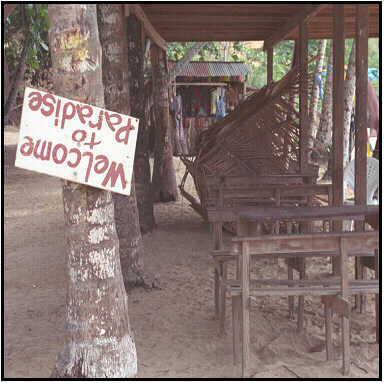 1.1. Preliminary considerations